

 SHARE:
In 1973, Prime Minister Trudeau made one of the most remarkable policy U-turns in modern political history. Impressed by the force and implications of the Supreme Court decision in the Calder Case, which in effect affirmed that there is such a thing in this country as aboriginal title, Trudeau announced that he would 'give it a try.' He meant by this that his government would support, and indeed provide federal funding for, land claims.
Four years earlier, in the notorious 1969 White Paper, Trudeau's government, over the signature of his then-young and rather callow minister for Indian and Northern Affairs, Jean Chrétien, had declared that any special status and rights of the native population should be phased out. The 1969 White Paper asserted the Trudeau view that it is anomalous, if not absurd, for one part of a nation to have treaties with another. The 1973 reversal of this position launched the great ship of modern land claims -- the new treaties with what came to be known as First Nations.
Since that remarkable U-turn, Canada has witnessed an extraordinary flow of negotiations, legal actions and deals. The James Bay Settlement, the Inuvialuit agreement, Nunavut, the Delgamuukw judgment, the Nisga'a Treaty... these are some of the large, even dramatic, results of the post 1973 era. There are hundreds of other claims and attempts at settlement. The underlying political and moral map of Canada is being shaped by them.
This has not gone unnoticed around the world. In the course of working or lecturing in other countries, I have been asked to give talks and hold seminars for government officials, NGOs and indigenous groups about land claims in Canada -- invitations that have just about always been motivated by a wish to hear how such great achievements had been made possible.
In Australia, across southern Africa, in western India, in Brazil, as well as in Europe, I have heard the excitement and admiration that Canadian land claims and court rulings have inspired. From indigenous leaders, I have heard the passionate hope that, in their countries, similar deals could be reached. They too are in need of a reckoning with history, a recovery of pride and a new place within the modern nation state -- achievements they believe to have been won by and for some Canadian native peoples.
Here in Canada, we are of course aware that land claims and the new treaty processes, to say nothing of court rulings, are full of complication and have inspired doubt and criticism as well as optimism. But for those involved, they have indeed meant a reckoning with history. This has meant an examination of both Native heritage and the colonial attacks upon that heritage. It has meant a detailed account of how the establishment of Canada has meant destruction of the peoples who occupied and used these lands long before Europeans arrived. And it has included examination of how Canadian politics and settlement changed the lives, lands and governance of aboriginal communities.
Deep ties to the river
A complication in this process of reckoning lies in the way First Nation realities may themselves be the creation of the colonial process. An important example of this is the Indian Act, the piece of legislation that in 1876 first defined who an Indian was, giving them their status within the nation. Implementation of the act, which went through evolving interpretation and amendments, in effect created both 'Indians' and their bands as legal entities, limiting who and what an Indian could be and imposing forms of organization and control.
The land claims process has done well to manage to transcend some of these results of the Indian Act, but it always has to find ways of coping with them. Who qualifies as a native or community member has to be redefined. What comprises the community resource base has to be remapped. Governance has to be reconceived. And this points to a further complication, indeed a paradox: resolution of land claims results from government funded processes, under government control, to resolve a set of historical wrongs that tend to centre on what government has done and failed to do.
No one can be surprised, therefore, by the many difficulties and vulnerabilities facing the aboriginal groups that enter any part of the new land claims process. And there is a huge burden on government to ensure that government itself is able to see, and meet, these risks. A case in point comes from the Fraser Valley in British Columbia, at a five mile stretch of river that may well have been the most productive freshwater fishery in North America, if not the world.
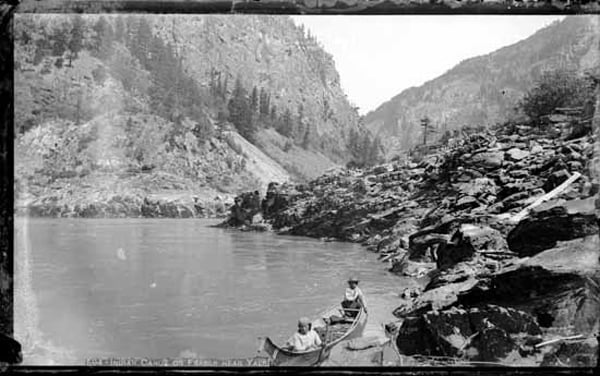
The Lower Fraser Canyon or Five-Mile Fishery are the European names for the spectacular stretch of the Fraser where that vast and magnificent river narrows into a roaring torrent of a gorge. The entire flow, draining tens of thousands of square miles of the British Columbia interior, surges between dramatic rock walls. In the most fierce part of the canyon, above Lady Franklin Rock, the Native fishermen use their dip nets and set nets, working off the rocky shoreline. And the salmon -- at one time in their tens of millions, but still in vast numbers -- pause in the back eddies, checked by the torrent they have to get through on their spawning runs upstream. This crowding of fish is perfect for fishing. Also, the climate at the part of the river valley is ideal: the arid air of the interior flows over the river, making it possible to wind dry a large proportion of the catch. The primary food supply for the year could be caught and processed here.
The archaeological and oral historical records suggest that several thousand people once lived and fished along the five crucial miles of this stretch of the river. Today, with the ancient villages of the canyon gone and the population scattered by many forces, including the devastation of disease in the 19th century and colonial government in the 20th, much has changed. But the fishing sites are still of great importance. Experts on the Aboriginal fishery on this stretch of the Fraser estimate that 60 per cent of the salmon harvest in Stó:lō; communities of the Fraser Valley area still come from some 93 family fishing sites in the canyon. Both early in the season, with runs of spring salmon, and late in the season, when the Sockeye appear in the river, families go to their sites on the fishery. They have cabins and drying racks. Food they need and delight in comes from this remarkable place; so does pride, culture and wellbeing. The ancestral homes and graves of their forebearers are nearby.
When doing interviews with young Stó:lō about where they found pride and meaning in their lives, I heard again and again about the excitement and delight that going to their family fishing sites brought to them. In communities where the struggle against pessimism and self harm in the young is so intense, at time desperate, the value of these places reaches to the core of social wellbeing.
The risks of agreement
The latest and much publicized modern treaty is The Yale Final Agreement. This aims to transfer ownership and management of the areas of land adjacent to the great canyon fishery of the Fraser to the Yale First Nation. The lands include most if not all of the fishing sites that Stó:lō-Coast Salish people have developed, managed and used for hundreds, perhaps thousands of years. So it looks as though the Yale Agreement is a timely and important reckoning with history.
The trouble is that the agreement both does and does not pay due attention to history. The rights of a First Nation to its resources is of course a reading of history, and is built on detailed accounts of how the land and river were known and used in the past. But many of the people who know and use that set of fishing sites have been dispersed. Guided by ideas about farming as the right way to live, government forced families to move from the rugged lands of the canyon to the wide alluvial valley downstream. Many Stó:lō were resettled in the agricultural region of the Fraser Valley, around Chilliwack. But the people who moved away from the fishery to live still went to the canyon to fish, to learn, to pray and in some cases to be buried. Attachment to those sites did not just fade away. The resource did not simply slide into the hands of those who lived near to it. Every fishing season, families go back to their sites to catch the food they need and find the heritage they identify with.
At the moment, it looks as though the Yale Agreement will entrench the rights of the people who live in or near Yale, and deny or reduce the rights of those who live outside that community. This is to create or to aggravate tension and hostilities in the wider area. It is to consolidate and worsen a historical wrong that came from the implementation of the Indian Act: the splitting of peoples into small bands on scattered reserves, and the relocation of people to places that governments thought would be right for them. It is also to launch argument and legal actions that would drain resources and ever further erode relations within and between the First Nations of the area. Historical damage has come from measures that failed to acknowledge deep needs for heritage or links to land and resources. By pressing ahead with this agreement, the government could yet again be proceeding without due regard to those needs and links, without addressing the painful results of history. This would make things worse, not better, for the Stó:lō community as a whole.
This does not mean that a treaty with Yale, or any other, First Nation is ill-conceived. There are many in the aboriginal community of the Fraser Valley who support the treaty process. But it does mean that government should pause and look hard at ways to address the problem they may be about to create. Many land claims have had to deal with what has been called "overlap" -- the complication of different communities or adjacent First Nations having rights to the same area or resource. Where this has arisen between different peoples -- the Innu and Inuit, of Labrador, for example -- there is conflict but not an attendant bitterness within either one of the groups. Where there is dispute within a people, bitterness can be very great. And if there is a history of tension, then the treaty process can intensify hurt and lead to deepening hostilities. Those who live in small communities know all too well how damaging, painful and long-lived this kind of internal strife can become.
Many Stó:lō are expressing great anxiety about the Yale Agreement. They see it as a violation of rights to places that have profound importance for them. The British Columbia government must pause to consider how to address this worry. And the federal government should make it clear that it would not ratify an agreement that was very likely to make things worse for aboriginal people, that was a failure to make amends for history.
If care is not taken now, if no process is put in place that can address and resolve this internal conflict, an agreement will be reached that could well be unjust and harmful -- a disregard for the rights of some aboriginal families in favour of the rights of others. Yale should get the treaty it is entitled to; the Stó:lō downstream of Yale should be assured that this will not mean they lose their right of unimpeded access to the canyon, their fishing and cultural sites and their fishery. Canada needs to be able to take pride in its way of dealing with First Nations. This requires time for reflection on the implications of a deal, and a process for ensuring internal strife is eased rather than intensified. These conditions are not being met in the Fraser Valley. Haste and lack of process are creating grave risks. The kind of conflict that is brewing along the canyon of the Fraser River could be a cause for shame. ![[Tyee]](/design-article.thetyee.ca/ui/img/yellowblob.png)
Read more: Rights + Justice, Politics







Tyee Commenting Guidelines
Comments that violate guidelines risk being deleted, and violations may result in a temporary or permanent user ban. Maintain the spirit of good conversation to stay in the discussion.
*Please note The Tyee is not a forum for spreading misinformation about COVID-19, denying its existence or minimizing its risk to public health.
Do:
Do not: