
Opinion

Alberta Fills Pipes with Corrosive Denial

With so many now heeding the harsh effect oil sands bitumen has on pipelines and refineries, why aren't the province's regulators?

By Andrew Nikiforuk, 21 Feb 2011, TheTyee.ca

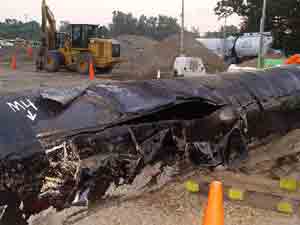
Ruptured Enbridge pipeline in Kalamazoo, Michigan

Ruptured Enbridge pipeline, carrier of DilBit, in Kalamazoo, Michigan.

Related

The Energy Resources Conservation Board (ERCB), which regulates oil and gas activity in Alberta and is 63 per cent funded by industry, put a very oily foot in its mouth last week.

In so doing, the highly dysfunctional regulator merely reminded the world how extremely complex, leaky and vulnerable the bitumen industry has become.

Despite the regulator's lamest obfuscations, the province's asphalt-like crude is probably hell on pipelines, most definitely hell on refineries and real trouble for North American free trade.

Now, the Natural Resources Defense Council (NRDC), one of North America's most powerful environmental groups, created a real uproar with a brief report on the pipeline safety risks associated with ferrying bitumen to the U.S. markets in the Midwest.

Raw bitumen, which does not float on top of sand, is a heavy and viscous crude, rich in sulfur, heavy metals and acids. It can't move through a pipeline without being heated and diluted with a variety of light hydrocarbons.

The best bitumen thinners include condensate, pentane plus, gasoline or naphtha, a byproduct of oil refining. Diluted bitumen or DilBit (not to be confused with the comic strip hero, Dilbert) contains about 70 per cent bitumen and 30 per cent diluent. About half of all Canadian oil sands exports come in the form of DilBit.

DilBit disaster

Steve Wouri, president of Liquid Pipelines at Enbridge, Canada's premier bitumen shipper, says "DilBit is... the most cost-effective means of extracting and shipping bitumen from the oil sands using condensate as the diluent."

He should know. Enbridge spilled a good whack of DilBit (more than a million gallons) in Illinois and Michigan last year, prompting a half billion dollar clean-up job. The dramatic leaks on aging piplines also illustrated the brittleness of the entire bitumen pipeline system.

As a consequence of the spills, oil prices shot up by nearly $10, Midwest refiners imported Louisiana crude by barge up the Mississippi River and oil sand exporters lost millions of dollars.

Given this troubling history and the proposal to build TransCanada's Keystone XL pipeline to the Gulf Coast, the NRDC wanted to know if piping diluted bitumen posed more safety risks than conventional crude.

It first asked Alberta's ERCB for some pipeline corrosion information. Alberta, after all, has been moving DilBit since the 1980s. In fact more than two-thirds of all crude produced in Alberta must be transported as DilBit.

The regulator told the conservation group that a company called Visible Data Inc. ("The Energy Data Specialists") managed its pipeline data.

So, the NRDC promptly hired the company "to help understand the data," explains Susan Casey Lefkowitz, director of the groups tar sands campaign. "Visible Data did the analysis and gave us the numbers."

The data specialists found that Alberta's hazardous liquid system experienced "218 spills greater than 26 gallons per 10,000 miles of pipeline caused by internal corrosion from 2002 to 2010." That's a spill rate several times greater than that recorded by a much older U.S. pipeline system.

However, the NRDC noted that differences in pipeline sizes and regulations made it difficult to make a clear comparison. The data, however, clearly begged a significant question: does DilBit cause more corrosion problems in pipelines due to higher pressures, higher temperatures and bitumen's many contaminants (sulfur, acid and heavy metals)?

Slandering bitumen?

The ERCB, which has a remarkable 100 per cent approval rate for oil sands projects, tends not to favor such inquiries.

In the middle of the NRDC press briefing on Wednesday, the board abruptly issued a press release written by one of it many spin doctors, Davis Sheremata. (The board only speaks to citizens via its professional communicators and not via its political appointees or God forbid, its pipeline experts.)

The board accused the U.S. conservationists of making "misleading statements" on pipeline safety as well as defaming "the characteristics of diluted bitumen."

Then the board had an "oops" or Dilbert moment. The very next day, it issued another press release. It sheepishly admitted that it hadn't read the NRDC report and based their comments on an earlier version. The board then offered this convoluted sentence:

"However, in reviewing the final version the ERCB determined that all of the key data and allegations that the ERCB expressed its concerns over are present in the final NRDC report and remain incorrect."

Sheremata, no pipeline expert, also claimed that, "DilBit is no more corrosive than conventional crude."

Billions to adapt refineries for bitumen

Now, no petroleum engineer could afford to be so woefully inaccurate. Or misleading.

Consider this truthful assessment from an industry insider: "Bitumen is often corrosive, requiring significant metallurgy upgrades in refinery crude, vacuum, and other downstream processing units."

He goes on: "It can cost billions of dollars to upgrade a refinery to process heavy bitumen. There are concerns that the costs of converting refineries to process heavy bitumen will be hard to recoup. Long term, the ability to use heavy bitumen is an issue that's expected to confront the refining industry for an extended period of time."

The National Centre for Upgrading Technology, a federal research group, supports this frank analysis. It says that bitumen contains more than 50 per cent pitch and contaminants such as "salt, solids, metals and asphaltenes," which "may lead to downstream processing problems." Adds one 2006 NCUT memo: "Hence the perspective that 'as crude prices increase, crude quality decreases' becomes well founded."

'Several processing problems for refiners'

Baker Hughes, a global oilfield service company, also has issues with bitumen's lousy quality. A 2010 white paper on Canadian crude noted that "Athabasca bitumen" was high in sulfur, nitrogen, metals and acid, and that this sort of junk crude "will present several processing problems for refiners." Moreover, "the composition and contaminant levels of bitumen-derived crudes does not make them an easy replacement for conventional crudes, especially since most existing refineries have limited capacity to accept poorer quality feedstocks."

The Canadian Crude Quality Technical Association, an industry group with 56 members, now wrestles with bitumen's difficult character every day. The group is currently investigating waste issues at several refineries, possibly due to low quality feedstock caused by bitumen. It's also researching product shrinkage as well as fouling studies involving three different kinds of DilBits, in addition to naphthenic acid corrosion.

Like the NRDC, the association also wants to quantify "the impact of instability/incompatibility on crude transportation, desalting and refinery processing," caused by bitumen exports.

Given bitumen's well-documented impact on refineries, the stuff probably kicks the stuffing out of Alberta's pipelines too. Yet three inquiries to members of the Canadian Crude Quality Technical Association and the Alberta Oil and Gas Pipeline Operators Safety Council went unanswered. In other words, the NRDC asked an inconvenient question.

Rising leaks on oil sands pipelines

Pipeline safety statistics kept by the National Energy Board (NEB), Canada's national energy regulator, also confirm that the NRDC is on the right track.

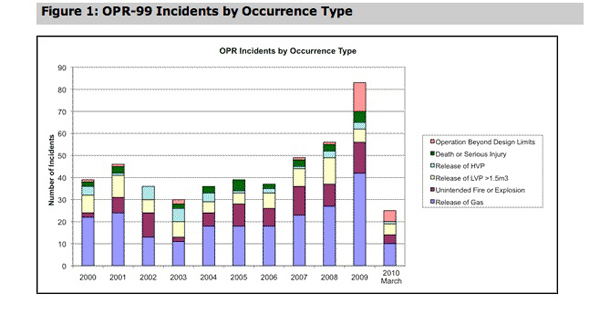
The NEB, which is 90 per cent funded by industry, regulates bitumen export lines to the U.S. Since 2006, as DilBit shipments escalated to 500,000 barrels a day, the number of spills, leaks and other incidents on NEB pipelines have nearly doubled.

NEB pipeline, graph of events

The ERCB would probably never admit it, but DilBit also appears to be highly corrosive for foreign trade and the North American Free Trade Agreement (NAFTA).

Just last year the Canadian Association of Petroleum Producers (CAPP) dedicated an entire meeting to the use of imported condensate to move Canadian bitumen to U.S. markets. Yes, Canada now imports foreign oil in order to export its bitumen to the United States.

Corroding the free trade agreement?

Until 2005, Canada produced enough of its own condensate to export the tarry product. But as raw bitumen exports grew by leaps and bounds, industry experienced a widespread diluent shortage.

At first industry imported condensate from the U.S. When that didn't satisfy demand, a hefty volume of "non-NAFTA diluent began entering the western Canadian diluent pool," or more than 78,000 barrels a day. Much of it poured through the port of Kitimat, B.C. There it was loaded on train cars and shipped to Fort McMurray. A lot of this condensate came from Asia, the Middle East, Venezuela, Peru, Bolivia and even Pakistan.*

But diluting Canadian bitumen with foreign oil has created a big problem for free trade. Or as CAPP simply put it: "DilBit made with non-NAFTA originating diluent is not a NAFTA-originating good."

That means that certain diluents, when "sourced from certain non-NAFTA countries," could attract U.S. duty charges. U.S. Customs and Border Protection have already asked for diluent origin documentation from oil sands exporters such as Cenovous (EnCana).

As the CAPP presentation coolly noted: "The country of origin issue could be expensive if it is not managed properly." Try $30 million a year. In fact, duty could be charged on DilBit made with foreign oil going south and then charged again as the diluent heads back north to be used for another bitumen shipment.

Mixing oil, 'unethical' and not

Given that diluent sourced from Asia and the Middle East will only grow as Canada exports more raw bitumen to U.S. refineries, "the issue will only become larger," says CAPP. By 2025, for example Canada could be importing more than two million barrels of foreign or so-called "unethical" oil a day, just to transport bitumen to U.S. refineries.

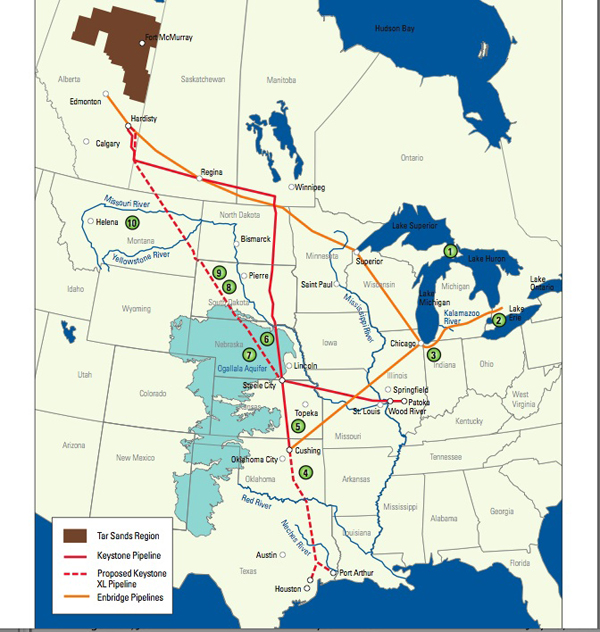
NRDC map of Keystone pipeline, U.S.

Pipelines from oil sands south to U.S. Dotted line is proposed Enbridge Keystone pipeline. Source: NRDC.

So, the NRDC has opened a volatile can of wiggling hydrocarbons. Bitumen is an extreme and difficult product that puts more wear and tear on crude infrastructure. The NRDC has asked a good question about pipeline safety based on good industry data.

Although the ERBC doesn't want to answer the question about bitumen's corrosive properties, new safety regulations are probably in order.

Despite what sheepish regulators might say, petroleum engineers recognize that bitumen is one nasty feedstock and hell on wheels for refineries as well as upgraders. (Pipeline transportation of DilBit is also two times more GHG intensive than shipping fully upgraded synthetic crude.)

Last but not least, diluting bitumen with foreign oil has now created a massive headache for free trade that no one really wants to talk about.

Dilbert, who should not be confused with DilBit, once said: "Engineers like to solve problems. If there are no problems handily available, they will create their own problems."

Given bitumen's impressive ability to foul up petroleum infrastructure, engineers have found a miraculous resource capable of creating more problems than the profession can ever solve.

But you didn't hear that from Alberta's regulator.

*Story updated at 4:16 p.m., Feb. 21, 2011.  [Tyee]

18  Comments:

Login or register to post comments

  • Cool Hand

    2 years ago

    Risky Business

    "A hefty volume of "non-NAFTA diluent began entering the western Canadian diluent pool," or more than 78,000 barrels a day. Much of it poured through the port of Kitimat, B.C. There it was loaded on train cars and shipped to Fort McMurray."
    __________________________________

    So we have supertankers plying north coast waters delivering toxic diluent/condensate to port in Kitimat. And then shipped by CN Rail to Fort Mac. Not a peep from anyone. Ever heard of CN Rail's derailment record?

    OTOH, a relatively safer pipeline proposal carrying diluent/condensate along the same corridor draws fire. Don't get that one.

  • bfearn

    2 years ago

    Thanks Andrew,

    Like nuclear power, mining, banking, the military and so many other 'Western' passions the true costs are never revealed. That is the way socialism for the rich and capitalism for the poor works.
    With the rich running things why would it work any other way?

  • Marysue52

    2 years ago

    It's TAR Sands--not oil sands

    Why, oh why, are commentators so chicken? Say it akk like it really is--no euphemisms!

  • G West

    2 years ago

    Ever heard of a pipeline rupture?

    Enbridge sure has.

    And here's just a partial list:

    http://landkeepers.ca/images/uploads/reports/Spills_and_Ruptures_on_Enbridge_Pipelines.pdf

    A couple of rail cars???? Not such a big deal in comparison.

  • YCSTS

    2 years ago

    Tar Sands can be replaced with Nuclear Energy & Methanol.

    bfearn, Western passion for Nuclear Power?!? Are you kidding me? Do you have any knowledge whatsoever about what is going on in Western country's Energy Policy. In the West, Energy Policy is essentially straight out of Big Oil's playbook, moving away from Coal, moving big into NG, including Middle East LNG imports, doing ZIP about Oil Dependence, and replacing Clean, Green Nuclear & Hydro Electricity with NG electricity generation. Oh, and lot's of high priced worthless Wind & Solar power generation to greenwash the NG, and pretend the Oiligarchy is actually doing something about GHG emissions and the coming Peak Oil catastrophe, when in actual fact the politicians are doing their damnest to bring about that same catastrophe. The only passion for Nuclear Power is in Asia, where the pragmatic Chinese, Japanese & Koreans are rapidly building their Nuclear Energy sector, and unlike the West, they will actually avoid Peak Oil catastrophe and reduce their GHG emissions to Nil, by developing the Nuclear Economy.

    The logical thing, instead of throwing all that NG down the sewer, processing bitumen, and generating Electricity, is to convert NG into Methanol, which costs 3.1 cents per liter, and burn Methanol in converted engines and especially to replace all Heating Fuel. Greenies are always touting efficiency, well the Methanol engine is double the efficiency of a gasoline engine and about 15% more efficient than a diesel engine. Methanol is the cleanest burning of all liquid fuels. And the EPA estimates there would be a 95% reduction in fire deaths & injuries if gasoline was replaced with Methanol. And you can ship Methanol easily in pipelines and in tankers, as Methanol actually cleans the pipelines, and spills are a triviality. They quickly evaporate and are consumed by bacteria. Mixed with water it actually increases plant growth.

  • Jeffrey J.

    2 years ago

    Witnessing The Destruction of Our World

    It is surreal to read the incredible essays of Andrew Nikiforuk, in the safety of our homes, and realize that we are witnessing the destruction of an entire planetary ecosystem. But because it is in slow motion, and we awake the next day, safe and sound, we think we are safe. We are not.

    I believe there were citizens like Mr. Nikiforuk during the end of Easter Island (watch the DVD: Rapa Nui), or the end of Rome (read Dark Age Ahead by Prof. Jane Jacobs), or the end of the Mayan Empire (read Collapse of Complex Societies by Prof. Joseph Tainter). They all did what we are now having to experience. Knowingly watching as mindless ideologues and business elites destroy mother earth.

    At our most philosophic, I must say it will be a comfort to share this experience with Andrew there to tell us how the Titanic is going down. That is meaning enough. In the end.

    Thank you.

  • YCSTS

    2 years ago

    True Environmentalists must support Real Alternatives to Oil.

    Jeffrey J., it just ain't good enough to report on the Environmental Destruction of the Big Oil Cronies, it is necessary to strongly support realistic alternatives to that same environmental destruction. I do admire Andrew Nikiforuk's excellent reporting on the Tar Sands destruction & the Oiligarchy's efforts to obscenely profit from the destruction of the Earth. But, sadly Andrew has shown ZERO support for any realistic, sustainable alternatives to the Tar Sands.

    Another, good citizen of the Earth, who spoke of Global Warming & Environmental Destruction long before Greenpeace ever jumped on the bandwagon, has unlike Andrew Nikiforuk, taken a stand, that the only option to save our Earth and Humankind is Nuclear Energy. The world's foremost environmentalist, James Lovelock calls Nuclear Energy "The Natural Energy of the Universe":

    http://www.youtube.com/watch?v=OOaDY13bI84&feature=player_embedded

  • Jeffrey J.

    2 years ago

    YCSTS: Check Out Chris Hedges For A Realistic Alternative

    Nuclear Energy, or National Self Determination? I prefer the latter, as the former simply consolidates power into the hands of the tiny number of people ruling the rest of us.

    Hedges publishes weekly at TruthDig.

    http://www.truthdig.com/report/item/where_liberals_go_to_feel_good_20110124/

    "The only gatherings worth attending from now on are acts that organize civil disobedience...Either we begin to militantly stand against the coal, oil and natural gas industry or we do not. Either we defy pre-emptive war and occupation or we do not. Either we demand that the criminal class on Wall Street be held accountable for the theft of billions of dollars from small shareholders whose savings for retirement or college were wiped out or we do not. Either we defend basic civil liberties, including habeas corpus and the prosecution of torturers or we do not. Either we turn on liberal institutions, including the Democratic Party, which collaborate with these corporations or we do not. Either we accept that the age of political compromise is dead, that the corporate systems of power are instruments of death that can be fought only by physical acts of resistance or we do not. If the liberal class remains gullible and weak, if it continues to speak to itself and others in meaningless platitudes, it will remain as responsible for our enslavement as those it pompously denounces."

  • jimbobdog1

    2 years ago

    Why pipe bitumen?

    It occurs to me that it would be much more beneficial to just refine this crap in Canada and pipe the resulting product to the US. Much less impact on pipelines and better deal for us. Too simplistic, I guess.

  • mikeb

    2 years ago

    crude

    The NAFTA issue is the most dangerous for Canada. Not that it threatens our economic wealth but that it's solution will require refineries to be built in Alberta. This investment would require massive amounts of money which of course industry will demand from government. Even at $100 per barrel the amortization will be measured in decades. Does the oil industry believe there is time ? Are the citizens willing to risk it? Can the environment stand it?

  • HeMan

    2 years ago

    so many inconsistancies

    Of course, the article here is pointing out the obvious - DilBit is fairly corrosive.

    The solution: build more upgraders and export full synthetic crude to the US. This is equivalent to the export of raw logs vs. finished product.

    More jobs, less pipeline risk.
    ---

    And the resource in the ground is technically heavy oil, not tar (which is a derivative of coal), and is chemically distinct from what most people in the petro industry regard as bitumen. Language is such a funny thing. API grades and chemical composition tell the truth -- heavy oil.

    ... and there's nothing that can replace oil. Sorry kiddos, let's recognize this.

  • jwstewart

    2 years ago

    Witness, or Particpant ?

    "It is surreal to read the incredible essays of Andrew Nikiforuk, in the safety of our homes, and realize that we are witnessing the destruction of an entire planetary ecosystem. But because it is in slow motion, and we awake the next day, safe and sound, we think we are safe. We are not."

    We may think we are innocent as well, but those pipelines full of denial run directly to most houses in Canada, where they terminate in a smokestack.

    In exchange for fueling that smokestack, the pipeline carries OUR money back to continue the destruction.

    And contrary to Heman, there are replacements available across Canada.

    http://dealers.waterfurnace.com/waterfurnace/cgi/index?mapid=CA

  • x4estworker

    2 years ago

    Your Naivete is Showing

    Yes, let’s shut down the Alberta oilsands because it is not quite to the liking of the greenies.

    Then we can buy even more oil from Moammar Gadhafi, a man who as I type this is bombing his own citizens in the streets of Tripoli with Libyan Air Force jets.

    But that’s what I love about the greens. They are really good at whining about the perceived environmental problem of the week and not good at all at proposing practical realistic solutions.

  • RickW

    2 years ago

    perceived environmental problem?

    Oh those rose-coloured glasses you wear! Don't you know they are so '70s, X-man?

  • G West

    2 years ago

    Mais non

    With domestic consumption of 284,000 bbl/d in 2006, Libya had estimated net exports of 1.525 million bbl/d. It is possible that current exports (pre the ongoing crisis) may be slightly higher.

    From official trade data as reported to the Global Trade Atlas for 2006, the vast majority of Libyan oil exports are sold to European countries like Italy (495,000 bbl/d), Germany (253,000 bbl/d), Spain (113,000) bbl/d and France (87,000 bbl/d).

    With the lifting of sanctions against Libya in 2004, the United States has increased its imports of Libyan oil, by 2006 an average of 85,500 bbl/d of Libyan oil reached the US, up from 56,000 bbl/d of oil imports in 2005.

    It is conceivable that some small portion of this oil may end up in Canada because of the way pipelines deliver Canadian oil. One can be certain though that Canada is a NET exporter of oil - not a net importer.

  • x4estworker

    2 years ago

    G West, I Rest My Case; Over to you, Rick W

    You are right. Canada is now a NET exporter of oil. Shut down the oil sands and we would not be. We would be a large importer.

    We would then have to feed our oil habit, which isn't going away anytime soon, with oil from Libya, Saudi Arabia, Venezuela, Nigeria and those other pillars of human rights and democracy around the world.

    Maybe Rick W can explain that one (more likely not)if he were to take off his green coloured glasses.

  • G West

    2 years ago

    No, we don't HAVE to export oil

    We can more than meet our own needs with conventional oil - and that's all we should be doing.

    Catering to America's addiction - or China's - or any other country's addiction is NOT IN OUR OWN BEST INTERESTS.

    In fact, it creates (and is creating) a mono economy in this country - over-emphasizes the importance of one province at the expense of the rest of the country AND discourages both innovation and diversification.

    Not to mention that it is going a long way to ruin the environment and pollute the atmosphere.

    The problem is that the 'greenies' you so dislike don't actually take their arguments to the logical conclusion.

    If you don't like Libya - you ought to HATE ALBERTA...because it (and the TAR SANDS) are turning Canada into another Libya....

  • RickW

    2 years ago

    X4estworker

    As per G. West:

    Quote:
    No, we don't HAVE to export oil

    Take that, you fiend! Biff, Pow, Kabam!

    • The discussion for this story is closed. No more comments can be added.