
How city design can help save the planet. First in a series from a vital new urban planning handbook.
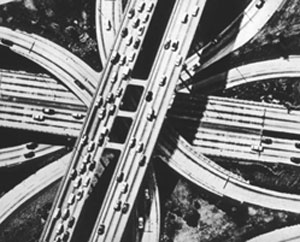
Wrong way: Breaking car dependence is straightforward.
[Editor's note: This is the first of eight excerpts from Patrick Condon's new book Seven Rules for Sustainable Communities: Design Strategies for the Post Carbon World. They will run every Wednesday and Thursday for the next four weeks.]
In 2002, scientists sounded the alarm about the loss of ice on the Arctic Ocean. Global warming was affecting the Arctic climate more rapidly than anyone had previously thought possible. They predicted that if nothing was done to curb the level of greenhouse gas pouring into the atmosphere there might be no summer ice covering the North Pole by 2050.
Early in 2009, they updated their projection. Given the rate of ice loss, the new date by which the Arctic Circle will be ice free could be as soon as 2012. The loss of ice triggers other effects, none of them good. The white ice that once reflected warming sun rays no longer does so. The deep blue ocean water that takes its place absorbs those rays, warming the water and further accelerating the warming of the planet.
Bad things happen in threes. The added heat also releases methane gas that was previously trapped under polar ice. Methane gas, like carbon dioxide, traps heat in the atmosphere, but molecule per molecule it is many times more damaging. The cascading effects of climate change, previously predicted for the distant future, are already here.
Experts at the United Nations-sponsored Intergovernmental Panel on Climate Change (IPCC) all agree that the two-degree-Celsius rise in global temperature, the so-called "safe" level of warming that we will still get even if we cut GHG emissions by 80 per cent, is a rise that is unavoidable.
The IPCC predicts that, even at this "safe" temperature increase, up to 50 per cent of the planet's species will become extinct. But we are on a path where GHG produced from the burning of fossil fuels is not dropping but increasing rapidly. With a five-degree rise, much more would be lost.
What have all of these gloomy scenarios to do with a book on city design? Everything. If we change the way cities are built and retrofitted, we can prevent the blackest of the nightmare scenarios from becoming real and can create the conditions for a livable life for our children and grandchildren. It is not apocalyptic to say we can save their lives.
We often read that buildings account for about half of all GHG production; transportation, for about 25 per cent; and industry, for most of the rest. But this division obscures a fundamental point: cities are responsible for 80 per cent of all GHG -- caused by the way we build and arrange our buildings, by all the stuff we put in them, and by how we move from one building to the next. Since the problem is caused by cities, the solution should be there too.
Citizens and their elected officials have been slow to acknowledge the connection between GHG and urban form. This book may help change that. It is written for designers, policy makers, developers, regulators and ordinary citizens in the hope that it will arm them with an understanding of the ways our cities are failing and offer them very specific actions to cure them.
How did cities get this sick?
In any journey, it helps to start with a look back from where we once came. Various historical starting points could be studied, but the end of the Second World War marks the time after which cities changed the most. Many compelling reasons drove the crucial choices we made at that time; foremost among these was the need for a place to live.
After the Second World War, a variety of policy inducements provoked a massive redistribution of population across metropolitan landscapes. In the United States, the mortgage interest income tax deduction, low interest GI loans, restricting new mortgages through bank "red lining" of older residential areas and the 1956 National Interstate and Defense Highways Act, which funded the construction of the interstate highway system, were most significant.
Provoked by these inducements, middle-class and working-class families who had traditionally occupied higher density walkable and transit-served neighbourhoods fled to much lower density and car-dependent suburbs. Average densities began to fall in every North American metropolitan area, while transit ridership as a percentage of all trips began to fall with it. Older, prewar parts of the metropolitan landscape still maintained healthy transit ridership, but transit use in newer areas was near zero.
As North Americans moved from transit to cars, their per capita GHG amounts began to rise too. Of course, no one worried. GHG production was not important at that time, as the implications of this increase were not widely known and were even less widely accepted. Buying fuel for the family car was also not a concern, as prices were low. The brand-new high-speed freeways provided previously unimaginable freedom of motion, allowing workers to hold jobs 25 or more miles from home.
This was a massive change that fundamentally altered the reach of cities. In 1950, the Boston metropolitan urbanized area was only 345 square miles. In 2000, it sprawled over 1,736 square miles, a quintupling in only five decades.
During this period of dramatic metropolitan expansion, land was generally less expensive on the peripheries. This made it profitable to build residential developments ever farther away from the metropolitan centre, with single-family homes generally dropping in price as one moved farther out. This concentric reduction in house prices gave rise to the saying "drive till you qualify," a widely used phrase meaning that home buyers were induced to push a home search farther and farther from the centre of the region until their income matched the qualification requirements for the mortgage.
With so much unprecedented freedom of movement in this new urban landscape, house price became much more important than location. A distant job was easy to reach, and shopping centres catering to millions of auto nomads were soon to come. Eventually, vast stretches of the metropolitan landscape become completely car dependent, forcing individuals and families to spend more and more time behind the wheel and to rack up ever increasing vehicle-miles travelled.
The new single-family homes were not only auto dependent but, because of their shape and exposure to the elements, also inherently hard to heat. We now know that the GHG production of this style of home is up to four times greater per capita than that of home types common to older centre cities.
The problem emerges
The cracks in the system began to emerge after the 1974 "oil shock," a supply constraint caused when the OPEC nations cut off the flow of oil to the West. Spending long hours in line for gas exposed the weakness of the economy to interruptions in the flow of imported oil, by now a clearly vital resource.
At first the response was significant, provoking a shift away from larger cars and a lowering of speed limits to save fuel. But over the longer term, the lesson went unlearned.
Dependence on imported oil has increased dramatically in the intervening decades, and average fuel consumption per capita has risen sharply and steadily, only reaching a plateau in 2007. Also unfortunate: scientists who began loudly sounding the alarm about global warming at this time were largely ignored, and with the election in the United States of Ronald Reagan, a man who had no interest in energy conservation, the moment was lost.
During the 1980s and 1990s, suburban low-density development moved the United States from being a country where most of its residents lived in former streetcar-served districts, where alternatives to the car were possible, to one where the majority of residents lived in districts that were completely auto dependent.
Rather than put in place national, state and regional policies to reverse or at least mitigate an ever rising per capita use of fuel for the single passenger automobile, the reverse occurred. U.S. transportation bills from the 1970s through the 1990s favored expanding the interstates and feeder highways over transit; no policy proposals to require walking-distance access to transit and commercial services in new districts were ever seriously considered.
Canada fared somewhat better. The Canadian federal government was happy to collect a substantial gas tax but, unlike the U.S. government, was under no obligation to return it to the provinces in the form of highway funds. Thus, Canadian cities have far fewer freeway miles per capita than do U.S. cities.
Absent any national, state and provincial policies, average densities in metropolitan regions continued to drop until at least the year 2000. Exceptions were few, with Vancouver and Portland, Ore., notable among them. More numerous were the extreme examples of centrifugal forces pushing population to peripheries, impelled by vast new highway expenditures, even where regional population was stable.
Infinitely increasing car dependence
All of these forces combined to create an entirely new U.S. and Canadian urban landscape. Many thoughtful voices argue that this is a good landscape where families can find a house they can afford with a yard for the kids in a community of their own choosing. This is a strong argument, but one that can be sustained only if we are willing to forever increase the percentage of national treasures we commit to highway construction, the amount of personal wealth we pour into the gas pump, and the amount of carbon we pour into the atmosphere.
The trends are not hopeful. Per capita driving has increased alarmingly for decades, and until 2008, when fuel costs leapt briefly to over four dollars per gallon, was increasingly inelastic (meaning not responsive to market signals, such as increased fuel price).
For most people, driving is no longer a discretionary expense. They cannot just shift to walking or taking mass transit in auto-dependent landscapes; there are no sidewalks to walk on, there are no walkable destinations to walk to, and for all intents and purposes there are no buses to catch.
Auto-dominated landscapes have forced families to devote ever larger shares of their income to transportation, a share that now, for the first time in history, approaches the share consigned to paying for a home. Whereas in 1965 most families owned one car, now two cars is the norm.
The increase in two-income households has contributed strongly to this trend. The two incomes needed to pay off the mortgage on the home can be maintained only if both workers have a car to get to work. Dropping children at daycare and driving older children to otherwise inaccessible schools makes a car even more indispensable.
But it's not just "bread winners" who need a car. Everyone of driving age needs one. To be without a car in these landscapes imprisons one in the home, leading to a craving for escape with a car as the means. But in this case, escape does not mean freedom.
A landscape where walking is impossible is a landscape where our legs are used only to get from the couch to the refrigerator and from the front door to the driveway. Residents of auto-oriented suburbs walk less and weigh more than people in walkable areas.
While direct causation is difficult to definitively ascribe, the evidence is highly suggestive. The body is designed primarily for walking. If walking is systematically denied by one's environment, this cannot be a good thing. Many studies suggest that the epidemic increase in teenage obesity and alarming rise in juvenile-onset diabetes can be at least partly ascribed to the physically paralyzing influence of auto-oriented landscapes.
Climate change
Thirty per cent of the world's carbon dioxide production comes from the United States and Canada, where only about six per cent of the world's people live. Of this amount, about a quarter comes directly from transportation -- and the bulk of that from single-passenger automobiles.
This number does not include the CO2 consequences of the immense infrastructure of car manufacturing and support or the CO2 production from building the roads and highways all those cars need (concrete production is the largest single industrial producer of climate change gas, with most concrete in North America used for highway and bridge construction). Factoring in those amounts brings the CO2 share for transportation closer to 40 per cent.
The community of nations is finally agreeing that planetary meltdown can be avoided only if we cut climate change gases by 80 per cent by 2050. The United States and Canada, who have heretofore been the most reluctant of the G8 nations to acknowledge the crisis, have now agreed.
During a period when the United States alone will add 130 million more people, it is madness to assume an 85 to 90 per cent per capita reduction can be achieved unless we reverse the trend toward ever greater auto dependence. Misplaced faith in such technological quick fixes as hydrogen cars, electric cars, or switching to ethanol will not help us.
Changing to alternative energy sources will do nothing to change the fundamental entropy of our transportation choices; many other sources require huge energy inputs in their creation, lead to food scarcity in developing countries, and in the case of corn-based ethanol require more petroleum to make the fertilizer, drive the farm equipment and truck the raw materials here and there than they give back in fuel.
Reasons for hope
At this point, the problem may seem too big to solve. But all is not lost. As Robert Yaro, president of the Regional Plan Association of New York, says: "The bad news is that we have massively overbuilt the freeway system. The good news is that we have massively overbuilt the freeway system."
By the first part of this sardonic aphorism, he means that America has overinvested in a system that has, in the absence of any other land use planning controls, made a sprawling and highly inefficient urban landscape inevitable, as the excessive transportation demands that this infrastructure unleashes became impossible to satisfy.
By the second part, he means that the exact system that unleashed these forces is large and extensive enough to accommodate through infill the expected massive increases in population. If a way could be found to increase the land use intensity of all of the districts within the freeway service area to double or triple their present level (and surely, given the low coverage by buildings, such a thing should be easily possible), then per capita demand for long-distance travel should gradually drop as well.
The first step in recovery is always admitting that there is a problem and then taking responsibility for change. But proven therapies for restoring the health of a region are required.
Citizens are justifiably insecure about how and what to change. Changing the way we build regions is like changing any habitual behavior. Habitual behaviors, such as drinking, smoking or taking drugs, anesthetize us in the near term but lead to larger problems in the long term.
Building sustainable regions is the same. NIMBYism in the face of higher density development proposals is tremendously satisfying for citizens who understandably feel they have protected their community through their opposition. But the long-term effect of these actions, multiplied by many thousands of other equally habitual actions, is to worsen the disease. A set of principles -- call them rules for healing cities, if you will -- is a necessary tool for recovery.
Over the years, many others have recognized this same thing. The list of simple rules, or "steps to recovery," that forms the core of this book is not original. What is unique to this book is the attempt to simplify and order them clearly as a set of integrated urban design therapies for healing the urban landscape.
The hope is to provide citizens and leaders in the public and private sector with a simple but credible framework for action.
Seven rules for sustainable, low-carbon communities
1. Restore the streetcar city
The North American city was and is a streetcar city. Streetcar cities are characterized by easy access to transit, a wide variety of house types, and services and job sites very close at hand -- the exact elements of a sustainable city. We have largely ignored this fact. It needs rediscovering.
2. Design an interconnected street system
Fine-grain interconnected street networks ensure that all trips are as short as possible, disperse congestion and are compatible with walking, biking and transit.
3. Locate commercial services, frequent transit and schools within a five-minute walk
People will walk if there is something to walk to. The most important walking destinations are the corner store and a transit stop. A minimum gross density of 10 dwelling units per acre is required for this to work.
4. Locate good jobs close to affordable homes
The trend toward ever larger commute distances for workers must be reversed. "Good jobs close to home" is a fundamental requirement. The vast majority of new jobs in the United States and Canada are compatible with complete community districts.
5. Provide a diversity of housing types
Zoning laws have tended to segregate communities by income. Communities designed for only one income cannot be complete, and when repeated throughout the region, they add to transportation problems.
6. Create a linked system of natural areas and parks
Keeping our waters clean and our streams and rivers healthy requires a rethinking of urban drainage systems and stream protection policies. Maintaining the integrity of these systems must be a first design move when planning new communities. Far from protecting these systems through restriction, these systems must form the public space armature of new and restored communities.
7. Invest in lighter, greener, cheaper and smarter infrastructure
Suburban homes have at least four times more infrastructure per dwelling unit than do walkable streetcar neighbourhoods. Exaggerated municipal standards for roads and utilities cost too much to build and maintain, and they destroy watershed function. Smarter, cheaper and greener strategies are required.
The final rule: Love one rule, love them all
These principles represent the elements of a whole. Achieving one without the others -- particularly if it is at the expense of the others -- will be of limited value and could be counterproductive.
Tomorrow (Thursday): Rule 1 -- Restore the streetcar city ![[Tyee]](http://thetyee.cachefly.net/ui/img/ico_fishie.png)
Patrick Condon is a professor at the University of British Columbia and holds the James Taylor Chair in Landscape and Liveable Environments.
35
Login or register to post comments
mopled
2 years ago
One thing about climate cultists
I've noticed is that they never let facts get in the way of a rant.
"The summer of 2010 was unusually cold, according to the Centre for Ocean and Ice at the Danish Meteorological Institute. For almost the entirety of the June to August period, mean daily temperatures were below the corresponding daily temperatures over the past half century during which the Centre has maintained records.
The cold progress of this past Arctic summer can be seen in the Centre’s graph, seen here. The red line – this year’s temperatures – falls below the green bell curve starting just before Day 150 (late May) of 2010, indicating that just about every day this last summer was colder than normal. The green bell curve represents the historical record — the temperatures that the Arctic has experienced since 1958."
http://climaterealists.com/index.php?id=6274&linkbox=true&position=7
There is no doubt that most of the heat recorded in cities is due to the "urban heat island effect."
"1. While satellite measures are available the Intergovernmental Panel on Climate Change (IPCC) does not use them for the official measure. They use the surface record and it is directly influenced by the Effect.
2. Because the UHIE was not identified in the early claims of global warming and allowed incorrect exaggerated claims.
3. Although official agencies take corrective measures for the UHIE there is considerable concern about how this is done and whether it is done correctly and adequately.
4. Few people know what it is or how it is important in the global warming debate.
5. The UHIE should be part of urban planning.
Official temperatures rarely represent the actual temperature of the city for which they are given because most weather stations are at the airport. In some instances they are outside the city and are not representative. In other places they are compromised by growth of the city. Airports were the natural location because pilots essentially were the only people using early weather services."
http://www.friendsofscience.org/assets/documents/FoS_Urban Heat Island.pdf
We also have the terribly inconvenient facts that CO2 is not capable of changing climate and the "greenhouse effect" is a fiction.
"CO2 levels have been 10 to 20 times higher than the present during multiple periods of Earth's history without causing a 'tipping point' of no return, while retaining the belief that CO2 levels 10 to 20 times less are causing a 'tipping point' now. In fact, an entire ice age came and went with CO2 levels about 11 times higher than the present throughout the Ordovician period shown in the graphic below. The latest eco-scare-alert notes that Antarctica abruptly transitioned from a warm, subtropical hothouse to the present solid ice sheet during a period when CO2 levels exceeded those of today by 10 times."
http://hockeyschtick.blogspot.com/2010/09/cognitive-dissonance-of-agw.html
alive
2 years ago
lebensraum?
The funny aspect of this is that people who now live in the suburbs are not using their yards, but in fact living just like they would have lived in an apartment building, meaning doing their best to avoid their neighbours!
The typical house has a double garage facing the street and you will be hard pressed to know if anyone is ever living there.
The extra interior space and "privacy" seem to be the incentive, so why is it that nobody builds apartment complexes that feature enough space to satisfy these people?
It is no joke when you hear a man say he has to store his winter-tires in the bathtub, because there is no other space to store anything!
Try owning two vehicles in the city and find a place to park them; the city keeps reducing the number of parking spaces required on new construction, as if that automatically stops the need for that extra car?
The so-called artist studios were a joke, the living quarters were not seperated from the workspace and the entry was without fail only a narrow door, making it impossible to bring in anything wider than the door.
If you want to bring people back into the city, it is essential to build apartments and townhouses that will accomodate them.
It is a joke to squeeze people into ever smaller places and then wonder why they prefer to drive for hours to have the space they desire.
morechatter
2 years ago
Bad Habits Die Hard
It still amazes me the solution hasn't been found because if ever there was a need it is now for the planet and that is living that is. Many are already dying as world hunger is at an all time high. Don't abuse reduce, reuse, and recycle and don't forget to hop on the bus and turn off lights as many are still in the dark when it comes to global warming. Especially the automotive industry and big old oil who likes to continue to burn it all up.
Locate good jobs close to home??? Good jobs are hard to find, especially ones that can help pay for the outrageous price of a house. I found an old newsprint article where you could rent a house for $50 dollars a month and a penthouse apartment for 45. However those days have changed as banks and government and real estate companies do their very best to bubble up the market until it bursts. Its a gamble for sure but if anything Government and Banks and Land Developers have learned from the US fiasco is its the homeowners that are going to be hurting as the banks made that extra 10% that will help drive us to an early death. If things are going to change it has to start at the top where big profits win out over the environment and human life.
freebear
2 years ago
7 rules; 10 guidelines; etc.
I have offered up in the past 3 simple principles for a sustainable city:
1 Scale - build at a human scale (walking) rather than a 'machine' scale (car)
2. Mix or Diversity of use - try and integrate uses rather than separate uses
and
3. Distance - reduce between activities
Now if only the 'sheep' and the follow the herd politicians would learn more bout better ways to plan and design communities.
snert
2 years ago
This is gonna be rich
The article starts off by totally ignoring the #1 problem which is over population. Another thing that seems to be ignored is the amount of energy consumed by re-shuffling the deck.
There is truly no hope.
Keye
2 years ago
Diet also
While urban infrastructure is important, and indeed also the question of overpopulation, what is also absent from the discussion is the effect of the widespread culturally-promoted industrial meat and dairy diet, and the agricultural practices that support this diet, on greenhouse gases. What people eat is one of the primary drivers of greenhouse gas emissions affecting climate change.
Any discussion of urban infrastructure must also include a discussion of support systems to transitioning to organic vegan diet, the single most powerful practice each individual can undertake to do his or her part in helping the planet heal.
Explore the SupremeMaster web site (link below) for information related to the effects of agriculture on climate change, and how to transition to a vegan diet. (Some people may not appreciate the unusual and creative approach taken by the woman who organizes this information; nevertheless, her sources are credible, and for all topics she provides links to the sources of the information. Many top-notch doctors and scientists appear on her programming, and information is freely available, including cooking shows, recipes, health information, etc..).
http://www.suprememastertv.com/
puppyg
2 years ago
On the buses... NOT
Regarding 'infinitely increasing car dependence', I have just had a shock. In trying to locate public transportation from Hamilton to Orillia, Ontario, I have had to give it up and reserve a rental car.
It has been 30 years since I last rode the buses in Ontario. The company that served was bought out by Greyhound, which has since eliminated many of the smaller routes.
My best hope was an early-morning Go-Train to Toronto's Union Station, followed in turn by a subway ride to the bus depot, a three-hour-plus wait for a bus connection to Barrie, Ontario, a change to another bus company in a different part of town (taxi?), and then another four-hour wait for a connecting bus to Orillia.
The two bus companies (TO-Barrie, Barrie-Orillia) apparently have no communication or co-ordination regarding schedules. I found a newspiece indicating that the second company often delays its Orillia-bound passengers for up to 45 minutes beyond scheduled departure time in order to see if anyone was arriving off the Toronto bus. Often enough, there were no such connecting passengers.
The cost of such travel for two, beyond the waste of a full day for what should be less than two hours of driving, was going to be more than the cost of a three-day car rental.
Thirty years ago, this run was cheap and easy with just one coordinated connection.
The time has come to slay all government opposition to expanded public transit before these cads doom us all.
freebear
2 years ago
Ironic that NIMBYs no to higher density
are then surprised when they are seniors, and that there are no apartments/condos in their community so that they can retire and still live in their community.
I'll wager that in the near future you will see senior with roommates renting 'large single family homes.
David Beers
2 years ago
snert
The author is an urban planner writing about how to design cities to be more evironmentally efficient. He isn't positioning himself as czar of population control. There 'truly is no hope' as you put it, when the first anonymous response to good faith, expert work such as this is a derisive dismissal.
clear.the.air
2 years ago
Consumption, not population, is our problem
@ snert:
You're right that population is a problem but our lack of sustainability as a civilization is more a function of those of us in wealthy countries using too much stuff. The lifestyle of the average American takes 9.5 hectares of planet's ecosystem goods (e.g. oxygen, minerals, fresh water, trees, arable land, biodiversity) and services (e.g. waste assimilation, carbon dioxide absorption, erosion control, aesthetics, recreation, temperature regulation). Australians (7.8) Canadians (7.1) Britons (5.3) Germans (4.2) Japanese (4.9). The world average is 2.7 hectares. China (2.1) India and most of Africa, where the majority of future world population growth will take place, are at or below 1.0 hectares per capita.
Further,
"Just five countries are likely to produce most of the world’s population growth in the coming decades: India, China, Pakistan, Nigeria, and Ethiopia. The carbon emissions of one American today are equivalent to those of around four Chinese, 20 Indians, 30 Pakistanis, 40 Nigerians, or 250 Ethiopians." (http://goo.gl/o3Yq)
Basically, it us who need to change and laying blame where it isn't deserved is both unfair and wrong.
Greg in Calgary
2 years ago
mopled
This kind of tired denial is irrelevant. All of the points you raise have been refuted ad nauseum by people who actually know what they are talking about.
You keep visiting climaterealists.com and Friends of Science to reinforce your misunderstanding of climate science, but there are lots of better resources out there. Let's face it, those folks have issues that science alone can't deal with.
Why don't you go to http://en.wikipedia.org/wiki/Global_warming, for starters. That's a pretty good round-up of current thinking about this issue.
dorothy
2 years ago
You just don't get it, clear.the.air!
"Just five countries are likely to produce most of the world’s population growth in the coming decades: India, China, Pakistan, Nigeria, and Ethiopia. The carbon emissions of one American today are equivalent to those of around four Chinese, 20 Indians, 30 Pakistanis, 40 Nigerians, or 250 Ethiopians."
Well if the exchange rate is that crummy, that just makes the imperative so much more urgent of those people hitting the brakes on procreation, yes?
clear.the.air
2 years ago
What don't I get?
Hi Dorothy,
What don't I get? I get that we live on a finite planet and that over the last sixty years we affluent nations have been on an oil fueled binge of consumption. According to the Millennium Ecosystem Assessment while this has improved well-being it has also degraded 60% of global ecosystems leading them to warn:
“Human activity is putting such strain on the natural functions of Earth that the ability of the planet’s ecosystems to sustain future generations can no longer be taken for granted." (http://www.millenniumassessment.org/documents/document.429.aspx.pdf)
I am not saying we don't have a global population problem. Without a doubt investments are needed in education and development so that people in developing countries can get skilled jobs and reduce their need for big families. But it is wrong to blame poor countries for a predicament that is the result of our heavily consumptive ways. In this context, the ethical decision and value for money in terms of saving something for future generations is in us rich country folk having fewer children. Some statisticians out of Oregon State have looked at this problem and found that:
"... every child in the US adds 9,441 tonnes to each parent's carbon footprint. This is assuming that emissions per capita continue at today's levels. Compare that with 1,384 tonnes of carbon dioxide for each child in China, or 56 tonnes in Bangladesh."
Once again, it's us that needs to change.
clear.the.air
2 years ago
the missing link from the above quote
http://www.guardian.co.uk/science/blog/2009/aug/04/population-climate-change-birth-rates
RyanB
2 years ago
Vegan Diet? Not quite
I don't buy that a vegan diet is going to save the planet. Growing grain and beans (which are really bad for you btw. Google it.) takes a lot of space and resources. Cows can eat grass and not damage the land it's on if it's farmed right.
MkumbaJoe
2 years ago
Great article....The Canadian Federation of Municipalities
As is often the case, Americans, in some parts of the country, show more progressive action than we in Canada. It was refreshing to read how the American sea bord "Regional Planning Association" is showing leadership in these matters.
The Canadian Federation of Municipalities is a dinosaur, whom no one ever hears about , when we should. They should be showing REAL leadership in these affairs. Besides, we all, through our municipal governments, sent them money.
Talk about an ineffectual albatross around somebody's neck.
make_up_another...
2 years ago
This is interesting in the
This is interesting in the midst of the current mayoral race heating up in Toronto. Most of the ideas being floated go from bad to worse in a contest to see who can appeal to the car crowd by proposing expensive and hopeless infrastructure projects that will only tighten gridlock. Thankfully Dalton is standing behind the expansion of street car service.
I agree with the idea of building communities where things are done on a human scale, a concept of streets where people are part of the streetscape. This will happen eventually, not because the car crowd will have a change of heart, but because it will be too expensive to run cars the way we do now. Money talks.
KWD
2 years ago
The end of the Second World
The end of the Second World War may have marked the time that cities changed the most, but the choices made, subsequent to WW II, were simply a time lag of events that more closely followed the extremely rapid technological changes tied to the discovery of petroleum. The need for a place to live was a symptom not a cause of city sickness.
None of the “crucial choices” and demographic shifts would have been possible without cheap, easily accessible, very portable and seemingly endless supplies of oil. But the low hanging fruit is gone and what’s left is becoming increasingly costly to harvest … rapidly dwindling oil supplies will bring an end to business as usual and the start of depopulation. Demographic shifts will be most evident and most painful in the areas that use the most oil.
Implementing the seven rules, to accommodate these shifts, will be extremely costly. Given the unfolding global debt crises and the economic hardships accompanying these crises … which are a direct response to rapidly increasing energy costs and resource scarcity … is it seems unlikely that taxpayers will buy into this plan of their own volition.
It will be interesting to see how P.M. Condon gets around reality.
peasant43
2 years ago
Hope Mr. Beers?
James Lovelock the (Gaia guy) makes the same point as Snert, Mr. Beers. He's a bit of an expert too.
snert
2 years ago
clear.the.air
Sorry, but "consumption" in Canada is not and never will be a major problem as long as we keep our population relatively low. The following is a rough calculation used to show the footprint of any given country as opposed to that of it's individual citizens which is the method most alarmists prefer to use.
Using http://en.wikipedia.org/wiki/Per_capita_emissions (Year 2005 Tonnes of CO2e) and http://en.wikipedia.org/wiki/List_of_countries_by_population here is a different view of a 'country's' greenhouse gas footprint on the planet.
The calculations are simple and I believe that more up to date figures would produce nearly the same result. There could be some realignment around Canada if more current figures were used but I don't think our final position would change that much.
Tonnes/capita x population density per/km2 = tonnes/km2
Canada 22.6 x 3.41 = 77.066
China 5.5 x 139.6 = 145.1
India 1.7 x 360.8 = 613.36
Pakistan 1.5 x 212.1 = 318.15
Nigeria 2.1 x 167.5 = 351.75
Ethiopia 1.0 x 79 = 79
US 23.5 x 32 = 752
Germany 11.9 x 229 = 2725.1
Norway 11.2 x 12.5 = 140
Note how extreme Germany is compared to Ethiopia and also how Ethiopia's footprint is just a shade larger than Canada's.
As to the reason that I've crunched the numbers this way, it is just to show that Canada, as a country, is not the pariah that people would make us out to be. I am not saying that we should abandon any attempts to use energy more wisely but that our need is not so pressing that we need to be stupid about it.
I believe it unnecessary for Canadians to make huge sacrifices when the results have a minimal impact on the planet as a whole.
snert
2 years ago
David Beers
"How city design can help save the planet. First in a series from a vital new urban planning handbook."
I really don't think you can address one issue without addressing the other at the same time. Sorry.
Jerry Munro
2 years ago
The "Other" Elephant...
"You're right that population is a problem but our lack of sustainability as a civilization is more a function of those of us in wealthy countries using too much stuff." clear.the.air
Much true, yourself drawing closest to it where you say, "...but our lack of sustainability as a civilization is more...". Which I would leave to stand on its own, though the remainder of your observation is true enough too.
The fuller reality, faced up to head on I think, is that the problem with our civilization is the economic primarily, but also the class social model around which it is built, and which underpins and drives it..., its dependency on endless growth in resource inputs, production and consumption, of which over-population is but a major manifestation. Without this "endless growth" in inputs, outputs and consumption, such as is already fraying at the edges in this collapse of the postwar prosperity period, "this socio-economic" arrangement begins to come unglued and slide into crises upon crisis.
The over population issue, save for the religious notions around it, is going to be easier to deal with, I think, once the larger "dominant socio-economic model" issue, even more "loaded" in its conflict potential. is finally faced up to, fought out, and resolved.
Until then, rules and plans around sustainable community development seems to most of us, understandably, kind of remote and pie in the skyish. It has this air of unreality about it because, in our heart of hearts we know, there is still this "other" elephant in the room that most folks, including urban planners, still are striving mightily to pretend they don't see behind the drapes there.
Greg in Calgary
2 years ago
Vegans/Cows/Urban planning
RyanB said: "Growing grain and beans (which are really bad for you btw. Google it.) takes a lot of space and resources."
I don't really think this is about vegans vs. cows or whatever. It's pretty clear that meeting a population's protein needs by farming cows is inefficient in terms of growing protein, and probably unsustainable in terms of water, energy and chemical use. Not that we shouldn't grow animals, but we should recognize that we focus too much on the meat side of the equation.
We need to find a balance where we're all getting enough of the right stuff to eat, and we have some diversity both in food production and consumer availability.
So if you don't want to eat beans, don't. I like them.
Greg in Calgary
2 years ago
Overpopulation
coyoteman: The over population issue, save for the religious notions around it, is going to be easier to deal with, I think, once the larger "dominant socio-economic model" issue, even more "loaded" in its conflict potential. is finally faced up to, fought out, and resolved.
That's kind of the way I look at it, but it does sound like it's going to have to get a lot worse before it gets better.
Jerry Munro
2 years ago
I agree... Snert
"I really don't think you can address one issue without addressing the other at the same time. Sorry." Snert.
And all that being addressed as well, along with the issue of the "built in" nature of the underpinning socio-economic system. For they all do interact with one another, with each being driven in part by the other, but esecially the "economic" and "class" drivers upon which it all hinges and depends.
It's "convenient" to look at aspects of life "in isolation" sometimes, but "practically" it is important to see it as the whole it is.
Jerry Munro
2 years ago
Gteg in Calgary...
"...but it does sound like it's going to have to get a lot worse before it gets better." Greg in Calgary.
Looks like it. I cringe to think just how much worse it might take.
carfreecity
2 years ago
automobiles
the car habit has destroyed our environment and our habitats.
How stupid to put up with all the NOISE, stink. fumes, toxins, filth, stress and injuries and deaths.
It is rude : to drive daily
and to start your engine beside me.
How many more of these things will we allow?
How stupid to continue to design a world for automobile use.
realisticman
2 years ago
The writer tells us that 30%
The writer tells us that 30% of world CO2 production comes from North America. Canada, one tenth the size of population and production of the US must therefore amount to around 3%. BC being around 12% of Canada must therefore amount to around point three six of one percent (.36%). If you are in Vancouver, around half of BC's population, your community is responsible for around .18% of global CO2 production.
Time to get on a bike, save the planet and show the other 99.82% of the world how to live right! They will be sure to follow.
welcome
2 years ago
Cities
Why does the Municipal Tax of a Condo equal that of a small house on a large lot? Charge for the real cost of land in towns and cities. This includes the roads, sidewalks, water and sewer lines, travel cost of City workers and Police etc.
YCSTS
2 years ago
lack of choice in personal transport
So on one hand we can ride a dangerous (to ourselves) bicycle or E-Bike. Or else we can ride a dangerous (to others) smoke belching, fuel guzzling steel tankmobile / deathmobile. Gov't regulations prohibit any alternative.
Why are we forbidden to drive the ultralight electric vehicle? Made out of Spectra or Kevlar. One or two seats with room for at least a dozen bags of groceries. Think F-16 cockpit. Total weight 400 lbs. Energy consumption 40 km/kwh or 4 km per penny. 4 kwh battery pack. 130 km range. 3 hr recharge off of any standard 120vac receptacle. All wheel drive, regenerative, anti-slip braking on all 4 wheels. Very low center of gravity, most weight is wheel motors and batteries under the driver seat. No heavy material in front of driver to cause injury in a collision. Top speed 60 km/hr. Would bounce off of a solid wall at that speed - no injury.
Cost about $7500 to build. Lifetime - 30 yrs at least. Zero turning radius - by reversing the right and left side wheel motors. Maintenance - virtually ZIP. If dead-on-road grab it with one hand and pull it off. Much more agile than any 4X4 on the road - low weight - will not slide out-of-control on ice like a typical vehicle creating a 5,000 lb steel missile. Much harder to get stuck than any car on the road. Will climb up the stairs, through the doors, in the elevator and into the office - since it has a low footprint, no noise, no smoke, no pollution. No oil, no fire, no engine, no emission control, no cooling system, no PCV system, no ignition system, no starter, no flammable fuel delivery & storage system, no engine coolant system, no transmission, no mechanical steering assembly.
Compare total cost of $7500 vs $3000/yr for public transit, which is much slower, much more polluting, you can't carry much or store anything like groceries, and has a lower footprint than humongous steel buses. Because bicycles, e-bikes and ultralight EV's are so compact, maneuverable and light, it is dirt cheap to make an elevated transport system with light-weight steel frame overpasses that eliminate the left turn bottleneck. Easily the fastest travel between point A & point B inside the City. And the cheapest per passenger-mile transport system you can build - BY FAR!
We need an alternative PERSONS transportation system for bicycles, e-bikes, e-trikes and ultralight speed-limited electric vehicles. The steel tankmobiles can be confined to the Truck Route.
Iwonder
2 years ago
Suburbs
Do not knock suburban communities too much. More and more people who live in suburban type lots are producing significant amounts of fresh food--vegetables, fruit, even chickens.
mopled
2 years ago
Greg in Calgary
I visit many more sites than that. In case you have been living in a closet for the last 10 months, the net is bursting with information on the scam. I chose the articles above for content.
Here's a good one for you. Corbyn predicts long term weather for a living and he is correct 85% of the time.
Climate change a hoax by gravy-train scientists,
Astrophysicist Piers Corbyn
http://www.youtube.com/watch?v=eEmUS7PAWFw&feature=player_embedded
Yes, we need to pay attention to urban design and perhaps design buildings and streets to lessen the Urban Heat Island Effect, but since we are entering what may be a new Little Ice Age, we may need all the heat we can get.http://news.sciencemag.org/sciencenow/2010/09/say-goodbye-to-sunspots.html
RickW
2 years ago
Why Don't We Just Keep Doing The Things We Do?
After all, it's everyone else's fault that things are going down the tubes.............
realisticman
2 years ago
Spot On
Spot on, the sun, not. Mopled is right, mopled is no rightist freak who's paid by 'big oil'. The fact is, there have not been any sunspots for a while now and if you are old enough to remember, they are responsible for some of the weather on Earth.
Here's a 'head's up', do not be surprised if we do indeed enter a period of global cooling. Where the blame for this will be thrown will depend on which forces the perennial naysayers and navel gazers decide are not on 'their' side.
The universe is, and always will be, in balance.
mopled
2 years ago
'Global climate disruption'!
The new name for Global Warming aka Climate Change suggested by John Holdren, Obama's Climate Czar.
If at first you don't succeed...change it's name again.
"it will give Holdren the excuse to introduce all the draconian measures he has long believed necessary if “global climate disruption” is to be averted: viz, state-enforced population control; a rewriting of the legal code so that trees are able to sue people; and the wholesale destruction of the US economy (“de-development” as he put it in the 1973 eco-fascist textbook he co-wrote Paul and Anne Ehrlich Human Ecology: Global Problems And Solutions)."
http://blogs.telegraph.co.uk/news/jamesdelingpole/100054012/global-warming-is-dead-long-live-er-global-climate-disruption/
You can't make this stuff up!