
Why the oilpatch is already preparing to surf the green wave it sees coming. Second in a series.
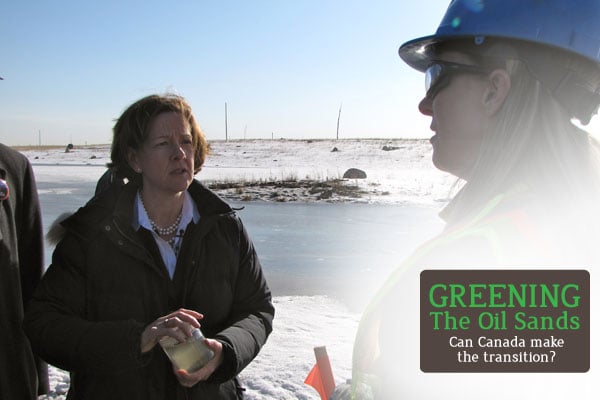
Alberta Premier Alison Redford, campaigning in March at a former Suncor tailings pond at Wapisiw Lookout in Fort McMurray, cited the link between environmental leadership and economic growth.

-
Why did a parliamentary committee suddenly destroy drafts of a final report on tar sands pollution? Here's what they knew.
-
Speed up oil sands, give $300 in petro proceeds to each citizen, says surging Wildrose party.
-
When world-renowned climate scientist Andrew Weaver and his colleague, Neil Swart, weighed in last February on the carbon threat posed by Alberta's oil sands, their conclusions set off a storm of protest -- and revealed a moral dilemma at the centre of the response to global warming.
Weaver and Swart's research, which appeared in the prestigious scientific journal Nature Climate Change, was straightforward enough: burn every single barrel of bitumen buried in northern Alberta -- itself, a virtually impossible task -- and you'd raise average global temperatures by 0.36 degrees Celsius. (Bump that figure to 0.42 degrees, if you include the carbon impact of extracting, upgrading and transporting that bitumen.)
Burning all of the world's estimated coal reserves, the paper concluded, would result in 40 times more warming: nearly 15 degrees Celsius, drastically exceeding the two degree threshold deemed safe by scientists and political leaders. "Canada's oil sands: not so dirty after all," read one prominent news headline. "Climate expert says coal not oilsands real threat," read another.
The report had political influence as well. Federal Natural Resources Minister Joe Oliver used it to attack his government's critics, telling Parliament that Weaver's figures proved, "the NDP's opposition to the oil sands is increasingly ideological and unbalanced."
"Freaking criminal," is how one environmental insider described the report's aftermath. Outraged, Nobel Prize-winning climate economist Mark Jaccard accused Weaver and Swart of propagating the message that, "stopping tar sands will not prevent climate change."
It was a basic logical fallacy, Jaccard charged, to assume that "since an individual component on its own is not a problem, then it isn't part of a problem that exists when all components are added together."
In fact, Weaver and Swart had made a similar argument. Limiting global temperatures to safe levels, their Nature article concluded, will require a rapid transition to zero-carbon energy sources on all fronts. Global leaders must also avoid making "commitments to new infrastructure supporting dependence on fossil fuels." That, Weaver later added, included Enbridge's Northern Gateway pipeline, intended to carry increasing volumes of Canadian bitumen to market.
Cast in moral terms, then, the debate over the greenhouse gas threat posed by Alberta's oil sands invokes an age-old dilemma: how much personal responsibility should one actor bear for a collective outcome?
This is the central tension of our global warming crisis, and the crux of any plan to address it.
Does Alberta, or Canada, have a moral duty to slash oil sands emissions, even if that action on its own may have little impact on the climate? Or, to pose the alternative, how moral is it to get rich selling the continent's most polluting oil and ride free on the carbon reductions of others?
The Tyee Solutions Society ran variants of this dilemma by some of North America's leading climate thinkers. By and large their responses aligned: there's a moral case to be made for shrinking oil sands emissions, yes. But real impact, if and when it comes, will be driven by the environmental and economic decisions of others. That is, unless we have the foresight to move first.
The latest federal government figures support the idea that coal should be a greater climate worry for Canadians than bitumen development.
The country's coal sector pumped 78 megatons of CO2 into the atmosphere in 2010, compared to 49 megatons from the oil sands. Coal took the dubious honour of being Alberta's largest emitter too, with a provincial carbon footprint of 52.6 megatons.
But those figures only tell part of the story. The oil sands industry is expanding so fast, according to Environment Canada in a July 2011, report, that its carbon footprint will nearly double within eight years, reaching 92 megatons and far eclipsing coal emissions.
Simon Fraser University energy economist Mark Jaccard: Those who shrug off a Canadian role in turning back climate change, 'delude themselves.'
That 44 megaton increase in oil sands emissions will also more than wipe out the 23 megatons of CO2 reductions that are expected to be achieved over the same time period from phasing coal out from Canada's electricity supply.
The oil sands' 92-megaton footprint, in fact, would dwarf the impact of every provincial and federal climate initiative in Canada. That collective effort is expected to slash 65 megatons of greenhouse gases in 2020.
"You might hear from people in Alberta that, well, oil sands only represent one one-thousandth of global emissions," Pembina Institute oilsands director Jennifer Grant told The Tyee Solutions Society. "Our argument is, that number has huge implications for Canada being able to do anything meaningful on climate change."
An arms-length advisory panel to the prime minister, known as the National Round Table on the Environment and the Economy (NRTEE), reached a similar conclusion last year just months before the federal Conservative government axed the panel in its 2012 budget.
"Our emissions are growing faster than those in the U.S., principally due to projected oil sands production and export growth," reads a 2011 NRTEE report. "This means achieving emission reduction targets... in Canada and curbing emissions growth is potentially a larger task than in the U.S."
Canada's inability to meet domestic climate targets is already drawing a harsh international response. China, India, Japan and tiny Tuvalu, which could one day be swallowed by rising Pacific waters, condemned Prime Minister Stephen Harper's withdrawal late last year from the Kyoto Protocol. "[This is] bad news for the fight against climate change," France's foreign ministry said at the time.
'Alberta does not matter'
But putting aside this international outcry, and the potential damage to Canada's reputation of further inaction, we're still faced with that same nagging dilemma, albeit on a slightly larger scale: How will the efforts of Canada, whose emissions comprise about two per cent of the global total, meaningfully impact the climate?
Some very smart energy thinkers argue not one bit.
"China's additional emissions in 2010 were greater than Canada’s total emissions, and there is also always India, waiting to burn all of its coal," wrote Vaclav Smil, a University of Manitoba professor who's won accolades from Bill Gates and others, in an email to The Tyee Solutions Society. "Alberta does not matter, it is just a tiny part of the whole."
This is also the view of Canada's Conservative government, whose natural resources minister, Joe Oliver, ridiculed environmental critics in a January speech to the Calgary Chamber of Commerce.
"Some claim the development of the oil sands, which is responsible for one-one thousandth of global emissions, will destroy the planet," he said. "Yet they are upset to be called radicals."
But others, such as Mark Jaccard, call Oliver's argument bogus, a way for individual actors to opt out of a shared responsibility. In the end, they argue, each emitter, no matter what its size, will play a role in saving or sinking the climate we all rely upon.
"The only people who can't figure this out are those whose self-interest it is to delude themselves," Jaccard told The Tyee Solutions Society.
Get ready, or get caught
Were this debate taking place only in lecture halls, textbooks and academic journals, it could continue indefinitely. On the question of oil sands emissions, though, events unfolding outside Canada's borders may someday force a resolution. And if we fail to prepare, some prominent climate and energy thinkers argue, the outcome will bode poorly for Alberta's bitumen industry.
Talk these days of national climate policy regimes in Canada and the U.S. may be political suicide. Yet other jurisdictions aren't waiting. Coal-dependent Australia is moving forward with a national carbon tax. Mexico has just passed an ambitious global warming agenda.
While nobody expects climate action in either of these countries to impact Alberta's oil sands development on their own, they belong to a global trend that already is.
Consider California, the planet's eighth largest economy, and the European Union, its largest. The two jurisdictions are leading the planet's nascent carbon emissions cap-and-trade market. And both are proposing ambitious, if highly contentious, additional fuel carbon standards that would limit the sale of oil sands-derived fuel and other high-emission energy sources.
Canada's leaders have been very clear that the major reason they're lobbying so hard against the EU's proposed fuel standard is fear that the legislation will be adopted by other countries.
"We're concerned about standards being set that might be copied elsewhere in the world," former Alberta energy minister Ted Morton said last year. Indeed, this is what happened to the EU's automobile air pollution standards, which, from the mid-1990s onwards, were replicated in China, India and other Asian countries.
China has also pledged to have a national carbon tax in place by 2015. And in the U.S., where support for a federal cap-and-trade scheme briefly flourished before dying with the recession, President Barack Obama recently promised to "take further steps to deal with [climate change] in a serious way."
Should a global consensus emerge over the decade ahead that stringent limits, and steep market prices, need to be placed on the planet's carbon, it could transform oil sands emissions from an environmental sore point to a massive financial liability.
Exactly how big that liability might be was suggested in a 2010 MIT study. In it, several researchers modeled the impact of emerging global climate policies on Alberta's bitumen industry. Their conclusion: "The niche for the oil sands industry seems fairly narrow and mostly involves hoping that climate policy will fail."
The more stringent global climate measures become, the team concluded, the less demand there is for petroleum products. This trend would especially hurt oil sands development, with its high carbon footprint and tight profit margins. Bitumen producers could lower their emissions with carbon capture and storage technology, but that results in an even more expensive product.
"It's kind of a bind that the industry is in. These types of relatively expensive petroleum sources would likely not be economic," senior MIT lecturer and study co-author John Reilly told The Tyee Solutions Society.
The Alberta government is not oblivious to these developments. In fact, another group of experts closer to home repeated essentially the same warning in May 2011.
"The world is changing," read a report from the Premier's Council for Economic Strategy. "We cannot afford to shut our eyes to this transformation. Neither can we let today’s prosperity make us complacent."
Former Conservative industry minister David Emerson chaired council concluding "low emissions alternatives" may render oil sands crude unwanted on the world market.
Chairing the council was David Emerson, a former YVR chief executive who served in both Liberal and Conservative federal cabinets and was Stephen Harper's industry minister. On the council sat several veterans of Alberta's hydrocarbon industry, including Clive Mather, a former executive of Shell Canada. Its outlook for the oil sands was sobering.
"We must plan for the eventuality that oil sands production will almost certainly be displaced at some point in the future by lower-cost and/or lower-emission alternatives," the report read. "We may have heavy oil to sell, but few or no profitable markets wishing to buy."
Never mind moral dilemmas. This was existential. And perhaps Globe and Mail columnist Jeffrey Simpson was correct in calling the report "dead on arrival," its vision "too far-sighted and bold." Emerson's warnings raised a few media ripples then appeared to sink for good.
Except that an interesting thing happened during Alberta's recent down-to-the-wire provincial election. Campaigning for a personal mandate to lead the province, Progressive Conservative Premier Alison Redford made a far-reaching announcement at Wapisiw Lookout in Fort McMurray, a former Suncor tailings pond the industry claims will someday be a functioning wetland.
"In order for us to be able to continue to grow the economy in Alberta," Redford told reporters, "we have to be global leaders with respect to energy development and with respect to environmental sustainability."
With that Redford pledged to spend $3 billion over the next 20 years, improving the environmental performance of the oil sands industry and funding emerging fuel technologies that could one day replace it.
Both commitments may be futile. A scientific study published in the same month argued that land disturbed by bitumen mining can never be reclaimed to its former state. David Keith, an internationally recognized climate and energy expert who now teaches at Harvard, questioned whether it was even worth the government's time or money to improve the industry.
"In the end, the oil sands are going to be crushed by climate policy," he told The Tyee Solutions Society.
But Keith and Redford could perhaps agree on thing: the economic climate may be changing as dramatically as the physical one. And on both counts, the sooner Alberta begins shifting to a low-carbon economy, the less painful that transition will be.
Tomorrow: Where do you think a lot of Canada's petro-executives stand on taxing carbon? You may be very surprised. ![[Tyee]](http://thetyee.cachefly.net/ui/img/ico_fishie.png)
Geoff Dembicki reports for The Tyee Solutions Society (TSS).
This series was produced by Tyee Solutions Society in collaboration with Tides Canada Initiatives Society (TCI). Funding was provided by Fossil Fuel Development Mitigation Fund of Tides Canada Foundation. All funders sign releases guaranteeing TSS full editorial autonomy. TSS funders and TCI neither influence nor endorse the particular content of TSS' reporting.
37
Login or register to post comments
Forest_Lover
1 year ago
Two views, no common sense government.
As a child growing up in Canada I have vague recollections of Canada being moraly responsible. If you look at us now it would appear that the devil himself has taken over our country and we are bound for hell. As if someone has calculated the sure fire way to get the most people into hell by burning the planet and all its inhabitants alive. Fill the planet with uncontrolled carbon dioxide but claim there's good money and jobs in it.
My parents left Hungary in 1956 amid a revolution and isn't it ironic that that same tool is all that Canadians have left to save themselves. My parents left one country to only have to live another revolution for democracy 56 years later. But do Canadians care??
seth
1 year ago
Easy Peasy
According to Bloomberg's tracking of renewable expenditures since 2004, if the money wasted to date on wind and solar (35 and 85 cents a kwh) with low efficiency gas backup producing less energy and more GHG's than if the wind/solar was just skipped and high efficiency gas used instead, had been spent on nuke power the world would now be coal free saving a million lives annually from coal air pollution. The impeding warming precipice would have be moved back 50 years or more potentially saving billions of more lives.
With nuke based synfuels costing less than $35 Brl, the only thing keeping operations like the Tar Sands going is Big Oil's money stuffing the pockets of Big Media and our corrupt politicians.
pwlg
1 year ago
An alarming trend
This isn't the first article by the Tyee that takes cap and trade at face value without a critical analysis or alternate voices being heard.
I suggest readers take a visit to the two sites I have added to the bottom of my comment for information regarding cap and trade and the use of forests as "carbon sinks".
The unverifiable or lack of independent verification of a variety of initiatives associated with the carbon trade market needs to be addressed. However, even a high ranking official with the UN's Environmental Programme (UNEP) at a conference in Vancouver in 2010 declared that it was impossible to monitor and police the carbon trade market.
Evidence of large scale fraud was recently uncovered with the EU carbon market trading system.
Nascent or not blind faith in cap and trade or carbon trading markets or using forests to offset continued climate changing practices must be offset with relevant and critical analysis.
http://www.carbontradewatch.org/
http://www.sinkswatch.org/
pwlg
1 year ago
Pain is pain is pain
"...the sooner Alberta begins shifting to a low-carbon economy, the less painful that transition will be."
I am not sure why Alberta is being singled out as a high-carbon economy when it appears that the entire developed world economy exists based on a high-carbon economy.
When you consider Alberta's reliance on oil and gas as well as coal for its electrical generation though how would any form of transition lessen the pain of reverting to an agricultural based dominant economy. How many people can this industry support sitting in offices administrating itself?
Jim Baird
1 year ago
Get rich selling energy with remedial environmental impact!
David Hone, Shell’s Senior Climate Change Advisor, pointed out in an October 2010 blog - The Real Issue - “CO2 levels in the atmosphere continue to rise (and given the current state of global action they could quite possibly go on rising for much of this century) we hear a great deal about storms and droughts but not a huge amount about the really difficult issue that most countries face, rising sea levels.”
The production of hydrogen using Ocean Thermal Energy Conversion (OTEC) addresses sea level rise by converting ocean heat to mechanical and electrical energy to reduce thermal expansion and converts liquid volume to gas that is used on land to produce power and water.
Ocean cooling by the conversion of heat to work also lessens icecap melting which is the greatest long term threat to sea levels.
OTEC was identified as early as 1881 as a potential source to meet human needs but cost and environmental problems associated with massive movements of water have prevented this potential from being met.
One way to overcome the cost and environmental hazards associated with massive water movements in an ocean thermal energy conversion (OTEC) system is to move instead small volumes of vaporized working fluid to a deep water condenser and then pumping the condensed fluid back to the surface.
OTEC implemented this way limits the thermal damage currently impacting the oceans by eliminating carbon emissions, increasing carbon dioxide absorption (cooler water absorbs more CO2) and cools the oceans to alleviate thermal expansion, icecap melting and potential marine extinction events. It also can diminish the thermal stratification that is detrimental to phytoplankton that are the base of the ocean food chain and the lungs of the planet.
Our forests are decimated by the Pine Beetle, our fisheries by ocean acidification and warming. Our coastlines and hence tourism is at risk to sea level rise and the current answer is to spray methane on the fire?
There are riches to be made solving the problem.
Hakuin
1 year ago
Anyone making plans for after The Big One?
Our own Richter 9 subduction party is in the pipeline too. Maybe even today. (or yes, maybe next century but don't you privately think our collective stupidity, laziness and inertia has EARNED us a good old fashioned smiting?)
In any case, a clean slate means someone gets to write their grand vision on it. You can rest assured the corporate greed monsters have already drawn plans to be rammed through in the confusion, has anyone who gives a damn about our environment prepared something for the people.?
An alternative to the Black Tar of Mordor?
Jim Baird
1 year ago
How much personal responsibility for a collective outcome?
Seth argues above for nuclear power, the drawbacks of which are waste and weapons proliferation potential.
About 20 years ago the Subductive Waste Disposal Method was invented in this province and was subsequently described as the state-of-the-art and most viable solution to these problems.
It has never been implemented because it was falsely claimed to be ocean dumping and the provincial government put the final nail in the coffin by imposing a ban on uranium exploration and by extension all things nuclear.
The same force of Nature, subduction, that might have resolved the problem instead precipitated the Fukushima disaster which is believed to have blown the spent fuel from reactor 3 from its containment pond and left the fuel from reactor 4 precariously situated atop a highly compromised structure.
The amount of radioactive cesium that leaked from the Fukushima was announced months ago at about 168 times the release of the same material from the atomic bomb that was dropped on Hiroshima.
Since the Jet Stream typically flows directly from Japan over British Columbia it is likely that locally we have been exposed to more radiation from that event than we ever would have been had we provided the solution to the waste problem and profited from the experience.
What have we gain by being irresponsible?
What have we lost as a consequence?
freebear
1 year ago
Why the oilpatch is already preparing to surf the green wave it
Just like Gordon Campbell did!
Jim Baird
1 year ago
High carbon footprint and tight profit margins
A few years back I was invited to tour Husky Oil’s SAGD operation at Tucker Lake Alberta.
On looking at the SAGD schematic it dawned on me I had seen a similar drawing issued by the U.S Department of Energy in support of an umbrella heat effect to keep moisture from infiltrating and damaging nuclear fuel rods in a Yucca Mountain nuclear waste repository.
The problems with spent nuclear fuel are heat and ionizing radiation.
The same heat that could mobilize viscous bitumen and ionizing radiation that could fracture long chain bitumen molecules into more valuable fractions underground. All at significant savings in energy and in the absence of CO2.
Bitumen also has unprecedented capacity to sequester radionuclides as was noted by a recent study by Canadian, French, Australian and American scientists.
Placing spent fuel in a deep oil sands formation to foster production would provide a massive economic benefit to Alberta, the best way to address the NIMBY factor, and is one of the few ways Alberta can produce its resource in compliance with Section 526 of the U.S. Energy Independence and Security Act.
Providing the solution to the spent fuel problem would make Alberta's oil sands indispensable.
Lord Oxburgh, one of the world's leading geologists and former British chairman of Shell said of this approach, “I have often myself wondered whether it would be feasible to harness the heat generated by sequestered nuclear materials. I suspect that the major problems might well be political rather than technological.”
The real political problem for this country will be when the oil sands high carbon footprint and tight profit margins price it out of the market.
Hakuin
1 year ago
nuke waste fracking tar sands?
and what conceivable material could permanently contain highly radioactive waste at depth?
wiley
1 year ago
mining oxymorons and painting them green
Redford's "grow the economy" comment is the crux of the problem. She like all other politicians is a brainwashed parrot, and would love to inject more economic highs into the arms of all growth addicts. She fails to recognize that humanity has already overshot the carrying capacity of it's home planet by a large amount. Forget growth, we can't even maintain what stupendous wealth we already have without mining all the limited resources of our own grandchildren.
This is a global kleptocracy propped up by ponzi economics, so no point singling out Alberta. And as we conduct this massive theft from the future, we are also rapidly reducing the ecological carrying capacity of the planet, so the significance of any "green wave" rehab. becomes more of a bad joke with each dire report of our impending doom.
For anyone not caught up in magical thinking, and paying attention to natural history, there really is only one outcome when so many well-fed people carrying so much baggage climb so far out on one particular branch of life - it breaks!
judycross
1 year ago
"Carbon footprint" indeed
4/100 of 1% = 400 parts per million.
Get real!
You are not going to like the post industrial world that the carbonnazi-dunderheads have planned.
When asked what "sustainability" means, the Greenbots can't give a definition.
Can you define sustainability? ICLEI can't...
http://www.youtube.com/watch?v=aEy6S7vfMKY
but they sure know how to party:
Champagne flows as enviros demand lower living standards
http://www.youtube.com/watch?v=8QGkAchO1bg&NR=1&feature=endscreen
Jim Baird
1 year ago
Nuke waste encapsulted in bitumen
To sequester radioactive and other hazardous components of waste for storage and disposal, waste can be converted into "waste forms" that immobilize these components in stable, solid matrices. For example, waste can be chemically incorporated into the structure of a glass or ceramic matrix so that the atoms of radioactive species become bound, or encapsulated in materials such as bitumen, grout, or cement.{Waste Forms Technology and Performance: Interim Report (2010))
Steam forms a chamber in the SAGD process, down which the mobilized bitumen drains to a producing well. This bitumen chamber would permanently encapsulated the spent fuel after the heat source decayed.
cyberclark
1 year ago
How to scale? How to weigh in?
I agree totally nuke power is the best alternative for all of us. It has been all but destroyed by 30 year old technology that failed at the time they were scheduled to be replaced. When the hawks are up; the doves have no place to fly.
My thoughts would be to freeze expansion of the tar sands now. They offer jobs and an economy of sorts which cannot be jettisoned away by alarmists who are captured by a sensational editorial here or there.
The Alberta Conservatives operate in a thick veil of secrecy. The truth and proportions are hard to find.
Right now, the Alberta Taxpayer is paying 750 million dollars a year to an experimental centrifuge operation at Mildred Lake. The oil companies pay nothing.
Gigantic centrifuges and like conveyors are spinning off liquids from the slurry and piling the product.This is an experiment which leaves one to speculate what the goal is.
At the rates of cleanup with an operation this size it will take hundreds of years to spin Mildred lake. So, if it is to help anything and is something other than another make work program for the industry it will have to be worked in conjunction with many other technologies in play.
The whole design of the tar sands operation is gone from sight; gone from mind. Unfortunately internet, instant video, geo-plotting personal navigation and reasonable air craft rental prices has put a new face on what is in sight.
Original designs were not concerned with being seen. Times were very different then; expectations of the public were much less and much less intense.
Times have changed, big time! I say again, freeze expansion of the oil sands now.
BC under the Liberals and the Western Premier alliance are heading in the same direction of Alberta. Soon enough BC and Saskatchewan will hear royalty will have to come down to be competitive with Alberta. You heard it here first.
Hakuin
1 year ago
what proponents of nuclear power
continually fail to realize is that the quarrel is not mainly with the science and engineering.
People are the significant variable. Human judgement simply isn't good enough to be trusted with technologies that can wreck our only present biome. You don't gamble with your single bottle of water in a lifeboat.
Fukushima and Chernobyl didn't happen because of an earthquake or an engineering failure. In one case businessmen made decisions for business purposes (ie: MONEY), the other was someone "trying something".
After seeing things like the BP spill in the Gulf of Mexico, the rape of Ecuador for oil, the Exxon Valdez and so on, isn't it obvious that given time and opportunity corporate psychopathy and greed would inevitably make any commercial nuclear enterprise a very long-lived disaster indeed? Who cares if the engineering is sound if the man in the suit wants to buy a new chalet NOW?
freebear
1 year ago
Well said Wiley!
"For anyone not caught up in magical thinking, and paying attention to natural history, there really is only one outcome when so many well-fed people carrying so much baggage climb so far out on one particular branch of life - it breaks"
It is worth repeating!
Jim Baird
1 year ago
Nuclear Power
Hakuin, I have no argument with your assessment. I have witnessed a quarter of a century of the industry's refusal to address its problems.
The oil sands are doing the same thing and it will blow up in their face.
Nuclear waste is with us regardless. Its drawbacks are a match for the problems in the oil sands.
It seems only logical to mate the problems with matching solutions.
My family's chalet, car and life savings went into the research.
What more would you have us sacrifice?
Jim Baird
1 year ago
Free bear - Natural history
Subduction is Nature's recycling mechanism.
Hurricane's are Nature's response to an over heating ocean.
Over 90% of the heat attributable to global warming has been absorbed by the ocean.
OTEC using a heat pipe, converts this heat to power in the same way, using the same delta T as a hurricane.
We disregard these analogies at our peril and the expense of a vibrant economy.
judycross
1 year ago
Poppycock, Jim!
"Federal Emergency Management Agency Director Craig Fugate said the frequency of tornadoes and hurricanes is cyclical, and he doesn’t know if global warming has anything to do with it."
http://wattsupwiththat.com/2012/05/31/fema-loses-the-global-warming-plot/
And it is now official. Just as we switched from "global warming" in 2007 when it was apparent that it wasn't warming anymore, now the meme is....ta dah!
Sustainable Development....
Only the name changes, the anti-life agenda remains the same!
http://www.cfact.tv/2012/06/18/iclei-members-admit-bait-and-switch-to-boost-climate-agenda/
Are you ready to be bathed in microwave electromagnetic smog 24/7 in the name of Sustainability?
http://citizensforsafetechnology.org/DNA-Democracy-and-the-Wireless-Revolution--STILL-HOT,2,2277
Luck
1 year ago
WHEN THINGS ALIGN ....................
WHEN THINGS ALIGN IN NATURE,
NATURE WINS,
KEEP PUMPING CO2 INTO THE ATMOSPHER,
WHY WE CAN'T SEE IT,
BUT JUST WHEN YOU THINK YOU HAVE IT MADE,
NATURE STEPS IN,
AND SHUTS YOU DOWN,
NOW THAT WILL BE A SOBERING TIME,
AS ANIMAL, MAN AND WOMAN KIND,
AS WE KNOW IT,
CLUTCH FOR THEIR LAST BREATH,
pipeup
1 year ago
stop selling crack
In terms of just the carbon question (taking out the magnitude of local/regional impacts of the tar sands - including digging up carbon sinks like the boreal which are not part of the equations provided in this article), there's an over-riding question of responsibility too. Just because you found crack, does it mean you should sell it? The end-user of the tar sands produces countless emissions - should we be fueling this addiction and further cooking the planet, or should we leave it in the ground so that reduced supply will force creative solutions?
Interesting series Geoff - look forward to the conversations, questions and insights they produce.
DJC
1 year ago
It's all very interesting, but
What if you don't buy in to the whole CO2/AGW thing?
My thoughts are that CO2 is plant food, comprises less than half of one percent of the atmosphere, and human emissions are continually eclipsed by natural processes.
If you don't agree with the (IMHO Flawed) premise that human emissions of this comparatively weak greenhouse gas are driving the Earth's climate to change, then this is all a little like spending hours on end debating the finer points of intelligent design.
freebear
1 year ago
Just drive an ATV around the space station awhile and tell me yo
your environment is just fine!
Earth is a giant spaceship that we need not, be fouled by our own waste and excess wants!
Hakuin
1 year ago
Jim:
http://www.youtube.com/watch?v=qoyKe-HxmFk
judycross
1 year ago
The Rio Carbon Capers are riotous
"Climate researchers working for the United Nations have issued an astonishing plea for immunity from prosecution. Government-funded personnel sought the ruling on the eve of the latest round of international climate talks scheduled for Rio de Janeiro, Brazil (June 20, 2012).
The United Nations Framework Convention on Climate Change (UNFCCC) issued it’s formal request for immunity from prosecution to “protect” researchers who have provided “evidence” supportive of the man-made global warming scare story. The perplexing plea will likely reverberate throughout the general scientific community as further affirmation that many climate scientists were not conducting honest research after all."
It gets even better.....
"Especially worrisome is that in conjunction with the application for a sweeping “get out of jail free card” for all it’s scientists the UNFCCC is remorselessly promoting a mammoth Green Climate Fund, intended to help mobilize as much as $100 billion a year for projects to lower global greenhouse gases. At the Rio conference the UN plans to trumpet a new draft planning and agenda document, “The Future We Want,” that will compel American families to pay $1,325 per year to “stop” climate change."
http://climaterealists.com/index.php?id=9795
freewilly
1 year ago
OTEC
OTEC could work but I doubt its going to solve our worlds energy problems. Thats your pet project, great . Like a lot of great ideas its unlikely to fly. Its too late and Im sincerely sorry thats the case Im with Seth go big, go nuclear make it so.... In a few years 10 year olds will be splitting atoms in their parents bedroom, theres performance artists sequencing DNA for the hell of it. a guy trying to build a fusion reactor in his apartment.... last I saw he got a big dose of radiation, wonder if hes ok?
Hakuin
1 year ago
We could do this
http://news.stv.tv/scotland/101744-scotland-tonight-orkneys-experimental-underwater-turbine-generator/
RickW
1 year ago
Hakuin
Yep - we could. But we could have done this as well:
http://trid.trb.org/view.aspx?id=113388
But the only leaders we have are those who lead from behind......
Sask Resident
1 year ago
Shale?
Oil and natural gas released by new techniques from tight formations like shales may make the oil from the oil sands too expensive in the world market. The US, with some imports from Canada, may soon be self sufficient in energy, even exporting some. So when oil drops to $40/bbl and natural gas prices stay low, oil sands expansions will not happen.
As for carbon taxes, nobody mentions that Alberta already has a real carbon tax not just a tax on auto fuel. Also that coal-dependent Australia has included many exceptions in its national carbon tax so it will only apply to exports. An in Canada, the real big producer of carbon emissions remains the cars driven to work each day in Vancouver, Toronto and Montreal.
Sask Resident
1 year ago
pipeup: stop buying crack
If everyone stopped buying and using crack, nobody would sell it. So the best way to reduce carbon emissions is to stop buying petroleum fuels. Like crack, if you banned selling it, it would just go underground. You have to stop the buyers and users.
Jim Baird
52 weeks ago
Nuclear Waste is toxic for 100,000 years
The oil sands have been in place a good deal longer.
Hakuin
52 weeks ago
Yes Jim
But now we are digging them up.
Hakuin
52 weeks ago
Um,
"in Canada, the real big producer of carbon emissions remains the cars driven to work each day in Vancouver, Toronto and Montreal."
I thought in Vancouver's case it was all those ships in English Bay. You know, the ones carrying Alberta oil and other irreplaceable
resources to China and cheap plastic crap the other way.
Jim Baird
52 weeks ago
Digging oil sands
Eighty percent of the oil sands are too deep to dig up. SAGD operations produce oil from about the same 500 meter depth that regular geologic disposal of nuclear waste is proposed.
Emplacement would be through a directionally drilled bore.
Craig King
52 weeks ago
Good fences make good neighbors . .
If you can't make stuff you can't defend yourself.
People come and take stuff away from you if you can't defend yourself.
hg
52 weeks ago
Alternate Power
Some interesting ideas here. This is what should be subsidized instead of oil extraction. As a matter of fact, part of the royalties from oil should be funneled into alternate energy research and development.
Jim Baird
52 weeks ago
Interesting ideas
hg, the Tyee Solutions Society and Tides Canada would be a good place to start pushing such an agenda.