Alberta already invests some carbon taxes in low emissions tech. But sky's the limit say industry insiders. Fifth in a series.
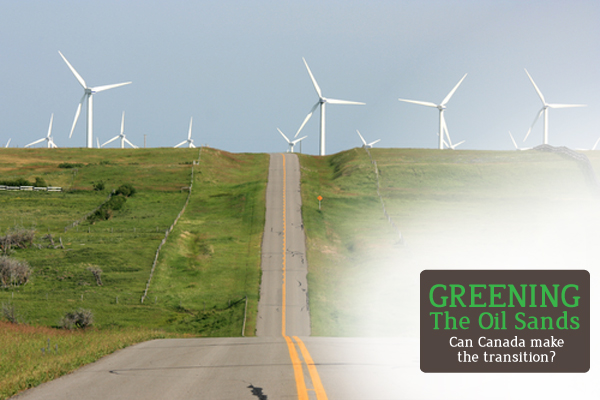
Road to a diversified economy: Wind farm near Pincher Creek, Alberta. Photo: Shutterstock.

-
We must fashion together our story of transition. Coolly, rationally and with good will. Here's what The Tyee and Tyee Solutions Society will be contributing.
-
As U.S. programs show, Canada could 'win-win-win' by doing more to help homeowners retrofit.
-
What could Canada achieve then? Here's the jaw-dropping answer.
Spring gusts sent a lone plastic bag spiraling into the crisp April air over downtown Calgary. Smokers sheltered out of the wind in recesses and doorways of office towers looming high above them.
Inside one of those towers are the offices of Greengate Power. To Alberta's leading producer of wind-powered electricity, the gusts blowing beyond the window represent money. A magazine displayed in the company's seventh-floor lobby had a cowboy on its cover, standing beneath two bone-white wind turbines.
"The challenge we have in Alberta," company founder and CEO Dan Balaban told me when we met in his sparsely furnished office down the hall, "is our need to diversify the economy beyond oil and gas."
One answer to that need, the green power executive thinks, is blowing across Alberta's prairies -- some of the strongest and most reliable, if under-utilized, wind resources in the entire world. Balaban hopes Greengate can ride those gusts into becoming the country's biggest independent producer of clean electricity.
But if there's an ill wind for Alberta's oil sands in the rise of clean energy, Balaban doesn't see it. Instead, he believes, the bitumen sector will find it difficult to expand without a lush green-energy sector alongside it.
"We're starting to see a backlash against Alberta's fossil fuel industry in some pretty meaningful ways," he said. "Demonstrating we have a vibrant renewable sector will help give us the social license we need."
Balaban's not the only Albertan, or the only executive, who sees the fates of clean energy and fossil fuels in Canada as closely tied. Alberta's government shares that view: for the past three years it’s invested revenue from the province's carbon-levy on large greenhouse gas emitters into a fund which supports low emissions technology.
Results so far have been modest -- leading critics to see a convenient way for major polluters to claim climate progress when little is actually being made.
But as the scale of the climate challenge becomes clear, there are those who believe that radically experimental advances in technology are humanity's best shot at cooling the atmosphere.
Promise
From the right vantage point in downtown Calgary, you can see past the city's western edge to where the prairie meets snow-capped Rocky Mountains. This abrupt change in elevation creates one of the most accessibly windy regions in the country, if not the world.
A nascent wind-power industry has grown slowly over the past two decades to capture the resource. Wind turbines now supply about five per cent of Alberta's electricity needs, including the energy to run Calgary’s entire light rail system.
That figure is set to grow, especially with the construction of Greengate's 300 megawatt Blackspring Ridge project. When it's done, it will be the largest wind farm in Canada.
Observers such as the Pembina Institute see huge potential as well for Alberta's hydro, biomass, geothermal, solar and cogeneration, among other low carbon energy sources.
Perhaps one day. But for now Alberta gets three-quarters of its electricity from the dirtiest fossil fuel of all, coal. Coal-fired power stations are the province's largest source of carbon emissions: 52.6 megatons in 2010 (although likely soon to be overtaken by oil sands emissions, which were 49 megatons that same year).
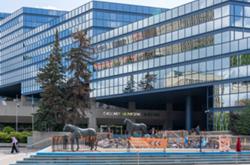
Standing street level in downtown Calgary, it's easy to lose sight of Greengate's seventh floor offices amidst the soaring towers that surround them, many branded by oil and gas company logos. So too is Alberta's fledgling clean energy industry dwarfed by its fossil fuel counterpart.
Yet a provincial initiative now entering its third year of activity claims to be slowly turning that imbalance into a boon for global warming solutions. The Climate Change and Emissions Management Corporation (CCEMC) was created in 2007, after Alberta introduced North America's first market price on industrial greenhouse gas emissions.
It was a selective price, complexly applied. Each year, the province's largest emitters, collectively responsible for half of Alberta's carbon footprint, were expected to meet a climate reductions target set by the government.
This target wasn't based on slashing their overall emissions, but on a 12 per cent cut to the emissions intensity of their operations -- the carbon released, say, to produce one barrel of oil. (How that target actually applies to each emitter is based on a complex time frame that varies by operation.)
Failing to meet their target by year's end meant these emitters had to pay a penalty on whatever emissions exceeded it. At $15 per tonne of CO2, that penalty was considered by some to be little more than a limp-wristed slap.
Nevertheless, it now raises about $74 million each year for the province. That revenue goes directly to the arms-length CCEMC, whose mandate is to invest it in promising low-emissions technology.
"The vision I think overall, is not to abandon traditional forms of energy development," CCEMC executive director Kirk Andries told The Tyee Solutions Society. "But rather, as we draw down on those resources, be thinking about building up renewable forms of energy."
There's an elegant symmetry to the idea at odds with a few hard economic facts. Since its inception in 2010, the CCEMC has approved 32 low emissions projects worth $167 million in all. Last year alone, total oil sands investment was about $15 billion.
Still, the Crown corporation claims that each dollar it invests is leveraged three to four times, bringing CCEMC's real impact closer to $830 million. It also argues that many technologies it funds wouldn't have been feasible without its support.
One example it points to is a $2.65 million investment in Coastal Hydropower Corp.'s Carseland project, a plan to generate low-impact hydropower from the Bow River with "fish-friendly" underwater turbines.
"CCEMC funding is essential to the Carseland project," Coastal founder and president Neil Anderson says in the technology fund's annual report.
Or there's the $10 million the CCEMC has pledged to Biorefinex Canada Inc. That will help fund a demonstration facility outside Lacombe, Alberta, which turns organic animal waste (think carcasses and cattle feces) into renewable electricity and high-grade fertilizer.
Small technology start-ups like those aren't the only companies benefiting from CCEMC support. Some of Alberta's major greenhouse gas emitters have also applied for, and received, funding.
Suncor, for instance, which made $1.46 billion in net income in the first quarter of 2012, is using a $3.3 million CCEMC investment to research new ways of making oil sands operations more energy (and hence, carbon) efficient. Encana, Cenovus, ConocoPhillips and Nova Chemicals have also received financial backing.
Andries was unapologetic about directing public money to some of Canada's most profitable, and most polluting, companies.
"We're here to pick the best projects possible," he said. "From my perspective, it doesn't matter what size of company it is. What matters is, how many tonnes of GHG are you going to reduce?"
Waiting for results
That's a question critics have asked more broadly of the CCEMC itself. The corporation claimed in its most recent annual report that projects it has supported to date will reduce Alberta's carbon footprint by 8 megatons by 2020, or about one sixth of the province's medium-term reduction target.
Pembina Institute calculations suggest that's optimistic. The non-partisan research body thinks CCEMC's venture will cut Alberta's emissions just one megaton by 2020, a fraction of the corporation’s estimate.
That perspective may be too short. Some CCEMC investments, Pembina acknowledged recently, "hold the promise of paving the way for greater emission reductions in the longer term.” Ultimately, it judged, "it is too soon to tell how effective" the technology fund will really be.
That hasn't stopped some oil sands producers from arguing that paying Alberta's $15 carbon levy, and thereby investing in the fund, is equivalent to reducing greenhouse gas emissions at their own operations.
"This strategy," Nexen claimed in documents it filed to the 2010 Carbon Disclosure Project, "is fiscally prudent and meets environmental objectives. A tonne of carbon [reduced] from any eligible/verifiable source has the same net environmental effect."
Which is technically true. But it's not the reality -- not yet. Paying the government's $15-a-tonee carbon levy is an investment in low-carbon technology, but it won't result in actual carbon reductions for years to come, or possibly ever.
Overall, Pembina has concluded that CCEMC's technology fund is, "inherently a mechanism that defers emission reductions until later."
Depending on your perspective that's either a cynical way for government and industry to claim progress while deferring harder choices; or, it's a tantalizing wager on new technologies, that while untested and therefore risky, could pay off hugely in the future.
The snowball effect
That gamble has its proponents. Many climate thought leaders have expressed doubt that for all that binding targets, public exhortations, industrial regulations or even carbon pricing can accomplish, it won't be enough to solve our global warming crisis.
The missing factor, those analysts say, is transformative technology, an overhaul of energy systems on par with the microchip revolution.
The best way to accomplish such a techno-revolution, McGill University economist Christopher Green and co-author Isabel Galiana argued in a 2009 paper for California's Breakthrough Institute (the group which has led much of this thinking), is robust support at the centre of any climate strategy for research and development of new technologies.
They see a modest carbon tax, rising slowly over time, playing an important ancillary role as a reliable source of income to fund risky new low-carbon projects: almost exactly (minus the rising carbon tax) Alberta's plan.
Green acknowledged that Alberta’s approach, "might not do a lot on the emissions front" right now. "But when it starts paying off," he told The Tyee Solutions Society, "it could be like a snowball coming down a hill with wet snow, and having a tremendous effect in transforming the world's energy picture."
Leaned back in his office chair, Balaban, the Greengate Power CEO, is focused on a less dramatic transformation: proving to Canada's oil and gas capital that clean energy can deliver high economic performance alongside its environmental benefits.
He listed several ways Alberta could accelerate the business case for renewables: implement a clean energy standard, favour natural gas over coal, raise the province's carbon price. Yet even Balaban seems reticent about imagining a near future without hydrocarbons at all.
"I believe it's in all of Canada's interest that we have a healthy fossil fuel sector in Alberta," he said. "Increasingly this is a driver of the national economy."
Maybe Balaban is just a realist. Or perhaps this is how you build consensus for clean energy in a province that emits more than a third of Canada's greenhouse gases, by presenting your low-carbon sector as less of a rival to fossil hydrocarbons and more as an ally, whose vitality is in their best interest.
"To continue developing our fossil fuel-based resources we need to demonstrate that we're environmentally responsible," Balaban said of Alberta. Then comes the pitch: "We have the opportunity to exploit some of best renewable energy resources in the world."
The one, he believes, can clearly help the other.
On Monday, the "Greening the Oil Sands" series picks up with a look at whether "clean, green oil" is an oxymoron. Find the entire series to date here. ![[Tyee]](http://thetyee.cachefly.net/ui/img/ico_fishie.png)
Geoff Dembicki reports for The Tyee Solutions Society (TSS).
This series was produced by Tyee Solutions Society in collaboration with Tides Canada Initiatives Society (TCI). Funding was provided by Fossil Fuel Development Mitigation Fund of Tides Canada Foundation. All funders sign releases guaranteeing TSS full editorial autonomy. TSS funders and TCI neither influence nor endorse the particular content of TSS' reporting.
21
Login or register to post comments
Jim Baird
51 weeks ago
transformative technology
Basic physics teaches that 1 Calorie is the equivalent of the work done against a gravitational field of 1 by a mass of 427 kilogram falling a distance of 1 meter.
Conversely 1 kilogram falling a distance of 427 meters produces the same result, which is the raising of 1 kilogram of water by 1 degree centigrade.
There are significant regions of the tropical oceans where the temperature differences between the surface and deep waters of the ocean are as high as 21 degrees.
These regions are therefore effectively thermal dams of a height of 8967 metres or about 350 metres greater than Mount Everest.
Theoretically the Carnot efficiency given a cold reservoir of 278K and a hot reservoir of 299K is 7 percent. Practically it is closer to 2.5 percent for Ocean Thermal Energy Conversion so the height of the ocean’s thermal dam is effectively reduced to 217 metres or just slightly less than Hoover Dam which stands at 221 meters
Unfortunately this massive potential to provide the world with clear renewable energy is not available to Albertan's.
The intellectual property and means of producing the infrastructure are another matter.
Marysue52
51 weeks ago
TAR Sands
Good article, except for the obsequious "oil" Sands. Grab some guts, Geoff. It's TAR Sands. They were called TAR Sands for decades. Don't let any ESSO CEO euphemize the mess. Why be gentle with the Oily Barons now? They were blatant enough to buy politicians, but do you journalists want to wimp out,too? It's TAR Sands. You can write it! It will only take a cm. of guts to do it. T-A-R Sands. C'mon! You can do it!
cyberclark
51 weeks ago
Who sets the "Green" agenda?
Green was on a track to a slow death until President Obama took the reigns.
He brought in a series of laws with teeth that said that Energy imported into the US had to have a "green component" The larger components would be given precedence.
This prompted oil and electrical exports to buy up what existing wind farms they could and build wind farms an otherwise far out hydro schemes in order to integrate the green into their stream.
In the US it took a different direction. You don't hear much about http://www.areva.ca/ and http://www.areva.com/EN/home-57/areva-com.html.
Areva runs the Nuclear Generating plants in the US. President Obama's crew gave the nuclear Generation plans an additional 10 year extension on their life time. It will be reviewed again at that time.
This bit of book keeping allows the US to claim still more green points as Nuclear is still the Greenest of them all and comes in at the price of Coal which is the dirtiest.
Lots to think about.
Sask Resident
51 weeks ago
Turning organic animal waste
Turning organic animal waste (think carcasses and cattle feces) into electricity is not renewable, since you have to have animals grow to produce waste. Eventually, I assume you will have to build huge feedlots to provide enough animal waste to turn into methane to burn to produce the electricity. Why not just burn the organic material instead?
Too bad that the article doesn't mention that Alberta has produced and produces more electricity from wind than any other province. They also have a wind farm that is economic at wholesale electricity prices.
Jim Baird
51 weeks ago
Defering emission reductions until later
In other words until the sunk costs made today become the rationale for the status quo tomorrow.
cityzen
51 weeks ago
you can't handle the truth
It's in "all of Canada's interest" to shut down the tar sands now, and make an immediate switch to whatever renewable energy sources we can develop. It's reprehensible that the Canadian (and Alberta) government is ignoring the overwhelming evidence that anthropogenic warming of the atmosphere due to our use of fossil fuels presents a clear and present danger to civilization and to all life on Earth. Detrimental climate change has already begun, the carbon dumped into the atmosphere so far will already warm the planet beyond agreed safe levels, and the feedback of the melting Arctic and permafrost will soon accelerate the process. We must become a zero-carbon society within the next decade or face the consequences (and it's bloody unlikely that the world can change that fast). No fat-cat exec is willing to make any significant changes in the energy sector unless it shows profit to the corporation and to the investors, so we can't rely on industry to make any serious changes. Government has proven to be fundamentally flawed, corrupted by corporate supporters, completely incapable of implementing the controversial policies necessary to represent and protect its citizens - our institutions have become a gross impediment to positive change. For those of us who haven't buried our heads in the tar-sands (and the numbers grow as people begin to learn the scary facts the national media is unwilling to present), we know that the future of our children depends on taking matters into our own hands.
judycross
51 weeks ago
Bird and Bat kills are not "green".
This is classic Hegelianism. Create an imaginary problem, man-made global warming,(morphed to "climate change", now "sustainability") then provide the solution.
Wind isn't a solution, since it creates its own problems.
Wind is a fig leaf for the newly ashamed Alberta taxpayer, who after years of constant propaganda by foreign funded NGOs, feels the need to be welcomed back into the fold of the "nice people".
Sidney Ball
51 weeks ago
That's just batty!
Ah, the expected windbaggery (gasbaggery may be more accurate) from Judy Cross, who believes every nutbar conspiracy theory – from chemtrails to 9/11 troofer nonsense to “mad scientists want to take over the world by conspiring to invent climate change”, but doesn’t recognize the most obvious and verifiable one: that the polluting and wealthy fossil fuel industrialists are paying big money to provide her and her fellow shills with their absurd talking points, thus helping to put humanity at risk.
It’s also interesting to see those who support the oil and gas industry’s efforts to endanger the human population for the sake of profits suddenly find some compassion for birds and bats. Because, we know that burning coal and oil and gas and developing tar sands operations are all perfectly safe for birds and bats.
Luck
51 weeks ago
THIS GREEN ENERGY IS .................
AS BLACK AS TOBYS ASS,
AND MORE DANGEROUS TO THE ENVIRONMENT,
ALTERNATIVE FUEL SOURCES CAN BE SUBSTITUTED,
LOOK AROUND THE REAL WORLD,
NEED SUSTAINABILTY OVER PROFITS,
NO SUSTAINABILTY,
WON'T HAVE TO WORRY ABOUT PROFITS,
judycross
51 weeks ago
Oh, Sidney, you really need to get out more
and maybe look up at the sky once in a while.
http://stopnortherncaliforniachemtrails.blogspot.ca/2012/02/chemtrails-agenda-21.html
http://foodfreedom.wordpress.com/2011/10/12/why-in-the-world-are-they-spraying/
Nobody believes the "Mad Muslims With Boxcutters did it" fairytale anymore, except establishment shills.
As for the Global Warming aka Climate Change aka Sustainability Agenda, that is all documented. It's called Agenda 21. Hello?
What is Alberta's Premier doing at the New World Order's Bilderberg ...
2 Jun 2012 ... Alberta Premier Alison Redford, a global warming proponent, will bounce ideas with other environmentalists how to implement UN Agenda 21 ...
http://thebiggreenlie.wordpress.com/2012/06/02/what-is-albertas-premier-doing-at-the-new-world-orders-bilderberg-meeting/
I really like this exposure of the junk science practices of the Climateers
"Shamelessly, these “scientists” sustain the sham wholesale in their well funded institutions where, despite billions in funding, they still use outdated computer programs that model Earth as a flat disk lit by constant and frigid twilight. This government “flat earth modeling technique” has persisted since the early 1980′s when computers had far less processing power than today. But by stubbornly keeping their antiquated calculating method this embattled clique of climatologists think they can continue to get away with a fudge factor in their numbers that contrives an additional heating anomaly which they claim is the “trapped” energy of the GHE.
But 21st Century satellite and computing power is leaving the charlatans with no room to hide their bad accounting practices. For too long this tight-knit climate science community has gotten away with conducting a phony debate that only disputed the amount of warming from CO2. Never did they question the so-called “settled science” of the GHE – a monumental intellectual travesty.
Adept critics say that by sticking to their outmoded flat earth physics formula climatologists thus avoid the otherwise inconvenient fact that the sun actually shines on only half the planet. Is this important? Yes, because in our age of super computers, to continue to treat Earth as if it were a flat disk is a needless statistical anomaly (or perhaps a deliberate trick?). Climatologists thereby hide the fact that all gases in our atmosphere help to distribute solar energy around the globe and thus cool our planet. Without such gases the sun-facing side of our earth would become unbearably hot and the dark-side of our earth would be unbearably cold; an undeniable moderating effect by those gases (including carbon dioxide) that counters the pseudo scientific claims of the UN that more CO2 in the atmosphere results in more warming."
http://climaterealists.com/index.php?id=9795&linkbox=true&position=2
RickW
51 weeks ago
The price of oil is dropping as we "speak".....
.....maybe it will drop through the floor - as far as the TARSANDS are concerned. The question then might well be: Will the Harper government increase the subsidies the oil companies get - in the name of "national security" os some such fable?
lynn
51 weeks ago
Super-sizing the Wind
This is no road to Damascus epiphany by Big Oil....this is just stage setting. But these oily guys and gals always expose themselves. They couldn't think small and green, if their lives depended upon it ( and sorry to tell them - their lives ( and our ours, too) do depend on exactly that.) Green only means Big Money to them. Big. Big. Big. Greenbacks.
So everything is SUPER-SIZED - pipelines, oil tankers, even the wind. And super-sized wind comes with its own problems as judycross states....and conveniently the oily guys and gals fail to mention that. Even our poor fish will be subject to the same kind of super-duper marketing madness via "fish friendly underwater turbines" I wonder what that does to the navigation abilities of fish? To their life cycles...and to their reproduction process...to "life" as fish and marine life have known it for aeons.
Quote: "Then comes the pitch:
"We have the opportunity to exploit some of best renewable energy resources in the world."
The key words are 'the opportunity to exploit'.
Quote: "Demonstrating we have a vibrant renewable sector will help give us the social license we need."
The key words are 'the social license we need'.
This is pure marketing and distraction accomplished by a Trojan Horse slapped with green paint and positioned perfectly in the interests of camouflage alone.
Quote: "Results so far have been modest -- leading critics to see a convenient way for major polluters to claim climate progress when little is actually being made."
Exactly.
Good Article.
Hakuin
51 weeks ago
uh Lynn
you do realize Judy is a denialist?
frank2
51 weeks ago
Thank goodness I'm 75. I've
Thank goodness I'm 75. I've had a good life (member of the most favoured cohort of the most favoured country the most favoured century in recorded history). My grandchildren have no such luck. They can expect to suffer (even in fortress North America) the multiple political and economic disasters implied by our myopic environmental and economic policies. If I should live another score years, I may even experience some of the early disasters.
What rays of hope are there? that there will be some political "tipping point" to move humanity towards rationality, before the environmental tipping points create a totally unmanageable situation? So long as those benefiting from scientific ignorance continue to wield so much power over policy and opinion this hope must remain faint.
Finally, on the articles: a swingeing carbon tax, raised over time until actual reductions in emissions are achieved, would work -- but hard to see how it could be made acceptable politically. Hence, pessimism.
judycross
51 weeks ago
Hakuin, the High Priest has cast me out
Yes, Lynn, not only do I deny CO2 can change climate, but I also don't think humans should be compared to maggots. I notice that attitude did not prevent Dr.Suzuki from making two families....but then Elite lackeys never think the rules they make for others apply to them. If they did, we wouldn't have the spectacle of 50,000 people partying it up at Rio+20 on champagne and foi gras.
Buck up frank2, it's not the oil sands or CO2 which will make life unlivable for our grandchildren. Fukushima and the plans the NWO has for us are the problems we should be concentrating on.
"Delusion is a big problem with the green crowd"
http://www.theprovince.com/technology/Delusion+problem+with+green+crowd/6823927/story.html#ixzz1yWd7A5s9
OwlRol
51 weeks ago
Chronology vs terminology
Ah, Judy, you're at your usual best.
But just a trivial correction in the bigger scheme of things.
"Climate Change" was a term long used in the science community, accelerated during the 80s, based on research and exponentially improved data collection. Seems our current Harper government would prefer less accurate information, as he shuts down excellent quality, scientific data collection and analysis sites, of many streams and specialties, across our nation.
"Global Warming" was a 90s mainstream media, simplified tag, pushed at an audience assumed to have an average intelligence of a 14 or 15 year old.
But, not your chronology, rather the other way around.
Not a big issue but, Judy, which of the 2 term users do you belong to? After all, you need to use the term of choice, even in a state of denial.
OwlRol
51 weeks ago
Good start but fulll tilt shift required
Regardless of climate issues, it should be obvious that we need to shift away from fossil fuel consumption to renewables ASAP.
We are going to increasingly inaccessible regions (eg. offshore Arctic) and using innovative technologies to extract more and more difficult to access and process fuels.
Although often celebrated as successes by the big corporations, stock markets and certain governments, this global project shows a growing kind of desperation. We're just putting off the inevitable.
It's not when a dollar's worth of fuel is used to extract less than 3 or 4 dollars worth of fuel. It's when extraction produces less than 3 or 4 times the energy used to process and ship the fossil fuel. No point, economically.
Carefully using this finite energy to wean ourselves off fossil fuels would be most logical. Instead we ship it all over the place, even half way around the planet, a considerable ammount of which is to be wasted on military applications.
Ludicrous that taxpayers should have to pay for very profitable corporations to research greener methods of extracting mineral resources that belong to those same taxpayers. Cute shell game.
Good to see some effort toward making the shift, but it's simply not enough. That's why legislation is required, not kowtowing to big corporate whims.
Unfortunately its contrary to the neoCon mantra of deregulation and small government.
And we've long been a wasteful civilization except in the worst of times.
the real ODB
51 weeks ago
Sask Resident
You're right on. This has always been my objection to producing power from "biomass". Whether it's animal carcasses or feces, wood chips, wood waste (why this should even exist) or garbage, you have to keep creating more and more of your "fuel" to keep feeding your generation plant. Not exactly "green".
Jocelyn Plourde
51 weeks ago
Tar Sands
The bitumen sector should not be allowed to grow, no matter how many wind turbines are installed. The Alberta Tar Sands is the greatest environmental disaster on Earth and there is no amount of green energy that can compensate for it. Period.
lynn
51 weeks ago
Making Corruption and Vice Look Nice
I don't expect to agree or disagree with anyone here on everything... but where I do agree with judycross is in her assertion that "bird and bat kills are not green" and that there are problems with windpower - 'Big' problems (my words) - because the kind of so-called green power being alluded to here is really the privatization of the wind....on a massive scale. Besides the massive unnecessary scale, besides the price-tagging and making a commodity out of something that should be free to all free men and women, they are wrecking havoc on the natural and delicate balance of nature. There has been much concern and health issues over the vibration levels that travel through land and air from these massive wind farms ...with disturbing consequences to the health and nervous systems of humans, birds, and wildlife.
I think judy is bang on here as well:
"Wind is a fig leaf for the newly ashamed Alberta taxpayer, who after years of constant propaganda by foreign funded NGOs, feels the need to be welcomed back into the fold of the "nice people"."
I agree. Corporatism and its participating fascists have always throughout history convinced themselves that they were "nice people".
It is that delusion that allows these self-righteous quislings to define a successful economy as one with increasing corruption, inequality and poverty. Nice corruption, nice inequality and oh-so-nice poverty, of course. And all of it now nicely camouflaged in green.
Hakuin
51 weeks ago
Oil profiteers conflating finishing the job
Of cooking our only home with "caring for the environment"? I'd laugh, but then again, der Harpenfuhrer was permitted to steal Canada and the Americans are allowing a few billionaires to purchase their next "election" -
So I guess the species really is too stupid to survive.