
News

A Tyee Series

Breakfast With the Oil Sands' Top Salesman

Meet Tom Corcoran, the ultra-Republican hired to stop clean energy bills that threaten the flow of Alberta crude.

By Geoff Dembicki, 15 Mar 2011, TheTyee.ca

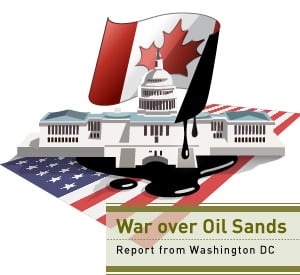
Oil Sands War graphic, Dembicki series

Related

What's an excellent day for Tom Corcoran? A day when a U.S. clean energy law dies on the battlefield.

Corcoran is a former Republican congressman who now advocates on behalf of Alberta's oil sands. Since 2008, he's played a lead role in a lobbying campaign orchestrated by the world's wealthiest oil companies and the Canadian and Alberta governments. This fossil fuel-friendly coalition has pressured -- often successfully -- against any U.S. clean energy law targeting the oil sands industry.

Corcoran has agreed to meet me at the Capitol Hill Club, an exclusive social hub for Republicans blocks from the Capitol building in Washington D.C. For more than 60 years the club has served as a "refined and elegant" hangout for presidents, vice-presidents, governors, members of Congress and "influential Republicans everywhere," according to its website.

As I wait outside the bone-white, four-storey townhouse, a well-coifed and expensively dressed man paces back and forth, talking fast into his iPhone. "I'm not saying the damage is irreparable, but I wish you'd kept me in the loop..." The 71-year old Corcoran arrives right on time. We exchange pleasantries and walk inside.

The reason I'm in Washington is to learn how a sparsely populated Canadian province landed at the centre of the most wide-ranging climate change debate in United States history. The immediate answer is obvious. With one of the very largest known oil reserves on the planet, Alberta is the single most important supplier of crude oil to America.

Yet as yesterday's opener to this series explained, mining Alberta's viscous oil sands requires much more energy than conventional oil operations, generally resulting in higher greenhouse gases.

Environmental groups argue that in a rapidly warming world, this is no time for the United States to grow dependant on the world's most carbon intensive oil.

Corcoran's brigade, meanwhile, vigorously opposes any limits on Alberta oil sands growth, framing their multi-billion dollar industry as a vital source of American energy security that could be wiped out by tough clean energy legislation.  

If Corcoran is a top field marshal in the War Over the Oil Sands in Washington, this visit with him today, I am hoping, will help me see how he reads the battlefield, the arguments he uses for ammunition, his strategy for total victory.

As it turns out, I won't be disappointed.

Target one: Section 526

There's no mistaking the Capital Hill Club for anything other than a Republican stronghold. Just inside the front doors, Corcoran leads me past two large elephants carved from dark wood. In the lobby hangs a painting of George W. Bush (a smaller portrait of his father adorns the hallway to the men's washroom). Two key architects of the Tea Party movement -- Koch Industries' David Koch and Americans for Prosperity's Tim Phillips -- invited new Republican legislators to a welcome party here, shortly after their side won back the House of Representatives in December's midterm elections.

We take the elevator downstairs to the Auchincloss Grill. Imagine a cross between a sports bar, Royal Canadian Legion hall and a rich friend's dad's basement. Corcoran and I sit at a table near the entrance. I ask him how a four-term Illinois congressman who resigned in 1984 became interested in the frigid hinterlands of northern Alberta.

"We've got the moral responsibility to help people do what they want, so they can develop themselves," he explains to me between sips of coffee. "Oil is a big part of it."

As he goes on to elaborate, it becomes clear that to understand Corcoran's read on his enemy, you need to know something about a provision named Section 526 in the 2007 Bush-era Energy Security and Independence Act.

For decades Alberta's oil sands were considered an "alternative" source of oil too costly to be developed on any major commercial scale. A swift rise in oil prices about six years ago caused the industry to explode virtually overnight, transforming Alberta into one of the world's most promising suppliers of fossil fuels.

It wasn't long though before this newfound prosperity was threatened by emerging clean energy laws in the United States. In 2007, climate-concerned policymakers led by Democrat congressman Henry Waxman managed to insert provision 526 into the Energy Security and Independence Act. Put simply, the provision made it illegal for U.S. government agencies to buy unconventional fuels with large carbon footprints. Though its ambiguous wording is still a source of contention, Waxman soon made clear he meant for the law to apply to fuel imports from Alberta's oil sands.

"This provision," Waxman wrote, "ensures that federal agencies are not spending taxpayer dollars on new fuel sources that will exacerbate global warming."

Canadian officials sound alarm

Canadian embassy staff were hard-set against Waxman's interpretation. They worried the law could set an "important precedent" for future -- and wider -- limits on the oil sands industry, according to internal emails obtained by the Pembina Institute. "We hope that we can find a solution to ensure that the oil keeps a-flowing," wrote the embassy's Jason Tolland in early 2008.    

The relatively frictionless approval of Section 526 was quite unusual, in fact, for a political scene dominated by interest group politics. "It was just one of those funny stories in Washington where this section [526] was overlooked," Greg Stringham from the Canadian Association of Petroleum Producers told IPS news.

"I don't think Canadians or oil companies knew about this section," he added.

That ignorance didn't last too long. Canadian embassy staff had by early Feb. 2008 flagged the provision to the American Petroleum Institute, Exxon Mobil, BP, Chevron, Marathon, Devon and Encana, internal emails reveal. "As yours is a company involved in the production of oil sands in Canada," then-energy counsellor Paul Connors wrote to an Exxon Mobil lobbyist, "I wanted to bring this issue to your attention."

The American Petroleum Institute soon formed a working group to monitor the provision. That group met with Canadian embassy staff and representatives from Alberta's Washington office in early February. Canada raised its concerns through official diplomatic channels as well. Then-American ambassador Michael Wilson wrote to the U.S. Secretary of Defence that month, stating that Canada did not want to see Section 526 applied to fossil fuels produced from Alberta's oil sands.

Building a war machine

It was around this time that Tom Corcoran entered the scene. The former Republican congressman was born in 1939 in the rural community of Ottawa, Illinois. Growing up, he rode a yellow school bus each day past farmer's fields. As he tells it, there's little distinction between North American security, personal freedom and an abundance of fossil fuels. Oil helped "people do what they want."

Corcoran began talks in late 2007 with the American Petroleum Institute and other major oil industry players. Their goal was to form a group that could help maximize the amount of unconventional fuels powering the United States. These are fuels -- such as oil sands, heavy oil and oil shale -- which exist in huge quantities across North America yet require much more energy to produce and refine than smooth-flowing traditional crude.

Without major technological improvements, the upshot of their full-scale development would be massive greenhouse gas emissions, a nightmare scenario for many environmental groups.

But with Canada's oil sands industry booming, Corcoran decided to focus his efforts mainly on northern Alberta. In the summer of 2008, he and his allies launched the newly named Center for North American Energy Security, a powerful lobby group with oil majors such as Exxon Mobil and ConocoPhilips as members. Its first plan of attack: repeal Section 526.

Tomorrow: How Corcoran's group launched a full-scale campaign -- alongside the Canadian government's own efforts -- to kill Section 526.  [Tyee]

11  Comments:

Login or register to post comments

  • Fiat lux

    1 year ago

    There's need for oil,

    There's need for oil, there's no question about it, but for how much and what purpose? The enjoyment of the occasional glass of wine, or beer, doesn't justify full scale alcoholism, the oil economy has become.

    The main purpose of the oil economy is to fill the demands of deregulated capital, to maintain its imagined value, by the collectivization of economies into the hands of ruling sectors, by separating the producers from the users and the destruction of all levels of self sufficiency.

    Stalin and Mao must be rolling in their graves for not having thought of this racket and used only bayonets to reach their powers

    In other words, the oil economy is not for the purpose to supply people with the necessities of life and survival, but the "creation of wealth" into the hands of the usual colonizing predator class, with economic systems that have become the biggest crime waves against humanity and the environment, in history.

    The predators always end up on top of the manure pile and deregulated money and the oil economy are the biggest rackets lifting them above the stink

    Ed Deak.

  • the real ODB

    1 year ago

    Had enough yet?

    "Growing up he rode a yellow school bus each day past farmer's fields." No doubt those same fields are now paved over with overpriced real estate "developed" by the same robber baron scumbags who started importing food products from the 3rd world, putting local farmers out of business thanks to cheap subsidized oil. I'm sure they'll place the blame on currently rising food prices on "over paid" foreign farm workers. Oil helped "people do what they want." Sure, if you're in a position to manipulate governments and markets. But not if you're an Illinois farmer.
    PS: right on Ed!

  • Fiat lux

    1 year ago

    UN report on agriculture

    I've only been preaching this for 30 years

    http://www.alternet.org/food/150158/groundbreaking_new_un_report_on_how_to_feed_the_world%27s_hungry:_ditch_corporate-controlled_agriculture/
    Groundbreaking New UN Report on How to Feed the World's Hungry: Ditch Corporate-Controlled Agriculture

    By Jill Richardson, AlterNet
    Posted on March 8, 2011, Printed on March 14, 2011
    http://www.alternet.org/story/150158/

    There are a billion hungry people in the world and that number could rise as food insecurity increases along with population growth, economic fallout and environmental crises. But a roadmap to defeating hunger exists, if we can follow the course -- and that course involves ditching corporate-controlled, chemical-intensive farming.

    "To feed 9 billion people in 2050, we urgently need to adopt the most efficient farming techniques available. And today's scientific evidence demonstrates that agroecological methods outperform the use of chemical fertilizers in boosting food production in regions where the hungry live," says Olivier de Schutter, the UN Special Rapporteur on the Right to Food. Agroecology is more or less what many Americans would simply call "organic agriculture," although important nuances separate the two terms.

    Used successfully by peasant farmers worldwide, agroecology applies ecology to agriculture in order to optimize long-term food production, requiring few purchased inputs and increasing soil quality, carbon sequestration and biodiversity over time. Agroecology also values traditional and indigenous farming methods, studying the scientific principals underpinning them instead of merely seeking to replace them with new technologies. As such, agroecology is grounded in local (material, cultural and intellectual) resources.

  • Jerry Munro

    1 year ago

    Fixing the Fixer...

    "In other words, the oil economy is not for the purpose to supply people with the necessities of life and survival, but the "creation of wealth" into the hands of the usual colonizing predator class, with economic systems that have become the biggest crime waves against humanity and the environment, in history." Fait Lux

    A few here still don't get it, or like the rman, are ideologically committed and refuse to. And a surprising number of what otherwise appear to be "green capitalism" adherents.

    But at least here on Tyee, the tide has definitely turned, and I think across much of society. There IS a widespread understanding outside hired gun "ultra-Republican" and our own Liberal/Conservatives, that the damage being done socially and economically to society, and to "our natural systems nest", is integral to capitalism and its operating dynamics. Addicted to wealth creation for the few as it is, which is what gets it up in the morning and is its raison d'etre, is the drink it absolutely has to have.

    We are in trouble... and the problem by now is less to endlessly analyze the problem, we know it. It is to find the wherewithal means outside the box of needles that is "the system", and finally deal with it.

    Ah, there's the rub!

  • OwlRol

    1 year ago

    Hi Ed, Got to agree with

    Hi Ed,

    Got to agree with nearly everything you post.

    I'm not sure how this agriculture-food, U.N. item got into a response to an article on tar sands exploitation for energy & profit,

    I don't see the connection, except links to fertilizers and pesticides, using fertile lands to produce fuel rather than food (competition to fossil fuel industries), the moronic, long range, high energy movement of goods for processing and sales, or the effects of climate change on food production.

    Although it should be a separate topic, Agroecology is more significant to our well being than oil profits
    or U.S. imperialism.

    On agroecology, my hero is Dr. Vandana Shiva, Monsanto & Carghill's worst nightmare, what a gutsy, intelligent woman. Check out her Navdanya institute or her (and others) Manifesto on Food and Seed. Great stuff.

    If we have so much oil (albeit dirty bitumen), "enough for more than 100 years", why is this govt. so intent on developing very risky & expensive Arctic offshore oil, especially given last year's Gulf fiasco?

    Get it out of the ground amap and asap. Export profits with only a trickle back to GDP.

    Jerry, "the rub."

    I suppose we have 3 choices.

    1. The status quo & ultimately go down in painful environmental blowback.

    2. Revolution of a quasi Leninist type. Results are unpredictable and could end up worse than the present situation. Besides, its surprising how many people are quite content with the way things are.

    3. Push for green Capitalism, knowing that it is only a first step toward a more egalitarian society. Perhaps too slow to work, given the pushback by entrenched financial interests and their exponential growth.

    Constant growth is as unsustainable as cancer to life, and constantly accelerating growth is worse than insane.

    Have I missed a path to solving the problem?

    As a side note, has anyone heard from Coyoteman? Haven't heard from him for some time. Hope he's O.K. I miss his Marxist comments.

  • Fiat lux

    1 year ago

    Owl,....The agriculture

    Owl,....The agriculture article got in, as response to the letter above it, but nothing is really out of line, because all these stories hang together, as part of the crime wave ruining Earth and humanity by the same predators with the same economic theoiries.

    I fully agree with you on Vandana Shiva. I had some correspondence with her years ago about some items on one of the World Bank forums. A truly great mind and human being.

    Any form of armed, or violent revolution is counter productive, as it usually brings on great damage to innocents and a new set of the worst kind of predators.

    The only worthwhile revolution is of the minds that can not be controlled by special interest goons.

    Marx was a bum who starved his own children to death, while sitting in the British Museum reading, or trying to get into the pants of the wives of his followers.

    Of course, he said some clever things, but so have all others , like Hitler and the rest of the monsters.

    Having seen the terrible things and even mass murder done to millions, including to my own family in Marx's name, is enough to make me come out fighting.

    When we talk about philosophers, the first thing we should do is look at their personal lives, whether they're real or simple bullshitters. Like Karl was.

    Ed Deak

  • Jerry Munro

    1 year ago

    OwlRol...

    "As a side note, has anyone heard from Coyoteman? Haven't heard from him for some time. Hope he's O.K. I miss his Marxist comments." OwlRol

    Welll, actually he's taken on a dual perona. :-) He has always had this schizophrenic aspect... one, a bit of an animal, this coyote character in which he slinks about on all fours. The other, this puny, more or less upright in human form, that is the freckle faced Jerry side of his personality... the Jeff Miller to Lassie, in the old tv series.:-)

    And both of their morals have long been questionable. :-)

    Much agree with most of what you write... as well as Fait. I just disagree re Fait's views on Marx etc. (Like most folks, I don't care who or how many they fornicate with. Adults are responsible for their own sexuality, and free to do "pretty much" as they want. Though I may look some askance from my superior moral positions. :-) It's Marx's ideas I'm about dealing with, not his sexuality. He, like Fait or I, get to fuck or not who we want/can or don't want, outside that. He, like I and others, MAY or may not be sex, dope and booze pariahs.

    Yet, I have to say re your second option: While I advocate for revolution, in a particular, not "necessarily" violent context... Indeed, hopefully not. ...I don't think, indeed I think it would be a serious mistake, to repeat the "highly centralized State" of Lenin's Soviet Russia in this country. That was a particular model, to the time and place that was then. This is now, a quite different time, a quite different, more highly developed economy and working class populace, with a quite different "democratic tradition". (Nothing is ever perfect.)

    There is a quite different expectation of, indeed socio-economic "need" for the further development of "democracy" into the economy and in other ways, into THIS particular revoluitionary context. This is NOT Russia 1917 OR China 1927 or 1947. Which is what the revolutionary Left in this country, or what is left of it, finally and completely needs to get through its collective head. In my view.

    So while I advocate for your second option of a "kind of" revolution, I think it is not quite so simplistic as you pose it. Kind of like how I see Fait's "personalized" critique of Marx, whether he is right or wrong about his bedroom gymnastics. 8-D lol

    I live in a glass house. I have to be careful about throwing stones.

    Jerry aka Coyote
    http://coyotetimesca.blogspot.com/

  • zalm

    1 year ago

    Best comment

    "The enjoyment of the occasional glass of wine, or beer, doesn't justify full scale alcoholism, the oil economy has become."

    I like the tenor of your thoughts Ed.

  • OwlRol

    1 year ago

    Coyotes are survivors

    Ed, my error. I forgot to look at the preceding comment except as reference to this big oil manipulator. And yes, its all interconnected. I try to compartmentalize topics, sometimes with little success, so as to not overly diffuse ideas to insignificance.

    Good to see that this coyote character, freckled schizo or not, is doing well. :-)

    Both Lenin and Mao ignored one of Marx's key principles, that the revolution he spoke of would require an educated proletariat, not a small vanguard of leaders indoctrinating the masses, as was the case before and after those 1918 and 1948 revolutions.

    Gwyn Dyer (spelling??), in one of his 4 part series,THE HUMAN RACE, pointed out that when 50% of a population becomes literate, it only takes a couple of generations for major, often revolutionary change (but not usually all at once).

    Alvin Toffler' s FUTURE SHOCK and THE THIRD WAVE (about 1980) foresaw the internet and its resulting social networks which have allowed people to see how others live and think and allows them to communicate with each other. Things are changing rapidly.

    This is the hopeful start for many and surely fearful for others. Much of the latter have retreated into gated communities of the mind. That seems to be the downside of some networks and chat rooms.

    I too hope for a peaceful revolution of the mind, but that only seems to happen when the rich and powerful back down, compromise and share, at least somewhat. Note Libya. Note the greed and fear in the big tar sands cartel and their political lap dogs.

    For now they are winning. Each battle is significant but methinks that ultimately they will be forced to retreat. The problem is that our global civilization may not have the time this may take.

  • OwlRol

    1 year ago

    Never great with names & dates

    Sorry, 1917 & 1947 is more accurate, not 18 & 48, although I guess what calender and what part of the country a person lived in.

  • Mikemah

    1 year ago

    heh

    If ever there was a justification for a pre-emptive strike this guy fits the bill.

    • The discussion for this story is closed. No more comments can be added.