
News

A Tyee Series

Farmers Harvesting the Sun's Rays

Make conditions right, and renewable energy could become a profitable crop for food growers across Canada.

By Colleen Kimmett, 2 Dec 2010, TheTyee.ca

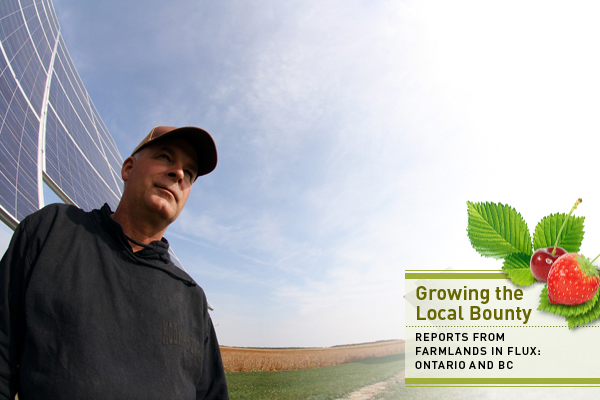
Solar farmer Dave Ferguson

Dave Ferguson says his newly installed solar panels offer a lot of financial security, with a minimum use of land. Photo: Justin Langille.

Related

Dave Ferguson, like all farmers, spends a good deal of time watching the weather. Today he's keeping an eye on the clouds that have been forming all afternoon. The air is heavy, humid, and you can almost taste the rain.

This time of year, early fall, is when the weather matters most. Ferguson is a cash cropper in southwestern Ontario, about an hour from London. Like most farmers here he grows soy, corn and wheat, and he needs to harvest while the sun shines. Timing is everything in this line of business, and two main forces will determine the difference between a good year and a bad year: the weather and the global markets. That's true for any farmer, but especially for those like Ferguson who depend entirely on these three food commodities.

Well, almost entirely. This year, Ferguson started harvesting solar energy on his farm, thanks to a new program in Ontario, MicroFIT, that offers a premium for energy generated from renewable sources like wind and solar.

"We are in food production, but now I'm in energy production with a minimal use of land," says Ferguson, standing in front of his two solar arrays, which sit in a tall grassy patch of land near the property line of his 100-acre farm. "This is helping me with some security for later on down the road."

Since the MicroFIT program launched last year, even supporters have been quick to point out that it has had its fair share of problems. But it proved that, with government support, farmers will eagerly invest hundreds of thousands of dollars in renewable technology -- the kind of small-scale, distributed and diverse renewable technology that many experts say we need to invest in right now. Farmers in B.C. say it offers the kind of incentive that we need here to help both struggling farmers and a nascent green tech sector.

In 2009, Premier Dalton McGuinty's Liberals introduced the Green Energy Act in Ontario. One of the things it did was expand the feed-in tariff (FIT) program, whereby the provincial arms-length utility, the Ontario Power Authority (OPA), would pay more for energy produce using renewable resources like wind or solar. The Ontario Federation of Agriculture welcomed the act, calling it an opportunity for farmers to take part in the "green energy revolution" and help create new manufacturing opportunities. "OFA will work with the government to ensure necessary safeguards accompany green energy developments to preserve farmland and protect the interests of rural residents," stated OFA president Bette Jean Crews in a press release.

The MicroFIT program is part of that, but it targets small projects, 10 kilowatts or less, that are installed and owned by individual homeowners or businesses. In return, those businesses and homeowners were guaranteed a hook-up to the grid, and a 20-year contract selling energy to the province at 80.2 cents per kilowatt hour.

The government offered no limits, promising that the program would be open until 2011, and that anyone who met the conditions would be offered a contract. The Ontario Power Authority was immediately swamped with interested parties. Within six months of launching, the program had received 16,000 applications.

"This is a one-shot deal, the MicroFIT system," says Ferguson. "The 80 cent a kilowatt hour [rate] was too rich -- it was a mistake by the OPA. But farmers can do math. We figured it out. This is a 10-year payback before I make money, then I have 10 years of making money. If you go to industry, they won't look at a 10-year payback. Farmers will."

Ontario farmer Dave Ferguson on why installing solar panels in an old pasture on his farm is better idea than investing in a tractor. Video: Justin Langille.

In July of this year, when the Ontario government did in fact lower the rate offered under the MicroFIT program, there was a vocal backlash led in part by the Ontario Federation of Agriculture (OFA). It was successful in reversing the government's original decision to have the new rate retroactively apply to those who already had a conditional contract, and had invested in solar equipment.

The OFA has been able to play a role in shaping the MicroFIT program in other ways: for example, by ensuring that the program prohibits energy generation on Class 1 or 2 farm land. Don McCabe, OFA vice president currently sits on a panel that is reviewing the program.

He says so far, their main concern is ensuring that farmers who have accepted a conditional contract are able to hook their project into the grid in a timely manner. "We do have concerns about ensuring that the connections of these things are dealt with an in an appropriate manner to make sure we end up with a system that still has strong integrity in the long run," says McCabe, adding that generally, farmers seem to be pretty happy with how it's working so far. "The best feedback is no feedback."

The biggest benefit of the program is that it’s helped farmers diversify their income, says McCabe.

Ferguson agrees, and says it's been a financial boon not just for him but for the community as well. When the program was announced, Ferguson worked with nine other farmers in the area to collectively examine their options. They invited different solar and IT companies to give presentations, and were able to ask questions, ask for various features, and negotiate a price.

"This cost me a touch over $90,000,” says Ferguson. "If I went out and bought a new 100 horsepower, name-brand tractor, front wheel assist, fairly loaded up, I'd be looking at the same kind of money. And a tractor I use a few hundred hours a week. These are working every day, seven days a week."

Because the solar panels are hooked to the larger grid, it's not energy being used directly on Ferguson's farm. So it's not helping the farm per se, he says. But it does help the farm's bottom line, and it's a secure source of income at a time when prices for global food commodities like soy, corn and wheat are volatile.

"Is it too rich, yes, maybe it shouldn't have been this price," he says. "But it made us jump and the money I make will be spent here in Ontario."

LOCAL FOOD TAKEAWAY: COMBINE FOOD AND ENERGY PRODUCTION

Renewable energy technologies like small-scale wind and solar have been slow to take off in Canada in part because the payback period on these technologies is long.

Solution? Make it easier for farmers to invest in renewable energy. Despite its failings, Ontario's MicroFIT program has proven that given the opportunity, farmers will invest in the kind of small-scale and diversified renewable energy technologies that experts say is necessary for a low-carbon future.

There are several advantages to mixing agriculture and energy production. One, farmers are good investors, willing to put down large amounts of capital and accept long-term payback periods. Two, they can make use of underutilized parcels of land without hurting crop production. Three, long-term energy contracts provide economic stability for farmers, helping boost their bottom line.

Certainly, the MicroFIT program is not without its detractors. One energy analyst told the Toronto Star recently it has turned out to be an "unspeakable disaster." A large part of the criticism is due to the fact that, even though the feed-in tariff has been reduced from 80.2 to 64.2 cents per kilowatt hour for any new producers under the program, it's still costing the government -- and ratepayers -- a lot of money. The same electricity that OPA buys for 64.2 cents per kilowatt hour is sold wholesale to smaller utilities for between four and six cents per kilowatt hour. Electricity prices in Ontario have increased 18 per cent this year.

Still, renewable energy advocates like the B.C. Sustainable Energy Association and independent analyst Paul Gipe have said that a feed-in tariff is a key policy mechanism for strategically building renewable energy capacity so that it benefits rural and urban communities.

Because of B.C.'s hydro advantage, renewable energy in this province's agricultural sector has mainly been focused on biogas.

Chilliwack farmer Chris Bush recently began converting cow manure and farm waste into bio-methane, and Bill Vanderkooi, a dairy farmer in Abbotsford, is in the process of turning his farm, the Bakersview Eco-Dairy, into a commercial demonstration project for on-farm renewable energy. By the end of the month he expects to be finished the installation of an anaerobic digester that captures biogas from cow manure. That biogas will then be burned in a co-generator, to produce heat for the farm's learning centre and hot water tanks. Vanderkooi expects it will produce enough electricity to meet about 30 per cent of the farm's requirements.

Vanderkooi paid for the $500,000 digester with help from the BC Bioenergy Network, BC Hydro and the provincial Environmental Farm Plan program.

Although his farm only has 50 cows, "the purpose of what we're doing is to prove out this technology," says Vanderkooi. "We modeled it for a commercial-scale farm, somewhere between 150 and 200 cows."

Aside from energy production, anaerobic digestion technology can pull nutrients like nitrogen and phosphorus out of the manure. In the Fraser Valley, which is already over-burdened by these nutrients, Vanderkooi says this is perhaps the more exciting aspect of anaerobic digestion.

But he says that, compared to Ontario, B.C. is still at a disadvantage when it comes to on-farm renewable energy. "There is a proposal put forward to the ministry for a green energy rate that includes anaerobic digestion," he says. "But the policies aren't really in place here in B.C. the way they are in Ontario where they've been quite active over the past three years."

Once the farm is in a stronger financial position, Vanderkooi says they want to get small wind and solar going.

"It's a matter of finding the right partner and the right technology," he says. "But a rate premium is really quite important to provide the incentive for these."  [Tyee]

15  Comments:

Login or register to post comments

  • seth

    2 years ago

    nuts

    Paying 80 cents a kwh for power that wholesales for 3 cents. Only the very stupidest of greenies would think that made sense.

    The cost of solar PV per sq foot is already less than a dirt cheap mass produced skylite from Home Depot. There are no further factory production savings possible from the tech - the cost has bottomed and has nowhere to go but up.

  • airwin

    2 years ago

    All such subsidies should be removed.

    This farmer figured he would make back his initial investment cost in 10 years and then have money rolling in until the photovoltaics wear out (typically for the remaining 10 years of their average 20-year lifetime) for the cost of the land that will be taken out of food production. That is why he and a lot of others took up this offer so rapidly. The subsidized rate has now been reduced to $0.64 per kWH, but I predict as they gain experience with how many kWH typically are produced for such systems in Ontario and as the installation cost is reduced through experience, that the subsidized rate will be reduced a lot more.

    Of course, the reason for such subsidies for "Green" sources of power is the cost of the standard power sources is a completely subsidized also since it does not include the environmental cost. I personally like the Green position which would be to stop all these stupid subsidies and simply have correct accounting of the true cost (including realistic environmental cost) for all power generation. Under those conditions, I believe photovoltaics would spring up like mushrooms on every roof top in Canada! And farmers could get back to doing what they do best, which is to produce food (which again should be subsidy free, but that is a different issue).

  • seth

    2 years ago

    subsidies

    As I pointed out the cost of solar is bottomed it is not going down.

    There are no current subsidies on nuclear power in Ontario all subsidy long since paid if there ever were any. Nuclear power in Ontario costs 2.6 cents a kwh less than 3% the cost of solar which receives hundreds of billions in worldwide subsidy.

  • airwin

    2 years ago

    Nuclear power has no subsidies? You have to be kidding me!

    @Seth: You are ignoring the huge economic cost of the next nuclear power plant meltdown (Chernobyl or worse). You are ignoring the cost of safely storing the spent fuel. Nobody has solved that problem yet, and the temporary storage facilities get more dangerous every year. I have even read some nuclear advocates who wanted to dispose of the spent fuel permanently by dropping it into the sun. That wouldn't hurt the sun in the slightest, but it is a totally impractical idea since it costs more energy to get the material out of the Earth's gravity well then was extracted in the first place! It is those little forgotten details that always make it so fun to read those who are still advocating nuclear power.

    One thing I hope we can agree on; the realistic cost of all energy is extremely high. Carbon-based is killing us through the greenhouse effect; nuclear has the downsides mentioned above; all the truly economic hydroelectric sites have already been taken and additional ones will have a huge economic cost in terms of valleys and fish stocks that are completely destroyed. Those energy sources never have realistic accounting which leads to bad public policy. And subsidies for wind power and photovoltaics (beyond a few years to prime the pump) are also bad public policy. Instead, I would like to see realistic accounting including all environmental costs for all energy sources. I am confident when that is done you will find wind power and photovoltaics are just about as expensive as now, while carbon-based, nuclear, and additional hydroelectric will be even more expensive!

    That realistic accounting should lead to the correct public policy which is energy conservation as the highest priority followed by emphasis on the actual cheapest energy sources (wind power, photovoltaics) when environmental costs are taken into account.

  • Bailey

    2 years ago

    Sand and transmission

    These people, Hydro companies and governments and their ilk, are deeply committed to the large owner paradigm. For one thing, they themselves are subsidised by large owners disproportionately, provided they keep the reciprical subsidies flowing.

    It prevents them from actually feeling empowered to make public policy according to long standing principles of public service. The reason solar equipment costs so much when the sand from which it is made costs so little, is that it's done almost exclusively by large owners who wish to make larger profits.

    Likewise the reason governments, when forced or allowed to make this power policy, feel that building in a 10 year profit free zone is acceptible is that large owners demand that nobody be allowed to compete by moving into an appropriate new technology but themselves.

    There is little mention in the debate of the cost of huge land grabs for transmission lines, the need for which is greatly less when the power can be produced very near the grid. This saving alone must nearly balance out the subsidy. But the chance of recieving big land grants for this is a big motive for big owners. So it must be a big factor in the decision making process going forward.

    I would wager that when large donators finally decide to pursue this policy of switching to new technologies, they will demand and recieve much better subsidies than any 10 year payback.

    I would point to the run of river contracts here in BC as evidence of that bias.

  • YCSTS

    2 years ago

    Nuclear Energy Facts.

    Airwin, Chernobyl was a military designed reactor (designed for plutonium production), which met ZERO safety standards, with no containment, highly flammable core, strong positive temperature coefficient and a negative safety culture. What happened there, cannot happen with a modern, safety designed reactor.

    Nuclear Power is the safest significant method of Energy production by far. Worst case scenario for a modern Nuclear Power plant is Core & Containment Breach with Large Radioisotopes release, occurs once in about 1700 yrs - if the world was powered ENTIRELY with Nuclear Power. And the most reputable study concluded there would be few if any off-site deaths in that exceedingly unlikely event.

    The truth about Chernobyl and modern nuclear power plant safety here:

    http://newpapyrusmagazine.blogspot.com/2009/01/relative-safety-of-new-generation-of.html

    Hazard of Energy Sources compared:

    http://nextbigfuture.com/2010/07/summarizing-deaths-per-twh.html

    Nuclear is lowest by far (including Chernobyl) at .04 deaths per twh, Hydro is 1.4, Wind is .15, NG is 4, Biomass is 12, Oil 36, Coal 161

    As for subsidies, total Government Subsidies for Nuclear Power in Canada from 1952 to 2009 is $21B in $2009. That has generated 2420 TWh of clean, green Nuclear Electricity. $21B/2420TWh = 0.87 cents per kwh! Wind Energy gets a Federal production subsidy of 1 cent per kwh, guaranteed for 10 yrs. And in Ontario, Wind gets 8-14 cents p kwh in direct subsidies. Solar 40-75 cents p kwh.

    Add to that a whole cornucopia of additional Subsidies for Wind & Renewable Energy that Nuclear doesn’t get, including huge Federal Tax Credits:

    http://canmetenergy-canmetenergie.nrcan-rncan.gc.ca/eng/about_us/ottawa/funding/incentive_program.html

    http://mcmillan.ca/Files/VKakoschke_WindFarmFinancing_0705.pdf

    Just take Harper’s & the Alberta Gov’t multi-$billion Carbon Capture subsidies – cost is now at $200 per tonne of CO2. Nuclear Power has avoided 2.4 billion tonnes of CO2 in Canada since 1972. $21B/2.4B = $8.75 per tonne. A good deal cheaper than $200 per tonne – for a fantasy that will not eliminate the CO2 but will bury it (hopefully) forever.

    In Ontario Nuclear power is subsiding Wind, Solar & NG energy:

    http://canadianenergyissues.com/2010/11/17/ontario-nuclear-power-moderates-subsidizes-the-cost-of-gas-and-renewables-an-investigation-into-the-price-of-political-correctness/

    As for Spent Fuel storage, it is a trivial issue, blown way out of proportion by Pseudo-Greenies. On site Dry Cask storage is secure and compact, quite viable for centuries if need be. Where do you get dangerous from? Even a direct Aircraft Collision won’t release the vitrified spent fuel. However, it is pretty obvious by now, that Spent Fuel should be burnt in GenIV reactors, as it contains 100’s of $trillions in clean energy.

  • YCSTS

    2 years ago

    Nuclear Energy Facts, cont'd.

    An example of few of the many GenIV reactors that can run on Spent Nuclear Fuel:

    General Atomics EM2:

    http://nextbigfuture.com/2010/09/general-atomics-to-develop-energy.html

    Accelerator Driven Fission:

    http://www.telegraph.co.uk/finance/comment/7970619/Obama-could-kill-fossil-fuels-overnight-with-a-nuclear-dash-for-thorium.html

    http://csis.org/files/attachments/091007_chang_virginia_tech.pdf

    Helion Fission-Fusion Hybrid:

    http://nextbigfuture.com/2009/12/development-path-for-helion-energy-for.html

    The IFR, Integral Fast Reactor:

    http://www.skirsch.com/politics/globalwarming/ifr.htm

    Using LCFRs (Liquid Chloride Fast Reactors) to Burn Nuclear Waste:

    http://thoriumenergy.blogspot.com/2009/11/lftr-and-msrs-achieve-doe-nes-goals.html

    A coke can size of Nuclear Waste results from a Canadian getting their lifetime’s electricity supply from Nuclear Power, vs 80 tons of Coal Solid Waste from a Coal Power plant. Our Federal Gov’t is going to freeze in place, right on the shores of Great Slave Lake – 280,000 tonnes of highly water soluble, carcinogenic, poisonous Arsenic Trioxide, which will have to be maintained FOREVER! CANDU nuclear waste has the same radiation level as natural Uranium after 500 yrs. So that’s 7X the total Spent Fuel in Canada, which replaced 2.4 billion tonnes of CO2 emissions, not some product of a minor Gold Mine.

    As for the environmental costs of an Energy Source, Nuclear is by far the lowest. The EU’s ExternE report, on Electricity Generation Sources, puts external cost Coal Electricity at about 10 cents per kwh, more than double what Nuclear costs. Nuclear at about 0.4 cents p kwh. (including the fossil fuel inputs which will disappear in a Nuclear Economy). An insignificant addition to Nuclear Costs. The Wind, Solar & Hydro numbers, are similar to Nuclear, but ignore the Huge Land Area of those Energy Sources compared to Nuclear. And noise and aesthetic costs of Wind. And totally ignore the very high cost due to the effect of cycling Wind (and to a lesser degree Solar) on the Shadowing Fossil Fuel Power Source. And 10X higher Water Consumption of Hydro, vs Nuclear:

    http://lightbucket.wordpress.com/2009/06/24/the-external-costs-of-electricity-generation/

    As for Energy Conservation, that’s great if you properly evaluate the thousands of methods, and choose ONLY those that are cost effective. That is NOT being done. Not even close. Money is thrown down the sewer on WHACKY Energy Conservation SCAMS that achieve virtually nothing or have incredibly high costs. This is the result of Greenie Religious types & corrupt Politicians making energy choices, both of whom are incapable or unwilling to scientifically & economically evaluate an Energy Conservation method. The current method of Energy Conservation, practiced by our Governments is to throw money stupidly at any and all methods that might save any energy, with ZERO evaluation – like Cost/Benefit Analysis.

  • Bailey

    2 years ago

    Missing the point a bit

    Dear YCSTS; The problem with nuclear power isn't that the wastes can't be safely managed, they could with reasonable people doing the management.

    The problem is that one simply cannot make the human being safe at all, no matter what you do to it. People are really really stupid. Especially military ones. Any humans who find themselves able to access any kind of power at all, actually. Completely unable to be predicted or controlled. Irrational. Foolish, Greedy and short sighted. Lots of them are actually insane, and walking about free because they have sufficient money or power to escape diagnosis.

    I'm old enough to have witnessed a period in our history in which billions of dollars were spent to arrange to incinerate and irradiate millions of grannies, schoolkids, mums and dads, dogs cats and gerbils in order to make the world safe. I'm serious. that's the exact reason the idiots gave; to make the world safe.

    I ask you.

    As further evidence, although you cite statistical evidence that rational nuclear uses would result in one leak every couple of millenia, I have a little list for you.

    Chernobyl, which you mentioned. Three Mile Island, Nagasaki, Hanford, which released radiation intentionally, apparently, as an experiment. Hiroshima, Christmas Island, The Thresher, White Plains.

    There have in fact been quite a few releases of radiation that we know of, land and sea, and probably others we don't and we've only been doing it since 1943.

    Until humans can be made safe, they simply can't be trusted with dangerous poisons that can be turned into large amounts of money, or used to bully and abuse other humans.

    It will absolutely end in tears.

  • YCSTS

    2 years ago

    Bailey, learn to use LOGIC & REASON not IDEALOLOGY

    Bailey, you are using a bogus argument, confusing Nuclear Power with Nuclear Weapons. Nuclear Energy is one of 3 classes of Energy that power our civilization. 1) Fossil Fuel Energy (85% of World Energy) 2) Renewable Energy (8%) 3) Nuclear (6%). To link Nuclear Energy to Nuclear Weapons is IDENTICAL to linking Fossil Fuel weapons to Fossil Fuel Energy. Fossil Fuel powered weapons have killed a 10,000X the number of people that Nuclear Weapons have. No Fossil Fuels, no planes, no bombs, no firearms, no chemical weapons, no missiles.

    There is no rational link between Nuclear Weapons & commercial Nuclear Power. Almost all countries that have Nuclear Weapons, first acquired the Weapons, BEFORE they had Nuclear Power. In spite of major International Sanctions, a failed, dismal economy, a small economically isolated country, North Korea, managed to produce Nuclear Weapons, and have successfully used both plutonium development with a simple minded graphite core reactor (terrible for commercial energy but great for weapons material) and have built a sophisticated centrifuge system to enrich uranium. So the simple fact is ANY nation-state that wants to build Nuclear Weapons can do so. Commercial Nuclear Energy is irrelevant to the effort. Control of Nuclear Proliferation, like the more deadly & dangerous Biological Weapons, and comparably dangerous Chemical Weapons is entirely a Political Effort.

    I already explained Chernobyl to you, why don’t you understand logic? It is not a modern, safety designed reactor. By far and away, the largest releases of Radiation to the environment are from Coal Combustion and Natural Gas production & combustion. Nuclear Power releases less than 0.2% of the former. And radiation is ubiquitous in the environment. You are radioactive, from radioisotopes in your body, like Potassium 40.

    Your nonsensical Idealism will absolutely end in tears. Billions will die if we do not rapidly begin a transition away from Fossil Fuels. Runaway Global Warming – Peak Oil – Oil wars – Water wars (plentiful potable water needs cheap energy). You would create a World of Scarcity, Poverty, Billions of desperate people with nothing to lose – then you will have War – brutal, destructive war on a scale never before seen. All because you are unwilling to sacrifice your stubborn, mindless idealism and instead logically evaluate an Energy Source using Probabilistic Risk Assessment – which includes accounting for ALL of the risks you mentioned.

    Bailey, do yourself a favor and ACTUALLY learn about Radiation from Radiation Physicists:

    Radiation, Chernobyl & Hormesis:

    http://www.riskworld.com/nreports/1999/jaworowski/NR99aa01.htm

    A rational evaluation of Nuclear Spent Fuel Risk:

    http://www.phyast.pitt.edu/~blc/book/chapter11.html

    Why you can’t use Spent Fuel for Weapons material:

    http://depletedcranium.com/why-you-cant-build-a-bomb-from-spent-fuel/

    http://www.phyast.pitt.edu/~blc/book/chapter13.html

  • Bailey

    2 years ago

    Missed it again, I'm afraid

    Thank you for all the capitals, I think it's important to communicate which parts of an argument are most important.

    You make my point for me. The link is though the irrationality of people who seem incapable of doing anything without converting it to those purposes you are trying to seperate. Every form of energy hat has become available has been swiftly weaponized. Perhaps the term idiots is hyperbole. I don't think so, but I suffer from all the common delusions of my species, as do you, as do we all.

    If there are reactors reacting in a world where there are more guns than people, then the products of those reactions will be weaponized.

    Logic and reason don't really come into it. Nor does ideology, ever, except in the post mortems we are continually conducting after our most inexplicible mistakes.

    The article above is about creating opportunities for economically oppressed farmers to increase their uses of the sun while providing a next step in the development of a benign power source. The sun.

    I do seem to remember a story about ancient battles where the warriors, with the sun in their eyes at daybreak on the field, turned the sun into a weapon by redirecting it's rays into the eyes of their opponents off their burnished shields. So even that source of energy has been weaponized, hasn't it?

    Humans can't be trusted with concentrated power. That's my point. I think it's a poor idea to create reactors and just scatter them willy-nilly around the landscape. If they don't produce carbon as they operate, they will create it later when whatever army takes possession of them burns our children to death.

  • YCSTS

    2 years ago

    Bailey, you are advocating Mass Extermination.

    You're arguments are ridiculous. You don't have a clue about the cost of Energy. Do you really think your benign energy source can power modern civilization? Solar has been around for millennia, and only fossil fuels allowed for civilization to develop. You are just another Greenie Religious Ideologue who is quite happy to sentence 5 billion people to death. Of course you won't be one of the 5 billion. Nope you are special. You will be part of the illustrious priesthood, whom the starving masses will serve.

    You will have starving, desperate people who will burn every bit of vegetation for fuel, as was done before fossil fuels were available, kill every animal, plant or whatever for food. War will be the norm. That's the World you would have for us.

    Whether concentrated power is going to be the demise of human civilization, or technology in general is of course a big question. Actually the most dangerous of weapons - biologicals - do not require a concentrated energy source - just technology, already available. The problem is you ideologues, somehow fantasize that you can go backwards in technology. First you will create MASS DEATH. Then you will have to confront the Tibet Problem. A peaceable nation, that foresaked weapons & war and was walked over by China. Your Fantasy World, will be a World in which some Alexander/Stalin/Hitler will EASILY conquer, and we will be right back on the same old long path to civilization.

    For better or worse, the march forward, dangerous as it is, cannot be stopped, and attempting to do so, will GUARANTEE Worldwide Mass Death & Destruction to the Earth, plants, animals & humans.

    I will also point out that the threat of Nuclear War has led to considerable restraint on the actions of nations. War was once romanticized by the rich & powerful. After all, they were never killed or injured. They made big money in Wars. Now even the super-rich face pain & death, should they be so foolhardy as to start a War - as they used to do.

  • Bailey

    2 years ago

    not if the solar thing works

    Large infrasructure is more vulnerable than small. Where every town or every block or every house produces it's power, nobody need starve, whatever the ill will of the masters you postulate.

    I understand your point about Tibet. They were always influential on one level. I would argue that since the misbehaviour of the corrupt Chinese army, they have become more influential, not less. And on a much wider scale. The message of the Dalai Lama has spread far and wide. Do no harm. Let compassion and loving kindness guide your actions.

    This is the antithesis, isn't it, to both our points? The antidote for insanity and hatefulness and cruelty of every kind, everywhere.

  • hakaakah

    2 years ago

    Anyone else see unicorns

    Anyone else see unicorns roaming behind Bailey?
    I cant believe we subsidize this crap. Suns down..ahh..but the coal/ng plants still running so all good! Arguing the proliferation is a weak arguement. After all. How the frig do the employees of Boeing get to work to make bombers. Fossil fuels.
    If Anyway if our divine leaders pulled their heads out of big oils ass we might put some funding towards a LFTR. I for one think we need to see another working model. I appreciate the links YCTS. Some of us are open minded enough to see the many benefits of nuclear power.

  • Bailey

    2 years ago

    You see unicorns?

    I have a question...

    Do they glow in the dark yet?

  • OwlRol

    2 years ago

    Energy

    Funny how a discussion on ways that, often desperate farmers could add to their income through green energy programs (perhaps big agribusiness doesn't want that), to the issue of nuclear energy's pros and cons. The first issue should be, beyond the farmer's dilemma, why do we need to increase energy production by 50% over the next 10 to 20 years, here in B.C.? Similar clean freshwater concerns, interconnected urban sprawl, etc. likewise bedevil us. Even worse on a global scale.

    Yes, energy for larger population and needed infrastructure (perhaps more than sustainable, long-term capacity), greater affluence & consumerism, but why this export gold rush for some "for profit" outfits to a few shareholders and CEOs (oh yah, and some non sustainable, occasionally toxic jobs)?

    Although I was going to let this one go, when Hakaakah joined YCSTS in his rationalized critique of Bailey's viewpoint, I had to side with Bailey.

    The root problem is not where more and more energy is going to come from, but how we level off and manage energy production, transmission, distribution and waste. Useful technology is only a small piece of that energy puzzle. Energy sources are secondary to efficiencies and the near inevitability of destructive side effects of production (often considered externalities by those energy companies). Ah yes, more so we can continue and increase what were doing.

    • The discussion for this story is closed. No more comments can be added.