
The Stop in Toronto has evolved into a dignified model connecting local producers with low-income eaters.
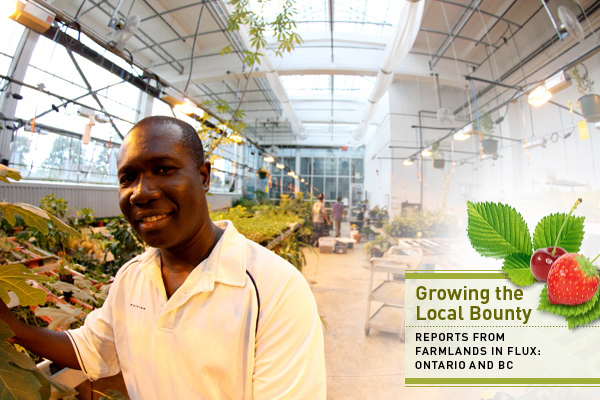
The Stop's greenhouse coordinator Lord Abbey. Photo: Justin Langille.

-
Diane Brown makes a delicious art of nutrition for the poor.
-
Author Sara Miles on her spiritual quest to help the poor.
-
In food lines of Vancouver, we found scant nourishment.
- Read more: Local Economy, Rights + Justice, Food, Environment

It's the lunch rush at The Stop, and chef Scott MacNeil is cursing the scalloped potatoes.
He calls out to the servers -- "You gotta wait five minutes!" -- standing on the other side of the kitchen's swinging door with half-filled plates. As MacNeil prepares another huge baking pan for the oven he fields questions from a group of nine food bank directors and employees.
"How's the day going?" asks one of the visitors, flattened against a stainless steel counter in the crowded kitchen.
"Busy," he replies. He is a few volunteers short today, and his attempt to pull off a quick batch of creamy, cheesy spuds didn't turn out well. "That's the last time I'll try that," he says. "Takes way too long."
Someone else wonders why there is plated service here, instead of having everybody line up. "It's the most efficient," MacNeil says (the lunch rush is typically 200 people over the course of an hour and a half). "Plus, we don't do lineups because we want to foster a sense of dignity here."
More than just a hand-out
When The Stop Community Food Centre first opened its doors in Toronto's Davenport West neighbourhood in the early '70s, it was one of the first food banks in the entire city. Over the past 11 years it's grown to be something much more. Along with the emergency food bank service -- a three-day supply of food, twice a month -- members can drop in for a meal four days a week, grow their own vegetables in a community garden, buy discounted produce at a weekly farmers' market, or take cooking classes.
While The Stop is rooted in providing food to those who can't afford it, it works on the premise that without food infrastructure, viable farms, civic engagement and personal empowerment, food banks are simply a stop-gap measure in the fight to eradicate hunger.
The organization's ability to harness a growing interest in local food has allowed them to not only boost their own programming, but also build local food infrastructure. The model is the envy of foodies and social activists alike, and a case study for municipalities in Ontario and beyond.
Chef Scott Macneil takes a break from the busy lunch service at Toronto community food hub The Stop to explain his kitchen to a tour group from the North York Harvest food bank. Photo: Justin Langille.
Which is why tour groups like this one, from the North York Harvest food bank, show up weekly to see how it's done. North York Harvest is the largest food bank in the city, serving approximately 11,000 people per month through 60 neighbourhood centres. Nation-wide food bank use increased 17.5 per cent in 2009, compared to the year before. Approximately 800,000 people used a food bank last year, many for the first time.
"We don't see the need for food banks ending in the near future," says The Stop's program director, Kathryn Scharf. "But what we are trying to do here is create a tiny microcosm of a food system."
'It allows us to connect with each other'
A secure food system is defined broadly as one in which everyone has access to healthy, sustainable food all of the time. Organizations working on food security tend to veer off in two directions, working on either the access part, or the sustainability part, often leading to a tense division depending on who you prioritize, says Scharf.
The Stop's flagship building, located on the first floor of a plain brick low-rent apartment tower, houses its low-income programming and The Stop's administrative offices. Here, the primary goal is access -- feeding hungry people.
In the dining room, where the tour group gets to sample the lunch (scalloped potatoes -- which turned out great -- mixed green salad, and a swiss chard, butternut squash, leek and sausage stir-fry) dozens of flags hang from the ceiling, representing the diversity of its members. On the walls are posters advertising pre-natal health classes and The Stop's popular Wednesday pizza night, featuring homemade pies baked in a wood-fired oven outside. There's also a digital counter, deli-style, so people can have a meal while they wait for their number to come up at the food bank.
A client quickly packs away a bag of fresh fruit and vegetables during the morning rush at the busy food bank counter. Photo: Justin Langille.
Through the dining room doors is the foyer where donated food is handed out. Monday is usually a busy day, says volunteer Sherifa Elkdaen, because they have to unload donations as well as fill orders. Like many of the volunteers, she is also a member. "As a team, we do a tremendous amount for the community, through advocacy and the community centre," she says. "It allows us to connect with each other."
Inside the food bank's dry storage room, there is a random assortment of unperishables: crackers, boxes of mac and cheese, baby food, and six-pound tins of Wendy's brand crushed tomatoes. But there's also always featured fresh produce; this month they have tomatillos and corn from one of The Stop's community gardens. They run two community gardens, Earlscourt and Hillcrest, and also get free or low-cost food for its programs through its new satellite site, The Green Barn.
The Green Barn an oasis for foodies
This site represents the other side of the division that Scharff talked about -- the sustainability side.
Located just a 10-minute drive from The Stop, in Toronto's midtown, the Green Barn is located in a real barn -- though it's one that once held streetcars, not cows. It's part of the the Wychwood Barn development, which opened in 2008 as a mixed housing, artists' studio and office space. It's a beautiful building, with high, vaulted ceilings, lots of glass and heavy wood beams. The Stop's share of the space here includes an office, as well as a greenhouse, sheltered garden, community kitchen and year-round, covered farmers' market.
Bushra Moinuddin peels hard-boiled eggs in one of The Stop's prep kitchens. She and her husband Mohammed volunteer to keep themselves active and working while on social assistance. Photo: Justin Langille.
In the summer, it features vendors with mostly organic produce; in the winter, artisan products like chocolate and cheeses dominate. Scharf acknowledges that it's a high-end market, out of reach of the Davenport community.
"But it provides a valuable role supporting farmers and it certainly builds that kind of community around there," she points out. "Because we have a connection with our high-end market, we can get food that, at the end of the day, farmers... wouldn't be able to save long enough to sell at another market.
LOCAL FOOD TAKEAWAY: LINK SOCIAL JUSTICE WITH LOCAL FOOD
Food security means that everyone has enough good food to eat. But people who rely on the charity food system (800,000 Canadians used a food bank last year) often end up with donated non-perishable goods that are low in nutritional value, or produce that is over-ripe by the time they take it home.
"The immutable truth," says The Stop's program director Kathryn Scharf, "is that low-income people don't have money to spend on food, and that local sustainable food costs more."
The solution? The Stop is working to bridge this gap with a wide range of programming that supports both farmers and eaters, that connects poor and wealthier communities in the city. It has been able to harness widespread interest in local food to help fund cooking classes, discount farmers' markets, locally sourced meals and community gardens for people who otherwise couldn't afford it. The Grow for The Stop initiative, for example, raises funds for a local farmer to grow fresh food for The Stop's members. The Stop is trying not to just feed people, but "create a tiny microcosm of a food system," according to Scharf. The key, she says, is having a well-funded, well-staffed administrative side to coordinate all of this. It is a model that other communities are interested in adopting as well.
Watch a Tyee interview with The Stop's Kathryn Scharf here.
"We also try to buy from them as well, so with the food that's donated, we make a little bit of money here, and then we channel it back."
Inside the greenhouse, volunteers are harvesting herbs. The warm glass building is fragrant with the smell of sage, thyme and basil, which will be used this week for the Green Barn's annual What's On The Table event, a $50 per plate fundraising dinner. Another $200 buys a spot in chef Chris Brown's kitchen to help prepare the meal and get a cooking lesson at the same time.
"It rubs people sometimes the wrong way when we have high-end functions," says Scharf. "But our What's on the Table event raises over $200,000 in one night. I'm pretty comfortable with that. We get to spend the money the rest of the year and no one's demanding Excel spreadsheets that are 50 pages long."
Farmers need to eat, too
Another successful fundraising initiative is Grow for The Stop. Instead of donating directly to The Stop itself, the money goes to a nearby farm (The New Farm in Creemore) to subsidize the production of fresh fruits and vegetables that are delivered to The Stop's food bank and lunch program.
"The Stop has become our single biggest customer," says Brent Preston, who runs the farm with his wife Gillian Flies.
"When we started out, we realized almost all our food was going to really wealthy people... either at farmers' markets or to some really high-end restaurants in Toronto," says Preston. "We really wanted to figure out ways to make our food more accessible, but at the same time be able to make a living. We thought this would be a good way to do it."
The Stop raises 90 per cent of its $2.9 million operating budget from private donations. This kind of no-strings-attached money is a blessing for a non-profit organization.
The increasing popularity of local food, and the fact that The Stop has such a variety of programming to appeal to so many people -- those interested in supporting farmers, in social justice, in food access, in democratizing the slow food movement -- have found a place in The Stop. It means that they are able to leverage all this money in one well-organized, well-staffed location.
"Very little of what we do is totally unique to The Stop," says Scharf. "As much as anything, what we're really doing is a funding model. We benefit from the critical mass of having all these programs based in one location."
Growing across the province
Greenbarn intern Indra Noyes, a psychology and environmental studies student at U of Tm, strips soybeans from an uprooted plant in the outdoor gardens. Noyes believes that the health of a society can be judged by the state of its environment. Photo: Justin Langille.
The Stop is now looking to replicate itself in other communities across Ontario, and hopefully, the country. Scharf is hesitant to give details at this point, but says there has been interest from other municipalities and funders. The goal is to work with existing programs and people and create a more coordinated hub for these services -- essentially, to institutionalize food work that's already being done "with a place and a sign on the door," says Scharf. "Aiming high, for big money. Not just $1,000 to a garden for some shovels... but actually having staff to support the work."
Scharf is uncertain whether the philanthropic interest in local food issues will last. "I think we need large-scale government investment before we replicate massively, because I think there will be a built-in limit to how much private money we can raise," she says. "The scale of the solution has to match the scale of the problem." ![[Tyee]](http://thetyee.cachefly.net/ui/img/ico_fishie.png)
This article is part of an extensive series Growing the Local Bounty: Reports from Farmlands In Flux in Ontario and B.C, that runs Thursdays and Fridays on The Tyee. A project of the non-profit Tyee Solutions Society, it is supported by the Metcalf Foundation, Tides Canada Foundation, and Vancity. Colleen Kimmett and photographer Justin Langille are part of the reporting team for this project. If your media outlet or organization would like to republish any or all of these articles, please contact Michelle Hoar to discuss.
5
Login or register to post comments
VivianLea Doubt
2 years ago
food, the heart of culture and politics
Fifty years ago Vancouver Island farmers produced 85% of the Island’s supply of food, which has now been reduced to about 10%. Here on the Island any disruption of transport routes – by a natural disaster or a border closure, for example – would quickly lead to food shortages for residents. Both problems of malnutrition and obesity are linked to many health issues and tax dollars spent on health care - and play a large role in various other illnesses.
In 2004, Health Canada studies indicated that a range of 8.1 % to 14.6 % of the population across the country had challenges in accessing adequate food. The currently accepted figure is about 10% of the population, or about 3 million Canadians. This figure relates to those who do not have enough money to purchase food, but we must also consider those who are mentally or physically challenged, or who lack mobility in various ways, or who lack either facilities or skills to prepare adequate and nutritious meals. The numbers of people using facilities such as food banks and soup kitchens continues to climb - comprehensive food security does not exist in Canada, one of the world’s wealthiest nations. Regardless of where we stand personally on the food security continuum, the realities of food insecurity do indeed affect each and every one of us.
There are countless opportunities and initiatives to change this - taking the example of Victory Gardens, a concept of backyard gardening that arose during the first World War, this kind of growing can have a significant impact. Although estimates vary, historically-derived figures show that 40 to 50 % of the produce Canadians ate during both the first and second World Wars was contributed by householders growing on small plots of land – in fact, the suggested size for a Victory Garden was 20 by 30 feet. Reviving some of the lost arts of canning and preserving, as well as ‘cooking from scratch’ can help with the pressures of the food budget in low-income families, in addition to ensuring more nutritious food. Whether it is inviting seniors to cook together in a community kitchen, or passing on and helping to preserve gardening and cooking skills, the work is not only practical but central to our lives.
Birthdays, anniversaries, weddings, funerals, public holidays, long weekends, hockey playoffs, opera season. Christmas, Ramadan, Valentine’s Day, Passover, Chinese New Year, Diwali. The theatre, the Grey Cup, Friday night dinner, Monday morning breakfast, the drive-through. Fast food. Slow food. What we eat, when and how we eat it, and who we eat it with are questions discussed and decided many times a day, and for the most important aspects of people’s lives. Few other products have such weight or significance. Food is the heart of our lives and our culture, and people who do not share in the harvest are sidelined from a community in real and visceral ways. This issue deserves to be front and centre in our political discussions.
RickW
2 years ago
But perhaps the real question is:
Is Rob Ford for or against food banks?
morechatter
2 years ago
the rules of death
Whatever the time and the place,basic human needs remain the same. Society must be arranged so that everyone is well and certainly isn't the case here in BC. Any rule of life must draw from the roots of life and satisfy vital needs or it be come the rule of death.
It is unfortunate this present government has strongly objects to families and their children eating properly. In fact the Liberals go out of there way as being hungry and without food for a child isn't good enough it must be unexpected for for the child or the disabled to receive the $20 government has allotted for a food crisis for the month. Mom's who ask for this crisis grant for their hungry children will find themselves in dangerous places as Ministry will break up their cheque and give them a few dollars each day so they really know what hunger is. Like they don't already as Ministry is always guick to demoralize, dehumanize if it gets to keep the clients supplements and put it into the slush fund. Sorry kiddies the premier has better uses for his money than you lot.
morechatter
2 years ago
Ministry says no to food
http://www.lifesitenews.com/ldn/2010/mar/10031607.html
Got no food
Going for surgery
Can not cook
Drop dead
Ministry would rather say no to a severly disabgled person for a food crisis for $20 for the month and force the sick person to appeal which can cost hundreds and take a couple months. Being hungry and not having sufficient money is not good enough as Ministry turns down women who just received surgery for her cancer despite doctor saying she needed it. Ministries excuse women needed to get up and build up that body mass and the malnourishment well that was her tough luck because she was to poor.
Anyways just getting ready to finish of the appeals and send them of to the United Nations not that it matters to much to Canada.
Socialwealth
2 years ago
The Misunderstanding of Food
Ever notice how eating serves many masters in society today? It serves handsome profits of billions upon billions of dollars to industries and enables livelihoods for hundreds of millions of people--it is as much a way of commerce and culture as it is a personal choice.
Agricultural and pharmaceutical industries may distort the needs for people to consume more food, but not because of some nefarious cabal or conspiracy, simply because economic incentives drive many invisible hands to do so. And those hands are beckoning us to try this--yum!
We simply eat too much. We also eat too frequently. And these distorted behaviors stand in contrast to the perils and plights of those that do not get enough to eat. The hungry suffer twice, once in lacking food and twice in lacking the nourishment of being at table in community with those that can eat freely.
It's the most noble act to break bread and share it with those less fortunate. But do we recognize that all surplus we have and enjoy today has come at the expense of supplanting more nourishing traditions and creditable habits. We can all agree we have more choices of food throughout the seasons today; I'm not sure we can agree we are more healthful because of them. It is not the variety of food that is killing us, but simply the overindulgence in the quantity and spice of life products that are pretending to be food itself. These supplements and fortified "things" are not real food and they do not satiate nor satisfy us. Food is no longer about the experience of wholesome nourishment--it's about entertainment and convenient stimulation. Another entire industry making a buck off our beleaguered intestines and addled endocrine systems.
If we would agree to eat less we would become more healthy as individuals and as a culture. Guaranteed. Yes, it might be the most simple act of civil disobedience you ever accomplish, yet it will likely remain the most difficult choice you never make because of capitulating to family and social cultures daily enjoinments to "eat, eat, eat, it's good for you!"
Really, why is it good for me? I know why it's good for people that visit The Stop in Toronto...
So, I dare you to try to eat a little less amount of food each meal. And to eat less frequently too. If you can't do it for yourself then do it in homage to the people that depend upon The Stop. You'll likely find a little chaos on the outside for a bit, but an enduring and complete bliss emerging from within, when you stick with it. And it gets easier.
Try and you'll see.