
News

A Tyee Series

Turning Waste Wood into Gas-Fueled Energy

Nexterra claims its UBC and Victoria projects mark the cutting edge against climate change. Not everyone measures the benefits the same.

By Andrew MacLeod, 25 Jun 2010, TheTyee.ca

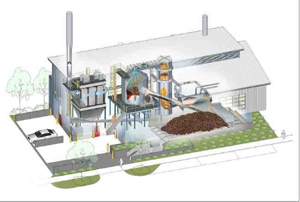
Dockside Green biomass plant

Biomass heat generating plant at Dockside Green in Victoria, B.C. Drawing: Windwill West.

Related

Nexterra Corporation CEO Jonathan Rhone says his company is reducing carbon emissions and helping fight global warming, and some green tech experts are fans.

But a critic says the company's process offers a marginal environmental improvement at best and has some serious drawbacks.

Nexterra builds plants that turn wood waste into a gas that can be used for heating or, soon, for generating electricity. Its highest profile project is in Victoria's Dockside Green development, one of seven completed projects outlined on the company's website. Another plant is under construction at the University of British Columbia.

"A centralized biomass system solidifies Dockside Green's reputation as a global leader in sustainable design and garners significant international attention given the rising concerns over climate change," boasts the website for Dockside, a LEED platinum development close to downtown Victoria.

According to Dockside Green's website, gasification produces no smoke but does emit "clean, odourless flue gases" while making green energy. Those gases do include carbon dioxide, by the way, a contributor to global warming.

Rhone said any time an energy source can be switched from a fossil fuel to a locally sourced biofuel, it's positive for the planet. If the question is what to do with scrap wood, gassification is better than combustion, he said. "Our technology provides a significant reduction in emissions compared to traditional wood-fired plants."

The president of the B.C. Sustainable Energy Association, Guy Dauncey, says he is "a complete supporter" of Nexterra's approach, calling it "an extremely intelligent thing to do with wood waste" and a climate friendly substitute for burning fossil fuels.

But Ben West, a campaigner with the Western Canada Wilderness Committee, has looked closely at the gasification process and says he has serious concerns. "It's just continuing down a road we need to get off," he said. "Burning more stuff... just seems to me to be a fool's errand."

GHG positive

Dockside Green's website describes the gasification process. It takes wood waste and burns it with water in a low-air environment. The process leaves an ash and creates a synthetic gas that can be scrubbed, cleaned, then burned to heat a water boiler.

The system is used to provide heat and hot water to residences at Dockside, and "heat will also be sold to off-site customers displacing natural gas use." According to Dockside, the climate change math works to the development's advantage: "The net result is that Dockside Green is expected to be greenhouse gas positive from a building energy perspective."

The system cuts greenhouse gas emissions from the development by 3,460 tonnes of carbon dioxide equivalent a year, a Dockside publication says. That's the equivalent of taking 850 cars off the road each year.

It also saves the development as much as $600,000 a year, plus another $100,000 a year on British Columbia's carbon tax.

Nexterra's website makes similar claims for its other projects. A United States department of energy system in Tennessee is said to save up to $7 million a year and 20,000 tonnes of greenhouse gas emissions. The UBC project will reduce the campus's natural gas consumption by 12 per cent and cut 4,500 tonnes a year of greenhouse gases. A system built for Kruger Products paper company's mill in New Westminster cuts 22,000 tonnes of greenhouse gases a year.

Plenty of wood waste

At Dockside, Rhone said, the fuel source will be urban wood waste like tree trimmings and the debris from clearing land. It's the sort of material that in the past would have gone to the landfill, where it would have rotted and released its carbon, much in the form of methane, a gas that has a much stronger greenhouse effect than carbon dioxide does.

Some 30 million tonnes of urban wood go to landfills every year, Rhone said, enough to power millions of homes. "We're really talking about a low value waste," he said. "There are enormous volumes of woody biomass all over North America that are currently under-performing."

Waste companies and local governments are starting to realize all that wood waste can be better used outside the landfill, said Rhone. "They're starting to divert it, grind it up and supply it to companies like Nexterra."

At times, Dockside's plant has been run on natural gas, he acknowledged, but it's running on wood now and the plan is to continue running it that way. It is also set to begin supplying the nearby Delta Hotel with heat.

VanCity's director of business performance, James Miller, said Dockside has built out around 20 per cent of its final 1,450 units. Supplying the Delta will allow Dockside to run the biomass system at something approaching its eventual load and will help Dockside be carbon positive, he said.

Displacing Hydro at UBC?

Other Nexterra projects also use local sources of fuel, Rhone said. The company's first project at a Tolko plywood mill in Kamloops uses bark that would otherwise be waste. Tolko makes a synthetic gas that it uses instead of natural gas to dry the veneer on its plywood.

A project at the University of Northern British Columbia chose a Nexterra gasification system over wood fired boilers, not wanting to contribute to Prince George's air quality problems.

At UBC in Vancouver, however, the recently announced project will displace energy the institution buys from B.C. Hydro. The Crown corporation gets the bulk of its energy from hydroelectric projects, making its energy very low in greenhouse gas emissions.

Asked if the UBC project is actually displacing hydro, Rhone said, "B.C. Hydro is buying more power, so this would be a renewable source of power... My understanding is they need to buy more power over the next 10 years to stop buying power from neighbouring states and provinces." The energy B.C. Hydro buys from other jurisdictions tends to be from sources like coal that generate many more greenhouse gases.

Rhone also said projects like the UBC one allow Nexterra to demonstrate its technology so it can be sold elsewhere. "The big market for us is the export market," he said. The company already has offices in Brazil and the eastern United States, plus plans to open one soon in Europe.

Besides the environmental argument, there's an energy security case to be made, he said. While people are increasingly concerned about relying on oil and gas imports, many communities have sources of biomass handy that could be used to reduce the need for fossil fuels in at least some situations.

'Carbon intense process'

The benefits are not, however, as clear as the promoters would have you believe, says WCWC's West.

"My primary concern's around the way the carbon calculation is done," he said. "It really doesn't hold up to basic math."

Biomass projects are considered carbon neutral because converting wood into a gas then burning it releases exactly the same amount of carbon as would be released if the material were left to rot. If the carbon is going to be released anyway, the argument goes, you might as well make use of the energy that's released.

"What's missing from that is the time span," said West. While it might take 20 years or more for a tree to decompose -- a process that would return some of the carbon to the next generation of plants if it occurred in a forest -- gasification releases the carbon immediately.

It's a carbon intense process, he said.

There are, however, some situations where gasification might make sense, West allowed. If there's a steady source of waste wood that has been treated, for example, gasification could be used to separate the toxins from the material. It would do it in a more controlled way than putting treated wood into a landfill, he said.

On balance, though, it would be a bad idea to structure the province's forest industry, as Minister Pat Bell has suggested British Columbia should, towards feeding gasification projects, West said. There are better energy choices if the goal is to benefit the environment, he added. "It seems to me burning stuff should be bottom of the list."

If the sector becomes much larger, it will be very difficult to grow enough trees to feed it, he said. As communities become reliant on these systems, they will need ongoing sources of fuel. It might make sense to use trees killed by pine beetles for now, he said, but "where do we go 15 years from now when we've burned all those trees?"

As a green business, he said, many of the projects may be more 'business' than 'green'. "You've got to understand which interest is driving the agenda."

Worthy of carbon offsets?

The UBC project is a partnership with the General Electric company. Nexterra's majority owner is Calgary's ARC Financial Corporation, a company that manages $2.7 billion in projects that include oil and gas exploration and production. It also invests in oilsands and unconventional gas projects.

Gasification projects like Nexterra's should be ineligible to be used as carbon offsets, West said. "I do have a really serious concern about giving carbon offsets to these projects," he said. "To call it carbon neutral and give it carbon offsets is a disservice."

Nexterra's Rhone said gassification does reduce reliance on fossil fuels and cut greenhouse gas emissions.

There is much wood around that will either rot on the forest floor or in a landfill, said Dauncey of the B.C. Sustainable Energy Association. "The question is what do you do with wood waste," he said.

"To me this is an extremely intelligent thing to do with wood waste, so I'm a complete supporter."

At this point, B.C. isn't growing trees specifically to feed biogas plants like Nexterra's, he said, adding that the future of bioenergy in B.C. is complex and full of uncertainty. There are questions around what to do with material thinned from forests, trees killed by pine beetles and used building materials. "Houses are demolished, there is waste wood, what do you do with it?"

And if the question is how to heat buildings, biogas is a step forward, he said. The process releases carbon from waste wood that is part of a natural short-term carbon cycle. If it helps keep the carbon from fossil fuels stored underground, where it's been for millions of years, that's positive, he said.

'Real changes in the marketplace'

Wood waste gasification is part of a move towards cleaner energy, Rhone said. "I think we have the largest cluster of clean tech companies in B.C.," he said. "Essentially what's driving demand for all these technologies is real changes in the market place."

The company may soon also be able to gassify biosolids, by the way. In the past the waste from sewage treatment has been used in agriculture, but many jurisdictions are changing their rules. "Biosolids are a huge problem in North America," said Rhone. The company has done an initial study on converting biosolids to energy and hopes to have a commercial solution available by the end of the year, he said.

Nexterra is also working with General Electric to use synthetic gas in an internal combustion engine to produce electricity.  [Tyee]

19  Comments:

Login or register to post comments

  • RickW

    1 year ago

    At least the gasification process is in place

    Which means that, when the absurd restrictions around the growing of hemp (etc) for biomass (not to mention the approx. 25,000 other uses to which it can be put), THEN WCWC's questioning of the math used to justify using scrap wood can be put to rest.

  • SharingIsGood

    1 year ago

    Lots to think about

    Yes, if this will work, as RickW says with other plants after the trees are gone (such as fast-growing poplars or hemp) it may be an energy stop-gap for the next generation or two. But...it is still a greenhouse gas emmitter.

    "There is much wood around that will either rot on the forest floor or in a landfill, said Dauncey of the B.C. Sustainable Energy Association."

    Wood that rots on the forest floor is what creates soil and healthy conditions for eco-systems to maintain themselves. Granted, global warming has already given us pine-beetle killed forests in the Interior. This creates a huge forest fire risk for our province. Is this method the answer?

  • seth

    1 year ago

    an alternate view

    Biofuels can only be a small niche component of the energy mix.

    http://www.huffingtonpost.com/richard-wiles/forests-new-coal-in-house_b_614034.html

    With clean and green mass produced nuclear power heading for less than one cent a kwh there is no place for these very expensive and ecologically dubious power schemes.

  • rantnic

    1 year ago

    IT AIN'T GONNA HAPPEN

    Just imagine if this biofuel were to power cars? Say only 1000 cars. (1000 X $100 Mo X 12 Mo = 1.2 M X 40% tax = $480,000 a year that the government loses. Too too much for them to allow it to happen. Maybe if they could tax the "bark" on our trees They could still take their "bite" out of our wallets

  • Luck

    1 year ago

    HEMP ETHANOL FUEL, THATS THE WAY TO GO.

    Another great article by Andrew and the Tyee. Cheers.

    Rick W is right on the money.

    Did a paper on value of HEMP in social econoic at SFU almost 30 year ago after 10 years of prior reseach with FN.

    FIGURES CAN CREATE A MILLION JOBS ACROSS CANADA, LOTS OF FALLOW LAND TO GROW IT, CANADA BECOME NOT OIL DEPENDENT AND HAVE LOTS LEFT OVERTO SELL TO USA AND MEXICO. FEDS AND PROV GOVS NEEDS TO GET THEIR HEADS OUT OF HOLLYWOOD. WHAT A GOD GIVEN PRODUCT WITH A MILLION USES sitting idle.

    Got the highest mark in the class for my essay efforts. Got 95%. Had 5% taken off for telling a fellow classmate and oilman that oil could be repalced and so could he. What a discussion that was. Hey Delbert hope you see this article. I still think your name is funny.

    Good for you Rick.....

    At least the gasification process is in place
    Which means that, when the absurd restrictions around the growing of hemp (etc) for biomass (not to mention the approx. 25,000 other uses to which it can be put), THEN WCWC's questioning of the math used to justify using scrap wood can be put to rest.

    I see in Kruger Products annual report that they are processing wood alcohol for fuel.

    Tried to contact the operations manager to discuss alternate fuel but the security at KP is unbelieveable.

    One wonders what else they make there???

  • RickW

    1 year ago

    SIG

    Quote:
    But...it is still a greenhouse gas emmitter

    Growing the biomass and "burning" it is neutral, emission-wise. All it is doing to capuring some small portion of the sunlight and converting it to some form of energy we can use. AND - there are many collateral benefits that can be derived concommitantly.

  • dave49

    1 year ago

    What will we do?

    As much as I consider myself progressive, I find it frustrating when people and/or groups decry our dependency on fossil fuels, then aggressively attack almost every alternative. Nexterra's technology is used outside BC. They have several plants at US universities, turning local wood waste into heat and displacing non-renewable fossil fuels.

    I'll concede the carbon emmission arguement may be legitimate, but maybe when we use a technology like this for 25% or more of our woodwaste.

    For now, I have little trouble with the concept that the process is carbon-neutral as it is using a biomass, renewable fuel. Offsets are a sticky question and subject to abuse depending on the trading system.

    If we need to remake our society from an energy standpoint, let's get on with it!

  • RickW

    1 year ago

  • westerneye

    1 year ago

    Hey folks, there were a

    Hey folks, there were a couple key points that I think need to be included in this discussion. First of all the overall GHG emissions from burning biomass are more carbon intensive than coal fired power. Biomass is not an efficient source of energy. Given the need to decarbonize our economy in the next few decades why would we invest in any carbon intensive technology? The idea that claims of carbon neutrality come from the idea that we will capture the carbon released by planting new trees. This simply is not based in reality. We are clearing the forests on our planet a the rate of a hectare a second. That's 2 American football fields every second. We are not increasing carbon capture we are reducing it.

    Also even if we planted enough trees it takes about 100 years to capture the carbon released. The earths trees cannot capture carbon at a rate anywhere close to fast enough. We need to be carbon neutral by 2050 at the latest not 2110. We would need to start a massive tree planting project world wide and protect most of the worlds remaining forests. We simply are not near doing that.

    Also as was highlighted by someone else trees are part of the web of life. Decompossing trees become nurse logs and are the source of soil fertility. Forest left alone are truely carbon neutral. Wood from construction and urban clipping are only enough fuel for niche applications.

    As much as using other sources of biomass rather than trees makes better sense we still are left with the carbon issue. just because you grow hemp quickly doesn't mean we can afford to release more and more carbon. Biomass is low grade fuel, that's all there is to it. There are a lot of practical uses for hemp fiber but it's not an energy solution given our current reality.

    Burning stuff for energy must be a thing of the past if we are to address the climate crisis. We are in overshoot as a civilization we need absolute reductions in carbon emissions starting immediately.

    Ben West
    Wilderness Committee

  • RickW

    1 year ago

    Ben West

    Quote:
    Burning stuff for energy must be a thing of the past if we are to address the climate crisis

    http://fuelandfiber.com/Hemp4NRG/Hemp4NRGRV3.htm

    The growing of hemp and other plants for energy is carbon neutral, as the plant and its components are only carriers to capture the sun's energy through photosynthesis. As such, the carbon released is only the carbon sequestered during the growing cycle.

    However, yes, the use of waste wood would in fact add to the overall glabal carbon output as it would be "burned" much faster than the absorption cycle could process it.

    But, what of the other 24,999 uses for hemp that do not involve carbon release? After all, it is the hemp hurds that are used for energy production, which comprise about 80% of the plant. The rest is much more valuable for any number of "by-products".
    http://www.binhaitimes.com/hemp.html

  • seth

    1 year ago

  • margot

    1 year ago

    first harvest sewage

    methane, from sewage or from rotting wood, is about 17 x the global warming potential of CO2. It makes sense, if our shit is going to give off methane anyway, to process and burn it. China has excellent projects, by the millions, for example.

    Getting the methane from rotting wood, as pointed out, takes much much longer.

    We need to work out how to do sewage right now. As in Sweden, and a host of other countries whose projects we never seem to hear or read about.

    Sustainable is a word loaded often with so much spin. But sewage is definitely something we are not going to run out of.

  • Fish-counter

    1 year ago

    It is about time...

    The next idea that is 50 years overdue for implementation is the use of traffic roundabouts instead of more and more and more traffic lights. They work extremely well in Europe, so why not in Canada?

    The reason is that our traffic engineers are all cowards when it comes to trying anything new (meaning new to them, not new to us or the rest of the world).

    As for waste wood, the forestry companies burn millions of tons every year in slash piles. It has to be worth hauling it ten miles to be burned in a furnace to produce useful heat.

  • Buddy

    1 year ago

    Burn Baby Burn

    Ben has a handle on it and the idea that this
    > burning is the only option is absurd. If pressure treated, painted and
    > wood heavy with resins were removed by not commingling, this material
    > could make it's way into soil creation through composting. Plus, the
    > opportunity exists for wood reuse. By always dumbing it down to the
    > lowest, quickest, cheapest and most convenient option, this reminds me of
    > the animated movie Wall-E. Sloth like fat lazy humans wallowing in a
    > reclined position, floating around outer space, after they've destroyed
    > Earth. When I first saw this movie, I thought surely we would not slip
    > down that slippery slope? But the more I see & hear, the more it seems
    > that this is exactly where we are headed. And everything, curbside
    > recycling, waste to energy or you name it, when it comes to waste, the
    > desire seems to be to jump on some big trucking, transportation
    > infrastructure, running lots of machines and dismissing local solutions.
    > The Zero Waste movement is clear. No burning! No landfilling. Now go and
    > design something that is logical, not easy! Love Canal had experts and
    > scientists shoving reports down our throats with claims of "no problemo".
    > Will we not learn? Quick, cheap, easy, convenient, big giant projects.
    > Some doctors used to endorse cigarette smoking. It is not hard to get some
    > "hired gun expert" to endorse anything, as long as they get their piece.
    > Deep water oil drilling??Would we not vote caution at this time?

  • doggone

    1 year ago

    Good point Margot

    Once appon a time I wrote a song: " I don't Mind Shit But I hate TV".
    Be that as it may. If there is a way to reduce sewage pollution of ground water and rivers and oceans let's do it! Some of the stuff flushed these days is like U235 (for those who imagine nukes to be "Environment friendly" have you ever heard of a nuclear plant being recycled? Or the spent fuel?
    OK - I've lost my train of thought but from my song:
    "My sister and a fella talked the other day
    One said that "Lovin' was the highest way"
    The other said "Sex was alright with him but you can't go on without a good B.M."
    People think I'm crazy and I just might be
    But I don't mind shit and I hate TV!"
    I think the chords are EAD

  • North of Hope

    1 year ago

    more detail

    Interesting article but I would like more detail about the amount of energy produced when wood is burned, how the wood is prepared for burning and what the products are that result from the burning.

    The provincial government has said that they support using biomass for fuel. And they say that it is good to leave the dead wood in the forests as it provides fertilizer for plants and maybe more trees. It seems to depend on who they are talking to or what program (or lack there of) they are trying to defend.

  • Stephanie T

    1 year ago

    And then there's this.......

    http://www.vancouversun.com/technology/FortisBC+prompts+fish+concerns+with+planned+Nicola+Lake+hydro+project/3203380/story.html

    From the article;

    Quote:
    "Pumped systems pull water out of a lake or conventional reservoir and move it in underground pipes uphill to fill a designated part-time reservoir. The water is typically pumped up at night when electricity demand is at its 24-hour low. When demand peaks during the day, such as breakfast or dinner time, the water is released back down to the lake in pipes — but not until it has run through high performing generators to create power. (snip)...
    It takes more electricity to move the water uphill than can be recovered when it’s released back downhill."

    Does this make ecological or economic sense to anyone? How about common sense? Is common sense really in such short supply that we are reduced to schemes such as this?
    WTF?

  • Stephanie T

    1 year ago

    On the other hand......

    This looks hopeful. Power from water, believe it or not.

    http://www.blacklightpower.com/index.shtml

    Maybe someone here with a more scientific background (than me) can check this out and tell us if it is feasible.

  • Fish-counter

    1 year ago

    North of Hope has a point. Leaving carbon in the forest is good

    for forest ecology.

    The "coarse woody debris" provides habitat for critters and the carbon is recycled by the fungi but it also hinders the replanting process. As always, there are shades of grey in these issues, but there is a place for burning some of the wood to produce energy, rather than burning it in a slash pile. The economics are one thing, but the other issues are laziness and inertia. Burning slash plies is easiest way to get rid of them and besides, that is the way it has always been done.

    To change the way forestry is done, we should give a contract to separate businesses to remove the slash; a small, private enterprise would quickly sort through the economics and practicalities and come up with a mutually profitable solution. The same thing applies to beachcombing for stray logs. At present, the logging companies still own their stamped logs, even if they are floating in the ocean or beached. They have first rights after salvage and they pay 50% of the market value to the salvager. All we need to do is to declare an open season on stray logs and they would be gone in 60 days.

    • The discussion for this story is closed. No more comments can be added.