
Out With The Old Engine, In With The New
How an East Vancouver start-up is transforming gas-guzzlers to pure electric.
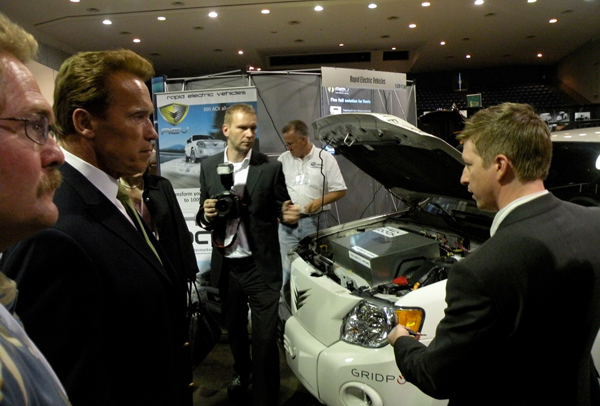
REV founder Jay Giraud introduces Arnold Schwarzeneggar to a REV electric SUV at a Santa Monica car show in October 2009.
Cool Tech vs. Global Warming: BC'S Cutting Edge against Climate Change
- BC Charts a 'Clean Tech' Future, but Is the Map Right?
- Here Comes the 'Smart Grid' Way to Save Power
- Is BC Ready for Smart Meters?
- Out With The Old Engine, In With The New
- Geothermal Just Got Hotter
- Turning Waste Wood into Gas-Fueled Energy
- King of Poop Power
- Green You Can Use, at Vancouver's Olympic Village
- Breeding Trees to Be Better Biofuel
The Ford SUV is suspended on a hoist in Jay Giraud's East Vancouver research facility, waiting to have its gas-guzzling core pulled out -- the first step on the road to becoming a battery-powered, 100 per cent electric truck.
"The engine, transmission, and gas tank are no longer necessary," says Giraud, the boyish founder and CEO of Rapid Electric Vehicles Inc. (REV) peeking his head out from under the chassis of his latest conversion.
By the time Giraud and his team are finished, all vestiges of the SUV's dirty oil past will be replaced by a modular electric drive system and transmission; from that point on, there will be no more gasoline emissions, and virtually no replacement parts or serious maintenance required.
Just two years in existence, REV is not waiting for big automakers or early-adopting consumers to bring the electric car revolution. Instead, they are focused on converting the estimated 68 million (mostly) gas-powered passenger fleet vehicles currently spewing millions of tonnes of greenhouse gases on roads across North America. The SUV on the hoist will be part of REV's first wave of electric conversions, built to order for a utility fleet in Burlington Ontario.
"With fleets, we can really throw a lot of [electric] vehicles into a space and create a real tipping point for that region using pure electric solutions," says the 34-year-old Giraud, who in a past life toured the world as a professional snowboarder before discovering clean tech in the mid-2000s. "We think that this is the future of automotive electrification."
Fleet vehicles ideal early adopters
REV produces modular "plug and play" drive systems -- meaning that the company prefabricates, builds, assembles and ships the drive system to the customer. An automotive technician at the fleet garage does not need to understand the complexities of the system: he removes the gas-dependent parts and drops in the new built-to-fit components.
Government and private-sector passenger fleets are ideal early adopters of 100 per cent electric vehicles: fleet vehicles are parked for at least 16 hours a day at a central location, making charging a snap; they drive consistent patterns, usually no more than 40 km a day; and, they repeat these same patterns over a very long life. They are also responsible for greenhouse gas emissions of mammoth proportions.
"If you consider that the average kilometres driven per year in North America are over 19,000 and the average kilometres per litre for a fleet vehicle is about 5.3, and there are at least 63 million passenger fleet vehicles in North America, you get a pretty big number of tonnes of emissions saved per year."
Looking beyond drive systems for the fleet market, REV is focused on addressing how societies of the future will transition from fuelling cars at gas stations to charging batteries at night. REV drive systems are designed with what Giraud calls "two-way grid capability" -- meaning the electrical grid can wirelessly communicate with the battery of a plugged in REV e-vehicle, allowing the utility to draw energy off the idle battery if it needs to.
"Everyone is looking at how utilities can manage all the energy consumed by a house, but nobody is working on making cars smart," says Giraud. "For 16 hours a day utilities could use very small amounts of energy from parked [electric] cars, and have gigawatts that they produced earlier."
Dragons and angels
Jay Giraud proved himself equal parts showman and entrepreneur last year, when he appeared on the Canadian Broadcasting Corporation's hit show Dragon's Den -- where entrepreneurs pitch business ideas to a panel of high-powered venture capitalists. Usually a crusty lot, the "Dragons" were so impressed with REV's business plan, they offered Giraud $250,000 for a 50 per cent ownership stake in the company. He said no.
A preferable fundraising approach has been to partner with BC-based GreenAngel Energy Corp., an "angel fund" that specializes in raising start-up capital for early-stage green tech companies. In February 2010, GreenAngel and REV announced an agreement to raise $5 million for the fledgling company this year.
Under the terms of that deal, B.C. investors will receive a 30 per cent refundable tax credit and be allowed to hold their shares within an RRSP or Tax Free Savings Account for further tax deductions. The GreenAngel partnership takes advantage of the B.C. government's tax credit program established in 2008 as part of the province's attempts to expand the cluster of companies and experts working in B.C. clean technology.
This tax credit program complements other incentives now available to some start-ups in B.C.: companies developing "prescribed clean technology" won't pay B.C. corporate income tax on taxable income earned outside the province (up to $75 million per year) effective this September, and qualifying clean tech specialists new to Canada will not pay B.C. income tax for five years after their arrival.
Such incentives pale in comparison to those of Ontario, California and Michigan, which are determined to attract the best green tech talent and companies in the world. But B.C. remains an attractive location for other reasons.
"There's no business advantage to being here, but B.C. offers lifestyle," says Randy Holmquist, owner of Canadian Electric Vehicles Ltd., which has been building specialty electric vehicles for airports all over the world for 20 years. "I could be way more profitable in Los Angeles... but I want to live here."
Giraud has a similar take: "British Columbia inspires smart, tech-savvy entrepreneurs to maintain this quality of living."
Vancouver's cross-over cluster
What has made it possible for REV to exist in British Columbia is the large pool of technical expertise, particularly in Greater Vancouver. Three decades as a centre for the design, development and manufacture of hydrogen fuel cells has ensured that there is plenty of talent to draw on.
"Vancouver is making this neat transition from fuel cell to electric, and there's a lot of battery specialists and chemical energy storage specialists," says Giraud, noting that a fuel cell car is an electric vehicle, so there is a lot of knowledge cross-over from hydrogen to pure electric.
With the talent pool has developed "clusters" of electric vehicle and associated technology companies: battery experts like Vancouver's Advanced Lithium Power, Delaware Power Systems Corp. (Richmond), and Delta Q Technologies Corp. (Burnaby), all of which rely on B.C.'s core of electrical engineering expertise. Canadian Electric Vehicles is a pioneer that continues to operate near Parksville on Vancouver Island, while Future Vehicle Technologies designs and produces its own innovative vehicles in Maple Ridge. Azure Dynamics -- perhaps B.C.'s biggest success story -- moved its headquarters to Detroit in 2007 to be closer to suppliers and U.S. customers, although much of its research and development still occurs in Vancouver. (Azure and Ford launched the Transit e-vehicle in February, which is being marketed to the e-fleet market.)
It will be these small, visionary companies, says John Stonier, spokesman for the Vancouver Electric Vehicle Association, that drive electric vehicles into being.
"There is an opportunity for the small start-ups like REV, because they can specialize in very specific technology applications, and fill in the holes the large companies just can't do themselves," he says. "[Start-ups] have limited resources, but they can use those resources much more effectively to get things done." ![]()


33
Login or register to post comments
RickW
1 year ago
So what about individual vehicle owners?
I have been holding onto my Honda Civic (now in it's 10th year), waiting for an "everyman's" electric and/or hybrid.
But so far, no go............and I don't want to spend for a vehicle up front what I would end up spending in fuel over the course of the vehicle's life anyway.
crackpot
1 year ago
Cost of conversion
Good article, and glad to read about GreenAngel, which sounds like a financing step in the right direction. But how much do these conversions cost?
What governments are willing to pay to appear green, and what regular joes can afford, are likely very different sums.
rantnic
1 year ago
Hi Ho Hi Ho to the land fill we go.
Where can I buy the little Ford SUV sans engine, gas tank, and other components not needed? If I can't buy the stripped out version for considerably less is the conversion economically viable? especially for the average (non government fleet) owner. After loosing my wonderful five year power train warranty, I must then dispose of all those new, unused, second hand parts. To the land fill or maybe ship them to China to become components of a competitors vehicle.
Jeffrey J.
1 year ago
Governments Need to Get Out of Our Way
Our current slate of identical, neocon regimes in BC and Ottawa have repeatedly blocked efforts by entrepreneurs to think outside the box. The ZENN was the first bold player to produce a lovely, all electric affordable car. Both Harper and Campbell did everything in their regulatory power to thwart this incredible vision, as it clearly encroaches on the oil and automotive industries.
http://www.zenncars.com/
Kudos to Mr. Giraud for this initiative and for the Tyee for covering it. Consistent with industries monopolization on business and ideas, we are likely to see no coverage of this in our CanWestGlobal or David Back owned media. Sadly.
The sooner governments and industry move out of our way, the sooner we can solve some of these energy issues.
Jerry Munro
1 year ago
The Underlying Problem...
All of which means what, at growing population and car ownership levels? The mass destruction of more fish/marine reproduction and other natural values with the damming of ever more rivers and streams, to keep a growing electric fleet on an ever expanding road system? A landscape clogged with ugly and bird killing wind turbine solutions?
In the context of dealing with world population levels along with curtailing endless economic growth, and demand upon the natural environment, there might be some sense in this rush to "clean electricity". As is, as we should already know by now, within the economic context of endless growth capitalism, it is simply but the exchanging of one form of pollution for another. It is cheap, if destructive, sleight of hand deceit.
That socket in your wall doesn't end there, with an endless supply of electricity just arising out of nothingness. It is part of a system that leads back to real rivers and streams, nuclear and dirty fuel generating power stations etc.
"Individualist human" or "free market" solutions instead of broader "social and natural value" based ones are at the heart of the problem. These former non-solutions are really just a part of the carny shill game that currently goes on with the environment, as well as all the other socio-economic problems of capitalism, including poverty.
There is no solution within the current individualist serving free market context. It is the underlying problem.
cboo44
1 year ago
Governments Need to Get Out of the Way?
"Our current slate of identical, neocon regimes in BC and Ottawa have repeatedly blocked efforts by entrepreneurs to think outside the box."
ALL "governments" have ALWAYS blocked the entrepreneurial drive of Canadians. NOT just the current idiots. Government bureaucracy is required to "pigeon hole" people/companies/enterprises so that they can be "processed". At the same time, MANY "entrepreneurial spirits" are at governments' front doors with their hands out, right?
Try this on for size: If the general population actually gave a damn, could actually take time out from their busy schedule to act and support a responsible transportation initiatives LIKE clean vehicles, would "government" still be "in the way" ? Don't think so.
Jerry Munro
1 year ago
Understanding Irreconcilability...
Which is the problem of the NDP view of the world of course, in part manifest here. They have that progressive impulse to change society for the better, while at the same time seeking to make peace and work within the context of the ongoing current "entrepreneurial spirit" regime. Which always puts the NDP in the lead boots position of "one step forward and one step back", going nowhere fast. They sound good, until you put the beggars in actual power... allowing even that "parliamentary power" is really only more "ritualistic" than "real" power. (Real, as in veto power never actually changes hands within capitalism. That always resides within the class ownership and control of the economy, rather than in a State parliament. Though sometimes they are and can be one. The old WW2 fascist regimes, the USSR, and much still, current Russia and China, for examples.)
The NDP have a serious problem with that need to "really" and "seriously" look outside the "current system" box. Their bare ass end is peaking out the lid, while their head is "practically" still in the dark of the box, attempting to make a peace with its class contents.
The poor NDP. I really do think they try hard, and that at least the rank and file is well meaning enough. They simply can't understand that what is irreconcilable, is actually irreconcilable.
And they've never, even the old CCF, really been any different. (Though they have been relatively "better" than they are. Which always, I think, is more than a little afraid.)
peasant43
1 year ago
Energy (kinetic) = .5(Mass X Velocity^2)
Mr. Pollon and the Tyee Solutions Society:
Unless you start reporting on where the energy to make the electricity is going to come from, these stories are advertorials.
It takes energy to move any mass. Electricity is not made by nature and stored in Saudi Arabia.
Mr. Pollon I've read your bio. There's no way you don't understand high-school science.
I know we have to pay the bills, fair enough. Mr. Beers this is Canwest quality.
David Beers
1 year ago
peasant43
Not sure I understand your critique -- and advice to The Tyee. We have run many stories about alternative energy sources, the need to 'power down' etc. But it's not the role of The Tyee and its writers to constantly tell people they must (or could) go cold turkey tomorrow.
A bit of high school science. Electric motora are up to 80 per cent more efficient than internal combustion. So although they consume energy that must be generated, they are far more miserly with the resources that went into producing that energy.
realisticman
1 year ago
It ain't coming from wind power
As the writer (Christopher Pollon) of this article tells us here:
"...Wind is much more costly than most realize and can only be utilized if government and B.C. ratepayers are willing to accept a very significant cost premium.”
Read more: http://www.bcbusinessonline.ca/bcb/top-stories/2008/12/01/blowing-wind#ixzz0pFm6nhw3
Fish-counter
1 year ago
Electric cars are not the panacea...
they would only work on the coast, for example. In winter, they would be uselss on the prairies. Here in coastal BC, however, they could easily fill 40% of the vehicle market, leaving more gasoline for the Hummers.
The mistake electrics made was to advertise as a universal solution; it isn't. It might evenually work for 20% of cars in Canada. The auto manufacturers and the maintenance industry need not fear electrics or hybrids. If they were even 10% smart, they would be leading the charge, so to speak.
The after-sales market in electric vehicles is in battery replacement. We need to address the recycling of lithium batteries. The one plant in North America was in Trail, until they blew up and burned down. Again, as with all technological change, there is a huge market for the innovators.
RickW
1 year ago
Electric motors DO work in cold weather......
They just need some device to keep the batteries warmed up.
However, I digress. As Mr. Beers pointed out, electric motors are 4x+ more efficient than IC engines:
http://www.amazon.co.uk/Why-We-Hate-Oil-Companies/dp/product-description/0230102085
John Hofmeister, ex-president of Shell Oil, states in his book that the internal combustion engine is now more than 100 years old. When it was first built, it's operating efficiency was in and around 20%. A century on, the operating efficiency of the infernal combustion engine is in and around 20%.
Is this because the IC engine isn't capable of producing greater efficiencies? Or is it because the engine manufacturers are not capable of giving a damn?
Coyoteman: The electric motor has an operating efficiency between 80% and approaching 100%. Just converting from IC to electric would mean a reduction in energy use of 75%. However, given the penchant of investors in demanding profits NOW, they would not be happy about this - a major hangup in the capitalist system.
realisticman
1 year ago
coyoteman
I see the old noodle's still functioning.
Understanding Irreconcilability...
Well said. Makes sense to me and I like the way you framed it. The thing is; I don't want either the State or the capitalists in control. When I wake up energized I want to be able to employ that entrepreneurial spirit if it sparks inside my noodle and I want the freedom to exercise that unencumbered, understanding that I shouldn't tread on anyone's toes or spoil their enjoyment. The present set up is run by questionable managers but would another arrangement be any less buffoonish? Methinks not and methinks this game is less intrusive because it's less controlling, and don't tell me you don't appreciate that.
RickW
1 year ago
Tesla Roadster
http://www.cbc.ca/consumer/story/2010/05/28/con-tesla-canada.html?ref=rss
Not exactly "everyman's" transportation.......
Jerry Munro
1 year ago
Economic Democracy....
"The thing is; I don't want either the State or the capitalists in control." wrote realisticman.
Hear, hear. I agree entirely.... which is what I am all about, if you have been reading me carefully over the recent years here.
I am in favour of "local", "plant by plant" worker AND "local community" control over at least the major means of production and strategic development direction. (Which does not necessarily mean, I think, every mom and pop shop or purely "individualist" economic activity. Once workers and outside financing enter into it however, all bets are off and the equation changes to the larger "public/worker" interest and control over "economic property and activity". One's "individualist" interest, unlike present capitalism, must bend to that... the public or greater common good interest. Whereas now, it must serve the capitalist.)
In short, I advocate a "democratic system" of local "worker-community ownership and control" of the commanding heights of the economy, including all "economic property", and NOT "state ownership". The concept of "State" ownership and/or control is anathema to this "economic democracy" model, no less than it is, if largely hypocritically, to current individual capitalist "entrepreneurship". It would be left to these local worker-community controlled enterprises to work out systems of co-operation, for raw material, goods and services supply, and marketing etc, with other similar enterprises on a local, regional, provincial or national basis, as needed.
I advocate a new form of "collective community interest democracy", which includes the individualist interests of those who make it up, decide and operate it. Outside of one's own personal, including home property however, the principle is "common ownership and democratic direction" of the economy, including share/returns distribution. More purely narrow "Individualist" serving capitalism, however it wants to wake up and feel about itself in the morning, would be simply verboten, frankly.
You have an "entrepreneurial spirit" and a good economic development concept? Great! Discuss it with your community, which would be the sole source of startup capital, and determine if there is a common interest, not much differently than you would do now with the "private" banks, and work out a deal. Then be prepared to work within the democratic framework of this new socio-economic arrangement.
How I see it, more or less. Though like I keep saying; in the end, as this new struggle against current "capitalism in crises" unfolds, the essential features and character of the economic democracy that must come to supplant it, will be shaped by more than just myself. All who participate in this new revolutionary period that is emerging, will play a part in detaining what comes to be or not. (If I'm even still around at all. :-)
rantnic
1 year ago
Rock and a Hard Place = Capitalism and Bureauocracy
Between making a profit and imposing a tax, the present regime has it all tied up. The development of the electric vehicle was put on hold back in the 30's because the governments didn't have a way of taxing it. Even today, how could they tax the electricity used in your car separately from that used in your home. Could they outlaw solar cells and wind generators so that you could not make your own power? Rockefeller donated millions of dollars to the Women's Suffrage Movement to initiate the outlawing of alcohol production. Every farmer could run his tractors, trucks and all on untaxed (clean burning) alcohol, made from a corn field. No wonder that the government of the time backed Mr Rockefeller and his oil companies. So,what has changed? I could build a hydrogen generator in my backyard to make hydrogen for my car, I could even generate the power to do so with wind. Would I be allowed? Maybe, until it caught on, then the hammer would fall. Rules, regulations, and prohibitions would surely and quickly make this unfeasible, all to restore the balance of the established corporate profit/taxation ratio.
Jerry Munro
1 year ago
The Top 1%...
As I shall repeat, the hard place between capitalism and "the state" is what you have now. Though again as I say, in the history of capitalism, both can be and more and more are one and the same, which is not unknown. (WW2 fascism, the State Capitalism of the so-called Old Communism/Socialism models, current Russia, China, USA and much of the rest of the developed capitalist world. Including this country, increasingly under the ever more "fascistic Conservatives".)
The real alternative is between this current "bureaucratic" corporate capitalist/state run model and democracy, pure and simple; wherein the economy is democratized and given over to local enterprise by local enterprise, worker and community power, and made to serve the worker-local community interest. There is no other choice, save again, competing individualisms/gangsterism and the chaos wherein all roads lead back to private/corporate capitalism again and again, wherein again "real" power is ever effectively alienated from the ordinary working masses and their communities.
We have a choice: This competing, increasingly inhumane, every man and woman for him/herself, as has been across all forms of class society from the time of slavery, or a truly democratized economy that places power in a way that will serve the interests of the greatest number-, as opposed to the top 1%.
It's our collective choice.
Further wherein, given my choice, we may finally BEGIN to move away from all the religious and other obscurantisms, and endless economic growth imperatives that get in the way of our finally beginning to bring human populations and our demands into line with a sustainable "planetary" reality. In which context, how we see what is and is not clean energy etc. , for example, may also change. (For example, I think, it is not so much "carbon emissions" per se, or any other energy use form that is such a problem, as it is the sheer volume of it our current population and economic activity levels impose upon the natural and life sustaining systems of the planet. It is the sheer overwhelming "mass" of shit we are imposing upon the planet that is challenging its capacity to absorb and deal with. We need to bring our own numbers and our activity down to levels the planet and its systems can cope with... or we will eventually be shut down anyway.)
dave49
1 year ago
Off-the-shelf tech has been readily available for years
Off-the-shelf technology to do electric conversions has been readily available for 15 to 20 years. What is new is the interest in doing this. We have been too hung up on vehicle speed and range, when there is a sizable niche for a decent urban commuter vehicle. This contributes to an obsession with new and better batteries. Lead-acid batteries are heavy, old technology, but they are proven, reliable and far more affordable than the newer technologies. A metallurgical engineer told me that the new batteries are ugly when it comes to recycling, despite their friendlier materials.
To overcome environmental and health concerns of using and recycling lead batteries, I understand there is a company in Quebec that recycles lead-based batteries in a sealed process, so residual waste is confined for proper treatment. Let's hope theory and practice meet for this plant.
We don't need some highfalutin high-tech start-up and it's venture capital partners to get on with this. Just do it!
KWD
1 year ago
down The Road to a pure and simple democracy
Every socialists dream …pure and simple democracy; “… wherein the economy is democratized and given over to local enterprise by local enterprise, worker and community power, and made to serve the worker-local community interest.”
Taking “real” power away from the top 1% … the greedy elite and the corporate gangsters that seem to have a strangle hold on the flow of wealth … and placing it in the hands of locals and their enterprises sounds good on paper and makes for a good story line but the likelihood of that taking place on a grand scale is extremely low. Probably nil.
Not because we can’t rise up and force corporations to yeild under the pressure of public opinion, but because the distribution and abundance of resources … primarily energy, at the community level … are insufficient, or in some cases, non-existant to let that happen. In today’s world no man or village or state is an island unto itself.
That fact alone demands that before we can have an egalitarian world view that respects community interests, we require a global consensus on how resources are accessed, distributed and used. As we can see from today’s world events, global cooperation is more remote than ever and becoming increasingly unlikely.
The opportunity for a pure and simple democracy does exist, somewhere down ”The Road”, but getting there won’t be easy. It may require living a much simpler lifestyle in a world less dependant on fossil fuels and with far fewer people.
RickW
1 year ago
Every socialists dream
Can't have this until we get rid of specialization. As Robert Heinlein was wont to say, "Specialization is for ants." We are not ants, and were never meant to be.
http://www.starnewsonline.com/article/20100529/ZNYT01/5293004/-1/entertainment02?Title=Strike-in-China-Highlights-Gap-in-Workers-x2019-Pay
After years of being pushed to work 12-hour days, six days a week on monotonous low-wage assembly line tasks, China’s workers are starting to push back.
dave49
1 year ago
RickW - ICE efficiency
As I recall, from a thermodynamic standpoint, the internal combustion engine (ICE) runs on the Carnot cycle. This may be a case of what Engineer Scott used to say to Captain Kirk on the original Star Trek series: "But Captain, I can't change the laws of physics."
KWD
1 year ago
life in the colony
Good to hear China's low wage assembly line workers are pushing back. Now if we could only get the high wage specialists, who occaisionally work even longer hours, to do the same maybe we'd see the end of Robert Heinlein's ant hill.
RickW
1 year ago
Law of physics.......
....doesn't mean we are locked into one of the least efficient ways to make a conversion into energy.
If we can't increase the effiency of the IC engine, then scrap it.
rac
1 year ago
Hype and More Hype
Electric cars are just more greenwashing PR from the auto industry to try and convince people that the auto has a future. Flooding valleys to produce electricity for the least efficient form of transportation ever invented yet this is exactly why the BC government is pushing for Site C.
It is unacceptable that governments are going further in debt to subsidies electric cars. The money should be spent on real sustainable transportation solutions like rapid transit, high speed rail and cycling instead.
Fortunately, many people are seeing through the hype. It is quite shocking that the tyee would publish such a piece that looks like it is straight out of a corperate PR factory.
http://www.lowtechmagazine.com/2010/05/the-status-quo-of-electric-cars-better-batteries-same-range.html
http://dogandlemon.com/site/2010/03/28/electric-cars-a-major-environmental-threat/
RickW
1 year ago
rac
Providing there is provision for ease of travelling BETWEEN urban centres. The feds say it isn't economical to provide high speed rail in this country, because we have a small, spread out population.
The reason I would back highway-speed autos is to counter their arguement.
Jerry Munro
1 year ago
Getting There Won't Be Easy 1...
"That fact alone demands that before we can have an egalitarian world view that respects community interests, we require a global consensus on how resources are accessed, distributed and used. As we can see from today’s world events, global cooperation is more remote than ever and becoming increasingly unlikely.
The opportunity for a pure and simple democracy does exist, somewhere down ”The Road”, but getting there won’t be easy. It may require living a much simpler lifestyle in a world less dependant on fossil fuels and with far fewer people." wrote KWD.
I had begun to worry that this thread, with a very important discussion just beginning to happen, had died a premature death. When suddenly along somes my old friend and brother-in-law "of a sorts", riding in like the Lone Ranger.
And he is right. Frankly. It is difficult to encompass and encapsulate the full scope of reality in any single or even multiple "comment(s)" on a Tyee thread.
I think that I have, at best, indicated the main line of development that needs to occur, in social, political and economic terms, for the current crisis period of capitalism to be resolved successfully. But reality is, of course, always more complex than any single theory. :-) From which Law of The Universe even such as I am not exempt. :-) (I will berate KWD over a good single malt soon about this. He is such a shit. :-)
But as I have already conceded, he is at least much correct. But what he is especially correct about, I think, is that this "revolutionary" change for which I advocate is of such a problematic complexity that it is unlikely to be able to occur in any one single country... for all the reasons he indicates. Which is why it is really difficult to be optimistic about outcomes to the current period.
And which is why precisely, the old, old communists of the founding ideas thereof, pre-Leninist, always thought and wrote of what would have to be a "World Revolution" against capitalism, and its impossibility within "one country", and of the importance of "Internationalism" between the revolutionary working class elements over its course. For a time after the October Revolution in Russia even, Lenin thought/hoped that this was going to happen, certainly in Europe post WW I, and prepared the Bolshevik armed forces for it, ready to roll into Europe and assist the anticipated working class risings there. Which, of course, never occurred, we now know, save sporadically and largely unsuccessfully. In fact, the failure of this to occur largely explains the rise of Stalinism upon Lenin's death. Whereup entered by the back door thereafter, the State Capitalism of the old USSR which Stalin largely ushered in.
Continued next post...
Jerry Munro
1 year ago
Getting There Won't Be Easy 2...
From previous post...
And the problem KWD describes largely remains, as the main problem to the rise of a new economic and political reality democracy supplanting Capitalism.
To which I can only say, in such a short frame as this especially, that we shall just have to see how the current crises of capitalism develop, and to where they lead. A "global" collapse of capitalism as is already much underway "just might" lead to a new "world revolution" opportunity, at least of sufficient breadth and scope as for a new "global working class" beachhead to be established... in which while "nationalism" may play no small part, in such as Canada, it is linked up with an "internationalist" vision in such a way as to be ultimately successful.
We shall just have to see. Though I think it is looking, at least, more promising than my brother KWD, who is really such a negativist fellow, might indicate. He is just too, too intellectual, and not visceral or passionate enough. :-)
jwstewart
1 year ago
Mr. Beers (et al) your high school science fails....
A litre of gasoline contains about 8.8KWH of energy, the per capital gasoline consumption in BC is about 18 litres per WEEK. That's 8.236 MHh per person, or roughly 37TWh, which is almost 1000 times BC's current electric generating capacity.
The point peasant49 was trying to make is there is no fuel source for even a small percentage of electric vehicles, regardless of the comparison of ICE .vs. electric motor efficiency.
The only possible replacement for the gasoline powered automobile is the bicycle.
You can muddy this issue with politics, ideaology or psuedo science, or solve it by riding your bike.
YCSTS
1 year ago
EV's can readily replace most Fossil Fueled Vehicles
Avg. domestic vehicle travel is about 50 km per day. An EV gets typically 6 km per utility kwh, City Driving Profile. So that's 8.3 kwh per day, to supply the avg vehicle energy consumption. The average domestic power consumption per household is about 36 kwh per day.
So EV use would only increase an avg household's electricity consumption by 23%. Since per capita electricity consumption is 3X the domestic amount, per capita, that would only increase per capita share by 8%.
Realistically, EV's will only gradually start replacing Fossil Fuel vehicles, so increasing supply to power EV's is easy to do. What’s more EV's are predominantly City Vehicles, those who want a vehicle for intercity or country travel will still opt for a fossil fuel powered vehicle.
EV's replacing Fossil Fuel powered vehicles? Should be no problem.
edoherty
1 year ago
Get on the e bus
All this hype about battery electric cars verges on greenwash. They are so expensive and environmentally damaging to build that they mainly make sense for intensive fleet use such as taxis and delivery vans or as car share / rental cars. (And that only really works with interchangeable batter packs).
On the other hand, grid tied transit vehicles are cost-effective and environmentally sound right now, just like in 1910 when the interurban started running through Surrey.
I can go out and get on an electric bus for $2.10; I don't need to spend $50,000 for an electric car. People in many communities in BC including Surrey, Langley, Nelson and Victoria had electric transit almost a century ago. Why not now?
Maybe The Tyee could devote some time to writing about the history and potential of electric transit in BC? I can read about electric cars in The Province.
Chris Keam
1 year ago
high-speed rail
It's interesting to hear high-speed rail discounted as unfeasible in North America when it was high-speed rail (for its time) that actually made it possible for both Canada and the U.S to expand and build the urban centers that now house the majority of the population. Esp. as that urbanization is increasing. I guess we have to be thankful that the Fathers of Confederation had a bit more vision than the current crop of politicians... who spend our money on spectacles and corporate bail-outs instead of the forward-thinking solutions our kids need. Makes them akin to deadbeat Dads who blow the baby bonus on a big night out on the town and paying off their bookie, instead of new shoes and school supplies.
DavidN
1 year ago
Coyoteman
I certainly agree that the current form of market economy is primitive and predisposed to staying the old world power course.
But…
Once your workers unite and expel the bad guys, what would you do for power and industry?
How would it work?
Consuming the elite would only last so long before the new elite would need tax revenue. I bet they would have human nature also. What power source next; nuclear, draft horses, what?
The revolution will probably end up with me guillotined, but it would be nice to know what the new elite has in mind since you have an inside track and a clear idea of what a "pure democracy" is.
edoherty
1 year ago
Fast and efficient, or high speed
Chris Keam wrote :"It's interesting to hear high-speed rail discounted as unfeasible in North America when it was high-speed rail (for its time) that actually made it possible for both Canada and the U.S to expand and build the urban centers that now house the majority of the population."
Jargon alert! 'High Speed' is used in all sorts of ways, but policy wonks usually say if it is not over 220 km/h or so it is not high speed. A train that only goes 200 km/h is 'fast', but not 'high speed'.
Give me fast, comfortable electric trains for a reasonable price. I will even settle for 160 km/hr if I get a sleeper berth, which I guess is a slow train these days.
'High speed' equals high cost and high energy use, save it for the highest density corridors.