
- Ms Kaye is a Tyee Builder. You can be, too.
- Mary Carlisle is a Tyee Builder. You can be, too.
- Prem Gill is a Tyee Builder. You can be, too.
- Nancy Flight is a Tyee Builder. You can be, too.
- Justin Everett is a Tyee Builder. You can be, too.
- John Westover is a Tyee Builder. You can be, too.
- Nora Etches is a Tyee Builder. You can be, too.
- Edward Henderson is a Tyee Builder. You can be, too.
- Bharadwaj Chandramouli is a Tyee Builder. You can be, too.
- Dean Chatterson is a Tyee Builder. You can be, too.
- Marius Scurtescu is a Tyee Builder. You can be, too.
- Robert Parkes is a Tyee Builder. You can be, too.
- James Murton is a Tyee Builder. You can be, too.
- Susan Doyle is a Tyee Builder. You can be, too.
- Vincent Strgar is a Tyee Builder. You can be, too.
- Helen Spiegelman is a Tyee Builder. You can be, too.
- Subir Guin is a Tyee Builder. You can be, too.
- Kimball Finigan is a Tyee Builder. You can be, too.
- Joanne Manley is a Tyee Builder. You can be, too.
- David Leach is a Tyee Builder. You can be, too.
Dhaliwal's Bid for Vision Slot Marks Political Shift
Indo-Canadian wants 'to bridge communities' in Vancouver.
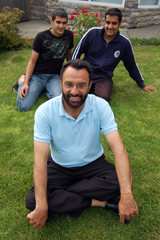
Vision candidate Kashmir Dhaliwal, with sons, Vardip and Deepak.
Kashmir Dhaliwal, who announced his candidacy for Vancouver city council this morning, lives on the city's south slope. It's a part of town that has for decades been under represented on council.
"In the last five elections, only 10 per cent of the candidates who ran for city council were from south of 41st Street," Dhaliwal told The Tyee last week. "Ninety per cent were from the northern part of the city."
The lack of civic representation is particularly striking in Dhaliwal's neighbourhood, near the century-old Ross Street Temple. Though the city's 32,515 South Asian residents comprise the city's second-largest minority (after Chinese-Canadians) none have sat on city council since the 1970s.
But Dhaliwal, a former sawmill worker who now builds houses, said his candidacy for the Vision Vancouver nomination is about more than fair representation for Indo-Canadians.
"I want to represent not only South Vancouver, but all communities in all parts of the city," Dhaliwal said. "I want to act like a bridge between communities."
An arranged immigration
Dhaliwal, 54, moved to Canada in 1983 to meet the woman who would become his wife.
"It was an arranged marriage," he said. "In those days, most marriages were arranged."
He'd earned an MA in history before leaving India. But like many immigrants, he arrived with little money -- in his case, $32 -- and took what work he could find. Dhaliwal was a parking attendant for a few years, then landed a union job at Silvertree Sawmill, where he stayed until the it closed in 2005.
"I didn't get another job after that. We had a partnership in a bottle depot, plus I am doing some small developments. Right now we are building three houses," he said.
Dhaliwal is also president of the Khalsa Diwan Society, a Sikh institution that for more than a century has helped South Asians navigate new lives in Canada.
"When they started this society, the main idea was to involve all the communities -- Hindus and Muslims, Sikhs, Christians -- it was for everyone," he said.
In addition to operating the large Ross Street Temple -- which attracts 10,000 people a week -- the society provides daily meals, services to job seekers and seniors, assistance with immigration and tax paperwork, and classes in everything from yoga to English.
"We never promote anybody inside the temple," he said. "Inside the temple, we are neutral... outside the temple, we can support anyone we like."
Indo-Canadians becoming business owners
Dhaliwal has since the early 1990s been an active volunteer for provincial New Democrats and federal Liberals. He counts MP and former premier Ujjal Dosanjh among his family friends.
But for all his work at the national, provincial and temple levels, Dhaliwal did not become engaged in civil politics until becoming involved in Vision Vancouver's hotly contested mayoral nomination race early this year.
"During this nomination for mayor, I helped Raymond Louie. During that time, I met many Vision people, and I came to know the ideas of the Vision party," he said. "A lot of Vision members approached me... and after long hesitation, I decided to run."
Dhaliwal said Vision's centrist approach will appeal to Vancouver's evolving South Asian community.
"In the past... our community was a working-class community. People liked leftist ideals at that time," he explained. "Now we are entering into being a business community. You see a lot of our community involved in small developments, in the taxi industry, in the trucking industry, and in franchise businesses like Subway and Quiznos. So now they like Vision because, with one hand they support labour, and with the other hand they are supporting small business, too."
Dhaliwal said community policing is his top issue. He said the Ross Street Temple provides space to a community police office. "The results are awesome. People love it." He's also interested in streamlining small business regulations. But foremost, he wants to open up city hall.
"I want to be a councillor to whom people can have direct access," he said. "If someone has a concern -- it doesn't matter how small a matter, and it doesn't matter what community they live in -- they should be able to go directly to their councillor."
City Hall curse?
With 5.6 per cent of the city's population, South Asians represent the second-largest ethnic group in Vancouver. (Behind the Chinese, with 29 per cent.) Yet no South Asian has been elected to city council since university professor Setty Pendakur was elected on the TEAM slate in 1972.
For the last six elections in a row, Vancouver voters rejected every candidate of South Asian decent, at all levels of civic office.
The 1993 election was notable. The Non-Partisan Association swept nine council seats but lost the tenth when its Indo-Canadian candidate, Daljit Sidhu, finished almost 10,000 votes behind the next Caucasian NPA member.
During the same time, the city elected several South Asian MLAs and MPs, including Ujjal Dosanjh, Herb Dhaliwal, Rob Nijjar and Wally Oppal.
"We were at a disadvantage," explained Rattan Mall, the outspoken editor of the Indo-Canadian Voice. "While Indo-Canadians made up the majority of voters within several federal and provincial ridings, we were minorities among citywide voters."
He said Surrey is also under represented. South Asians comprise 27 per cent of Surrey's population, but account for only one of eight city councillors.
"There is prejudice," he said. "It's not as bad as it used to be. And I believe there is less prejudice in Canada than in almost any other country -- including India -- but it's never going to go away 100 per cent."
No 'monolithic community'
Mall added that Indo-Canadians themselves must shoulder some of the responsibility for their lack of civic representation.
"For a long time there was this obsession with becoming an MP or an MLA, while civic office was somehow considered to be beneath our dignity," Mall said. The titles are used in India, which also adopted the British parliamentary system.
Compounding matters, Mall said many South Asians are not eligible to vote. "Many Indo-Canadians are ambiguous about becoming Canadian citizens," he explained. "For example, in many families, the wife will get her Canadian citizenship, but the husband will not, in order to preserve his rights back home in India."
Mall predicted Dhaliwal will do very well among moderate Sikhs, who make up the majority of members at two of Vancouver's three temples.
"There's no such thing as a monolithic community here," he said.
Strategic move by Vision
Terri Evans teaches geography and political science in SFU's urban studies program. She agreed that prejudice still plays a role in civic politics.
"There is still some perceived stigma about the Sikh community. What you hear about Sikhs in the mainstream media is often still very negative," she said.
Evans said that because Indo-Canadians tend not to be as integrated into Vancouver as Chinese-Canadians, there are fewer opportunities for people to overcome those media-fuelled stereotypes.
"The community is not as transparent. Joe and Jane public have not been able to experience Indo-Canadian culture in the same way that they have Chinese culture. The community is still very temple based."
Evans also said Vision's promotion of Dhaliwal, as well as Filipino candidate Rey Umlas, and Greek candidate Demitri Douzenis, is "very strategic."
The math works like this: for most of the past two decades, the right-leaning NPA party and left-leading COPE party each drew in the range of 50,000 voters. If a Vision candidate manages to turn out an extra 10,000 or 20,000 ethnic voters, a Vision-COPE alliance could have a significant advantage in November.
'If you do not run'
"I think Vancouver had finally reached a point where a majority of the people in our city speak a first language other than English," said Councillor Raymond Louie, a Chinese-Canadian who was Vision's top vote-getter in 2002. "And as our diversity has increased, people are starting to recognize that more important than skin colour is what you bring to the table -- what values, what kind of work ethic."
Louie said he will endorse Dhaliwal, and work to get him elected.
"He's been working within the South Vancouver communities for years. I see his run for council as a natural extension of his ongoing public service," Louie said.
For his part, the soft-spoken Dhaliwal ducked most of The Tyee's questions about identity politics and reiterated his desire to build bridges between communities. When asked about the long list of Indo-Canadian candidates who failed to win seats on council, he took the optimist's stance.
"They lost by only a few thousand votes. The other 90 per cent of the people supported them," Dhaliwal chuckled. "Maybe people just didn't like them."
He added, "If you do not run, you can not win."
Related Tyee stories:
- Candidates Stampede to Vision
Already, 28 contenders vie to join slate for Vancouver election. - Saying Sorry Isn't Enough
Komagata Maru and the politics of official apologies.


26
Login or register to post comments
sanamark
3 years ago
Wards!
If we actually joined the rest of the civilised world, Vancouver would have a ward system and this area wouldn't be under represented.
cboo44
3 years ago
Dhaliwal's Bid
Actually, what Kash said was "he was PLANNING to run".
A "Ward System" is not a be all to end all , either. "Ward systems" tend to give birth to influence peddling, pandering, bribery and graft.
Whistleblowers BC
3 years ago
DiverCity in Vancouver Politics
Ultimately it's up to Vision Vancouver members whether Kashmir Dhaliwal gets the nomination. It is a competitive race with a lot of stellar candidates, Mr. Dhaliwal is in good company and he's obviously got a lot of community experience. Hopefully he's been able to sign up a bunch of people who will turn out for nominations.
This municipal campaign is clearly about diversity. Politics everywhere has to become more diverse, inclusive and representative of citizens of different backgrounds and generations.
I think the NPA is starting to tremble in their boots because their palate, as always, remains rather White. I understand they've extended their candidate deadline. Good luck with all of that.
Barring any unforeseen circumstances, I think Vision's going to clobber everyone else. I hope COPE thinks carefully about their strategies for this election. There is a real need for some soul searching
about candidates who will go forward this November.
Should be interesting all around. I don't envy the council that will get the headache and aftermath of 2010.
logical
3 years ago
cboo44: Dhaliwal's Bid
My reason for suggesting cboo44's "Dhaliwal's Bid" letter as "offensive" is I believe our current "at large" system isn't free of "peddling, pandering, bribery and graft." I don't believe any type of gobernment is free of them.
Tony
3 years ago
STV or Proportional Approval Voting Even Better
sanamark makes a good point in saying that wards would probably make it easier for South Asians to be represented, but with both wards and our current at-large block voting system, only about 40-50% of the voters will typically win representation while the other 50-60% will have their vote wasted.
With either STV (preferential ballot) or proportional approval voting (a different way of counting the 'X's we currently use), almost everyone ends up with a representative they want, regardless of how anyone else voted. Very few votes are wasted (probably less than ~5% on a 10 seat council). These reforms are simpler to implement than wards because they don't require any changes to boundaries (though both are compatible with several multimember wards - Justice Berger pointed out in his 2004 electoral reform options report that we could adopt (say) three districts for the city, each of which would elect 3 or 4 councilors).
If you're interested in helping work towards this kind of system, let us know by sending an email to
.
Luke Skywalker
3 years ago
Indo-Canadians
Certainly representative of the Indo-Canadian community politically and Vision Vancouver in general.
That's 36 years. Unbelievable. Setty Pendakur was part of the centre-left contingent with TEAM back then along with Harcourt and Marzari.
Stangely enough, Pendakur is endorsing the NPA's Peter Ladner.
The 1993 election was notable. The Non-Partisan Association swept nine council seats but lost the tenth when its Indo-Canadian candidate, Daljit Sidhu, finished almost 10,000 votes behind the next Caucasian NPA member.
Yeah, I've never understood why the members of the Indo-Canadian communtiy in Vancouver have always placed next to last in all of the races (council, school board, and parks board).
Wish Dhaliwal the best in his race to break that trend.
I don't agree with that math. Over the past 2 decades of civic elections, Vancouver council has comprised the following:
NPA - 52 elected;
COPE/VV - 25 elected;
In order for the NPA to win over double the number of council seats of combined COPE/VV, COPE and the NPA cannot each draw 50,000 voters! Doesn't make sense.
Tony
3 years ago
The Math Does Work (Sort Of)
Over the past 4 elections, both COPE/VV and the NPA have ranged in average support from about 24-44%, give or take a percent or two. But with our at-large block voting system, seats tend to be allocated in sweeps when one major party has an average support of just a few percent more than the other (so that the top-ranked candidate of the losing party wins fewer votes than the bottom-ranked candidate of the winning party).
Block voting is about as far from a proportional system as you can get, so if the NPA has won twice as many seats as COPE/VV, they might only have had an average of ~3-5% more of the vote, so the original comment could easily be true (though I think the major parties have only approached 50,000 votes on average in the last couple of elections).
Luke Skywalker
3 years ago
Tony...
The article states:
Yeah, during the 2005 election, where the mayoral candidate's votes Jim Green (+James Green) and Sullivan almost came to a draw, the average council votes went like this:
1. NPA - 49,808 votes;
2. COPE/VV - 47,898 votes;
Fair enough... it was a split council.
Going back to 2002, the NPA experienced a wipe-out akin to that of the NDP in 2001 when the Liberals garnered 77 seats to the NDP's 2 seats.
Also in 2002, another centre-right party, VCA, ran a mayoral candidate as well as council candidates including ex-NPA councillors Nancy Chiavario and Alan Herbert and well known small "c" conservatives Stephen Rogers and Art Cowie, among others, splitting the NPA vote.
Going back to 1999, the average NPA councillor received 36,132 votes versus 27,975 votes for the average COPE/Green councillor as they ran a split slate.
And I didn't include Nancy Chiavario or Alan Herbert who were incumbent NPA councillors turfed by the NPA who each averaged 23,393 votes with each likely drawing NPA voters.
Again, over the past 20 years, the NPA did not win more than double (52) the council seats of COPE (25) if the NPA won only 3% - 5% more of the vote.
Luke Skywalker
3 years ago
Tony...
The NPA held the mayor's chair for 16 years between 1986 and 2002, by a somewhat comfortable margin, and also controlled council.
COPE was toooooo left-wing for the average provincial New Democrat/federal Liberal voter, unlike Vision Vancouver.
In 2005, the mayoral election between the NPA and VV was the closest it has been in decades and we had a split council.
I again see a very close mayoral election in 2008 between Ladner and Robertson with a similarly split council.
Frank
3 years ago
Luke
I think what Tony's point is is that the NPA could sweep every seat for all time if they have 50,001 votes to COPS's 50,000
There is no proportionality whatsoever in the current electoral system and that begats landslide victories.
Tony
3 years ago
Past 4 elections
Thanks, Frank - that's exactly my point. Over the past four elections, the NPA averaged about 36% of the vote vs 34% for COPE/VV, but won 25 seats to 15 for C/V - a highly disproportional result.
Luke, as you point out, the 1999 election was quite interesting - with former NPAers Chiavario and Herbert in the race, Leduc and Dhugga ended up about 10% behind the other NPA candidates and so didn't get elected, likely because, as you also point out, the NPA supporters probably gave 8 or 9 votes to the NPA candidates and 1 to Chiavario or Herbert. Dhugga may have suffered because NPA supporters were more likely to drop him from the ticket than any other NPA candidate. This shows that our current system essentially requires every candidate to win support from 35% of the voters or more, and most councilors are elected by the same 35-40% of the voters.
Luke Skywalker
3 years ago
Tony...
I apparently understand from your original post that you advocate STV for municipal elections and, in that regard, I already have a problem with STV at either the provincial or federal level, albeit I would look at supporting an MMP system based upon the successful German model with its 5% threshold.
I'm also of the frame of mind "if it ain't broke, don't fix it".
That said, I kinda think that STV or MMP for that matter is not appropriate for municipal elections.
In fact, current municipal elections are already akin to STV in one respect... it allows for the voter to "choose" the 10 councillors that voters believe are "their" favourites, without selecting same on a scale from 1 to 10.
Since 1978, Vancouver has been thinking from shifting from that quasi-STV system to FPTP in terms of the ward debate and referendums. Somewhat backwards from the current provincial discussion.
In any event, Vancouverites have the same "at-large" system as every other municipality in BC and no one else has complained AFAIK, eg. the Union of BC municipalities.
BTW, many people don't "slate" vote but select those they believe best suited to represent them on council... typically involving a mix of political persuasions and cross-voting.
That's why Vancouver's Harry Rankin was elected in 1968 and thereafter, among others. In fact, many "centre-left" politicians are elected and even "control" councils in "centre-right" municipal jurisdictions as a result of voter preferences and cross-voting.
Frank
3 years ago
Luke
If they get to vote for 10 people it means they have 10 votes. Under STV their vote still only adds up to one.
"Many"? Most people don't bother voting at all and of those that do there would be a number that don't know the candidates in any way, shape or form and are simply voting a slate. Which is why the elections are so susceptible to landslides.
Luke Skywalker
3 years ago
Frank...
You don't understand STV. Under a 10-member STV constituency, the candidates are all "ranked" according to "preference" on a scale of 1 to 10 and candidates are dropped off with the STV formula, so to speak, AFAIK.
Hey, if ya have been following municipal elections in Victoria, North Van City, Vancouver, Richmond, Delta, Surrey, Coquitlam, etc. for the past couple of decades you will not see many "landslides" in terms of political representation from one end of the spectrum.
You are correct though, in terms of voter turnout... 30% or less seems to have been the norm in most municipalities due to well... voter apathy and STV ain't gonna change that.
Frank
3 years ago
Luke
Apparently one of us doesn't since you are arguing with what I said.
Under STV, no matter how you ranked the candidates or how your vote is sliced and diced, you end up with one vote, period.
If you don't buy that, you should check out the STV site.
Frank
3 years ago
STV
For anyone else who thinks some people get more votes than other people under STV, you should google it. STV got almost 60% support yet its still very misunderstood.
Luke Skywalker
3 years ago
Frank...
For anyone else who thinks some people get more votes than other people under STV
I still kinda think that ya don't understand STV, like most people.
Depending on the size of the STV constituency... 10, 7, or 3 elected candidates... each voter has the same number of votes ranking their preferred candidates, be it 10, 7, or 3 (out of whatever number of candidates) and the lowest ranked candidates are knocked off in a complex ranking system.
Frank
3 years ago
Luke
Geez, I would have thought you would know how STV works given your interest in polling.
No, its not the same as the municipal voting system you prefer.
You need to read about it before you try and bluster your way out of the hole you just dug.
I'd rather argue with you about something interesting, and something you're up to speed on, this is just shooting fish in a barrel.
Frank
3 years ago
Luke
You need to read the voting-for-fruit example in this link.
http://en.wikipedia.org/wiki/Single_transferable_vote
As I said above, no matter how you slice and dice a person's vote, in the end, everyone's vote counts the same, 1.
Maybe 3/5 of a person's vote went to one candidate and 2/5 to someone else etc. But in the end, and I want to be sure you understand this, their vote adds up to 1. Not 10, 7 or 3.
Tony
3 years ago
Frank's Right
Frank's bang on here, and STV is . The basic idea behind STV (using the example of a 10 seat city council) is that any group of just under 10% of the voters (9.1% to be more precise) can elect whichever councillor they want. You can rank as many or as few candidates as you want. If 9.1% of the voters rank a particular candidate as #1, that candidate gets elected, regardless of how everyone else votes. This principle extends to groups of candidates - if 30% of the voters rank candidates from a particular party first, and rank all other candidates from that party before they indicate any other cross-party preferences, that party will elect 3 councillors. This is how STV offers proportionality.
Our current system is nothing like STV. I actually see it as essentially 10 parallel FPTP elections with the same voters voting in each parallel election - no wonder it produces landslides. Three of the last four councils produced 8-10 seats for the leading party based on average support of 35-45%.
Budd Campbell
3 years ago
ASK PREMIERS HARCOURT AND CLARK ABOUT WARDS
sanamark and choo44:
If you want to know why Vancouver, and other heavily populated municipalities such as Abbotsford, Burnaby, Coquitlam, Delta, Kelowna, Langley Township, Richmond, Saanich, and Surrey aren't required to have a ward system when their populations exceed 100,000 people, ask former Premier's Mike Harcourt and Glen Clark why not. It was their responsibility to change the Vancouver Charter Act and the Municipal Act to require this step as a matter of course.
I could add that if the size of a provincial electoral district is, with the latest redistribution, an average of 49,000 people, surely it's reasonable to think that every municipality over 50,000 population should go to a ward system, given the costs of running for office. That would add seven more municipalities needing wards: Kamloops, Maple Ridge, Nanaimo, New Westminster, North Vancouver District, Port Coquitlam, and Victoria.
Budd Campbell
3 years ago
FRANK - WHAT DOES THAT TELL YOU???
STV got almost 60% support yet its still very misunderstood.
Gee Whiz, Frank. What does that tell you.
Frank
3 years ago
Budd
It tells me that there should be more money for funding some education so people have a better idea of what they're voting on.
But STV isn't the electoral version of Esperanto, it really is used in other jurisdictions. Jurisdictions where people already understand it. Unfortunately, as Luke's example shows, there is a lot of misinformation out there already that has to be challenged and then the real facts explained.
Tony
3 years ago
Multiyear Averages No Consolation
Luke, I'd also meant to say that it's little consolation even if over time the number of votes and seats balance out - any given city council is likely to be highly unrepresentative, with 40-60% of the voters not having appropriate representation on council. Only STV or similar proportional voting systems can produce accurate representation for each and every council.
As for our current voting system not being broke, it's likely the main reason why we don't consistently have South Asians elected to city council and the school and parks boards. It's why the Green Party has only ever elected one candidate (Reimer to the school board). Also, Vision and COPE have a nifty little problem right now - how many candidates should each run. Since they largely draw from a pool of about 40-50% of the voters, if they each run a full slate, they'll split the vote and let the NPA win a landslide. We should have a voting system that would elect people from each party in proportion to how much support they have amongst the voters. STV does that, which is why I support it.
Budd Campbell
3 years ago
IF THEY DIDN'T KNOW WHAT STV IS, WHY DID THEY SUPPORT IT?
Frank
It tells me that there should be more money for funding some education so people have a better idea of what they're voting on.
I am always in favour of voters being better informed. If you believe public money should have been spent advertising the wonderful advantages of STV to voters prior to the referendum, would that not tend to bias the outcome just a tad? Would it be fair to ask that an equal amount of public money be spent advertising the advantages of SMP or MMP?
Given your belief that most of the 58% of voters who supported STV had no idea what it was, why do you think they supported it? Could it simply have been a blank slate into which they read all their frustrations and disappointments with BC politics, and to which they simply wanted to say "enough already"?
Frank
3 years ago
Budd
You're right, I'm against that. I would say why not use some of that money they spend telling us that BC is beautiful and so on, as if we don't have windows in our houses, but I'd rather they just scrapped the ads altogether.
The Sun, the Province, CKNW etc running a some big features on how it works would be nice but that would be up to them. Plus if I recall last time around the feature I saw in the Sun was good for curing insomnia.
If they were on the ballot I would say so. I'd like to see them explained anyway but that would be wishful thinking.
Yes. Although to be fair I think its their frustrations with the outcomes of our electoral system and they were willing to vote for any change at all. Plus of course many would say the Citizens Assembly studied all of these things and they picked this one so that's good enough for me.
I see the 58% as being pro-change, not necessarily pro-STV. But regardless I want to see the system changed.