


 SHARE:
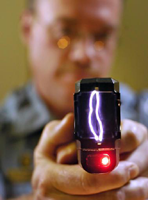
The shooting was premeditated. Cpl. Gregg Gillis plotted it out a month in advance. Two weeks later, he nailed down the date and location: the RCMP Richmond detachment. My first thought upon waking that morning: What to wear to my own zapping?
En route to Richmond, I half expect a last-minute call to cancel my appointment with 50,000 volts of electricity. Gillis, the RCMP's use-of-force coordinator, agreed to my request just weeks after Robert Dziekański died at YVR on Oct. 14, after being tasered twice by Richmond-based RCMP officers.
A provincial government inquest on taser safety started this week, while the coroner's inquest into Dziekański's death set to start this month has been pushed back until the RCMP investigation concludes.
A final report from the Commission for Public Complaints Against the RCMP (CPC) is scheduled for release in June; their interim report recommended immediate implementation of stricter regulations on its use, citing usage creep, lack of transparency and the need for a national training program redesign.
Letting a journalist go through "conducted energy weapon" (CEW) training seems like the kind of trouble the RCMP would go out of its way to avoid.
Training day
But here I am and Sgt. Mike and Sgt. Gene of the undercover drug squad are my schoolmates for the day-long re-certification course, which is mandatory every three years. Their initial two-day training included "exposure" to the Taser's zap, which used to be mandatory. But with rare reports of adverse reactions, it's now only strongly recommended.
Gene has never once used his Smith and Wesson pistol in his seven years as a Mountie and has only once fired his CEW on a man who had been threatening an ex-girlfriend and became "combative" after Gene chased him down and tried to get him cuffed. Drug squad team boss Mike, with 12 years of service under his holster, has never fired either gun. Neither are keen to be zapped again today, but I elicit raised eyebrows when I tell them the plan is for me to be tased.
"I'll do it if you do it," says 32-year-old Gene, a university grad and former Canadian Forces member who acknowledges it "sounds like a big cliché," that he joined the RCMP "to do my part for my country and community."
Our trainer, Adrian Tarasoff, wearing an RCMP issue T-shirt emblazoned with the Public and Police Safety patch (a maple leaf and a gun), begins the touch-screen Powerpoint training presentation by discussing the mechanics of this most-studied weapon in law enforcement.
Standing on the trigger
Tarasoff reminds us that tasers fail to work 20 per cent of the time. And even with optimal deployment -- when both darts hit the subject, ideally with a 36-inch probe spread -- one out of 10 times it won't cause the ideal five seconds of neuro-muscular incapacitation.
The now-famous YVR video footage clearly shows Dziekański writhing around, yowling in pain after being tased. But his muscles didn't appear to freeze up. Since the ideal deployment range is between 12 and 18 feet, I wonder aloud if the officer fired from too-close range, or perhaps one of the darts didn't connect? The officers won't speculate about these details involving their former colleagues (all have been transferred to other detachments since the incident) while the Integrated Homicide Investigation Team (IHIT) looks into the case. It's scheduled to wrap up by end of this month, when data stored in the X-26 model's software should be released, including a pertinent piece in that puzzle: the duration of each zap.
Multiple and prolonged tasing (a.k.a "standing on the trigger" for longer than five seconds) is a hot button safety topic and one which the CPC report singled out as problematic among taser-related "adverse findings," particularly when the stun gun was "applied multiple times even after the subjects were no longer exhibiting combative or resistant behaviour."
'You may need multiple applications'
I've already done some homework on this topic and know that each pull on the trigger delivers a five second zap, called a "cycle," but tasers can cycle repeatedly for up to ten minutes. Yet, stats about multiple cycles are hard to come by. The CPC report singled out the lack of published RCMP field use data as "a significant oversight," while field use stats collected by stun-gun maker Taser International merely report that law enforcers apply "more than one cycle" almost a third of the time.
"You may need multiple applications," says Tarasoff after we've reviewed some taser-related arrest videos. "First to get him under control, then once the rescue officers move in. You may need to apply a second and third application to maintain control until you can get the cuffs on. It makes no sense if those two officers going in there get into a big scrap with him. It endangers the person you're arresting and the officers."
The subject comes up again when Tarasoff gets into the medical research. Much of it is funded by Taser International, according to a recent Canadian Medical Association Journal article that cites conflicts of interest among taser researchers. Tarasoff says that today's RCMP training material about the adverse effects of multiple tasing -- based on medical studies of anaesthetized pigs and humans -- is no longer "relevant." He discounts findings, for example, that "prolonged applications" can impair breathing. Tarasoff goes off script to add that, "Research since then shows multiple applications have no [harmful] effect on subjects."
Alone with a taser
Tarasoff's source is a Taser International co-funded study by Minnesota-based emergency medicine researchers, a group that has previously published studies showing no medical adverse effects on healthy volunteers.
"Once that new info is published and peer reviewed it'll probably replace this curriculum. But we'll go over it anyway," he says. He then proceeds to speed-read through RCMP policy introduced in 2005, including advice to "subdue with one strike," since "multiple deployment or continuous cycling may be hazardous," and "CEW applications directly across the chest may cause significant enough muscle contraction to effect breathing."
Off-script now, he adds, "Don't stand on the trigger for 30 seconds, but if you need multiple applications to get that person under control with the least injurious means, by all means do that. But you will have to be able to articulate why you needed to use multiple applications." Since Mounties typically work alone, he adds, "It might not even be feasible for me to handcuff the guy if I'm alone."
These new, yet-to-be established recommendations on multiple and prolonged tasing underline the fact that protocols are by necessity always changing based on emerging medical studies. But Tarasoff doesn't mention an already published 2007 study conducted by the Cook County Electrical Trauma Study Group, independent Chicago-based researchers who have been studying the weapon since 2005. Their study (replicated again this year) showed that after enduring only two seconds of an X-26 zap, the heart rate of pigs jumped from 80 beats per minute (bpm) to about 300 bpm. Tachycardia can occur at 120 bpm and cause lethal heart attacks.
Change of plans
At lunch break, Cpl. Gillis shows up and says the lawyers got cold feet about the plan to zap me. "As you learned this morning, there's risk of injury," says the 43-year-old RCMP expert in taser training who has been exposed more than 20 times during training and compares its effects to the muscle burn of a gym workout. "You could potentially tear a muscle and we would be on the hook for your medical expenses and loss of income. You could come after us for pain and discomfort."
I had been questioning my sanity for days and contemplated chickening out many times, but now I feel like a dinner guest promised a full meal that never materializes. Why can't I sign my life away with a waiver? Gillis says he'll make another call during lunch. "My school of thought is that if we're saying this is safe for use on the public, why not?" offers Gillis.
Back in the classroom, Tarasoff hands us each a loaded X-26 Taser and then goes over recent policy and protocol changes. Example: even if they draw a Taser on a subject, they will have to file a report by the end of shift, not within 15 days "because people haven't been completing the forms." Officers are now also allowed to remove the barbed darts from the subject instead of waiting for a medical officer, unless they've hit "sensitive areas" like eyes and genitals.
'Excited delirium' situations
"Remember that if the situation dictates, you can use multiple applications," Tarasoff says once again. "If the subject is in the grips of a mental health crisis or has excited delirium (ED), they'll need medical assistance ASAP. In order for EHS to intervene, they first have to be restrained and under control. It falls on us to do that. With ED, the use of a CEW in probe deployment mode may be the most effective response to establish control."
This is another surprising recommendation, since the CPC Taser report specifically called for restricting use with ED subjects. "Right now [report author] Kennedy is putting out off-the-cuff comments if you will," Gillis responds. "Where's the meat and potatoes? We have to go on science and the leading medical expert in this country Christine Hall [a Victoria ER physician] is still saying, 'Look this is better than fighting with these people and traditional methods.' So as a result we're going to continue to use it in ED cases."
Gillis thinks Dziekański exhibited classic ED behaviour: "profuse sweating, extreme mental and physiological excitement, disoriented, irrelevant speech, erratic behaviour like arming himself with a stapler, trying to break glass, the repetitive movements, like making a pile of things by an opening door. Physiologically, these people are writing cheques they can't cash and they need medical attention fast. The best plan with ED cases is immediate CEW."
Tarasoff adds, "It's better to use the CEW a couple of times instead of fighting them." Tasing, he points out, is typically far less risky than going hands-on, according to in-custody death stats: 63 per cent compared with 27 per cent that are Taser-related. But the CPC advised against using Tasers in all but the most combative ED cases -- and in Dziekański's case, the Mounties ended up going hands-on as well, to get him cuffed.
The Dziekański takedown
They're schooled to restrain subjects in the face-down position, known as the "prone position," though one of the officers appears to have pressed down on Dziekański's head and neck, which is known to cause hypoventilation. What gives with that? "We're taught to avoid the neck, but not necessarily the head," says Gene, who is also an officer safety instructor and has worked the YVR beat. "You want to avoid compromising someone's breathing, so you should apply pressure to the shoulder area. But I can't comment directly to the video."
According to Amnesty International, Tasers have been targeted as a contributing factor in 30 of almost 300 deaths in North America, but while medical specialists debate its safety, an Office of the Police Complaint Commission (OPCC) report singled out underlying medical conditions and drug use among 19 restraint-related deaths in B.C. between 1990 and 2003 -- none involved Tasers.
Dziekański's post-mortem toxicology report showed no drugs or alcohol, but after being tased he was clearly involved in a physical struggle, which has a particular risk for ED cases. A 1998 Ontario study found that all 21 ED in-custody deaths between 1988 and 1995 were associated with restraint either in the prone position or by putting pressure on the neck.
Burning in protocol
Gillis points out that 80 per cent of the time, officers are able to arrest citizens without engaging in physical combat. In the other 20 per cent of cases, the goal of RCMP training is to "burn protocol into an officer's C-drive" so they can "establish control quickly with the least amount of injury to all parties involved."
But each situation dictates a unique response, so while the CPC pushes for a concise national training protocol, it can be dangerous to expect officers function like automatons. For example, Gillis mentions a Chicago cop who accidentally drew his gun instead of his Taser, then shot and killed the already cuffed perp. Gillis says the accident was a result of muscle memory and, thus, the RCMP now advises officers to pack the Taser in a leg holster on their non-dominant side and draw it with the non-dominant hand.
Gene and Mike practice drawing left-handed, then the scenario-based training begins. First, all their weapons have to be replaced with dummies, though the Tasers' barbed darts remain. Gillis will act as the bad guy. He dons a helmet and a brown padded suit and we head into a narrow dark hall next door. Gillis does such an impressive acting job that my adrenaline surges as if this were a real life or death situation and time seems to pass in fast-forward.
Next is the de-brief. The officers have to justify exactly how and why the bad guy was actively resisting arrest, warranting Taser use. Mike and Gene were easily able to pinpoint these factors earlier while armchair quarterbacking training videos. But now their memories of the scenario events are fuzzy and they sound more like schoolboys at the principal's office.
"If we do [scenario training] right we should be able to get a similar adrenaline and dopamine response to a real life situation and that impacts recall ability," explains Gillis. "The best way to get accurate info is to ask the bare bones questions and then after 24 to 48 hours, after those chemicals clear themselves and after good REM sleep, do a secondary follow up interview. But the public doesn't always understand this issue. These are basic physiological reactions to the stress of dangerous situations where there's a chance of death or grievous bodily harm to the public and to the officer. In a real life situation, they might not even make it home."
Balancing risks officers face
Indeed, while Dziekański became a household name, one Ontario-based Mountie and two from B.C. where killed in the line of duty. "How many people remember their names?" wonders Gillis, who maintains that Tasers curb dangers for both officers and civilians.
But unlike guns or batons, the X-26 Taser deployed on Dziekański stores pertinent computer downloadable information including the number and duration of zaps. The fact that thorough field-use statistics haven't been made public by the RCMP or Taser International certainly heightens public distrust and, more importantly, could negatively impact training protocol, cause usage creep and unnecessarily endanger lives.
Gillis collects the dummy Tasers and starts replacing them with live cartridges. Am I about to get zapped?
"Unfortunately, the people at the Department of Justice have a bigger circle of influence than I do," says Gillis and provides a skiing analogy for their refusal to allow my tasing. "You accept the risk of falling and breaking a leg, but [the company operating the ski hill] can't sign off on the status of the chairlift because the assumption is that it is safe. Can you really sign off your rights on something like the Taser when we really don't fully understand and know the risks?"
Trouble is, nobody fully knows the risks, and until we do, the controversies surrounding this weapon are bound to continue.
Related Tyee stories:
- Taser Video Prompts Review
But the RCMP continues to self-police for now. - Tasers: What Police and Media Aren't Saying
A month after The Tyee was first to report a Taser-related death in custody, VPD Chief Graham and media offered a late, garbled look at the issues. The new provincial inquiry needs to look hard at 'excited delirium.' - Dead in Custody
Did Vancouver police fail to save Roman Andreichikov's life? Or did they have a hand in killing him? The mystery may centre on a factor called 'excited delirium'.
![[Tyee]](/design-article.thetyee.ca/ui/img/yellowblob.png)
Read more: Health, Rights + Justice









Tyee Commenting Guidelines
Comments that violate guidelines risk being deleted, and violations may result in a temporary or permanent user ban. Maintain the spirit of good conversation to stay in the discussion.
*Please note The Tyee is not a forum for spreading misinformation about COVID-19, denying its existence or minimizing its risk to public health.
Do:
Do not: