
No New Homes in Premier's Homelessness Plan
Coleman challenges cities to "step up."
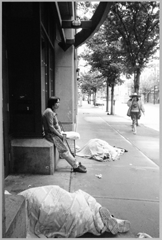
Donna Gorrill photograph from the just-released Hope in Shadows' calendar.
Premier Gordon Campbell has constructed an intricate array of innovative responses to B.C.'s sprawling homelessness crisis -- but he's not building more housing.
Campbell announced plans for longer shelter hours, wider street outreach programs, and more rent supplements at a well-attended news conference on Oct. 12. Together with Housing Minister Rich Coleman, he challenged municipal governments to speed up preparation of sites on which charities might fund supportive housing in the future.
"We're saying to municipalities, 'OK, you've got land. Get it ready in a year,'" Minister Coleman said. "The cities need to step up. The challenge is on them."
But conspicuously absent from Premier Campbell's announcement was any commitment to build new social housing.
"There was not one new home announced here today. Not one," said MLA David Chudnovsky, a New Democrat who serves as critic for homelessness.
"Let's call a spade a spade," said Vancouver City Councillor George Chow. "It is now clear that we are not going to meet our Olympic housing commitments. We can't do it. And that's our fault."
Shelters to stay open 24-7
Premier Campbell and Minister Coleman announced $41 million of new measures as part of the provincial effort to reduce homelessness:
-Fund shelters to remain open 24-7. By not sending homeless people back into the streets each morning, shelter workers hope to spend more time counselling clients about treatment options and housing alternatives.
Friday's announcement was delivered at Lookout Emergency Aid Society's Yukon Shelter, one of the few Vancouver shelters already open 'round-the-clock. Lookout executive director Karen O'Shannacery said, "Being open 24-7 provides people with better opportunities to find a more stable housing situation."
-Expand the province's street outreach project to a total of 27 communities. Modelled on Vancouver's successful outreach program, B.C.'s outreach workers have already moved more than 1,600 homeless people off the streets and into stable homes. The program will soon be extended to Campbell River, Comox, Courtenay, Dawson Creek, Fort St. John, Nelson and Vernon. Additional funding will provide specific outreach to homeless Aboriginals.
-Provide rent supplements to help an additional 750 poor families afford market housing, expanding on a pilot program that is already housing 315 families.
-Fund pre-development work to make city-owned sites ready for construction by next fall. BC Housing has already had discussions with Vancouver, Surrey, Victoria and Kelowna about ways to fast-track their permitting processes.
"We're hoping the cities will work with us so we can have that pre-development done within a year," Campbell said. "We can then take those sites to people who want to invest, and say, 'All we need now is your financial commitment.' We believe we will be able to generate an additional 1,500 units of supportive housing in all areas of this province."
Can Vancouver act quickly?
Both Campbell and Coleman acknowledged that the fast-track challenge is aimed at cities like Vancouver, where social housing projects have lingered in planning stages for years.
Union Gospel Mission's proposal to build a new homeless shelter, soup kitchen and recovery centre in the Downtown Eastside has already been mired in Vancouver City Hall for almost two years, and the city does not expect its development board to take up that proposal until 2008.
Likewise, two of the three new supportive housing buildings for which the province has already announced funding continue to languish in the planning process. City officials do not expect work to begin at 337 Pender and 980 Hastings until sometime next year.
"Vancouver is unique," Coleman said, after the briefing. "A zoned site in Vancouver can still take 18 to 24 months to get in the ground."
"We're not pointing fingers," Campbell said separately. "We're going to go to all municipalities that have land, and we're saying, 'Let's get this land so that we can build housing on it. And let's not just say we are going to do it, let's actually give ourselves a time frame in which we will get it done."
Vancouver Mayor Sam Sullivan did not comment on the challenge during his short address on Friday, and did not participate in the press scrum afterward.
Councillor Chow, who grew up in the Downtown Eastside, doubted that Vancouver will be able to meet Campbell's one-year deadline.
"Given what we are doing right now, it's not realistic," Chow said. "I hope we could push it a bit faster. But I think it will be difficult. Because of the strike, we have so much work in the backlog."
High expectations dashed
Opposition critics and housing activists who had expected a major housing announcement were bitterly disappointed.
"It was pathetic," said the NDP's Chudnovsky. "If I were the premier, I would have been embarrassed to call this a major announcement."
Chudnovsky noted that the $41 million allotted for these programs totals exactly one one-hundredth of the provincial budget surplus.
"The VANOC committee called for 3,200 new units by 2010," Chudnovsky said. "And the premier announced today that maybe, by next year, maybe, they'll look at funding up to 1,500 units province-wide. That's unacceptable."
Pivot Legal Society attorney David Eby echoed Chudnovsky's disappointment.
"They best they could come up with was a plan to build social housing. But people can't live in plans. They need bricks and mortar," Eby said.
Eby noted that there are not even any new shelter beds in the premier's plan. Metro Vancouver shelters reported turning away homeless applications on 28,922 occasions between October 2005 and April 2006, the most recent period for which statistics are available. That's an average of 138 turn-aways each night.
"Today's announcement expands emergency programs for a homeless population that expanded directly as a result of this government's refusal to build social housing," Eby said.
Campbell and Coleman acknowledged that there were as many critics as supporters in the room.
"Critics are critics," Coleman said. "The reality is there is not a jurisdiction in this country that you can find that's as advanced on housing issues as we are in British Columbia today."
"There are always going to be people who never think it's enough," Campbell said. "It's good to have people who are constantly pushing you to do better. I'm one of those people."
Criticism to continue next week
The premier's announcement celebrated the one-year anniversary of Housing Matters BC, the provincial strategy through which Campbell's government is spending $328 million this year, in addition to the $41 million announced Friday.
But Campbell's innovative programming changes are unlikely to dim the chorus of criticism orchestrated as part of the Homelessness Action Week (see sidebar for more information).
Squatters began camping at 980 Main St. on Sunday afternoon. Minister Coleman announced the revival of a decade-old plan to build homeless housing on that site more than six month ago. The squatters raised a banner that read, "Empty lots. Empty promises."
On Saturday, six members of the radical Anti-Poverty Committee were arrested after they attempted to take over a shuttered SRO in the Downtown Eastside. At a Sunday rally, the controversial group vowed to launch another squat soon.
"We will resort to whatever means necessary to provide poor people with shelter," the committee warned in a faxed statement. "If the police forcefully prevent us from sheltering homeless women, we will wage an escalating campaign of direct action that will not doubt aggressively disrupt city hall."
At the opposite end of the decorum spectrum is a visit by the United Nations' special rapporteur on adequate housing, Miloon Kothari, who will listen to Vancouver's homeless and meet with government officials and Olympic organizers. Vancouver is one of four Canadian destinations for Kothari.
Headlining two of next week's many events is Gordon Laird, who authored a nationwide report entitled "Homelessness in a Growth Economy: Canada's 21st Century Paradox."
Laird found that between 200,000 and 300,000 Canadians are already homeless, while fully half of all Canadians live in fear of poverty.
"The widespread and rapid growth of homelessness in Canada since the mid-1990s is unprecedented in this nation's post-war history," Laird's report warns. "Shelter has become one of the defining social issues of Canada's new millennium."
Related Tyee stories:
- Vancouver Drops Olympics Housing Pledge
Promise was 'non-binding' NPA votes. - How Homeless Housing Got Stalled
And why this project will take a decade to get built. - Vancouver Losing SROs Faster than It Can Replace Them
Based on figures in city's own report.


gordon
13-10-2007
open 24 hrs to counsel housing alternatives, hahahahaaaa
It's unbelievable that the government can say funding for shelters 24/7 will assist the homeless with housing alternatives, when there is no affordable housing whatsoever. So exactly what are the alternatives that the government has in mind? Maybe endless nights in the emergency department costing taxpayers billions and society its humanity? Maybe a shelter equipped with rented lockers for their worldly goods and a shopping cart lockup on site?
I'm getting sick of the government treating the homeless problem as a lack of shelter space, homes and housing are whats needed not shelters. They might as well rename homelessness to shelterlessness, then at least they are addressing the problem they refuse to acknowledge. The bible talks about the man who asks for bread, and who would give him a stone? The stone was the shape and smoothness of a loaf of bread in those days. It is a clear message about mocking those in need. It is apparent that those in power are mocking the electorate and the needy, time and time again with posturing that makes fools of us all. The time has come for the righteous to step up and take the world by force for these are violent times and the violent will take it by force.
Ecclesiastes 5:8 If thou seest the oppression of the poor, and violent perverting of judgment and justice in a province, marvel not at the matter: for he that is higher than the highest regardeth; and there be higher than they. (a read of the next 5 verses is quite on topic as well)
Matthew 11:12 And from the days of John the Baptist until now the kingdom of heaven suffereth violence, and the violent take it by force.
Bless you Gordon Campbell, your going to need every single prayer when it comes time for you to answer for your misdeeds.
bcneocon
13-10-2007
For once I agree..
.... with the Tyee fellow travellers. It's time for the Campbell guvmint to help the least fortunate in our society. We have the privilege of living in the strongest economy in Canada, which in turn is the only non-deficit economy in the G7. We can afford this Gordon. Time to pony up. 3200 spots for affordable shelter? Yes, let's do it.
P.S. Bible quotes from lefties? Huh?
Canis Latrans
13-10-2007
The System and Homelessness
Of course capitalism has no real motivation or intention to resolve the problem of poverty. At the same time it cannot say this outright, so it simply endlessly talks the talk and goes through the vacuous motions.
And the reason for this again, of course, is that the wealth of the Alpha ruling class depends upon and is taken from the share of the total economic product that would otherwise go to the working class, were social and power issues actually, even relatively, more equal. Which results over the course of that share theft working its way through the economy and down the class structure, especially when capitalism is not sufficiently controlled by regulation, in the creation of a permanently deprived and dispossessed underclass.
The ruling Alpha class are not complete dolts. They understand that this is how it works, and the inevitability of the poverty result, as well as at least the socially and politically conscious elements of the working and underclass do.
They, again of course, have the ruling class controlled corporate media, in addition to their wealth manipulated and controlled state, that assists them in obfuscating the class and economic realities of the system's working and social product result,and in scapegoating the poor for their own impoverished condition. (They also have a tame trade union movement as well of course, which continually diverts and distracts the broad working class away from actually and seriously challenging the ruling class dominant arrangement they have with them. In exchange The System tosses the Big Labour leadership illusory crumbs that they are too a part of the power system, and therefore have a stake in confining their ritual shadow boxing to wages and such, rather than raising the ante to include real working class power in the ownership, management and direction of the economy and the creation of social policy.)
Capitalism and its working result inevitably creates poverty. It can no more resolve the problem than it can divest itself of control over private profit accumulation, or really and seriously act to control human over-population or development growth. That is like asking The System to fall on its own sword.
realisticman
13-10-2007
Bad News say the Usual Suspects
As Mark Smith of Triage Emergency Services & Care Society said yesterday on CBC, in response to this Campbell government initiative, "This government has done more homelessness than any government in history, and I've been in this for 27 years".
Triage is an independent, non political, non religious, charitable organization working on life long solutions to homelessness in Vancouver. We are one of Vancouver's leading homeless service providers.
But, of course, why would a bunch of malcontents and NDP yelpers defer to an expert when their minds are made up?
realisticman
13-10-2007
Quote
"This government has done more for homelessness than any government in history, and I've been in this for 27 years".
SharingIsGood
13-10-2007
realisticman
A government:
1. that reduced the minimum wage,
2. that rolled back wages, illegally fired health workers etc.,
3. that reduced services to the poor,
4. that allowed home-ownership to become impossible for most of the people in the
5. that has shown a net decrease in buying power for the poor and middle class while the wealthiest have had huge increases (during a time of prosperity),
6. that has been condemmed by the United Nations for its treatment of poor people, and
7. that increases gambling, alcohol consumption, user fees for necessary services, etc.,
8. etc. etc....
has done more to create homelessness than any of its smoke and mirror media charades can ever begin to cover up.
SharingIsGood
13-10-2007
correction to #4 above
"4. that allowed home-ownership to become impossible for most of the people in the"
should have been continued to read:
"4. that allowed home-ownership to become impossible for most of the people in the
[median wage bracket to afford],"
SharingIsGood
13-10-2007
green and reduce homessness at once
I think that the provincial government needs to create green taxes to provide public transportation and shelter for the poor in some formula such as the following:
1. high energy consumption vehicles not used for carpooling, commercial transport, or construction purposes pay annual green taxes of $200 for every litre (or portion thereof) above 8/100km. Solid proof of carpooling and commercial activity must be provided through SIN numbers, dates, records of materials hauled and distances. Incentives can be provided for people to use vehicles consuming less than 6 l/100 km.
2. tax levies of $2000/annum for every domicile that exceeds:
- 1500 sq. ft. for 1 occupant
- 2000 sq. ft. for 2
- 2500 for 3
- 2750 for 4
- 3000 for 5
- 3200 for 6
- etc. increase of 200 sq. ft. per every additional occupant. If a homeowner exceeds more than one size level (as per occupants) then he or she pays additional fees of $2000 per level.
3. new homes that do not employ energy efficient designs and construction materials (including occupant load per no-sleeping area) will be taxed heavily or possibly not approved at the building permit stage. This includes consideration of constructing homes that are made of exterior surface materials (siding, roofing, windows) designed to last at least 100 years without heavy environmental upkeep (such as continual painting and resealing with petroleum-based products). Interior floor surfaces should also be made to wear for long periods of time. New homes should come with warranties for energy efficiency and years of useful service.
4. Allow homeowners to easily convert existing large homes into duplexes, triplexes and quads. Tax breaks to all homeowners who demonstrate they have retrofitted and improved houses that were energy inefficient through proven design and documented reduced consumption. Tax heavily those homeowners who remodel for the sake of appearances and not through need.
Note that: 2, 3 & 4 (above), though generous in terms of size allotments, will still encourage people to build smaller, energy efficient homes. Those items will alsa encourage homeowners to invite other people to live in already over-sized housing. Vancouver can increase its density without building more. Some of the taxes levied may need to be applied toward improving water and sewage infrastructure that may be necessitated by the increased densities; however, there should be no watering of any vegetation in people's yards except by hand.
zalm
13-10-2007
Build it next year?
Why next year?
One charitable society I is sit on the board of, has a substantial property in the City that we'd like to at least double the number of social housing units on from nearly 100 to more than two hundred fifty.
We've had very preliminary discussions with a couple of city staffers, but we're not even THINKING of pre-design, never mind building until 2010 is over and construction costs come back down to a reasonable level and labour gets a bit of a holiday and is ready to go back to work at a sane pace and build good buildings.
The pace is too crazy and costs are too high now to do more than encourage speculation on buildings built without a shred of decent engineering or oversight. There will be huge bills coming out of the New Home Warranty Program in the next few years on any building built between 2005 and 2010.
That's not me talking, that's the other 8 developers and contractors that sit on this society's board. Some of them may be Campbell supporters, but I can hear heads shaking wayyyy over here.
George Chow's right. We've failed the poor and it's our fault.
notamused
14-10-2007
Realisticman says: Quote:As
Realisticman says:
I just listened to the whole interview, which you can find at http://www.cbc.ca/mrl3/8752/bc/ondemand/audio/MULHOLLANDSMITH.wmv. In it, Mark Smith also says: "Emergency shelters are a band-aid solution, and an expensive one at that."
The point of the Tyee article is that the $41 million announcement does not include funding for building housing, a point that is not debatable. Here in Vernon, which was recently identified in a province-wide study as the city in which more people live in "marginal" housing than any other, this morning's paper lists a total of 18 apartments and basement suites for rent.
Bailey
14-10-2007
Tax fraud?
Please correct me if I'm wrong here, but if some tens of millions of taxpayers dollars are spent for the express purpose of ending homelessness, but no affordable homes result, is that not some kind if financial crime? Malfesance? Misappropriation? Fraud? Something?
Where will that enormous amount of public money wind up, exactly? In whose specific pockets? And finally, is it still possible for a citizen or group to bring a private prosecution if they see a crime has been done, and the police won't act?
G West
14-10-2007
Excellent point Bailey
The police, at least the chief of police in Victoria, seem to have been more interested in 'preventing' the disclosure of information about financial matters than he was about investigating them..
See Mary's blog:
http://bctrialofbasi-virk.blogspot.com/
She has some other interesting stuff about what our provincial 'leaders' spend their efforts on as well..
Have a look.
Canis Latrans
14-10-2007
re Build It Next Year...
Interesting observations above by yours, Zalm.
I'm the president of a condominium Strata Society, with frequent need of construction trades services and others etc, and the trick right now is even finding someone that is free to do the necessary work you need to have done. And all costs right now, from materiale to insurance are through the friggin' roof, the latter mostly as result of the absurd prices/value of our real estate in the current white hot speculative market. (Our kids are certainly never going to be able to afford to buy them at this rate-, at least working class kids, never mind the underclass.)
There is a madness to the frenetic pace of activity and all manner of speculation right now, that has near outstripped all capacity and people's ability to pay, save the richest, and is approaching the level of Extraordinary Delusions and The Madness of Crowds. (A book of considerable antiquity that some of you may have read in your ancient pasts. :-)
This is one of those moments in history where one wants to be seriously considering the old market and common sense shiboleth that, when everybody is going in one direction, you should likely be moving as quickly as possible in the opposite.
Right now, capitalism is off all its meds.
Taser the fugger!
G West
15-10-2007
panhandling and begging
The assumption at the core of the argument of those who say panhandling should be ‘banned’ is unmistakable – and it has nothing to do with aggressive begging, the use of intimidation and/or physical or vocal threats which are already prohibited behavior.
Criminalizing begging is simply another way of restricting the rights of certain individuals to communicate with the other members of their communities. Such an approach restricts the freedom of expression of the beggar and infringes upon his or her basic human rights.
Beggars, the homeless and the indigent are already a seriously marginalized part of our society as it is; sweeping up the poor, many of whom have poor general health, suffer from malnutrition, mental illness and addictions and denying them the only interface they have with so-called ‘normal’ society simply plays further into the hands of those who would like to simply ‘ignore’ the plight of these people.
Already social outcasts for a variety of reasons, criminalizing the simple act of asking for help in a public way is immoral: they are citizens too. In fact, the simple fact that beggars can be found on the street corners of our cities says a great deal about the functions and failures of the modern state.
We need to listen and we need to look at them – not rob them further of one of the only human rights they still possess. And we need them to remind us daily of where we’re going as well as where we came from.
monty
15-10-2007
homeless shelter
In 1996 I canvassed BC Building Corp. for empty buildings. There was an unused jail on SW Marine Drive, so I canvassed all the agencies and we inspected the place. Wrote Darlene Marzari, Min. of Housing and the shelter opened and ran as Lookout South until 2002, When Gordo came to power he promptly shut down the shelter, sold the land and condos sit on the site. This gov't has never had any concern about homelessness. Mark Smith has forgotten the attention paid by the NDP.
cocean
15-10-2007
Shelters? No Public Housing? No
Should the BC Government build more shelters? No.
Should the BC Government build public housing? No.
I am Coordinator of WISE, a BC-based group and growing national movement of persons on low income. WISE has always argued that the government should get out of the housing business.
We do not support the notion of public housing, since public housing developments end up ghettoizing the poor.
Nor do we support pouring more money into shelters. Shelters are bandaid solutions to a problem that wouldn't exist in the first place were proper government policies in place.
Pouring more money into bad policy, including policies of the current BC government, won't help.
What is needed, among other things, are:
1. more money going directly to local governments to enable them to address poverty and housing issues in their own way, as they determine appropriate for their communities.
WISE supports the "One Cent" campaign put forward by Mayor David Miller of Toronto - which looks like will be adopted by the Federation of Canadian Municipalities. The idea is to have one cent of every seven cents collected from the GST returned to the communities in which the GST was collected. WISE goes further and suggests that one cent of every seven cents should be retained by the communities at source, rather than go the feds only, eventually, to be returned by them.
We propose a similar campaign be mounted by BC communities through the UBCM, that is, to campaign for the retention of one cent of every seven cents collected through the PST.
2. the cancellation of TILMA, a behind-closed-doors agreement that was signed by the BC and Alberta governments. (Google 'TILMA' here on The Tyee for more info.)
3. local governments acting to support mixed and greener housing, neighbourhood squares, community public gardens within reach of all residents, walkable/cyclable roads and pathways, ....
jimbob1
15-10-2007
preventing a court challenge
One item missed by our local daily and tyee is this sudden, much needed, change of policy for goodwill and optic purposes was to thwart a court challenge to the right to sleep in our capital.
http://www.loveandfearlessness.com/city.htm
I believe the bylaw(s) would have been quashed, as it was in L.A. forcing the government to provide, as they should, when more and more of ones natural rights are taken away.
The anouncement has nothing to do with altruism. Look at the website and see what the press is missing.
snert
15-10-2007
Corrected link
http://www.loveandfearlessness.com/city.html
It appears that the 'l' in html is important to some browsers.
cocean
15-10-2007
Fierce independence, novel solutions
Was trying to recall, when writing my previous post, a report I had read some months ago which had a profound impact on me. Had forgotten that I'd added it to the WISE website! Here it is:
SHELTER: Homelessness in a growth economy (PDF, 2.6 MB).
By Gordon Laird, for the Sheldon Chumir Foundation for Ethics in Leadership.
I particularly recommend Section 4, on Toronto's Tent City.
We all get tired of the statistics and sad story after sad story. What gets missed is what poor and homeless people have to say for themsleves and what they think about their situation and its solutions.
The above study is a must-read for anyone who cares about eradicating poverty and homelessness.
G West
15-10-2007
thanks cocean
Pointing out, as Laird does, that a decent home, nutritious food, proper health care and decent clothing for everyone (and especially families) is the first step on that stairway to success and economic self-sufficiency that critics always say the poor and the homeless fail to negotiate.
It shouldn't be surprising why - nor should it be a surprise that we'll continue to see people fail to negotiate steps 2 and 3 if we don't realize that finding a way onto step 1 is what's critical in this journey.
SharingIsGood
16-10-2007
well said, G West
If the wealthiest 1% would give 10% of their earnings toward improving social problems, they would still make more than 20 times as much as the bottom 20%. This could go a long way toward improving things. Personally, I think that the wealthy need to give up their obscenely huge homes: they are environmental dinosaurs.
Further, like what Ed Deak and a number of other regular Tyee submitters say, this government needs to stop robbing the wealth of this province from the people to give to foreign "investors" and huge corporations that have no ethic but a strong bottom line for shareholders and money in the pockets of corporate executives. We can all have plenty if we share.