
More Homeless than Athletes in 2010
Can Vancouver's Olympic pride be saved? First in a series.
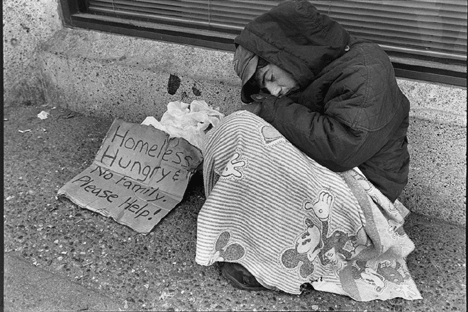
Vancouver homeless youth. Photo by Elaine Briere.
2010: More Homeless than Athletes?
- More Homeless than Athletes in 2010
- Vancouver's SROs: 'Zero Vacancy'
- Homeless to Housed in One Day
- Province's Boasts of 'New' Homeless Units Don't Add Up
- Dobell Homeless Plan Stalled
- Homeless Solution Up for Vote
- Olympic Partners Said to 'Fudge' Housing Claims
- Vancouver Losing SROs Faster than It Can Replace Them
- No New Homes in Premier's Homelessness Plan
- Coleman 'Committed' to 12 Towers
"When the world arrives in Vancouver in 2010, what kind of city will they find?" asked Mayor Sam Sullivan in his inaugural address.
They will find a city in which there are more homeless Canadians shuffling in the shadow of BC Place than Olympic athletes parading inside the Vancouver stadium.
That's the conclusion of a three-month investigation by The Tyee, which found that unless Mayor Sullivan and B.C. Premier Gordon Campbell radically reshape their response to North America's fastest-growing homelessness crisis, the number of Greater Vancouver homeless will easily exceed the 5,000 athletes and officials expected to participate in the 2010 games.
And it could get worse. If affordable housing continues to erode throughout the region at the rate it has during Vancouver's recent SRO buying binge, there could be twice that many. Should that happen, there would be one homeless person for each of the 10,000 members of the international press corps expected to encamp at the new $800 million Vancouver Convention and Exhibition Centre.
During the coming days, The Tyee will publish articles that explain:
- How the sudden loss of Vancouver's residential hotels accelerated a crisis that had been growing since Gordon Campbell's BC Liberals slashed welfare benefits
- Why Housing Minister Rich Coleman's bold expenditure of more than $100 million provincial tax dollars will deliver very little additional housing
- How local and provincial taxpayers could wind up spending more money taking care of the homeless than building Olympic venues
- Why Mayor Sullivan's elaborate plan to privatize social housing is an untimely gambit that appears to have distracted his administration during a pivotal time
- Where neighbourhood NIMBY groups have stalled the construction of sorely needed supportive housing
- What governments, business, non-profits and Olympic organizers must do this year in order for Canada to avoid a lasting legacy of shame in the wake of the 2010 Winter Games
Today: A look at the numbers.
Over 2,200 homeless now
On March 15, 2005, a team of social workers counted 2,174 homeless people in Greater Vancouver.
Starting at 5:30 in the morning, they scoured shelters, drop-in centres, parks, and other locations frequented by the homeless to produce The 2005 Greater Vancouver Homeless Count. The total number of homeless doubled since the previous count in 2002, from 1,121 to 2,174. More than half (1,291) were found within the City of Vancouver, followed by Surrey (371) and New Westminster (92). (A map of their findings is here.)
"All counts underestimate homelessness, because of the difficulty in finding those who do not use services or spend time where homeless people congregate," wrote the report's authors. Also, the one-day count did not consider people sleeping in detox facilities, recovery houses, hospitals or sofa surfers -- even though many of those residents have no fixed address. "Thus, the Homeless Count did not enumerate every homeless person in the region on March 15, 2005, and is an undercount."
But while the report does not claim to offer a complete count of homelessness, it does provide an accurate survey of the region's homeless population. Among its findings:
More homeless people were found on streets than in shelters; the number of street homeless rose by 235 per cent since 2002.
People of Aboriginal identity accounted for 30 per cent of the region's homeless population, while making up only two per cent of the total population.
When asked why they were homeless, 44 per cent cited lack of income, 25 per cent named addiction or other health conditions, and 22 per cent blamed the high cost of housing in Greater Vancouver.
Less than half of those counted had a steady income source. The rest survived on income from panhandling, bottle collecting, casual employment, or illegal activities.
Nearly three quarters reported chronic health conditions, such as addiction, mental illness or physical disability. Addiction was the most common; almost half of the homeless who responded to this question reported problems with addiction.
When asked which municipality they considered their last permanent home, 75 per cent reported somewhere in Greater Vancouver. Another 8 per cent reported their last permanent home was elsewhere in B.C., 15 per cent reported a location elsewhere in Canada, and one per cent reported a location outside Canada.
The next Greater Vancouver count will be conducted in 2008.
'Unprecedented demand'
Local counts have found higher numbers of homeless.
Judy Graves coordinates the Vancouver Housing Centre's award-winning tenant assistance program. She's worked in the Downtown Eastside since 1979, and has spent much of the last decade trolling the city's streets, parks and alleys for people in need of housing.
Graves conducted her own count in 2005. Using the same methodology biologists use to count wildlife, she found up to twice the number of Vancouver street homeless enumerated in the one-day count. Her next report is due late this fall.
"There are a couple of neighbourhoods in the City of Vancouver where I believe we're seeing a decrease in the number who live outside overnight," Graves said. "In other neighbourhoods, especially outside of the urban core, we're seeing quite an increase in the number of homeless on the street."
The undercount may be even more dramatic in smaller communities. Like most suburban municipalities, Port Coquitlam has no service center at which homeless people would congregate. Not surprisingly, the 2003 regional count was able to locate a mere 10 homeless people in PoCo, and the 2005 count found only 35.
Then, last summer, a new service organization began working in the area. Within months, the group had identified 177 homeless in PoCo.
"I think the situation is comparable in Burnaby and Surrey," said Diane Thorne, an MLA who represents the Coquitlam-Maillardville riding and also serves as housing critic for the New Democratic Party. She estimated that the actual homeless population in Greater Vancouver's suburban communities is "10 times" the 2005 count.
Thorne noted that B.C. does not conduct a province-wide homeless count. The best available statistic is that between October 2005 and April 2006 a record 28,922 people were turned away from B.C. shelters.
"There is an unprecedented demand for shelter services, not only in Vancouver but across the province," Thorne said. "There have been enormous increases in long-term and repeat users."
Disappearing rooms
Anecdotal evidence also suggests that the Vancouver homeless epidemic is deeper than the 2005 numbers suggests.
"Rooming houses and hotels are falling like flies," said Jean Swanson, a veteran Downtown Eastside activist now with the Carnegie Community Action Project.
Twenty-two residential hotels were sold in 2006, with a combined total of 1,178 rooms. By adding the number of rooms from which tenants were evicted to the number from which tenants were forced out by rising rates, Swanson counts 600 low-income rooms lost during the same year.
"If we lose 600 more this year, another 600 in 2008, and 600 again in 2009, that's 2,400 units of low-income housing likely to vanish before the Olympics," Swanson figured.
Likewise, intake workers at social housing centres report much longer waiting lists.
"It's just depressing," said Mark Townsend, who directs the Portland Hotel Society. "You feel like Solomon cutting up the baby, yeah? Shall you take this guy who's a problem tenant and no one will have him, or that one who's in a wheelchair and stuck somewhere?"
"We have just flat run out of empty rooms in Vancouver," Graves agreed. "We're at zero vacancy rate in those little rooms that were the last housing refuge for people. Anybody who's in the street now is going to have a precious hard time finding a place to go."
Homeless shelters are overflowing, despite the addition of 181 new shelter beds since 2000. The Downtown Eastside Women's Centre, a daytime drop-in facility, was pressed into service as an emergency shelter last November -- and an average of 50 women continue to sleep there every night.
And outreach workers are reporting more rough sleepers. The Vancouver Area Network of Drug Users, which operates nightly street patrols, is not only seeing more addicts on the streets, but is losing its own members to homelessness as well. Whereas only one-tenth of its members were without shelter as recently as 2002, now one-quarter of Vandu members are homeless.
"It's more dire, for sure," Townsend said. "Much more dire."
More homeless than athletes
After more than a dozen interviews with these and other housing experts, The Tyee has concluded that unless the city and province begin construction of additional supportive housing this year, there will be an estimated 5,600 homeless people living in Greater Vancouver by 2010.
There are two components of this projection:
- The Vancouver count will triple to 3,800. In the fall of 2006, Pivot Legal Society forecast that Vancouver homelessness will triple by 2010. No credible rebuttal to that forecast has emerged. And after weighing the number of new units BC Housing currently plans to open in the next few years against the accelerating loss of existing SRO rooms, The Tyee concluded that the zero vacancy rate will remain and Vancouver's most vulnerable residents will continue to be displaced.
- The regional count will roughly double to 2,000. It appears likely that the 2005 snapshot undercounted suburban homelessness by a greater margin than it did Vancouver. Also, as part of anti-drug efforts, some suburban municipalities continue to raze drug houses, bulldozing affordable housing in the bargain.
Swanson, Thorne and a few others regard The Tyee's projection as too low.
"If the attack on the rooming houses continues, I think we'll see much more than that in Vancouver," Swanson said.
"I expect regional homelessness to triple, at a minimum," MLA Thorne predicted. "I hope I'm wrong about that."
Graves, Townsend and others thought the number was accurate, or a bit high. Graves offered perspective.
"As recently as 15 years ago, there was no street homelessness in Vancouver. We did have shelters. We did have the odd coot," Graves said. She believes that Vancouver could vanquish homelessness again -- within a few short years -- if political leaders made it a priority.
"The causes of homelessness are complex," Graves said. "But the solution is kindergarten simple: Build supportive housing."
Related Tyee stories:
- Seven Solutions to Homelessness
Each is working somewhere else, and will save money and lives here. - Province Snaps up Poverty Hotels
Plan to protect housing catches insiders off guard. - Shovelling with Mayor Sam
Stalled homeless units finally jarred loose. Pols scramble for credit.


31
Login or register to post comments
Grumpy
4 years ago
Shoot the poor
In Canada, the problem of poverty is ignored, to the repeated chorus of booming economy and jobs everywhere.
The problem is, the booming economy is mostly government funded or the investments being made by the drug trade and where skilled jobs go wanting, the government refuses to fund education that would offer training for people to do the aforementioned jobs.
The result, economic and social chaos.
Fiat lux
4 years ago
There's no booming economy,
There's no booming economy, because BC and Canada are being sold off to foreign owners, who now control the economy and the governments. This is what NAFTA, WTO and other phoney treaties are about, not "free trade".
When you sell your house and property, you can live of the proceeds high off the hog, for a while, but what happens when the money runs out? The sale of resources, properties, and off the shelf inventory is not an income in any realistic business accounting, therefore, the reports of a "booming economy" are just more economic fraud to mislead people so the carpetbagger corporate mafia can steal more.
As far the Olympics are concerned, they've long ceased to be sport and became show business, where athletes are bought and sold. It started with the Soviet era athletes having been employed by the state and in the early postwar years filled up with enhancing drugs, then the idea was picked up by the West by permitting sponsorships. Now all we have are professional performers.
The worst lies are the claims about the great benefits this racket will bring to BC. Like hell. It will leave behind a large number of expensive infrastructure that will have to be maintained and paid for by the public.
Expo 86 went on for 6 months and devastated the rest of BC, where all businesses suffered losses. I never went near the thing, but it cost me $5,000. of lost income. All over independent restaurants and other guest based businesses went bellyup, because the locals went to Expo and the foreign visitors never came.
So, what can these fools expect from a couple of weeks in the middle of the winter?
Ed Deak, Big Lake.
Grumpy
4 years ago
And Vancouver too!
Ed, businesses in Vancouver suffered too, with Expo 86. I was in the 3 rd year with my store and business dropped 50% in 1986. Instead of a tourist bonanza, it was a tourist wasteland.
What happened is that tourist came Friday and did the fair for 3 days and went home! Locals stayed away from the downtown core and regular tourists could not find accommodation.
Except for the bars, hotels and restaurants, businesses will suffer for the registered trademark Olympics.
Fiat lux
4 years ago
With all the past evidence,
With all the past evidence, how can these screwballers get away with the fantastic promises about the great benefits the Olympic racket will bring ?
Ed Deak.
Working Memory
4 years ago
Think local Act global
This happens in almost all Olympic regions in the free world. Politicians and mainstream news media knew this would happen well before the 2010 Bid was awarded to Vancouver/Whistler. They chose to ignore it until their backs were against the wall.
Mainstream news media like the Sun, the Province and yes, even the Georgia Straight have already made considerable profit selling condo ads in their respective publications to developers who irresponsibly hyped Olympic frenzy in an effort to boost profits at the expense of the community. Don't forget to blame "all" these companies for contributing to gentrification.
There is nothing wrong with selling ads to developers, but it is a news company's responsibility to the community to also balance the ads with at least the same amount of space explaining what happens when paper real estate millionaires are made over night. News companies never did this until they were forced. It's way too late for them to explain how it works now.
Violent protest happens in all Olympic regions regarding homeless issues and not once in history has violent protest ever made a difference.
It is way too late to protest locally about this issue. VANOC and the IOC simply look at protesters as a cost of doing business. They've had to deal with this issue in every single Olympic region in modern Olympic history and they know how to manage it effectively.
If you want to to make a difference impact how the IOC generates future revenue by making it harder for them to sell the Games to other regions in 2014, 2016, etc. Protesting locally only hurts our local economy. The IOC expects you to protest locally, but they do not know how to deal with host cities that take a local issue global. Do what Sydney Australia did in 2000 and surprise them.
Talking about it here at The Tyee is a start, but if that's all you're doing than it amounts to little more than whining. You have an email account, use it to voice your complaints to community and business associations, and local media in regions that are currently interested in hosting the Games. Use independent news websites like NowPublic.com to reach around the world. (NowPublic is based in Vancouver)
VANOC cannot possibly host a successful Games without the cooperation of the community and local businesses. If you, your company, or someone you know have intentions of becoming a volunteer make sure all parties involved understand the repercussions of unconditionally supporting the Games. Bottom line, don't volunteer until VANOC and politicians make gains to treat our community with more respect. Tell them today you refuse to volunteer. Don't wait.
Some of us have been raising these issues for years. It's time you get on board too.
You have the power to take back your community, but you can't do it using old and outmoded strategies.
Maurice Cardinal
Editor: OlyBLOG.com
MadOvid
4 years ago
Make the Olympics about the Homeless
There are many ways we could respond to the coming Olympics. We could piss and moan about them, do what the APC did and trash offices, or we could actually do something constructive. Here's my suggestion, make preparing for the Olympics just as much about alleviating the homeless situation as building arena's and such. The world is coming to BC in 2010 according to the Liberals, and what is the world going to think of BC when they walk down East Hastings. So lets do the patriotic thing, the good thing, the sound business thing. Let's fix this problem. Then when the Olympics inevitably comes, we'll be prepared.
flattax
4 years ago
Build it and they will come
Quote "Then, last summer, a new service organization began working in the area. Within months, the group had identified 177 homeless in PoCo."
Response: In economic terms, the above situation is called an ADVERSE EFFECT. By trying to reduce an undesired situation, you make it easier to be in that situation.
By building social housing you create homeless people. How? Well people come from all over canada to take advantage of it. It also makes being homeless easier that it would have been. And for many other reasons.
You really want to get rid of the homeless problem? Then eliminate social housing. Sure we will have unrest for a while, but after a few months or years, the homeless will leave or find some place to stay on their own. Problem Solved.
Fiat lux
4 years ago
The above letter is typical
The above letter is typical ideological nonsense and a prime example of:
Costs can not be cut, only transferred on other sectors, the environment and/or the future.
Homelessnes is not going to be solved by sending the victims somewhere else.
It would be interesting to see the statistical percentages of homelessness during the past 50 years and especially in the past 20 under the FTA and NAFTA.
Ed Deak.
realisticman
4 years ago
Soft Touch
Vancouver's already known as a soft touch, even Cunningham of one of the homeless orgs said he came out from Ontario because the 'crack' is better here. Trouble is there are too many people 'crashing' in Vancouver social housing that shouldn't be and consequently those that perhaps should can't find a space.
alive
4 years ago
Shanty Towns
FT you done it again!
Did you ever visit "developing countries" and happen to watch the shanty-towns that is hidden away from the tourists?
Of course the homeless here will also find a place to live, perhaps some garbage dump?
So, there will be no sanitation and some will get sick and die; maybe that is also OK with you, as long as nobody sees it?
One could wish that you were forced to live as a poor person for a month or so.
rockerbiff
4 years ago
MadOvid - first you have to
MadOvid - first you have to elect a government to do what you suggest. Second - homelessness may not be something that is fixable to the point of 100% invisibility.
Atlanta's solution was to ship all the homeless out of the area - one can only hope any level of gov't would not resort to such tactics - but if all else fails, expect it.
The IOC has ALL by the short n curlies and as we get closer we get to 2010 their grip will tighten ever so slightly that we may not even notice the pain. But it will hurt nonetheless.
Percy
4 years ago
Subtract one third
Since 1 third of the homeless describe "home" as some other community, it would make more sense to send them back "home" and deal with their situation there, rather than contemplating providing free or subsidized housing in one of the most expensive markets on the planet. Clearly they are only in Vancouver because of the services that subsidize their lifestyle. And remember, all these grand schemes are financed by property tax, that is, by taxing homes. Find me an economist who believes that this makes any sense, rather than making housing still more unaffordable.
clubofrome
4 years ago
Teepee living
I like the idea of tent cities. Everyone loves camping. Some basic sanitation facilities and a safe environment with a manageable size. Provide a few jobs for resident campers, a volunteer board like a camp council to help administer and some corporate sponsors and some relief funds for food and water and basic health care. The whole camp is portable and they could be located in all area's of the lower mainland. Hiding the problem will not eliminate it. This visible community will be a reminder that our society is responsible and we are only as strong as our weakest members. Start with one on the lawn of the provincial legislature building.
JIm
4 years ago
Has attaching the Olympics
Has attaching the Olympics to the homelessness problem done any good for the homeless?
Although these are completely unrelated issues most of the homelessness debate has actually turned into a anti-Olympic debate, as is so eloquently demonstrated on this board. The so called root of all evil, gentrification, started long before the Olympics were coming to Vancouver.
If we didn’t get the Olympics we would be having the exact same problem.
It always amuses me how every NDP MLA thinks solving all problems are as “kindergarten simple” as spending more money. I guess she’s saying that if we hoard the drug addicts and mentally ill into ghettos all of our problems will magically go away. Out of sight, out of mind.
The real question is how do you help people who don’t want to be helped? If 75% of homeless are drug addicts, giving them more money will not solve any problems. Or do you indiscriminately build housing ghettos that become decrepit in a matter of years?
How is VANOC supposed to build social housing before the games? Explain, please someone. Should they house the drug addicts in the Olympics village before and during the games? That way the scum bag athletes who come to Vancouver can feel the wrath of the drug addicts. After it's the athletes fault we have drug addicts.
Blaming VANOC for the housing problem is wrong and holding VANOC to account is going to do nothing for the homeless, but it may get your mug in paper, which I suspect is what most of the so called anti-Olympic housing advocates want.
bob the cat
4 years ago
Squatters shacks
Anyone remember in the fifties the hundreds of "Squatter Shacks " that lined Indian Arm on both sides of the inlet from the Second Narrows Bridge to what is now Cates Park?
Malcolm Lowry lived along there for a time.
I guess he`d have to write "Under the Volcano" (Malcolm Muggeridge rated it the best modern novel in the English language)
under the Burrard street bridge these days huh.
snert
4 years ago
Housing crisis? What housing crisis?
A Glob & Mire article.
mvb
4 years ago
Quote:If we didn’t get the
Probably true, but wouldn't we also have a few extra billion dollars with which to build up affordable housing and train/hire much needed support workers?
This year for the first time I've ever noticed (maybe I wasn't paying enough attention) there are recognizable homeless people in my neighborhood in the suburbs -not recognizably homeless, but homeless people I recognize because they have become a persistent facet of my community.
Regardless of the coming games, we are looking at a crisis - and not just in Vancouver.
Frank
4 years ago
JIm
Sure JIm, so we'll instead use your solution, ignore social problems and spend billions on parties instead. That should work.
G West
4 years ago
Profound misplaced faith
Reading some of the comments after this story it came to me that some individuals appear to put their faith in:
(a) the positive outcome of such corporate events as the Olympics;
(b) their acceptance of the idea that if only we could get these free-loaders to go back 'home' all would once again be rosy on the streets of the 'greatest city in the best place on earth'; and
(c) that if we just leave things to corporate solutions and the invisible hand of the market, well, we've really got nothing to be concerned about.
In any case, perhaps these same people would be interested to read the following:
http://www.nybooks.com/articles/20275
from the heart of the corporate oligopoly.
Even there, in the belly of the beast, questions, good questions, are being asked about just where things are headed.
Martin
4 years ago
Just a publicity stunt
The "homeless count" that was performed in 2005 was simply a publicity stunt that was published during the provincial election campaign in an attempt to influence the outcome. There was plenty of reason for them to inflate their findings.
Fact is, the poverty industry in the downtown eastside (social agencies hooked on government money) will never solve the homeless problem. Why would they? They would lose their government grants if they did.
I bet that every homeless count will show an increase from the previous one. That way the poverty industry will keep up the constant demand for more and more money.
Frank
4 years ago
Martin
How much does the employees of the "poverty industry" make a year? A ballpark figure is fine.
Do they decide themselves how much they should get paid and how rich their pensions should be like the Liberals do? Just how much do they get in government grants? Does Campbell agree to those cheques or does he have a gun to his head?
And just how much control over solving homelessness and poverty do they have? 100%? Less? A ballpark figure is fine.
Would it be safe to say that in your opinion the government would have solved poverty and other social ills decades ago if it wasn't for the rich and powerful poverty industry?
And I'm willing to bet every census will show an increase in population so that governments can tell us growth is happening.
Monte Paulsen
4 years ago
homelessness is fixable
I'm grateful for all the strong opinions voiced in this thread. There's one with which I'd like to take issue.
"rockerbiff" suggested that "homelessness may not be something that is fixable to the point of 100% invisibility."
I respectfully disagree, by 99 percent.
One of the reasons I agreed to write this series for The Tyee is that unlike most other social problems (e.g., addiction, racism or AIDS), homelessness is something that clear-thinking policymakers actually DO know how to fix. UK and US cities that have embraced the "Housing First" approach have dramatically reduced their levels of homelessness.
After studying this issue for months, I believe that if the city, the province, and the federal government were to work together on the homeless file as well as they work togethter when orchestrated by VANOC, we could eliminate 99 percent of street homelessness by 2010. (And we'd be on track to dramatically reduce non-street homelessness in the following years.)
I'm not anti-Olympics. I'm looking forward to the 2010 Winter Games. And when the day comes, I want to feel as proud of Canadian compassion as I will of Canadian hockey.
-- Monte Paulsen
Bucky
4 years ago
Use Riverview to house the homeless.
Sullivan has suggested Riverview could be used to house the homeless as many of the people on the street were released from Riverview as it underwent it's downsizing. Even if they could retrofit the buildings there to make SRO's most of the homeless aren't going to stay. The Riverview grounds are beautiful but there isn't anything there for them to do and as the investigators discovered half the downtown homeless are drug and/or alcohol addicted. "Addiction was the most common; almost half of the homeless who responded to this question reported problems with addiction."
Riverview could be a solution for a few but if the intention is to get the homeless away from downtown for 2010 it won't work until they address the reasons homeless people come to the Main and Hastings area in the first place.
clubofrome
4 years ago
FGNP
It's the Federal Good Neighbour Policy. Of course it would make sense to tackle this as a national program. All regions of the country need to take care of their homeless populations not encourage them to go elsewhere. Just as those now discovering homlessness in our community's in the subburbs. Good! Make them welcome, adopt them, and take responsibility for them. They are the ones cleaning up your area of litter and cans/bottles etc. Many homeless are not attracted to the poison and toxic environment of the downtown east side. There are no borders for social problems. Gated communitys are for retired Tory cabinet ministers and Liberal Senators as well as the corporate criminally insane. Lets not think of them as keeping us out but locking them inside!
Atta Boy Monte!! Good Canadian kid, probably from Kingston! Right up there with Booby Orr, greatest player ever! Way to go Monte...
realisticman
4 years ago
More Study, please
Paulsen
When asked why they were homeless, 44 per cent cited lack of income, 25 per cent named addiction or other health conditions, and 22 per cent blamed the high cost of housing in Greater Vancouver.
Less than half of those counted had a steady income source. The rest survived on income from panhandling, bottle collecting, casual employment, or illegal activities.
Nearly three quarters reported chronic health conditions, such as addiction, mental illness or physical disability. Addiction was the most common; almost half of the homeless who responded to this question reported problems with addiction.
That gives us some idea of who and why. What about a study as to who not and why not. Interview recent immigrants from poor countries that came here with little and ask them why they are not part of the Vancouver Homeless.
A more comprehensive understanding of the homeless phenomenon is called for to understand to what degree exists a voluntary component and we must ask if we wish to pay for their indulgences.
If, as the study concludes, around 50% of these people are addicts, then is it right and proper that we pay for them to live Downtown Vancouver? If we wish to help them, will housing them Downtown be of assistance or perpetuate their plight?
Frank
4 years ago
Realisticman
We know the income levels of immigrants are on the low side but we also know Immigration Canada probably isn't letting people with addiction problems into the country.
So if you're connecting two dots and saying immigrants are less likely to be addicted and homeless than home-grown, that's probably true. But what of it? The stat doesn't lead anywhere beyond that.
For example, are children of immigrants more or less likely to engage in criminal activity than the children of home-grown? And if they are what does that mean policy-wise?
Regardless of who the homeless are they are people and we should help them up and into some shelter.
realisticman
4 years ago
OK then
Fine. Question is; throwing money into what? If it's not poverty alone that put them there since poorer immigrants are not homeless, then is it partly lifestyle choice, for some? The healthy young with backpacks, dreadlocks and skateboards that I see in the DTES are there for what reason? Fashionable choice gritty lifestyle in soft-touch Vancouver? Perhaps, even probably. This group saps the services for those truly in need of assistance.
Providing super-cheap or free shelter for some of the people that are addicted will only help them in the short-term. Methinks that forced detoxing might be necessary and it will not happen in the open drug market Downtown. Some people need to get, or be taken out of town. Many ex-addicts will say the same. That's what's needed to really help them.
Frank
4 years ago
Quote:If it's not poverty
It may have been a "lifestyle choice" at one time but when people want to move on they should be given the assistance they need to do so. They shouldn't continue to pay over and over for a choice they may have made a decade earlier.
Could be physical, mental or sexual abuse at home or it could be the lack of a home altogether. If you're an orphan the gov't kicks you out on the street at 18.
If all the kids on the DTES have good homes in Kits to go to then sure, they don't need resources. But we don't know if that's true.
And that's fine. But people actually from Vancouver should be assisted in Vancouver. People from Maple Ridge can be assisted there and so on.
No one is arguing that the addiction problem itself shouldn't be helped. However, when voices are raised to do that people complain about the cost. Then when voices are raised about the homelessness people say its a waste of money because of the addiction. Its fine with me if both problems are helped simultaneously.
greengreen
4 years ago
Poverty Industry
Sorry but I must agree with this point of view. Was very slightly involved with WEINN in the west end - what a joke. Next to nothing achieved (at great cost) and then continual whining for a two year extension to finish their "work". A total waste of money and time - all under the guise of trying to help the homeless.
Frank
4 years ago
WEINN
You agree with Martin that WEINN is the cause of homelessness? I disagree but then I've never even heard of WEINN, perhaps its true that they are sucking billions out of the economy and preventing the homeless from being housed.
Filmcouver
4 years ago
Homeless count not a publicity stunt
As someone who volunteered for the count and is not involved in the "poverty industry", I can tell Martin that it was no publicity stunt. Martin should talk to his friend Peter Ladner who also volunteered, and he would find out that staff from the Province were actually involved in the methodology and the count itself. Everyone knows that counts are not accurate, but some decision makers need the data to make decisions to take action.
In the case of the 2005 count, there is some evidence that at least one muncipality had the police do a "sweep" of homeless "nests" just prior to the count, so that the numbers were lower.
Also, counts do not always go up. In the US and UK, where the government have taken actions to deal with homelessness (providing housing and supports) the numbers in recent counts have gone down, substantially in many cases.
I hope that Gordon Campbell talks to Arnie about how they have achieved so much success in California.
Finally, this does not have to be about ideology. Philip Managano, the Republican appointed homelessness "czar" in the US describes in detail how it is cheaper to solve homelessness than to manage it like we are doing here.
In 1985, Vancouver did not have a homeless problem, sure, a few hundred people at most cycled in an out of homelessness, but not the chronic problem of today. It is solvable.
Martin, I invite you to participate in the 2008 count. You will be welcome.