Opinion

A Tyee Series

Uncool: Vancouver's Olympic Architecture

It's ever more clear we should have set designers free.

By Adele Weder, 17 Dec 2008, TheTyee.ca

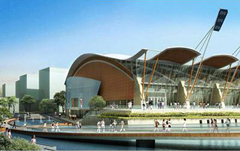
Richmond Oval

Richmond's skate oval: splayed heron?

Why is Vancouver, with design talent that more than matches Beijing, shaping up to offer such an unremarkable Olympic architectural legacy?

Sure, Winter Games are smaller-scale, lower-profile and a lot colder than Bejing 2008. But aside from that, it's a bit of a head-shaker. The firms responsible for the 2010 venues include a few of Vancouver's top architects. Neither their names nor their imagination, though, will carry much weight in 2010. China used architectural bravura to argue its new importance in the world. VANOC, by contrast, seems determined to keep its architecture as unremarkable and anonymous as possible. The VANOC website brags about the impending world-class facilities, yet there isn't a trace of information about the architects, apparently because that would dilute the value of the corporate sponsors' names.

And as the main venues rise out of the ground, we're reminded that corporate culture, more than any other kind, is the bane and bedrock of this Olympiad.

'Richmond Oval... a lasting symbol': Campbell

When the Richmond Speedskating Oval officially opened last Friday, we got our first flush of Olympic architecture. Premier Gordon Campbell declared that "Like the Bird's Nest Stadium, or the Water Cube in Beijing, the Richmond Oval will be a lasting symbol, known around the world."

To this, I'd say that the premier has farcically misspoken. The network of design teams behind the oval is made up of generally solid talents. But if the world shows us any mercy, the Richmond Oval will not be judged against the visually stunning Bird's Nest by Swiss architects Herzog & de Meuron, or Water Cube by Australia's PTW Architects. It would just be cruel.

On the inside, the oval is grand. The multinational firm Cannon Design is the oval's architect of record, with Victoria-based sports architect Bob Johnston designing a splendid interior of pine-beetle infested wood. Fast + Epp deserve heaps of praise for their engineering prowess. Rounding out the project is Hotson Bakker Boniface Haden and Phillips Farevaag Smallenberg, who have done fine work in the open space and overall urban design. But from the outside, in terms of architectural beauty, alas, the Richmond Oval is a dog.

Or -- more apropos -- a very odd sort of bird. It's supposed to be inspired by the heron, the municipal symbol of Richmond. What it evokes is a giant fowl splayed flat on the ground, with a line of winglets sticking out on one side. Beijing had its Bird's Nest Stadium, so perhaps it was inevitable that Vancouver would attempt its own ornithological gesture.

Oh, and by the way -- don't be that impressed by VANOC and civic boasting of the oval being "on budget": the cost overruns were quietly contained by gutting the landscape architecture and other design elements.

The managed message

I suspect a preponderance of corporate culture may have hindered the creative process. Oval architects Marion LaRue and Bob Johnston of Cannon Deign have been restrained from responding directly to media inquiries. All calls to Cannon were deferred to Richmond City Hall or to Cannon's U.S. public-relations office; the architects clearly didn't boast much public authority. My plea for a simple one-on-one interview or studio visit was torpedoed in favour of an officious PR-monitored meeting at Cannon's Vancouver office boardroom.

The two architects sat quietly at the boardroom table, while two marketing and public-relations professionals led the conversation and the disembodied voice of Cannon's Virginia-based president of professional services, Ken Wiseman, emanated from a StarPhone at the centre of the table. The meeting concluded with a soft-focus DVD presentation of various designers and City of Richmond officials riffing on scudding clouds and soaring gulls.

Then Wiseman's voice piped up from the StarPhone: "I hate to disappoint you, but it was really a collaboration."

No doubt about that. It is the architectural repository for everything the stakeholders seem to covet after Beijing: splashiness, birdliness and bravado.

The oval's design process and results suggest collaboration of not just architects but also civil servants and paper-pushers. A classic case of design by committee -- but that's no way to build a masterpiece.

Symbolism rocks: the curling facility

A better architectural flagship for the Games is the subdued and banally named "Vancouver Olympic Centre" -- the curling venue designed by Hughes Condon Marler Architects, located on the eastern shoulder of Queen Elizabeth Park. It's no Bird's Nest, but it's basically a good, sophisticated, clean design. Earlier this year, its lead designer, Darryl Condon, was happy to give me a thorough, in-office explanation of its design features and rationale, without a squad of PR professionals vetting our conversation as with the Richmond Oval.

The programme and circulation patterns make sense, and it's slated for a well-thought-out conversion to a community ice rink/swimming pool/library after 2010. Its roofline swell is a reiteration of a form we've seen before, in Hughes Condon Marler's own very fine West Vancouver Aquatic Centre. So: nothing earthshakingly new. Yet this version is somehow more Olympian: its canted facades make it look as though the whole building is lunging forward, like a curler heaving the stone down the ice. There you have it: the Vancouver Olympic Centre, leaning towards Nat Bailey Stadium in a half-predatory, half-amatory stance. Pretty much like the Vancouver citizenry itself, as we lurch towards the Olympic maw.

Athlete's Village: condo overreach

The other major new structure in the Olympic-venue family, the Athletes' Village, is now under construction on False Creek South. But if the oval defines our Olympian overreach, and the Olympic Centre our muted ambitions, the Athlete's Village may turn out to generate a legacy even more trenchant and memorable than the Richmond Oval. That's because it defines what the Vancouver Olympics have largely been about to now: high-flying real estate speculation. And a whole bunch of spectators watching in anticipation of a crash at the gate.

The village is a complex three-phase project by GBL Architects, Merrick Architecture and Nick Milkovich Architects -- esteemed creators all.

Each phase has its charms, and its requisite sophistication and LEED-certified sustainability features.

But at the end of the day, it seems destined to be just another swish condo project. Of the many, many designers involved, several have privately expressed deep frustration at the constraints imposed upon them during the multi-stage design process. "They're looking to us all for some kind of wonderful solution," fumed one architect I interviewed, "yet everything we bring forward gets whacked for some reason."

Destined to become a residential community post-2010, the Athletes' Village might end up being the greatest missed opportunity of the Games, Richmond notwithstanding. The potential for true legacy-making diminished when Vancouver's last city council upended the generous mix of equal parts non-market, mid-market and upper-end housing that the previous Vision government had helped craft.

Sam Sullivan's government cut the one-third-of-each-sector formula back to 20 per cent non-market. That scale-back transformed the Athletes Village from an audacious social experiment -- which, sure, probably would have had big cost overruns -- to a garden-variety mega-development, which -- surprise! -- also has big cost overruns.

Poetic intonations

Yup, the project boasts the requisite eco-wood cabinetry and water-saving faucets, but how environmentally responsible is a hive of half-empty condos? If we're going to take huge financial risks with public money, the stakes had better be worth it. A socially inclusive and architecturally daring housing project might have been.

Let's pull the last words directly from the developers' sales bumph -- specifically, the lavish Millennium Water marketing brochure that unfurls like a centerfold to show False Creek bathed in the lavender and ochre hues of a Vancouver sunset. The brochure concludes by quoting a Kashmiri proverb: "We have not inherited the world from our forefathers -- we have borrowed it from our children."

Safe to say that the brochure copywriters had no idea just how prophetic and financially apropos those words might turn out to be.

Related Tyee stories:

 [Tyee]

62  Comments:

  • watcher_t

    16-12-2008

    We should say Sorry

    "We have not inherited the world from our forefathers -- we have borrowed it from our children."

    The games are going to cost big time. What bothers me the most is the "Corporate" culture behind this so called sporting event.

    We the tax payer, or should I say the younger tax payer will be working to pay for this for most of their working life.

    For that we really should say sorry for burdening our children with this bill for a two week sporting event.

    What a waste.

  • damonisho

    16-12-2008

    Mediocrity

    I would disagree with the author's judgement of "ugly".
    But if we compare our buildings to what's being built elsewhere in the world, we have only managed to live up to our usual level of expected mediocrity.

  • rac

    16-12-2008

    Boring

    The Curling Rink is typical Vancouver bland. The Richmond Oval is at least interested compared to the boring buildings in Vancouver.

  • alive

    16-12-2008

    Different for the sake of?

    Haven't we had enough architect's nightmares already?
    Must every new building represent something different? Must every new school be different when one standard plan would save us money?
    Did we not learn anything from the leaky condo's?
    We were able to build weather-tight apartments for decades, but designers required new and fancy roof structures with little overhang and flat roofs.
    Why must a building be different and unique because some athletes have to sleep there for a couple of weeks?
    Did the roof of that Montreal stadium prove anything except that it did not work?
    Why not leave fashion to womens clothing, that at least only has a limited lifetime
    and is not sponsored by taxpayers!

  • Luke Skywalker

    16-12-2008

    It's Not that Bad...

    Quote:
    But from the outside, in terms of architectural beauty, alas, the Richmond Oval is a dog.

    I wouldn't actually call same a dog:

    http://rogersradiointernet.com/BC/CKWX/images/2007/richmond%20oval%20webcam%20july16.jpg

    Throw more money at something and yes ... a structure can certainly become more inspiring (thinking now about Montreal's Olympic stadium and Velodrome in '76)

    Quote:
    Athlete's Village... But at the end of the day, it seems destined to be just another swish condo project.

    Again, I disagree. Especially when viewing the project from the North False Creek steps at the old BC Pavillion (now Edgewater Casino):

    http://img221.imageshack.us/img221/5219/olympicvillagefromfcnaurf5.jpg

    For instance, the building on the front right has a certain semblance to the Fairmont Acapulco Princess Hotel... in the "Aztec" style.

    And these exterior rounded balconies, on another part of the complex. has some semblance to Chicago's Marina Towers:

    http://farm4.static.flickr.com/3094/2815866063_88c1b0b8eb_b.jpg

    So all in all, not too shabby. But it also takes much more money to construct "remarkable" architecture in terms of "reaching for the sky".

  • Jeffrey J.

    17-12-2008

    Camel: A Horse Designed by a Committee

    An excellent, well written piece. So timely, so true, and so disappointing for BC residents. Given the nature of the Campbell Liberal regime, its really no wonder.

    The direction Campbell has taken is stark: arbitrary, undemocratic, unilateral, impatient and angry. That kind of leadership has potent ripple effects on anyone trying to work for him. Architects included.

    The result? Committee designed stuff that uninspires and underwhelms. Welcome to BC, no longer the best place on earth.

    Great article.

  • dave49

    17-12-2008

    Kudos, Adele

    Great article!

    Our obsession with being a 'world class city' is such a farce. Self-delusional hype promoted by Campbell and his ilk so he can line his friends' pockets with our hard-earned tax dollars.

    A Vancouver-born friend living in England, put it this way:
    [How our political turmoil is playing (not really) in the USA]
    No mention in the UK press either, which was totally captivated by the American elections. The only time I recall the BBC reporting on the Canadian elections was when Harper was caught plagiarizing a speech from, of all sources, former UK Labour leader Neil Kinnock! Even the result of the election was little reported and NOTHING about the aftermath.

    Dave, part of the problem is certainly a starry-eyed love of all things American, but another part of the problem is that Canada does go out of its way to be irrelevant on the world stage – Occasionally Chretien played the “Trudeau” card, but otherwise Canada has not had an international profile in the entire time I have been away – well, actually, that is not quite true – the Winter Olympics always garner us some press, especially when Team Gretzky got crushed!

    Where does this leave Canada and Canadians? I, as an expat who has lived in 5 countries (US, Mexico, Bulgaria, France and the UK) will tell you: it is STILL the case that each and every week I meet someone new who asks what part of “America” am I from. Normally I simply answer, without batting an eye, “Vancouver”, and the conversation goes on since most of my interlocutors do not know where Vancouver is! When they DO know I get the annoying (because it is so clichéd and shallow) “Oh, sorry about that, you Canadians don’t like being mistaken for Americans do you”, spoken in a condescending sort of “isn’t that cute” way. Depending on my mood I then respond with either:

    Oh no, we LOVE America even more than you do, which is why we are taking the place over – haven’t you noticed how they now speak English, eat proper bacon and cheese and watch Jim Carrey on the television? I also have a great riff I do on the “actual Canadian-ness” of virtually anything and everyone you can think of!
    No, don’t mind it much – say, what part of Wales are you from (many of a certain sort of Englishman finds this rather abrasive, especially if spoken with a cod-Welsh accent!).

    So you can see I have had considerable time to work out counter-strategies! But the fundamental problem is that Canada is, in the minds of most people, and as Voltaire so eloquently put is, “quelque arpents des neiges”.

    Over and out, from the “Green and Pleasant Land” where welfare mothers arrange for their children to be kidnapped so that can then be “found” by friends with whom they split the reward money!

    Dystopically yours,

  • Mt Pleasant

    17-12-2008

    The Most Mediocre Place On Earth

    If you want to see a truly amazing building inspired by birds, check out Santiago Calatrava's work for the Milwaukee Art Museum. http://www.calatrava.com/main.htm
    If Wisconsin can make such brave choices in architecture, what is wrong with us in Vancouver? Are we so awe-struck by the richness of our natural landscape to conceive that man is capable of equally amazing creations? Or are we so "nice" and afraid of offending that we indulge everyone's opinions/feelings until all architectural interest is eroded? The combined legacies of Expo and 2010 seem to be a grey-green glass gaggle of blah-dom. What a shame when these buildings could have been a reflection of the striking beauty and bold wildness of our natural surroundings.

  • Isaac

    17-12-2008

    Lets blame the Architects?

    Thank you Adele Weder for stimulating this round of architect bashing. Does anyone else squirm upon reading that architects (along with economists) are "The most dangerous people on Earth today...filling our lives with waste, costs, desperation and ugliness." ?? It seems the Tyee brings out the real nutbars. And why should new schools be repetitive standard plans - this approach does not save money, as every site and context is different, plus it is well known that students, teachers, and their communities take a real pride in the uniqueness of their schools, and there are huge positive spin-offs.

    I'm no Olympic booster, but if there is any value to this 17 day boondoggle, it will be the leftover buildings and infrastructure which have been partly funded by other than just we local taxpayers. From what I have seen, these buildings are not "uncool" - they are handsome, sophisticated, intelligently designed, and will benefit their communities. If they lost some of their more flamboyant gestures due to the collaborative process, well so be it. The implication that they ought to be worldwide tourist attractions is misguided. Let Beijing have its Birds Nest and Water Cube. I would rather live here.

  • Dr Alexander

    17-12-2008

    I am with you dave49

    After having spent six years in Norway and other parts of Europe (moved back to Van three years ago) I ran into exactly the situation that you describe.

    I had a sat dish and watched BBC, Sky News, French TV, German TV and Norwegian TV, Canada was barely ever mentioned, let alone any politics involving Canada.

    The interesting thing is that most Europeans expected non-Euros to appreciate the most minute nuances of European culture. If you didn't, you were an uncultured oaf. On the other hand, for most non-British Europeans (also except for Germans), they lumped Canadians in with the Americans

    EURO: "Oh, you are from America"?
    ME: "No, I am from Canada!"
    EURO:"Well. It is practically the same thing"

    At any rate, I have never been able to figure out the infatuation with having a "world class city". I have been to a few and, when you go a couple of streets off the main drag, they are ridden with the same problems that we have over here. A gold-plated dog turd is still a dog turd.

  • Fiat lux

    17-12-2008

    OK Isaac, what have

    OK Isaac, what have economists given to us in the past 40 years, except inflation, poverty, homelessness, fraudulent accounting, like the GDP etc. and now a monumental crash that already kills millions every year?

    I've been working with architects for all my working life, as a tradesman an designer. Whenever one of them showed up on the worksites, the whispers from between the teeth: "What the hell does the asshole want here now?" Because they came up with the most ridiculous ideas, screwing up the whole show.

    I was working on our local school 21 years ago, built for up to 40 kids, with 17 corners and not a single roofline the same angles. Designed in New West.

    We tried to warn the architects that the roof will dump dangerous avalanches on the footpaths, but they ignored us. Several years later, all the roofs have been sporting blockers and snow fences.

    As I understand, architectural students in Germany have to serve 1 year as carpenter, or whatever, apprentices.

    I was asked to build the custom cabinets and installations for the fancy, Williams Lake restaurant the Laughing Loon in 1988.

    The architect was a German, who gave me a pile of drawings, with construction details etc. I called him about it and and he asked: "What are your recommendations?" I just about fainted as in 30 odd years before no architect ever asked me anything like that. So I told him and he agreed.

    The work looked exactly as he wanted it, but I saved the owners up to 50%. After that he only gave me the perspectives and everybody was, and still is happy. So happy that the new owners tell customers that it was all imported from England, because nobody in Canada could make anything like the quality .

    Of course, I'm only a nutbar with a Cambridge education, also a skilled tradesman and professional artist, with a large number of articles an illustrations in trade magazines.

    Pick up a collection of Lee Valley Tools Wood Cuts magazines, where you'll find a number of my articles and also all the "Shop Tip" illustrations, done by me.

    So, what can you do, or is your claim to fame?

    Ed Deak.

  • Rooney

    17-12-2008

    Really?

    This article is ridiculous! There is not one interview, not one expert, just one person's opinion. Nothing more. This is just another great example of complaining for the sake of complaining. Do some real research. Find out what the architectural industry is saying about the 2010 venues. Maybe that will be something worth reading.

  • Urban Dweller

    17-12-2008

    Did anyone think about the costs?

    This article attempts to compare the Beijing Olympic venues made by cheap Chinese labour working like little worker bees to get those things done on time. China is flush with cash and you know it, yet you continue to make a comparison. Egregious.

    I agree that the architecture isn't great, the Oval is nice and the rest of the buildings fit in nicely with the communities they are in. There were design modifications and scale backs on most projects due to risings costs. Again the people at the Tyee would know that yet they continue to bash the Olympics any chance they get.

    So the oval wasn't on budget? I thought initially there were cost overruns that the City of Richmond agreed to pay. After that they didn't bury the costs they simply modified and took out certain elements to bring it to the new budget. Thats what you do in any kind of project. Maybe venture into the business world and see what goes down to make things happen. Perhaps, then you could write with a full perspective and not just your anti-corporate propaganda.

    We get it that you aren't for corporations because somehow you feel they are the enemy.Yet, you expect great architecture with design competitions and then expect it to be on budget and on time. Give your head a shake.

  • alive

    17-12-2008

    me too

    I can so most certainly back up Ed Deaks claim that architects are a breed unto themselves, living in a make-believe-world where everything is possible.
    They have never lifted a hammer in their lives and have no ideas about what works and what is a waste of time.
    I too have had the misfortune to have to work to plans drawn up by such dreamers, and can testify that they cause delays and eventually their ideas need to be modified anyway.
    The only time you do not see them, is when you want them to explain what in hell they had in mind, and you can point to a print and show that it is faulty!
    Obviously they think that their purpose in life is to make sure that whatever already has proven to work, will never again happen!
    In a nutshell their motto seem to be: change for the sake of change!

  • Dr Alexander

    17-12-2008

    Who cares what the Architectural Industry

    is saying about the 2010 venues.

    They are not paying for it and they don't have to live here.

    I'm with Ed D. on this one.

    I'd bet that some clever architects probably spec'd out some Christmas tree and they are the upside down ones you see around these days.

    Visually... interesting. But hard to keep hydrated.

  • Stump

    17-12-2008

    Professionals

    I ran across an apt quote w/r/t professionals today, attributed to Lazlo Moholy-Nagy:

    By 1946, in Vision In Motion, Lazlo Moholy-Nagy was more direct. While criticizing the division of labor that relieves all workers, designers, manufacturers, and distributors of direct responsibility for the contents of products, he complained that “…irresponsibility prevails everywhere” and reserved especial disdain for professionals:
    “The industrial era marks the extinction of the amateur and the arrival of the careerist, whose only aim is to commercialize the means of expression, that is, not to produce out of conviction, but merely to deliver technical skill for whatever subject is asked.”

    It seems apropos to the discussion here.

  • alive

    17-12-2008

    sorry Isaac

    Everybody is qualified to judge architects and their designs!
    Only people looking to create monuments for themselves have any need for a special structure!

    Now it is no longer the Emperors and kings, but the multinationals who seem to have a need to leave a permanent reminder of their presence!

    But still it is us, the fools, who have to pay for it!

    So we get fed this garbage about the importance of leaving a reminder of a silly olympic game.

    What are those games by now: a bunch of people who have developed unusual traits and as a result can do things ordinary athletes may not be able to do!
    Big deal!

    What is infuritaing is the parasites who make a permanent living promoting this nonsense.

  • Isaac

    18-12-2008

    Apology

    I apologize for what was interpreted as a personal insult to another commentator. I am a relatively new and infrequent Tyee participant, and I apparently broke the rules. I responded to his initial comment regarding architects, which I considered outrageous in the extreme, and he then responded with a longish diatribe, disparaging architects in general, boasting about his own accomplishments, and challenging me to match his credentials. I did not take the bait, but reiterated my opinion of his initial comment, and unfortunately repeated my insult, for which I am sorry.

    I remain disappointed by the level of commentary on the subject at hand, which is the 2010 Olympic architecture. As another commentator pointed out, Adele Weder did not really provide much other than her own perspective, and her opinion that the Architects were overly constrained by the beaurocratic and/or corporate powers behind the Olympics – it’s hard to judge how true this really is.

    I repeat that I am not / was not an Olympic booster and remain unconvinced that we should have gone down this road. However, from what I have seen of the building designs, my opinion is that the Architects have done a worthy job within their constraints, and that it is entirely appropriate that the buildings do not strive to be overly grandiose. As for the suggestions that these buildings (and all Architecture?) should be viewed somehow as either Propaganda or Art, or that we are meant to be inspired and intimidated to suit some sinister agenda - that is a simplistic idea, and harkens back to some very outdated concepts of Utopia and Big Brother - I think we are largely past all that by now (although great design should continue to inspire). To those of you who might really believe that a community Curling Rink is corporate/government “propaganda”, give your heads a shake.

    The Olympic buildings are first and foremost functional facilities, which are intended to have a useful community life beyond 2010, and that's what is important, more so than any symbolic legacy. As to their on-going operating costs, I think we can assume the design teams have been pretty careful in planning for energy efficiency, life cycle costing, etc. – that’s a big part of what professionals do these days.

    Cheers

  • Stump

    18-12-2008

    "To those of you who might

    "To those of you who might really believe that a community Curling Rink is corporate/government “propaganda”, give your heads a shake."

    If you don't think that's the case, please explain why so many arenas and stadiums sell naming rights? And why so many of those contracts go for big bucks. GM Place is so named for a reason. Think of all the places bearing corporate names. No offence, but you're being very naive if you don't think buildings are a form of propaganda.

  • G West

    18-12-2008

    Thanks for that Isaac

    I suspected you were new here and, as I hope my comments illustrated, I wasn't trying to be overly critical - just informative.

    I'm happy to see the discussion move back into the area of the built environment.

    Actually considering the 'architecture' of the 2010 games: one of the main problems with the skating oval is exactly the 'functional' question you've brought up.

    The Calgary Olympics, as far as I know, have been considered a 'success' from a functional or training and development perspective as a means to enable young Canadian athletes to develop their potential as future Olympians.

    Correct?

    I'm not dealing here with the 'value' of Olympic hype or the commercialization of the games or the political uses they’ve been put to but simply making an observation about the worth and appropriateness of that venue - long term - to a certain class of Canadians and to the goal of promoting athletics and excellence on a broad - winter sports oriented - front.

    On that score, assuming you agree that the major architectural achievement of the games is the Richmond Oval, I'd have to say the effort is an embarrassing failure. Irrespective of how well the ‘profession’ has handled itself.

    Not as much as a ‘building’ per se but in terms of being a piece of ‘great’ architecture which is true to its function and worthy of its aims.

    My understanding is that the future of the building is as a gargantuan community field house - not a dedicated facility to encourage Canadian skating excellence and future Olympic development. A local and isolated ‘Richmond –centric’ facility that will have little or no meaning to Canadians outside of the municipality.

    If the Chinese facilities have anything to recommend them, it is in the sense that they are relevant to future ‘national’ Chinese sporting development in ways that virtually all of the Vancouver venues are not. If you wanted to debate the actual ‘designs’ of the ‘bird’s nest’ or the ‘water cube’ I’d be inclined to suggest they are novel and quirky, inherently functional and appropriately purpose built. In the longer run, I’d be surprised if the Chinese installations - particularly the water cube - ever really enter the lexicon of ‘great’ architecture. In many cases, what makes a building great has less to do with the structure itself and more to do with the negative space around it.

    I think, as a matter of fact, that that's the primary point Ms Weder's making - and I tend to agree with her.

    Cheers.

  • realisticman

    18-12-2008

    Negative 'Hype'

    Because Burnaby and the administration there desperately wanted the Oval - and didn't get it, there are many sympathizers that just would love it if the Richmond Oval were a failure. Like so many negative longings these people were also longing for the Oval to come in late and over budget - which it didn't. It's open on schedule and the financing came primarily from a private company paying more than expected for land Richmond had purchased, over the years, from owners wishing to sell.

    The Richmond Oval is a striking architectural facility, inside and out, in a spectacular location and is close to the soon-opening sky train line. The graceful roof is supported by an impressive exposed BC wood structure. The north glass wall brings in massive daylight illumination and offers spectacular views.

    "After the 2010 Olympic Winter Games, the Oval will expand to its permanent full-use model with the capability of hosting both summer and winter sports simultaneously.

    Beginning in March 2010, Olympic decommissioning and retrofitting will transform the Oval into a multi-use facility featuring ice, court and track. Indoor track, badminton, volleyball, basketball, combative and wheelchair sports, indoor soccer, gymnastics and special events are just some examples of the Oval’s many uses. It will become a centre of high performance sport competitions, training, testing, rehabilitation and administration.

    Other Oval amenities will include: a 9700 square foot athletic development centre; a 16,000 square foot sports science and research testing facility; a sport rehabilitation and medicine area; an indoor paddling centre; a fitness studio for group exercise; a rowing and cycling studio; and a community fitness facility. Retail and commercial leasing space will be available, as well as multi-purpose community meeting spaces. A number of Canadian national sports teams are expected to make the Oval their international training centre and it will also be the home of leading sport development agencies."

  • SharingIsGood

    18-12-2008

    It will have to be decommissioned

    The ultra-expensive speedscating oval amounting to millions of dollars of refrigeration equipment etc. will have to be decommissioned because the ground will not support it. The soil/silt is too unstable. I wonder if it was part of the original plan to decommission the oval or if, after the fact that they had won the bid and construction was begun, they had to figure out how to make lemonade out of a lemon? It seems incredibly wasteful to put in an olympic class speed-skating oval with the intention of tearing it apart after the olympics.

  • G West

    18-12-2008

    Sharing

    Perhaps the good burghers of Richmond can turn the Oval into a west coast version of Montréal's Biodome - which is what happened to the Velodome cycling facility from the 1976 Montréal Games.

    I guess we should take some small comfort that 'Chairman' Jack Poole and his Olympic henchmen didn't build an ice palace to rival the Montréal Stade Olympique. But then, we're going to have enough trouble paying for the rest of the mess they're working up to.

    I reckon that collapsed tower at Whistler will be bringing memories back to a time a handful of years ago when the 'maintenance' schedule and safety record of their little mountain playground was called into serious question.

    That's the trouble when money is the only thing you think is important - you just can't help getting into trouble.

    By the way, is HSBC an Olympic partner?

    Seems to me I read just the other day they got taken for about a billion beans by Madoff's little ponzi scheme.

  • zalm

    19-12-2008

    R'man

    blah, blah, blah.

    Nothing your unmediated press-relations bumph quotes hides the fact that Richmond sold part of its legacy of property - something that no other municipality in the Lower Mainland has ever done - to fund a single-purpose facility that will be useless twenty years after its construction, solely to market itself to the world.

    Richmond taxpayers in 2030 will look back and shake their heads in sorrow and wonder. It's a piece of municipal governance worthy of a minor emirate fast running out of oil. And Halsey-Brandt and Brodie will go down in local history alongside Cain, Omri and Judas.

  • realisticman

    19-12-2008

    kvetch, kvetch, kvetch.

    "Besides Manoah Steves, Samuel Brighouse (1836-1911) is probably the most recognizable name in the municipality.

    Samuel Brighouse made two very successful purchases of land when he returned from the Cariboo Gold Rush. One was in the west end of Vancouver where he and two partners purchased 550 acres of forested land. Because of this purchase, they became known as the Three Greenhorns.

    In 1864 he purchased 697 acres in what is today the downtown core of Richmond where he raised thoroughbred horses and grazed cattle. The present and past City Halls, Minoru Park, and Richmond Centre Shopping Mall were eventually built on land that he had once owned. Minoru (later Brighouse) Racetrack was built on a piece of his property as well.

    He, too, was a petitioner for the incorporation of Richmond as a municipality and served on Council in 1883."

    http://www.richmond.ca/cityhall/archives/exhibits/schools/boomers/brighouse.htm

    "The River Road property was purchased as part of the Brighouse Estates in 1962 for which the City paid approximately $1.45 million for the full estate of approximately 548 acres. The River Road property which is approximately 17 acres is the last parcel of land from the Brighouse Estates. The River Road site was also identified.. as a possible location and/or funding source to cover the cost of replacing Richmond City Hall. This option was rejected; however, Council directed staff to explore other opportunities for the future use or sale and development of the River Road property that would
    provide a community legacy in recognition of the fact that this site is the last of the legacy lands that the Brighouse Estates had become since its purchase in 1962.

    http://209.85.173.132/search?q=cache:2IuelhYZZB8J:www.richmond.ca/__shared/assets/DOC07032616906.pdf+brighouse+estates&hl=en&ct=clnk&cd=4

    WIN, WIN, WIN.

    26 March 2007

    The City of Richmond announced today that it has reached an agreement to sell and lease the 18.6-acre Oval Riverfront Lands to ASPAC Developments Ltd. for a total of $141 million.

    http://www.skyscrapercity.com/archive/index.php/t-456738.html

    “The Oval Riverfront Lands are the last remaining portion of the Brighouse Estates, which was purchased by the City more than 40 years ago,” noted Mayor Brodie. “That wise investment provided for many of the civic amenities we enjoy today and helped guide the development of our City Centre. The legacy of the Brighouse Estates gave us the opportunity we have today and we need to make a new investment in our community that will also pay dividends for future generations.”

  • G West

    19-12-2008

    Nope wrong again

    You're still not addressing the real issue.

    The Olympics are meant to be a legacy for the country and for Canadian athletics- not for the municipality of Richmond and its soccer moms.

    Which is fine with me as long as the good Burghers of Richmond don't come crying for financial help a few years down the trail.

    How many skaters are going to reach Olympic levels of performance at the Richmond Oval after it has been turned into a field house for soccer tots?

    I don't care how much Taillibert's nightmare cost in 'extras' - the failure of the Montréal Olympics was a consequence of catering to the same kind of megalomania that pushes Poole and Campbell.

    I never wanted the Olympics in the first place, but, if we're going to have one, it should be about athletes and performance and not about pointless preening.

    Paul Ramsey was exactly right - it's what goes on IN schools that is important. Most of the good that was done in this country since the war - by the generation of men and women who fought in World War II - was the result of education administered in Nissen Huts and temporary structures erected hurriedly after the war to accommodate the higher educational needs of returning soldiers. The last thing real education needs is architectural tomfoolery….

    Architecture is too often little more than a manipulative attempt to enforce conformity or show off some pointless technical trick.

    Virtually all them leak and shed bits too boot - for all the fuss about Taillibert as a designer, the suggestion that the Stade Olympique is a good example of anything but a white elephant is simply not sustainable.

    I suspect the Richmond Field House - if it survives the next earthquake, will be pretty much on a par with the Big Owe. Richmond is welcome to it!

  • Mr_Minimal

    21-12-2008

    Intersting responses

    First of all stump, who do you think really brought it to the forefront? i know it comes as a shock, (it always does) just read SITE circa 1963. who do you think leads it today? Ever hear of LEED, green architecture (not a bad book to start with), sustainability etc. Do you really think these are main street movements. Son, main street is just learning what architects have been pounding on the table for over 40 years. in case you didnt know, and from the sounds of it you dont, the "JOB" of architecture is prediction of whats next. All architects work in the future, some are 10 years ahead, some are more. FLW may have been a 100 or more. Point is do you know whats next after the "age of ecology" - the architectural movement we are now entering ( I say entering because the formal nature of the movement has yet to be fully determined.)
    The next movement is.......sorry, thats for me to know. ( you'll find out in about 30 years ) and still think you were in on it. lol

    As to the eco vs organic blog. I didnt say FLW started eco architecture, I just said he used the word ecology before it was a 'word". By the way, you dont see the link bewteen eco and organic?

    I'm interested in your views folks, please answer with suppotive positions, not just
    ?? or uniformed outright rejections.

  • Isaac

    21-12-2008

    Good for you Mr_Minimal..

    … to ask for reasonable responses. I hope you get them, but I must say, as a relative newbie here, much of what I see in these discussions is something else. As the Tyee Editors have put it, there is an awful lot of “sarcastic baiting” in these threads, (and I may be guilty of that too) usually preceded by self-righteous know-it-alls making marginal but outrageous comments in the first place.

    I like to give people the benefit of the doubt, but some folk’s credibility really diminishes in my mind when they are so quick to oversimplify some pretty complex issues, and then attach blame with such certainty.

    I guess we can be thankful that the hardcore conspiracy theorists have not yet weighed in (please don’t!).

  • G West

    21-12-2008

    Nope

    Wright's dates are June 8, 1867 – April 9, 1959.

    His book, from which I quoted, was published in 1943.

    And by the way, that was one of the more rational passages I could have picked from his section on 'Broadacre City' near the end of the book.

    No baiting, just facts.

    Wright was voted the 'Greatest American Architect' by the AIA...a designation I have no problem with. He was also a serial philanderer and a consumate liar.

    I think my responses on this subject have been entirely reasonable. LEED classifications are fine things, but watch them disappear from the table as the recession worsens.

    Furthermore, Mr Minimal, if you have a link for SITE, whatever it is, I'd like to see it.

    Here's the Google search:
    http://www.google.com/search?q=SITE&rls=com.microsoft:*&ie=UTF-8&oe=UTF-8&startIndex=&startPage=1

  • G West

    21-12-2008

    And the link to organic - Wright's term

    Isn't relevant, in my view.

    Wright meant something when he talked about 'what' organic architecture is or was, but he wasn't saying anything about ecology.

    I assume the 'visionary' you're writing about is Paolo Soleri and his 'arcologies'.

    As for the word ecology, it has its roots in 19th century biology and was adopted by certain 'political' movements dedicated to protecting the environment, especially from pollution, in the late 20th century....

    As for the first ecologist, in the North American context I think it's hard to argue that anyone except John Muir deserves that title.

    In any case, cheers.

  • Stump

    21-12-2008

    Who came first

    "First of all stump, who do you think really brought it to the forefront?"

    I'd agree with G. West that John Muir was probably one of the first environmentalists and one of the first people to bring environmental issues to the forefront.

    I'd say the Great Stink in London (1858) would also be one of the events that precipitated the realization that we had to take better care of the planet to ensure our own wellbeing, although I doubt the good people of London would have put it in those terms.

  • The discussion for this story is closed. No more comments can be added.