

 SHARE:
"When it comes to city planning and design itself, I do believe we are world-class," stated City of Vancouver planning director Brent Toderian in a recent article.
If true, how to explain the Mohawk?
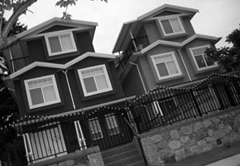
That's what some are calling the latest Vancouver housing form, an evolution of the Vancouver Special that is rapidly peppering neighbourhoods all over East Vancouver (much like its predecessor had done in the 70s and 80s).
Although most don't know the Mohawk by name, you will find them along major Eastside arterials or bikeways -- Knight, Nanaimo, Renfrew, Rupert. They are very hard to miss: a two-storey box with a half-sized strip of "hair" on top.
Having heard all types of remarks by dumbfounded observers as to what they were all about (my favorite being a couple who thought it may have been the newest style of the avant-garde), the unfortunate truth is that it is largely created by the City of Vancouver's own planning regulations.
More specifically, the Mohawk is a result of the peculiar interaction between allowable floor area, the two-and-a-half storey height restriction, and a sneaky requirement that states that any air space above 12ft in height counts towards one's floor area (discouraging open mezzanines along with the large roofs of local heritage homes that give these endearing homes their human scale).
These are the very same rules that account for many new homes having half of their at-grade levels filled with sand -- a fact recently brought to the public's attention by Raymond Louie at the Vision Vancouver mayoral debate as a detriment to affordable housing.
Nothing Special
Although there are many similarities between the Mohawk and Vancouver Special -- insofar that planning regulations created them both – there are important differences. Unlike its grandfather, the Mohawk is a poor performer in the long term.
Aesthetics aside, the interior layout of the Special has proven to be one of the most robust over time. With minimum load-bearing walls, and two separate but comfortable dwellings, these homes are easily transformed and accommodating to families of all types. In fact, it played a significant role in the densification of our housing stock and the resulting vibrancy of our most cherished Vancouver neighbourhoods.
Its biggest drawback, however, was its length, which irate citizens and politicians passionately fought to temper and succeeded through adjustments by city planners to the local building bylaws.
Ironically, instead of moving towards better options, each attempt to exercise control resulted in a poorer form of architecture and, consequently, urbanism. The Mohawk is a result. Although it may be considered more physically attractive than the Special, its awkward and unforgiving interior layout -- bisected by stairs and load-bearing walls – makes this home exceedingly difficult to change in accordance to the dynamic needs of its inhabitants.
Given how rapidly Vancouver is changing -- with ebbs and flows of people from all around the globe seeking to partake in its splendour -- the days of the Mohawk are numbered before ground is even broken. It's disposable. It is junk-food architecture.
A cell transforming a whole
But why should the design and city planning around a single home matter? Normally, it wouldn't. But as the Vancouver Special taught us decades ago, multiply it 25 times and one has a street; 200 times you have a neighbourhood; 1,000 times one has a large portion of our city. Which is exactly what the Mohawks have succeeded in achieving.
Junk food architecture begets junk-food urbanism. But the forms houses take do not happen by accident. It is a deliberate act by those planning our cities and regulating how we should build. So what does this say about Vancouver's city planning?
That such urbanism could be considered world class is truly remarkable. But we all know that the flattering words about Vancouver are not about the city as a whole, but a select few projects focused around the downtown peninsula. And that is all the more disconcerting because -- with all due respect to Mr. Toderian and all like-minded individuals -- the handful of projects that could be described as achieving "world class" status or design excellence are negligible in comparison to the increasingly disposable urbanism that characterizes the vast majority of the everyday landscape.
In fact, looking at the newest additions to our ordinary neighbourhoods -- the Mohawk being one of the most prevalent -- one can strongly argue that Vancouver's city planning is moving in the opposite direction.
The delusions that seem to have resulted from the many books and articles that have been written describing Vancouver's urban achievements are becoming increasingly dangerous. Have we done good things in the fields of urbanism and planning? Definitely. Should we be proud of how far the city has come to date? Undisputedly. But the neighbourhoods in which most Vancouverites live, work, and play -- far from the heavily touristed million-dollar towers of the downtown core -- leave much to be desired in terms of both planning and design.
As the proliferation of the Mohawk demonstrates, these areas are home to some of the worst city planning decisions yet. Ones that promise to be around for a while to come because discussion of how to make these places better has been overshadowed by a few extraordinary examples.
Let's rethink planning
What does this tell us about regulations and planning? Must city development be controlled in some way? How? Note that urban planning as an organized profession has existed for under a century. And, during this time, we have made some of the most detrimental urban mistakes in the history of cities. This has lead many to put forth a strong argument for the societal self-organization and emergence that supported civilization for the 6,000 years prior to our times.
But such a revolutionary argument notwithstanding, conventional planning practices -- that date back to the days of the industrial city and simplistically focus on words, numbers and percentages to shape three-dimensional space -- have shown themselves incapable of dealing with the many complex problems associated with the contemporary city. As stated above, these processes are what created the problems in the first place through institutionalizing a simplistic way of thinking. Even Vancouver's "great" urban achievements are rooted in this outdated mode of thought.
Planning experiments such as form-based building codes certainly offer a step in a better direction. Such codes focus less on land-use planning and more on the architectural and urban "form" of the built environment to create a desirable public realm.
At the very least, however, our planners must closely monitor the real implications of their abstract regulation and find expedient ways to address the continual problems that arise from our growing city.
If we are to truly engage the social, economic and environmental dilemmas of the present, the planning process itself must be rethought, lest horrible urban experiments like the Mohawk become more commonplace.
Related Tyee stories:
- Bright Idea: Zone for Affordable Housing
BC has far too few affordable homes. Whistler has none. Councillor Tim Wake warns: "Plan early, or react later." - Will EcoDensity Make City More Affordable?
History, and high land values, say don't count on it. - The Little House That Could
Could densify cities affordably, that is. The rise of the laneway cottage.
![[Tyee]](/design-article.thetyee.ca/ui/img/yellowblob.png)
Read more: Housing, Urban Planning + Architecture






Tyee Commenting Guidelines
Comments that violate guidelines risk being deleted, and violations may result in a temporary or permanent user ban. Maintain the spirit of good conversation to stay in the discussion.
*Please note The Tyee is not a forum for spreading misinformation about COVID-19, denying its existence or minimizing its risk to public health.
Do:
Do not: