


 SHARE:
[Editor's note: This is the second of Steal This Idea!, an occasional series focusing on practical green solutions.]
The asphalt will crack and erupt, and green plants and vines will sprout forth.
No, this isn't my end of the world prophecy, this is about parking. Or gardening. Or both.
The street I live on has several apartment buildings and five houses. In other words, every person who lives on my street has underground parking or their own spot off the back lane. Yet the street is lined --choked -- with parked cars. What's the problem here? Or rather, what's the solution?
I am not usually one to advocate for another law -- in fact, I have considered running for office on a "One Bylaw Repealed Every Day" ticket. But, an easy way to free up space in our cities would simply be to require that if you have a parking spot on your property, you use it. Leave the public space for public use.
Mapping it out
So how much space is there, and what could we do with it? Google Maps shows my block is 850 feet long and a little quality time with a tape measure finds the distance between sidewalks is 41 feet, so in just one block we have 34,850 square feet to play with.
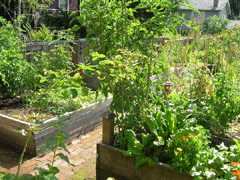
First, let's make it a one-way street, one lane wide, with a couple of pullouts. This maintains access for emergency vehicles, taxis and mini-buses for wheelchairs. We could also throw four spots for visitors into each block. At one end we can put a half-court for basketball, street hockey, skateboarding or rollerblading so once again shouts of "Car!" will mean the players get a short break. For the rest of the block, I propose gardens. We have enough space left for 150 very nice garden plots, each about 3 by 4 metres, plus walkways.
Or, we could continue to enjoy the heat rising off the asphalt, with the rich visual stimulus of dented bumpers and the sound of car alarms.
Volunteers anyone?
Cleveland, Ohio is a hub of Asphalt Gardening, where planter boxes are put right on top of parking lots, separated from the polluted soil and oily road by a layer of wood chips. This would be a great way to try Garden Streets -- do a block or two, then a couple of years later rip up the asphalt and put roots down.
I happen to live in Vancouver, where the city council passed a motion to have 2010 new garden plots by 2010. A handy graph on the linked page shows there is not even a dream of actually achieving it, even though it is a pittance by some standards. (The city-state of Singapore, for example, produces 25 per cent of its own vegetables.)
So call me the answer to Vancouver City Hall's prayers because 2010 new garden plots is only 14 blocks of Garden Streets.
Could we start street gardening without a controversial bylaw to eliminate street parking? Sure. The city could run a newspaper ad explaining the idea and asking blocks to volunteer. Let the citizens do all the legwork of convincing their neighbours. Using bio-intensive gardening methods, my block could provide all the vegetables needed for 22 people, plus all the plant material needed to keep the soil productive -- no need for chemical fertilizers here.
Tasty numbers
Arable Acres found that Vancouver could grow all its own produce by farming the existing front and back yards. Times have changed since the study was done in 1980 -- there are more people living in the city, and development has eaten up space. But other things have changed too. That study suggested those gardens could produce $100 million worth of produce. That is $265,000,000 in today's dollars. The possibilities make your head spin -- 70 hectares of farm in Burnaby produce 10 per cent of the vegetables grown in the Fraser Valley. Arable Acres estimates Vancouver has about 3,000 hectares in streets and another 3,000 hectares in yards. Putting this into practice, the Edible Estates project is farming front yards in six cities across the United States, from Lakewood, California to Maplewood, New Jersey.
All of these delicious statistics beg the question whether the current trend in zoning experiments -- reduced on-site parking so drivers have to fight for spots on the street -- is entirely a good idea.
The idea has been: remove parking and you will remove cars, thus helping build more great places like the pedestrian-scale streetcar neighbourhoods that are being or have been gentrified all over North America. And yes, this appears to be at least a mossy shade of green.
But why should we let private cars be pushed onto the public street in the first place? Why should the taxpayers, including the pedestrians, cyclists and transit riders, pay for the real estate and the asphalt underneath other people's cars?
True cost of cars
Land in urban centres is at such a premium that each street parking spot in front of my building is worth $25,000. Add to that the fact that each car actually has three to four parking spots scattered around the city, just waiting for it (otherwise you wouldn't be able to find a spot at the end of your trip and would be forced to drive back home, spinning like a hamster in a wheel). The total subsidy to drivers is at least $100,000. If drivers had to mortgage their street parking, they would be paying $600 per month. And to think I can't find bike racks.
It would be easy to turn my block, with all its underground parking, into a Garden Street, but why stop there? Imagine your own block stuffed with flowers and vegetables. Big sprays of lupins, colourful mats of marigolds, nodding rows of poppies. The big white blossoms of pumpkin changing to the shiny orange of jack-o'-lanterns-to-be. Fat, red Early Girl tomatoes alongside the sweet Gold Nugget grape tomatoes.
Speaking of grapes, why not trellis a few up for summer shade and delicious juice? And, instead of the "decorative" street trees, you can have fruit and nut trees -- with no cars for fruit to fall upon there is really no reason not to do it.
If what I've said here makes sense to you, please feel free to practice this rallying cry: A garden plot -- not a parking spot -- for every citizen!
Related Tyee stories:
- Lure of the Urban Veggie Garden
Digging for love, money, fame and sex appeal. - Let's Put Fruit Trees on City Streets
An ideas with cultural and culinary appeal. - The Little House That Could
Could densify cities affordably, that is. The rise of the laneway cottage.
![[Tyee]](/design-article.thetyee.ca/ui/img/yellowblob.png)
Read more: Transportation, Food, Environment









Tyee Commenting Guidelines
Comments that violate guidelines risk being deleted, and violations may result in a temporary or permanent user ban. Maintain the spirit of good conversation to stay in the discussion.
*Please note The Tyee is not a forum for spreading misinformation about COVID-19, denying its existence or minimizing its risk to public health.
Do:
Do not: