Opinion

A Tyee Series

The 50-Million-Tree Slurp

Hey coffee drinker, isn't it time you started mugging it up?

By Ruben Anderson, 30 Apr 2008, TheTyee.ca

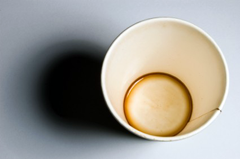
Paper Cup

How to give forests a coffee break.

We have some amazing technology developing here in Canada. Homegrown high-tech whiz-bang -- Nobel Prize material, really.

This system is too good to be true: it can provide fuel, or be easily processed into one of our most versatile building materials; it can sequester CO2 to slow global warming; be harvested for food; increase ecosystem health and biodiversity by providing habitat for animals, birds, plants and insects; slow damaging storm-water runoff; purify water; and help remediate contaminated soils. The feedstock is free and abundant, and maintenance on the system is negligible.

Or, we can destroy trees for pulp to make paper coffee cups, which, after 15 minutes of use, we throw in the garbage can. Then, we pick the cups up with pollution-belching trucks and throw them in a dump, where they rot and create more greenhouse gases. To say this is not an elegant solution to beverage transportation is quite an understatement -- but what could we replace it with?

I have never really understood the delight with which coffee companies brand their paper cups. After all, we usually throw stuff in the garbage because it is low quality or broken. Take a walk down any inner-city alley and you will quickly get a picture of which mattresses sag too soon and which televisions are prone to burning out. A look in the garbage cans will tell you which coffee shops are serious about the environment, and which ones are causing serious environmental damage.

Disposable taste buds?

There are lots of problems with disposable cups. Up to 90 per cent of flavour comes from the aroma you inhale, so the non-recyclable styrene lids make your morning jolt about one-tenth as delicious.

Paper cups are all lined with plastic to prevent sogginess and, if you want to keep your reproductive organs functioning, plastic is seldom considered a good marriage with hot or acidic liquids.

And of course, trees are elegant and amazing organisms that deserve better than to be pulped into coffee cups -- think Stradivarius. Forests generate value with an ease industry will never replicate. The unmeasured economic value provided by Canada's boreal forest for things like water filtration and air purification has been has been estimated at $93 billion. That is two and a half times as much as the combined economic value of the forestry, mining, oil and gas and hydroelectric industries in the boreal forest. This would represent eight per cent of Canada's entire GDP, and trees don't need a pension or healthcare.

And yet we keep grinding them up -- North America uses 60 per cent of the world's paper cups, 130 billion of them per year. Those cups require about 50 million trees and 33 billion gallons of water, which could sequester 9.3 million tonnes of CO2 and quench 550,000 drought-stricken citizens of the state of Georgia, without even asking them to lower their ridiculous consumption rate of 166 gallons per day.

Easy solutions

So. Please stop. There is really no need to argue further. Paper cups are stupid.

Let's dispense the obvious solution quickly: buy a travel mug. I bought this one in 1997 and engraved my phone number on it in case I forgot it somewhere. But, if for some reason the same species that landed on the moon, climbed Mount Everest and eradicated polio cannot remember to carry a travel mug, we might want to have a few back-up systems.

A good place to start would be a deposit system, which has been very effective for milk, beer and soda bottles -- there is even a café in Toronto selling coffee beans in returnable bottles. I would suggest that a few stores or chains agree to co-brand metal travel mugs so you can return your mug to Joe's Café or Caffe Roma, whichever is more convenient. A cargo bike can redistribute mugs as needed if they start piling up in one store.

And, a deposit system suddenly gives value to used cups, something we used to call garbage. In fact, deposits fund a whole industry of binners, or dumpster divers -- servicing those of us who are too lazy to sort recyclables from trash. Just put your mug down anywhere and one of these hard-working urban recyclers will be happy to return it for you. So if those mega-chains just can't imagine living without the brand value of their cups spilling out of garbage cans everywhere, well, that pretty clearly speaks to who is just greenwashing, and who is truly trying to be green.

Looking at a stranger's mug

On a smaller scale, a coffee shop could head to the thrift shop and buy up the ceramic mugs. When I owned a coffee shop, we bought only the mugs that had been personalized with photographs. You know, the kind that say To Grandma, with pictures of babies on them. Some were more exciting, though. My favourite pictured a brunette in white lingerie, holding a glass of champagne and reclining on a hotel bed. Creepily, the I Love You message was in kiddie-style crayon writing.

Armed with these cheap mugs, the café can just give them away for customers to sip and stroll their way up the street. If a dozen metal, newspaper-style boxes were placed six blocks away, in a circle around the café, customers would come across a handy box to put their cup in just as their coffee was finished. Along roll the cargo bikes again, to whisk the cups back for washing.

Even as we transition to systems of deposits and reuse, let's remember to slow down and savour. Do you think the English are so passionate about a cup of steeped leaves, or is it the break, the time to think and talk and reflect, that they love?

So instead of throwing away our cups, let's throw away the smell of bleached paper and the cuts from sharp plastic lids. Once again, it turns out that living sustainably is actually more joyful -- not just better for the world, but better for us.

Related Tyee stories:

 [Tyee]

10  Comments:

Login or register to post comments

  • jilenium00

    4 years ago

    Timmy Ho's

    I live right down the street from a Tim's and the alley is COVERED in disposable cups. It breaks a part of my heart everytime I see it. I've long had a beef with Tim Horton's and even made a Facebook group about it: http://www.facebook.com/group.php?gid=6721933857.
    It's mostly tongue-in-cheek but I think there are some good points, and I really like the horror stories others have left.

  • southdeltawalker

    4 years ago

    mugs mugs everywhere.....

    Why are some people still using paper?? There must dozen's of surplus mugs for every person in Canada.

    At our thrift store they are 25 cents each...some are even "collectible".

    I was at a big antique/collectible sale on the weekend...there were "millions" of tea cups and mugs on the tables..yet the dealers were drinkin out of paper cups!!...
    How easy would it be for the dealers to take one off the table and use it, rinse it and put it back for sale..hardly any of the cups/mugs sold anyways!

    I've been to "environmental" events were paper cups were used!!

    The group i'm in, we have all reusable mugs-all from the thrift store.
    One person is responsible for bringing them and they we wash them when the event is over-how easy is this?? Takes about 5-10 min.

    Remember thermos's? Back in the ol' days when people actually took there own coffee/tea to events.
    Yesterday i found this great thermos at the thrift store. It is from the 60's.
    I "tested" it last night, puting in boiling water-this morning it was still boiling hot.
    Lets make thermos's the new "cool" fashion accessory!!

    Anyways love the suggestion for deposits on mugs and also the newspaper style return boxes.
    Living sustainably is creative and fun!
    Can hardly wait to go out with my "new" thermos.

  • abelluz

    4 years ago

    Monsieur Starbucks

    Has anyone sent this fabulous piece to Mr. Starbucks? There are some great pointers here... specifically about the fact that our trashy ways are also toxic (the plastic coating on paper cups).
    It all makes perfect sense... and what a great way for a big coffee serving conglomerate to make 'good' news spin in their direction!
    Hum, I'll see what I can do, I'm sure Mr. Shultz can be b-lined...

  • ME2

    4 years ago

    Coffee cups

    I've read that the paper cups we've been convinced to buy in order to support our forest industry and to disfavour the use of oil, are in orders of magnitude far more environmentally unfriendly than styro cups.

    The first issue is that paper cups, with their wax/plastic sealants, take many decades to biodegrade, and contribute disproportionately to plugging up landfills.

    I dug up this unattributed quote :

    A study by Canadian scientist Martin Hocking shows that making a paper cup uses as much petroleum or natural gas as a polystyrene cup. Plus, the paper cup uses wood pulp. The Canadian study said, ‘The paper cup consumes 12 times as much steam, 36 times as much electricity, and twice as much cooling water as the plastic cup.’ And because the paper cup uses more raw materials and energy, it also costs 2.5 times more than the plastic cup.”

    Because a styro cup is 99% air (as foam), it uses only a very tiny amount of oil in its structure. In order to counter-act the charge that it too was slow in breaking down, it as been modified to make it more biodegradeable.

    That, then, is the case for styro cups vs the paper one.

    But every one of those very same arguments then arise in spades re the manufacture of ceramic and metal cups.

    And if one assumes that somehow the multiple usage of these will eventually offset their comparatively enormous original energy costs, what about the energy costs of heating and providing the gallons of water and the soap necessary to wash them after each use? I would suggest that the very first washing would equal the energy costs for a styro cup, and then what?

    Am I wrong?

  • Fii

    4 years ago

    SO not classy, too

    I've been using a "personal mug" as they call it, for years now. It blows my mind as I stand in that 20-person line up each morning at sometimes Starbucks, sometimes Tim's- I'm usually the only one who isn't grabbing ANOTHER paper cup.
    The thing is, unless cafes start giving more than a 10 cent discount for the personal mug, PEOPLE WON'T TAKE THE INITIATIVE. I think Canadians actually like drinking out of paper cups...?

  • ME2

    4 years ago

    Styrofoam

    I'm just back from going out for a coffee (ceramic cup) and a conversation with a friend who's a retired petroleum chemist.

    He unqualifiedly states that from our biodegrading perspective, styrofoam is absolutely indestructible.

    I apologise for the misinformation.

    However, there ARE recycling uses for this material, and so, as with so much of our trash, the answer is recyclimg.

    And re your plaint Fii, people do what they see others doing.

  • Yammer

    4 years ago

    good article

    I'm sipping from my metal mug... and resolving to use it exclusively.

  • Andrea from Bec...

    4 years ago

    I had a travel mug, but then

    I had a travel mug, but then I discovered it had BPA and probably phthalates. So I bought a stainless steel mug. However, it makes my coffee incredibly hot -- too hot -- and I can't really drink from it. Also, the coffee doesn't seem to come out very well, so I have to fight to get my stream of burning hot coffee. I wish I could test drive some stainless travel mugs.

    SO, that's why I often have a paper cup. I'd prefer to use my stainless mug, though. And sometimes I tough it out by using the stainless. Ouch, though.

    Andrea
    http://www.consultantjournal.com

  • urban_lenny

    4 years ago

    It was my New Year's

    It was my New Year's Resolution this year to put the kibash on my use of paper coffee cups.

    I'm pretty low-impact otherwise - I live close to work (10 blocks), ride my bike, walk, or bus almost everywhere, buy local, fair-trade, ethical, organic whenever possible, etc., but I had the paper coffee cup monkey on my back despite all of this. I realized this was contradictory to my nature and values otherwise, so I decided that it had to go. I used to use at least one and usually two disposable cups a day for the last couple years. That's at least 365 cups (365!), for those who are counting.

    So far it's been a rousing success (I have only used 4 paper cups so far this year), but it has made me realize how much is being wasted in this habit. I had a hard time remembering to bring my cup in the beginning, but now it's second nature.

    People need to take a little action, because even eliminating another 365 cups, or 730 or 1095 or so on will make a difference.

  • Ruben

    4 years ago

    Why recycling is not the answer

    Thank you all for the responses to my column. I wanted to add a little detail based on some of the points.

    ME2 questions the energy efficiency of washing travel mugs. This is an excellent point, and is the foundation of Life Cycle Analysis. To be truly comprehensive we need to include everything possible--all the costs from extraction to disposal and all the related consequences should be factored in..

    So, styrofoam should reflect the impacts of oil spills, gas flares, landfills and garbage trucks, as well as starving fish and seabirds when they eat the degraded styrofoam. It may be a good idea to include a part of the military budgets needed to secure access to petroleum.

    Travel mugs require mining, refining, fabrication, shipping, retailing and washing. No small impact.

    The problem with LCA, however, is that it is totally incapable of valuing the future. We may think wood pulp is worth X, but when we cut down the last tree, its value is literally priceless. That makes all preceding calculations worthless. More likely than cutting down the last tree, though, is running out of non-renewable resources. They are, after all, non-renewable. So, getting a realistic LCA for styrofoam, which is made from oil that is depleting is difficult to impossible. How can we really value the oil needed for a cup compared to a syringe for diabetics? In ten years will we be happy with our choices?

    The nice thing about travel mugs is that the water and energy to wash them are renewable, from the rain and sun. It does take a long time to pay back the big investment in stainless steel, but like I said, I have been using the same mug for ten years. I am way ahead of disposables.

    Lastly, recycling isn't. Re means again, and most recycling can't be made into the product again. It is made into something lower grade than the original--a few steps later and it is still garbage. Specifically, almost nobody recycles styrofoam; it has many big challenges to effective recycling. When they do, it is made into dumber products like boat flotation. Please check out the sidebar for a link to "We can be garbage free" where I talk about this in more detail, and give a few great links.

    Thanks for reading,

    Ruben.

    • The discussion for this story is closed. No more comments can be added.