


 SHARE:
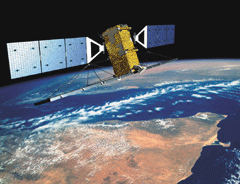
[Editor's note: This is testimony given yesterday by Professor Michael Byers to the House of Commons Standing Committee on Industry Science and Technology on the proposed sale of Canadian aerospace firm MacDonald, Dettwiler and Associates Ltd., which includes operations in Richmond, B.C. The Tyee reported previously on concerns over sale of MDA's satellite operations. Byers holds the Canada Research Chair in global politics and international law at UBC.]
I have been closely following the issue of Radarsat-2 for some years now, most recently in my capacity as the leader of a project on sovereignty and shipping in the Northwest Passage for ArcticNet, a federally-funded consortium of scientists from 28 Canadian universities and five federal government departments.
Prime Minister Harper has recently taken some significant steps to assert Canadian sovereignty in the North. He committed to a deepwater wharf on northern Baffin Island; a cold-weather training centre for the Canadian Forces at Resolute Bay; six-to-eight ice-strengthened patrol vessels for the Canadian Navy; and a $750 million polar icebreaker. It is the latter commitment that I want to dwell on, in relation to the proposed sale of Radarsat-2 to Alliant Tech Systems, a U.S. company.
Now, imagine that the new icebreaker was constructed as a public-private partnership with "Northern Defence Associates" (NDA), a hypothetical Canadian-owned company based in Richmond, B.C. Under the arrangement, the Canadian government contributes $445 million towards the construction of the icebreaker -- in return for a specified number of hours during which the vessel will be available for use, on a priority basis, by the Canadian Coast Guard.
Imagine also that ownership of the vessel vests in NDA, which is allowed -- indeed encouraged -- to create jobs and stimulate economic activity in Canada by chartering the icebreaker to other users when it is not required by the Canadian Coast Guard. Such other users might include, for example, commercial shipping companies requiring ice-breaker escorts through the Northwest Passage.
Everybody is happy. The Canadian government obtains a major tool for sovereignty assertion. NDA obtains significant subsidies in return for providing a public good, and the opportunity to garner profits through private contracts on the side. Commercial shipping companies from around the world also benefit, promoting trade and general prosperity.
That is, until NDA announces that it intends to sell the icebreaker to an American company called "Southern Techsystems" (STK) that specializes in supporting Antarctic operations. A controversy erupts -- and rightly so. Will the icebreaker continue to be registered in Canada? Will it continue to be available for use, on a priority basis, by the Canadian Coast Guard -- given that it might not maintain a Canadian registry, and will frequently be deployed in the southern ocean tens of thousands of kilometres away from Canada's North? To what degree would Canada's new sovereignty assertion capabilities be lost, or at least compromised?
The clear parallel
Does anyone think that the sale of the icebreaker would be allowed to proceed? Yet the parallel between this hypothetical and the proposed sale of Radarsat-2 to Alliant Techsystems is very close indeed.
Radarsat-2 is a remote sensing satellite that provides imagery of remarkably high definition, even at night and through clouds. It is the perfect tool for mapping Arctic sea-ice and tracking ships -- including, according to some reports, submarines travelling at shallow depths (as they would be in the Northwest Passage).
Indeed, the Canadian Ice Service has been the largest domestic user of Radarsat-2's less powerful predecessor, Radarsat-1.
With the Northwest Passage rapidly opening due to climate change, Radarsat-2 has become an essential tool in upholding Arctic sovereignty. Being able to monitor ships from space, and map the presence and thickness of any remaining ice, is a necessary complement to having naval patrol vessels, Coast Guard icebreakers or helicopters available to interdict foreign vessels.
Lose our authority over Radarsat-2?
Radarsat-2 was developed through a partnership between MDA and the Canadian Space Agency, with Canadian taxpayers paying $445 million or about 85 per cent of the total cost. In return for its investment, the Canadian government was promised large amounts of imagery as well as "priority access" to Radarsat-2 in emergencies. These might include floods, forest fires, oil spills -- or a suspect vessel entering Canada's North.
Once Radarsat-2 is sold to Alliant Techsystems, the United States will likely replace Canada as the country with licensing authority over it. I have sought to confirm this with several officials from the Department of Foreign Affairs, including in the minister's office. All of them claim not to know what will happen to the license.
If the United States becomes the licensing authority, Ottawa's ability to control what the satellite is used for -- and to commandeer the equipment in emergencies -- might be lost. And even if Canada were to retain some sort of notional control, one can well imagine that control breaking down in certain circumstances when the company in question is owned and located in the United States.
Suppose, for instance, that Canada wanted priority access for sovereignty assertion purposes just as a major war involving the United States was breaking out in the Middle East.
One can even imagine the U.S. government using Radarsat-2 in ways that directly contradict Canada's interests. Suppose that the United States sends a ship into the Northwest Passage without Canada's consent. Or that it attacks a foreign country in the absence of UN authorization or a truly imminent threat -- and in direct contradiction of the Canadian government's stated position.
Where's the benefit?
The Canadian government recently announced that it will introduce legislation enabling foreign investments to be blocked if they are contrary to Canada's national security interests. As I understand it, the move is directed primarily at Chinese state-owned companies investing in the Alberta tar sands. But a similar concern should prompt the government to block the Radarsat-2 sale.
This committee is focused on the test set out in the Investment Canada Act. I am not an expert in that legislation, but in light of the Arctic sovereignty dimension, I find it hard to believe that the sale of Radarset-2 offers a "net benefit" to Canada.
Finally, I wish to remind the committee that there are also powers -- and a somewhat different test -- provided under the 2005 Remote Sensing Space Systems Act, which was enacted especially for Radarsat-2. That legislation requires that the foreign minister approve any transfer of the satellite's licence. And in making his decision, the minister "shall have regard to national security (and) the defence of Canada."
Radarsat-2 is just as essential to the national security and defence of Canada as the $750 million polar icebreaker the government has recently committed to build. For this reason, I believe that it should stay in Canadian hands.
Related Tyee stories:
- Crash of Canada's Space Biz
Why BC firm's sale to Americans leaves huge crater. - Arming the Heavens
Why we must oppose US weapons in space. - Squinting to Confirm a New 'Earth'
Does exoplanet Gliese 581 c exist? Could it support life? UBC team key to finding out.
![[Tyee]](/design-article.thetyee.ca/ui/img/yellowblob.png)
Read more: Science + Tech










Tyee Commenting Guidelines
Comments that violate guidelines risk being deleted, and violations may result in a temporary or permanent user ban. Maintain the spirit of good conversation to stay in the discussion.
*Please note The Tyee is not a forum for spreading misinformation about COVID-19, denying its existence or minimizing its risk to public health.
Do:
Do not: