
Each is working somewhere else, and will save money and lives here.
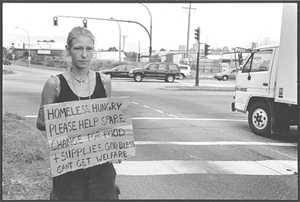
Boundary Road exit, Vancouver. Photo Elaine Briere.
Homelessness is not necessary. Unlike most other urban social problems, homelessness is something policymakers actually know how to address. The U.S. and Britain have slashed their rates of homelessness during the past decade. But in Canada, homelessness is on the rise; and in the Vancouver region, the official count of homeless persons almost doubled from 1,121 souls in 2002 to 2,174 in 2005.
Price of Homelessness
In 2001, the B.C. Ministry of Community, Aboriginal and Women's Services published a study examining costs of homelessness in B.C. It found:
Homeless people cost taxpayers up to $40,000 per year in service and shelter costs. By comparison, the costs of a person in supportive housing ranged to $28,000 per year. Normal Canadians spend an average of $11,200 a year on shelter.
Homeless people cost taxpayers an average of $11,410 a year in costs via the criminal justice system. The average taxpayer, by comparison, pays $362 a year to maintain the system.
Homeless people cost $7,893 a year in social services; the average taxpayer pays $179 a year to support those.
Homeless people cost $4,714 a year in health care; the average Canadian uses $2,633 per year in publicly funded services.
Homelessness is not cheap. Provincial taxpayers spend up to $40,000 annually per homeless person, according a 2001 study. That money is spent on police calls, hospital visits and other emergency social services. If there are only 2,174 homeless people in the Vancouver area (an official figure everyone in the field assumes is well below the actual total) and if each person uses $40,000 in services (a figure that did not include all local services), then British Columbia taxpayers are spending $86.9 million a year just to help people living on the streets stay alive.
Housing them all would cost less than half that much money, and numerous studies show that people who live indoors go to jails and hospitals far less than people who live on the streets. The average Canadian spends only $11,200 a year on housing. Even government-run supportive housing -- where residents get social services, such as counselling -- costs only $28,000 a year.
This essay highlights seven solutions to homelessness.
Each of these ideas is working somewhere.
Each is affordable, in that they will cost taxpayers less than the $86.9 million a year now being spent just on survival rather than solutions.
And while constructing new supportive housing is one critical component of an overall solution, none of the solutions presented here involve building anything new.
Also, none of the not-so-new ideas presented here is being proposed by either the Tories in Ottawa or the Liberals in Victoria; and only one is included in Vancouver Mayor Sam Sullivan's sweeping Civil City Project.
Idea One: Trade Fairs for the Homeless
Ask any homeless person why they are living on the street, and one theme will inevitably emerge: they were unable to navigate the maze of programs and procedures intended to help. The same bureaucracy that frustrates all of us can utterly stymie those of us with mental handicaps or drug addled brains.
In the fall of 2004, a group of homeless advocates in San Francisco tried an experiment. They rented a local convention hall, persuaded nearly every social service provider in their city to set up a table, and opened what amounted to a trade fair for homeless people. In addition to information about every short- and long-term housing program available in the city, Project Homeless Connect provided clothing, shoes, free phone calls, counselling, medical treatment, dental care, eye exams and glasses, benefits information, government identification cards, and more. There was live music, free food, and, yes, even secure valet parking for shopping carts, so that clients could wander the aisles without fear of having their few possessions stolen.
Project Homeless Connect was so successful in enrolling new clients into existing social service programs, that San Francisco now convenes the event six times each year. Homeless participants report that they feel respected and safe at the event. (This is particularly relevant for Vancouver, where many homeless people -- especially women -- avoid visiting social service offices in the downtown eastside for fear they will be robbed.)
Homeless Connect has helped galvanize service providers as well. Social workers and activists and bureaucrats all get to know one another and build relationships that make it easier for them to help their clients navigate among providers. And volunteers clamour to participate. High schools and colleges allow students to volunteer in lieu of class work, and a few Bay Area companies have started allowing their employees to take paid days off work to help organize the event.
At least 32 U.S. cities sponsored homeless connect days in 2006, and more are planned for this year. Vancouver, Burnaby and New Westminster each launched pilot projects based on the Homeless Connect idea last October. New West Mayor Wayne Wright served dinner to the Queen City homeless. Vancouver Mayor Sam Sullivan did not attend.
Idea Two: Raise the Welfare Rates
You don't need another study to know most people become homeless when they can't pay their rent.
It's cheaper -- not to mention more humane -- to help people pay their rent rather than rescue them after they fail. The majority of Vancouver's homeless are on welfare. Taxpayers could spare themselves that $40,000-a-year in street services if the province would cough up a couple hundred dollars a month to cover the gap between what welfare pays and what it costs to rent an apartment.
Welfare pays $510 a month to single, employable adults aged 18 to 64. That's broken down into $325 a month for rent, and $185 a month -- or $6 a day -- for everything else. Those rates have not been adjusted since 1991. But the Vancouver area real estate market has changed dramatically. By 2004, according to a report by the Greater Vancouver Regional District, the average market rent for a bachelor apartment in Greater Vancouver was $678 per month.
Raise the Rates advocates raising welfare rates by 50 per cent and indexing them to inflation (the way MLA salaries are indexed). Also: ending barriers to getting on income assistance, and raising minimum wage to at least $10 an hour. Data compiled by the Canadian Centre for Policy Alternatives found that raising welfare rates by 50 per cent would cost only about one-sixth of B.C.'s recent budget surplus.
Idea Three: Train Young Workers
Those with the highest risk of becoming homeless are young adults recently discharged from institutions such as jail or foster care. Lacking even basic employment skills, a terribly high percentage of them wind up on the streets.
Even day labour can be hard to get for people who lack required work clothes, such as steel-toed boots. Providing such items presents an opportunity for the private sector to become involved. "During Homelessness Awareness Week, one group put out a call for steel-toed boots," said Vancouver homeless fair co-ordinator Helesia Luke. "Within a few days after the newspaper article, Scott Paper and Lafarge Cement donated a good supply of used steel-toe boots. Of the first three individuals who received boots, all are still working...now two of these three people are off the street."
The best practice is to expand programs such as Vancouver's innovative BladeRunners, a training program for at-risk youth that focuses on construction and related trades. BladeRunners provides construction trades training and places young people on paid internships to earn hands-on experience. Rona is reportedly exploring a similar program that would train young workers for its stores.
Idea Four: Spread the Love Around
When asked which municipality they considered their last permanent home, three out of four homeless individuals say they live in the Vancouver area. (In the most recent count, only 15 per cent reported residing outside B.C.) The best practice is to return most of these individuals to local communities similar to those they preferred before they became homeless. Years of research shows that individuals moved to so-called "scattered site" housing tend to reintegrate into mainstream society faster than those housed in large facilities in troubled neighbourhoods such as the downtown eastside.
Developers of scattered site supportive housing often face intense resistance from not-in-my-backyard style neighbourhood groups, which fear the arrival of recovering drug addicts or the mentally handicapped into their neighbourhoods. For example, resistance was fierce to a recently rumoured supportive housing project at Dunbar and 16th Avenue in Vancouver. Those fears reportedly spawned an anonymous group called NIABY: Not In Anyone's Backyard.
Helping neighbours overcome these fears presents an opportunity for faith communities to help the homeless. Many churches, synagogues, temples and other worship centres already offer a variety of support services such as soup kitchens, clothing racks and subsidized child care. These faith communities recognize that the act of helping others is one of the most rewarding experiences life offers. Leaders of such communities need to take the next step, and begin organizing forums that actively encourage the development of safe, supportive housing in their neighbourhoods. Faith communities are ideally positioned to educate about supportive housing, most of which prohibits any drug use (residents are routinely tested) and monitors all other activities.
In addition, many faith communities own land. Churches and temples can work together with non-profit developers of supportive housing to build small-scale complexes that include, for example, a few units of supportive housing alongside a new community hall.
Idea Five: Buy a Few Hotels
Even if all the marginally homeless were given enough money to pay their own way, and even if all the "healthy" homeless -- those with mild mental illnesses and addicts in recovery -- were moved to scattered-site supportive housing, there would still remain a core group of hard-core addicts and those with severe mental illnesses who need a place to live.
Since it's cheaper to house these hard cases than to continually treat them on the streets, it makes sense to create a facility for the hardest-to-house. The city's official homeless strategy figures that area governments have to build 400 social housing units a year for the next 10 years in order to house the homeless. With fewer than 500 units planned in the next three years, it's clear that not even go-go Vancouver can build its way out of the current (and growing) homeless crisis.
And since there's no way Vancouver could site and build such a politically problematic facility in time for the Olympics, the most obvious solution -- though not one that anyone in government wants to talk about -- would be to buy a few old hotels, convert the rooms to housing, and establish closely monitored facilities that tolerate discrete drinking and drug use.
Buying hotels is not a permanent solution. It's more of a band-aid that will take pressure off emergency services for a few years while more appropriate facilities are being built. But most of the older motels and hotels in the city are not permanent structures anyway. They are getting torn down rapidly because their lots are worth more to developers than what the older hotels could generate. Conveniently, many of the region's older hotels and motels are already located in high-traffic neighbourhoods, such as Kingsway in Vancouver or King George Highway in Surrey.
The idea of housing people no matter what their problems may be is a hallmark of recent U.S. efforts to end homeless. Seattle's "Housing First Initiative," for example, combined housing with in-house medical and mental health services. In its first six months, the pilot program it has already been successful at moving roughly two dozen chronic homeless -- many of whom have long-term addictions -- off the streets.
Idea Six: Give Addicts Time to Heal
More than half of the individuals contacted during the 2005 homeless census reported they were addicted to drugs or alcohol. Those who work with the homeless figure that nearly all of the hardest-to-house individuals are long-term drug users.
Most of these addicts have tried to clean up numerous times. They check into detoxification clinics for a week or so, then transfer to one of a number of 28-day treatment programs scattered throughout the Lower Mainland. But the majority of homeless addicts have used drugs on a daily basis for more than a decade. Most find that four to six weeks of forced abstinence is not sufficient to overcome decades-long habits. As a sad consequence, the vast majority of formerly homeless individuals return to using within a year of completing a 28-day treatment. Some estimates calculate the relapse rate as higher than 90 per cent.
Thus many of the hardest-to-house individuals live lives like revolving doors: detox, treatment, a short stint in welfare housing, a longer stint on the street, then back to detox. It's not uncommon to find addicts who have repeated this cycle more than a dozen times.
What these addicts need is time to recover, and a supportive environment in which to rebuild their lives. So-called "recovery houses" differ from treatment centres in that in lieu of medical staff and treatment, they offer simple group counselling and regular participation in 12-step programs. Because recovery houses are much less expensive to operate than treatment centres, addicts can stay for a year or more while slowly rebuilding their lives. The best-run recovery centres, such as Impact House in California or The Last Door in New Westminster, report that up to 90 per cent of the clients who complete their programs are still clean a year later.
A small raise in the welfare rates, coupled with small grants that reward long-term addicts who remain in recovery and continue to test clean, would enable hundreds of homeless addicts to rebuild their lives from within the safe confines of recovery houses -- rather than tossing them back out to fend for themselves after a few weeks of treatment.
Idea Seven: Bring Governments Together
Like one of those cliché cop movies in which local and federal cops scuffle over turf, governments squabble endlessly over which agency is responsible for what. And policies enacted by one government often wind up costing another. (Mayor Sullivan's plan to ticket homeless offenders, for example, is virtually assured to cost the province more money in overnight jail stays.)
In Britain, the Rough Sleepers' Unit was created back in 1998. Rough sleeping in England has fallen from around 1,850 measured cases a night in 1998 to around 500 now, and cases of new homelessness are at a 23-year low. The unit serves many functions, but a primary one is co-ordinating response among the myriad agencies.
Likewise, the U.S. Interagency Council on Homelessness has educated lawmakers and co-ordinates among local, state and federal agencies. The council develops and encourages best practices, such as homeless connect days and housing first polities.
What's needed is something that will bring to homelessness the sort of focus that the Vancouver Agreement brought to drug policy. Homelessness will end only after bringing an individual off the streets becomes more important than whether or not that person is using drugs or receiving assistance or any other concerns.
This idea of bringing governments together is one of the cornerstones of Vancouver Mayor Sam Sullivan's Civil City Project. But realpolitik is such that there's only so much any mayor can accomplish. Lasting detente will require leadership from premiers and the prime minister.
At some point, political leaders will recognize that it's far cheaper to prevent homelessness than to fund the ongoing treatment of homeless individuals. When they do, there will be no shortage of policy suggestions awaiting their attention.
Related Tyee stories:
Monte Paulsen is a contributing editor of The Tyee.
64
Login or register to post comments
Cycling Commuter
6 years ago
Comments on "Seven Solutions to Homelessness"
Years of research shows that individuals moved to so-called "scattered site" housing tend to reintegrate into mainstream society faster than those housed in large facilities in troubled neighbourhoods such as the downtown eastside.
Definitely. When addicts are constantly surrounded by other addicts, they think laying unconscious in a back alley with a needle sticking out of their arm is normal. The downtown eastide is a killing machine. The average lifespan there is something like 40 years compared to 80 years average in Canada. If you removed from the equation the non-addicted people who happen to live in the downtown eastside, longevity figures for addicts would look even more dismal. Gentrifying the downtown eastide and separating addicts from each other by scattering them would save a lot of lives. The poverty industry wouldn't like that. They want to continue making a lot of money by fighting gentrification and keeping the downtown eastside killing machine just the way it is.
Another way to save addicts from themselves is to pay the shelter portion of their welfare directly to landlords. This step alone would prevent a huge amount of homelessness. Many drug addicts currently spend their shelter allowances on drugs instead of paying their rent and that eventually gets them evicted.
Yikes! The poverty industry must really hate this approach! Here again we have an example of a policy that can help fight addictions, save lives and let recovered addicts return to gainful employment, thereby denying the poverty industry a source of perpetually helpless and slowly dying victims to feed their poverty machine. The poverty industry can be expected to dispatch a vast army of lawyers to fight this threat to their lucrative livelihoods.
Cynic
6 years ago
It's probable that the provincial and federal governments already know about these solutions. It's not like these are new ideas. It's just that they don't fit in to the elite's thumb-on-our-necks agenda. Compare the money figures above to the $100 million being spent on the luge run in Whistler, or the $15 billion surplus that will only be used to "pay down the debt". The solutions to poverty are well-known and clear, so when will we people stop accepting the empty rhetoric from our elite-controlled politicians?
Truman Green
6 years ago
All great ideas, and Paulsen's genuine concern is obvious.
Most enlightening is that homelessness is very expensive to taxpayers -- even more than using extraordinary measures to ensure housing.
Still, politicians tend to do what gets them elected, so maybe those of us who are emotionally disturbed when we see people lying on cold streets, should become more vocal.
Josephine
6 years ago
Dear Cycling Commuter,
Your reference to "the poverty industry" is most offensive. Most of us who work in non-profits to help people living in poverty take a huge INCOME CUT to do so. We could make a lot more money working for the government or in private industry working to make rich people richer. Also, there are no perks, meaning such things as a social status or even social APPROVAL, a pension plan, wealthy social connections and clients, and easy successes (the welfare system is now so punitive it's difficult to help your clients get anything from welfare).
It's much easier to defend the rich and the able bodied than it is to defend the poor and people with disabilities who were not born into privilege like Vancouver's mayor.
Capitalism
6 years ago
Thank you for this Article Tyee!!
I think this proves that there is enough money in the system. I read that the average homeless person receives $40,000 - $60,000 in taxpayer funding. This is alarming given that there are single mothers raising kids and supporting themselves for $30,000/yr.
Clearly, we need to use existing (not new) resources more efficiently. Too many governments, too much politics, too much interference, not enough accountability.
Honestly, I believe the government should contract out these services and compensate the executor for reaching milestones. You get a not-for-profit company (arms length from the government) to set up housing, food, access to medical services, etc.
To make sure you attract the best of the best, you pay accordlingly. Reward executives for reaching certain milestones, etc.
Politics = ineffeciency. There is never a clear mandate, your bosses are always changing and each has its own vision. You have elected officials with zero managerial/hands on experience exercising undue influence on these matters.
With all due respect to Mr. Sullivan, who is good for business, tourism and getting things built - what the heck does he, Larry Campbell, Gordon Campbell or Carole James know about running and managing these types of things???
It is complicated stuff - fund allocation, raising funds, soliciting the right contractors, finding the right land, going through readings, etc. etc.
Capitalism
6 years ago
Truman Green:
It is alarming isn't it. I want to stop hearing about Gordo and his cuts! That Gordo is responsible for homelessness.
Gordo is guilty, as it the NDP previous, the Socreds, all levels of city council, etc. for the same thing.....mismanagement!!!
The system is designed for failure! Let the government provide the funding and determine funding levels. Let an arms length company act independently to solve these problems!
Capitalism
6 years ago
Look at BC Ferries - I know all you lefties will disagree - however, politics have been removed!! The government still owns the assets, though for all intensive purposes - it is a private company.
BC Ferries has upgraded ships, is rarely delayed, kept fees reasonable, upgraded its terminals - and significantly reduced its operating deficit to zero, from tens of millions of dollars!
They have had some problems with its fleet - basically a bunch of crappy boats it inherited from the disfunctional company it inherited....
Alcibiades
6 years ago
It isn't, as you so cavalierly put it, a question of: "the average homeless person receiving $40,000 - $60,000 in taxpayer funding."
You need to read a little more closely and critically Cappy. As usual.
maestro
6 years ago
Cycling Commuter:
Good points...
A while back I had a discussion with a Criminology student about his chosen field. He said that one of his profs made a comment :
"The system is a SUCCESS because of its FAILURE ".
I asked for more clarification, and he stated that the Criminal Justice System is dependent on " Failure " for it's " Success ".
The "success" is related to the number of jobs related both directly and indirectly to the justice system.
Thus: The more the system "fails" the higher the employment.
Don't they call it " Corrections" ??? How many kicks -at- the- can does the system 's paid and unpaid participants get?
If it fulfilled its Correction mandate, it would throw Judges, Lawyers, Police officers, Social workers, Sheriffs, Prison guards etc etc. out of work.Hence the MORE failure , the MORE jobs...or conversely jobs dependent on failure.
Look at Pickton case...while only charged and still before trial, the bill is apparently $100 Million so far...(with my own and others suspicions that the system had suspcions far ealrier on...and perhaps a tie in with vicitms who were also DES drug addict/prostitutes ). The potential still exists he may be found Innocent or Not Guilty beyond a reasonable doubt.
No refund, but possible appeals. More cost.
Cont'd in next post.
southdeltawalker
6 years ago
as someone who has voluntered in the downtown eastside all i can hope is that articles like this will have an effect and get something done.
the scene on the streets is shocking. i have a friend who works in the downtown eastside and he told me last week that he works in "an insane asylum, the asylum is on the streets not in an institution".
there are 7 ideas presnted here. there are many ideas , initiatives, plans, agreements etc. for homelessness and drug addition but the problem is spiralling in the downtown eastside.
it is interesting that the study that looked at the cost of homelessnes was done in 2001, so thes figures are probably out of date and the actual cost is higher.
also before Campbells cuts there was provision for work clothes i.e. work boots from Ministry of Human Resources
[ "Within a few days after the newspaper article, Scott Paper and Lafarge Cement donated a good supply of used steel-toe boots. Of the first three individuals who received boots, all are still working...now two of these three people are off the street.]
if the lack of workboots was the cause of homelessnes surely a way can be found to provide work boots before the people invovled become homeless.... how crazy and upside down is this especially considering the costs of homelessness!
how many of you readers have spent time recently in the downtown eastside? well i have, myself and friend had our lives threatened by meth. addicts, we stepped over needles, condoms and people lying on the sidewalks, the smell of urine was overwhelming. the people we dealt with were mostly filthy, out of control due to drugs and other addictions.
there are long term solutions to deal with this but the will and the money has to be there.
yes for some, training or a trade fair works but for the majority it is long term solutions and commitment
as a society the question is: are we going to make a real effort to care for people and take action on what is happening on the streets or are some going to sit in our comfortable homes with bigger and bigger locks and just wait for people to die off or somehow go away?
are we going to elect politicians who give lip service or people who have a commitment to to change and brave enough to commit the policy changes and funds that are needed?
are we going to make a commitment to take action to do something about this?
the shocking daily scene of homelessness and drug/alcohol addiction reflects on us and our humanity.
Grumpy
6 years ago
Cappy, BC Ferries improved under Hahn? you must believe in the tooth ferrie. What BC Ferries has done is recouver the seats, and 'puff' stuff like that. No major maintenace has been done to the boats. The engines are held together with bailing wire and it is almost a death ride taking them. Look at the rust!, Feel the vibrations of the uhappy engines. Yess cappy all the reno work has been cosmetic.
Now to the poor.
Seems nothing has changed much since Dicken's time.
Enid Godtree
6 years ago
Though I do appreciate this article for the wealth of options it lays at the floor, I feel it is being over optimistic about the money issue. While it is estimated that we spend 40,000 a year on homeless for healthcare, social services and policing, I doubt that an increase in spending on housing or any of the other proposed options would lead to a decrease in spending on the former. Show me a doctor, hospital, cop or social service worker who would say: "Ya...actually I guess we have enough to operate well right now."
Personally, I think what the author is good to point out is that all these ideas are on the table and they wouldn't cost 'much'.
Incidentally I lived in Norway where homeless is almost non-existant and where it does exist is usually due to drug addiction. People with poverty and mental health issues are kept off the streets due to high spending on a wide and diverse combination of social services, mainly funded by a combination of high taxes and government revenue through national industries. In contrast to Capitalism's belief, government is not always inefficient, in fact the Nordics consistently outperform the rest of Europe economically and all of North America when it comes to government deficits.
However, capitalism's analysis is very useful here because it represents he thinking that most neo-liberal government beuricrats have adopted. These people though they have management training, are, in fact, god-awful managers. They do not listen to experience, tend to be arrogant and take credit from the hard work of people below. None of them have worked in a homeless shelter, none of them acknowledge that minority groups are over-represented in homeless populations because of a history of economic exploitation. None of them know there ass from their elbow when it comes to social policy. To them it all comes down to the economic models of Milton Freedman who is, thank god, dead.
Luckily, thanks to a handful of activists and social workers, these issues are finally having their day in Vancouver and BC.
moodyguy
6 years ago
Good Article:
Homelessness is an issue, the problem is deeper.
I believe that the biggest barrier to addressing the homelessness issue is not that processes to solve the are unavailable or unaffordable, rather, I believe that the issue is not truly on the radar screens of policy makers. When I hear Sam Sullivan speak of homelessness, I hear him comment on inappropriate behaviours and harrassment, not on how unconscionable it is that people in this country of plenty have to live on the street, often as on west fourth, within sight of significant wealth.
Homelessness does not fit into the neoconservative world view except as a starting point that provides tremendous incentive to work and advance (Tom Peters wrote an article in Time magazine in 2000 that virtually extolled poverty in India as a source of motivation for those impoverished-a framing of the issue that I found repulsive). From this perspective, the homeless can get out of there situation, they simply have to work hard enough. Unfortunately this is an argument that I have geard stated in various forms many times.
Developed nations with a high standard of living do not have the homeless issues that we have here, third world nations do. Developed nations with a high standard of living know that not only the individual but the society loses if there is not a mechanism in place to prevent those who, for what ever reason, find themselves in dire straits from hitting the point of homelessness. They put in place the kinds of systems mentioned in this article and others to prevent this from happening.
Homelessness is not a problem. It is an issue that arises out of our acceptance as a society, and the acceptance by policy makers, that the lowest level to which members of our society can fall is living on the street in the downtown east side or on West Fourth (take a look around McDonald's and Safeway at 9:00 am any day) out in the cold and in a state of desperation so low that it requires a major effort to bring people back to being an integral part of society. This is the problem.
Fix this problem, and then there will be solutions to the issue of homelessness implemented that will work. Continue as we are, and in-spite of the best efforts of not-for-profit organizations, we will continue on the path toward resembling a third world city (Immedla Marcos had some beautiful buildings built on the Manila waterfront, just as our Olympic stuff is going up) and both the growing number of homeless and our society will suffer.
Truman's post is correct, homelessness, not the behaviour of the homeless, must be made important to policy makers.
Fiat lux
6 years ago
In societies and economic systems built and nurtured by so called "competition", there must be losers and the homeless are the prime example. Not to mention the slave labour countries that produce the goods for our "consumption".
Competitive systems always demand greater and greater inputs for lesser and lesser benefits, until they self destruct.
Empires and economic systems based on them, destroy the lives of peoples on their way up, until their inevitable collapse.
When corporations openly boast that the main purpose of their existence is profits and increased market values of their shares, poverty is created and becomes inevitable, because those constantly increasing profits must come from somewhere.
Yes, I'm a private enterpriser, but not a capitalist in the present, criminal sense.
Ed Deak.
Capitalism
6 years ago
moodyguy:
the root of the problem can't be fixed. there are drugs, abuse and quite frankly uninspired people in this world.
i grew up in a middle class neighbourhood and know (of) one guy living on east hastings. this guy had great parents growing up. they attended all of his hockey games, cared for him, gave him an allowance, etc. he actually asked me for change on Dunsmuir about 7 years ago - not knowing it was me. we had a 5 minute chat, I gave him a 20 - he told me how terrible he felt about how his parents felt.
from the first day i stepped on the ice with this guy, i knew he was addicted to trouble. he was the first kid to smoke, to smoke a joint and drink.....
as a young teenager, he was lazy, skipped class and got caught up in bad stuff. honestly, i firmly believe it was in his genes.
People like him exist - it is the case in all major cities. Got to Seattle or Portland - they are even worse! We should take care after the mentally and physically disabled. We should take care of the mothers struggling to raise their kids and provide equal education for everyone.....
I have no problems with paying higher tuition fees for my kids when the go to college - because I can afford it. I have no problem paying taxes to support those who want, need and deserve our help.
My problem is with the mechanisms in place. Quite frankly, there is taxation without representation. This money enters this big hole, and his managed inefficiently from start to finish. Government programs exist as much to overcompensate their unionized employees - every bit as much as to achieve their "so called" desired objective!!
Alcibiades
6 years ago
Why is it that this sounds a lot like someone who 'loves to get shit-faced and play the tables at Vegas'?
You and your friend appear to have a lot in common - he just happened to have worse luck I guess.
maestro
6 years ago
Well put Cap....
Current Mechanisms, Taxation without representation, the big hole....etc. etc.
Speaking of Hockey, my sons coaches' wife is a stewardess, recently they travelled to New York...she commented to me on how bad N.Y. used to be, but how much better it is now....yet here in Vancouver...they avoid the downtown.
Why re-invent the wheel??? Seems other jurisdictions are being Pro-Active,and seeking solutions, thus why not see what works and what can also be applied here?
I think there exists this " underbelly " in society that needs to be more clearly identified as to what perpetuates this vicious made -in -BC cycle.
That underbelly includes a lax Legal system and such things as using general tax revenue to allow ( if not further encourage )people to poison themselves with safe injection sites(oxymoron) and dress it up as Harm Reduction versus "out -of -harms- way", "cold- turkey " etc.
That sort of laissez -faire attitude simply breeds more failure and even worse, effectively makes EACH one of us PUSHERS, via the big tax general revenue hole our taxes are injected into..., which I (and everyone else) should truly resent.
Alcibiades
6 years ago
maestro:
How about turning that on its head?
Most of Campbell's friends have a personal… and exclusive 'access' to his 'shell-like' and pay little or no taxes. In fact, there is a whole list of Order in Council appointments whose well-paid jobs is spinning the news and misrepresenting the facts so that the average voter thinks Campbell is a good guy.
In fact, he’s the power hungry chairman and C E O of a little fly-by-night effort that might better be called Liquidation BC than ‘the best place in the world’.
And that last remark, it’s an insult to the intelligence of anyone who knows that the Safe Injection Site is actually saving lives that would have been lost without it. Does that mean if it closes down we’ll all be party to murder? Give your head a shake. Please.
anarcho
6 years ago
It all boils down to this. Welfare for the corporations good, welfare for the poor, bad. Hence we have the homeless, who could be housed on a fraction of the money given away on money-losing projects like the Olympics. People don't matter, only the corporate elite matter. Capitalism is the state socialism of the rich.
Alcibiades
6 years ago
Welcome back anarcho,
Happy New Year.
grw
6 years ago
Speaking of New York, I remember distinctly my first visit there in 1986. I was shocked at seeing people lying on the streets just like they showed in the movies. That meant that I saw none of that here in Vancouver as recently as 1986. My, how far we've come. Presumably we were a capitalist society back then, too, with winners and losers -- only the losers didn't find themselves living on our sidewalks. What happened?
Oh, and this:
That made me laugh! I don't know if it was intentional or not, but I think I'm going to use it. Those purposes really are intensive, aren't they?
Jay Currie
6 years ago
I'm surprised that some of the other work on homelessness was not mentioned in this excellent article. One set of studies made a distinction between the occasionally homeless and the hard core in, as I recall, New York. It found that the costs associated with the 20-30% of the hardcore homeless were on the order of three times those of the occasional. So call the hardcore in Vancouver a $150,000 a year per person problem.
As well, it can be important to make distinctions between the lucky mental patients who in a spasm of political correctness were sent to "live in the community", the hapless crack addicts, Natives and plain old outdoor drinkers. Each pose different challenges and need different care systems.
Finally, at some point a decision has to be made as to the degree to which the care systems can operate on the basis of according the homeless the full autonomy of citizens. Is there a point where mandated care, possibly by way of Court intervention, is required?
maestro
6 years ago
ALCI:
People need BOTH roots and wings... but not kept in a taxpayer -funded " suspended animation " detached from reality and ultimately/inevitably "6 feet under" prematurely .
Drug addiction via safe injection sites is just a prolonged disease versus a cure. Your logic implies we should inject more cancerous cells into cancer patients, give booze to those suffering from cirrhosis of the liver, play poker with gamblers..etc. etc.
Is this a rather illogical meets backhanded way to lessen the environmental impact...ie "less people, whatever it takes?"
I'd much rather see these people live to 80, than die at 40, and thus not have contributed to population control via that methodology .
Give MY head a shake????....sorry, I'm getting a bit dizzy from the bizarre logic being continually promoted to sustain this slow means of what amounts to a public execution. At least give me the "voucher -option" to direct my pro rata tax contribution share towards those who would ACTUALLY benefit from TRUE harm reduction...,ie homeless shelters, food banks, etc. etc...
Coddling the problem incubates the problem , publically endorses the problem...makes it more socially acceptable, and thus creates more clientele, more tax dollars get flushed...
I ' d rather see a "Closed permanently due to lack of demand " sign .
Capitalism
6 years ago
Alci,
You know - I've never been able to understand this. Sure, I am able to shelter a little income through trusts and RRSPs. I also have the advantage of the capital gains exclustion. However, the vast majority of my income is taxed at a very high rate. In addition to this, my consumption is taxed at 13.5%.
The more you are taxed as a businessman - the more your profit is reduced. The less profit, the less risk you are willing to undertake. Therefore, your investment goes down. When investment goes down, you borrow less, produce less, pay less interest and consume less. Everything is less!
We have a great country. We are not a country full of mature, multi-national companies which employ half of the country - i.e. Netherlands - ING, Heineken, Shell and Philips.
We are a country built by risk takers, entrepreneurs and small businesses. Sure, investment income is subject to lower taxes. However, this is necessary to induce investment, encourage risk and promote competitiveness.
You and your friend appear to have a lot in common - he just happened to have worse luck I guess.
Work hard - play hard. I've burned the candle on both ends for years! I'll probably live a short life, but I love my work and I love my free time. I'll trade it for a few years in a retirement home!
Truman Green
6 years ago
You would be absolutely correct, Maestro, except for one small item:
Heroin, if injected properly and not accompanied by contaminants and a bizarre price tag, is not a dangerous drug.
Hard to believe, eh! I was shocked to learn this too, so I won't hold it against you.
Study up on it! It is fairly addictive, but not as addictive as nicotine.
Most of the deaths accompanying heroin use are not from the drug itself, but rather from the social, criminal and medical degradation from other sources that accompany it--such as its legal prohibition, for instance, not to mention the absence of good nutrition and living on the street behind dumpsters or under overpasses.
There was a little-known study to this effect by a grad student at SFU. Conclusion: You can find it online if you try really hard.
Here's what I'm saying: I could inject heroin every day for the rest of my life, (not that I do or would) without being unduly concerned that it would cause any medical problems.
And I'm also claiming that heroin is the world's safest analgesic--unless taken in overdose.
If I am correct, would you concede that I have supplied falsification to your 'cancer-disease injection' paradigm?
Truman Green
6 years ago
Try this, Maestro:
http://www.sfu.ca/mediapr/sfnews/1996/Sept5/heroin.html
Of course, I don't expect you to be convinced by one study. The 'killer-heroin' belief is one of our society's most persistent (even suburban) urban myths.
Therefore: safe injection sites are a good idea!
murdock
6 years ago
writes Capitalism.
incorrect, for one leads people and manages things.
homeless people, people looking for leadership, not just another 'manager'.
bikerbill
6 years ago
It seems that everyone here agrees that homelessness is a problem that is not being adequately addressed in BC. The common threads seem to be that there is insufficient political will to put the funding into prevention actions or that there is something wrong with the 'mechanisms in place' for delivering the care.
It seems incredible that we can't deliver an effective care program to 2, or even 10 thousand homeless people. As many have pointed out the cost to society as a whole is trivial. There must be a lot of people not reading this article who don't have the same views as us. Otherwise politicians would have to commit to solving the problem. I think the true plight of the homeless doesn't touch the majority in our society unfortunately. And our political system responds to the wishes of the majority.
murdock
6 years ago
writes southdeltawalker.
I have a thought, perhaps the Legislature needs to sit for an entire session at a location in Gastown?
Force the MLA's to stay at the fleabag hotels in the area.
Demand that they walk past all of it for three months and see how long it takes before the needed solutions come to light?
murdock
6 years ago
posted bikerbill,
thus our system has fallen into the tyranny of the majority...where a legislative assembly has become even more callous than any 'king'.
anarcho
6 years ago
Happy New Year too, Alcibiades! Let's hope 07 continues the downhill trend for the right-whiners...
jimmy_laroux
6 years ago
Great article, Tyee!
Alcibiades
6 years ago
Cappy, everyone else's consumption taxed at 13.5% - and for people at your marginal rate of tax that's a lot less of a big deal than for folks surviving at, say $23G/annum. The 50% free ride on Capital Gains, dividend credits of various kinds, not to mention legal scams like the business investment loss carry forward and back are all dodges not available to the people who can't whisper in Gordon's ear.
Not to mention a four year holiday for existing income trusts and the continuing fun and games of REITS - which also play into your hands and only apply to ordinary workers if they happen to eventually gain something from an RRSP. Which are in themselves actually seldom a good idea for ordinary investors and workers - but that's another story.
Every dollar earned is a dollar available for tax; that's a principle that's democratic and equitable. As far as the simulative growth from investments made out of the thin air and organized by our own banks - it does far more harm than good for real people.
This:
Is just plain bs.
The sooner we whip the cream off the bottle and beat it back down into the milk, the better for you - cream is far too rich a diet, and the better for the rest of the population - which has been surviving on skim milk. You cling to the lies because it's what you like to believe.
Oh, and if you can't see the dichotomy between what you say about yourself and what you wrote about someone you 'knew' was going wrong WHEN YOU WERE A CHILD - well you have a tin ear my friend, unlike Gordon Campbell's shell-like appendage - 'such a nice man indeed'
Dave A
6 years ago
Isn't it sickening to sit here watching the hype from Canwest Global re the storm-damaged Stanley Park, putting out calls for community to "step up to the plate" and donate to clean up the mess, along with provincial and federal promises and offers of millions for cleanup? And yet the issue of the homeless and proposals to alleviate it in this city are ignored and swept under the carpet. Hey, guys, let's get our priorities straight!
Alcibiades
6 years ago
maestro:
You haven't actually looked at the statistics. You'd rather have the people die?
Certainly sounds like that to me.
And that b.s. about 'taxation without representation' is just American bafflegab it has no currency in this country – or this conversation.
If you want to have a serious discussion then you need to actually be serious.
Instead, as I think Stump pointed out to you a few months ago, you're just playing - very incoherently - with words and syntactical symbols. I think he wrote about your overworked ellipses. What was it he called it?
skumeek
6 years ago
excellant starting point, these 7 solutions. but to prevent homelessness we would need to do more.maybe if it was tax deductable to provide support to the homeless and not just thru a service support group. i would like to see churchs and service groups support our bc homeless and people on welfare. 10 families in a church sponser a welfare family. make available goverment buildings for sleeping at night,most citys have unused buildings. the art exhibt of homeless shelter in japan had some very nice looking shelters in last weeks sun i m sure bc could build some even nicer. people can and do live in tents and do it well if set up properly. build some bathrooms,collect garbage,offer police services, maybe in stanly park until the trees grow back. how much will we pay the morning squad that removes the bodies? and who wants that job?
doggone
6 years ago
I liked this article too. When I lived in the "Big Smoke" I was always attracted to the Carrel Street/Water Street areas.
There is something about being there: maybe the pavement beneath your feet. There is no farther to fall. People share with people. The fact that this does not translate into "good economics" and the other lingering fact that Vancouver is planning to host the "winter Olympics" (and a significant number of tourists (dollars)) makes this concern doubly immediate:
What are you going to do, Sam Sullivan, if the olympic visitor is distressed by the stuff he/she sees on the city streets?
RickW
6 years ago
Cappy:
Yes, that's why the new ferry WILL NOT be called Spirit of Hartley Bay -- because politics is not involved. Try another ferry (er, fairy) story, sir!
RickW
6 years ago
Some 3,000 trees (and counting!) down in Stanley Park. How about using them to build housing.....?
Sam Salmon
6 years ago
The individual pictured with the sign saying she's homeless is in fact a well known resident of Commercial Drive and lives in a basement suite on 2nd Ave.
The intersection she's standing at often has someone holding a sign with a sob story-I've seen it twice in a month-all lies.
Alcibiades
6 years ago
Gee, I thought she was an actor specifically posed for the photo.
DJT
6 years ago
Quoting Capitalism: "This money enters this big hole and his(sic)managed inefficiently from start to finish. Government programs exist as much to overcompensate their unionized employees...as to achieve their so called desired objectives".
I've got news for you, Cap. The Community Social Service sector is the lowest paid government sector of all. Folks who work with the homeless, physically/ mentally disabled, etc. make an average of 16-18 bucks an hour, and that is WITH a union.
You want to talk about a "big hole" that money enters? What is your stance on the Olympics, or are you profiting from that (in which case you'll make an exception)?
Capitalism
6 years ago
They aren't looking for any type of leadership. They are looking for the next fix - sad bud true.
It may surprise many of the Tyee readers, but I don't really know that much about social services as they pertain to homelessness or welfare. I really don't know how, when or how much people get paid.
The problem is government. It is full of overpaid hacks, from health care to civil service. The funny part is those who deserve to be paid a little more - teachers, nurses, doctors and legislative members are underpaid. You have unionized bookkeepers making the same money a teacher does!
Beyond that, there is no vision - and when there is - it constanty changes as governments do. Governments do not attract the best people in Canada, like they used to in the USA.
The good news is that 50% (or so) of government workers are set to retire in the next 7 years. This is a great opportunity to wipe the board and be lean!
Capitalism
6 years ago
DJT:
The Olympics is an investment that will pay dividends. From it, we have secured federal funding like we've never seen before. We secured RAV, Sea to Sky upgrades desparately needed (mortality rates are the highest than any road in the country). Tourism will boom and the Vancouver's marvels will be documented internationally.
In addition, most of the facilities will be profitable after the Olypmics - with exception for the $110M bobsled track.
This is not an expensive party for the rich. It is an investment for the next generation - much like Expo and the Calgary games....
maestro
6 years ago
ALCI:
I seem to recall we had quite a pissing- match going before 2006 concluded. I believe the TYEE editor edited some of it on a past topic.
Let's try, perhaps by a New Year resolution circa 2007 to resolve to stick to the given topic and not refer back to old posts. It is obvious we both come from different points of view in the political spectrum, which is fine, and perhaps quite constructive and enlivens debate and perhaps contributes to mutual enlightenment .
However, Comments like .." as I think Stump pointed out to you a few months ago...." is simply sandbox childishness , you also state it with UN certainty ie "as I (you)think ".
I myself don't think its kosher to refer to what Stump may have implied, .......maybe in a few years the TYEE can afford a REAL "Spelling and Grammar Police " to review each post before it gets posted , but then there goes the spontaneity.....versus the TYEE Guerilla faction that picks and chooses "thoze whooz spellink and grahmmr iz beink bahd " .
As far as elliptical etc. arguments, sorry that's a very subjective term...the fact that some parties sometimes cannot grasp anothers' concept or anothers' point at the interim, (or at times ever)does not necessarily indict the other.
Some TYEE posters , who I myself don't often agree with yet still respect, repeat philosophical views I myself think are BoguS, but I may simply engage in debate in the future.
Sometimes a few future posts will cure whatever deficiency ails " the given grasshopper ".
Sometimes years of subjective propoganda taken as objective truth needs a literal and figurative jackhammer to get through on the path to true enlightenment.
Now ....Back to our regular TYEE NON-programming...and Happy New Year to all!
anarcho
6 years ago
The Olympics is an investment that will pay dividends.
Yeah, for the construction companies and real estate interests. Meanwhile the taxpayer - that Cappy is always so concerned about - are left holding the bag. Also who pays for the RAV line and the Sea to Sky?
Capitalism
6 years ago
Not me. I sure don't respect Alci's opinion - though I respect people right to have an opinion. Alci flat out refuses to acknowledge that there are any benefits to a capitalistic socliety, refuses to accept that tax policy impacts the economy, refuses to understand how investment increases employment and why providing incentives to invest is spurs this. He sees this a corporate thievery.
Alci believes that small business merely plant a seed and grow a money tree.
I respect many socialists. I see some benefits to a socialistic society. Though clearly, not many. I am willing to accept that many people are better under the NDP that under the Liberals. I agree that sometimes businesses take it too far!
Unless somebody is willing to concede the benefits of capitalism and low taxes - I am unwilling to listen to them.
Many socialists see this, but place higher priorities on wealth equality and re-distribution, environment over growth, care for the poor over the economy...
I am fine with this. I've never once said that the Conservatives are the best party for the environment, the poor, urban issues, etc. I have said they can't be worse than Liberal rhetoric - though it is clear that the NDP would be the toughest re. the environment....
Capitalism
6 years ago
What don't you understand about dividends. Dividends are recurring. Welfare is not. I am relatively well traveled and most people are shocked when they hear Vancouver/Toronot have no transit link to the airport. Virtually all major US cities do, and they are heavily used.
Vancouver is growing big time and we are putting an up-front investment. If you don't build it now - it will be impossible as the Cambie (and other corriders) become more crowded. This RAV line and tracks will exist in perpetuity.
As far as the Sea to Sky highway - Whistler generates billions for our economy. The roads were bad, too curvy, single laned and dangerous. They had become too congested given all the tourism and an upgrade was inevitable. The Olympics merely increased the pace.
Alcibiades
6 years ago
Maestro:
Sorry bud, no dice. And I haven't been edited so that's not a concern either.
If you say nominally ridiculous things expect to get called on them. And, when I see you reverting to the kind of nonsense you seem fascinated by - don't imagine I won't remind you about it in the future. I'm keeping a file on you.
Alcibiades
6 years ago
And Cappy, for someone who's biggest thrill is getting drunk at Vegas I could care less what you think of me.
To earn your respect would mean I'd have to give up my own self-respect.
Alcibiades
6 years ago
Of course there are benefits to a capitalist plutocracy. Virtually all the benefits go to the cream at the top of the pile. That's why four fifths of the people on Earth go to bed hungry most nights.
You can obviously live with those contradictions. I can't. And there are socialist countries in Northern Europe who have done things differently - and far more successfully and equitably than we have in America.
If you check the proportion of those countries' GDP that goes to foreign aid and development you'll find they lead the world in that area too.
So drink up and keep throwing those dice.
maestro
6 years ago
Ok ALCI...
Well,... can't say we didn't T-R-Y.(but obviously you missed the editing).
ALCI Quote: "I'M KEEPING A FILE ON YOU "
What's this with "a file" ???...are YOU the one that knocked -off the Ex- KGB agent in Britain with the radiation injection ?
BTW ....who needs a file ???
The TYEE provides it for F-R-E-E.
Seems like your main purpose(vs. contribution?) is to threaten TYEE posters with "feathers" you seem to confuse with "pointed sticks".
Nice doggie...Nice doggie...
Maybe we should pass -the -hat and send YOU to Vegas... "1st Class" ... to chill out a bit ...maybe even lecture to a less -than -sober audience to your hearts' content.
Regardless, IF you wish to ad- nauseum "post" and posture yourself as Judge and Jury and believing that everyone who disagrees with you is 110% guilty of stealing from their fellow man /person/neighbour...etc. etc. ...thats' your so- called " right". However, I think many of us will wisely decline from imbibing in that typical ALCi Kool -Aid.
Now,go back to the sandbox, stay at the fringes, and careful that the cat didn't also use it as a litter box and sh!te in it first.
alive
6 years ago
homelessness
Yeah, another Howler!
Montreal is barely done paying for its great adventure into Olympics.
Do you wonder why Houses in Whistler are dropping in price? maybe the owners realize they will be saddled with a heavy tax for years to come...eh?
Alcibiades
6 years ago
Maestro and Kool-Aid
I've always been curious about anyone who uses that construction - more than 100%.
How do you manage it? I know you spend a lot more time here than I do, but 110% of the time.
And this, maestro,
is something worthy of Elliot. Well done.
maestro
6 years ago
See.... Now you drag Elliot
See....
Now you drag Elliot into it ?
There you go again, Alci aka Karnac,....speaking for others.
Who's next?
PS You're just envious you didn't think of it first.
maestro
6 years ago
BTW...re: 110% 110 % is
BTW...re: 110%
110 % is the "minumum" cover - charge for Leftie -Rumpelstiltskins,..... 100% is NEVER enough.
Alcibiades
6 years ago
Elliot + maestro = vituperative nonsense
You're the one who used 110%. I never do.
The idea itself is hyperbolic nonsense, almost never used outside of mindless sports commentary.
If you don't see the similarity between Elliot's vituperation and your own ad hominem cacophony directed at anyone who doesn't happen to share your mealy-mouthed attitudes, well, I'm afraid I can't help you.
When you actually stop playing to the cheap seats, you sometimes make a nominally valid point. The Condo thread was a good example.
Just turn down the volume and try to be a little less flamboyant. If you don’t like the playback, be more careful what you post in the first place.
G West
6 years ago
Housing affordability in a realistic perspective
Minimum Housing Wage 2006: Housing Continues to Move Out of Reach for Minimum Wage Workers
• Rising rent levels in all 28 Canadian Census Metropolitan areas have resulted in an increase in the minimum housing wage required in all of these cities.
• Single parent families with only one wage earner and difficulty working long hours face the greatest challenge. In Vancouver, Calgary and Toronto a single parent must find a job paying almost three times the minimum wage in order to cover the rent for an average two-bedroom or three bedroom apartment.
• Toronto remains the most expensive city, but compared to 2005, Calgary and Edmonton
are catching up, due to the greatest increase in rent levels in the country since 2005. Minimum housing wage measures the level of hourly wages that a person or household must earn to afford an average rent unit without paying more than the norm of 30% of before tax income for housing.
An hourly wage of more than $10 is necessary to afford a small bachelor unit in ten of Canada’s largest cities. For families requiring a three-bedroom unit an hourly wage of more than $15 is required in 17 of the 28 largest cities. By comparison the highest minimum hourly wage in BC is only $8/hr, while most provinces have a minimum wage of $7.00 to $7.75
Vancouver and Toronto remain the most expensive cities for renters to rent in Canada, but Calgary (3rd) and Edmonton (9th) recorded the greatest shift in the overall ranking compared with 2005. Table 1 identifies how much a household must earn per hour in order to afford units of specified sizes in each city.
In Toronto a single person must earn more than $14/hr to afford an average rent bachelor while a family needs a combined income of almost $25/hr, more than three times the average wage.
Montreal, although one of the three largest metropolitan regions is notable for the relative level of rental affordability, ranks 20th among the 28 census metropolitan areas (cma). The least expensive places are also in Quebec – where Sherbrooke, Trois Rivière and Saguenay – all have average rents that are affordable to both single persons and two-earner families earning minimum wage.
Source: Canadian Housing and Renewal Association (CHRA) by Steve Pomeroy, Focus Consulting In Ottawa.
maestro
6 years ago
So G West: I've been
So G West:
I've been watching the news the last few nights...
STANLEY PARK and the devestation seems to be the opening story.
I see BCTV / CanWest has a literal telethon and a donation campaign going to assist the Park's restoration. All sorts of people are apparently donating funds,....including bigwigs like Jimmy Pattison, Telus, etc.
I'm sitting here thinking " What's WRONG with this picture ???"...
Maybe this vividly shows what's wrong with society , and it seems so surreal. Now don't get me wrong, I love Stanley Park, we actually spend a whole day there last summer in wait for the Fireworks show and walked along the seawall..in some of the very areas hardest hit the last few weeks. The park is a jewel on any global adjudication scale.
Now I'm wondering, given the likelihood that millions of $$$ will be raised towards Stanley Park's restoration...how WILL the money be spent ?
What are the Public's REAL priorities?
I am reading into it as ultimately paying City of Vancouver Union staff to do the work......no-one has indicated to the contrary. I don't see why this couldn't be one of these public projects to employ the needy and homeless etc. and a project with mega -societal pay back ie self empowerment, self esteem, foot in the door for future employment, good healthy outdoor work etc. etc.to help the less fortunate get back on track.
This would be a very labour intensive clean up and remediation as well.
It's not at all a "make work" project, the work ultimately needs to be done, but by "who"? ...and why " them" ? VERSUS what- about- those- other -people -over- there?
Thus I'm NOT convinced that the park restoration couldn't be one mega Win - Win situation. Maybe someone or some parties will see this and pursue the mega Win -Win possibilities.
G West
6 years ago
G West says
Oh don't worry about that. Folks feel better donating for trees than they do for people. Not a thing they can do - even if they did follow your advice - would address the subject matter and the statistics posted above here.
The homeless are only the 'effects' of a system that cares more about profits than people; and more about 'parks' than families.
The cause is something else again. I'm not convinced most people really want to talk about what's happened to this society since the 1970s.
I do know how to fix it.
And cleaning up Stanley Park isn't a fix - it's a band aid. Just another phony effort to pretend that being world-class has anything to do with people and families.
Still, I appreciate the fact you seem to be taking Alcibiades advice.
Cheers.
btw, what is up with this new format?
It sucks.
RickW
6 years ago
Dividends
Cappy:
Welfare is an investment in human potential, just as an education is. I defy you or anyone to predict who among us will "succeed" in this life. Heck, your "types" would have put Stephen Hawking down at birth.......Or relegated Einstein to the coal mines. Tsk!
maestro
6 years ago
G West: Re Stanley
G West:
Re Stanley Park
"Carpes Diem",..otherwise another lost opportunity.
I'm not sure the Public really comprehends beyond a knee -jerk cheque-writing response.
It's like a charity...I'll show you the money if you FIRST show me the plan.
Sh!te happens...my guess is that over $2 million will be raised, ....but effectively this is a problem that should otherwise be dealt with normal Public funds. What next, donate for snow removal ? Maybe the whole exercise is an indictment of the Public's "zeitgeist".
Each year we camp in a Public Provincial park...they have a program that A-N-Y tree that falls is left there to rot...they are limbed and bucked up, and are removed from paths, .....yet there is a lot of dead wood purposely left on the forest floor.
PS However, I know you an ALCI ring up big telephone bills...even though you both are neighbours in adjoining Mansions, but rest assured, the thought I submitted earlier came from within.
G West
6 years ago
G West to Maestro
I thought there was some change in that policy - letting deadfalls lie - after the fires of the Kelowna summer. Too much dry fuel if a fire gets started. That's what I understand anyway. I suppose in small isolated parks it might not be a problem but in any area contiguous with major forest resources I think it might be a problem.
Certainly, they're not going to do that in Stanley Park. There's too much concern about fires and folks camping in the park now without leaving the fixings for a lot more fires to hand.
I don't believe in charity. I believe in fair and equitable taxes and well-funded public schools, not elitist private ones.
RickW
6 years ago
Homelessness
http://www.cbc.ca/canada/story/2007/01/12/border-plan.html
1/2 million elderly Canadians living in poverty;
kids living in poverty;
working people unable to find acommodatons;
single parents (mostly moms) struggling and losing;
and this government blows good cash on baubles.