
Opinion

A Tyee Series

Forestry Firms Burning Jobs

Why they'd rather torch timber than feed mills.

By Ben Parfitt, 29 Nov 2006, TheTyee.ca

Wood Waste

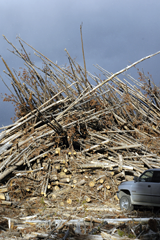
Wasted: About 3,500 jobs worth. Photo by Fred Knezevich.

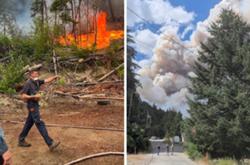
Forests Minister Rich Coleman expresses alarm at the number of jobs that are going up in smoke in British Columbia as mountains of good wood are set ablaze on logging sites across the province.

But his claim -- most recently in the pages of the Vancouver Sun -- that he lacks the "empirical numbers" that would give the public an idea of just how bad the problem is, is simply disingenuous.

In truth, Coleman can easily learn how much usable wood is getting torched. And the answer strongly suggests that B.C. is returning to the bad old "Brazil of the North" days that animated environmental debates more than a decade ago.

Moreover, the squandering of publicly owned timber can be traced directly to policy changes that Coleman and his colleagues passed during their first term in office when the Opposition was reduced to two seats. The changes rewrote the rules governing forestry in B.C., placing company interests ahead of the public good.

And almost all of them, including rules governing wood waste, were instituted by the Liberals in a failed attempt to appease the powerful U.S. softwood lumber lobby, but more on that in a minute.

Piles of massive waste

First, the numbers.

B.C.'s Ministry of Forests has long maintained a database known as the harvest billing system. The database allows anyone to access information on the amount of trees being logged. By doing six simple searches of the database covering the most recent 12 months, The Tyee arrived at a province-wide figure for the amount of wood listed as "waste/residue." According to Coleman's ministry, such wood is "merchantable," meaning it could be used to make lumber or pulp.

And according to the database, 3.5 million cubic metres of it, enough to fill the beds of 100,000 logging trucks, was left on the ground between October 1, 2005 and November 1, 2006. Using a conservative calculation of one job per thousand cubic metres of wood, that so-called "waste" could conceivably have kept two of the largest sawmills in B.C. busy for a year and put 3,500 additional people to work in our forest industry. Instead, the wood was torched and forestry dependent communities lost untold opportunities to create jobs by making lumber and other products.

Making matters worse, the problem may be graver than the figures suggest. The very companies that do the logging are also responsible for producing assessments of how many logs they leave behind. That information then goes to government, where it subsequently falls to public servants to go into the field and audit the companies.

But it is questionable just how effective the auditing is. First, annual logging rates in the Interior have jumped by more than 15 million cubic metres in response to the mountain pine beetle. According to one MOF auditor, that means public servants are lucky if they get to one in 10 waste piles. Second, the costs to go to remote logging sites, particularly on the coast, where more than 2.2 million cubic metres of usable logs were left behind last year, is prohibitively high.

Making matters worse for government auditors, forest companies have up to 60 days following logging to complete their waste surveys and another 30 days more to submit the results to government. During that three-month lag, many of the waste piles may no longer be there. They've been burned.

Because this massive amount of waste is dispersed across a vast landscape in literally thousands of log piles, the general public has only the vaguest idea of what is going on.

'Three times more waste' now

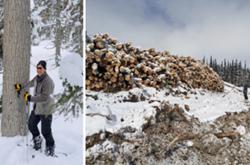
But for people who know where to look -- and Fred Knezevich, a former Ministry of Forests employee in Williams Lake and avid photographer is among them -- it is clear that there is a big and growing problem. Recently, Knezevich pulled off a stretch of the Coquihalla Highway to photograph what he first thought to be a particularly egregious example of wood waste. His image shows angled logs shooting off dramatically in several directions, as if some giant had dropped them there prior to playing a game of pick up sticks. In the lower right foreground, the hood and cab of Knezevich's silver pickup truck juts into the frame. It is dwarfed several times over by the towering stack of logs that shoot into the sky and out of the photograph's upper frame.

"Unfortunately," Knezevich wrote Coleman in early November, "I noticed it was a small pile compared to the piles further from the highway."

Frank Robertson reports similar experiences. A power engineer and long-time pulp-mill worker in Prince George, Robertson journeys down logging roads twice a year in search of firewood for his lakeside cabin. "In my estimation," Robertson told The Tyee, "there's three times more waste than there used to be." And much of it, he adds, is high quality wood. On one recent trip, Robertson found logs three to four metres long and a half-metre or more across. And this was just off of Highway 16 west of Prince George, a corridor dotted by some of the biggest sawmills on the continent.

"There's not a mill that should be shutting down based on what I'm seeing being left behind," Robertson said. "Adding insult to injury, when you go back to those same piles a couple of weeks later, there's nothing left but embers. That's what really gets me."

Missed energy source

What might addle Robertson even more is to learn that the standards governing wood waste in B.C. were relaxed by the provincial government in a failed attempt to appease the U.S. softwood lumber lobby. In December 2001, a document prepared by the Ministry of Forests Revenue Branch and that B.C. and U.S. officials later poured over as they attempted to break the impasse between Canada and the U.S. over alleged subsidization of Canadian lumber producers, proposed to "eliminate" stringent zero-waste policies.

The document noted that such policies essentially forced companies to use "uneconomic timber or logs." The document stated that under proposed policy changes, companies would be "free to make commercial decisions" about what logs they left behind. The rules were subsequently changed to today's "take or pay" system, which essentially allows companies to leave behind many logs behind so long as they account for it and pay the requisite fees to the province.

Yet this policy change, along with others, did nothing to assuage the U.S. softwood lumber lobby. Under the Softwood Lumber Agreement, now winding its way through Parliamentary approval, B.C. forest companies face caps on access to the U.S. market. Once certain export or price thresholds are met, companies will be forced to pay export duties on products they ship south of the 49th parallel and that are covered by the agreement. Meanwhile, the public is left to watch as a growing numbers of logs are destroyed rather than being used in some way.

One way much of that wood could be used, suggests NDP forestry critic Bob Simpson, is as a source for energy. Rather than burning masses of logs in the bush with all of the associated energy wasted, the logs could be chipped and used to make wood pellets or they could be burned under extremely high heat in facilities that generate electricity and feed it onto the hydro grid.

Building in rewards

The challenge, Simpson says, is to create the incentives for that to happen. Clearly, forest companies are taking only the best logs and leaving the rest. Government can do two general things to turn that around, Simpson says. Either force companies to bring all the wood in, and offer some kind of break on stumpage payments to make that happen. Or allow companies to take the logs they want and then throw the harvesting sites open to anyone else that may want to utilize the abandoned wood. If the second course of action is followed, incentives may be required to encourage wood pellet companies and others to bring equipment onto logging sites to process and later transport the wood.

Where might the funds come from to do that? Well, for starters, the money that the companies pay government for the wood they waste could be one source. According to the Ministry of Forests, the payments companies made to government for the logs they abandoned last year were just under $7 million.

"We're not doing the kind of strategic thinking we need to do, and all of this waste indicates that," Simpson says.

He adds that an overriding objective should be to ensure that forestry activities are geared as much as possible to addressing global warming. If we're going to burn logs, burn them to create energy, then offset the associated CO2 emissions with aggressive reforestation efforts.

But that would require creative policy interventions, something the province seems less and less inclined to do, preferring instead to let the market dictate what is best for our publicly owned forest resources. And if that means companies setting logs ablaze rather than using them, then so be it.

Tomorrow: How the Softwood Lumber Agreement punishes B.C. firms that add value to raw wood.

Related Tyee stories:

 [Tyee]

27  Comments:

Login or register to post comments

  • Skookum1

    5 years ago

    Comments on "Forestry Firms Burning Jobs"

    I'm out of the loop on the standard calculations, but could the estimate of wood being burned be converted into hydrocarbon emissions for me, so I can get a grab on how much carbon this clearing and burning is dumping into the atmosphere. Not as if the Liberals were interested in Kyoto-oriented thinking, but it's still an interesting question, huh? What's the cost to our future climate, both locally because of systematic deforestation (and the concordant warming of the Fraser etc), and also at the macro level of the carbon equation.

    This is theoeretically billable damage, under any system where carbon emissions had a dollar value reckoned against the emitter, i.e. in terms of cost to society/the planet. Right now it's a firesale, so to speak, "just good business"....and also keeping American lumber producers viable in their own country. Gee, if only we showed such protectionist zeal ... well, we'd be beaten down with a stick, that's what, and that's what went down with the softwood thing, window-dressing it under/via the Tories or not.

    There was an item on the news that had some guy from one of the Interior mills saying that if 80-85% of a log was still in good shape, it still wasn't millable; they only want logs that are 100%, or they're not worth cutting. Not worth it to WHO, exactly? If they cut those trees, dead or not, they should have to mill them...

  • Grumpy

    5 years ago

    This is the sort of crap that happens when you have accountants instead of foresters running the show!

    Look at Emmersons record at Canfor, sure profits went up, but it was at the expense of the forest. Any graduate forester who dissagreed with him was fired or suffered the ill of a forced early retirement!

    Quote:
    As ye has sown, so shall ye reap!

    BC forest industry is on the downward slide to oblivion as the cut and run forest companies do not care what happens in 20 years, it is profits now and f*** you later!

  • maestro

    5 years ago

    Waste is waste is waste is waste....:

    We all here these stories of how logging operations leave so much good wood behind.

    However, there HAS to be a better way. Seems to me that the modus -operandi is the given company cuts the trees, cherry picks the harvest, then creates slash piles, burns them and then replants.

    What the system cries for is perhaps recycling mode...whereby after the first round of cherry picking, a second group can enter the picture and at least be given the option of cherry picking the leftovers. If no one is interested, then perhaps the status -quo ie burn the slash.

    As it stands, the current system seems to be limiting the supply of raw wood to be processed on the market ...even though it has taken 100's of years to grow to even get to that point. Cut trees deserve FAR better.

    As the example quoted above, I can't believe a log half a metre in diameter and 3-4 metres long is burned...in the Interior(depending on the species) that is practically Old Growth with tight grain...

    Maybe Ed Deak/ Fiat Lux can comment with his wisdom, experience and insight on what the options should be. Again, the secondary level of processing should be in place after the cherry picking, versus "burning the evidence".

  • Capitalism

    5 years ago

    Grumpy:

    It isn't a pretty industry, nor a relatively profitable one either. It is, however a very competitive industry.

    BC has implemented some of the toughest forestry standards in the world, so I don't want to hear cut and run. Jobs on the other hand is a concern.

    However, you can hardly blame this on any government. Jobs are a function of supply and demand for a product, and technology. The US housing market has hit rock bottom and thus, demand for housing inputs (i.e. lumber) has followed.

    In Quebec, they are re-training forestry workers to become miners. This is a problem everywhere and has nothing to do with Liberal policies - give me a break!

    It is terrible to see generations of foresters losing out. Things change - fisheries was once BCs biggest industry. Try and find an employed fisherman these days.

    Economic policy should have a vision to create new jobs, industries and be able to react to changes in this world - not preventing change.

  • murdock

    5 years ago

    More Forestry inspectors are required.

    The cuts of the first term are now showing more of the 'pain', so that the commercial captains could 'gain'.

  • AlineClaire

    5 years ago

    I worked on Vancouver Island this past summer in the forest industry and have quite a few photos demonstrating what I thought to be a DISGUSTING waste of wood that could have been used for pulp, if not for saw logs. I also have an upadated photo of the piles after they were torched taken by my boss this past October. I was shocked at the stuff that was left as "waste," but they say with high gas prices and low pulp prices, it's not worth it to haul it, and it's also not worth it to leave standing because companies are required to keep their logging contractors working. If they don't get the required volume to their contractors it becomes a larger cost to the company than if they cut, yard, pile and then simply burn wood.

    While the Liberals' new results based policies seem to have left many large loopholes for forest companies to enjoy, I believe that the "Bill 13" that requires a company keep their contractors working was an NDP creation (though I might be mistaken).

    The fact is that no dollar value has been put on the TRUE value a standing forest has (including values for visuals, habitat, soil protection, carbon sequestering, water quality, etc.) so it is impossible to have policies that will result in the best use of the resource based on the true costs and benefits.

  • maestro

    5 years ago

    As the article does outline, we are up against the Pine Beetle Kill and the limited harvest time...ie supposedly 4 -5 years(?) before the wood quality deteriorates. The glut of wood must be enormous.

    However, IF some of this harvest includes good healthy trees, that IS a crime. My view is that the logging harvest should focus predominantly on what is ALREADY dead wood yet which is also still merchantable.

    Hopefully all this snow and cold temperatures throughout BC will kill-off these little Pine Beetle bast*rds and we can get back to the normal harvest rates.

  • lenny

    5 years ago

    Skookum,
    The release of carbon by burning wood is not the same as the release of carbon by burning of fossil fuels. The wood's carbon will be released back to the atmosphere whether it is burned or left to rot. The carbon contained in plants is constantly being cycled between plants and the atmosphere as plants grow and die. Releasing carbon sequestered in the earth over millions of years in the form of fossil fuels and adding it to the cycle is a completely different matter.

  • doggone

    5 years ago

    Every stick has value.
    If we can do no better than dump it and burn it we should leave the tree on the stump. There exist some tried and true methods of logging - remember the "woodcutter" in many children's stories.

    I have watched the B.C. Logging Industry most of my life (and worked in it west coast) enough to know that most of what we have done would have been better left alone to rot or burn as nature deemed. In the crash of '79 we worked hard to put logs in the salt water - the barge never came. we yanked the logs back on land and left them to rot. Pointless waste.

    Much like the fisheries the process seems to be:
    1) buy big equipment and start extracting the resource.
    2) If you make money buy bigger equipment and "grow" your income.
    3) Repeat if nessessary

    When the crash inevitably comes sell the worn out monster for scrap or simply leave it in the bush (or in the case of huge fishing boats tie it up in French Creek and walk away)

    So far so good - we have done this repeatedly so it must be pretty good "economics".

    There other ways to do "Business" but in the case of forestry these alternatives are (very actively) discouraged

  • doggone

    5 years ago

    Now I have tried "Click here to log out" and I seem to be stuck in the Logged in mode so prepare to scroll through a bunch more of my blither:

    I had a pellet stove for a while. Too many squeaky, wheezy mechanical parts. Now burning pellets is not that complicated. A lot of homes in the Okanagan were heated with "Sawdust" burners in the '40s to the '70s when most mills went to bandsaws. The old "sawdust" from a "Head Rig" was chunky and if dryed, it would burn just fine (and clean) and feed down a simple hopper. the houses built in the early '50s had minimal insulation but in the coldest weather I ever experienced: -46 the sawdust burner pumped more than enough heat with no depedence on electrical power. Im fairly sure that pelletized fuel would also feed down a similar hopper and burn as well or better. I lived in that house for about 20 years. just after I left my mother had the chimney cleaned for the first time. According to the chimney sweep there was no need to clean it.
    So take this idea to the bank somebody - I'm too busy commenting:
    Peletize every peice of "waste" wood in the province.
    The new improved "sawdust" burner could have catalytic afterburn and particulate scrubbing. It would be far less polluting than a slash burn.

    If someone is already doing this I'd be very interested to purchase one.

  • doggone

    5 years ago

    Appear to be stuck in "logged in".
    I sent an email to Tyee support (as I was requested to do by the web manager)
    I don't know what is going on but as long as my posts get plastered up there I am entertaining one person at least: me.

    The problem with oversupply of wood is not a problem in a sane world. Use some of it to build warehousing for the massive piles of logs - keep 'em dry and they won't rot so fast. Down the road there could well be a good use for that fibre whether it is pelletized, chipped or pulped. Wood, like fresh water (or gold) is a wonderful substance.

    So somebody please inform me as to why we are still burning slash.

  • SharingIsGood

    5 years ago

    Murdock says:

    Quote:
    More Forestry inspectors are required.

    And I couldn't agree more. Much of the following of the forest practises code has been converted to self-regulation under this government. Under a capitalist system, self-regulation is no regulation at all.

    After-all, it doesn't take a forestry degree:
    * to know that clear-cutting and poor road-building leads to erosion, increased water temperature, and death to salmon and other lake and river life;
    * to recognise that wasteful practises are immoral - no matter what part(s) of nature is being wasted;
    * to understand that unless we get a long cold snap, we are going to lose lots more wood to the beetles.

    2.2 million cubic meters of West Coast logs being wasted is foolish: there were no beetles in that wood. It's not like the wood was going to rot in the forest anyhow. What is even more fooling is the building of an olympics during a time when the interior is being ravaged by beetles. The money spent on the olympics would have been much better spent in creating Ikea-like industries with higher quality wood than the Norwegians have to work with. People would have been happy to become trained to work with state-of-the-art wood manufacturing equipment. The pulp industry could have grown as well if our government had invested in building plant and equipment for using pulp to make preformed packaging as an alternative to much of the plastics currently in use. Any and all wood waste that is burnt, should be used to generate electricity (using scrubber-stack furnaces). When timber is to be logged, the waste should have a pre-designated place where it is to be taken for electrical generation. Small portable boiler plants could be developed for putting power into the grid so that smaller logging and milling operations could conform. Further, if it unsound to covert the waste to hydro (due to location etc.), then perhaps the heat energy can be recovered by converting it to steam for heating the houses of low income families through the winters.

    Much of the technology for all of the above exists: it just requires the will of the people (we who own the forests) to make our government bend to our will. It is our government, after-all; we are not subjects of the government. The government has been elected/hired to follow our will. It is my desire that the Liberal government begins respecting the needs and desires of the electorate. They can begin with stopping any further privatization and becoming stewards of our resources/the environment.

  • SharingIsGood

    5 years ago

    Please forgive the many typos in the above - after reading my posting, it is worse than I thought. I beg that I am fairly arthritic these days, and it is a chore just to put anything into this computer. I will attempt to use a word processor in the future from which I can cut and paste.

    Doggone's use for the wood is an excellent way to get those BTUs to people.

  • The brain

    5 years ago

    Waste is moste definitely a major problem in the cutblocks in BC not just with whats left on blocks, but with the lost potential in slashpiles for heat and on site portable milling.

    As Skookum one alludes to, burning wood of any kind is a greenhouse gaser. And while we are inefficient in terms of converting wood into heat for homes, there are now more efficient ways of burning wood in pellets or otherwise than before to use the heat practically. To that end, slash piles should remain unburned for three reasons:

    - To lower CO2 emmissions targets in BC associated with global warming.
    - portable millable on site wood.
    - firewood potential.

    Part of the solution lies with changes in provincial government environmental policies that currently encourages the burning of slash piles and regulates cutblock waste threshholds. (Unfortunately, since Campbell has cut environmental spending by 24%, I don't see any intitiatives by the Campbell government to do anything other than "let it burn".) As well, the current inept Campbell government could look into the commercial viability of slash piles as a future commercial energy source (but won't).

    The rest of the solution lies with logging companies and mills that are willing to look at the small scale evaluation and potential of their existing cut blocks for indirect revenue and combined savings in the costs associated to burning slashpiles.

    And this second solution is dependent on the people it takes to pull it off since much of the slash piles across BC will be spread out and the methods needed to cherry pick through the piles for good wood, and hauling out either partially milled product on site, or whats left collected for energy in the years to come... more is needed in terms of effort from both government and private sectors in determining the potential markets and scale of what slash piles do hold in value.

  • Alcibiades

    5 years ago

    How about lets start with 'changing' the provincial government.

  • Mr. Beer N. Hockey

    5 years ago

    There is a place up around Quesnel that is cranking pellets out of beetle kill like crazy. Much of their production is being shipped to Sweden where it fires co-generation power plants. That's what I hear anyway. There is no excuse for any form of fibre being wasted.

    The management of our forests is a 100 year old joke. Here's to the next 100.

  • The brain

    5 years ago

    Good posts by everyone, more is definitely needed in evaluating the potential markets for the existing and future slash piles to come. Until these potential old/new markets are evaluated, there should be a freeze put on the burning of existing piles until the government and private sector comes up with a realistic answer, especially so in a global warming environment.

  • DJT

    5 years ago

    Sharing is Good: "we are not subjects of the government". The first thing that needs to happen is for someone to break this news to Gordon Campbell.

  • IAMC

    5 years ago

    What's interesting, is that new proposed power plant planned for Princeton is to be a dual burning power plant. It would be designed to burn wood or coal.
    I don't claim to know the percentage of the different fuels that will actually occur, but if you are talking about getting BTU's out of scrap lumber, this plant certainly has this option.
    Now what is the pollution caused by either fuel, I don't know.
    We have no shortage of trees in Canada. Remember that we have the largest forest in the world, the Boreal Forest.

  • doggone

    5 years ago

    Imac: I find myself agreeing with you. What on earth is going on?
    But if we continue trying we could certainly create a shortage of wood fibre in B.C.. Just buy some bigger "feller bunchers" and "hoe chuckers" and burn it. Why not "helli log" the difficult logs out to the burn?

    This is straight out of '50s SciFi paperbacks: Consume or Die.

    We CAN do it
    If we try

  • RickW

    5 years ago

    Quote:
    We all here these stories of how logging operations leave so much good wood behind.

    Not much different than the factory trawlers and their so-called "by-catch"......

    There are those who claim the efficiency of the "economies of scale", which is pure BS, as large companies must necessarily waste in order to stay in business. The most efficient way to harvest wood is through independent, small scale operations, which have an interest in staying in one area.

  • relayer

    5 years ago

    Great, IAMC... shall we clearcut that next?

  • Skookum1

    5 years ago

    Quote:
    And this second solution is dependent on the people it takes to pull it off since much of the slash piles across BC will be spread out and the methods needed to cherry pick through the piles for good wood, and hauling out either partially milled product on site, or whats left collected for energy in the years to come... more is needed in terms of effort from both government and private sectors in determining the potential markets and scale of what slash piles do hold in value.

    I'd think anyone who came up with a way of quickly retooling mills to accept shorter logs and log-segments would stand to make a lot of money right now.....

  • doggone

    5 years ago

    Skookum 1:
    I doubt it.
    The "experts" whether hired by industry or government have to deal with the details of the Softwood Lumber Agreement.
    No matter how well we know them or how much we like them they are beholden to a corrupt system. It did not get better in the '60s and it will not improve spontaniously just now

  • anne cameron

    5 years ago

    Capitalism... give me a break. I mean, really, that is just such horseshit.

    I live on the West Coast of Vancouver Island, surrounded by the evidence of logging. The waste is disgusting. Small wonder we have a company opening up in Gold River to make electricity out of "waste wood".

    The companies actively work against any chance that folks could go out, pick up the dead'n'down, cut it into stove lengths and maybe even sell it to other folks, thus creating a boost to their employment insurance. Most of that mess can be utilized.

    They're burning it because it's EASY to burn it and because they can.

    And all this jingoism and pony puckies about market this or the economic that is just so much eyewash. It's all a case of mind over matter: the companies don't mind and the rest of us don't matter.

  • Step easy

    5 years ago

    If the number one industry in BC is still forestry and the forest floors in BC are as littered with unwanted revenue as described, then we all must be living the dream huh? What a f***ing disaster. Profit before absolutely everything else, including livelihood, animal and ecological habitat, and of course reducing the global warming trend. Thank God the housing market in the US is starting to subside.

  • doggone

    5 years ago

    Anne:
    I think it's more sinister than "Because it's easy and because they can". I logged a bit, Promoted mining stocks a bit (BC mining exploration, Vancouver Stock Exchange).

    The people on the ground (mostly Male) do not know what they do.
    Forgive them

    • No best comments selected by an editor for this story yet. To see all comments, click the All Comments tab, above.
    • The discussion for this story is closed. No more comments can be added.