It's 20 years since NAFTA. Its damage is why latest trade deal must be stopped.
By Raul Burbano, Kristen Beifus and Manuel Pérez-Rocha, 8 Mar 2013,
TheTyee.ca
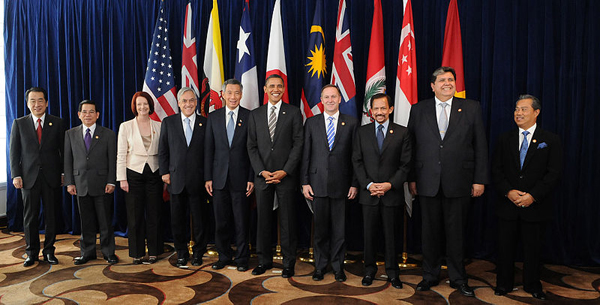
Send them a message: Leaders of TPP member states.

-
Secrecy the standard as Canada enters Pacific treaty talks.
-
It's a mug's game. Late to the negotiations, we're set up to lose big.
-
What the BC government can't tell you about the sweeping new treaty being framed with Europe.
- Read more: Rights + Justice, Politics, Labour + Industry,
A 16th round of the Trans-Pacific Partnership (TPP) negotiations is underway in Singapore this week. Canada and Mexico join the nine other TPP countries for the second time since the U.S. government invited its NAFTA partners to join late last year.
The TPP is a super-sized trade deal-expanding on so called "next generation" trade and investment deals that NAFTA countries have pursued in the wake of the stalemate at the World Trade Organization. This pluri-lateral agreement poses serious new threats to North American communities -- threats that a tri-national movement of trade justice activists is preparing to fight in the lead-up to a possible July TPP negotiating round in Canada.
Since NAFTA was signed almost 20 years ago, all three North American countries have seen good jobs vanish, worsening income inequality, public services weakened through underfunding or offloaded to the private sector, increased food insecurity (in particular in Mexico), and ecosystems on the point of breaking. NAFTA promised a flourishing North American economy that would benefit all. In Jan. 2014, NAFTA has been in place for 20 years and the promised trickle down benefits have not been realized by communities.
Three nations, no winners
In the past 10 years, Canada has lost 500,000 manufacturing jobs. A new United Way Toronto report found that in and around Toronto, Canada's largest city, 20 per cent of people are now employed in precarious, unstable or part-time jobs. This type of employment has increased by 50 per cent in the past 20 years since NAFTA was signed. In this same period, not a single notable social program has been introduced or expanded. Free trade has permanently eroded our sense of what people can do together for the common good.
Canada is also facing over $2.5-billion worth of legal suites by corporations that are permitted to sue countries under NAFTA for potential profits if blocked by health and safety or environmental laws from conducting business as usual. Current suits include a U.S. corporation challenging a moratorium on natural gas fracking in Quebec, a court decision to annul a patent by Eli Lilly, a decision against opening a new gravel quarry in Ontario because of the likely effect on water and farmland, and many others "coming down the pipeline."
In Mexico millions of small farmers were displaced when NAFTA came into force in 1994 creating a massive push for migration to the United States. But NAFTA hit Mexico very hard again during the 2008-2009 financial crisis given Mexico's dependency on the United States. In fact, Felipe Calderon's presidency has been characterized by the slowest growth since 1954, a mere 1.58 per cent in average from 2007 to 2011, and, according to World Bank indicators, between 2007 and 2010, GDP per capita in Mexico decreased by 3.71 per cent, which is among the worst performance in Latin America.
The United States, which is leading the TPP charge, has also suffered under NAFTA. The AFL-CIO in February challenged the benefit the TPP offers to workers, citing that the U.S. trade deficit "has increased dramatically under NAFTA -- from $75 billion in 1993, to $540 billion today (in nominal terms)." Since the implementation of NAFTA, says the AFL-CIO, "the growth in the trade deficit with Mexico has cost the United States nearly 700,000 net jobs." The AFL-CIO is calling for a Global New Deal that promotes growth "with equity, protect their health and safety and foster sustainable development."
Next generation of handcuffs
Next generation corporate trade deals like the TPP and the proposed "comprehensive" pacts that Canada, the U.S. and Mexico are pursuing with the European Union, purposely take away our ability to pursue alternative economic strategies. These deals are designed to ensure that governments have no power in the economy, and that they are only useful when they are using tax payer dollars to bail out large banks and other corporations.
Like NAFTA, the TPP will handcuff our ability to set regulations in key areas like finance, industry, the environment, public procurement and fostering programs to create jobs at home. Free trade offers corporate subsidies for the rich and cut-throat competition for everyone else. So it should come as no surprise that communities across the continent and the Western Hemisphere are mobilizing in what can be expected as the battle against the TPP.
On Dec. 1, hundreds of labour, community, public health and internet freedom advocates from Canada, the U.S and Mexico descended on the Peace Arch Park in Surrey, B.C., between Washington State and British Columbia. The Tri-National Unity Statement that came out of that strategic gathering has been signed by hundreds of organizations representing tens of thousands of people across the continent.
Since our Dec. 1 cross-border action, community and NGO organizations from central and Latin America are raising their collective voices in opposition to the TPP. This opposition was solidified at the People's Summit in Santiago de Chile -- parallel to summit EU-CELAC Summit -- this past January where civil society gathered to express and share their concerns and develop strategies to stop it. They are calling out the TPP as a ‘tool of disintegration' in the region because it attempts to destabilize regional processes of integration that challenge the neoliberal model inherent in the TPP.
These alternatives include the Union of South American Nations (UNASUR) and The Community of Caribbean and Latin American States (CELAC), as well as economic blocs like MERCOSUR and ALBA trading regions. The TPP is seen in Latin America as a second attempt by the United States to push a Free Trade Area of the Americas (FTAA) in the region with help from countries whose governments are subservient to de the U.S. led neoliberal ideology and "free trade" economics.
Stopping our governments from doing any more damage with corporate rights pacts like the TPP needs to be a priority of the peoples of North America. We must demand an alternative, more equitable and sustainable global trade regime. Trade and investment deals must respect and promote fundamental environmental rights, indigenous sovereignty, labor rights, including equal rights for migrant workers and people of color.
Communities and local governments need to be able to actively create high-wage, high-benefit jobs in ways that do not undermine the well-being of our sisters and brothers globally.
Rich people, poor communities
Governments must be able to promote democratic public policies in the public interest without fear of catastrophic lawsuits in non-democratic and non-transparent investment tribunals.
Free trade creates rich people not rich communities. We have 20 years of evidence from NAFTA... we don't want any more. Stop the TPP! Sign the tri-national statement of unity against the Trans-Pacific Partnership, and to sign-up to be more involved, go to www.tppxborder.org. ![[Tyee]](http://thetyee.cachefly.net/ui/img/ico_fishie.png)
Raul Burbano is the program director of Common Frontiers (Canada). Kristen Beifus is the executive director of the Washington Fair Trade Coalition and Manuel Pérez-Rocha is a member of the Mexican Action Network on Free Trade (RMALC) and an associate fellow of the Institute for Policy Studies (IPS).
14
Login or register to post comments
Fiat lux
14 weeks ago
We have a system where
We have a system where governments with a so called "majority" are permitted to exercise dictatorial, fascist powers during the term of their office, with their trained seal puppet MPs approving everything their so called "leaders" demand, for their post politics string of directorships.
In other words, the TPP is a done deal.
Violence is no solution, as it always backfires, but unless the population stands up and demands changes to the present corrupt system in peaceful, democratic ways, the country will be sold off under their feet, on the advice of the monetary priesthood of so called "economists".
We, who fought against the FTA and NAFTA ,have seen this coming, it is all on paper and can be proven, yet the sucker public still keeps electing corrupt politicians , all over the world, the same way as millions have always sacrificed their lives for crooked leaders throughout history, as always demanded by history's priesthoods.
Ed Deak.
Otto Rant
14 weeks ago
Too Bad All Major Parties support Trade Agreements
Judging by comments from his shadow cabinet, the Mulcair's federal NDP insiders are fully on board with signing away Canadian rights and economic opportunities.
I hope enough NDPers read this article to remind themselves that FTA and NAFTA were rightly opposed by most Canadians, and that Mulcair, the wanna-be Liberal and Tory, has to go ASAP.
Broadbent's NDP was the last high-water mark for the party, and it took millions of last minute dollars from hidden corporations through the National Citizens' Coalition, and an American P.R. firm telling the NDP to drop their anti-Free Trade message in favour of glorification of the leader, to prevent NDP from winning a share of power and stopping the FTA.
Now Bay Street, and probably more than a few shady characters from foreign countries, have stifled that threat by spreading a few dollars, messing up the on-line voting system, and ensuring that the NDP has a sell-out for a leader.
How ironic that Mulcair's NDP is severely threatened by defection to sovereigntists who support Quebec independence. Better some kind of sovereignty than none.
If only Justin had inherited some of his dad's genes. He might have realized that maintaining Canadian sovereignty is one of the main duties of Canadian governments. But he already sold out, as indicated by his brown-nosing to the Alberta/America oil system that is draining our country with few benefits for its citizens.
Paul Forseth
14 weeks ago
The article is manipulative
The article is manipulative bunk. Fortunately, most reasonable people see through the article's deceptions.
Sorscher
14 weeks ago
Money and influence
Everyone wants trade. The real question is how do we divide the gains from trade?
Our current trade policy is bad because it shovels the gains from trade to those who already have plenty, and it pushes aside public interest. Bad trade policy puts civil society at a disadvantage.
The path to good trade policy will come from popular awareness of what good trade policy looks like and popular opposition to bad trade policy.
This goes beyond simply making a rational persuasive argument. We have a solid understanding of what's wrong with our failed trade policy. We need to mobilize political opposition.
Fiat lux
14 weeks ago
First of all we have to
First of all we have to define what the word "trade" really means ?
Is it between people exchanging necessary products, services and resources, or is is a collectivized system between ruling special interests, controlling the markets with deregulated, imaginary monetary figures that have replaced Stalin's bayonets.
E.g. There's a news item claiming that the price of meats and other foods is going up.
The control of the beef markets by mega corporations fixing prices, and ruining ranchers and beef production, has wiped out many, drastically cut back beef production, while raising prices in the stores.
Is this what we call "trade" ?
Let's hear Paul Forseth's explanation and excuses on how the destruction of private enterprise and its replacement with collectivization controlled from abroad is good for the economy and people who are forced to accept it.
Ed Deak.
Fritz
14 weeks ago
I Second the Motion
E.D: "Let's hear Paul Forseth's explanation and excuses on how the destruction of private enterprise and its replacement with collectivization controlled from abroad is good for the economy and people who are forced to accept it."
“That which can be asserted without evidence, can be dismissed without evidence.”
― Christopher Hitchens
"The article is manipulative bunk..."
-Paul Forseth
...Mr. F you have been dismissed (~|~)
bcwoodcarver
14 weeks ago
re meat prices
so don`t buy their steroid & antibiotic infected products.
Good healthy meat is available at slightly higher prices from your local butcher or farm.
Fiat lux
14 weeks ago
We have all the healthy,
We have all the healthy, organic meat we need on our own farm, but we were forced to sell our herd of cattle on account of the bankruptcy prices forced on us by the feedlots, controlled from abroad.
As I wrote before, we estimate 1,000 less cattle in this neighbourhood alone, with ranchers forced to sell, or cut back and do other jobs.
In any case, we can easily prove that organic meat should be much cheaper, better tasting and healthier, with the ranchers getting fair prices, by not force feeding cattle with grains and shot full of antibiotics, growth hormones and steroids in the feedlots.
Yet, this racket is called "free enterprise" by some crooks and idiots, not to mention paid off politicians and economists.
Ed Deak.
dorothy
14 weeks ago
So this is where we are faced with
the prospect of creating our own economy away from the ripoff deal we are being offered. If need be, we can do it village by village, and of course, some members will have to go 'outside' and work to bring in the inevitable cash for taxes and fees that are unavoidable. We should study the economy of monasteries and set up similar systems, except for the religious aspects and living quite that closely together. Some people have strated on something they call 'cohousing', and that sounds interesting. there is lots to do. Fighting it is a waste of energy. Buckminster Fuller said 'Don't involve yourself in fighting the existing conditions. Instead, build a new model that makes the old one obsolete'.
Steve Hetherington
14 weeks ago
Good points Dorothy
But please remember---these "existing conditions" along with everything else they are doing---tar sands-oil-mining-fracking-damning our rivers for power we don't need-----are destroying our planet--OUR planet.Something we can never"cohouse "without.Your system sounds great Dorothy----but do we have time?
Fiat lux
14 weeks ago
Steve....Start with the
Steve....Start with the universities where all parts of this crime wave, against the environment and humanity, are being taught as "sciences".
All the politicians are doing is following their advice.
Ed Deak.
Steve Hetherington
14 weeks ago
Yes Ed
But who is it,at these universities that write the curriculums?
Fiat lux
14 weeks ago
I think, what we should ask
I think, what we should ask is , who is paying for them and for what reasons ? How many university departments are now controlled by the corporate mafia, forcing research and brainwashing students ?
Ed Deak.
Hakuin
14 weeks ago
The old way will be abandoned by the people
When they hit rock bottom. Rock bottom is missed meals. Right now we are hobbling along on willingness to cling to lies for comfort in the face of looming reality. Enough will continue to play the game until it is utterly, utterly bankrupt. No such thing as a smooth transition.
A new economic model is needed and apart from an inchoate social consensus that it will involve more sharing and less greed, nothing has been presented. Hopefully we are less vulnerable to a strong man dictator seizing the reins at a timely moment ( say what you will about Godwin but at least the cautionary tale has been kept alive in literate countries).
Perhaps something transcending the old nations is coming along. The web makes it both possible and clear that we may more in common with a class of individuals found everywhere rather than mere countrymen. Interesting how "trade agreements" universally never serve those common classes but rather always profit elites wrapped in flags of convenience.