
Opinion

Alberta's Strange Sinking Sensation

Why can't Canada's wealthiest province break even? Blame the paradox of plenty.

By Andrew Nikiforuk, 21 Feb 2013, TheTyee.ca

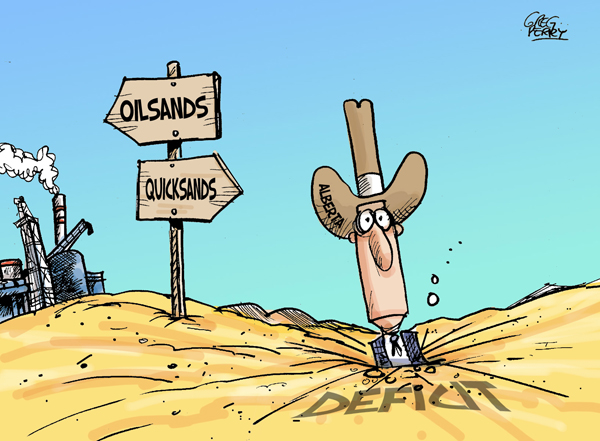
Cartoon about Alberta's deficit

Cartoon by Greg Perry.

Related

Gosh.

Alison Redford, the premier of Canada's wealthiest province, has encountered a $6 billion "bitumen bubble" on the busy Highway to Hell.

To most Canadians this curious disclosure seems confounding, if not paradoxical. How can "the economic engine" of Canada run five government deficits in a row yet promise prosperity for the nation? Is no one in charge?

Yet Redford isn't the only befuddled leader of an oil-fueled government. Thanks to the volatile nature of the world's most lucrative commodity, various petro states find themselves short of cash. And that's because most petro states don't know how to budget let alone govern.

Like any plantation economy, petro states operate pretty much like irrational monocultures: they know how pump oil, sell oil, talk oil and spend oil. But they don't know how to save or diversify its slippery wealth.

And whenever the price of oil plunges from $140 to $30 as it did in 2008, the fragility of petro states, regardless of their extreme political stripes, becomes as visible as a fat man in an overheated sauna.

Venezuela, home to the world's second largest oil reserves, just devalued its currency and it is as much awash in socialist debt as Alberta is in Tory deficits.

Texas, the father of all short-sighted petro states, has a tax system so calcified that it can't cope with a sudden drop in oil prices either. In Nigeria budget failure has become, well, a national pastime.

Louisiana, a polluted playground for BP, offers its citizens 440 different tax breaks as well as a steady diet of bust and boom budgets.

And yes, the former Soviet Union had a slight problem with oil price volatility and depletion back in the 1980s. In fact an unexpected fall in prices precipitated the collapse of a "stable" global superpower.

But recording deficits (and blatant inequalities) amid mountains of oil wealth makes every petro state, well, a paradox of plenty.

Oil's volatile revenues sculpt governments into masters of dysfunction; purveyors of fiscal neglect; practitioners of lazy statecraft; betrayers of democracy; traders in conflict, and ultimately, fully compliant to Big Oil.

But Redford, who can't spell the phrase Dutch Disease, avoided these uncomfortable realities in her little speech about the sad bitumen bubble.

Talk therapy?

According to Redford, the price of bitumen has taken an unexpected turn for the worse and the province now has a spending problem equal to the size of its education budget.

She then invited citizens to take part in a conversation about what to cut. Alberta Finance has even posted a digital budget for citizens to play with on the Internet.

But the invitation to converse is disingenuous. Petro states, which are studies in the abuse of power, engineer monologues for their citizens, not dialogues.

Moreover, Redford has already identified the politically correct solution. Oddly, it is not higher royalties, better governance, fiscal accountability, responsible taxation or even the novel upgrading of bitumen into more valuable products.

No, the only solution to Alberta's money woes appears to be the construction of more pipelines that might, cross your fingers, find higher prices for dirty bitumen in Communist, Saudi or Koch-owned refineries.

In so doing Redford illustrated what political scientist Terry Lynn Karl calls the crux of the oil resource curse: "It is a lot easier and faster to build a pipeline than an efficient and representative state."

Truth in short supply

Now here's what Redford forgot to tell her dear petroleum stakeholders, er, citizens.

First and foremost, Alberta has an integrity problem.

Alberta's string of deficits have nothing to do with lack of bitumen pipelines, but everything to do with the shale gas revolution which has dropped the price of natural gas to record lows.

Prior to the shale gale, natural gas earned more than $5-billion in annual royalties for the government: today the cash cow pours little milk ($1 billion) for Alberta's one party state. Yet Redford never mentioned "the shale bubble."

But there's another important omission. The gap between bitumen pricing and West Texas Intermediate is not new. Bitumen is a junk crude and signature of peak oil that requires costly upgrading and complex refining. The heavy gunk won't even move through a pipeline unless diluted with costly condensate.

As a result, a 2007 Bitumen Price Review warned Alberta's government about dramatic price drops in bitumen markets. "Essentially there is a lack of adequate market access due to increasing production levels." By failing to upgrade and refine bitumen into higher value goods such as gasoline the government would absorb "a high share of price risk" that goes with pouring raw bitumen into the marketplace.

But Alberta's petro state and its petro media ignored the report as well as the idea of adding value at home. So the growing price disparity is really a function of dedicated overproduction as well as a lack of smart planning. (Premier Ralph Klein didn't believe in such things and preferred to run government on "auto pilot.")

Between 1998 and 2008 Alberta regulators rubber stamped more than 100 tar sands projects raising bitumen production from 600,000 barrels a day to nearly two million. This policy predictably flooded the U.S. Midwest market with raw bitumen and drove down prices.

At the same time Alberta's Tories neglected to pay attention to declining oil consumption in the United States due to the 2008 oil shock and financial crisis. Having already been smacked by the effects of hydraulic fracturing on shale gas prices (it killed them), the government let itself get smacked again by a temporary tight oil glut in the Bakken and Eagle Ford.

In short, incompetence and laziness helped Alberta Tories create their very own bitumen bubble.

Follow the tax money

In addition to honesty gaps the size of tar sands mining pits, Alberta, like many petro states, has a dismal tax problem. The province's one party state draws, on average, 30 percent of its revenue from oil and gas projects. For more than 40 years Alberta's Tories have ruinously used these same petro dollars to distort, undermine and degrade a proper taxation system as well as enrich its cronies.

This explains why Alberta Treasury can still advertise Alberta as a fantasy honey pot with "low personal and corporate income taxes, the lowest fuel taxes among provinces, no capital tax, no payroll tax, no health premiums, and no sales tax" while the province chocks up one deficit after another and Redford cries bitumen bubble tears.

U.S. political scientist Michael Ross attributes such behavior to the pernicious "taxation effect" of oil: "When government derive sufficient revenues from the sale of oil, they are likely to tax their populations less heavily or not at all, and the public in turn will be less likely to demand accountability from -- and representation in -- their government."

Terry Lynn Karl, the acclaimed author of Paradox of Plenty, describes the petromania resource curse more directly: Easy access to oil wealth lowers "financial discipline within bureaucracies and leads to reckless budgetary practices. Most importantly, it preempts efforts to mobilize domestic resources through taxation" which, in turn, creates more dependence on oil.

And this explains why Redford (and the Harper government) now turn to Chinese national oil companies to solve the province's self-inflicted woes instead of difficult statecraft, the upgrading of bitumen or an overhaul of Alberta's out of whack tax regime.

Adam Smith, the moral philosopher, often warned of the perils of "the income of men who live to reap where they never sowed," but you won't hear him quoted in the bitumen republic of Alberta.

Binge spending, then hangovers

But oil also engenders a "spending effect." On this matter Alberta has become something of a petro state poster child.

During booms Alberta vomits cash and expands government, and during busts, it hacks off government services like some crazed surgeon jacked on cocaine.

To facilitate the recent bitumen gold rush it has invested billions in roads, hospitals and water treatment that industry, the boom's chief beneficiary, should have paid for in full.

A variety of left and right wing economists have identified binge spending in Alberta as a problem for decades. In fact running on public taxes instead of oil loot is the only honorable solution says Herb Emery and Ron Kneebone in a 2011 article.

Alberta must "redirect the revenues gained from the sale of resources away from the government's budget and toward saving," conclude the pair.

"This entails the establishment of some form of a fiscal rule: a commitment to long-term fiscal probity that enables the government to resist the demands for unsustainable spending increases or tax cuts. As we noted previously this is the solution to the problem of energy price volatility that has been successfully employed by energy-rich Norway and that has been frequently urged upon the Alberta government. Unfortunately, it is a solution that has eluded the government of Alberta."

But nobody listened.

Spending isn't the only disease. Alberta has a serious revenue collection crisis too. It still gives away its hydrocarbons at bargain basement prices and saves nothing. (In contrast Norway has stored away $600 billion for the day its wells run dry.)

Moreover the government has only collected its minimum target (a 50 per cent share of oil and gas profits) twice in the last decade. The Parkland Institute has calculated that Alberta Tories have left nearly $40 billion on the table for state owned corporations and multinationals to pocket over the last 10 years alone.

(When Fred Dunn, the former auditor general, repeatedly pointed out the scale of this neglect in 2007, 2008, 2009 and 2011, he was accused of overstepping his mandate.)

But if Big Oil took the same cavalier attitude toward meeting its fiscal targets as the Alberta government, their shareholders would have had their heads in buckets years ago.

Oil between the ears

Last but not least, petromania makes governments grossly incompetent. Easy wealth seems to discourage hard thinking, the same way scarcity stimulates innovation.

Alberta's idea of governance consists either of throwing money at a problem or making the problem bigger so more petro dollars can drown in ever larger pools of stupidity.

To solve a crisis in health care spending Alberta created a Soviet-like superboard which, of course, delivered less accountability and more bad service.

To deal with the province's growing carbon liabilities the province proposes an even larger insanity: it recommends that taxpayers fork over $50 billion over several decades to subsidize carbon capture and storage schemes -- that will waste energy and money in equal proportions and solve nothing.

The government has so botched electricity transmission with a sweetheart deal involving corruption-plagued SNC Lavalin that is has created a multi-billion scandal more significant than the so-called bitumen bubble. And on it goes.

Oil has dumbed Alberta down. The bitumen republic now gives away its resources. It doesn't save any money. It neglects ground water protection. It has no responsible tax regime. And its calcified one party state represents hydrocarbons instead of citizens because that's what petro states do.

In the end petro states are as incapable of reforming themselves as the Canadian senate. So take note citizens of British Columbia, Saskatchewan and Newfoundland: you've got a problem.

In a petro state politicians and business leaders become so tied to the perverse incentives of mining oil, says Terry Lynn Karl, that they "develop networks of complicity based on the classic exchange between the right to rule and the right to make money."

Such thinking, says Karl, "links economic and political outcomes in a manner akin to former socialist countries -- a reality that seems to elude most observers."

No matter.

Redford, who might someday hold the Exxon Mobil Chair in Political Studies, has encountered "a bitumen bubble," and like every other petro leader she doesn't know how solve a problem of her own government's making.

BONUS GUIDE: 16 SYMPTOMS OF PETROMANIA

How do you know when you live in petro state? Here are some key signs:

When your government pays 30 per cent of its road, education, and hospital bills with finite and volatile hydrocarbon revenue.

When your province posts five budget deficits in a row during a so-called "bitumen boom."

When the billionaire owner of a hockey club (the Oilers) donates $430,000 to extend the 40-year rule of a one party state that ran out of ideas 30 years ago.

When Alberta Health says it can't comment on the public health impacts of hydraulic fracturing because Alberta Energy is responsible for "sustainable energy development."

When the government approves 100 bitumen projects over a ten-year period without a cumulative impact assessment.

When government officials ban the use of the word "tar sands" the same way the U.S. military forbade the use of the word "insurgency" in Iraq.

When your government fires the Chief Elections Officer, Lorne Gibson, in 2009 for doing his job and reporting on widespread electoral fraud.

When your former premier, Ed Stelmach, advises the Ukrainian government on how to sell shale gas development to a skeptical public concerned about groundwater contamination.

When most university research chairs acquire boutique petroleum brands such as the Enbridge Research Chair in Psychosocial Oncology; the Cenovus Chair in Canadian Plains Mitigation and Reclamation, the TransCanada Chair in Regulatory Law and the Talisman Chair for Sustainability and the Environment.

When prominent scientists such as David Schindler are vilified and slandered for reporting on documented water contamination from tar sands development in top science journals.

When your government estimates that cleaning up toxic waste in the tar sands will cost more than $20 billion but asks industry to set aside only $1 billion.

When politicians describe bitumen, a badly degraded tar enmeshed in sand, as "the jewel of hydrocarbons."

When the province's oil and gas regulator argues in Queen's Court that it owes "no duty of care" to Albertan landowners or the province's groundwater.

When a bunch of Calgary lawyers decide that the best market for their self-branded "ethical oil" are Chinese national oil firms directed by the world's leading moral philosophers, the Communist Party of China.

When other Canadians arrive in your province not to make a living but to make a killing.  [Tyee]

Read more: Energy, Politics, Environment,

24  Comments:

Login or register to post comments

  • Hakuin

    12 weeks ago

    When people of average intelligence

    (And quite possibly lower than average education) find themselves the coincidental beneficiaries of random fortune and geography it's often the case that they seek to explain and justify it by creating some sense of exceptionalism. Blame it on the pattern craving primate brain. Humans are still prisoners of their evolution. In Alberta's case it sets them up for exploitation by global players. Remember that the "con" in con game derives from confidence, the prerequisite of such being getting the confidence of the mark by making him feel "special". If Alberta is awash in oil and still broke the blame rests on the gullibilty of the average Albertan.

  • Tbarnston

    12 weeks ago

    More Numbers Please

    Nikiforuk has uncovered Canada's economic Achilles heel.

    Suncor is already considering cancelling two new mines and an upgrader project because they are not viable. http://www.cbc.ca/news/business/story/2013/02/06/business-suncor-voyageur.html

    A major recession across Canada is likely if Alberta fails to continue developing this resource.

    This is why Harper has no negotiating power at the global trade table. Other countries can see we've painted ourselves into a corner, and they are making us pay a serious price to get a piece of global trade.

    It would be helpful if the Tyee could do more numbers based economic analysis of the Canadian economy so that citizens can have a feel for when this shell game might end, and what the impact a declining rate of oilsands investment would be for BC and the rest of the country. Nikiforuk's rhetoric is on target, but it doesn't help families or communities plan mitigation strategies.

  • mission impossible

    12 weeks ago

    Fort Mcmurray

    All that money, all that wealth, the big wages of Fort Mcmurray and they can`t afford to keep the school open.

    http://www.huffingtonpost.ca/2013/02/13/four-day-school-week-proposal-fort-mcmurray_n_2679334.html

    A 4 day school week has been proposed as a money saving idea, parents who attended public meetings on the issue are staunchly against it.

    And big oil has refused to help the workers, refused to chip in monies, they just can`t afford it..

    This raises childcare issues and kids with nothing to do on Fridays but play in the mud.

    Perhaps Andrew Nikiforuk..

    You might consider adding this item to the list of 16

    You know you`re a petro state when the center of the tar-patch can`t afford a 5 day school week.

    Cheers

  • Otto Rant

    12 weeks ago

    Don't Blame Alberta. Canada needs sovereignty over energy.

    Don't just blame Alberta. Blame Canadians as a whole for defeating Pierre Trudeau's National Energy Program. Whole nation states are the only entities large enough to counter oil imperialism, and in the case of Libya and Iraq, not even.

    Forget F-35s. Buy some Russian or Chinese planes designed to defend a country's sovereignty against American attack! And get rid of the traitor Harper, along with Trudeau junior, who is set to betray Canada. As for Mulcair, we don't need foreign investment. Canadian corporations and individuals are holding record amounts of cash, and will invest at anything over 2.5% expected return. If not , the federal government should. Start with renationalizing Petrocan.

  • Fiat lux

    12 weeks ago

    In Canada and in many parts

    In Canada and in many parts of the world the only thing any politician has to do is to call him or herself a "conservative" to get elected.

    Feeding and housing people, looking after the environment that keeps us alive is automatically "left wing socialist", and anti "wealth creation", so people won't vote for it.

    The LNG industry now wants billions in public subsidies, coming out of people's pockets, to keep on pumping billions of litres of water underground to remain "competitive", so the 1% can become richer and send more money and benefits out of the country to our "wealth creating foreign investors".

    Not to mention the PPP schemes the public has to pay double prices for, but don't appear on the books as debts.

    This is all called "good economics", while the poverty, destruction, pollution, sickness and debtload grows, but this is "conservative", therefore not any form of "socialist giveaways" and must be OK.

    Ed Deak.

  • rangerkim

    12 weeks ago

    I'll add a third characteristic ... ignorance

    "In short, incompetence and laziness helped Alberta Tories create their very own bitumen bubble."

    It is beyond comprehension just how ignorant and foolish the Albaturda cabinet is. These guys are operating on prejidice, social mythology and old wives tales ... just take a read of any part of Hansard.
    Andrew is also right about their inability to plan; these goofs couldn't plan lunch. A few years ago the petro-corps were all a'tither about new upgrading plants. There were plans for 12 of them, and nothing but wild cheers from GOA. Of course there was not enough labour, land, equipment or materials around to constuct half that so the cost of every project in Alberta went through the roof. Now, just 1 upgrader is being built and the petro-corps are all a'twitter about the extra $50 a barrel they can get at the saltchuck. Again, only wild cheers from GOA.
    There's a lesson there for BC with now 5 LNG plants on the table for Kitimat. Ain't gonna happen! But letting the petro-corps and their sycophants in Victoria run with it will break the economy for a generation.
    Again, I don't know what the solution is but getting rid of the retards in government and demanding a higher minimum level of knowledge, competance and integrity for such an important post has got to be a good place to start. I mean these guys are taking down a 6 figure salary; it's not unreasonable to demand something more than flashing white teeth and a handsome profile for these positions.

  • Booker

    12 weeks ago

    BC

    Andrew's call for BC to beware of it's natural gas wealth is well taken. British Columbia (which is not as far from being a one-party state as we would like to think) should also institute the Norwegian program. The province should run on a budget that does not include gas royalty revenues. We need to have a sustainable government without that. The royalties should be kept in a "pension" fund for the future.

    I found Nikiforuk's writing about petro-states to be the most interesting part of his most recent book, the Energy of Slaves. It is fascinating how oil wealth leads to anti-democratic systems. It's not a coincidence that Harper, our least democratic PM in memory, comes out of a petro-state.

    There also seems to be a correlation between Petro-states and fundamentalism, though that may be somewhat tenuous. Alberta had a lot of fundamentalism before the oil boom. In any case, petro-states are perfect for anti-democratic, paternalistic social systems, and it's not a coincidence that jurisdictions without oil wealth are more democratic, progressive, well-educated, and innovative.

  • ron wilton

    12 weeks ago

    Best of the best

    This is the best article I have ever been fortunate enough to encounter on this perilous topic.

    This article should be required reading for every Canadian including pathologically blind to science and economics politicians like redford, wall, clark and most especially harper.

  • Jeffrey J.

    12 weeks ago

    Nikiforuk: A National Treasure

    Like so many of Nikiforuk's essays, this latest article is (yet another) tour de force. The writing: chiseled and polished. The content: stunning and compelling.

    Canada is now ruled by a corporate autocracy. You can find remnants of our once thriving democracy here and there, withering and dying, like small branches in a tree. But the core of Canada's just society is now dead, eaten out by external financial entities that have little regard for peoples needs.

    This is what it looks like when a country is invaded and taken over. All without a shot being fired. As we know from Naomi Klein's Shock Doctrine, this has happened to many other nations. We are just the latest victim to lose our sovereignty.

    Thank you Andrew Nikiforuk. You are a national treasure.

    Great coverage as always.

  • Van Isle

    12 weeks ago

    I figured not so long ago

    I figured not so long ago that the whole Tar Sands is going to implode. Most of all those people who work in and around Fort McMurrey are going to be 'going home'. All those taxes created by all those well paid trades people; gone. All those huge paycheques; gone. Maybe a lot of people will get so mad that they're going to pick up their pitchforks and march on to the various Provincal Capitals and Ottawa. Can we say; 1930's Great Depression again?

  • Talon

    12 weeks ago

    Keep it up, Mr. Nikiforuk

    Wow! Another first class article by the man who keeps me and thousands of others informed on the strange habits of Albertans. Thank you so much for this. Cheers!

  • Fiat lux

    12 weeks ago

    Not only the Tar Sands that

    Not only the Tar Sands that are going to implode, but the whole fraudulent neoclassical market economic system forced on the world by a criminal sector as their plan for "wealth creation"....

    ...otherwise known as stealing the world blind. Blindly accepted as long as they call themselves "conservatives" which licences and excuses everything.

    The brotherhood of communists and capitalists collectivizing and stealing.

    Ed Deak.

  • Quince

    12 weeks ago

    Easy money

    As usual, regular folks are way ahead of politicians.

    Thirty years ago, in Africa, people who observed foreign donors and government officials drive 4-wheel-drive vehicles from Ministry to Embassy and back, made a very simple distinction: there is easy money and real money.

    Easy money you spend like there is no tomorrow. But real money, well-earned, you save or spend wisely.

  • Mark Crawford

    12 weeks ago

    Right on Andrew

    My own institution (Athabasca University) has been a microcosm of the ALberta public sector. It is because of the shale gas revolution, as you say.

    It was ALWAYS wrong to depend on oil revenues the way the government has; even if those revenues had not wildly fluctuated, we would still be using revenue from non-renewable resources to subsidize current consumption; and of course that subsidy benefits disproportionately the richest and largely transient elements of the population.

    Onging programs and operating budgets--and the taxation to pay for them-- should be based upon only a basic bedrock revenue stream.--Any big upswings should go to building up the heritage fund, contingency funds and special one-off infrastructure projects.

    My own estimation is that about $1 billion of the current $4 billion is waste and extravagant spending that no one would pay taxes for; the rest should be brought in through increased taxation. We could raise that revenue through a small 2% provincial sales tax ( or HST of %7) and/or a medical services premium. Alberta would still have by far the lowest tax burden in the country.

    For heaven's sake , it is only common sense. The ultimate irony is that ALison Redford is actually a pretty sensible persone who knows all of this--she is hemmed in by conservatives on all sides.

  • skeletor

    12 weeks ago

    How to boot out the current politicos

    Several of the above commentors have mentioned how we allow "retards" to run our gov't and that we should boot them out. The question is how? I know a great number of very bright well educated young people and none of them have any interest in political life. It would seem to me policos being a self selected group are self selecting out the smart honest people we need to run our system. Not to say policios are not smart but they are a different type of smart. Futher still those that enter political life with the best intentions either leave because they cannot work in the system the way it is or they learn to work in the system and lose their intended path.

    It's tough, we young people who be the ones pushing for change but we let the old gaurd continue to run everything at status quo.

  • Skywalker

    12 weeks ago

    Right on Andrew!

    But skletor, go a little easy on the ivory tower stuff about younger people. I run into a lot of them and engaging them in intelligent discussion is just as hard as many older folks. Try getting either to read and not spend their evening watching the latest idiotic reality show.

  • virimpig

    12 weeks ago

    alberta's red ink

    DELETED FOR SEXIST COMMENT -- MODERATOR

  • bfearn

    12 weeks ago

    Agreed...

    the Alberta gov has been foolish, nah stupid, for all the reasons Andrew mentions but the main reason for this stupidity is the pending global warming problem that they and the rest of us are just not taking seriously.

    If the Alberta gov had done everything right oil from the tar sands would still be a tragic mistake. Unfortunately we will have to wait for the millionaires to get flooded out of their waterfront homes before anything meaningful happens.

  • Feverish

    12 weeks ago

    Not funny virimpig. Makes you

    Not funny virimpig. Makes you appear to be the last 3 letters of your handle.

  • rd

    12 weeks ago

    The Even Bigger Bitumen Bubble

    Britain's Financial Times recently reported on the global "Carbon Bubble" and the growing acceptance that to stave off the worst impacts of climate change somewhere between two-thirds and four-fifths of known fossil fuel reserves would have to be left in the ground. The FT report mentioned investment analysts who had begun steering clients away from high-carbon fuels in favour of lower-carbon alternatives.

    Athabasca produces not only the highest-carbon petroleum but it's also incredibly costly to extract, upgrade, dilute, transport and refine into a marketable product. When you've got the most expensive product on the market, it had better be the cleanest, not the dirtiest.

    The global carbon bubble is poised to burst. The markets will see to that. Alberta and Canada, however, will live with the economic aftermath for years after the bottom falls out of the bitumen trade.

  • metacomet

    12 weeks ago

    The Race to Beat Sustainability

    Big Oil's haulin' the shit out like there's no tomorrow because, for them, there might not be. Capital investment committed irreversibly at a relatively leisurely pace for a few decades, but once the thing was up and thundering, the environmental sustainability line was passed just as irreversibly; it was inevitable. From that point after industry faces increasing constraint from the growing number of environmental fronts, starting with David Schindler, expanding to BC First Nations' Constitutional pipeline blockade and joined most recently with Obama's newly announced climate change policy that is sure to constrain the Keystone pipeline. Industry must stake as much claim as will withstand or frustrate the encirclement that appears inevitable.

    Meanwhile economic sustainability has recently boiled to the surface. The high carbon footprint of tar processing is no longer credibly questioned as environmentally unsustainable but is now increasingly seen as being economically unsustainable, too. The obscene burden to taxpayers is no longer easy to hide, cleanups are now taken into account and booms and busts no longer excuse imprudent haste. Tar sands industry and friendly governments have been busted big time fudging the figures on bitumen development. A big fat forensic audit is just over the horizon and industry is in a big hurry to profit while the profits are huge. And as long as there's any profit, a siege can be withstood for a long time thereafter.

    Haste makes waste and rash decisions. Enbridge's and Harper's hand was not only forced, but way overplayed; it couldn't trump the Constitution with regard to FN treaties along the BC pipeline rout; threats, smears, bribes and political games are no substitute for sustainable enviro-economic policy nor comprehensive Treaties. But that would take more time than Black Goo Rush sour-gassers feel they have.

    The strategic constraints to tar sand development are seldom talked about but they scare the pants off multi-nationals because strategy is the purview of sovereigns, their most potent rival to whom they must occasionally submit. The minute China, which happens to be our major ally's (and world superpower) strategic rival, bought into the tar rush (and especially Northern Gateway), the strategic stars entered from both side of the stage. It is imperative US strategic policy to ensure a rival can or will be cut off from resources required to make war; they won't miss China.

    Sovereignty is also a concern to pitch-privateers: Alberta is sovereign; it owns the resource and can set it to whatever purpose it wants, at whatever price it wants. Currently it wants to stem justly deserved criticism of its royalty policy. It's enough to keep Big Oil awake at night.

    And what if voters don't vote for Stephen Harper again? That's why everybody's in such a big hurry, a pity, really, because that's the thing that exacerbates all other problems in Albetar.

  • ireckon

    12 weeks ago

    BFEARN IT'S OK

    The fall of the house of Gore is nigh.

    http://wattsupwiththat.com/

  • Purple Library Guy

    11 weeks ago

    Venezuela

    I was with you until, in an effort at evenhandedness or extracting general principles unfortunately unencumbered by research, you mentioned Venezuela. Socialist debt? Venezuela's debt is about 32% of GDP. Less than half of that is foreign debt, and the central bank's foreign currency reserves are so high they amount to nearly 3/4 of the total foreign debt. Canada wishes it had such Socialist debt problems.

    Fact is, Venezuela generally budgets based on a very conservative price assumption for oil. The latest budget was done based on a price of $50/barrel. One might accuse them of playing the kind of politics Paul Martin used to, understating revenues so when things come out better than predicted they'll look good, but not plausibly of imprudence.

    Venezuela did indeed devalue their currency. So? Lest we forget, one of the proximate causes of the Argentina meltdown back a few years was an IMF-driven refusal to devalue their currency. Their local industries became uncompetitive with imports and their economy tanked. Venezuela's currency doesn't float, and it has higher inflation than the dollar. It would be stupid not to devalue every so often.

    A more appropriate general principle would be, looters do not budget well. If your political objective involves grabbing as much moolah for a wealthy elite as you can rather than improving the country or province for its inhabitants, you will blow holes in your budgets in the process of handing them money. This is generally a right wing problem, or in the Middle East one might say a monarchist problem--different wealthy elite, same story.

  • bhglennie

    11 weeks ago

    Oil revenues

    Third world countries have $ billions in revenues for their oil, but Canada is loosing money.
    Maybe we should hire a Mid-east prince to bargain for us !

    • The discussion for this story is closed. No more comments can be added.