

- Ms Kaye is a Tyee Builder. You can be, too.
- Mary Carlisle is a Tyee Builder. You can be, too.
- Prem Gill is a Tyee Builder. You can be, too.
- Nancy Flight is a Tyee Builder. You can be, too.
- Justin Everett is a Tyee Builder. You can be, too.
- John Westover is a Tyee Builder. You can be, too.
- Nora Etches is a Tyee Builder. You can be, too.
- Edward Henderson is a Tyee Builder. You can be, too.
- Bharadwaj Chandramouli is a Tyee Builder. You can be, too.
- Dean Chatterson is a Tyee Builder. You can be, too.
- Marius Scurtescu is a Tyee Builder. You can be, too.
- Robert Parkes is a Tyee Builder. You can be, too.
- James Murton is a Tyee Builder. You can be, too.
- Susan Doyle is a Tyee Builder. You can be, too.
- Vincent Strgar is a Tyee Builder. You can be, too.
- Helen Spiegelman is a Tyee Builder. You can be, too.
- Subir Guin is a Tyee Builder. You can be, too.
- Kimball Finigan is a Tyee Builder. You can be, too.
- Joanne Manley is a Tyee Builder. You can be, too.
- David Leach is a Tyee Builder. You can be, too.
The Expert's Report that Damns the Northern Gateway Pipeline
Veteran energy analyst David Hughes calculates three reasons the project is bad for Canada.
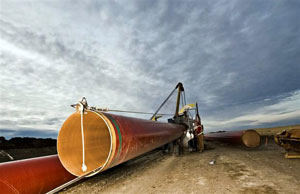
Enbridge pipeline construction in the Athabasca region. Source: Enbridge.
HOW FAST CAN OIL SANDS REALLY GROW?
A slide presentation by geologist David Hughes includes charts showing the wide discrepancy between commonly accepted growth scenarios for the Alberta oil sands, and significantly higher projections put forth by Enbridge and other proponents of fast build-out of oil sands infrastructure. The slides also include satellite views of the oil sands showing growth over nearly three decades. View the slides here.
The Northern Gateway Pipeline will explosively increase the scale of oil sands production at a level not in the national interest, says David Hughes, one of Canada's foremost energy analysts.
By tripling oil sands production rates above 2010 levels, the project will "compromise the long term energy security interests of Canadians, as well as their environmental interests," charges Hughes.
The proposed pipeline, designed to ferry bitumen to Asian markets, will also liquidate a non-renewable resource at prices that will likely seem like a bargain down the road says Hughes in a 30-page report titled "The Northern Gateway Pipeline."
The top-notch analyst also points out that Enbridge, Gateway's proponent, has made up its own oil sands growth forecasts, which it has provided to the National Energy Board to justify the project.
"Enbridge has generated its own projection of a further increased oil supply, with no methodological backup, to justify the need for its Northern Gateway project to the National Energy Board."
Hughes' damning report also posits a simple question that Canada's media routinely neglects: why does the Canadian government support a proposal to export oil to China when nearly half the country (Quebec and Atlantic Canada) is nearly 100 per cent dependent on declining or volatile reserves from the North Sea and the Middle East? (The study was funded by the author and by Forest Ethics with intervenor money for the Gateway hearing provided by the Canadian Environmental Assessment Agency.)*
He also singles out a glaring public policy omission: Canada does not have a credible energy plan. "The absence of a National Energy Strategy, given the non-renewable nature of the majority of the energy inputs to Canadian society, represents an extreme vulnerability to the long-term security interests of Canadians."
Author's 32 years with Natural Resources Canada
Hughes is neither a radical nor a foreigner. Nor he is an environmentalist. In fact the no-nonsense geologist regards the oil sands as a strategic resource that should be developed measurably and carefully in the national interest.
His energy expertise is genuine and hard won. The rock hound worked for the Natural Resources Canada for 32 years where the senior researcher focused on analyzing coal reserves, shale gas and unconventional natural gas supplies.
The retired 61-year-old energy specialist now gives detailed and sobering talks about declining global energy supplies across the continent.
The report, which has been submitted as evidence to the National Energy Board (the author will testify at the public hearings), squarely questions the "Canadian energy superpower" rhetoric of the Harper government. Hughes says it's based entirely on the oil sands -- a low quality and environmentally high-cost source of oil.
But Canada does, however, burn super volumes of fossil fuels. Canadians now consume five times more oil than the global per capita average, says Hughes. In addition half the country depends on oil imports (780,000 barrels a day) from foreign countries. In fact, the majority of oil consumed in Quebec and Atlantic Canada comes from volatile regimes in the Middle East.
How can Canada be an energy superpower, asks Hughes, when it will become "increasingly dependent on OPEC and the vagaries of the world oil markets for what is likely to be much higher cost imported oil?"
Furthermore, Canada's highest quality energy resources are declining. "Our natural gas production peaked in 2001 and conventional oil peaked in 1973. The superpower claim is totally a statement about the tar sands," Hughes told The Tyee.
But bitumen is not light oil, cheap oil or even easy oil. It's taken 40 years of dedicated brute force and landscape destruction as well as nearly $200 billion worth of mostly foreign capital to reach marginal production levels of 1.5 million barrels a day. (See satellite images)
In the global scheme of things, that's a drop in the bucket. It's also a modest figure given that Canada now consumes 1.8 million barrels a day. (Domestic demand could grow to 2.25 million barrels by 2030).
Moreover Canada has or will soon pick the best fruit first in the oil sands, says Hughes. The mineable portions are the richest and cheapest to extract. These are the focus of nearly 90 per cent of the 26 billion barrels currently under "active development" according to the Alberta Energy Resources Conservation Board.
Of the remaining 143 billion barrels, 90 per cent can only be exploited by in situ methods, which are so energy wasteful and water intensive that many experts think this technology should be banned or severely limited.
According to the "growth" forecasts by the Canadian Association of Petroleum Producers (CAPP), Canada could extract 3.7 million barrels a day by 2025 (the maximum recovery rate) but such haste would exhaust the 26 billion barrels "under active development" within 19 years. The Gateway Enbridge pipeline, which proposes to suck out half a million barrels a day to Asian supertankers, would accomplish that job quickly.
Three strikes against
Hughes thinks that the rapid liquidation of Canada's highest quality bitumen reserves, as proposed by Enbridge, is bad national policy for three reasons.
For starters, peak oil means the end of cheap oil. What stays in the ground will only get more valuable over time, says Hughes. Speedy liquidation means not only a revenue giveaway but exponential growth of pollution and water contamination. (Current mining waste liabilities already total more than $20-billion.)
Second, energy returns on bitumen are dropping fast, which means that industry will increasingly spend more energy to get less energy back. Right now industry secures but 5.7 barrels for every barrel of oil or its energy equivalent invested in tar sands mining operations. In contrast, the Middle East still garners superior returns of 20 to one. (According to energy expert Charles Hall, our currently oil-driven civilization requires returns of 10 to one or must face economic stagnation.)
But the steam plants, models of inefficiency and waste, win returns of 3.8 to one for in situ recovery (80 per cent of the resource). Given that the best bitumen resources with the highest energy returns are now being used up, a rapid extraction policy leaves Canadians with the dregs of the barrel as well as less energy and even bigger environmental messes, says Hughes.
Third, the Enbridge pipeline is based on a projection that accelerates liquidation of a non-renewable resource in the absence of any national policy. Hughes points out that Northern Gateway is not needed unless oil sands production is ramped up by more than three-fold over 2010 levels. Enbridge bases its Northern Gateway proposal on the assumption that oil sands production can be tripled in less than 25 years. (Remember it took 40 years to reach 1.5 million barrels.)
The Enbridge forecast, which was an extension of CAPP's most optimistic forecast of tar sands development filed in its application to NEB, has no documented methodological basis. This was confirmed in an email to Hughes from CAPP.
It stated: "The extension is not from CAPP. Looks like someone has done the extension without our cooperation. In other words, we can't comment on the methodology."
CAPP, the nation's powerful oil lobby, has two growth scenarios for the tar sands. Given existing approvals and projects under construction, CAPP's more conservative forecast says oil sand production will grow from 1.8 million barrels a day to 2.8 million barrels by 2019 (tar sands production including diluents). That's a 50 per cent increase over 2010 production levels.
But a super "growth" CAPP scenario based on speculative numbers suggests production could reach nearly 4.6 million barrels per day by 2025, a growth rate of 154 per cent.
Enbridge, however, took these figures and jacked them up to 5.8 million barrels a day by 2035 or a growth rate of 217 per cent over 2010 levels. "Enbridge's rationale for the Northern Gateway Pipeline is based on its own unsubstantiated and highly optimistic projections for growth in oil sands production beyond 2025," reports Hughes. "This may serve Enbridge's corporate needs and those of its shareholders but does not consider the longer term environmental and energy security needs of Canadians."
In summary Hughes concludes that 50 per cent growth in oil sands production can be handled by existing pipelines and U.S. demand. In other words Gateway is not needed. (A Natural Resources Canada briefing note reached the same conclusion last year saying "Even without Northern Gateway, Canada will have enough crude oil export capacity for some considerable time.")
Slow and steady
Like many oil patch veterans, Hughes favors a slow and prudent course and doesn't recommend much further growth in bitumen production. "I agree with [former Alberta premier] Peter Lougheed. I think we should have a planned growth strategy that puts Canada first."
But Enbridge's radical growth projections would expand the scale of the mammoth tar sands project and triple current levels of production by 2035. Hughes calls such irrational growth a threat to the nation "in the light of the long term energy security and environmental interests of Canadians."
Furthermore, "the absence of National energy strategy which safeguards the long term energy security and environmental interests of Canadians means there are no constraints on the uncontrolled liquidation of Canada's intrinsic energy resources."
Asked why Natural Resources Canada hasn't raised these critical energy issues, Hughes paused for a moment on the phone at his home on Cortes Island in British Columbia.
"That's a good question," he replied.
*Story updated at 3:26 p.m. on Jan. 12, 2012.
[Tags: Energy, Environment, Labour + Industry, Politics] ![]()


48
Login or register to post comments
A Voice
19 weeks ago
Valid points
This man raises some very valid points that our govt needs to open its eyes to. I say Canadians first, not China.
Van Isle
19 weeks ago
It should be interesting to
It should be interesting to see Enbridge's professional liars counter-spin Mr' Hughes's report. I have wondered for years how come our Federal Government allows foreign into eastern Canada and but not one bloody drop of oil from Hibernia is refined or consumed in Canada. Betcha dollars to donuts the mass-media says sweet-bugger-all about Mr. Hughes's report.
Van Isle
19 weeks ago
Ooops, sorry, fergot to put
Ooops, sorry, fergot to put in 'oil' behind foreign.
coop
19 weeks ago
Finallty, the truth gets out
Once again the Tyee and Nikiforuk brings the true story of the insanity behind the pipeline proposal. I found the Hughes's report this morning on Fb and sent it off to all the major media - let's see if it makes it in the mainstream news. This report should be enough to suspend the hearings!
Vox.Pop
19 weeks ago
Follow the Money
Always a good plan to 'follow the money'. Who will benefit from the Enbridge pipeline? I mean, specific individual names, not corporate entities. It is always individual people who make these decisions, like Gwyn Morgan ex-EnCana CEO, who ended up a millionaire but started as a lowly engineer.
Skywalker
19 weeks ago
It is really treason.
The practice of selling off a diminishing resource in a country, thereby risking the economic security and national interest should be considered treasonous. And, Joe Oliver worries about a few environmentalist being radical because they oppose this treasonous behavior?
Jim Baird
19 weeks ago
Constant sustainable power from BC Technology
Patrick Takahashi, Director Emeritus of the Hawaii Natural Energy Institute at the University of Hawaii recently blogged:
OTEC COULD BE THE ONLY SUSTAINABLE OPTION IN THIS CENTURY TO PROVIDE ENERGY AND RESOURCES FOR THE WORLD.
Conventional OTEC is economically plagued by the size of the pipes required and environmentally by the volume of water these pipes move.
Both of these problems are addressed by GWMM OTEC which is BC developed technology that reduces the size of the conventional infrastructure by as much as 900% -- 1 meter pipes compared to 10 meters, increases the thermodynamic efficiency of the process by transferring heat through phase changes rather than in fluids and maximizes energy potential while limiting environmental impact by recirculating heat in a closed system back to the surface rather than dumping it to the depths.
In other words GWMM OTEC makes THE ONLY SUSTAINABLE OPTION IN THIS CENTURY TO PROVIDE ENERGY AND RESOURCES FOR THE WORLD viable.
As Dr. Paul Curto, former Chief Technologist with NASA, points out in response to my recent OpEd News article, The Willie Sutton/Will Rogers Approach to Energy:
OTEC is a magic or silver bullet for so many of our problems, and serves to solve the most tragic problem of all — mass extinction.
All of the other “solutions” fail to address the problem at hand, and we are running out of time.
In the process of producing all the renewable energy the world needs you eliminate carbon emissions, increase carbon dioxide absorption (cooler water absorbs more CO2), cool the oceans and prevent potential extinction events due to clathrate breakdown or thermal runaway caused by warming amplification from increased atmospheric moisture.
By securing the global intellectual property to this technology this provinces stands to be the world leader in safe, sustainable energy production.
gguppy
19 weeks ago
Just who's going to benefit anyway?
The way it stands if this project goes ahead is that British Columbians may get a few long term jobs and all of the risks including having to clean up after a spill while Alberta will get none of the risks but 100% of the Royalties from the oil that flows.
BC should not in any case entertain approving this project and allowing it to trespass our Province unless long term Royalties are to be shared 1/3 to Alberta; 1/3 to British Columbia; and 1/3 to the First Nations' land it crosses.
RickW
19 weeks ago
Vox.Pop
Right on! We should in ALL cases, see who gets the money FIRST! These mega projects are really nothing less than less than an elaborate pyramid scheme.
Here's where I first heard of David Hughes:
http://walrusmagazine.com/articles/2009.06-energy-an-inconvenient-talk/
snert
19 weeks ago
coop
It's not the "true story", the only truth about it is that a report was written.
FWIW that report had some valid concerns but that does not make them the truth.
grizz
19 weeks ago
"I agree with [former Alberta
"I agree with [former Alberta premier] Peter Lougheed. I think we should have a planned growth strategy that puts Canada first."
really? i remember peter lougheed saying "let the eastern bastards freeze in the dark". how does that "put canada first"? i hope we can do better than that.
rockdoc
19 weeks ago
snert and grizz
snert,
Near as I can tell the report references the latest data and statistics and is as objective as possible. That doesn't make it the truth but it is obviously an effort to be as objective as possible. Certainly better than what comes out of the ideological spin machine that passes for our government in Ottawa.
Grizz,
Lougheed was pissed about the National Energy Program and its price caps etc. - likely justified. But for several years he has been a calm voice of moderation in terms of what is going on in Ft. McMurray.
Skywalker
19 weeks ago
Not good enough, snert.
You then have an obligation to state exactly what he said that is not the truth and what the truth is. We can then determine your "truthiness"..
Cynic
19 weeks ago
When it comes to corporations
When it comes to corporations like enbridge and indeed, the 1% and the elite, we must always bear in mind their good intentions. They understand that we protesters mean well but are sadly deluded and unable to grasp the big picture. How could we possibly understand their vision, their plans? At least they're pretending to accommodate us with these wonderful hearings, but in the end they will do what's right for mankind.
pwlg
19 weeks ago
time for action
I see that one reader has sent the report of Mr. Hughes to a major media outlet.
I suggest that all of us concerned about this insanity send his report as well as Nikiforuk's two articles this week to as many friends, media outlets and lists that we can muster.
I started doing this yesterday and am surprised by the responses I have received back. All in praise of both Hughes and Nikiforuk's work.
RockyRacoon
19 weeks ago
http://www.marxists.org/archive/trotsky/1918/military/ch06.htm
‘Disarm, stop exterminating your fellow-men, stop oppressing.’ Naive creatures! They advised the wolf to put his wolf’s teeth on the shelf... present-day scientific socialism has named them, with justification, utopians. This, of course, does not mean that the aspirations of the utopians were not noble in the highest degree...Mankind’s experience, the whole of history, refutes this policy of utopian and Tolstoyan pacifism. The oppressors have inherited, from one generation to the next, their views, feelings and aspirations as oppressors; they drink in with their mothers’ milk the striving for power, for oppression, for domination, and they consider everybody else, the working masses, to have been created merely so as to serve as basis and foundation for the rule of a small group of members of a privileged estate who are born, so to speak, with spurs on their heels, ready to ride on the backs of the working people. Yes, we are trying to establish the Communist order, under which there will be no hostility between classes because there will be no classes... in one world common to all, and engaged in a common task. Our aims... We say, not to the exploiters but to the working people:
‘Until the Communist order has been attained, remember that you are the only force that is capable of bringing it about. And remember (and we in Russia know this all too well, from experience), that the ruling classes of the whole world will yield not an inch to you on the road to that end without a fight: that they will cling to their privileges and profits, to their rule, tooth and nail, to their last breath: that they will try to bring confusion, chaos and discord into the ranks of the working class itself – all so as to maintain their power.’
And, guided firmly by awareness that it is impossible to change social relations otherwise than by bloody struggle, we in Russia took the first step towards communism precisely by overthrowing the rule of the bourgeois classes and establishing the political rule of the working classes. This is already, in itself, a great victory that we have won. The bourgeoisie is not in power here: power belongs to the working class. Having acquired this political advantage, it is able to fight to fulfill its fundamental tasks.
Thus, the question of power is of primary importance. Saying that Soviet power, as such, is a bad thing means fostering self-distrust in the working class. Under the Soviet system the proletariat can establish whatever kind of authority it wants, and responsibility for that authority rests with the proletariat. The authority which exists in Petrograd, in Moscow and in other cities, since it has been created by the workers, can be changed by them. The workers can convene the All-Russia Congress of Soviets whenever they choose, and re-elect therein the Central Executive Committee and the Council of People’s Commissars, and they can re-elect the local soviets.
pwlg
19 weeks ago
time for action
I see that one reader has sent the report of Mr. Hughes to a major media outlet.
I suggest that all of us concerned about this insanity send his report as well as Nikiforuk's two articles this week to as many friends, media outlets and lists that we can muster.
I started doing this yesterday and am surprised by the responses I have received back. All in praise of both Hughes and Nikiforuk's work.
lrh
19 weeks ago
At last some common sense
At last some common sense info without alot of spin. I wish we could find more like this.I think it would help people make informed opinions.
realisticman
19 weeks ago
Yes, Very Nice
One environmentalists quote: "...compromise the long term energy security interests of Canadians,..will also liquidate a non-renewable resource at prices that will likely seem like a bargain down the road says Hughes"
This is like holding on to horseshoes because you've got lots of them and you think the price is going to go up. Cartels do this then get into trouble with being a cartel. What happened to the horseshoe hoarder? He got burned when someone invented the automobile. His stock was worthless. Does Hughes think we'll need oil for ever?
"He also singles out a glaring public policy omission: Canada does not have a credible energy plan. "The absence of a National Energy Strategy, .."
The recent Supreme Court ruling against a national securities administrator clearly defined the separation between federal and provincial rights and their jurisdiction. Natural resources are a provincial area of ownership and any attempt by the federal government to create a national plan would almost certainly result in court challenges and constitutional battles; not just from Alberta but from several other provinces.
It will be a reckless government that tries to create any strategy that rules over provincial resources. It would require opening up the constitution and anyone who has forgotten how that works out should Google it.
http://www.bloomberg.com/news/2012-01-12/chevron-to-work-with-statoil-repsol-in-canadian-waters-1-.html
"The superpower claim is totally a statement about the tar sands," Hughes told The Tyee. ..."
No it's not.
"Chevron Corp. (CVX), Statoil ASA (STL) and Repsol YPF SA (REP) agreed to jointly drill oil exploration wells off Canada’s Arctic and Atlantic coasts.
The Canadian division of San Ramon, California-based Chevron will work with Stavanger, Norway-based Statoil and Madrid-based Repsol to explore for oil in the Orphan Basin off the coast of Newfoundland, with Chevron controlling 65 percent of the project, the U.S. oil and gas producer said today in a statement.
The companies will also cooperate on drilling wells in the Flemish Pass Basin, while Chevron and Statoil will cooperate in the Beaufort Sea.
Newfoundland holds more than a quarter of Canada’s conventional oil reserves, according to the website of the government of Newfoundland. Offshore oil production has made the province the fastest-growing economy in Canada, according to the U.S. Geological Survey.
In the Arctic, including parts controlled by Canada, companies are eyeing oil reserves that may be as large as 90 billion barrels, the U.S. Geological Survey said in 2008. ..."
realisticman
19 weeks ago
As for Eastern Canada Imports
They are not mainly from the North Sea and the Middle East.
"Imports from Venezuela are dominated by crude oil. In 2009, Canadian oil imports were valued at $778 million, making up nearly 86% of Canada’s total imports from that country. Fluctuations in oil imports account for the volatility in Canada’s total imports from Venezuela in recent years.
Because of Canada’s significant oil imports from Venezuela, Canada is a large net importer of extractive industry products. "
Government of Canada
http://www.parl.gc.ca/Content/LOP/ResearchPublications/2010-49-e.htm
rockdoc
19 weeks ago
realisticman
Time to get real. Venezuela imports are only 3% of Canadian imports. Read Mr. Hughes' report. 86% of 3% may mean something to you but is totally irrelevant to this conversation.
realisticman
19 weeks ago
Clarification
From Stats Canada, for 2006 : Total crude oil supply was 103,974.1 thousand cubic meters with 49,284.9 or over 47% of that being imported. Large imports of crude were purchased from Algeria, Iraq, Saudi Arabia, Nigeria and Venezuela, the UK and Norway.
rockdoc
19 weeks ago
realisticman
Just noted your earlier post. Looks like you think oil is going out of style and will be worth nothing if we don't sell it down the pipe as soon as possible - are you a high ranker in the Harper regime? The arctic may hold 90 billion barrels but most of that is not in Canada. Canada's conventional oil reserves are a pittance compared to the oil sands, so Newfoundland's claims are like your smoke and mirrors statements on Venezuela above - totally irrelevant to the conversation. Time to get real realisticman.
realisticman
19 weeks ago
rockdoc
Oil won't go out of style for a long time but that doesn't mean we should hoard it, whether it's conventional or not. Kerosene was refined in Nova Scotia in 1846 and coal has been mined since the 17th century. Oil has been produced in Canada since 1858 and it will not stop for while yet.
Opponent ask for a national plan, imagining that this would help them stop Alberta. But...
"Canadian energy policy reflects the constitutional division of powers between the federal government and the provincial governments. The Constitution of Canada places natural resources under the jurisdiction of the provinces. The provincial governments own most of the petroleum, natural gas and coal reserves, and control most of the electricity production. This means that the national government must coordinate its energy policies with those of the provincial governments, and intergovernmental conflicts sometimes arise. "
RickW
19 weeks ago
R/M old man....
Read this:
http://walrusmagazine.com/articles/2009.06-energy-an-inconvenient-talk/
David hughes does not want to hoard oil. He merely wants it's price to reflect it's strategic importance. At the moment, it's going for firesale prices.
hapibeli
19 weeks ago
The gas bubble world
From; The Arch Druid Report on blogspot; Shale Gasp Is a Bubble
"The shale gas bubble is the big economic story you haven’t heard about, though that will likely change in the near future. Behind all the hype about limitless shale gas are two simpler and noticeably less impressive realities. The first is that fracking technology applied to shale deposits can free up modest amounts of natural gas. The second and more important is that for the last half dozen years or so, at least, fracking technology applied to Wall Street has been able to free up immodest amounts of credit, providing the funding for an explosive growth in the natural gas drilling industry.
The intersection between those two facts has produced a classic bubble, with wildly inflated reserve estimates bringing a torrent of cheap credit to bear on an asset that can’t support the grandiose claims made for it. Because US mineral rights laws and Wall Street’s expectations both require firms that buy shale gas rights to produce right away, irrespective of the state of the market, natural gas is now selling for a price—wobbling around $3.50 per thousand cubic feet, last I checked—that covers much less than the cost of drilling and extraction. My readers will no doubt recall real estate speculators in the midst of the bubble feverishly buying rental properties even when the rent covered only a small fraction of the mortgage payments; the logic here is exactly the same.
Thus it’s as certain as anything can be that at some point in the fairly near future, probably though not certainly within a year or two, the shale gas bubble is going to pop, major names in the industry are going to go the way of Countrywide Mortgage and Washington Mutual, and gas drilling is going to slump until rising gas prices and declining budgets for exploration and drilling come back into a relationship that makes sense. Mind you, it’s equally certain that the closer we get to the bubble’s end, the more extravagant will be the claims made for the permanence and game-changing nature of the so-called “shale gas revolution,” and the more abusive will be the responses of those whose jobs depend on the bubble to any suggestion that a bubble is in fact what’s going on."
Peter Dimitrov
19 weeks ago
Good Points but not within scope of Govn't Joint Review Panel
I applaud this article Andrew and likewise I agree that the three key points raised by David Hughes have merit. However, the issues raised by David are not within the narrow scope of the terms of reference of the Joint Review panel of the proposed Enbridge Gateway project. Essentially the scope of the hearings is to assess the environmental effects of the project and their - as well as hear First Nations and others within the Canadian community. For further info see this url:
http://gatewaypanel.review-examen.gc.ca/clf-nsi/dcmnt/jntrvwpnlgrmnt-eng.html
Whilst the panel will receive and hear Mr. Hughes, IMO, I think it will have minimal weight in their decision making process.
The Environmental Assessment process, with its narrow scope, with its appointment of their bureaucrats to make a narrow decision in accordance with the terms of engagement is deeply flawed from the start. Consider this, would you allow three bureaucrats from Ottawa to sit at your kitchen table and ultimately make decisions that could irreversibly affect your home and its value to you? The pipeline and super-super tankers will be traversing through First Nation's homelands - IMO, it is they alone, as aboriginal rights and title holders who should be deciding this matter!
hapibeli
19 weeks ago
The limiless carbon reserves fantasy
Only those who believe that the oil reserve quotes are from honest brokers dares to believe in limitless oil, natural gas, uranium, electric cars, flying pigs, and the future worth of carbon energy stocks. Chortling out loud!
dave49
19 weeks ago
Hewers of wood and miners of bitumen...
I recall an interview with Australian Tim Flannery (The Weathermakers). I remember what he outlined as the future for the Australian economy: being a supplier of raw resources to China.
I've read two good assessments suggesting neither Northern Gateway nor Keystone XL will be in Canada's interests in the long run. Why don't we look after the CANADIAN demand first. Canadians will still pay world price.
Many discussions neglect the shortage of skilled labour in Alberta, which is predicted to hit about quarter million people with high output growth strategies. It will be perverse if we are regularly flying foreign workers in and out of northern Alberta with all the implications for effectively less net energy return and a greater carbon footprint.
I just saw the movie "The Revenge of the Electric Car". As the vice-chairman of General Motors noted, automobiles are our last major [consumer] manufacturing sector, everything else has been moved offshore.
Why can we use this stuff at a reasonable pace, get Eastern Canada off 'foreign' oil and build some new refineries.
As for BC, I'm going to stick my neck out and suggest that rather than exporting liquified natural gas to Asia, we consider a gas-to-liquids plant and make gasoline and other synthetic petroleum products that way. However, I just has a quick look at info about Shell's Pearl project in Qatar and the REAL cost may put it totally out of question.
mmphosis
19 weeks ago
SIGN THE PETITION
http://dogwoodinitiative.org/no-tankers/petition
kmdyson
19 weeks ago
the satelite images
of the tar sands tells a story ... and not a nice one!
freebear
19 weeks ago
China's military needs the oil !
Another reason why the Chinese arer so interested in tarsands!
boondoggle
19 weeks ago
Our corporate leader
Awesome journalism! When you read the facts one fact towers above all. We have a corporate oil puppet raping our country with the aid of the corporate media (including of course the CBC). Where are the mainstream journalists? Reporting on Harper's charming rendition of "With a little help from my friends"...how special. Is there any hope that Canadians will wake up and stand up before it's too late?
robertjb2
19 weeks ago
Desparate Oil
Once again Harper and Company are caught lying to Canadians.
As Hughes has stated we have a choice: Hit the wall or manage the descent. It seems we are determined to hit the wall at full speed.
Could it be Harper is pushing Gateway as a ploy to rushing the US into approving Keystone? The last thing they want is for China to get its hands on tar sands oil. Keystone could be sold as the lesser of two evils in an era of energy desparation.
Frank Lee
19 weeks ago
China is in a hurry, Enbridge is in a hurry
But the Keystone and Eastern Canadian routes both make much more sense in the short to medium term for Canada.
If, as the previous writer suggests, the promotion of Gateway is a ploy, then Harper at least gets marks for cleverness. Although the same might not be said for Enbridge, who have spent something like 10 years developing this proposal?
RickW
19 weeks ago
robertjb2
Perhaps Harper thinks he can manipulate China once it becomes "dependent" on TarSands oil.......?
Skywalker
19 weeks ago
Right RickW
and Harper will manipulate China when pigs fly. Now the other way around is more likely.
RickW
19 weeks ago
Skywalker
You have to remember that Harper has contracted the Dutch Disease, and it has caused him to exhibit many of the traits proudly demonstrated by the candidates for the leadership of the GOP in the US.
OleumBenevolus
19 weeks ago
The problem with Mr. Hughes opinions ...
The problem with Mr. Hughes opinions is that they're rather typical of someone who has worked in the Federal bureaucracy for over 30 years. He and others like him just have no idea how a market economy works.
Central to his thinking is the idea of a National Energy Strategy (in the 80's we would have called it a National Energy Program). Hughes and ex-Premier Lougheed think that you can assemble a panel of experts that will decide 1) the exact timing to extract the bitumen from the ground for the highest possible price 2) the ideal rate of production growth 3) whether pipelines are required and if they are what markets they should serve 4) the exact permissable energy input required to produce a barrel of oil. The Soviets tried this command and control based economic approach and we all know how that turned out.
In a market based economy Energy producers invest billions of $ per year to deliver product to their customers in the hope of making a profit. There are high risks and high rewards. There are benefits to both producer and customer. There is no guarantee that they will continue to receive a profitable price for their product over the 30 to 50 year lifetime of their project. There is intense competition to acquire mineral rights, hire the best talent and implement the best technology to unlock the resource. There is no guarantee that their expensive to produce energy will not be displaced from the market by as yet unknown major new resource finds or transformative energy producing technologies.
Full disclosure: while I'm not an employee of a "Big Oil" or pipeline company I have been know to fill up at a "Big Oil" gas station several times a month :)
RickW
19 weeks ago
OleumBenevolus
That is quite a fantasy you've conjured up. Check the stats (especially among Big Biz) about investment vs. returns. Big Pharma for instance, is spending less and less on R&D, and instead is concentrating on buying up patents. And there is no way Big Oil would invest the billions it has on a wing and a prayer. But the energy market is captive, especially the hydrocarbon part.
OwlRol
19 weeks ago
Some dream world's crumble over a short time
OleumBenevolus, you are living in a fantasy world being promoted by some ideologues and corporate interests.
A "corporate central command economy" is no better than a "state central command economy".
A mix that prioritizes all Canadians' needs, especially residents in the affected regions, must take precedence over narrow corporate interests.
A national energy strategy/program is badly needed in Canada. Fossil fuels are one of Canada's energy resources, not corporate resources. As such, they should serve all Canadians, including central and eastern Canadian residents, rather than the imported "unethical" oil these depend on.
Fossil fuels need to be used to develop sustainable energy for Canada's future, not so much exported where the invisible and BLIND market determines best prices. (eg. Canadian oil powering the Chinese military is a more extreme example).
"There is intense competition to acquire mineral rights, hire the best talent and implement the best technology to unlock the resource."
Please replace "best" with "least expensive and somewhat acceptable". Unlocking the resource is easy, given our gargantuan technologies.
Our "best talent" needs to be used elsewhere in energy development, rather than trying to fast track extraction and export of our fossil fuel resources.
"In a market based economy Energy producers invest billions of $ per year to deliver product to their customers in the hope of making a profit."
"in the HOPE of making a profit" Ha, ha, even during the worst of the recession, Exxon Mobil, Shell and Chevron continued to profit, just not at the same rate. Even BP hardly missed a beat, despite the Gulf oil spill.
"There is no guarantee that their expensive to produce energy will not be displaced from the market by as yet unknown major new resource finds or transformative energy producing technologies."
Anyone who pays attention knows that corporate profits will only increase with demand. That's guarantee enough.
"unknown major new resource finds", meaning arctic and antarctic (the latter unvavailable climatically or politically). These will never cover the increasing demand. Profits safe but maybe slightly lower.
"transformative energy producing technologies". Wonderful, that's exactly where we need to go, instead of trying to stall them.
So why is China, with all its coal mines and oil demand, now the global leader in solar and wind technologies amongst others, while Canada ranks low in OECD countries on this file?
Your market economy thinking is surely much lacking. Take off the blinkers.
realisticman
19 weeks ago
Rol
Any national energy strategy/program would infringe on provincial rights. Anyone that tries to open up the constitution to do this is asking for divisive national unity problems in a number of provinces.
There are currently around 100,000km of oil and gas pipelines in Canada. There almost certainly will be more.
Investing in solar and wind technologies in Canada and the US is very much out of vogue after the recent bankruptcies.
Google: Solyndra LLC, Timminco, Arise Technologies Corp., ATS Automation Tooling Systems Inc., Canadian Solar Inc.
It's not as though they haven't tried.
The question Canadians need to think about is whether they are prepared to give up the financial benefits that oil and gas bring, particularly because they exist and we have them. What government services are we prepared to cut back on? Also, if solar is such a financial bust, then should taxpayers be reducing money from health-care, education and infrastructure to subsidize companies that don't seem to be able to develop a market and hire employees or pay back a dime.
North of Hope
19 weeks ago
Van Isle says
" I have wondered for years how come our Federal Government allows foreign into eastern Canada and but not one bloody drop of oil from Hibernia is refined or consumed in Canada. Betcha dollars to donuts the mass-media says sweet-bugger-all about Mr. Hughes's report."
As well no one mentions that the gas from off-shore Nova Scotia is piped through Nova Scotia and sent to the US. None is used in Canada, all of it is for the US.
We do need a National Energy policy in Canada.
OwlRol
19 weeks ago
Rman, points well made, but...
Rman, I'm aware of how market fluctuations affect investments in the private sector.
Reading through your references and links, the items below stood out.
The cost of solar panels dropped by half while efficiency is much improved.
New investment and competition, notably by Warren Buffet and Trans Canada has caused BP to drop many of their solar (not wind) investments, fearing profit losses due to stiff competition.
"Buffett’s MidAmerican Energy Holdings agreed this month to buy a $2 billion solar project under development in California and a 49 percent stake in a $1.8 billion plant in Arizona. 'GENEROUS SOLAR TAX CREDIDS', valid to 2015 may have lured the billionaire investor, who already owns wind farms, into his first solar foray, Gerard Reid, an analyst at Jefferies International Ltd., said on Dec. 7." (Financial Post - Bloomberg News, Dec 21, 2011)
So the U.S. government incentives have promoted private investment in this form of energy production.
Where are there similar TAX CREDITS in Canada's alternative energy R&D, especially when comparing the yearly billion dollar subsidies given to the oil sector?
Why was a Canadian wind energy company hung out to die until the German government attracted them to move there with a $50 million grant for starters?
Free market, hardly. Big Oil doesn't want such development unless they control it.
And the Harper government is in their pockets, so little if any federal assistance is available for alternatives.
As to the constitution and federal, provincial powers, if fossil fuel development is under provincial jurisdiction (in this case, to the benefit of Alberta), then transport of that same product must also be under provincial jurisdiction, (in this case, to some benefit but much risk of B.C.)
So, if the B.C. government, at the wish of most of its citizens, rejects the Northern Gateway project, does that cancel it, or is pushing it through, as you said, "asking for divisive national unity problems in a number of provinces."?
realisticman
19 weeks ago
Rol
Tax credits are available. Timminco went belly up and owes millions to funds using Canadian taxpayers money. They owe $26 million to the Quebec Government alone. Ontario's FIT program has helped finance over 3,000 contracts for Bioenergy, Solar PV, Hydroelectric and Wind.
There are government tax credits all over the place. In Quebec there's an R&D program that actually pays part of an employees salary. The Ontario Ministry of Finance says, "Ontario offers attractive R&D tax credits. Provincial and federal incentive programs combined offer globally competitive incentives/ Offering 44.99% Savings and up to 55.99% for some Ontario programs".
It's all there in the Report by Canada's Technology Triangle.
No bank would forward the up-front cash for even office rental if these companies were not taking advantage of all the tax credits.
Ownership of resources rests with the provinces. Transportation is probably something else. Have you read the Constitution?
The difficulty of this constant cry for a national energy program was evident at the NDP convention in Montreal this past weekend. Candidates called for a federal national housing and transportation strategy. Thomas Mulcair said no, reminding the audience that these are areas of provincial jurisdiction, going back a couple of hundred years, and implying that Quebec would never agree to the feds stepping in to tell Quebec what to do in social policy, infrastructure policy and, of course, in energy policy. The Rest of Canada can go ahead and make their own plans and programs but it will not be a national one. Been there, done that! If one province opts out (with financial compensation), as Québec would from any of these schemes, then other provinces will be able to opt out too.
Mulcair must be wondering why it is that the rest of Canada just does not understand the fundamental division of powers laid out in the Canadian Constitution.
OwlRol
19 weeks ago
federal credits
Some good points about available tax credits, but note that I said "federal assistance", as in the U.S.
Nearly all your references are implemented by greener thinking provincial leaders than PM Harper will ever be.
realisticman
19 weeks ago
Stephen Harper's personal
Stephen Harper's personal opinion is irrelevant! The Canadian R&D assistance programs are in place across the country and there's not much he can do about it. These programs have been there for ages, they all only work in conjunction with provincial programs.
As with ALL programs this is run from the appropriate provincial office. (how many times before some people realize that Canada is a very much decentralized federation?)
www.cra-arc.gc.ca/txcrdt/sred-rsde/menu-eng.html
The idea that oil companies are subsidized but renewable-energy companies are not, is a complete and total myth.
realisticman
19 weeks ago
This One?
"Did you know...
In 2010, Canada had a total installed wind power capacity of over 4,000 MW, ranking 9th worldwide. "
prowind.ca