Way ahead of Occupiers, US founding leaders raged against powerful, corrupting financiers.
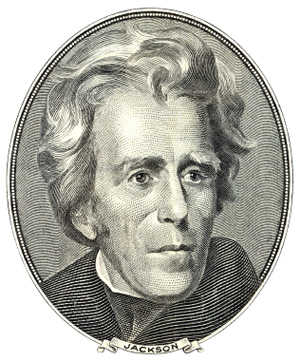
Andrew Jackson, whose image is on the US $20 bill, called bankers 'thieves and vipers.'

-
Way cleared for US mortgage firms and easy credit, insured by Canadian taxpayers.
-
Inept budgeters axed $100 million yearly tax revenue from fat financial institutions. And it gets worse.
-
Profit-hungry bankers, weapons makers pushed EU member over brink.
The Tea Party and the Occupy Wall Street movement have more in common than they realize. Patriotic followers of the Tea Party exalt the vision and courage of America's founding fathers. The common element uniting the diverse interests of Occupy Wall Street is rage against greed and corruption within the banking industry.
In fact many icons of the American Revolution were worried about the same thing and battled mightily against the unfettered power of the banks more than 250 years ago -- a struggle that continues to this day.
Even before the Declaration of Independence, the passage of an obscure British law called the Currency Act of 1764 was a major colonial grievance that contributed to the American Revolution. This law prohibited American colonies from issuing their own legal tender and was seen as an effort to lock the colonies under the monetary control of the Bank of England. Benjamin Franklin was a colonial agent in London at the time and lobbied strenuously to have the law repealed.
Following the American Revolution, the founding fathers struggled with how to pay off the war debt and hotly debated whether to allow a privately held central bank to issue and control the American money supply -- the model that exists today under the US Federal Reserve.
Thomas Jefferson vs. 'the most deadly hostility'
Thomas Jefferson, author of the Declaration of Independence, strongly opposed the legality of what became known as the First Bank of the United States, which was majority (and later wholly) owned by private investors. Among his many statements against the bank, Jefferson warned: "[The] Bank of the United States... is one of the most deadly hostility existing, against the principles and form of our Constitution."
While Jefferson was an iconic champion of small government, he knew that divesting monetary authority to private interests may saddle the U.S. taxpayer with perpetual debt and leave to government beholden to powerful financial interests: "Bank paper must be suppressed, and the circulating medium must be restored to the nation to whom it belongs."
Pointing out the poor business case of outsourcing the money supply to private banking interests, Jefferson calculated that over a 20-year period, half of the revenue collected by the government would be siphoned off in interest payments: "It is literally true that the toleration of banks of paper discount costs the United States one-half their war taxes; or, in other words, doubles the expenses of every war. Now think but for a moment, what a change of condition that would be, which should save half our war expenses, require but half the taxes, and enthrall us in debt but half the time."
Jefferson was not alone in his concerns. James Madison, the primary author of the U.S. Constitution, also believed the national bank proposal was illegal, as did Attorney General Edmund Randolph. However, their rival Alexander Hamilton prevailed on President George Washington in 1791 to sign a charter for the bank for 20 years, which expired in 1811.
Andrew Jackson vs. 'a den of vipers and thieves'
Huge debts caused by the War of 1812 caused the U.S. Congress to reluctantly incorporate the Second Bank of the United States in 1816. Many of the lawmakers who opposed renewing the charter of the First Bank of the United States five years earlier conceded that keeping the government solvent was impossible unless they capitulated to the banking sector.
Modeled after it predecessor, the Second Bank of the United States was a privately held corporation that enjoyed the enviable position of being the sole depository of U.S. government revenue. It was also the sole issuer of U.S. currency, which it lent at interest to the U.S. government in exchange for Treasury Bonds.
This model -- like today's Federal Reserve -- is seen by many observers as a perpetual public debt machine. Any new money printed is exchanged for promissory notes from the U.S. government. The interest charged by the central bank for new legal tender is ultimately paid through taxation on the U.S. public, who may believe their money is going toward public works and services when it may instead be shoveled out the back door to the private interests who profit handsomely from this deceptive arrangement.
The charter of the Second Bank of the United States was due to expire in 1836, but their directors applied for renewal four years early in hopes of thwarting opposition from then president Andrew Jackson -- a fierce opponent of the Bank. "Old Hickory," as he was known, told a visiting delegation of Philadelphia bankers, "You are a den of vipers and thieves. I have determined to rout you out, and by the Eternal, I will rout you out!"
In what became known as the Bank War, Jackson vetoed renewing the charter in 1832, stating that "some of the powers and privileges possessed by the existing bank are unauthorized by the Constitution, subversive of the rights of the States, and dangerous to the liberties of the people."
He also conducted an investigation of reports of widespread corruption by the bank and concluded "beyond question that this great and powerful institution had been actively engaged in attempting to influence the elections of the public officers by means of its money."
To finally finish off his powerful foe, Jackson issued an executive order in 1833 halting federal deposits into the bank and diverting federal money to a number of state chartered banks. Jackson had to fire two treasury secretaries who refused to carry out the order. He was threatened with impeachment and survived the first attempt to assassinate a sitting president. The bank's president, Nicholas Biddle, then engineered a financial crisis by calling in loans across the country, but the bank eventually lost its charter in 1836 and went bankrupt in 1841. No U.S. central bank existed for another 72 years.
Abraham Lincoln vs. the war profiteers
The next iconic president to battle the banks was Abraham Lincoln, who struggled to find a way of funding the Union effort in the American Civil War. The financiers of the day offered to lend the government funds at interest rates in excess of 20 per cent. Lincoln's novel response was to spurn their money and, for the first time, have the U.S. government instead issue its own interest-free currency -- nicknamed the greenback due the olive ink used to print the new bills.
The National Banking Act of 1863 also instituted a hefty tax on the chaotic patchwork of local bank notes that prevailed at the time, driving the U.S. towards a single national currency under the control of the U.S. government.
By the early 20th century the banking industry was again mobilizing in the wake of the financial crisis of 1907. In 1910, a secret meeting of the nation's wealthiest bankers was convened on a private South Carolina island to draft a plan that eventually resulted in the third U.S. national bank -- the current Federal Reserve Bank. According to an account by B.C. Forbes some years later:
"Picture a party of the nation's greatest bankers stealing out of New York on a private railroad car under cover of darkness, stealthily riding hundreds of miles south, embarking on a mysterious launch, sneaking onto an island deserted by all but a few servants, living there a full week under such rigid secrecy that the names of not one of them was once mentioned, lest the servants learn the identity and disclose to the world this strangest, most secret expedition in the history of American finance. I am not romancing; I am giving to the world, for the first time, the real story of how the famous Aldrich currency report, the foundation of our new currency system, was written."
Theodore Roosevelt vs. 'an invisible government'
Meanwhile a high-profile congressional hearing concluded there was widespread criminal collusion within the American financial sector. Theodore Roosevelt gave voice to rising anger against the rise of corporate power in America in a 1912 speech:
"Behind the ostensible government sits enthroned an invisible government owing no allegiance and acknowledging no responsibility to the people. To destroy this invisible government, to befoul this unholy alliance between corrupt business and corrupt politics is the first task of statesmanship."
While the Democrats under Woodrow Wilson had campaigned against setting up a U.S. central bank, the Federal Reserve Act was passed by Congress on Dec. 23, 1913 and signed into law the same day.
Like previous U.S. central banks, the Federal Reserve Bank is essentially a privately controlled cartel that issues money at interest to the U.S. government. It was not long before voices began to be raised against "The Fed." According to a 1932 speech from Rep. Louis T. McFadden, the Chairman of the House Committee on Banking and Currency from 1920 to 1931:
"We have in this country one of the most corrupt institutions the world has ever known. I refer to the Federal Reserve Board and the Federal Reserve Banks. The Federal Reserve Board, a Government board, has cheated the Government of the United States and the people of the United States out of enough money to pay the national debt. The depredations and the iniquities of the Federal Reserve Board and the Federal Reserve banks acting together have cost this country enough money to pay the national debt several times over...
"Some people think the Federal Reserve Banks are United States Government institutions. They are not Government institutions. They are private credit monopolies, which prey upon the people of the United States for the benefit of themselves and their foreign customers, foreign and domestic speculator sand swindlers, and rich and predatory money lenders."
Franklin Roosevelt vs. government 'owned' by banks
Franklin D. Roosevelt was also no fan of the financial sector, stating in a 1933 letter to Col. Edward Mandell House: "The real truth of the matter is, as you and I know, that a financial element in the larger centers has owned the Government ever since the days of Andrew Jackson."
Even FBI head J. Edgar Hoover was wary of the increasing influence of banks, stating in 1955: "Banks are an almost irresistible attraction for that element of our society which seeks unearned money."
Since then, the erosion of government oversight in the American banking sector has continued apace. Banks scored an enormous victory over regulators in 1999 with the repeal of the Glass-Steagall Act -- an important law that had been on the books since 1933 and required a clear separation of commercial banking from the much more risky investment banking.
The systematic dismantling of U.S. financial regulations that dates back decades contributed directly to the financial crisis of 2008. Three years after this global catastrophe, the now-infamous financial mechanisms called credit default swaps remain entirely unregulated.
Patriots! Rejoin a great US tradition!
In recent years banks have become so powerful they apparently don't even feel the need to feign deference to federal regulators. After providing hundreds of billions in public bailouts to their colleagues at Bear Stearns and other reckless speculators, The Fed rejected a 2009 request from the U.S. Treasury for a review of the central bank's governance and structure. One candid trader stunned a BBC on-air panel last month by flatly stating, "governments don't rule the world, Goldman Sachs rules the world."
Given the power struggle between the U.S. government and powerful banking interests dating back to the days of the American Revolution, it is strange that Tea Party leaders such as Rick Perry now dismiss the Occupy Wall Street movement as "class warfare." Rather than join the battle against the banks stretching back to the days of Benjamin Franklin, the patriots of the Tea Party have unwittingly become a zombie army of the same corporate interests seeking to destroy the very institutions the founding fathers fought so hard for.
The widespread revolt against the excesses of wealthy financiers spreading across North America would be very familiar to the founding fathers. Iconic Americans from Thomas Jefferson to Teddy Roosevelt battled valiantly to protect the fragile notion of liberty against repeated and coordinated attacks from a corrupt and self-serving banking sector. In contrast, the milquetoast response by President Obama to the recent crimes of corporate America indicate just how enfeebled the U.S. government has become.
But hope springs eternal. More than two centuries on, the true spirit of the American Revolution is finding new life on the streets below financial towers across the continent. While the foe is formidable, these battles have been waged -- and won -- many times before.
If Tea Party followers would study their history, they would realize this patriotic fight is their own as well. Their ample energy and justifiable anger would be a welcome and appropriate contribution to this historic struggle.
Tomorrow: An Occupier's Reader: Eight years of Tyee articles documenting the growing wealth divide. ![[Tyee]](http://thetyee.cachefly.net/ui/img/ico_fishie.png)
Mitchell Anderson is a frequent contributor to The Tyee. Read his previous articles here.
35
Login or register to post comments
Conductor274
1 year ago
Dumbed down population
I'm not at all surprised that the Tea party people don't understand what goes on with banks and wall street. The education system has been underfunded for a reason. With a dumbed down population the bankers can continue pillaging the public purse with impunity. They just tell their PR machines like Fox News and Sun TV what to say and their viewers suck it up and repeat it as the truth.
Iwannajob
1 year ago
excellent article
This article is a must read for all our politicians and news talking heads. And our university students. I'm willing to bet that the European meltdown has a similar history to America's if not the same actors (bankers)
Fiat lux
1 year ago
The Tea Party is a highly
The Tea Party is a highly organized underground organization for world control under corporate dictatorship, and not a spontaneous, populist movement.
What they have accomplished was to wake up the disorganized, but long overdue, populist, Occupy movement.
Ed Deak.
mopled
1 year ago
I do hope you cover Canada's capitulation to the Banksters
In 1974 the Trudeau government gave us a modified Federal Reserve type system. The Bank of Canada has the power to create up to 20% of the money supply essentially without interest, but that has been abandoned in favor of borrowing and paying interest.
As far as Goldman Sachs ruling the world goes, we have only to look at the present Governor of the Bank of Canada, Mark Carney, an alumnus of Goldman Sachs to see the truth of it.
The history of the Fed by G.Edward Griffin The Creature From Jekyll Island A Second Look at the Federal Reserve is a book worth reading. Here's the video:
http://video.google.com/videoplay?docid=6507136891691870450
Lizzzie Roy
1 year ago
The Tea Party
The Tea Party is mainly funded by the the billionaire Koch Brothers who 'paid' the politicians in Wisconsin to steal away power from the unions/the people and this was really the beginning of it all in the States. So to say they and the Occupiers are alike is like saying the Tea Parties are Democrats and the Occupiers are Dictators.
mopled
1 year ago
Note to Ed
The Tea Party was co-opted the day Sarah Palin appeared unbidden before their rally in Illinois.
"There’s a major political fraud underway: the GOP is once again donning their libertarian, limited-government masks in order to re-invent itself and, more important, to co-opt the energy and passion of the Ron-Paul-faction that spawned and sustains the ”tea party” movement. The Party that spat contempt at Paul during the Bush years and was diametrically opposed to most of his platform now pretends to share his views."
http://www.salon.com/2010/02/21/libertarianism/
Obama supporters have tried to co-opt the show of displeasure presently occupying major cities in the US using Soros funded Moveon.org.
http://www.prisonplanet.com/moveon-org-hijacks-occupy-to-push-obama-tax-agenda.html
"The best way to win an argument is to control both sides of it."
Fiat lux
1 year ago
Karl Rove's Blueprint for
Karl Rove's Blueprint for Stopping a Jobs Bill
Jonathan Chait, New York Magazine
Jonathan Chait writes: "Karl Rove's organization, American Crossroads, which functions as a kind of privately run Republican Party organization, has a memo laying out how the party ought to oppose President Obama's jobs bill. It's a telling window into the contours of the jobs debate. The specifics of Obama's proposal are all highly popular, and the Republican challenge is to oppose it anyway. The memo offers a fascinating look at the mechanisms of political spin in general, and the particular dilemma of the Republican Party as it blocks economic action in the face of crisis."
READ MORE
questing
1 year ago
The Business of Banking
I don't know why a British Columbia news outlet would write an entire article on the American banking system in which we have no influence of any kind, yet not a single word is mentioned about the Canadian banking industry, the history of the Bank of Canada, or the experience in Alberta.
The comment by "mopled" above is yet another sad example of the disinformation spread by the uninformed in keeping the public oblivious to what is our business and our right to know, and over which we can have some influence and control if we become informed and gather some courage.
I suggest Mitchell Anderson read the almost 900-page minutes of the Standing Committee on Banking and Commerce in Canada, 1939, and then write a story about the privately-controlled Bank of Canada. Anyone who thinks the bank is owned by the Canadian government is ever so wrong.
Sooke
1 year ago
Tired Old Class Warfare
What total nonsense!
The US housing collapse was caused by the US Federal government agencies Fanny May and Freddie Mac insisting that banks lend money to people who they ordinarily would never have lent money. Thankfully the Canadian government did not participate in this insanity.
You want to hate the banks? That's your business. You think they're ripping you off? Don't deal with them. Join a Credit Union.
If you think they're making so much money, buy some of their stock.
If anyone is being ripped off in this society, it's the rich.
Check this out:
In 2009, the bottom 50% of taxpayers, those who made less than 32,000 a year, paid 2% of total income tax collected.
The top 10%, those who made more than $112,000 a year, paid 70% of all federal income tax.
http://ntu.org/tax-basics/who-pays-income-taxes.html
Tax the poor!
Fiat lux
1 year ago
Sorry about this forward, the
Sorry about this forward, the READ MORE didn't work and I don't know how to make it work.
It came to me from RSN, or Reader Supported News
Ed Deak.
Vox.Pop
1 year ago
Learn from History
This was an excellent review of how the bankers have corrupted the USA from its very beginnings. Readers should also know that Alexander Hamilton who wanted a national Bank was also president of the Bank of New York - one of the big 5 still dominating the US today.
They should also realize that Nathan Rorhschild (the power behind the private Bank of England) threatened the US with a war if the first bank's charter was not renewed - hence the War of 1812. It is also not a coincidence that all the US presidents that have brought in or promised to bring in government money (i.e. bypassing the private banks) have been victims of assassination attempts.
It is time to nationalize the Fed, freeze payments on US debt & charge the banksters with fraud.
Vox.Pop
1 year ago
@Sooke the Troll
This poster is another troll from the conservative camp.
Just ignore his pathetic attempts to hide the real class war that he so obviously benefits from.
mopled
1 year ago
From the B of C website
"A special type of Crown corporation"
"The Bank was founded in 1934 as a privately owned corporation. In 1938, it became a Crown corporation belonging to the federal government. Since that time, the Minister of Finance has held the entire share capital issued by the Bank. Ultimately, the Bank is owned by the people of Canada."
http://www.bankofcanada.ca/about
/who-we-are/
But just to be sure, it looks like my winter project is reviewing the current Bank of Canada Act.
http://laws-lois.justice.gc.ca/eng/acts/B-2/
Sooke
1 year ago
Vox.Pop
If you can't refute the message, attach the messenger.
questing
1 year ago
Bank of Canada
The B of C is a crown corporation but is independent in its actions and of government. I direct you to the Public Accounts, Vol. 1. 1993. p.6.8.and 12, where it lists the twenty-one crown corporatios. Two of the twenty-one crown corporations are "not an agent of Her Majesty". One is the Bank of Canada and the other is Canadian National Railway Company."
The Bank of Canada Act(s) do not tell the whole story. You may want to get a copy of
Bank of Canada Management and Accountability, Memorandum for Royal
Commission on Financial Management and Accountability, Revised 1981.
Of course, you will want to look at the shares. No member of government can vote on any issue with regard to the management of the B of C. Also, of interest, is the matter of government issuing a directive to the Governor of the B of C. If you are tempted to believe this is a possibility, I would like to direct you to read an article in, Saturday Night, April 1983, entitled, "The Untouchables." And so on ...
Enjoy!
MichaelT
1 year ago
uh yeah it was the Bank of
uh yeah it was the Bank of England's attempt to centralize control of the money supply that set the revolution off and running.
max von smartt
1 year ago
one world government, banksters in charge
the new world order has long been plotting a one world government directed by private central banksters and other various elite such as attend the ultra secretive bilderberg conferences; the bank for international settlements, the BIS in switzerland is the central bank for central bankers, something to watch out for. pending is a new global currency after the collapse of the yankee paper dollar. something to do with carbon taxes based on gore's totally discredited inconvenient truth re anthropentric global warming; not that this hominid beast is otherwise trashing the planet and breeding like rabbits...
Cynic
1 year ago
Well hallelujah. Finally the
Well hallelujah. Finally the Tyee prints an article about the fight to control the money supply. Bravo. Of course, much more needs to be said.
It is truly horrific to realise the position we are in. The human race is ruled by numbers, and that is all money is, just numbers. Those of us who understand this are an unhappy lot. We shrug our shoulders and shake our heads at the lunacy of it.
@mopled, where do you find the 20% limit? I've never seen it.
@questing, to my knowledge the shares in the BoC are held by the minister of finance on behalf of the people of Canada. Not that negates the fact that it only supplies the cash portion of the money supply, <5%, and the privates loan into existence all the rest.
Like Lord Acton said, it's the people versus the banks, i.e. the people versus the clever psychopaths who run the system.
creeker52
1 year ago
The US banking industry is
The US banking industry is way more transparent than the Canadian banking industry, which is one of the most secretive banking industries.
The Canadian banks have taken over most of the Trust companies and LIfe Insurance companies. They have increase to amount a single shareholder can own of their shares.
They no longer have to deposit reserve funds with the Bank of Canada.
The total from the Chartered Banks was $120 Billion. Question. Are there still Deposit Banks and Investment Banks.
Fiat lux
1 year ago
My long time definition of
My long time definition of the present banking system:
"Money is a licence for the control of energy, issued by a special interest sector for its own benefit"
Ed Deak.
Cynic
1 year ago
In a nutshell, here's the
In a nutshell, here's the belief system that controls human beings: banks take in deposits and then lend those deposits, making a profit on the differential paid in interest.
No. Prove it, you can't, it's a lie. Banks don't lend deposits. Every new loan is made with new money that the banks print fresh by tapping a keyboard. It's unearned money that demands repayment with earned money, plus interest. Understand and weep.
RickW
1 year ago
So why don't we "fool them"......
.....and keep our wealth in a shoebox under the our beds? Then, when we need something, we can barter.......
http://www.cbc.ca/news/canada/story/2006/07/07/paperclip-house.html
Umslopogaas
1 year ago
Best investment.
[VAGUE ALLUSION TO VIOLENCE REMOVED. -MODERATOR.]
mopled
1 year ago
Cynic, sorry, but I can't find the reference
that up to 20% of the money supply that the Bof C was allowed to create was something I read 15-20 years ago when I first got interested in the topic. The most likely source was William Krehm who wrote:
The Bank of Canada: A Power Onto Itself
http://www.comer.org/bookstore/Reviews/bank.htm
lynn
1 year ago
Cynic -
Thanks for the illuminating nutshell.... succinct, and brilliantly said.
Fish-counter
1 year ago
So let's take out a few ATM machines.
In the 1930's, the Bonnies and Clydes were seen as heroes. It seems we are going back to the future.
I wonder exactly how many mortgages were loaned out in Canada without proof of income?
What percentage of them were made by East Indian (I just can't get used to the phrase South Asian) loan officers to East Indian clients?
I am serious. Income wasn't even an issue for five years; it was all about who you knew.
Sorry if you think this is an ethnic slur, but the question has been raised elsewhere.
siamdave
1 year ago
kudos -
to the Tyee for really stepping outside the MSM box with this. For an article on the Cdn situation, interested readers could try http://www.policyalternatives.ca/publications/monitor/key-neglected-tool-economic-recovery , or a somewhat less polite look at what allowing banks to control "our" money has meant in Canada, the last 30 years, here - What Happened? http://www.rudemacedon.ca/what-happened.html .
dustytrails
1 year ago
Good article on Banks but...
The bias against the Tea Party is completely wrong in this article. The Tea Party movement is about bringing the U.S. back to a smaller and re-constituted government as the Founding Fathers wanted. They feel the government no longer represents the interests of the people for which the US constitution was designed. They feel the U.S. Constitution has been usurped by interests in both the Democratic and Republican Parties.
The Tea Party is no friend of the banks as many of them line up behind Ron Paul and want an audit of the Federal Reserve. The Tea Party would agree to reconstitute the U.S. Dollar just a JFK tried to do from the Federal Reserve (look what happened to him).
The real zombie army is the George Soros financed, global socialist movements, who have used students to become their pawns in the occupy (wherever) action. The occupy movement should join together with the Tea Party movement but the problem is the occupy leaders are not interested in limited government and controlling government spending its all about wealth redistribution (by force). I have not heard one person at an Occupy event declare we want freedom from government, limited government, cap government spending, pay down debt, creating a fair playing field for all (true free market), only advocating expansive government, anti capitalist (when it should be anti corporatist) messaging and more interference in the market place.
zalm
1 year ago
mopled
"Cynic, sorry, but I can't find the reference that up to 20% of the money supply that the Bof C was allowed to create was something I read 15-20 years ago when I first got interested in the topic.
Perhaps it could be just a reference to the calculation of M1 as a percentange of total money M3 - roughly 20%. M1 is basically all the cash in the economy as printed by the Bank of Canada. It's M2 and M3 that are created by other financial instutitions and companies (and even people) doing the business of the nation, and they're roughly five times the size of M1.
OF course, you'll se the definitions of M1, M2 and M3 on a number of websites including the BoC's own.
I'd be interested in the results of your research. I've long puzzled over the relationship between the private wealth-printing presses and the BoC and I can see the need for both, but haven't left myself (a committed Utilitarian) the time to do the research necessary as to how to change it for the benefit of more people.
So that doesn't mean I approve of private banks "printing" money into circulation that then becomes a debt owed by the taxpayers of Canada, the shareholders of the BoC. And it's pretty clear that economists don't all agree on this either.
siamdave
1 year ago
- doesn't add up
Zalm, if you check around, you find that the Bank of Canada (via Cdn mint) has 'printed' in the area of $55 billion dollars in 'hard cash' money. And there is about three trillion of debt in the country - 1.5 trillion consumer/personal debt, 1 trillion government (including provincial, municipal), and another half trillion business debt. And those figures are on the low side. The idea that private banks are 'only' creating ~80% of the money supply is way off. The idea may go back to the pre-70s, when the BofC did play a much bigger role in both creating credit for the government, and controlling the amount of money the private sector banks could create, and I think the gov actually did 'create' ~20% of the money supply. More detail in the essay referenced earlier. But the solution is obvious - a money supply created and controlled by a *democratic* government - which does not mean the current gov, which is fully controlled by Bay St, and thus is a plutocratic government, and part of the problem thus not ever going to be part of any solution.
Cynic
1 year ago
Thanks Lynn. @zalm. "M1 is
Thanks Lynn.
@zalm. "M1 is basically all the cash in the economy as printed by the Bank of Canada."
Nope. All the money aggregates include cash as a small component. M2+ is generally accepted as the most useful measure of the money supply. As of Friday's stats, BoC notes in circulation barely comprise 4% of that.
Next, go to statcan and total up all the debt figures and you'll find they exceed the money supply by more than three to one.
This is clear tyranny and brutality, definitely not a democracy.
mopled
1 year ago
This is worth a watch
Greg Palast, investigates Goldman Sachs attempt to strong arm a poor folks credit union for supporting #OWS
http://www.activistpost.com/2011/10/goldman-sachs-and-occupy-wall-streets.html
RickW
1 year ago
dustytrails
The Tea Party doesn't want women to be as equal as men.........'nuff said there.
mopled
1 year ago
RickW, could we have a reference for that gem of disinfo?
Most of the articles I saw after a search emphasized how big the role of women is in the Tea Party.
"Women control the household accounts and we know when spending is unsustainable, threatening the very fabric of our families, or our country as the case may be. As one Tea Party rally sign aimed at big government succinctly put it, "My kid isn't your ATM.""
http://www.guardian.co.uk/commentisfree/cifamerica/2010/oct/19/tea-party-movement-sarahpalin
“For years, it has been the liberal women who have organized and been staunch grass-roots and policy advocates,” Rebecca Wales, a spokeswoman for Smart Girl Politics, a new group formed to train and mobilize women in the tea party movement. “No longer is it only the liberals. Conservative women have found their voices and are using them, actively and loudly.”
http://www.politico.com/news/stories/0310/35094.html
zalm
1 year ago
Cynic
"Nope. All the money aggregates include cash as a small component. M2+ is generally accepted as the most useful measure of the money supply. As of Friday's stats, BoC notes in circulation barely comprise 4% of that."
Next, go to statcan and total up all the debt figures and you'll find they exceed the money supply by more than three to one.
I did.
http://www40.statcan.ca/l01/cst01/econ07-eng.htm
Notice the totals at the bottom? $500B worth of M1 set against $2.5T of M2 + M3? That looks like 20% to me.
Besides, just because the banksters don't count M3 doesn't mean we shouldn't. It still buys stuff too - like the houses we can't afford to buy any more.