
Opinion

How to Create Green Jobs in BC's Forests

Sure, China's a hot market for our raw logs. But the world wants wood products we could make.

By Ben Parfitt, 15 Aug 2011, TheTyee.ca

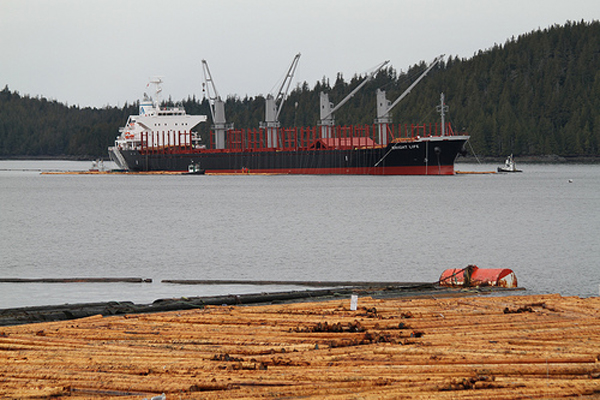
BC logging ship

Ship loading raw logs in Prince Rupert for export to Asian market. Photo by Stef Olcen from Your BC: The Tyee's Photo Pool.

Related

Ever since U.S. house prices peaked in mid 2006 and the great economic slump began south of the border, B.C.'s government and forest industry alike have been understandably anxious.

Dependent as we have been on the U.S. market for billions of dollars in forest product purchases, B.C. naturally yearned to open up new markets.

Given its spectacular economic growth, China became the focus, and before long B.C.'s marketing efforts yielded gains in both the volume and dollar value of forest products exported.

But on closer inspection, B.C.'s China foray may offer considerably less promise than hoped (at least if current trends prevail). The problem is that the province's focus has been on market diversification as opposed to product diversification.

What we're shipping to China remains primarily non-processed commodities. Our China exports include shiploads of raw logs and low-value lumber products, and lack high, made-in-B.C. value.

They also lack distinction, meaning that if China turns off the tap, B.C. will be left to compete in global markets with products that are readily substituted. In the short-term, this may prop up an industry that has lost ground in its historically most important market, but in the medium and long term it will not take B.C., its forest industry, or the many communities dependent on that industry to a better place.

Diversifying and upping the value of what we make remains the best hope B.C. has to put the industry on more solid footing. It's also central to any credible plan to restore the health of our forests and to use both our forests and forest products to maximize carbon storage, one of the great natural tools at our disposal to address climate change. Higher value wood products hold the carbon that the trees they are derived from once held and they can do so for generations.

We can move up in the world

The good news is that B.C. has ample opportunity to move up the value chain.

In Ontario and Quebec -- two provinces with significantly smaller annual log harvests than B.C. -- the sales value of higher-value wood products in 2010 was, respectively, $928 million and $825 million. B.C., by comparison, managed just $345 million. For every 205 cubic metres and 298 cubic metres of wood used respectively by Ontario and Quebec to generate one full-time forest industry job, B.C. required 1,189 cubic metres to accomplish the same feat (one cubic metre equals one telephone pole).

Clearly, B.C.'s approach will achieve neither a sustainable forest industry nor healthy sustainable forests, both of which are worthy objectives that quite properly are linked. Without the latter, there is no former.

One of the best hopes of improving the health of B.C.'s forests and its forest industry is to ensure greater social and economic benefits from the utilization of fewer raw resources. You can't make forest products if you don't have healthy numbers of healthy trees. Yet in B.C. such trees are becoming a premium, thanks in no small part to the monumental mountain pine beetle outbreak in the interior of the province and all of the escalated logging activities that took place in response to it in the first half of the last decade.

The raw facts

So in thinking about doing things differently, what realistically might we focus our efforts on and what could be the results?

Well, why not begin by focusing on raw log exports? Even using B.C.'s relatively poor job generation poor unit of wood, we could add another 2,630 manufacturing jobs to our forest industry just by requiring that logs currently shipped to China and elsewhere were, instead, manufactured in B.C.

Then we could turn to the profligate waste of usable logs at logging sites across the province -- wasted logs that are eventually pushed into piles and burned releasing copious, and completely unnecessary greenhouse gases into the atmosphere. Again, based on current employment rates, we could create another 2,400 jobs by working with that wood, which would take pressure off of logging forests prematurely.

Third, we could immediately invest in increased, publicly funded reforestation efforts as governments on both the left and right ends of the political spectrum did in decades past. At a modest investment of $100 million per year, we could renew our forests with an additional 91 million new trees per year, providing an additional 5,200 tree planters and tree nursery workers with good seasonal jobs.

And finally we could require legislated minimum levels of investment in new and existing mills as a condition of logging companies retaining access to public forests -- something that could, over time, catalyze another 10,000 or more jobs in the province's moribund value-added sector.

Even that wouldn't catch B.C. up to Ontario and Quebec. But it would be a good step toward a healthier, more diversified, carbon-friendly industry.  [Tyee]

36  Comments:

Login or register to post comments

  • Stephen Cooley

    40 weeks ago

    Forestry jobs

    Way back when, BC had a policy that said logs had to be processed near to where they were cut down. Companies and politicians in the pocket of companies have totally eliminated that requirement. It needs to be reinstated. The change (reform) will bring short term pain for long term gain. As it is we have short term gain for long term pain.

  • ICAMP

    40 weeks ago

    What you think is nice but.....

    It'll never happen. We USED to export finished products, but when the forestry industry got sold out to Japanese pressure, that was it. We lost our backbone. This was the start of the decline of the life of the working and middle class in BC and the rise in offshore ownership in EVERYTHING.

    I remember it.

    The companies won't want to pay the labour, and the governments won't want strong unions supporting the working and middle classes again. It's a nice idea, but so are cars powered by puppy kisses and unicorn farts.

  • Okanagan Orchardist

    40 weeks ago

    The author states...

    "we could immediately invest in increased, publicly funded reforestation efforts as governments on both the left and right ends of the political spectrum did in decades past."

    Under the BC Liberal government we have reduced stumpage fees, have given away forest licenses to vast areas of prime growth trees, and within the last few years, have also given away the land on which those trees were harvested. Now you would like to take tax payers money to replant those areas? It should be part and parcel of all licenses to include mandatory reforestation.

  • doggone

    40 weeks ago

    TheTyee we know and love

    This is more "Like It!"
    Listened to family and their friends (loggers and small holding farmers - Okanagan) in the '50s talking this way and voting Socred. One uncle had a small mill that put out railroad ties from pine cut on his portion of the mountain above. He used to talk about the "economy" as a "House of Cards".
    Guess these people were just frapping away a few years ahead of time.
    Sorta like Gordon Gibson

  • Fiat lux

    40 weeks ago

    Two guys can make a good

    Two guys can make a good living with a small sawmill and 50 truckloads of logs per year.

    The automated mills need 70-80 wage years of investment and 400 loads of logs per job.

    This is for the sake of the GDP, growth and "efficiency"

    So, figure out why the forest industry, that used to have hundreds of independent companies, contractors and sawmills working 40 years ago, now has a half dozen, with the odd small operator here and there.

    Of course, this kind of collectivization is not communism, but wealth creating capitalism.

    Luckily, we have a single operator mill next door, where we can buy our lumber. There should be thousands of them supporting and operating like real, logical economies, but we also had suicides in this area when small mill operators lost their log supplies to the corporate mafia, by government actions. One local operator closed down his mill when he lost his log supply, went out to the local dump and shot himself.

    Economies designed for exports are the recipe for disaster. The emphasis should be on local production and exchange of products, in other words real "trade" and "self sufficiency" to the highest degree, and only the export and import of goods societies can not grow, or produce locally.

    But, mention the words "self sufficiency" to miseducated economists and bought politicians and they fall down with convulsions. Too bad they ever get up, smiling.

    Like Mulroney asked somebody on TV, with tears in his eyes and his voice breaking, during the FTA talks : "You mean....and are advocating.... protectionism ??????"

    "Protectionism", the nastiest word in their language, while planning to buy $35. billion worth of useless jet fighters.

    Damn right, "protectionism", because some of the main activities of our lives is the protection of ourselves, our families and properties, paying billions ever year for "defence", so why in hell is there anything wrong with the protection of our economic survival and the wellbeing of our people ?

    Ask any "conservative" politicians, planning to include "property rights" into the Constitution this simple question and they call you a traitor.

    Sure thing: "Property rights" without "protectionism". Brilliant thinking, only brainless ideologues could come up with, while the country goes down the drain, and is sold off .

    In any case, the export of raw logs and resources is not an income in any rational business accounting, only in "economics" without debit columns.

    I wish I could have run my businesses without liabilities.

    Ed Deak.

  • Barryeng

    40 weeks ago

    Reforestation

    At one time not all that long ago, companies were charge with reforesting the areas that they logged. They also had appertenance (cut it where you log it) clauses and waste assessment inspectors to contend with. A lot of forest company money went into ensuring that the present liberal government was elected, and immediately after they were sucessful the offending portions of the forest acts were removed.

    The trouble is that despite having a very friendly government giving them everything they asked for the companies still could not make enough money to suit themselves. Blame the housing crisis in the US all you want, it is still mismanagement by the present government and the companies that they are in bed with that is causing our present forest jobs crisis.

    The problem is that until the government changes, and the mindset of the affected parties changes, not much else is going to change. To fix the forestry jobs issue, we must first fix the government issue. That means an election as soon as possible.

  • P. Markunas

    40 weeks ago

    2011 logs exports to China much higher

    Year-to-date log exports to China are up 236% over 2010
    (see BC Stats here)
    .

    It would be interesting to know how Mr. Parfitt would see implementation of "requiring that logs currently shipped to China and elsewhere were, instead, manufactured in B.C."

    Could BC impose an export tax? Russia was recently compelled to significantly reduce its export tariffs on raw logs in order to qualify to join the WTO.

    In 2003 the BC Liberals significantly weakened legislation tying logs to communities. Could those ties be restored by an NDP government committed to supporting communities, or would lawyers for the corporations be able to block that?

  • Waltz

    40 weeks ago

    Re. The author states...

    Here I believe the author is referring to the vast areas of NSR resulting from disturbance by wildfire, pathogens and insects and not to areas logged by industry. For the most part, the forest industry is still legally responsible for reforestation of areas that it logs, but not for all areas. The industry is not responsible for reforestation on many areas logged under small scale salvage operations. The government estimates the area of NSR attributable to small scale salvage logging to be 300,000 hectares. So. the author's recommendation to step up tree planting is pretty modest given a decade of government neglect.

  • Stephanie

    40 weeks ago

    Protectionism - Damn Right!

    Protectionism – Damn Right!

    I always enjoy Ed’s point of view and clarity but this time I also want to say that I agree completely with his comments pertaining to protectionism and security of the people.

    “”Damn right, "protectionism", because some of the main activities of our lives is the protection of ourselves, our families and properties, paying billions ever year for "defence", so why in hell is there anything wrong with the protection of our economic survival and the wellbeing of our people ?””

    Mind you, I always appreciate the person who speaks up and states that the “Emperor is naked.”

    Stephanie, northern BC

  • snert

    40 weeks ago

    I really don't see what China has to do with this.

    Quote:
    What we're shipping to China remains primarily non-processed commodities. Our China exports include shiploads of raw logs and low-value lumber products, and lack high, made-in-B.C. value.

    This is just what we've been doing all along to the export market.

    "But the world wants wood products we could make."

    Such as?

    Oh, and just what is a low value wood product and conversely a high value one?

  • paisley

    40 weeks ago

    MOF the good ole boys

    Don't get me wrong because I do appreciate anyone's concern on the subject of raw log export as it mystifies me how the export is surrounded with public silence and acceptance.
    What most don't realize is that there was a conspiracy among the large tenure holders to subvert the original intention of Tree Farm Licenses(TFL). Amazingly and to their credit the drafting of the original licensing by the Socreds was to serve two purposes. Firstly, being to provide license holders with a secure timber supply and secondly to provide manufacturing jobs within the boundaries of the license. With this legislation the government handed out large tracks of land to mostly foreign owned logging companies which spent a great amount of effort to subvert the requirement to maintain manufacturing employment. Most of the manufacturing jobs actually occurred nowhere near the harvesting areas but at the very least there were manufacturing jobs in the lower mainland(somewhere in the province). The initial licensing was not with out corruption and the public was witness to "honest Bob Sommers", the Minister of Forests of the time spending some well earned time in jail for taking bribes. This feat of incarceration was accomplished by none other than from the efforts of Gordon Gibson Sr. whom for his troubles was kicked out of legislature(as a sitting MLA) for proclaiming that "honest Bob" was a crook which indeed he was.
    As we witness today it has become apparent that the large tenure holders have finally subverted the requirement of manufacturing jobs and have no doubt that corruption within the Ministry of Forests enabled that to occur.
    Surprisingly many believe that the language in the original harvesting tenures requiring manufacturing jobs disappeared under our current Liberal government which is not true at all. In fact the requirement to manufacture disappeared under the watch of the ( can’t find our ass with both hands ) NDP government of the early 90’s.
    In some defence of the inept NDP of the time you should note that I filed FOI requests in search of direction from the Minister of Forests to remove the manufacturing requirements from the TFL contracts. There was nothing to be found because the Minister of Forests made no such direction to remove the manufacturing requirements. According to Glen Robertson my MLA at the time when questioned about the deletion of manufacturing from the TFL agreements, he claimed that no elected officials knew that these modifications had even taken place.
    This in itself points to corruption within Ministry of Forests and specifically those that had ties with the previous Socred government. No surprise.

  • WilliamD

    40 weeks ago

    Reforestation

    There seems to be a lot of misunderstanding about who is responsible for reforestation. The bottom line is that if a logging company harvests an area, then that company is responsible for reforesting it. There are exceptions -- BCTS, a crown entity, "sells" harvest rights to blocks of timber, but retains the reforestation commitment.

    There are real problems with forestry in BC, but in general, reforestation is not one of them.

  • Cool Hand

    40 weeks ago

    Complicated Matter

    I recall, circa 1980, then NDP leader Dave Barrett using the "tertiary investment" mantra in wood manufacturing repeatedly.

    Nothing ever came of it. If a financial opportunity exists, then industry will step in to fill the void.

    Unlike oil and gold, forest products are not a pricey commodity and has had more downs than ups. I certainly wouldn't put a dime in that volatile industry.

    Fortunately, China is filling a void purchasing our softwood lumber, otherwise another ~10,000 currently employed would remain idle.

    In fact, for the first time ever, China has surpassed the U.S. in purchasing softwood lumber for the months of May and June.

    China has also been paying a higher price at $163/cubic metre v. the U.S. at $142/ cubic metre.

    Without China's surging imports of B.C. lumber the forest industry would be in the doldrums as U.S. softwood lumber purchases are down ~41% from last year.

    Now the topic of log exports to China and elsewhere comes up and that's a complicated matter. Unlike the interior forest industry (where little log exports originate), the coast forest industry is a high cost endeavour.

    Particularly the north coast forest industry, where not much milling takes place. Witness the closure of Eurocan Pulp and Paper in Kitimat and Skeena Cellulose, which provided cash-flow for sawmill woodchips and the closure of other area sawmills.

    And that's where most of the raw log exports originate. Ban law exports on the north coast and no one is going to come running to open up a sawmill or further tertiary industries. Just ain't gonna happen in that high-cost area.

    What will happen is the unemployment numbers will soar from FN peoples, loggers, truckers, etc. - everbody along the raw log
    export food chain. Tell these folk that they won't have any money to put food on the dinner table.

    These folk reside in NDP held ridings (Skeena and North Coast) and if the NDP takes the position of banning raw log exports up there, watch them lose these ridings in an election.

    BTW, the rationale behind raw log exports is clearly laid out in this document:

    http://www.for.gov.bc.ca/ftp/het/external/!publish/web/exports/generating-more-wealth.pdf

  • Fiat lux

    40 weeks ago

    There was a time when the BC

    There was a time when the BC forest industry employed close to 100,000, all well paid people, BC and Canada had no debts to speak of and had half of the present population.

    That was before the present, wealth creating economic theory was forced on us and the world.

    As far reforestation is concerned, there are many areas where planting has to be done three times, before it works.

    The official counting is carried on for 3 or 4 years, often reported successful, and then all the seedlings die. We have seen it in this area all over, including with the planting in our own forest, which has never been clearcut.

    The worst damage happens on privately owned land, where the rules don't apply.

    Competitive economies are a race to the bottom, both for humans and the environment, with politicians and other "experts" lying their eyes out to mislead the public into following their idiocies.

    Ed Deak.

  • paisley

    40 weeks ago

    Cool Hand is right

    Industry has found a way to make a dollar from adding value to raw logs it's called ultra cheap Chinese labour. Funny most of us thought they never did anything with those raw logs. Thanks for clearing that up.

  • Waltz

    40 weeks ago

    Re. Reforestation

    I would disagree. The rate of reforestation by government is a major concern in British Columbia potentially threatening certification of forestlands for sustainable forest management.

    In 2002, the provincial government cut ministry funding for its reforestation program by 90 per cent. Also that year, it rescinded its legal responsibility for the reforestation of areas disturbed by wildfire and pests.

    This move effectively removed the legal requirement that British Columbians might subsequently use to hold the government accountable for a ballooning NSR and for poor performance against its own service plan targets and measures for reforestation – now completely removed from the forests ministry service plan.

  • Fiat lux

    40 weeks ago

    The seedlings for

    The seedlings for reforestation come out of carefully maintained nurseries, pumped up with artificial fertilizers, watered.

    Then they're dumped into dry ground in wide open, clearcut areas, under the beating sun and expected to survive.

    Then, when they dry up and die, the area has to be replanted and recorded as new acreage, to jack up the figures.

    Sometimes the seedlings survive the first 2-3 years, but that's when the worst death rate comes, for some reason. Even on our own shaded land, under the most natural conditions.

    Some of our friends are in the tree counting and reporting business and so we know what goes on, with the public carefully kept in the dark.

    In the mills, half horsepower of human energy is replaced with 10 or 100 hp of electric, or oil energy, the surplus workers are forced into city slums where they have to buy everything to survive and this racket is then reported by economists as "efficiency" and "growth of the GDP".

    Ed Deak.

  • RickW

    40 weeks ago

    P. Markunas

    Quote:
    or would lawyers for the corporations be able to block that?

    To answer this, all we need do is take a page from the softwood lumber dispute. The US has lost all its challenges, but continues on. Likewise, BC could let the lawyers launch lawsuits 'til the cows come home, and refuse to acknowledge them. I think it's called "being resolute" (aka, intestinal fortitude).

  • RickW

    40 weeks ago

    snert

    Quote:
    This is just what we've been doing all along to the export market.
    "But the world wants wood products we could make."
    Such as?
    Oh, and just what is a low value wood product and conversely a high value one?

    Kindly explain to me why Ontario and Quebec can generate almost 5X the jobs per cubic meter than BC can.

    Don't you actually READ these articles?

  • RickW

    40 weeks ago

    Cool Hand Ol' Sport

    Please see my question to snert. Care to address the SIGNIFICANT difference in jobs per cubic meter between Ontario/Quebec and BC?

  • snert

    40 weeks ago

    RickW

    Yes, I actually read the article but I didn't read things into it that aren't there. Maybe you might like to elaborate on just how there is a "SIGNIFICANT difference in jobs per cubic meter between Ontario/Quebec and BC?" This article doesn't.

    Were the questions that I asked too challenging for you to actually answer with some specifics?

    As far as I'm concerned there is nothing new in this article with the exception of the use of the word China.

  • P. Markunas

    40 weeks ago

    Appreciate your resolve Snert...

    ... but I'm interested in hearing an informed opinion address the questions raised. The thrust of the article makes sense to me, but could a follow-up article elaborate on the mechanisms which might be used to achieve the goal and the risks associated with each?

  • RickW

    40 weeks ago

    snert

    You don't think 5X is significant? Just what IS "significant" in your opinion?

  • Stewart MacKenzie

    40 weeks ago

    Tree planting is not reforestation!

    Referring to tree planting as "Reforestation" is so inaccurate as to be dishonest and cravenly conventional.
    Professional foresters, largely dependent upon the status remaining quo, continue to pretend their methodology is sound and that man can in fact do a much better job of restoring a healthy forest than nature is able to do!

    I've spent a lot of time over more than half a century researching, harvesting and producing wild foods and medicinals including arnica, saskatoon, huckleberry, poplar buds, chickweed, calendula, and others. These are resources with tremendous potential which are not only being ignored but actively destroyed by foresters intent on chemical solutions which either kill the many other valuable species or render them toxic with the endless treatments of fungicides and herbicides {and even arsenic) required by the unhealthy and unlikely to mature planted trees.
    It works for the chemical companies, but not for the deer, moose, First Nations people or anyone who depends upon wild resources or water - including all you city folks who don't know or care about seemingly remote areas and issues like this.

    For many years Ben Parfitt has been masquerading as a "progressive" writer on forest issues, while pushing this same vision of more and more artificial, corporate dominated forests, ignoring all the many alternatives which are being developed slowly around the province despite a lack of support not only from the corporate dinosaurs and their minions but by the Envirocrats of the Sierra Clubs, Wilderness Committees and the Green party., None of these establishment figures can let go of the old ways of thinking in order to learn from the much older ways of herbalists and healers, who they attempt to marginalize or trivialize rather than engage.

    This family produces stuff for friends and family, and have no business agenda at this point, but I can tell you those who have used our salves and oils and tinctures have often reported results they term "miraculous", on conditions which have persisted through rounds of medical treatments only to be vanquished by the calendula oil or the arnica tincture or the chickweed ointment.
    People are paying 20 bucks for 50 ml. bottles of these kinds of products and the world markets are increasing exponentially - unlike the timber industry, which has already high graded the best of our forests and is bent on dominating all further development on those public lands! Wake up and smell the coffee folks - there is an enormous fraud being perpetrated here, not least by those pretending to be "progressive" while promoting the same old toxic and stupid approach.

  • Private Forest ...

    40 weeks ago

    Complex issue / So many myths / So much to say.

    There's just so much to say about this article, so we decided to write an entire blog post:

    http://pfla.bc.ca/blog/

    We look forward to your questions and comments.

  • snert

    40 weeks ago

    RickW

    Quote:
    You don't think 5X is significant? Just what IS "significant" in your opinion?

    In a general sense, no. There is a lot of territory that can be covered by "5X". Unless there are some specifics it is more or less meaningless.

    If you can't come up with any, specifics that is, why don't you just say so?

  • RickW

    40 weeks ago

    snert

    So you wouldn't mind seeing the forest industry reduce by 75% - and keep the same number of jobs?

  • RickW

    40 weeks ago

    snert - regarding specifics

    http://denimpine.com/

  • snert

    40 weeks ago

    RickW

    Quote:
    So you wouldn't mind seeing the forest industry reduce by 75% - and keep the same number of jobs?

    There's a point to that question?

    Oh, and denim pine is a specific that just so happens to be old news. Got anything better, like maybe what the actual difference between eastern secondary production a that of BC. Like I said "5X" covers a lot of territory.

    This article is nothing but a whine that makes extensive use of the word China in an attempt to freshen up old arguments on an issue that nobody has, so far, found a solution to.

  • RickW

    40 weeks ago

    snert

    Do you have a problem with using LESS resources to generate the same economy?

  • RickW

    40 weeks ago

    PS

    Didn't you read the entire sub-title?

    Quote:
    But the world wants wood products we could make
  • snert

    40 weeks ago

    RickW

    Quote:
    Do you have a problem with using LESS resources to generate the same economy?

    Why? Should I?

    "But the world wants wood products we could make"

    Again, no specificS.

  • RickW

    40 weeks ago

  • snert

    40 weeks ago

    RickW

    Wow! You hit it right out of the ballpark with that one, Rick.

    Just which ballpark are you playing in, BTW? It's not the same one I've been playing in. Somehow or other you have managed to not conclusively address one of the issues I brought up and the tangents, well they're something else.

  • RickW

    40 weeks ago

    Of course I hit it out of the ballpark!

    And there are no "tangents". They address the point. Too bad you can't (or wont't) see it.

    You just want everyone else to do the hard slugging, you sluggard.

  • snert

    40 weeks ago

    RickW

    Quote:
    You just want everyone else to do the hard slugging, you sluggard.

    You couldn't be more wrong. All I want them to say is something new. Neither you nor this article have done that.

    Tangents, hah, a politician couldn't be more evasive. Your last statement just proves the point.

    Quote:
    Didn't you read the entire sub-title?

    "But the world wants wood products we could make"

    One would think that if this were in a subtitle that some reference to such products would be made in the article, wouldn't one?

    • The discussion for this story is closed. No more comments can be added.