Opinion

You're Paying for Campbell's Faulty Prescription

British Columbians use tax cuts to buy health care formerly provided by the government.

By Will McMartin, 2 Nov 2010, TheTyee.ca

Three surgeons

BC public health spending per capita has slipped behind rest of Canada.

Related

"Our government has always felt that the best thing we could do is leave more money in your pocket so you can make your own decision about what's best for you and for your family."

So said Gordon Campbell on Wednesday, Oct. 27, in a province-wide television address intended to resurrect the premier's plunging poll numbers and restore his government's sunken popularity.

Campbell used his televised speech to unveil an unexpected 15 per cent reduction in B.C. personal income tax rates, and recalled that when he had cut personal income taxes by 25 per cent back in 2001, "our economy took off" as a result.

A day later, on Thursday, Oct. 28, the Canadian Institute for Health Research (CIHI) released its annual study entitled "National Health Expenditure Trends."

The numbers reveal the impact on B.C. health spending of Gordon Campbell's incessant tax-cutting over the last decade. For the seventh consecutive year under Campbell's leadership, our province's total per capita health expenditures have fallen below the national average.

And all of that decline is due to reduced public-sector health expenditures. Indeed, while Campbell's government has slashed taxes and put the brakes on public-sector health spending, private-sector expenditure on health in B.C. -- compared to elsewhere in Canada -- is soaring.

So, while Campbell argues that it is better to "leave more money" in taxpayers' pockets, it seems that many individual British Columbians -- at least those who can afford to do so -- are using that extra money to purchase the health services either no longer provided or rationed by the public sector.

BC's slip behind Canada in public health spending

The CIHI's latest analysis covers the period from 1975 to 2010. The data shows that B.C.'s total per capita health spending -- public-sector and private-sector spending combined -- was higher than the national average in 21 of the 25 years before Gordon Campbell's BC Liberals won election to government in 2001.

That trend continued through to 2003. In that year, per capita health spending in British Columbia was $3,930; for Canada as a whole, $3,900.

A dramatic change took place in 2004, when health expenditure across Canada rose to $4,114 per capita, well ahead of the comparable figure in B.C., $4,060. (These are current dollars; that is, part of the annual increase in expenditure is due to inflation -- a decline in the purchasing power of the Canadian dollar.)

That trend has continued every year since then; and indeed, the gap is growing between our province and the rest of the country. In the current year, 2010, the CIHI estimates that per capita health spending across Canada will be $5,614, but in B.C., just $5,355.

When Campbell's Liberals took office in 2001, B.C.'s total per capita health expenditures were $137 higher than the national average. A decade later, in 2010, British Columbians' per capita health spending will be $258 lower than for Canadians as a whole.

Looked at another way, B.C.'s total per capita health spending in 2001 was four per cent above the national average. In 2010, we will spend 4.6 per cent less on health care compared to other Canadians on a per capita basis.

And one last comparison between B.C. and Canada as a whole. From 2001 to 2010, total per capita health spending across Canada grew by 62.7 per cent; in B.C., it rose by just 49.2 per cent.

The cost of tax cuts to BC health care

How to explain B.C. falling behind the rest of Canada in total per capita health expenditures? The answer is simple: Gordon Campbell and his BC Liberal government have opted to allocate fewer resources to public-sector health care than nearly every other province in the country.

In 2001, B.C.'s per capita public-sector spending on health care was third-highest amongst Canada's 10 provinces, behind only Manitoba and Newfoundland. By 2010, B.C. had dropped to ninth place, ahead of Quebec alone.

According to the CIHI data, per capita public-sector health expenditures in B.C. in 2001 were $235 higher than the national average. By the end of the decade, in 2010, Victoria's per capita health spending will be $164 lower than for the country as a whole.
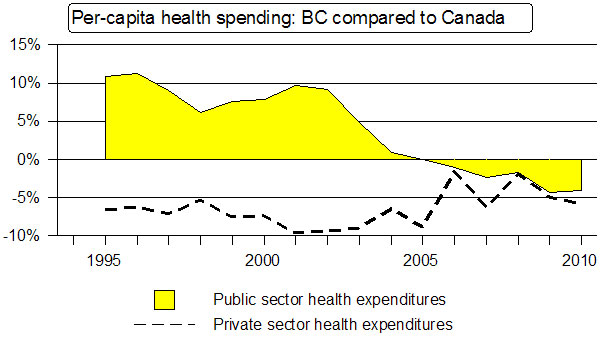
Health spending: BC compared to Canada

Source: Canadian Institute for Health Information, National Health Expenditure Trends, 1975-2010.

The chart above shows the dramatic decline in B.C.'s per capita public-sector health expenditures compared to the rest of Canada since Gordon Campbell became premier in 2001.

At the beginning of the decade, Victoria's health spending on a per capita basis was 9.7 per cent above the national average. By 2005 B.C. had slipped to slightly under the national average, and in 2010, we will be 4.1 per cent below the country as a whole.

Tax revenues then and now

None of this should be too surprising. As one would have expected, Victoria's taxation revenues under Gordon Campbell have fallen significantly as a proportion of the provincial economy. In fiscal 2001/02, the province’s tax revenues represented (see pp. 72-75 of this document) 10.6 per cent of B.C.'s gross domestic product (GDP), but by 2009/10 they had dropped to just 9.1 per cent.

Total government revenues -- from all sources, including taxation, natural resources, Crown corporations and federal transfers -- in 2001/02 represented 21.1 per cent of the provincial economy. After a decade of Campbell Liberal rule, the comparable figure in 2009/10 was an even 20 per cent.

(B.C.'s annual GDP is just under $200 billion, so each percentage point represents nearly $2 billion.)

With reduced revenues, Victoria has fewer funds to allocate to programs and services. In 2001/02, the province's GAAP (generally accepted accounting principles) expenditures were 22.7 per cent of GDP.

By 2006/07, that figure had plummeted to a bare 18.8 per cent, and in 2009/10 -- when our GDP reflected a weakened provincial economy in the global recession -- it was only 20.9 per cent.

(According to the government's 2010/11 budget, Victoria's post-recession expenditures will be about 19.7 per cent of GDP in 2012/13.)

PREMIER OVERSOLD POWER OF TAX CUTS

Premier Gordon Campbell claimed in his televised speech that B.C.'s economy "took off" as a result of his government's numerous tax cuts. The evidence he offered -- and later repeated in media interviews -- was that "since 2001, we've increased the number of jobs in British Columbia by over 400,000 people."

Let check with BC Stats.

In 2000, the year before Campbell became premier, the number of employed British Columbians -- that is, those with jobs -- stood at 1,931,300. In Sept. 2010, the comparable number was 2,318,600. That's an increase of 387,300, or 20.1 per cent over about nine-and-a half years.

By comparison, between 1991 and 2000 when the New Democratic Party was in power, employment grew from 1,577,500 to 1,931,300 -- an increase of 353,800 jobs, or 22.4 per cent over nine-and-a-half years.

Job growth when the NDP governed B.C. was about 2.4 per cent annually; under Campbell's Liberals, about 2.1 per cent.

All in all, it's hard to argue that tax rates over the last two decades have had much of an impact on provincial job creation.

— W.M.

British Columbians buying more private health care

In a nutshell, the tax cuts introduced by Gordon Campbell and his BC Liberals over the past decade have left Victoria with reduced financial resources. As a consequence, the province has fewer resources to allocate to public services, including health care.

So, as the latest CIHI report clearly shows, compared to other provinces across Canada, B.C.'s per capita health expenditures -- both public-sector and total -- are rapidly falling behind.

But that is not the case with private-sector health expenditures. While the B.C. government has been cutting taxes and restricting the growth of public-sector health care, individual British Columbians are allocating some of their tax savings to the purchase of privately-provided health care.

As stated earlier, total per capita health spending in B.C. rose between 2001 and 2010 by 49.2 per cent. The public-sector portion of those total expenditures grew by 43 per cent, but the private-sector component has soared by 77.4 per cent.

According to the CIHI, private-sector health expenditures represented 26.1 per cent of total health spending in B.C. when Gordon Campbell became premier in 2001. A decade later, the comparable figure is 29.2 per cent.

Returning to the chart higher on this page, it is evident that private health expenditures by British Columbians -- which historically have been well-below the Canadian average -- are approaching parity with the rest of the country.

In 2001, private-sector health spending in B.C. was 9.5 per cent below that of Canada as a whole. But over the last five years, from 2006 to 2010, the comparable average has been just 4.2 per cent.

And now, a further 15 per cent tax cut

Campbell's surprising announcement on Oct. 28 of a 15 per cent cut to personal income taxes means that the provincial government will have fewer financial resources in the future to spend on programs and services. And that means B.C. likely will fall further behind the rest of Canada in terms of per capita public-sector expenditures on health care.

It also means that we are likely to see a continuation of the growth in private-sector health spending.

"The best thing we could do is leave more money in your pocket," said Campbell in his Oct. 28 speech.

It sounds good, except that with the B.C. government providing relatively fewer health services in comparison to the rest of the country, many British Columbians will be using their tax-savings to privately purchase the health care once offered by Victoria.

As for those lower-income British Columbians who have obtained little or no benefit from Campbell's tax cuts, and cannot afford private health care?

The premier didn't say.  [Tyee]

14  Comments:

Login or register to post comments

  • DJT

    1 year ago

    I'm rich!!!

    "So, while Campbell argues that it is better to "leave more money" in taxpayers' pockets, it seems that many British Columbians... are using that extra money to purchase the health services either no longer provided or rationed by the public sector".

    They might also use that whole ten dollars per paycheque to cover the never ending price increases on food, hydro, cable, the various fees that will inevitably go up to pay for this tax cut, and a myriad of other price increases. The "big" tax cut will simply go in one pocket and out the other and, if anything, most people will still be in the hole. I fail to see how the economy will "take off" unless people make significant purchases by going further into debt because of some "I've got more money in my pocket" psychological phenomenon.

    Keep my taxes, Mr. Campbell. Provide the services you said in your (TV) speech (about 5 times) that families depended on the government to provide. They are important for you to provide, right Mr. Campbell? Surely you wouldn't lie to us?

  • plg

    1 year ago

    tax cuts

    More tax cuts...now how will the BC gov't (aka Gordon Campbell) pay for the cost overruns for the various Olympic related assets...

    Sea to Sky Highway $250 million
    Trade/Convention Centre $400 million
    Vanoc Operating $350 million
    RAV Canada Line $150 million

    These are just the cost overrun figures, the total capital cost (borrowed dollars) including cost overruns for these four olympic related items: $3.2 billion

    Now added to this mix is a hold over from the drunken olympic spending, BC Place Stadium roof....another $600 million!

    Who cares about health care when Campbell and his lame cabinet keep spending on items that do nothing to stimulate the economy in the long term.

  • sunshine coast girl

    1 year ago

    He also likes to continually remind us

    that his Mom raised 4 kids on a schoolteacher's salary. Hate to tell you this Gordo, but after 10 years of your "stewardship" of BC there is no way in hell she'd be able to do that now.

  • reallife

    1 year ago

    Health care expenditures

    I wonder if people in the rest of Canada are also getting healthier in relation to BC residents?

  • jim1966

    1 year ago

    Tax Cuts Are Useless When We Have Nothing To Spend It On

    It's true, we are either close to being broke or already there. Tax cuts do nothing for the low income group(s), in fact they do more harm than good. Yes, we all agree we pay too much tax, but how do you think the BC Liberals would pay for a 15% further tax cut?, There is usually only one way, cut other programs and or services, guess who gets affected the most by those same program and service cuts, if you guessed the low income group you get and A+. Campbell and Co are off the rails on this one. Any extra cash the BC can afford to spend should be used a bit more wisely than this man's tax cut ideas. Wrong approach and bad timing. I mean, is this all this government can do?, Is this all they know how to do?. These people are supposed to be educated and experts and leaders in thier chosen fields. Clearly they are not and we know it. It would be really cool for the tyee to write an article on "Life in BC, After The BC Liberals are out of Power". I for one have learned that our system of government is just bad and needs an overhaul. Laws can be changed, but we the people need our government to work for us and not themselves. Whatever party wins the next election not only has the thorny HST issue to deal with but more importantly the restoration of our faith in our leaders and in our system.

  • Cool Hand

    1 year ago

    Public Sector Health Spending

    2001

    BC Health Expenditures: $8.985 billion
    (2001 BC Public Accounts)
    Portion of Provincial Budget: 34.18%
    Population: 4,076,264
    (BC Stats)
    Per Capita: $2,204.22

    2010

    BC Health Expenditures: $15.515 billion
    (2010 BC Public Accounts)
    Portion of Provincial Budget: 39.48%
    Population: 4,530,960
    (BC Stats)
    Per Capita: $3,424.22

    2001 - 2010:

    Total Population Growth: 11.15%
    Total Health Expenditure Growth: 72.68%
    Per Capita Health Expenditure Growth: 55.35%

    Is this expenditure growth pattern even sustainable over the long term?

    StatsCan's recent Canadian Community Health Survey shows that BC is the healthiest province in Canada along with the lowest obesity rates. That finding obviously has an impact upon per capita health expenditures.

    The Frontier Centre for Public Policy rates BC second overall (behind Ontario) in terms of overall health care systems. And the BC Progress Board ranks BC in first position in Canada in terms of health outcomes.

    Doesn't sound too shabby to me.

  • PepperGirl

    1 year ago

    CoolHand, your stats are biased

    If you adjust your figures for inflation and present in constant dollars, you'll get a more accurate picture.
    Also, the apparent increase in health expenditures as a proportion of the provincial budget is more reflective of the sharp declines in expenditures on other programs (e.g., the hundreds of forestry jobs axed) than unsustainable health costs.
    These arguments have been used by backers of private health care in their attempts to dismantle our universal health care system. Don't buy into it, people. If you want to know whether private health care works, just look at our neighbours to the south, where costs are higher, and many people have no coverage at all.

  • Don_EC

    1 year ago

    Health Care Spending

    I have been concerned for some period of time about the drum beat from politicians about 'out-of-control' health care spending. This constant drone creates a kind of collective fiscal hysteria.

    Fiscal conservatives either use data the way the Premier did, or they point to the gross dollar amount, which, of course, is very big. But if one only uses current dollars, for example, a house that cost $25,000 40 years ago, now may sell for $500,000, an equally dramatic-seeming increase.

    This concern about the drum beat finally sent me chasing some health cost data.

    The World Health Organization indicates that the proportion of Canada's GDP spent on health care has increased from 8.8% in 2000, to 10.1% in 2007. And in the Organization for Economic Cooperation and Development shows the same ratio, but for 2008. It has increased to 10.4%.

    My point: Health care costs as a percentage of our economy are hardly out of control. As a % of GDP costs certainly appear to be increasing, and while the dollars involved require our on-going attention, we hardly need to set our hair on fire. On the other hand, it does seem appropriate to monitor expenses and outcomes, and certainly to examine what appears to be a dramatic shift from public to private expenditures in BC.

  • RickW

    1 year ago

    sunshine coast girl

    Quote:
    He also likes to continually remind us
    that his Mom raised 4 kids on a schoolteacher's salary. Hate to tell you this Gordo, but after 10 years of your "stewardship" of BC there is no way in hell she'd be able to do that now

    Not too many people raised by a single mom also get to name their own salary, either.

  • Frank

    1 year ago

    Brad/Luke

    So you're against medicare too?

    Harper too left-wing for ya?

  • Frank

    1 year ago

    Will McMartin

    Out of curiousity, where did all those federal dollars go that Paul Martin said would fix health care for a generation?

    From your stats it looks like there was no additional money going into health care at all.

  • CanadianLatitude

    1 year ago

    Privatisation is what low

    Privatisation is what low wage conservatives like Harper, Campbell and the federal Liberal MP Keith Martin want. http://www.montrealgazette.com/health/Canada+obsolete+health+system+needs+private+care+injection+Liberal/3723410/story.html

    Remember that next time you vote.

  • kmdyson

    1 year ago

    Gordo is 'sicko'

    Why these free market ideologues still cling to the notion that lower taxes is the answer to everything is a mystery to me...tell me how lowering taxes raises funds for health care, education, pensions,unemployment insurance...our social safety net...it is impossible...so the only result I could discern from tax cuts is cuts in the social spending...we really need the recall to begin asap...and the NDP better bloody well put it right and not pander to the same powers behind Campbell...

  • zalm

    1 year ago

    I've got a better idea

    Let's eliminate the roadbuilding subsidies and royalty holidays to the natural gas and oil drilling industry, and charge them industrial rates for freshwater withdrawals from our rivers, and save just over $1 billion over three years. (Figures from BC Budget 2010 pg 160.) That could go a long way toward reducing our debt that "all of a sudden" everybody seems so concerned about.

    It wouldn't hurt at all. We're still pumping the same gas we were three years ago, it's just most of it's for domestic consumption, instead of some of it going further east and south where they can't afford to pay for it now.

    The gas industry has sucked at the public teat for far too long, and Gordo has only made it worse in a royalty race to the bottom with Alberta to "try to keep the drillers in this province, because when they take their drills out of province, they never come back"

    Oh, I don't think so. And Chile proved that in spades.

    END SUBSIDIES TO THE NATURAL GAS AND OIL INDUSTRY! AND SAVE A BILLION BUCKS AND OUR FRESHWATER IN THE BARGAIN.

    • The discussion for this story is closed. No more comments can be added.