- Ms Kaye is a Tyee Builder. You can be, too.
- Mary Carlisle is a Tyee Builder. You can be, too.
- Prem Gill is a Tyee Builder. You can be, too.
- Nancy Flight is a Tyee Builder. You can be, too.
- Justin Everett is a Tyee Builder. You can be, too.
- John Westover is a Tyee Builder. You can be, too.
- Nora Etches is a Tyee Builder. You can be, too.
- Edward Henderson is a Tyee Builder. You can be, too.
- Bharadwaj Chandramouli is a Tyee Builder. You can be, too.
- Dean Chatterson is a Tyee Builder. You can be, too.
- Marius Scurtescu is a Tyee Builder. You can be, too.
- Robert Parkes is a Tyee Builder. You can be, too.
- James Murton is a Tyee Builder. You can be, too.
- Susan Doyle is a Tyee Builder. You can be, too.
- Vincent Strgar is a Tyee Builder. You can be, too.
- Helen Spiegelman is a Tyee Builder. You can be, too.
- Subir Guin is a Tyee Builder. You can be, too.
- Kimball Finigan is a Tyee Builder. You can be, too.
- Joanne Manley is a Tyee Builder. You can be, too.
- David Leach is a Tyee Builder. You can be, too.
Global Forces Making Vancouver a Major Oil Port
China craves oil sands fuel. Ottawa wants to diversify its US market. So huge amounts of crude will have to pass through a risky Second Narrows.
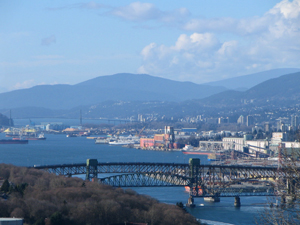
Second Narrows Bridge in Burrard Inlet received highest hazard rating by Coast Guard.
Every few days, tankers freshly laden with crude from Alberta's oil sands squeeze through the shallow Second Narrows channel in Burrard Inlet, make their way through swift currents in the southern Gulf Islands and on towards offshore markets.
Vancouver -- the "world's greenest city" in the words of Mayor Gregor Robertson -- has quietly become a major outflow of what Greenpeace calls "the world's dirtiest oil." This unlikely circumstance has happened with virtually no public debate and is driven by geopolitical forces now converging on the place many regard as the birthplace of the environmental movement.
Those forces include:
China's hunger for oil and investment in the Alberta oil sands.
Washington's emerging resolve to regulate against high carbon emitting fuels like the oil sands.
And Ottawa's resulting desire to find alternative Asian markets for oil sands oil.
Add in stolid First Nations resistance to a proposed pipeline from the tar sands to Kitimat, and all these powerful pressures converge on the aptly named Second Narrows, which already has seen its oil tanker traffic rise precipitously in the past decade.
A $200 billion need for new outlets
Vancouver was not envisioned as a major crude oil port. The pipeline from Alberta to Burnaby and Bellingham, Washington has been in existence since the '50s and originally supplied four refineries in Burrard Inlet with conventional oil from western Canada.
Three of those refineries have since closed. The current owner of the pipeline, American energy giant Kinder Morgan, recently expanded capacity to 300,000 barrels per day "...to transport growing volumes of product from Alberta's oil sands." Crude shipments from Vancouver have increased almost tenfold since 2001.
The occasional transit of surplus crude from Vancouver using comparatively small vessels has now become regular shipments using the largest class of tankers that can navigate the narrow and dangerous confines of Burrard Inlet.
The driver of this transformation is the Alberta oil sands, which saw production climb to 2.72 million barrels of synthetic crude last year. The vast majority of this oil and bitumen is transported by pipeline to U.S. refineries, where it now supplies eight per cent of domestic demand.
But companies that have so far invested $200 billion in northern Alberta remain vulnerable to an almost complete reliance on American markets. Growing concern about climate change and the election of Barack Obama mean that the enormous carbon footprint of the oil sands may eventually become a cost to producers.
Proposed carbon pricing legislation in the U.S. as well as low carbon fuel standards being adopted by California and other states could make many oil sands projects marginal or entirely uneconomic in future.
A recent assessment by Citi oil analysts warned investors that Alberta syncrude "...is not a fuel source that sits naturally within a low carbon economy and is unlikely to be a strategic winner as climate regulation tightens, albeit gradually, in North America."
What to do? Increasingly, oil sands investors are looking to China, and China is looking to the oil sands.
China buying stakes in oil sands
This year the Conservative government approved the sale of $1.9 billion in oil sands assets to two companies controlled by the Chinese government. Prime Minister Harper said at the time to "expect more Chinese investment in the resource and energy sectors... there will definitely be more."
He wasn't kidding. Another $4.65 billion deal this spring will bring Beijing's investment in the oil sands to $7 billion and counting. China typically buys into resource ventures not merely as an investment, but to feed their ballooning demand for raw materials, and oil is top of their list.
All this means that both oil sands operators and Chinese government now want to expand pipeline capacity through B.C. to the coast.
While much attention has rightly been focused on the proposed Enbridge Northern Gateway pipeline to Kitimat, local First Nations have made it clear they will seek to block the project. A long and likely litigious battle began this month when Enbridge applied for regulatory approval.
Which brings us to back to Burrard Inlet -- the only current oil sands access to the ocean. While it is true that small oil tankers have moved surplus oil out of Second Narrows for decades, it has never been done on this scale -- or using ships that exceed the dimensions of what the Port Metro Vancouver (PMV) previously considered safe.
Port has seen freighter slam bridge
Tankers exiting the Kinder Morgan Westridge Terminal in Burnaby must thread the narrow spans of the CN Railway bridge in Second Narrows, only at the highest tides, and only during daylight hours. The navigable channel here is only 121 metres across and as little as 12 metres deep at zero tide. The PMV Operations Manual from 2007 states that tankers with a draft up to 12.5 metres can only transit through Second Narrows at a high tide of 14 feet.
These restrictions seem well founded. The CN Railway bridge has the highest navigational hazard rating designated by the Canadian Coast Guard. In 1978, the freighter Japan Erica struck one of the bridge piers, shutting down rail traffic to the North Shore for several months. This vessel was one fifth the size of tankers now plying Second Narrows, and had a marine pilot on board at the time.
Related Document
The Second Narrows navigation restrictions date back to the 1970s, but are now being rolled back. In May of last year, PMV announced to the shipping industry changes allowing for tankers to transit Second Narrows with a draft of 13.5 metres (document available to the right). These new procedures were publicly released in April of this year.
Related Document
This new policy was apparently the result of a 2008 Risk Management Assessment (available to the right) involving stakeholders only from the shipping industry, though Transport Canada's methodology for Pilotage Risk Assessments defines stakeholders as "any individual, group, or organization able to affect, be affected by, or believe it might be affected by, a decision or activity."
B.C. pilots are highly competent and are being trained with tug operators on simulators to deal with the increased challenges of bringing larger vessels through the Second Narrows bottleneck. That said, the Pacific Pilotage Authority stated in a memo that vessel drafts should be limited to 13 metres until these simulations are proven to "translate to real life."
AFRAmax tankers such as those moving through Burrard Inlet can have a draft of more than 14 metres when fully loaded and carry up to three times the amount of oil that spilled from the Exxon Valdez. The Port recently intimated plans to move to bigger Suezmax tankers in the future with a draft of 18 metres, requiring dredging of Second Narrows.
While allowances for larger tankers have changed, the hazardous confines of Second Narrows have not. The highest tides needed for AFRAmax tankers leave a slack water window of about 20 minutes before Burrard Inlet begins to empty with currents reaching five knots. A worst case scenario spill in those conditions would flush crude out into the Georgia Strait and eventually throughout the South Coast.
Vancouver -- the hometown of Greenpeace and the "greenest city in the world" -- has quietly become a major outflow for controversial Alberta syncrude. The global forces driving these changes are converging on a narrow stretch of treacherous water that stands between the oil sands and the world. ![]()


34
Login or register to post comments
Fiat lux
1 year ago
Great!!!!. Communist China
Great!!!!. Communist China needs our oil sold to them by their capitalists brethren so they can process our resources into products, sell them back to us and then use the money we pay them to come back and buy the country from under our feet, Mao could never accomplish with armed invasion.
And this "science" is being taught in our universities as "good economics".
Ed Deak.
seth
1 year ago
Nuke the tar sands
No tankering of tar sands crude would be necessary if Alberta nuked the tar sands replacing gas generated steam with nuclear steam, saving big bucks and eliminating production GHG's at the same time.
Tar sands oil would be the most environmentally friendly crude in the world.
We'd need 8 big mass produced Candu ACR-1000 reactors or 300 hot tub sized Hyperion units ($400 kw of steam). The total cost of the zero GHG, clean and green Hyperion units is $9 billion. Natural gas at $4 a thousand cu ft is $3 billion a year. Payback - three years.
Any excess clean and green nuclear power would be delivered to the dunces at BCHydro at a third the price it's paying for dirty carbon intense run of the river power, generating huge profits for Alberta.
Alberta could like Utah, start a motor vehicle CNG program to use the surplus gas for autofuel at 30 cents a liter equivalent.
mariner
1 year ago
VANCOUVER OIL EXPORT PORT - NO ENVIRONMENTAL RISKS EH !
Let us all agree, there is no environmental risk in shipping oil in tankers to overseas markets. The industry use the latest and most up to date technology and Canada is well prepared for ANY MAJOR OR MINOR OIL SPILLS ON IT'S 243,000 KM COASTLINE.
Why don't we send the oil south through the pipe line from Alberta and then ship it overseas from Cherry Point, Washington. This is a purpose built refinery port already built and close by - especially since the US is one of the recipients of the "GREEN TAR SANDS OIL"
Or, is it the rich and famous in Vancouver are suffering from a severe case of NIMBY.
The BC coastline is world reknown for it's rich diversity of wild life and coastal ecosystems. Nowhere else is such an area known to exist relatively untouched. Let us keep it this way.
A very good compromise would be to EXPORT GORDON CAMPBELL OVERSEAS and allow a reasonable government to do the right and proper thing. Let us face it, Campbell cares not one iota for the problems he creates - only in money he can make. It is like a damaged piece of machinery that is running out of control - is the only way I can decribe Campbells irresponsible and reckless actions.
Not enough time is being spent on PROPER ENVIRONMENTAL ASSESSMENTS - as evidenced by the new "complaint" from the recent meeting of the Western Princes Premiers.
Thank you
blackie
1 year ago
nice history
Once again, no news, but sums up the history of oil shipments very well. Conspicuously absent is any comment from Kinder Morgan about its further expansion plans. Didn't they return calls?
If you got one of the senior execs on the phone, ask him about the potential for a new tanker terminal outside Vancouver Harbour. I'm convinced that's the long range plan, once they've developed the market. Other possibility is to expand the pipeline south and ship it all from Bellingham -- but that would be tricky. Oh, and ask him how scheduling is going for another call on producers to express interest in further expansion. That would give you a clue.
Oh -- and don't think it's just China. There's lots of customers in Asia besides China. One more thing -- ask that KM exec how they feel about their own pipeline proposal to Kitimat. Bet they're not too keen on it right now.
Next time you guys take a run at this -- why don't you see if you can crack some actual news into it. If nothing else, it would give you a better lead.
I'll give you this -- you might have woken up a few sleeping enviros who seem oblivious to what goes on under their own noses.
rantnic
1 year ago
Oilspill
The boardrooms that are running our government can be likened to a major oil spill. A spill that is polluting our society. Seeping into every crack and cranny, overwhelming the electorate (wildlife), an causing damage that will take decades re mediate, if it can be done at all. Wresting the power from the Bay Street Moguls, back into the hands of the people, will be the only way to stop the avarice of these tyrannical fools. Write to your MP and tell them our country is not a "business" open for exploitation by the highest bidder. If China wants our dirty oil they should be made to pay one hell of a lot more to absolutely insure our environment and our shores are kept totally safe.
cboo44
1 year ago
More Assumptions ?
It's nice to ASSUME a scenario for the sake of creating a "SKY IS FALLING" op-ed, but is the Port of Vancouver really practical? If one considers the far more practical and probable ports of Prince Rupert, Kitimat and even Roberts Bank, the "urban eco-guerrillas" would not be as ready to set their hair on fire.
As for being against trade with Chine, it's a tiny bit late for that dead horse.
max von smartt
1 year ago
gateway to china
voracious china looks to kanada for more and more raw resources to modernize and raise their standard of consumption. and they have hordes of emigrants to colonize the frontier-- take a look at richmond, where the first thing they do is to buy a vehicle. in practical terms the issue of tankers in burrard inlet can at least restrict their size to navigate through the hazardous channel.
the gateway road and bridge project is a red carpet to china, firmly endorsed by the feds and provincial liberals, a done deal.
Illahie
1 year ago
Good Article Mitchell
The economics of shipping crude oil mean that the industry will strive for ever larger vessels, and therefore will always test the limits of capacity and control.
The output from the oilsands will continue to increase, as will demand from China.
There are some advantages of shipping oil from Vancouver. The bottom is soft, and it is therefore less likely to cause a hull breach than up in Douglas channel which has a very rocky and irregular shoreline.
There are also many local assets that could be rapidly deployed to assist a vessel with a propulsion or control problem, such as the nearby fleet of Cates tugs.
The risks of a spill will however, continue to increase with the increase in shipping.
KWD
1 year ago
the cost of new outlets is a small part of the problem
If nuclear power is truly as benign as some folks want us to believe, why waste it on the production of dirty energy?
According to CBC News, January 17 (http://www.cbc.ca/canada/story/2007/01/17/oil-sands.html), the answer can be found in the minutes of a January 2006 meeting of U.S.and Canadian oil executives and government officials, where the U.S. proposed a five-fold increase in Canadian tar sands production. As soon as possible.
Using present technology, the northern Alberta tar pits are already the largest producers of greenhouse gases in Canada. A five-fold increase in dirty energy production, whether using natural gas of nuclear energy, won’t reduce greenhouse gases but it will turn much of northern Alberta into a toxic wasteland.
If the Cree or anyone else living downstream of the tar sands think they have water and health concerns now, just wait ‘till extraction goes nuclear.
RickW
1 year ago
BP Has Been Required to Post $20 Billion.......
.....for cleanup and compensation. It has been estimated by some parties that the total loss to the carribean area is/will be around a trillion. So what is $20 Bil going to do?
Likewise, all the so-called "preparation" for the BC coast won't amount to a hill of beans (except for the appearance of doing something by certain political hacks).
freebear
1 year ago
Louisiana Crying about the oil spill...and wanting compensation
and then crying about the Gulf oil and Gas industry being shut down and 20,000 sector workers need to get back to drilling!
Humanity is becoming a sad/bad joke!
morechatter
1 year ago
TILMA
Its what has encouraged business to set up shop especially when America was talking regulations and Canada was not. Are Canadians ready to pay the price because BP is also drilling for gas in BC as Billy Boy gives it his full hearted approval saying what could go wrong as he gives the go ahead to a company with NO CREDIBILITY? Western Premiers have ensured Oil Investors that one way or the other the public is going to pick up the tab.
morechatter
1 year ago
Oil Spills Can Oil Gaurantee
What are the odds of one happening does anyone know because it sure sounds like risky business as there just are no gaurantees no matter how careful as the venture is contigent on other variables like mother nature as in NF as wells are deepest and mother nature could turn the tide.
CanadianLatitude
1 year ago
Vancouver -- the "world's
Vancouver -- the "world's greenest city" in the words of Mayor Gregor Robertson
===========
lol ha ha ha the only green is cash of the rich. No one else can afford to live in Vancouver..lol
moodyguy
1 year ago
Oil sold to China?
Excellent summary of the situation. It is important to note, as this article does, that China (state owned companies) are not only buying oil sands oil,they are buying producing companies. This practice, which has been encouraged by the government of Alberta, of Canada and by numerous business commentators, will make it virtually impossible to regulate the oil sands as the province of Alberta, and to a lesser extent the federal government will be beholden to China for its revenue much as many African countries are and in the same way that colonies were. From a strategic perspective this is shameful and shortsighted
G West
1 year ago
It's TAR SANDS - and don't forget it.
Not oil sands.
Let's not succumb to political correctness...As Andrew Nikiforik points out in his book by the same name:
"Industry executives and many Canadian politicians get upset when they hear the term tar sands. They think tar is "greenie speak," a tasteless pejorative for the largest deposit of oil outside of Saudi Arabia (175 billion barrels). Marketeers and CEOs prefer the word oil in relation to the sands because it sounds abundant, accessible and clean. Oil raises investment case faster than tar does, and it reassures consumers nervous about the ever-rising price of fossil fuels. An emerging energy superpower such as Canada doesn't mine and upgrade nasty bitumen; it produces oil. The Alberta government says it makes sense to describe the resource as oil sands "because oil is what is finally derived from bitumen." If that lazy reasoning made sense, Canadiand would call every tomato ketchup and every tree lumber.
Passing off tarlike bitumen as oil is about as accurate as calling an aspen tree a Douglas fir, or a donkey a horse."
Andrew Nikiforik, TAR SANDS: Dirty Oil and the Future of a Continent P. 12
Jerry Munro
1 year ago
Oops, Sorry!
AND these are essentially, sans Capitalist China, the same global forces deep water "mining" the Gulf right now. Oops, sorry for spilling that! Sorry, but I don't have a napkin big enough to sop it up.
It is glorious for the likes of me, watching "the global system" implode upon its own contradictions.
And though my friend Fait Lux, in my view, much tends to over-simplify it some, coming out of his own personal history, in that, that ain't "Communist" China, but "Capitalist Chine" dressed up in and waving a "red flag", he is still essentially right.
The fact is, becoming increasingly clear, "The Communists" LOST the "revolutions" in Russia, China, and elsewhere like Vietnam even. There, as here in this country and the neocon overthrowing of the post war social contract in our time, we are back to the real face of Industrial Revolution/ Fascist Capitalism. And this came via treachery, the naiveté of the "communists" themselves, and the unpreparedness and political backwardness of "the masses". As time goes by here though, it is going to become increasingly important to understand what really occurred over this post "Great October 1917 Revolution" period.
OR this history will yet again be repeated, with a return to the illusions of "small scale" capitalism, which again evolves into "large scale" corporatist capitalism. For nothing stands still forever, even "petty rural capitalism" and the dreams of the urban "petite bourgeois". Capitalism at any level still nurtures and grows out of the dreams of individualist greed.
Greater democracy within the economy for the working masses, not dictatorships of any form, the "so-called" proletariat or otherwise, and flowing there out of, this new form popular democracy, such political institutions as may prove necessary. Democracy is the key to opening up the future to new, truly "revolutionary" possibilities.
Fiat lux
1 year ago
Communism and modern
Communism and modern capitalism are idiot twins under the skin, both ran by ideologically pure cadres waving different coloured flags, but with the same intent of collectivization the economy, while calling it "freedom".
The former communists in the former Iron Curtain countries are now the biggest capitalists and for all practical purposes, little has changed, apart from the colour of the flags and the name of the prophets used to rule, enslave and steal .
The Cold War armament hysteria was about foreign occupation threatening the "freedoms" of both sides, which is now being accomplished with non existing, imaginary capital and the same government are jubilating over the "wealth creation". .
As I wrote on the subject of the coming Prosperity mine disaster, we export our resources to China, then buy back the manufactured products so they can use our money we pay them to buy up the country from under our feet.
Brilliant economics !
Ed Deak.
NorseHammer
1 year ago
No Crude, only Refined Product
Its a given the Refined product creates JOBS in Canada, its less damaging to the environment when short sighted cost cutting leads to the inevitable tanker crash. Do the right thing, creat jobs in canada, and reduce the harm when spill the stuff.
dave49
1 year ago
Chinese demand for cars
I recently attended the British car show in Vancouver. One fellow had a note explaining that running a car for very many years was a wise use of resources. He noted a prediction that Chinese demand for cars would be 120 millon per year by 2030 (??).
Before the economic downturn global annual production was about 90 million vehicles, but fell off significantly with the economic downturn. Demand in China for 2010 is expected to be 17 million.
Just wait till peak oil hits. It's going to be rough!
From Wikipedia [Automotive Industry]:
"Around the world, there were about 806 million cars and light trucks on the road in 2007; they burn over 260 billion gallons of gasoline and diesel fuel yearly."
Fiat lux
1 year ago
Nobody is responsible for
Nobody is responsible for the Gulf oil rig explosion.
The rig was built in South Korea, registered in the Marshall Islands, it was operated by a Swiss company, the safety inspections outsourced to another private company and the crew was cut to bare bones "to save money" etc. etc..
The same wealth creating rules apply to all tanker traffic, with thousands of ships registered in countries of convenience, without any rules, or responsibilities.
In case of any disaster around Vancouver, the same excuses would apply.
Democracy is dead, the world is ruled by the multinational corporate mafia, endorsed by so called "economists" and enforced by bought governments.
Ed Deak.
freebear
1 year ago
So...
"Democracy is dead, the world is ruled by the multinational corporate mafia, endorsed by so called "economists" and enforced by bought governments"
All that is left is the coming implosion when all the 'assumptions' fall apart (e.g. oil forever).
dave49
1 year ago
This may be the information age, BUT...
We love to call our current era "the information age', but in reality, these are not single distinct eras, but ones that build on top of each other. The age of coal was largely replaced by the age of petroleum, but all our modern technology is built on those two foundations for energy, petrochemicals, and plastics (or 'engineering resins' as one company touts them).
I've been looking at a book I gave to my son, a Lee Valley Tools reprint of the "[The Boy's] Book of Trades." Originally published in 1865, it was intended to summarize the work of various trades to potential apprentices. It is truly a look at another time, where Industrial Revolution machines were just starting to change production of some products, particularly by replacing human labour with machine. I read about gilding, the trade of applying gold leaf to home decoration and picture frames. All the glues and coatings are made from linseed oil and animal hides.
Real shellac is still available, being the secretion of a tropical insect. But think of the vast array of coatings and glues brought to us by modern petrochemistry.
It's a peek into another world, and a stark reminder of how much we have changed in 145 years. Yes, we've come a long way, but we still need coal to produce metals and generate electricity, we still need oil for transport fuels, road building and petrochemicals. And we use a lot of these fossil fuels.
Fiat lux
1 year ago
Dave.....Look up the 9 back
Dave.....Look up the 9 back issues Lee valley's "Wood Cuts" magazine, published 91/92.
I had several articles in them on fine woodworking and also have done all the Shop Tips illustrations.
Generally, excellent articles all around. Too bad the mag didn't make it.
Just waving my own flag.
Ed Deak.
dave49
1 year ago
Seth - In the long run, the Tars Sands make little difference
Let's agree to disagree on CANDU and nuclear power. The reality is that the Tars Sands synthetic crude amounts to 3% of world production. Even the IEA has acknowledged that the Tar Sands WILL NOT make up for the drop in conventional oil production as peak oil kicks in. More conventional oil must be found.
In the meantime, China and India are getting involved in the Tar Sands to reserve a piece of the pie, as small and insignificant as it may be in the grand scheme of things. If we were a planet of 1 billion people, the Tar Sands would be significant.
Better read up on wood gas/producer gas and see what experimenters and small companies are doing. At least half a million vehicles in ran off 'producer gas' in WW II USA.
See -- http://wood-gas.com/wp-content/uploads/2008/12/woodgas12.pdf
morechatter
1 year ago
Negligence rules
BC government ensures risks are minimal and promises Government is on the job of ensuring all is well with the transportation of oil as as regulations are a thing of the past while industry monotors itself. Yeah right as concerned citizen says he is angry as all out doors because BC Ministry was warned of pending doom but choice to go for lunch instead as homes are demolished uder mudslide.
dorothy
1 year ago
Said long ago, but no less true today.
"If a nation values anything more than freedom, it will lose its freedom; and the irony of it is that if it is comfort or money that it values more, it will lose that too."
* W. Somerset Maugham, in Strictly Personal, ch. 31 (1941)
snert
1 year ago
Love it.
With all the whining and snivelling going on about the northern pipeline traffic will now be forced onto a half century old pipeline. This could prove very interesting and much more messy.
Ship traffic can be managed and pipelines can be properly built and maintained.
Less time should be spent saying no and more should be put into ensuring that disasters don't happen but we still get jobs done.
dave49
1 year ago
Ed -- Wood Cuts magazine
Ed, you are entitled to wave your own flag. A Google search suggests the magazine is pretty rare. I don't know if the Vancouver Public Library has it in its collection. Hope you are doing well.
Transport_nation
1 year ago
I've said it before
And I'll say it again. We need to have a closer look at the regulatory and enforcement regimes. ie Transport Canada and other Ministries.
In every single area of transportation and logistics the government is paring down regulation and enforcement. Transport Canada refers to industry as clients and the refer to labour as "labour". Like labour has a hidden agenda.
Well in discussions like the one on this thread arise, labour more closely speaks for community. Industry speaks for industry, CEO's and dividends. They are not concerned with the environment, working conditions or community, they are concerned with the profits for this quarter.
At the very same time tanker traffic is increasing thru the Second Narrows under the Ironworkers Memorial Bridge, the Port of Metro Vancouver is laying off port staff, including those who work on the Harbour Master patrol boats. Also Transport Canada is working with industry to reduce manning standards on harbour tugs that keep ships off rocks. And the shipping industry is working hard to decrease their contribtions to Coastguard and thus causing a reduction in costguard services. They have a new Commisioner who was at TC and responsible for decreasing inspection regimes in aviation.
Can you folks see where this is going?
On the rocks eh!
We need to press our MP's. MP's like Hedy Fry and Ujahl Dosanngh and sleepy out there in Port Moody. Yeah, James Murphy, thats it. Those folks have to hear from us.
realisticman
1 year ago
Oil Sands, our Heart.
'Alberta the driving heart of the economy,' Ignatieff says
Edmonton Journal June 20, 2010
"Ignatieff said the oilsands provide a great benefit for the entire country and will continue to do so in the future.
"We're going to be in a hydrocarbon future for a long time," said Ignatieff. ... He also encouraged supporters to go door-to-door and tell neighbours that "Iggy ain't such a bad guy."
Read more: http://www.edmontonjournal.com/business/Alberta+driving+heart+economy+Ignatieff+says/3177642/story.html#ixzz0rRB4RwGk
RickW
1 year ago
snert! Cudda, wudda, shudda!
And how does one go about actually DOING this? And WHO goes about doing this? Perhaps you are referring to the so-called "pipeline bomber"?
G West
1 year ago
Supporters?
Quite an army I guess
MGS
1 year ago
Carrot on a stick!
Manipulate the economies of countries so what was once working doesn't anymore and now you have to start to play their game as yours no longer works. This chess game is played in the highest offices of the land and no pollution, crimes against humanity or existing labour laws shall be allowed to get in the way. Same old shit at a different period of history. There will always be the Gordon Campbells of the world that will sell their own soul and sell you out for money, fame and their place in the history books.