
- Ms Kaye is a Tyee Builder. You can be, too.
- Mary Carlisle is a Tyee Builder. You can be, too.
- Prem Gill is a Tyee Builder. You can be, too.
- Nancy Flight is a Tyee Builder. You can be, too.
- Justin Everett is a Tyee Builder. You can be, too.
- John Westover is a Tyee Builder. You can be, too.
- Nora Etches is a Tyee Builder. You can be, too.
- Edward Henderson is a Tyee Builder. You can be, too.
- Bharadwaj Chandramouli is a Tyee Builder. You can be, too.
- Dean Chatterson is a Tyee Builder. You can be, too.
- Marius Scurtescu is a Tyee Builder. You can be, too.
- Robert Parkes is a Tyee Builder. You can be, too.
- James Murton is a Tyee Builder. You can be, too.
- Susan Doyle is a Tyee Builder. You can be, too.
- Vincent Strgar is a Tyee Builder. You can be, too.
- Helen Spiegelman is a Tyee Builder. You can be, too.
- Subir Guin is a Tyee Builder. You can be, too.
- Kimball Finigan is a Tyee Builder. You can be, too.
- Joanne Manley is a Tyee Builder. You can be, too.
- David Leach is a Tyee Builder. You can be, too.
World Cup's First Losers: South Africa's Homeless
The media vilifies them while police force them out of neighbourhoods.
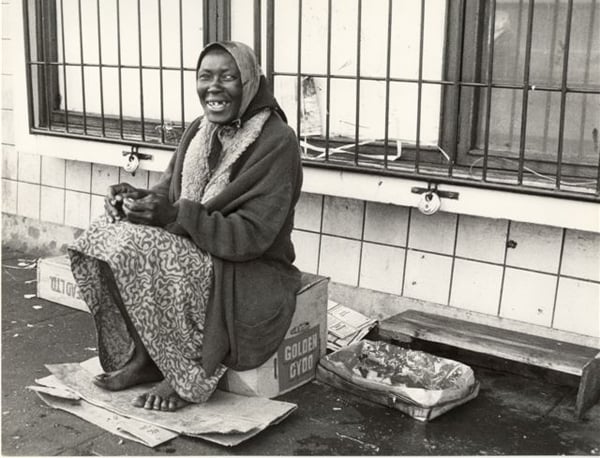
Homeless woman in Durban, S.A. Photo by Stefán Helgi Valsson.
People feared it would happen in the run up to the Vancouver 2010 Olympic Games, but it's happening today in cities across South Africa. With the 2010 FIFA World Cup looming, reports have surfaced that homeless people are being rounded up and forcibly removed before the eyes of the world turn to look upon South Africa.
Though the international media has picked up on the story with some vigour, from what I've observed working in Johannesburg's inner city these street sweeps seem to be nothing out of the ordinary.
Last August, as part of a campaign to tackle homelessness, the city's human development department took to the streets on a mission to stop people from giving money, food, clothes or blankets to the 3,000 or so homeless people living in Johannesburg's inner city.
"Their presence violates the city bylaws and we arrest them," Edna Mamonyane, spokeswoman for the Johannesburg Metro Police, said at the time. "This is a normal police exercise, but we have intensified our efforts because of the World Cup.
"We have had a tough job with the prostitutes -- every day they are warned or arrested," she added.
Reports claim that here in Johannesburg more than 800 people have been removed from the inner city area surrounding Ellis Park, where seven games, including a quarter-final, are to be held.
The campaign to remove homeless people from the public eye is defended by officials as being in line with the city's bylaws, which prohibit begging at intersections, as well as sleeping in streets, parks or any other public space.
Related to the forced removal of homeless people is the corresponding campaign, among the South African media and government officials, to vilify and dehumanize the homeless, in particular foreign nationals, in the run up to the World Cup.
Carte Blanche, a popular South African investigative television series, recently aired an exposé alleging that homeless women are renting babies for R20 per day (about $3 CAN) in order to earn more money begging at intersections.
On any given day, an estimated 300 mothers -- many of them Zimbabwean -- stand with their children at intersections across Johannesburg, begging from passing motorists. The exposé, like a number of other stories negatively portraying the homeless, serves to legitimize the street sweeps, and placate any concerns ordinary South Africans may feel for the homeless.
Significantly, much of Johannesburg's homeless population is made up of foreign nationals from other African countries, and there have been mounting concerns among the city's NGOs that xenophobic violence -- like that on May 2008, when 62 people were killed and hundreds of thousands of others displaced -- could erupt after the World Cup.
With its porous borders, its reputation as Africa's powerhouse and its close proximity to the ailing Zimbabwe, South Africa is a melting pot for other African immigrants -- both legal and illegal. But with such a large number of South Africans living in poor and destitute conditions, intolerance and contempt towards the country's foreign nationals, who are often considered to be a drain on the country's resources, is endemic.
Xenophobia is prevalent among all levels of South African society, from taxi drivers to police to social justice workers, and is rooted in legacies of colonialism and apartheid. The street sweeps are just one way the country's institutionalized xenophobia is playing out, and it could have drastic consequences for homeless people -- whether actual or perceived foreign nationals -- once World Cup fans return home.
In the weeks leading up to the Vancouver Olympics, I was touched by the way community and social justice groups united to protest the province's Assistance to Shelter Act. As the countdown to the World Cup comes to an end, I can only say that the lack of concern shown by local social justice groups and the general powerlessness of the homeless here in South Africa have been genuinely troubling.
We can only wait to see what the World Cup, and importantly, the weeks after, will bring. ![]()


10
Login or register to post comments
RickW
1 year ago
So Aparteid IS Alive & Well!
It just shifted gears.
Fii
1 year ago
How ironic. I was just
How ironic. I was just thinking that if people put half the effort they do into following the world cup toward helping the poor.... what a difference could be made.
zalm
1 year ago
Run them beggars out!
"The law, in its majestic equality, forbids rich and poor alike to sleep under bridges, to beg in the streets, and to steal their bread." - Anatole France
Not forgetting for a moment that the reasonably-corrupt ANC, along with the pro-apartheid National Party, runs things both nationally and provincially, it is nevertheless a surprise to see so little care and concern for the homeless xenophobia notwithstanding. Reaganomics must still be alive and well there...
barney
1 year ago
Some historical context please
Hundreds of years of brutal colonialism followed by a century of fascist apartheid cannot be undone in a decade or two. South Africa post-apartheid remains a violent place because of its brutally violent, racist past. It's been free of these shackles for a relatively short period of time. Don't expect miracles. And don't be ethnocentric in your evaluation of a nation that still bears many of the ills of its ugly past. This is the context and it can't be glossed over or ignored in a journalist's rush to condemn.
Nelson Mandela, former Communist Party loyalist cum ANC martyr knows all too well the ugliness first hand, via his years as a political prisoner.
Nelson Mandela says World Cup is "one of the greatest" events in Africa’s history, adding it's more than just a game. Mandela says the World Cup "symbolizes the power of football to bring people together from all over the world, regardless of language, the color of one’s skin, political or religious persuasion."
I get tired of the First World idealist socialist who demand we should never hold a soccer tournament or an international sporting event until every person in the host country is free of poverty. It's not either, or. Sometimes the two can work in tandem.
I'm not a huge football fan, and I think FIFA World Cup is a multi-billion-dollar branding racket, but in this case, sport can do good, can unify, and on this issue, I'm with Nelson Mandela and the 'beautiful game's' ability to inspire impoverished African youth to continue the struggle started by Mandela and the ANC!
urbanguy
1 year ago
What the World Cup means to South Africans
Readers interested in this issue may want to check out the opinion piece I wrote that The Globe and Mail published last week. Visit:
http://www.theglobeandmail.com/news/opinions/will-this-be-an-own-goal-or-a-national-triumph/article1592948/
semiahmoo8
1 year ago
The World Cup unites and inspires
The goal by Sephiwe Tshabala in the 55th minute sealed the joy of a nation as South Africa scored the first goal in the World Cup. The symbolism reflected in the goal will probably never be understood by RickW. To suggest that "Apartheid" has just shifted gears is a gross misunderstanding of the role of sport in building the Rainbow nation. It is also very cruel statement to the millions of South Africans who fought apartheid. Sometimes, it is okay to celebrate and be joyful at a great moment in South African sport.
barney
1 year ago
semiahmoo8
Well said, my friend. I think people who say Apartheid has 'shifted gears', or use terms like 'reverse racism' are generally people who are still very uneasy with the fact that South Africa is no longer ruled by a white minority, a country that now has one-person-one-vote.
These are people who will use this historic event of the World Cup to find fault and injustice in the post-Apartheid order and highlight those things, rather than focusing on the positives at hand. Again, Mandela has spoken eloquently on the symbolic importance of the World Cup, and I'm with him and the people on this issue.
semiahmoo8
1 year ago
The footballers of Robben Island
Follow the link to BBC Sport to an interesting 8 minute piece on the "Footballers of Robben Island". Perhaps, it will help RickW understand the role of football in the most brutal prison ever created by the old South African regime. It is a story of humanity winning over the attempt to dehumanize courageous men.
zalm
1 year ago
barney
If you think that sport can and should unify, that cheapens the vast number of more valuable things that we claim already unify us. At its simplest, each nation's anthem was written to evoke unity in the each member of the nation singing it.
Sport is inherently divisive - there must be opponents, there must be winners and losers, there must be glory for one and shame for the other regardless of just deserts, and there is no attention paid whatsoever to the effect fortune has on the results - far more so than multi-million-dollar salaries or kazoos in stadiums.
Sport has become an excuse for adults to abandon responsibility and engage in childish behaviour on a mammoth scale, and to additionally refuse to be responsible for the fallout.
South Africa has much to be proud of, not the least of which was its response to the terrors of apartheid, in the completed work of Truth and Reconciliation Commission. The many touching records and reports of this Commission still resonate with many whose loved ones were lost, and in the jail terms meted out to those who refused to accept either its authority or its judgments.
To claim, as semiahmoo8 does, that somehow a goal scored is the equal of that implies no lack of understanding on the part of those such as RickW. I can't comment on what it actually is - can you? Soma perhaps? Whatever, it certainly diminishes the true progress made by those who struggle to make the country a better place, and as such, it deserves all the scorn I can heap upon it.
Invoking the joy of a goal as justification for the willing abuse of the homeless is insulting. Your rebuttal welcome.
zalm
1 year ago
Gawd, I should shut up
I ran across this just last night in reading the contribution to atheistic thought of a "drink-soaked Trot for the war". He noted that another writer in passing quoted Seneca:
"A physician is not angry at the intemperance of a mad patient, nor does he take it ill to be railed at by a man in fever. Just so should a wise man treat all mankind, as a physician does his patient, and look upon them only as sick and extravagant."
- Lucius Annaeus Seneca
Says it wayyy better than I ever could, and in many fewer words.