- Ms Kaye is a Tyee Builder. You can be, too.
- Mary Carlisle is a Tyee Builder. You can be, too.
- Prem Gill is a Tyee Builder. You can be, too.
- Nancy Flight is a Tyee Builder. You can be, too.
- Justin Everett is a Tyee Builder. You can be, too.
- John Westover is a Tyee Builder. You can be, too.
- Nora Etches is a Tyee Builder. You can be, too.
- Edward Henderson is a Tyee Builder. You can be, too.
- Bharadwaj Chandramouli is a Tyee Builder. You can be, too.
- Dean Chatterson is a Tyee Builder. You can be, too.
- Marius Scurtescu is a Tyee Builder. You can be, too.
- Robert Parkes is a Tyee Builder. You can be, too.
- James Murton is a Tyee Builder. You can be, too.
- Susan Doyle is a Tyee Builder. You can be, too.
- Vincent Strgar is a Tyee Builder. You can be, too.
- Helen Spiegelman is a Tyee Builder. You can be, too.
- Subir Guin is a Tyee Builder. You can be, too.
- Kimball Finigan is a Tyee Builder. You can be, too.
- Joanne Manley is a Tyee Builder. You can be, too.
- David Leach is a Tyee Builder. You can be, too.
Torino, After Its Olympics
The Games transformed their city for the better, elected officials told me. Will we say the same?
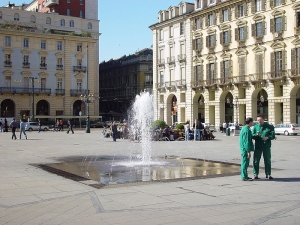
Torino's main square, Piazza Castello. Photo by Walter Aprile.
There are few signs today that Torino, once the centre of Italy's massive automobile industry, was just four years ago consumed by hosting the 2006 Winter Olympic and Paralympic Games.
The logos and street decorations are long gone.
There are no tourist postcards of the Games, and city officials are vague about whether the last of the life-size mascots has finally been packed away.
But as Vancouver prepares for its opening ceremonies, the architects of the Torino Games recall their Olympic experience as transformative, a milestone in the history of their city.
I learned this on a recent trip to Torino, having already visited four years ago with a Vancouver delegation of community and labour activists headed by then-councilor Jim Green. At that time, Torino's recent economic dislocation and the pressure of a new wave of immigrants was plain to see. Since that trip, I often wondered whether the monumental effort of hosting the Games would pay dividends -- and if that experience would have any lessons for Vancouver.
So, when I went back to Italy for a personal visit earlier this summer, I seized the opportunity to meet some of Torino's elected officials -- the people who conceived the bid and organized the Games -- to see how closely their experience lived up to their hopes. I make no claim to have heard all sides or to have compared every bid promise to the final product, but I was struck by both how clear-headed their plan had been and how matter-of-fact they were about the result.
With just months to go to the 2010 Olympic and Paralympic Games, the question for Vancouver is what we want for our city, and whether we can make it a reality.
Torino's bumpy road
Torino's story shows the possibilities. The city itself has about 900,000 residents in metropolitan region of 2.2 million, not far from the alpine towns that hosted the 2006 Games’ downhill events.
Once at the centre of 19th Italian politics and the drive for national unity, Torino became an industrial powerhouse -- only to face ruin a century later. Fiat's collapse in the 1990s destroyed 80,000 jobs and left an empty wasteland down the city's spine. By 1997, then-mayor Valentino Castellani believed Torino needed a new focus if it was to survive. The city was hemorrhaging jobs, the once-thriving industrial core was dead, and global guidebooks implied Torino was a good place to avoid if they mentioned it at all.
His centre-left council decided to bid for the 2006 Winter Olympic Games, calculating that the bid itself would demonstrate new confidence. If they won, so much the better. They did, securing the International Olympic Committee's approval in 1999.
'We opened up new spheres'
"We took the decision to try the bid as part of our process of transforming the city," Castellani recalls. "We had a new urban master plan, a strategic plan.
"We decided to make the bid because the city needed an international image. Our aim was to reposition the city on the international stage."
It worked.
Why?
"Because the Olympics were a success," says Piera Levi Montalcini, the city councilor who helped direct the municipality's Olympic efforts. "There were no problems, no accidents. It was well-managed and very successful."
Italy's Detroit -- the ugly sister to Rome, Florence and Venice, the city that tourist guides passed over, the butt of countless jokes in the chaotic run-up to the Games -- had invited the world, impressed its visitors, strutted its stuff and turned a page.
"Our mentality has changed to higher technology," adds Domenica Genisio, the councilor now responsible for managing former Olympic venues. "We've opened up to new spheres, new commercial activities."
The hardware of the city -- subways, public squares, a high-speed rail line -- was all improved, Castellani notes, and many projects were accelerated.
But more important were the changes in what he calls Torino's "software," the sense of pride, possibility and "affiliation in the city."
As evidence he points to the massive new social capital inherent in a legion of 20,000 Olympic volunteers, who continue to work together, socialize and provide a competitive edge for Torino when it bids for major sporting events and exhibitions.
As Levi Montalcini puts it, "the citizens feel the city is theirs."
Slow food and white nights
The city that was home to Fiat's legendary Lingotto autoworks -- since converted to a hotel, gallery, shopping centre and exhibition space -- is now headquarters for the Slow Food movement and host of Terra Madre, the massive global food fair that draws hundreds of thousands of organic and artisanal producers.
Changes in the city's life that were unthinkable in 2005 are now the norm.
One example is Torino's "white nights," which saw museums, stores and downtown facilities open for 24 hours during certain Olympic periods.
This idea was far outside the box in a working class town that tended to turn in early to be ready for the morning shift. But up to a million visitors crowded the streets during the Games for what is now a regular affair.
Traffic changes required for the Games also had an enduring effect, a real achievement in "Italy's Detroit."
The downtown area closed to cars is several times larger than it was in 2005, with trams, buses and bicycles running on designated routes parallel to major pedestrian thoroughfares.
New maps for travelers' imaginations
Ask Levi Montalcini and Genisio to name Torino's most notable physical legacy and they pull out a series of maps, each outlining a tourist walking tour that will feature art, museums, architecture or shopping, depending on your mood.
The maps are the result of a concerted public relations effort with tourism guide publishers to update the city's image. Torino commissioned new city travel guides from firms like the Lonely Planet and made sure up-to-date information was available.
As a result, Torino found itself on many tourists' itineraries for the first time.
"The commitment of the Olympics forced us to advertise our city as a whole," says Levi Montalcini, "and we had a worldwide stage to present this."
As the city's website puts it, "in more than a month of competitions, prize giving, concerts and celebrations, Turin learned to look at itself through the eyes of the world, to feel and live as a great European city."
Of course, none of this was without controversies and costs. Levi Montalcini can think of many expenditures that could have been avoided in retrospect, but not enough to make her regret the effort.
Genisio, responsible for managing remaining Olympic venues, wishes better plans had been made for conversion. The Olympic village, always intended for student and low cost housing, has been converted, and two rinks, as well as the speed skating oval remain in use.
In a city where ice sports were little known before the Games, one rink is used for hockey and figure skating, the other allocated entirely to public use. Winter sports programs in the schools promise a long-term supply of skaters.
Poured concrete and civic 'software'
Castellani says the total Games cost was about 3.5 billion euros, although the national government never disclosed the full security cost. About 2 billion euros, of which one-third reflected infrastructure investments, many already planned, that were accelerated.
He estimates the cost of the event at 1.5 billion euros. The organizing committee balanced its 1.2 billion budget. The city itself spent 300 million, far more than Vancouver, much of it on upgrading city squares, plazas and public areas, which are an enduring benefit.
The most important legacy, however, is the sense of civic self-confidence, reflected in the fact that the city's population, after a decade of steep declines in the 1990s, is again growing. A page has been turned.
Will Vancouver be able to make the same claim?
As Castellani noted, the infrastructure or "hardware" changes, while they were important and came more quickly, were not enough in themselves.
It was the change in the "software," the mood, engagement and sense of pride in Torino's citizens, that costs less but matters more.
![]()


21
Login or register to post comments
guru
2 years ago
Article nothing more than propaganda
Geoff Meggs will obviously say or do anything to keep justifying his pro-olympic stance. This two-week party for the rich does nothing but take needed taxpayer money away from the people and services the City is charged with providing. Shame on Meggs!
alive
2 years ago
right
yes, what exactly did we learn from reading this article?
That if you get civic pride that means people feel better, Wow!
Citizens of Vancouver may not feel so proud once they realize the increased tax they will face after the games.
What exactly did Expo 86 do for us? keep some taxi drivers busy for a few months, what else?
Oh yes, encourage some Chinese entrepenour to build on lands nearby at our expense for all the clean-up needed.
Yeah keep hoping folks, disappointment will come soon enough!
nogoodboyo
2 years ago
Why the Olympics won't have the same effect in Vancouver
In 2009, Turin's city councillor says, "the citizens feel the city is theirs."
What are the chances that a Vancouver councillor could say the same in 2013? Pretty darn slim. If Vancouver's elected officials were to conduct a poll of the people who work and/or live in Vancouver, I'm confident that they'd find that very few of them feel that "the city is theirs".
Most of Vancouver's workers cannot afford to rent a decent place within the city limits, much less invest in a piece of property. The Vancouver Police Department seems only to "serve and protect" the interests of business owners, the wealthy and themselves (of course). Citizens wishing to drink/eat/play/gather outdoors or to play music or to perform in any kind of spontaneous and creative fashion are quickly stopped and treated as criminals. Citizens waiting for the promise of affordable housing are soon told that it is the first thing to be jettisoned because of a slumping economy. Citizens are inevitably left to wonder where are the public spaces, the public art, the socioeconomic diversity, the employment and housing opportunities that are owed to them. And does anyone really care?
Vancouver does not belong to its citizens, it belongs to big business owners, developers and speculators-- no matter who may be in power at City Hall.
realisticman
2 years ago
Strange and sad
As Geoff writes, " Domenica Genisio, the councilor now responsible for managing former Olympic venues. "We've opened up to new spheres, new commercial activities."
The hardware of the city -- subways, public squares, a high-speed rail line -- was all improved, Castellani notes, and many projects were accelerated.
But more important were the changes in what he calls Torino's "software," the sense of pride, possibility and "affiliation in the city."
As evidence he points to the massive new social capital inherent in a legion of 20,000 Olympic volunteers, who continue to work together, socialize and provide a competitive edge for Torino when it bids for major sporting events and exhibitions.
As Levi Montalcini puts it, "the citizens feel the city is theirs."
See Geoff? The positive attitude you speak of relates to a healthy if somewhat abstract societal benefit that these people experienced. A better society. Yet the naysayers here, that ironically so often decry money itself, seem preoccupied with the monetary aspect and don't even see the collective improvement possible in the minds of the people.
At least you tried to explain it to them. Thank you.
Jeffrey J.
2 years ago
Torino Centre Left vs Campbell Far Right Regime
Society has always been about politics (the "polity"). Always has been, always will be. And in this context, the difference in politics is everything. Castellani was managing a failed city, that needed new focus. Campbell is running a once vibrant province into the the ground. But before the crash of the neocon Western empire of corporate greed, Campbell gave the green light to the Olympic greed machine. As Mr. Meggs notes,
"[Castellani's] centre-left council decided to bid for the 2006 Winter Olympic Games, calculating that the bid itself would demonstrate new confidence. If they won, so much the better. "
Contrast this with UBC Prof. Chris Shaw in Five Ring Circus (an excellent, insightful read) where disturbing questions come to light:
Why does the IOC pay no taxes?
Who are the real estate developers behind the Vancouver bid?
Why are mega projects paid for with tax dollars?
What are the true costs of the Games?
http://www.newsociety.com/bookid/3995
What citizens learns is that what happened in Torino will NEVER occur in BC. The politics are different, the motives are different, the values are different. Indeed, as Prof Shaw demonstrates, the Vancouver 2010 fiasco is far more typical of past Olympics than is Torino's unique circumstances.
If only it were otherwise. Interesting perspective Mr. Meggs. Best of luck.
The Blackbird
2 years ago
Did Torino's Host City Bid Book Include Social Legacy Promises?
I recently read that the Inner City Inclusive Commitment Statement which formed part of the 2010 bid book was the first of its kind. If this is so, Torino's organizers made no such promises as no one would be evicted or made homeless as a result of the Games.
This is a great distinguishing factor between Torino 2006 and Vancouver 2010: Here, VANOC and its government partners made such promises and - as we have seen with a near quadrupling of the region's homeless count and between one and two thousand evictions predicted to occur by the time the Games period ends - broke them royally after Vancouver/Whistler/Richmond won their Host City bid competition.
Think of how great things might be had the federal and provincial governments kept their end of the promises and started to fund and build social housing - as are their responsibilities - shortly after the bid competition when our economy was on the upswing. Instead, in June of 2007, John Furlong and Gordon Campbell appeared on TV to state the ICI was not a legally binding document so they were simply not going to do it. Shortly thereafter, the City of Vancouver made 14 properties available for such construction and, to date, building has only just begun on one of those lots. Pathetic.
So let's rejoice in the wonderful celebration we will be paying for for decades, knowing that once the Games have come and gone and VANOC's temporary shelter is dismantled and hundreds of Vancouverites are pushed back out onto the street with no place to call home.
PS: Given Vancouver City Council's recent warming up to the city playing host to a UFC event soon, I hereby challenge Gordon Campbell and John Furlong - that's right, I'll take both of you on at once - to a refereed 5-round bout in the octagon. That is, unless it's true the only people you like to hurt are those least able to defend themselves.
dave49
2 years ago
What are we comparing to?
I know people who were part of the great migration to Calgary and the Oil patch in the 1970s and 1980s. Several of them commented that Calgary developed a real sense of community with all the community and volunteer efforts that were part of putting on the 1988 Calgary Winter Games. Outsiders were finally accepted as Calgarians. I visited a relative in Calgary during the Games and saw several events. A huge network of people traded and shared tickets.
By contrast, the City of Vancouver's referendum campaign saw a 'yes' campaign funded by sources still unknown spending an estimated $500,000 to hire staff and stage public rallies. The 'no' side was Chris Shaw and half a dozen others who put together something like $1,200.
As for sharing and trading Olympic event tickets, the rules around tickets and attendee identification are so positively anal retentive, I don't see that happening very much. We have the most expensive Olympics ever, yet we're obsessed with scalpers.
I find Vancouver has community on a neighborhood by neighborhood basis, but I don't see a transformation of Vancouver's "civic software" resulting from the Games. Changing rules around volunteering have put off many people.
One of my favourite targets to disparage is Vancouver Magazine. It arrives at my door free, but I would never buy it. I recall about a dozen years ago a letter from a visitor to our fair city, who gushed about how Vancouver Magazine was such a great representation of the city. Really??? Vancouver Magazine has improved with seasoned journalist Frances Bula on board, but they used to publish about three good articles a year. Otherwise, all they seem to write about is real estate, plastic surgery, restaurants and 'power broker' lists. In my view, any visitor seeing two or three issues would think we are pathetic, shallow and self-obsessed!
We didn't get the Games because we wanted them as a community or someone had a vision of something better. It's all about the usual BC politics. As a neighbour, who moved from the USA a few years ago observed, BC politics is about getting in power and putting into place programs and projects that help transfer public money into your friends' pockets. These games are really just another example of this, pushed by people have much business to gain for themselves or their industries.
Sadly, the REAL cost of that style of politics is disaffection with the entire political process, evidenced by declining voter turnout. It seem to be coming around to the anarchist button that said, "Don't vote, it only encourages them".
Dan the socialist
2 years ago
He should do a piece on how
He should do a piece on how Sarajevo was helped by hosting the Winter olympics...
pithylittlegeek
2 years ago
dreamworld
That this aspect of the Torino experience can somehow be instructive for Vancouver is complete nonsense -- Vancouver is far from lacking in any sort of civic pride.
In fact, the opposite is likely closer to the truth, that we have far too much of it. We are so enamoured with our beautiful natural surroundings that we can thoughtlessly overlook a homeless problem that would shame any other city.
Jackie Humber
2 years ago
Geoff Meggs article on Torino.
I say BRAVO! to Mr. Meggs.
If some readers would look at the sentence in the deck they would find that Mr. Meggs is still qustioning the outcome of Vancouver's Olympic experience. Thank you Geoff for the informative piece and for asking the right people the right questions.
Let us all be a little more positive about the Olympics arriving at our doorstep in the next few months.
Maurice Cardinal
2 years ago
Pure Political Bunk
TOROC threatened bankruptcy about two months before Turin's big event unless taxpayers bailed the Games out.
Italians were held hostage, much like Canadians today.
Volunteers in Turin quit at alarming rates throughout the entire stretch of the 2006 Games.
It's well documented that the Olympic volunteer experience is so demoralizing, after the Games leave town the rate at which people in Olympic regions volunteer for community charities like the Heart and Stroke Foundation, drops considerably. Many vow to never volunteer for anything ever again.
Volunteer churn rates over the last decade average 3:1, and sometimes reach an astronomical 4:1, which means for every volunteer position needed, at least three people have to be hired to replace the volunteers who quit midstream - often on day two "after" they get their "souvenir" uniform.
So please Mr. Meggs, explain how today you paint such a rosy picture. Your interpretation is pure bunk, and as you can see from the comments here, no one believes you.
Here's the reality regarding Olympic Volunteering;
http://www.olyblog.com/f/08/SocialMediaF12012008.shtml#VOLUNTEER
urbanguy
2 years ago
what can the 2010 Olympic games give Vancouver?
Geoff Meggs has it about right. As he writes about Torino:
"The hardware of the city -- subways, public squares, a high-speed rail line -- was all improved, Castellani notes, and many projects were accelerated. But more important were the changes in what he calls Torino's "software," the sense of pride, possibility and "affiliation in the city."
That last point is the real payoff in Vancouver's grasp, if we seize the opportunity. As I wrote in my own piece about this for The Tyee back in 2004 (http://thetyee.ca/Views/2004/07/14/Seize_the_Games_Golden_Opportunity/):
"In the same way, metropolitan Vancouver might expect to become a quite different place post-2010: new and improved roads; better and more public transit; new community and recreation facilities; completion of the wholesale transformation of False Creek into a more complete, sustainable community and urban waterfront; an enhanced public realm; cultural critical mass and raised standards. But even more than these physical changes, is the prospect of developing a culture of excellence. And the ineffable, empowering sense of pride and self-confidence that citizens of all great cities evince."
While we can argue, legitimately, about whether the physical changes are worth the cost and social disruption the Games will bring, I still believe in the second part of the argument: seeing the Games as a compelling metaphor as agent of positive change. As I wrote back then:
"The 2010 Games might well be a wonderful experience for many. Yet what should excite Vancouverites more is the long-term transformation this opportunity offers our beautiful but still so young city. The power of such an event in the life of an emerging city should not be underestimated."
Call me idealistic if you like, and yes I know there are plenty of very real potential downsides, as many have argued, but we can still use our fast approaching date with the Olympics as a positive transformative event in the life of our city, if we play our cards right. Here's hoping we do.
morechatter
2 years ago
The Citizens Feel the City is Theirs?
Stop there! The Citizens of BC Strongly Feel the City is not theirs! And the rest of the communities seperated itself from Vancouver's expendiutures for the Olympics with cities saying, thats your problem Vancouver. We got our own problems.
morechatter
2 years ago
Don't forget the beg bug spray and a mask for possible pendemic
Its promises to be a memorable experience as the rains will most likely cloud your view from watching skiers slip and slide down those slopes, maybe it all depends as can't see much air travel and visiting the wet city to watch the games with a pendemic in the air? Heating bills will be less this winter.
morechatter
2 years ago
Oh, and last thing
Do you think its going to be a turn on to the rest of the world that Canada hasn't had it shots yet? And your stagging a world event in 6 months, maybe!
Muckeye
2 years ago
Geoff Meggs- Dream on
Could this article be any more pie-in-the-sky, airy-fairy? How much acid did you take before visiting Turin and talking to its ELECTED OFFICIALS. Oh right- that's the first place to turn to for news, (dis)information, and (un)truths. Yeah politicians- they know what really happened. And they never lie, ever!
The Olympic fallacy and all of its blind supporters is the biggest joke ever perpetrated on BC, and that's saying a lot. Want to bet that the HST has been introduced to help make up the massive shortfall in funds to pay for the Olympics? Wait until none of the expected corporate sponsors show up- guess who'll pay? But no, we should make the most of the opportunity, put on a happy face, ignore reality... I'm guessing those that offer this advice are the same people who ignore climate change and do nothing about it, who pretend that there was no recession because they still had over 100K in the bank and were able to take all of their Abu Dhabi vacation!
You want to make the Olympics a success? Then get out and tell the truth. Protest. Make sure the world that comes and that doesn't have its head up its you-know-what understand what has happened here, and what is happening in London, and Sochii, and... Do something about marginalizing and ending this trivial waste of resources in the name of absolutely nothing good.
dave49
2 years ago
pithylittlegeek's comment
We're on a similar wavelength. We're smug about Vancouver. Yes, the mountains and the ocean. And, don't forget being repeatedly chosen one of the world's most livable cities. And, what about when our urban planning successes get dubbed "Vancouverism?"
Add to that a clever governing party with an amazing PR/communications arm, led by a Teflon-coated leader. So, we get a progressive-sounding but totally shammy carbon tax, useless and immune to proof or disproof of it's effectiveness. We gloat about this progressive policy, while Rome proverbially burns, but nothing changes. However, we feel good about ourselves as Vancouverites and British Columbians.
The saddest part is we are buying into conning ourselves.
Maurice Cardinal
2 years ago
HST is really the OST
I stand corrected, some people commenting here do have faith in the 2010 Olympics, and in Geoff Meggs.
It's great to be able to stay so positive in the face of adversity and I'd like to do so too, but I did considerable research for my book, Leverage Olympic Momentum ... and the numbers don't add up.
I agree with Muckeye - the HST is really the Olympic Sales Tax.
* Salt Lake City 2000 deficit - $1.2 billion
* Athens 2004 - $12 billion
* Turin 2006 is still counting although we do know they threatened bankruptcy only two months before their big event.
* Beijing 2008 - a farce from start to finish that already within less than one year is complaining of white elephants.
* Vancouver 2010 - seriously struggling, stay tuned
* London 2012 - a deficit already in the billions
If someone could show me how VANOC is doing things differently I would rest easier, but all I see is the same old. If John Furlong was doing things differently he would be transparently addressing past IOC challenges and boasting how he is fixing a broken Olympics business model.
Yes Furlong completed facilities early, but doing so means we have to carry the costs longer before we see a payout, so he shouldn't be patting himself on the back claiming an economic coup. He also did it to save face - the IOC and VANOC's, Vancouver and Whistler's, and of course his.
The Olympic business model is structured to force Host regions to build out in a very limited and unreasonable time frame, and everyone knows, whether you are a purchaser or supplier, when you put a RUSH on any project the costs escalate considerably. It's no secret we paid sometimes three times more than the infrastructure is worth or will ever pay back to our region.
Why?
Because local politicians and civic leaders are not capable of raising interest and money without the Olympics.
Not much of a consolation, or to now claim we have so much because of the 2010 Olympics, when we will be paying for it three times over for generations.
Wishful thinking is not realistic.
Is there a viable solution? Definitely.
Go back to Olympic sponsors and
demand they kick more in to the kitty.
Olympic sponsors got a good deal from VANOC, and they are making a killing while taxpayers foot the bill.
Olympic sponsors claim they make a three, four, and sometimes fivefold increase on their Olympic investments. Is this fair?
I know it's a cold way to look at it, but follow the money.
http://www.olyblog.com/f/08/BeersLaPointeF03062008.shtml#BOYCOTT2008
Gene McGuckin
2 years ago
Dollars and Sense
Like Brother Meggs, I am a child of the 60s. But neither of us still espouses flower power as a strategy for protecting ourselves and our communities from corporate plundering on the scale of the 2010 Olympics--or for providing the offsetting "healthy if somewhat abstract societal benefit" dreamed of by "realisticman" above.
I say "Brother Meggs" because, as a retired paperworker, I remember him as a staffer for the Fishermen's Union and later for the BC Fed.
That in mind, it is strange that his song of praise for the potential benefits of the Olympics is not balanced by some concern for the overwhelmingly probable struggle facing the tens of thousands of public sector trade unionists going to the bargaining table next spring.
Everyone, who has thought about this for a moment, knows they will be told to accept vicious cutbacks because over $6 billion of public money has been transferred into corporate coffers in recent years.
Since Brother Meggs was also a privileged insider in both the NDP provincial and COPE Vancouver City governments, it is also passing strange that he expresses no worries about the hundreds of thousands of citizens those public sector workers serve--school children, children at risk, the elderly, the sick and disabled, the down and out, etc. This week's budget gives a large hint about the program-chopping spree to come.
While some might try to blame this "budget crunch" on the current international fiscal/economic crisis, this is a smokescreen. Cutting back, shrinking government, taming trade unions, and promoting social darwinism have been the ideological guides for Corporate Campbell and Co. since before they were first elected.
It was always their plan to continue this process in the 2010 round of bargaining with the recent Olympic outlays as a excuse. (Remember the $4,000 per capita signing bonus in 2005 to buy a four-year contract, so the planned battle would happen after the circus?) How handy that they can now try to use the international situation to obscure their own plundering on behalf of their friends.
Finally, given that Brother Meggs is an experienced political writer with some journalism experience (and therefore understands "spin"), it is curious that he wrote this article at all and did it in the way he did. What is the point?
He explicitly leaves open the possibility, in the headline and the text, that Vancouver might not have as positive an experience as Torino (no mention of the rest of the tax-paying province). He hopes this might be so, but, alas....
So, we are to be mindful of the fact that the Olympics might be--and might help bring--a plague of hardship for British Columbians. But we are to hope it will produce a warm and fuzzy outcome, "a healthy if somewhat abstract societal benefit."
And those of us who balance upon that teeter-totter will, or course, not feel compelled to join in the anti-Olympics actions that will accompany the circus.
taimei
2 years ago
So what is the similarity?
Vancouver is not a depressed city. Vancouver is not a working class city. Vancouver does not need more tourism. So what exactly is the connection between Torino's Olympics and Vancouver's?
Torino's bid to host the Olympics sounds like it was a very clever plan to bring money into the city, infuse its citizens with pride and put it back on the tourist map. Fine. But Vancouver? Don't we have enough douchebags strutting around already proclaiming this is the best place in the world?
dave49
2 years ago
Evolving Olympics
The thing that bugs me most about the way the Olympic games are evolving is the increasing intrusion of professional athletes, at the invitation of the IOC. The Olympics was supposed to be the high point in achievement for amateur athletes. But now we have professional hockey players and professional basketball players giving the 'all' for their country.
If you read the recent news, golf may be one of the new summer Olympic sports. And, surprise, surprise, golf god Tiger Woods would like to add an Olympic medal to his trophy collection. Tiger Woods is probably the wealthiest athlete on this planet. If he is allowed to participate in 'amateur' games, the English language as we know it is dead and should be donated to the marketers and spin doctors who have destroyed it.