

 SHARE:
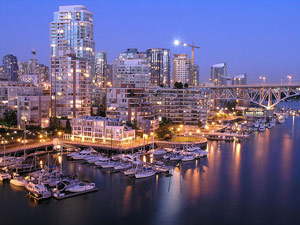
Imagine yourself as a city. Envisage the downtown as your head, or your heart, whatever. The suburbs are arms and legs, extremities. Waterways, freeways, like blood vessels. You get the picture.
Now imagine you're a city on the move. You're full of great ideas about how cities should be run. You're innovative, free-thinking. Sure, you're graced with spectacular scenery and everyone loves a handsome city, but you're a bit more than that. That's what you tell yourself.
So how do how you gain the world's attention for your updated image? Pierce through the yammering of all those other creative, handsome, free-thinking cities? Well, if you're Vancouver, you could throw a party, one of the world's grandest. Invite the best winter athletes on the planet, send them hurtling down your world-class slopes. And with the world's eyes on you, you could make the pitch: "I'm a Pacific Rim leader! I'm a model of sustainable urbanism! You could learn a thing or two from me!" And does the world listen? Or is it too busy admiring white-capped waves, reflected in your steel-glass towers, and the soaring mountains behind?
With only six months till Games-time, a prominent urban consultant fears we've missed a big chance to redefine Vancouver to a global audience. And city officials freely admit they're long overdue on a solution.
'Age of short attention spans'
I'm forking bites of Mexican food in downtown Vancouver with Lance Berelowitz, acclaimed urban thinker, editor of the bid book that helped Vancouver win the 2010 Winter Games. We chat overtop festive Central American music and the scraping of silverware on porcelain. I want to know why he wanted the Olympics here. What did Vancouver stand to gain?
"I'm not an Olympics fan," Berelowitz explains, with only a smattering of irony. "It's not the Games themselves which excite me. They're interesting -- but not that interesting."
Far from flippant, he makes an important -- and somewhat obvious -- point: the Games stand for so much more than amateur athletics. They belong to an elite cadre of hallmark events that offer cities a titillating chance to transform. Berelowitz mentions Expo 86, Vancouver's "coming out party" to the world.
For more than four months, the planet bore witness to a burgeoning -- and beautiful -- Pacific Rim city, vital, exciting and stable. Asian and American investment skyrocketed. Vancouver exploded onto the global tourist map.
Nearly 25 years later, and most of the benefits have been played out, Berelowitz argues. In our lightning fast epoch of digital information, global-thinking cities such as Vancouver must constantly covet the limelight.
"So in using another hallmark event like the Olympics, you can leverage it strategically to reposition or re-announce yourself to the world," Berelowitz says. "And you need to do that in this age of short attention spans."
Cultural centre smackdown
Days earlier, and I'm on the phone with University of Calgary sociology professor Harry H. Hiller, asking him to briefly explain the rapidly changing role of cities in a globalizing world. "Well, I usually teach a whole course on this...," he warns.
Since the late 20th century, developed countries have been moving beyond the industrial smokestacks that once gave them life. Most manufactured goods now come from places such as China, whose fire-sale labour prices entice big corporations.
That shift means many cities once reliant on rows of factories now trade on service and knowledge. Think Vancouver. Formerly defined as a hub for B.C.'s resource-based economy, it now caters to real estate moguls, Hollywood productions, scientific labs, international tourists. It's a pattern repeating all over the globe. The upshot is that post-industrial cities -- or those on the verge -- are forced to vie for investment. Pursue global attention. Seduce the hordes of creative people that will make them ever more attractive.
Seen this way, playing host to the Olympics makes strategic sense, Hiller argues. He points to London, home of the 2012 Summer Games. The English capital is clearly an axis of financial and cultural power, one of the world's great urban centres. Yet as ascendant cities such as Beijing become more globally-minded, London perceives a challenge, a need to assert itself.
"The key notion now, is that no large city is purely an island unto itself," Hiller says. "It is now part of a worldwide economy in which cities compete with each other."
'A setting in search of a city'
Assuming cities do indeed jostle for positions on a global ladder, Vancouver has a ways to climb, Berelowitz argues. No one disputes that urban centres such as Paris, New York or Tokyo occupy the top echelon of the global imagination. They're truly iconic, unrivalled in influence, de-facto capitals of an ever-shrinking world.
Descend a few steps though, and demarcating gets harder. Here you find the second-ranked cities. Places such as Sydney, Australia, which doesn't lack for global identity, but hails from an isolated country with a relatively small population. Chicago, Berlin, Barcelona. For a confluence of reasons, none of them are quite top-level stuff, Berelowitz says.
Go lower still to reach third-ranked Vancouver. In a North American context, Canada's Pacific heavyweight shines bright. It's a leader in the shift to a carbon-neutral society. Home to a dense, vibrant downtown. Testing ground for the continent's first legal safe injection site. But to a global audience, that lustre is lost somewhere inside a breathtaking vista of sea and snow-capped peak.
"The traditional branding of Vancouver -- to put it crudely -- is a setting in search of a city," Berelowitz laments. "That can only get you so far."
Yet the urban consultant sees no evidence of a strategic marketing shift in the lead-up to 2010. Instead, a repetition of the same anti-urban themes. A missed chance to redefine Vancouver to the world.
"If you look at the marketing around the Olympics to date, it's pretty much been about the spectacular city," Berelowitz says. "The political and Olympics powers are not showing Vancouver as an incubator of new thinking -- an innovative, creative place to be."
Tourism Vancouver's brand update
From the earliest days of Vancouver's bid process, the prospect of sweeping economic gain had the city's pulse racing. Business elites spoke of jobs in the tens of thousands, millions in tax revenue and, of course, a tourism bonanza. A 2002 government-commissioned study released just seven months before Vancouver won its bid -- appeared to justify their claims. The highest estimates dangled a $10.7 billion economic windfall, with two-thirds of the benefits visitor-related -- prospects that still have the city salivating.
"The Olympics reach three billion viewers," Tourism Vancouver spokesperson Wendy Underwood tells me over the phone. "It offers us a fantastic opportunity to raise the profile of our city."
Judging by the numbers, though, Vancouver could hardly be considered shy, even before its winning Games bid. In 1999, the city welcomed 8.3 million visitors, compared to 8.9 million in 2007. Naturally, the recession has slowed things down a little. A nine to 10 per cent overall drop can be blamed on it, though Vancouver isn't reeling as badly as most other Canadian destinations, Underwood says.
"We certainly think that part of that is because we're hosting the Games." Also, she notes, it helps that Vancouver's ideal location practically markets itself. Situated equal distances between Asia and Europe, it's a hub for international conventions, global travellers. And who isn't awed by the scenery?
"We have a beautiful destination," Underwood says. "It's a natural fit for tourism."
Nonetheless, Tourism Vancouver went through a major brand update in 2004, hoping to offer more than just a handsome mug to the world. The end result: "Safe, exciting and welcoming"; "Liberal-minded"; "Multicultural"; "Superior value."
"Overall, we're an exciting destination," Underwood says. "Vancouver's not just about things like the 2010 Games."
I arrive at city hall sweaty and out of breath, gasping after my steep bike ascent up Cambie Street. A milky grey sky lends drama to the hulking mountains in the distance, all the more striking from my hill-side vantage point. I'm here to meet Michael Magee, chief of staff to Mayor Gregor Robertson, and one of the creative minds behind a bold attempt to re-imagine Vancouver -- a mere six months before the Olympics.
"The city has never really branded itself," Magee tells me, as we settle into his corner office. "It doesn't really have a narrative or a story."
That could all change in the coming months. There's still some tweaking here and there, some lingering details, but Vancouver is close to launching a focussed, green persona. The goal is to cast the city as a global environmental leader. Draw green-minded companies. Sell the world on B.C.-style sustainability.
This all sounds great, I tell Magee, but why wait until so close to the Olympics, when the city's had years to contemplate its winning 2003 bid? Civic branding here has never been a real priority, he suggests. It's a job officials have largely left to the private sector.
Now, though, with climate change top of mind, Vancouver wants to capitalize on the global spotlight afforded by Games. That plan took a small hit when the feds cancelled the Forbes CEO Forum in Victoria, scheduled right before the Olympics.
But Magee's confident there's still plenty of chances to entice foreign investment.
After all, Vancouver offers much lower corporate taxes than places such as California. And the city's sheer livability, which is consistently ranked among the top in the world, is draw enough of its own.
"We've got a tremendous opportunity to bring a lot of business here," Magee says.
What are they smoking?
Last May, New York-based Bloomberg news agency posed this question to 2010 Games organizers: "Is it an Olympic torch, or a big fat joint?" The wire service barely suppressed giggles as it reported on the torch design unveiled by Canada's "marijuana capital," a whitish stick bulging in the middle with a flame burning at one end.
The design team had hoped to evoke skis slicing through powdery snow. Surely, any stoner likeness was coincidence. While the disparity made good comedic fodder, it was also symbolic of a larger disconnect -- Vancouver's own ideas of itself are not necessarily shared by the world.
A recent Angus Reid survey asked North Americans to describe B.C. Predictably, the Pacific coast province evoked the Olympics, great vacations and good weather for most respondents, British Columbians included.
More interesting, it also pointed to big gaps between local, national and international perceptions.
A majority of B.C. participants saw their province as an environmental leader and innovator of cutting-edge technology. Only 41 per cent of Canadians could vouch for B.C's green credentials. And a mere 28 per cent thought the techie label applied.
Meanwhile, less than a third of Americans surveyed identified B.C. as "Hollywood North," though Vancouver is the third largest film centre on the continent.
'Great story to tell'
"We've got a great story to tell here in British Columbia," Angus Reid research director Hamish Marshall says when I phone him about the results. "But perhaps we're not telling that story as well as we would like."
Do the Olympics offer a chance for renewal, I ask. Can a two week mega-event help Vancouver shape an identity worthy of such a pretty face?
"Absolutely," Marshall replies. "But people are focussing on the vacation destination. If the Games reinforce that I don't think we'll have seized all the opportunities they've presented us." ![[Tyee]](/design-article.thetyee.ca/ui/img/yellowblob.png)




Tyee Commenting Guidelines
Comments that violate guidelines risk being deleted, and violations may result in a temporary or permanent user ban. Maintain the spirit of good conversation to stay in the discussion.
*Please note The Tyee is not a forum for spreading misinformation about COVID-19, denying its existence or minimizing its risk to public health.
Do:
Do not: