



 SHARE:
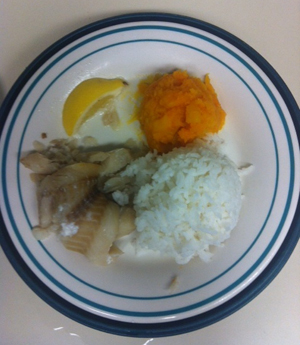
[Editor's note: In Part 1, Tyee Solutions Society reporter Colleen Kimmett visited a hospital in Guelph, Ontario, where patients are served meals cooked that day from fresh, often local, ingredients. Other hospitals are also catching on to the "good food" notion. Could the idea find a foothold in British Columbia? Kimmett set out to find out... starting in the Lower Mainland.]
Following on the example of St. Joseph's hospital in Guelph, a nationally-recognized model of bringing local food into big institutions, we wanted to find out how patients' meals measure up in Vancouver.
Indeed, could we do a plate-by-plate comparison of hospital meals: their ingredients, how far they'd travelled, what our health system paid for them?
Reasonable questions, we thought. Finding a satisfactory answer proved much more difficult.
Information about ingredients and food sources that other hospitals handed over readily, was refused by both Sodexo -- the $8 billion-a-year French corporation in charge of food service at Vancouver Coastal Health Authority (VCHA) facilities -- and the public health authority itself. Both parties cited contractual confidentiality for what they couldn't share about what's being provided to the sick, injured and elderly in Vancouver’s hospitals.
Which prompted us to ask another question: Shouldn't patients have a right to know what's in the food they are being served in public institutions, paid for on the public's dime?
Food as a 'business initiative'
"Are you a nutritionist?" asked Anna Marie D'Angelo, Vancouver Coastal Health's senior media relations officer. It came across as a facetious question, posed in a sarcastic tone. I had just finished introducing myself as a journalist, after all, doing research on hospital food and the health authority's stated intention to improve the sustainability of its patient meals.
I explained that I wanted to know as much as possible about the food at VCHA facilities. Everything from menus, ingredients, where those ingredients are sourced, how much is wasted, how much it costs, and what the nutritional content was.
After some back and forth about the focus of my story, D'Angelo directed me to Linda Renwick, regional director of food contracts for the Lower Mainland Business Initiatives and Support Services -- a unit of the VCHA.
Renwick sent a one-day regular menu, a "typical service pattern on offer to our patients," that included a nutritional analysis. She noted that all menus are approved and signed off by a clinical nutritionist. As for local food procurement, Renwick told me Sodexo's primary food supplier is the B.C. branch U.S.-based Gordon Food Services, and that Sodexo purchases 29 per cent of its products from B.C. -- an increase, she claimed, from 24 per cent the year before.
That still didn't tell me much. At St. Joseph's hospital I had spoken to Leslie Carson, at the time an employee of the hospital and responsible for all the food purchased. Just recently, Carson was let go by the hospital. The hospital would not discuss why, and attempts by The Tyee to contact Carson weren't successful. But when I talked to her while she was on the job, she was happy to tell me exactly what food was bought for patients, and from where.
Those conversations with Carson contrasted with what I was learning about food purchasing for Vancouver Coastal Health facilities, which was several layers removed from the individual hospitals -- let alone the patient.
Degrees of separation
Renwick's agency, the Lower Mainland Business Initiatives and Support Services (BISS), is one of those layers of removal.
Formed in 2003, the BISS took purchase decision-making away from individual hospital administrators; even, to a degree, away from regional health authorities themselves. BISS now does the purchasing for all the hospitals and facilities within four lower mainland health authorities: VCHA, Fraser Health, Providence Health Care, and the Provincial Health Services. (Nearly invisible to the public, BISS neither has an Internet presence of its own nor appears on the web sites of any of the health authorities whose purchasing it controls.)
According to a Fraser Health media fact sheet, however, BISS "pioneered" large scale contracting-out of certain non-clinical services, including the food that accounted for nearly half (43 per cent) of its $194 million spending in 2011/2012.
But that's not where the layers end. A year after it was created, the Lower Mainland BISS contracted out patient food services and house cleaning operations, both to Sodexo: a deal that health authorities said at the time would save taxpayer dollars and improve patient services.
The 10-year, $330-million agreement gave Sodexo its largest Canadian client. That year, revenues in the Paris-based multinational's healthcare and senior care division grew by four per cent, according to one market report.
The patient services agreement between Sodexo and VCHA, signed in 2004, is what you might expect from a corporate contract. At one hundred and forty pages, it's a dense tome that covers every aspect of how food will be supplied, right down to the Special K that must be stocked on wards, the options available for vegetarian or kosher patients, and the slice of birthday cake that a resident at a long-term care home should get.
It also covers details concerning the relationship between the two parties -- and the united face they are to present to the public. Among other things, it stipulates that VCHA and Sodexo would coordinate their messaging around patient food services and agree on "standardized and uniform responses to questions from the media..."
The agreement also outlines how the parties will monitor patient satisfaction and food service commitments. Sodexo is responsible for conducting audits and surveys that measure both, and VCHA is entitled to collect this information.
"A focus on… local."
I went back to D'Angelo and requested the food safety audits, patient satisfaction surveys, and meal service audits for UBC Hospital -- a highly regarded VCHA facility. It had drawn my attention for several reasons. First, because UBC Hospital was similar to St. Joseph's in size and, like St. Joseph's, it has a both acute and long-term care patients.
Beside that, UBC Hospital was already linked to local food. In Aug. 2011, Sodexo had announced several initiatives at UBC Hospital, including a composting program, the introduction of reusable china and cutlery, and "a heightened focus on buying local, organic and sustainable foods."
D'Angelo did follow up, providing a copy of a UBC menu from Nov. 2011; a blank copy of the patient satisfaction survey questionnaire administered in VCHA facilities twice a year; results from the two most recent surveys done at UBC Hospital in 2011; and sample meal evaluation audits from Jan. 2011.
These painted a positive picture of the food there.
The menu itself appeared not unlike the "meat and potato" fare offered at St. Joseph's: dinner on Dec. 3, 2011, was southern chicken, broccoli, potato wedges, wheat bread with margarine, and spice cake.
According to the two surveys conducted in 2011, patients rated meals 82 percent or higher for taste and flavour, temperature, and portion size. The lowest score was 78 per cent, for appearance.
Sample meal evaluation audits done in Jan. 2011, both scored the maximum points for temperature, presentation, texture, taste and aroma.
The glowing audits had been done by Sodexo's own kitchen staff however. Meanwhile, a 2008 independent survey of patient experiences in acute care across all VCH facilities reported a dismal 52 per cent for "overall quality of food" -- the second lowest of any area rated. (It was put into the column: "opportunities for improvement.")
Several emails requesting an interview with the director of food services at UBC Hospital and a tour of its kitchen, received no reply. And I was still drawing a blank on one of the things I was most interested in: What's in patient meals in Vancouver? And where do those ingredients come from?
Unfortunately, I wasn't going to get any more help from Vancouver Coastal Health.
"We believe we have been reasonable in responding to your extensive requests on this topic. We have provided you a lot of information and staff have spent a lot of time with you, going over the information," wrote D'Angelo in an email. "We don't have the resources to pursue more information for you."
Her boss, Gavin Wilson, gave me the same line.
I tried going directly to the source: Claudia Prusak, BISS's senior director of contract and operational services. Only to be sent back to GO: "I am required to follow Vancouver Coastal Health's Communications policy, which is to refer all media requests to Public Affairs, which is Gavin or Anna Marie [D'Angelo]," Prusak told me.
Secret recipes, very secret
I tried other sources who might have insight, including Margi Blaney, communications officer for the Hospital Employees' Union. Could she find someone in food services at UBC to tell me -- even off the record -- what's in the food and where it comes from?
The following week she emailed back with regrets. "This is the first time I have had no luck in finding someone who will talk," she wrote, but promised to keep trying.
She wrote again a week later. "I must admit, I have never experienced a more challenging situation than what I thought was a pretty simple ask of our members for participation/information. To date, I have had no response from members in food services at our UBC Hospital local. I'm not sure why."
Although she never did find someone willing to talk, Blaney did manage to obtain a recipe for meatloaf (see sidebar), one item that apparently is made from scratch at the UBC hospital kitchen.
I sought out a nutritionist at Langara College's nutrition and food services management program, which sends interns to VCHA facilities, including UBC Hospital.
"I can't help you much," she wrote back. "FS [food service] operations do not share their recipes. As health care is privatized in the province, getting awarded these contracts is very competitive. Providing recipes opens the door to determining food costs and therefore profits. You will not be provided this information by Sodexho [sic]."
Indeed, Sodexo's vice president of communications, Katherine Power, confirmed it: ingredients are proprietary information, closely held secrets they will not disclose. Nor does Sodexo reveal its suppliers for specific clients.
Power did say that 21.6 per cent -- not 29 per cent, as Renwick had stated -- of the products purchased for all of Sodexo's B.C. clients are sourced from B.C. suppliers (also, that VCHA is one of its largest clients). The list includes Island Farms Dairy, Monte Cristo Bakery, Delicatessen Omnitsky Kosher and Van Houtte Coffee, among others.
Power's figure of 21.6 per cent would mean a small decline in the percentage of food locally sourced compared to the 24 per cent figure for the year before cited to me by Renwick of VCHA.
'Sticky, deep and dirty' contracts
In the end, I had failed to answer what I thought were simple questions: what's in the meals being served patients at a single Vancouver hospital, and where did those ingredients come from?
I felt somewhat vindicated, however, when I spoke to Joshna Maharaj. A trained chef, Maharaj was hired in June 2011 to revamp the menu at Scarborough Hospital in Ontario to include more local and sustainable food. The funding that paid her salary -- from a provincial investment fund -- required that she establish a baseline of local purchasing so she could measure improvements.
To do that, Maharaj spent two days in the Scarborough Hospital's kitchen freezer, bundled in her winter coat in July.
The number of items she found marked "product of Ontario" was "shockingly low," recalls Maharaj: fewer than half a dozen. What was even more surprising was how few products had any label of origin at all. Only 70 to 80, she estimates, of the 400 or so product SKUs she looked at, indicated where they were made.
"What stands out is the fact that there's zero accountability," says Maharaj, whose contract at Scarborough hospital ended in March 2012. "There's no traceability, and it's really important for people to realize this."
"Here's the thing," she said. "There's a reason why hospital food feels like it's sort of a last frontier in the good food movement. And I think it is in part due to the fact that it is the place where some of the stickiest, deepest, dirtiest corporate contracts exist."
'Off invoice' rebates
To be clear, Sodexo is not the food services provider at Scarborough General Hospital. Nor am I aware of any breaches in its activities here in British Columbia.
However, in 2011, Sodexo paid $20 million to settle an accusation of fraud levied against it by the state of New York. The charges were laid after Jay and John Carciero, brothers and former Sodexo managers turned whistle-blowers, claimed that the company had pressured its suppliers for huge "off-invoice" rebates that were never shared with its clients.
The New York State Attorney General's office investigated, and found that Sodexo had in fact failed to disclose supplier rebates it received, and to pass the savings on to state facilities, including a treatment centre for at-risk youth and a service organization for developmentally disabled children, as its contract required.
"My brother, Jay, and I were angry when we learned that Sodexo, a multi-billion dollar company, was ripping off school lunch programs and other government food services," said John Carciero when the settlement was revealed in 2011. "We went through some tough times because we chose to speak out against what Sodexo was doing. We are grateful to the New York Attorney General's Office for vigorously investigating this matter and recouping money for the taxpayers. We hope other states will do the same."
I asked Chris Roberts, director of corporate citizenship for Sodexo about this case. He was not familiar with it, but stated: "We do not take kickbacks."
Roberts did say that Sodexo has "vendor discount agreements;" discounts on based on large-volume orders. "But there is nothing in our contracts to say that clients are entitled to that," says Roberts, who added these large orders are distributed to many different clients, or "units." Even if individual units received a discount based on their share of the order, the amount would be so marginal, it wouldn't be worth tracking, says Roberts.
Verification waived
Over its nearly decade-long contract, Vancouver Coastal Health has actually reduced the reporting it requires from Sodexo. A Freedom of Information request showed that VCHA does not collect food purchase records from Sodexo, an item of information the original contract required. According to VCHA director of public affairs Gavin Wilson, VCHA does not have access to Sodexo purchasing information because it’s not part of its current contract requirement.
Neither are there any records available for patient tray audits. According to Wilson: "While this documentation is indeed a requirement in our agreement with Sodexo, it is one that we ourselves have waived."
Wilson wrote in an email, "We did that because the audit scores were very stable for all sites, so it was perceived to be of little added value as an ongoing indicator. While it was considered useful at the start-up of the service to ensure accuracy, it was soon discontinued."
Nor did the same request turn up any record of meetings of the UBC Hospital's "patient food user committee." VCHA's 2004 contract with Sodexo stipulated that each of its facilities would set up such a body to provide ongoing patient input and feedback.
According to the Department of Information Access for VCHA, UBC Hospital never created the envisioned committee to seek patients’ views about the food they were served.
In my last phone conversation with Wilson, I expressed my frustration with VCHA's unforthcoming communications, comparing the health authority to a "fortress" from a disclosure point of view: difficult, if not impossible, to penetrate.
Wilson emailed me the next day, noting that the health authority had provided a staff member (Linda Renwick) for an interview. He used the word "extensive" to describe what documentation VCHA had provided me.
"We take our accountability to the public very seriously and have a good reputation with local media for being responsive and forthright," Wilson wrote.
I would just have to take that and chew on it -- rather like a meal of re-thermed, anonymous hospital food from... who knows where. ![[Tyee]](/design-article.thetyee.ca/ui/img/yellowblob.png)







Tyee Commenting Guidelines
Comments that violate guidelines risk being deleted, and violations may result in a temporary or permanent user ban. Maintain the spirit of good conversation to stay in the discussion.
*Please note The Tyee is not a forum for spreading misinformation about COVID-19, denying its existence or minimizing its risk to public health.
Do:
Do not: