



 SHARE:
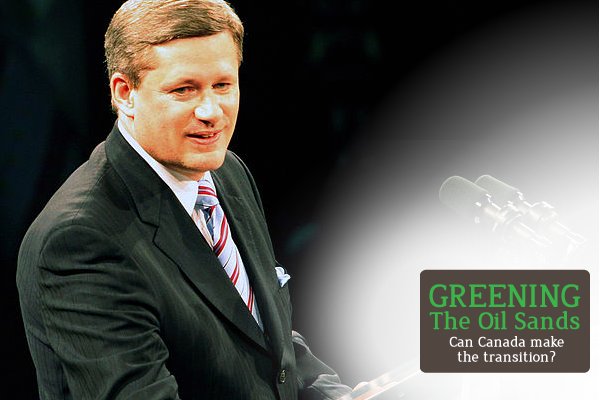
On Sept. 11, 2009, Stephen Harper's then-environment minister Jim Prentice called on his counterpart in Alberta, Rob Renner, and then-premier Ed Stelmach.
Prentice intended to pitch the province on the federal government's plan to control Canada's greenhouse gas emissions.
It wasn't going to be an easy sell. Ottawa planned to place clear limits on Canada's carbon emissions. Companies unable to meet those limits would need to buy credits from companies that exceeded their requirements. This would almost certainly impact the bottom-line of Alberta's bitumen and coal sectors, two of Canada's largest sources of industrial carbon emissions.
But Prentice's bureaucrats had prepared him with an answering argument: "We believe that a carefully designed cap-and-trade system will send the appropriate price signals to encourage changes and ultimately help reduce emissions," his briefing notes read.
There is no public record of what was discussed between Prentice, Renner and Stelmach, but two months later Prentice seemed frustrated during a conversation with U.S. ambassador David Jacobson.
According to a leaked diplomatic report on their meeting, Prentice lamented a growing international backlash against Alberta's "dirty oil," and complained that the province was dragging its feet on a solution. "If industry did not take voluntary measures, and if the provincial government did not set more stringent regulations," the leaked meeting notes reported, Prentice had threatened to "step in and press federal environmental legislation."
How serious Prentice was is debatable. By the time he abruptly resigned from politics a year later, oil sands' carbon emissions had grown by six megatons -- equivalent to putting more than one million new passenger vehicles on the road.
In May 2011 Prentice's replacement, one-time news anchor Peter Kent, announced that a national cap-and-trade system was "off the table."
Policymakers have struggled to find a viable alternative. The results show:
Canada now risks achieving barely a quarter of the carbon reductions it agreed to after the 2009 Copenhagen climate talks.
And Alberta's oil sands continue to be perceived as among the planet's great climate violators.
Yet if the Harper government once stood to influence Alberta positively on global warming policy, the opposite may be true today.
That somewhat counter-intuitive insight has emerged after months of research, as one expert source after another told the Tyee Solutions Society that the feds might usefully learn a thing or two from their Alberta counterparts, and even from the producers of "dirty" oil themselves.
Five plans, five misses
Canada's Conservative government has published five separate climate change plans since coming to power in 2006. Its federal Environment Commissioner Scott Vaughan's job to pore through each one with an auditor's eye.
"I have a legal mandate to report on Canada's climate progress," he told the Tyee Solutions Society.
Vaughan deals with hard numbers: Precisely how much greenhouse gas reduction will the government's plan achieve? And how close does that get Canada to meeting our declared climate goals?
A report Vaughan released this May revealed a moving target. The Harper government's first climate change plan in 2007 expected Canada's carbon footprint to shrink by 282 megatons between 2008 and 2012. Its latest plan, released in 2011, put that figure at 27 megatons for the same period.
What explains the 90 per cent drop in ambition?
In retrospect, 2007 was an exceptional year in Canadian climate policy circles. Public opinion polls ranked the environment as a number one priority for Canadians. British Columbia announced plans for North America's first economy-wide carbon tax. And Alberta took the groundbreaking step of charging major polluters for their emissions.
That year also saw the release of the Harper government's first official strategy to fight climate change.
The previous Liberal government had ratified the Kyoto Protocol along with 140 other nations. It committed Canada to reduce its carbon emissions by six per cent below their 1990 levels by 2012. It now fell to Harper, who once referred to Kyoto as a "socialist scheme," to keep that commitment.
Initially, the new prime minister appeared to shoulder the task. Speaking in advance of the 2007 G-8 Summit in Germany, Harper declared climate change to be "perhaps the biggest threat to confront the future of humanity today."
"Canada may be a small contributor to global warming," he added. "But we owe it to future generations to do whatever we can to address this world problem."
Tip-toeing into cap and trade
The heart of the Conservative climate strategy was an embryonic system of cap and trade. It put a modest market price ($15 per ton) on carbon emissions, the first step that business people, greens and climate policy experts have all called crucial to a low-carbon transition.
What Harper himself lauded at the time as a "practical, affordable and achievable" climate strategy, would force every major industrial facility in the country to reduce its carbon intensity (the ratio of emissions to production) by a certain amount each year, a target that varied for each operation.
Do-gooder companies that exceeded their targets would be given credits, which they could sell to laggard companies that hadn't. Those laggards had the further options of purchasing carbon offsets, or paying $15 for each ton of carbon emitted over their target. That public revenue would go into a clean energy technology fund, and the $15 per ton price would rise along with Canada's GDP.
In short, it was a system much like the one Alberta actually implemented that year (minus the rising carbon price). Critics called the federal plan "feeble" and full of "loopholes."
The federal environment commissioner was forced to agree. Even fully operational alongside other programs in Harper's climate strategy, Vaughan concluded that the nascent cap-and-trade system, "would not be sufficient to meet the government's Kyoto Protocol obligations."
Yet the plan would have brought Canada a step closer to accounting for greenhouse gas emissions as a valuable commodity -- a treatment that oil sands majors Cenovus and Suncor support alongside most Canadian environmental groups.
A quiet death
By 2009 the federal climate strategy, its "Regulatory Framework for Industrial Greenhouse Gas Emissions," as it was known, had survived two major revisions. Advisors estimated it would achieve 85 per cent of the government's short-term carbon reduction goal.
Then in 2010, the framework simply expired.
The circumstances of its demise are hazy. In June of 2009, the U.S. House of Representatives passed historic climate legislation that committed America to a national system of cap and trade. Most observers expected the Senate to do the same.
Harper faced a dilemma. His government could soldier on with the nascent cap-and-trade system it had spent the past three years fine-tuning to be the heart of its climate strategy.
Or it could kill that system and wait to see what the Americans would do.
It was in that moment of policy limbo that Prentice travelled to Calgary to pitch Alberta on some form of cap-and-trade (whether the Harper government's own, or the more fully -ledged U.S. plan is unclear), coming away empty-handed.
Making less of more
Four months later, in January 2010, Prentice was back in Canada's oil capital, this time to announce a new carbon reduction target for Canada.
Negotiated a month earlier at international climate talks in Copenhagen, it was the same target the U.S. had officially adopted two days earlier: a cut of 17 per cent below 2005 emission levels, accomplished by 2020.
Presented as progress, the new goal was actually a decisive step back from the country's Kyoto commitments.
Those demanded that Canada's emissions fall 6 per cent below 1990 levels beginning in 2012. The new goal meant they would still be 2.5 per cent higher than 1990 levels by as late as 2020.
Shortly afterward the government quietly deleted the "Regulatory Framework," a program Harper had once said, "positions Canada as a leader in fighting climate change," from its fourth global warming plan.
The feds cited "a decision to align Government of Canada actions to address climate change with those of the United States." But within months those actions would too be abandoned.
That July, the U.S. Senate's push for cap and trade collapsed in the face of partisan opposition. A surge of Republican victories in November's mid-term elections ensured it wouldn't soon be resurrected. Two days later, Prentice resigned from politics.
His replacement, Environment Minister Peter Kent, told reporters that any plans for cap-and-trade in Canada were "off the table."
Absent the scuttled "Regulatory Framework" however, little appeared to be left on the table. Surviving climate programs -- for instance, new efficiency standards for cars and light trucks -- were expected to slash only 27 megatons of carbon by 2012.
That was only one-tenth of the cuts that had been promised five years before.
By late 2011 Vaughan determined that Canada's original Kyoto target would not be met under any scenario. He was doubtful Canada even had a fighting chance of achieving its more lenient Copenhagen goals.
"The (Regulatory Framework) was the heart of the government's greenhouse gas emissions program," Vaughan told Tyee Solutions. "If you cut out the heart of your program, you shouldn't be surprised that the results are mediocre."
Still too little traction
Few observers of Canada's climate progress were shocked, then, when Kent announced his government's decision to pull out of Kyoto last December. (Canada was so far behind its targets that it would have needed to buy $14 billion worth of carbon offsets to comply). Yet the international response was furious.
France's foreign ministry called the withdrawal "bad news for the fight against climate change." The tiny Pacific nation of Tuvalu deemed it "an act of sabotage on our future."
Unrepentant, Kent predicted that other countries would soon follow Canada to the exit. "It's really only the Europeans who are staying with Kyoto," he said.
Though Japan and Russia were also set to miss their Kyoto targets, the Harper government's defiant withdrawal from the convention played into impressions that Canada, influenced by its bitumen industry, was holding back global climate progress.
The policy decision became a major international news story, with many observers reaching the same conclusion as BBC correspondent Richard Black. "In broad terms," Black wrote, "extensive tar sands development would not be compatible with continued adherence to the Kyoto Protocol."
In more than six months since setting off that outcry, the federal government has done little to douse it. Its current climate plan is to develop individual performance standards for each of Canada's industrial sectors.
Performance standards compelling emissions reductions in coal and electricity production are largely complete but still years away from implementation. Regulations for oil and gas operations will be unveiled in 2013.
The initiatives, Environment Canada spokesperson Céline Tremblay wrote in an email, will achieve "real environmental and economic benefits for all Canadians." But she acknowledged the criticism that every existing provincial and federal climate program combined will only get Canada one quarter of the way to its Copenhagen climate commitments.
With eight years left, as Vaughan argued in May's report, "it is unlikely that enough time is left ... to meet the 2020 target."
Follow Alberta?
Should Stephen Harper wish to prove Vaughan wrong -- or perhaps now "to do whatever we can to address this world problem," as he once promised of climate change -- his government could do worse than to follow Alberta's lead.
In 2007, the province implemented something much like what Harper had proposed the same year. Major industrial operations in Alberta had to reduce their carbon intensity by 12 per cent, and pay $15 for each ton of carbon that exceeded that target.
The approach revealed serious flaws, including a carbon price so low it may actually be impeding the low-carbon transition it purports to encourage. Yet after five years' experience with Alberta's system, many oil sands firms warmly support placing a market value on their greenhouse gas emissions.
One of the biggest oil sands players, Suncor, has even advocated for the Alberta price to be extended when it comes up for review in 2014. "Having a policy regime in place that creates a clear sense of the rules of the game and really allows us to plan longer term is very important," the company's vice-president of sustainable development, Gordon Lambert, told Tyee Solutions.
"If you're going to regulate carbon," agreed Jon Mitchell, Cenovus team leader for environment policy and strategy, "it should be done through economic measures, rather than regulation."
Mitchell, and much of the oil sands industry, would prefer the economic flexibility of a carbon price to the command-and-control standards now being developed in Ottawa.
The Canada West Foundation, a moderate pro-business think-tank, reached the same conclusion after hosting a series of workshops in Winnipeg, Saskatoon, Calgary and Vancouver last year.
"There is no question," a summary report read, "that Western Canada can prosper in a low-carbon future."
Alberta's carbon price will reduce its total greenhouse gas emissions at most by five megatons by 2020, the Pembina Institute estimates. That's a piddling amount for a province whose oil sands industry alone is expected to release 92 megatons of carbon in that year.
Taking Alberta's $15-per-tonne carbon price national, as Harper first proposed in 2007, could multiply its impact dramatically, slashing as much as 164.4 megatons from Canada's carbon footprint, and bringing the country within 13.6 megatons of meeting its 2020 Copenhagen target; a target it's now set to miss by 178 megatons.
Cheap in the long run
Extending Alberta-style carbon pricing to the rest of the country need not be expensive. Workups for the ill-fated 2007 "Framework" estimated that its economic impacts would be less than 0.5 per cent of Canada's annual GDP.
"Elements of our plan," Harper said in 2007, "could work not just for Canada, but for many countries in the world." Yet by earlier this year, his Foreign Affairs Minister John Baird claimed that an economy-wide price on carbon "would kill and hurt Canadian families."
Baird's view was strikingly at odds with his party's own natural constituency among business. And even with previous statements by Prime Minister Harper.
If attendees at the Canada West Foundation's workshops are to be believed, a who's who of Canadian capitalism that includes the Canadian Association of Petroleum Producers, Rio Tinto Alcan Ltd., Shell Canada and the Canadian Energy Pipeline Association, alongside clean energy startups, crown corporations, provincial bureaucrats and academics, is eager to adopt Baird's "family-killing" carbon price. The sooner, they say, the better.
From Canada West's Calgary offices, report author Shawna Stirrett told Tyee Solutions that the consensus the roundtables revealed didn't surprise her. "The reality is that industry does support carbon pricing," she said. Roundtable participants apparently agreed on something else as well: "The missing component everyone identified, was the political will to make it happen," Stirrett added.
This is the last article in an eight-part series "Greening the Oil Sands: Can Canada Make the Transition?" Find the entire series collected under a single URL (feel free to tweet, email and Facebook!) here. ![[Tyee]](/design-article.thetyee.ca/ui/img/yellowblob.png)
Read more: Energy, Environment









Tyee Commenting Guidelines
Comments that violate guidelines risk being deleted, and violations may result in a temporary or permanent user ban. Maintain the spirit of good conversation to stay in the discussion.
*Please note The Tyee is not a forum for spreading misinformation about COVID-19, denying its existence or minimizing its risk to public health.
Do:
Do not: