News

A Tyee Series

On Ocean Acidification, Are You a Banker or a Gambler?

Asking commercial fisherman to weigh the threat of increasingly acidic seas.

By Jennifer Langston, 10 Aug 2011, TheTyee.ca

Dock on the water

Related

[Editor's note: The Tyee is pleased to bring you this occasional series of articles, "Northwest Ocean Acidification: The Other Cost of Carbon Pollution," produced by the Sightline Institute.]

Not every commercial fisherman is convinced that curbing carbon emissions is necessary to stop global warming. But the evidence that fossil fuel pollution is making the oceans more corrosive -- and removing basic building blocks of the marine world -- starts to get their attention.

In Alaska, commercial fishing supports one-sixth of the state's economy and employs 70,000 people in high season, more than any other basic industry. Mark Vinsel, the executive director of United Fishermen of Alaska, the state's largest commercial fishing organization, last year ranked his concerns about ocean acidification this way: "I'd say probably on a scale of one to 10, it would be 20 or 30."

If you sliced open the bellies of our most popular eating fish, at one point in their life cycle you would probably find krill, plankton, oceanic snails or other shelled creatures -- the kinds of species likely to run into trouble as the oceans absorb more carbon dioxide from burning fossil fuels and other industrial processes.

As those carbon emissions rise, seawater becomes more acidic and sea life has more trouble finding calcium carbonate, a material that many creatures need to construct shells or skeletons, and, ultimately, to survive.

So if creatures at the bedrock layer of the marine food chain start to struggle in more corrosive seas, how might that affect an industry that provides nearly one-sixth of the world's animal protein, not to mention $3.9 billion in personal income in Washington (roughly two per cent of net earnings in the state) and more than $400 million in personal income in Oregon (one-half per cent of net earnings)?

Here's how Jeremy Brown, a Bellingham-based commercial fisherman who has spent nearly three decades fishing for salmon, halibut, black cod and albacore tuna, sees it: "I guess you could call it a second-order threat, but it's still pretty immediate. I think this really is probably the most fundamental challenge we've got. There's all this handwringing about the health of the oceans and people say, 'Well, we've just got to manage fisheries better and maybe create some marine protected areas and everything will be fine in the garden.' And that's really not [the case]... We've really got to figure out how to burn a lot less fossil fuel and shift away from carbon-based policies."

Some might argue that oceans are resilient places, that nature abhors a vacuum, and that other kinds of algae or grasses that thrive in more acidic seas could replace losses at the bottom of the food web. In truth, we do'’t yet know how complicated marine ecosystems will adapt to ocean acidification. The effects could range from minor to apocalyptic.

In that sense, you get to choose how scared you want to be, says Brad Warren, who directs the Sustainable Fisheries Partnership's ocean acidification program. But the most knowledgeable scientists tend to eschew the more optimistic view, he said. And a smart businessperson pays attention to signs of trouble, tries not to get caught behind the curve, and needs to rethink old strategies when they're no longer working. In other words, says Warren: "If you think of someone who has a fiduciary duty for the systems that feed us and provide jobs to half a billion people in the world -- from subsistence hunting to those making a lot of money -- one can view that with a gambler's instinct or with a stewardship instinct. What would you rather be -- a banker or a gambler -- with this resource?"

'Different might be OK'

An ocean rich in calcium carbonate is like a nutritious miso soup, providing essential ingredients that everything from plankton, corals, mussels, oysters, crabs, scallops, lobsters, sea urchins and abalone need at some stage in their life cycle. As waters become more acidic, and calcium carbonate becomes less available, some of these species have trouble building shells, don't grow as fast, or become stunted. As pH drops even lower, those protective coatings or internal structures can begin to dissolve.

"The thing that people really don't appreciate is how many organisms have these calcium carbonate mineral phases," said Burke Hales, an Oregon State University oceanographer.

Half the annual catch in the U.S. comes from mollusks and crustaceans, many of which use calcium carbonate. Another 24 per cent are the animals that directly feed upon those "calcifiers."

Not all calcifying species will be affected by ocean acidification in the same way, and exposure to low pH waters varies by location, time of year, and even time of day. But because the Pacific Coast and Puget Sound are hot spots for corrosive waters, the threat to the Northwest economy (which in this series includes coastal waters stretching from Oregon to Alaska) is significant enough that researchers are working to see how local species will respond.

Laboratory studies conducted so far indicate that some of the direct and indirect effects of increasingly acidic oceans include:

Plankton: Some forms of plankton that other animals rely on for food struggle or die under low pH conditions. Pteropods -- tiny winged sea snails comprise up to 60 per cent of the diet of some juvenile salmon -- have dissolved in low pH water. Embryos of Antarctic krill--which makes up a huge percentage of the diet of the southern oceans -- have failed to hatch in highly acidic waters.

Structure: Species that provide key underwater habitat for other creatures are vulnerable to ocean acidification. Coral reefs, which support a huge amount of biodiversity, are among the least tolerant of low pH waters. If oyster populations crash, eventually oyster beds that help support everything from sea anemones to sportfish will suffer.

Other chemical and nutrient changes: Ocean acidification may affect the availability of other nutrients and trace metals, altering the composition of microscopic plant communities that other creatures eat.

Shellfish: Among commercially valuable species, mollusks appear to be at highest risk. Northwest oyster hatcheries have had massive die-offs in recent years. Mussels, clams and scallops exposed to carbon-dioxide-rich water have had trouble building shells or have grown more slowly. Sea urchins become deformed and stop reproducing. Abalone larvae have died. The picture, however, may be different for crustaceans, some of which have actually grown thicker shells in low-pH waters.

Finfish: Direct effects on finfish are not clear (though clownfish have lost their sense of smell and ability to detect predators in acidic waters). But they may have to expend more energy or compete for food if the species they normally eat start to struggle.

Uncertainties about how these changes will play out across an entire ecosystem make it impossible to tally all the potential losses. One narrow case study found that if oysters and mussels decline in the wild at the same rate that's been observed in the laboratory, we could expect $75 million to $187 million in annual losses in the U.S. mollusk catch.

And, as the following chart shows, not all fisheries around the world will be affected equally. Below, the red colours include mollusks most likely to be affected by acidification, yellows indicate crustaceans, greens indicate predators that may be indirectly affected by food web effects, and blues indicate species whose responses to ocean acidification are unknown.
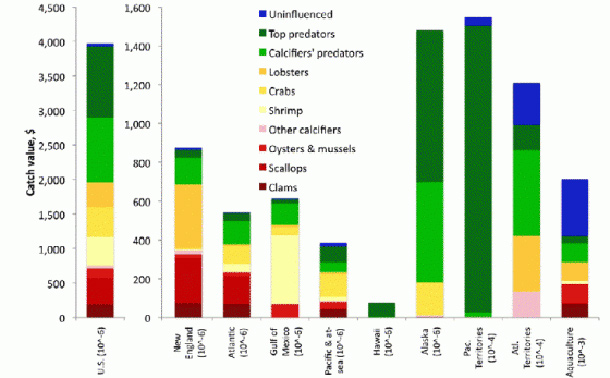
A chart of US catch values

Sarah Cooley, a Woods Hole Oceanographic Institution researcher working to put an economic value on ocean acidification's potential consequences, explains in a very readable interview with Oceanus Magazine that Alaska's fisheries (which produce 60 per cent of the seafood in the U.S. and where much of the Northwest fleet fishes) may be less vulnerable than New England fisheries that rely much more heavily on mollusks.

But the Alaskan catch could also decline, she said, because fish like haddock, halibut, herring, flounder and cod eat mollusks themselves. And that could affect top predators like swordfish, tuna, shark and salmon.

Her research suggests that the fishing industry itself -- along with our eating habits -- may be in for a change. As oceans become more acidic, we may have to eat other species, shift aquaculture production to creatures that are less vulnerable, or move aquaculture operations to geographic areas that are less affected (all of which are likely to raise costs).

In sum, Cooley says: "The [natural] communities are going to be very, very different. And different might be okay -- maybe. There still is an ecosystem to be had. But a lot of the things that we really enjoy, that our communities depend on, are not going to be there. We may be able to find other awesome things about the new communities, but chances are, the options will be limited."

New carbon policies required

While it's prudent for people to be concerned about ocean acidification, it's not sufficient, said Warren of the Sustainable Fisheries Partnership. While it may take decades to moderate the effects of carbon dioxide that the oceans are absorbing today, there are things that can be done now to improve the situation: develop extensive monitoring networks, invest in ocean acidification research, get a handle on stormwater and other sources of pollution that flush nutrients into our waterways.

While the seafood industry is by no means monolithic, Warren said, it trends conservative politically. But the threats from ocean acidification are causing some in the industry to advocate for the only direct solution: reducing carbon dioxide emissions.

"We work with people who cover the full range of opinions on that stuff. There are some people who think that Al Gore and the Tooth Fairy come from the same planet, but when they get their heads around this problem, some of those guys really go through a re-think."

As The Royal Society's groundbreaking report on ocean acidification emphasizes, the only real way to prevent it from becoming more acute in the future is "decisive and significant action to cut carbon dioxide emissions." Or, as Warren puts it: "You can use taxes, carbon markets, you can implement other controls, energy efficiency, increased use of cleaner power. There are many tools, but no one, I think, can credibly argue that you can do it without some kind of carbon policy. However you design it, or whatever axiom of change you bring to it, you've got to bring the actual flow of emissions under management."

In our next article, we'll take a closer look at existing laws that could be used to address ocean acidification and what kinds of new policies will become necessary.

Story modified August 10, 9:15 a.m.  [Tyee]

16  Comments:

Login or register to post comments

  • mopled

    1 year ago

    I can't believe you are still posting this nonsense!

    How can the ocean be "corrosive" when it is still alkaline? Doesn't anybody who writes for you understand basic chemistry?

    "A fallback position of AGW proponents is that the extra carbon dioxide we add to the atmosphere will contaminate the oceans, leading to “ocean acidification”. This occurs due to the following reactions.

    CO2 (g) -> CO2 (aq) [exothermic]
    CO2 (aq) + H2O (l) -> H2CO3 (aq) [this is carbonic acid]
    H2CO3 (aq) + H2O (l) -> HCO3- (aq) + H3O+ (aq)

    This statement “ocean acidification” is itself a lie. This is because oceans are not acidic to begin with, they are alkaline (pH~8.1 depending on where you measure it). An acidic solution has a greater concentration of hydronium ions (H3O+) than hydroxide ions (OH-), while an alkaline solution is the other way around. But won’t increasing hydronium ion concentration by 30% make it acidic? No, because the pH scale is logarithmic, meaning a pH of 6 has ten times the concentration of H3O+ than one with a pH of 7. A pH of greater than 7 is alkaline, while less is acidic.

    [H3O+] = 10^-8.1 M = 7.0 X 10^-9 M (M=Molarity- a measure of concentration)
    7.0 X 10^-9 X 1.3 = 1.0 X 10^-8 M
    pH = -log10(1.0 X 10^-8)
    pH = 7.986

    So then, an increased hydronium ion concentration by 30% will still leave us with an alkaline solution, meaning ocean acidification is not correct, it is ocean reduced-alkalinity. Pity that doesn’t sound as bad.

    According to AGW theory however, the oceans will heat up, they actually haven’t but let’s suppose they’re right. As we can see by the first equation, the dissolving of carbon dioxide is exothermic, which means it releases heat, and hence is less efficient at higher temperatures. If the oceans would warm as AGW suggests, there wouldn’t be as much CO2 in the oceans, meaning the impact of ocean reduced-alkalinity is lessened. I have never seen an alarmist try to reconcile these two points."

    http://climatenonconformist.wordpress.com/2011/06/14/ocean-acidification-is-a-lie/

  • mopled

    1 year ago

    Corral evolved with CO2 10x the present level

    "The ocean currently has a pH of 8.1, which is alkaline not acid. In order to become acid, it would have to drop below 7.0. According to Wikipedia “Between 1751 and 1994 surface ocean pH is estimated to have decreased from approximately 8.179 to 8.104.” At that rate, it will take another 3,500 years for the ocean to become even slightly acid. One also has to wonder how they measured the pH of the ocean to 4 decimal places in 1751, since the idea of pH wasn’t introduced until 1909."
    Also:
    "corals became common in the oceans during the Ordovician Era – nearly 500 million years ago – when atmospheric CO2 levels were about 10X greater than they are today. (One might also note in the graph below that there was an ice age during the late Ordovician and early Silurian with CO2 levels 10X higher than current levels, and the correlation between CO2 and temperature is essentially nil throughout the Phanerozoic.)"

    http://wattsupwiththat.com/2009/01/31/ocean-acidification-and-corals/

  • Illahie

    1 year ago

    This article is a deliberate attempt to deceive

    The author has previously admitted that the oceans are basic. Yet Jennifer Langston continues to deceive us with this garbage. The planet has many real problems why does she feel the need to write about a problem that does not even exist?

  • Fish-counter

    1 year ago

    Mopled is just plain wrong.

    The ocean pH may now be 8.1. It used to be 8.21 or close to that. That small shift in pH represents an increase in the acidity of 30% because pH is a logarithmic scale, like the Richter scale for earthquakes.

    Talking about acidity vs. alkalinity, remember that the full pH scale ranges from 1.0 to 14.0 with 7.0 being neutral. A change of 11.0 to 10.9 is an increase in acidity just as a change from 3.4 to 3.3 is. If Mopled wants to be pedantic, we could say that the ocean is becoming less alkaline. It amounts to the same thing.

    There are measurable changes in marine flora and fauna in places where the pH has changed most. A shift in marine alkalinity requires gigatons of CO2. About 98% of the CO2 we produce is dissolved in the ocean and it does not stay in the atmosphere for very long.

    If the dramatic extreme weather doesn't convince you of the effects of CO2 in the atmosphere, don't worry, it will. In ten years the impacts will be unmistakable to even the most ardent AGW deniers. Meanwhile people like Mopled are free to hang on to their delusions as long as they wish.

    There are models of the marine environment based on 2 x CO2 atmosphere. There is very little salmon habitat left in the North Pacific, even at those modest levels.

    Why am I bothering to refute the two above deniers? Because it is fun to see them explode in fury.

    The idea that an overwhelming majority of scientists are wrong or in a conspiracy would be funny if it weren't so serious. Ther deniers are like the catholic popes who denied that the sun was the centre of the solar system. They need a telescope.

  • mopled

    1 year ago

    I am underwhelmed by your "overwhelming majority"

    It actually turns out that there were only 48-52 people involved in the fakery by the IPCC. Now, it turns out that dozens of marine scientists have been bought for feethy lucre by the aptly named Pew!

    Naming Names: Marine Experts Tainted by Activist Cash

    August 5, 2011

    Yesterday I blogged about how the Pew Environment Group, an activist organization, has been funding research to the tune of $1 million a year for more than 20 years. Those named as Pew Fellows each receive $150,000.

    This is no small matter. The question of whether an entire generation of scholarship has been improperly influenced by activist funding must now be asked.

    How many people with doctorates now owe part of their success to this agenda-driven organization? How many scholars, in gratitude for such funding, currently maintain ties with this activist group?

    Is it really in the public interest for the line between advocacy and science to become blurred in this manner?

    Below is the complete list of marine experts (Pew’s term) who accepted this activist cash. Take a minute to scan it. It contains an awful lot of people whom the public is likely to regard as neutral, objective experts. There’s a PhD attached to their name, after all.

    But please also note that these people are standing shoulder-to-shoulder with full-blown political activists.

    For example, one of the individuals awarded $150,000 in 2007 was Dorothy Childers. The first line of her Pew bio describes her as “an advocate for marine and coastal conservation in Alaska” (my italics). Lower down we’re told she has also been a Greenpeace employee.

    Among the recipients of $150,000 in the year 2000 was the (now deceased) Marc Reisner – whose 1986 best-selling book Cadillac Desert was turned into a PBS documentary film. His expertise also appears to be closely connected to the series of activist organizations that employed him. For example, he spent eight years as communications director for the Natural Resources Defense Council.

    Sarah Fowler landed her $150,000 in 2005. Her bio is another long list of activist outfits, including the Nature Conservancy Council, Naturebureau International, and the International Union for Conservation of Nature.

    Among those who became Pew Fellows in 1992 is a lawyer named Victor Sher who is described as “the former president of the Sierra Club Legal Defense Fund” and Jane Lubchenco – who now heads the US government’s National Oceanic and Atmospheric Administration (see more about her activist ties here).

    Here’s the complete list. You can read a bio of each person and see photos by visiting this page on the Pew website and typing any of these names into the search box."
    http://nofrakkingconsensus.com/2011/08/05/naming-names-marine-experts-tainted-by-activist-cash/

  • mopled

    1 year ago

    I think you can buy a hell of a lot of consensus

    For $150,000 a pop!

    "the large group of people who contributed to the IPCC report were never asked whether they believe humans are responsible for climate change. Nor were they asked what portion of the overall change should be assigned to human activity and what portion should be assigned to natural causes. It just didn't happen.

    Rather, the conclusion that humans cause climate change was decided in one chaper out of a total of 44 in the IPCC report. Only the folks who worked on chapter nine of the Working Group 1 report got a voice.

    According to John McLean, who has crunched the numbers:

    Chapter 9...had 53 authors in total but more than 40 were part of a network of people who worked previously together. In direct contradiction to the IPCC's statements that the team of authors should have a wide range of views and experiences, most were climate modellers and there were many instances where several authors were associated with the same establishment...

    The second draft of chapter 9...received comments from 55 people and 7 governments. Of these 62 only 5 reviewers explicitly endorsed the overall chapter...

    Fifty-three authors and five reviewers are all that can be said to explicitly support the claim of a significant human influence on climate. [bold added] (p. 2)"

    http://climatechangedispatch.com/green-affected/7131-how-many-ipcc-scientists-say-so

  • mopled

    1 year ago

    Keep counting fish, baby

    because your ability to understand what you read can be called "selective dyslexia", and would be a severe handicap in a laboratory.

    As you said,7 is neutral on the pH scale and 8.2 down to 8.1 is still ALKALINE!

    Even worse is that the very dicey idea of average pH of all the oceans is nutzoid!
    pH varies with season, day/night, and how close to shore the samples have been taken.

    If there are less fish, there are far more relevant things to point to....like overfishing!

  • OwlRol

    1 year ago

    Ocean chemistry language problem

    Mopled, climate change is a fact if you pay attention. Human induced is most likely given the rapid timeframe.

    Your chemistry lesson on ocean acidification was informative. Perhaps the wording of acidification needs a change. Oceans will remain basic/alkaline for a long time, but the PH is dropping, likely to the detriment of ocean ecosystems. How much and how fast is still uncertain, but is the real problem, among many other, ocean, human induced problems.

    I attend to warnings but keep a sceptical view until I see more peer reviewed agreement or disagreement on an issue and its sub topics. I don't jump on the first alarm, nor do I criticize the warnings prematurely.

    There is some very interesting research on this topic, especially around the Seattle area, but I would like to see more research on similar geographic and oceanographic regions around the globe, notably temperate and sub tropical west coast regions like Chile, western Europe and to a lesser extent, South Africa and western Australia. I also would like to see more peer reviewed laboratory results.

    This is relatively new research overall and more data is required. Warnings are well warranted to draw attention to the issue, but to jump full bore onto one side or the other is truly irresponsible until more data is available.

    This is a problem of both professional and home made journalists. Got to make those oysters sexier, or no one pays attention. Got to make climate change, a topic with a much longer research record, controversial, especially in favour of the fossil fuel industry interests, or we might have to change our lifestyles and economic systems.

    You are good at citing the proponents' connections. Perhaps you should spend as much effort, although its already been done by others, on the antagonists' connections.

    As to the Pew institute, perhaps you need to examine their underlying motives before citing their efforts to appear green by funding a number of more malleable NGOs who are trying to work with industry to find solutions.

    As presented, your viewpoint is worth noting, but only "fair and balanced" in the Fox news sense. It results in a polarized outlook that will never get to the actual truth somewhere between the two extremes.

  • mopled

    1 year ago

    Yes, the CLIMATE CHANGES

    No, we're not changing it....we can't!

    The last thing I'd deny is that the
    CLIMATE BLEEDING CHANGES

    Fox News? You are trying a second hand smear...I can't even get
    Fox Frigging News!

    The Pew's underlying motives are whatever the Rockefeller Brothers Fund dictates.
    The same RBFund that finances the stupidity of 350.Org.

    The Australian government wants to put in a "Carbon Tax" that may change the temperature by -.000009 degrees in 30 years.

    I kid you not!

    It's not the "fossil fuel" interests that I'm fighting this Bad Science for...it's our rights not to be scammed by my government.

    Didn't you notice that schools and hospitals are going to have to buy "carbon offsets" next year.....and who gets to sell them?

    "BC's Strange Business of Carbon Offsets

    Hospitals and schools must pay the Pacific Carbon Trust, but what are they really buying?"

    http://thetyee.ca/Opinion/2011/07/22/StrangeOffsets/

    Wake up!

  • Illahie

    1 year ago

    The funny thing is

    The funny thing is that the oceans are by far the worlds largest storehouses of carbon. The carbon stored in the atmosphere is miniscule. The plant and animal life on land makes up a bit, but carbon stored in the ocean makes up almost all of the worlds carbon.

    The scaremonging acidifiers seem incapable of understanding role of Calcium Carbonate for instance. The next time you see a picture of the great barrier reef, or limestone sediments, think of carbon.

  • mopled

    1 year ago

    The latest on Carbon Offsets as subsidy to Big Business

    Public sector's carbon offsets subsidize B.C.'s big businesses

    Critics would like to see $18.2 million reinvested in own projects

    By Larry Pynn, Vancouver Sun July 8, 2011Public institutions such as schools and hospitals spent $18.2 million last year buying carbon offsets to compensate for greenhouse gas emissions -money that subsidized energy-efficiency programs of big industry rather than being reinvested in energy projects within the public sector.

    Among the private corporations that benefited from such offset expenditures: Lafarge cement; forest companies Canfor, Interfor and TimberWest; natural gas company Encana; and Kruger Products, a manufacturer of toilet paper and related products. They earned the right to sell offsets to the public sector based on energy-saving initiatives.

    The $18.2-million expenditure is the result of a provincial policy requiring public sector facilities to be carbon neutral starting in 2010. The program is designed to encourage energy-efficiency initiatives, forcing institutions to buy carbon offsets for their emissions through the Pacific Carbon Trust, a Crown corporation.

    B.C.'s public sector produced 814,149 tonnes of emissions in 2010, 84,367 of which were exempt from offsetting, including emissions from schools and transit buses.

    While public institutions say they support steps to improve energy efficiency, they assert that their money should be pumped back into their own facilities.

    Lee Gavel, chief facilities officer for Simon Fraser University, said the $444,452 SFU spent on carbon offsets last year could have been used for research on fuel-efficient technologies or capital projects to reduce carbon emissions.
    continues:
    http://www.vancouversun.com/health/Public+sector+carbon+offsets+subsidize+businesses/5070414/story.html

  • Okanagan Orchardist

    1 year ago

    You are right, Fish-Counter....

    Mop-Led damn near jumped out of his skin.
    Quite funny, really.
    :))

  • mopled

    1 year ago

    It was meant to be funny

    Because there is no amount of fact that will budge a religious mindset. But it is fun trying to get the true believers to at least question their brainwashed opinions.

    You do understand that there is no evidence left to support the AGW hypothesis, and plenty against, starting with the fact that it has been cooling since 2002.

    That means there is no longer even a correlation between CO2 and temperature. CO2UP...Temperature DOWN.

    There is NO CAUSATION WITHOUT CORRELATION.

    It was all the product of computer modeling...garbage in/garbage out!
    http://www.forbes.com/sites/larrybell/2011/08/09/climate-forecasting-models-arent-pretty-and-they-arent-smart/2/

  • G West

    1 year ago

    Truer words have not been spoken

    ....there is no amount of fact that will budge a religious mindset.

    The funny thing is that the words were written by a fundamentalist true believer; it is consoling to know that, centuries after the fact, there are still those who believe the earth is flat.

  • Okanagan Orchardist

    1 year ago

    There is only one thing you have to believe...

    It really doesn't really matter whether you believe that our earth is getting warmer or not. In the end, what really matters is the unmistakable fact that mankind is abusing the earth in a thousand different ways, and that this is something we can all do something about. From our seas, from our earth, from our skies, each of us should take the responsibility to keep them from abuse and free from pollution. There is no doubt that this is NOT happening. And although we can put the blame for this on certain individuals, on certain corporations, ultimately the blame lies on the heads of our government and the people and corporations that support it.

    I'm holidaying here in the Oak Bay area of Victoria for a few days with friends. If you are familiar with this area, it is comparable with West Van and other areas of the world where the affluence of those that have is put on display for everyone to see. It is tragic! These are the kind of people that don't care if there is global warming or not. They also don't care if you can dispute AGW or not. Their minds, bodies, and souls are bent on one thing --- to achieve as much wealth as possible. It doesn't matter whether nature is hurt in the process. It doesn't matter to them that by accumulating wealth, they are destroying the lives of people who don't have the capacity to fight back.

    As some of you I'm sure, hope, as I do, that their day will come.

  • mopled

    1 year ago

    Yes it matters whether the world is warming or cooling

    All this nonsense has been predicated on the Earth being warmed by a few more parts per million of a beneficial trace gas that we nasty humans have so unthinkingly generated in order to get places and to keep warm. That tiny bit extra has helped plants grow, but never mind. Now that it's cooling....none of it matters, I suppose.

    The incredible stupidity,refusal to examine evidence and constant chanting of the "man is evil and destructive" mantra eventually gets boring and turns most people off.

    In the meantime more evidence keeps piling up
    that climate change happens because of forces beyond human control.
    http://www.corbettreport.com/episode-177-its-the-sun-stupid/

    Even more evidence has been revealed which shows how phony the AGW case is. Here's a flaming example of the scullduggery which has gone on:

    "Global Warming Link to Drowned Polar Bears Melts Under Searing Fed Probe: 'Gleason concedes that study had major impact on controversial listing of bears' under ESA

    A Window on Climate Peer Review: 'The reviewers for polar bear article were Lisa Rotterman and Andrew Derocher'

    Spouse Review! 'Incredibly, it turns out Ms. Rotterman is his wife – yes, some people are more peers than others – and Derocher was awarded a large research contract by Monnett just before he reviewed the article. Wow'

    Sen. Inhofe Has Questions About Polar Bear Researcher Charles Monnett

    'Investigators seem to believe that Monnett helped direct $1 million for the new polar bear study to U. of Alberta scientist Andrew Derocher because he had been one of the reviewers'

    'One of hypotheses they're investigating is that Charles Monnett has directed $1 million to Andrew Derocher as payment for a positive review of Monnett's paper that Derocher wrote'
    http://news.sciencemag.org/scienceinsider/2011/08/senator-inhofe-has-questions-abo.html
    Polar Bear scandal update: 'Derocher's review of Monnett's junk paper could have been easily bought for $1 million of the U.S. taxpayers' money'
    http://motls.blogspot.com/2011/08/monnett-may-have-sent-1m-to-derocher.html

    As usual G.West has nothing real to say, just a lame attempt to smear the messenger
    with an inappropriate label which might better be applied to himself.

    • No best comments selected by an editor for this story yet. To see all comments, click the All Comments tab, above.
    • The discussion for this story is closed. No more comments can be added.