News

To Push Prisons, Harper Buried Own Government's Findings

Facts on crime and jail terms didn't fit vote getting strategy, so PM ignored them. Excerpted from Lawrence Martin's 'Harperland.'

By Lawrence Martin, 29 Apr 2011, TheTyee.ca

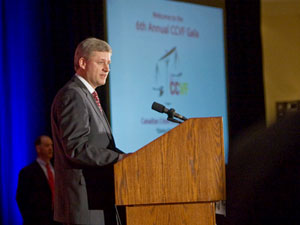
Harper giving a speech on criminal justice

Prime Minister Harper lays out his government's changes to criminal justice system in 2008.

Related

Under Prime Minister Stephen Harper, Canada's justice department, which had about 200 researchers in its policy branch, produced sophisticated studies that, as per the normal run of things in any department, were supposed to be used to inform policy decisions.

But a funny thing happened at justice. The researchers might just as well have gone on holiday.

The work they did went directly to nowhere because it either didn't conform with or directly contradicted the biases of the governing party. "We still produced a lot of stuff," said a former employee. "It just never saw the light of day." When a government starts suppressing its own research time and time again -- research the public is paying for -- it's serious business, he said. Some senior players in the department were bitter and frustrated, but they didn't dare raise their voices. They had their careers to look after, so they tolerated the censorship.

The Conservatives wanted to make up for many years of what they considered soft-on-crime legislation by their Liberal predecessors. New sheriffs were in town. Their crackdown measures included mandatory minimum sentences for a wide range of offences, a broadly expanded jail system, the closure of the prison farm system, the limiting of parole opportunities, and any number of other bills that set harsher punishments and sent young people to the slammer for minor offences. In its first four years, the government created or beefed up 19 minimums.

Rob Nicholson's justice department was the most ideologically driven in memory. The Conservatives planned to expand budgets for prisons by 27 per cent over three years. More space would be needed for all the incarcerations resulting from their new policies. Increased spending at justice continued even when almost all other departments were being hit with cutbacks.

Canadians could be forgiven for assuming that statistics and studies would be introduced to support the new draconian turn. But for much of this legislation, the stats and studies came primarily from outside the department and often contradicted the bills. Among the numerous studies was one by the Criminological Digest. Based on research covering 40 years, it showed that mandatory minimum sentences do not have a deterrent effect. Many state legislatures in the U.S. were trying to unwind such sentencing, as were the parliaments in Britain and New Zealand. The American experience indicated that increased jailing was hardly the advisable approach. Incarceration rates south of the border had risen 700 per cent over four decades, and there was no corresponding drop in crime. The state governments were moving away from the lock-them-up-and-leave-them strategy in a bid to reduce prison populations and soaring costs.

'Raw wedge politics'

A 235-page analysis of Harper's corrections policy by Michael Jackson, a law professor, and Graham Stewart, the retired head of the John Howard Society, said that pandering to people's baser instincts was overtaking decades of empirical evidence. "Raw wedge politics -- in place of studied evidence -- is the new face of public policy for Canada," wrote the authors. The government "creates the notion that the decent treatment of prisoners is somehow putting the public at risk when in fact it's the compete reverse."

Harper appeared to have little interest in hearing what the specialists had to say. In a speech in 2008, he rejected research-based justice policies, saying those behind them were trying to "pacify Canadians with statistics... Your personal experiences and impressions are wrong, they say; crime is really not a problem. These apologists remind me of the scene from the Wizard of Oz when the Wizard says, 'Pay no attention to the men behind the curtain.'"

Harper, said his friend John Weissenberger, viewed law and order as a matter of principle. "He feels that if you commit a crime the punishment should fit the crime. It's traditional conservatism in that it's the same type of idea he was raised with. It's closer to the average guy's view of law and order."

The Conservatives held to a dim view of criminologists. "In the case of crime," Ian Brodie said, trying to explain the Tory approach, "Canada had a very small community of criminologists propagating a policy perspective that didn't relate to the facts, and a bunch of people in government and the NGO community who got caught up in the thing for their own reasons." Brodie recalled a moment, shortly after their new government took over in 2006, when he, Rob Nicholson, Mark Cameron, Vic Toews and Stockwell Day were surveying the situation and asking, "Hey, do the facts matter here?"

Toews, he said, then spent years arguing with Statistics Canada that "the crime stats they collect massively understate crime in a known, systematic way." StatsCan reported on aggregate crime as reported to the police. "The problem," said Brodie, "as anyone who gives it a split second of thought realizes, is that not all crime gets reported to the police." Brodie made these remarks shortly before Harper made a highly controversial decision to scrap the mandatory long-census form, prompting the resignation of the head of Statistics Canada, Munir Sheikh.

Bashing the 'hug a thug crowd'

Right-wing commentators expressed outrage over reporting on crime by media that used only modern-day StatsCan numbers. Statistics from the agency said crime went down three per cent in 2009 compared to 2008, and 17 per cent compared to a decade ago. Critics, mainly on the left, used these numbers to try to undermine the Harper argument for a new get-tough approach.

The problem with the media, argued the Toronto Sun's Lorrie Goldstein, is that they use the wrong base date. If they went back to 1962 they would find that the crime rate was 131 per cent higher in 2009 than that year, he said. As for violent crime, it was 321 per cent higher than in 1962. Of the more recent dip, Goldstein wrote: "The knee-jerk argument from the hug-a-thug crowd that a slightly lower crime rate automatically means we don't need as many police or prisons is akin to arguing a lower mortality rate automatically means we don't need as many doctors or hospitals."

In keeping with their preference for wedge politics, the Conservatives attempted to label opponents of their philosophy "soft on crime." It was one of Justice Minister Rob Nicholson's favourite phrases. What struck Don Davies, the NDP justice critic, was that the government was ignoring the evidence from south of the border.

"If getting tough on prisons -- locking people up longer and more harshly -- resulted in a safer society," he pointed out, "the United States would probably be the safest country on earth."

Votes vs. findings

John Geddes of Maclean's was among those who tried to get data from Nicholson to support the government's contention that sentencing in Canada was too light. But the department couldn't furnish such data. Nicholson, Geddes concluded, was using impressions more than facts to justify minimum sentencing. "Nicholson's office and his departmental officials," he wrote, "admit they have not compiled statistics on typical sentences in convictions for most of the crimes they have targeted."

Critics of the crackdown extended from Margaret Atwood on the left to Conrad Black on the right. In 2010, Black, who was serving a prison term in Florida, said of the government's blueprint, "A Roadmap to Strengthening Public Safety," that "it is painful for me to write that this garrotte of a blueprint from the government I generally support is flirting with moral and political catastrophe."

As if trying to paint themselves as philistines, Nicholson and Peter Van Loan took to ridiculing those who opposed their policies for being, in Van Loan's words, "university types." Those with academic credentials did not appear to be high on his list of preferred people. The Conservatives, Brodie included, were persuaded, in fact, that criticism from society's most erudite members on their tough-on-crime package was a benefit to them.

The motivation for the Tories' approach was simple enough -- being tough on crime attracted votes. Post 9/11, Canadians had become more conservative on law-and-order issues, according to studies the government was prepared to believe. Because of this, the Liberals were prepared to support the Tories on many of the measures.

But Nicholson kept beating them with that hammer anyway. His constant refrain was that the opposition was trying to obstruct the Tory agenda -- if not in the House, then in the Senate. Senator James Cowan produced a chapter-and-verse account of the progress of the government's legislation that hung Nicholson out to dry. "Of the 21 law-and-order bills introduced by this government," concluded Cowan, "18 died on the Order Paper because Stephen Harper decided to prorogue Parliament [in 2009]."

Targeting Vancouver's InSite clinic

Nicholson appeared unfazed by criticisms that he was living in the Stone Age, even though he had once rejected the very approach he was now taking. As an MP in the Mulroney government in 1988, he vice-chaired a parliamentary committee that released a report opposing the use of mandatory minimum sentences except in the case of violent sexual offenders. In formulating its conclusions, the committee drew on the American experience.

The government's hard-headed approach was also seen in respect to Guantánamo and the gun registry. As for drug policy, the Tory attitude was reflected in the government's determination to shut down InSite, a safe-injection centre in Vancouver. Numerous peer-reviewed studies concluded that the supervised facility reduced drug overdoses and the spread of HIV/AIDS while increasing the number of users who sought treatment. B.C. courts ruled that the centre should remain open. But in keeping with their low regard for empirical data, the Conservatives launched legal challenges to lock its doors.

Before the Conservatives came to power, expertise played a greater role in policy formation. More scholarship came from within the federal bureaucracy. More input, though not a great deal, came from the rank and file of the party in power.

The Conservative Party under Harper, however, saw policy-producing activities reduced almost to the point of non-existence.

Policies in 'total control of PMO'

Harper occasionally sounded out the party on policy, as he did at a 2008 Winnipeg convention where some token resolutions were passed. But basically the rank-and-file members bought in to the idea that they were just there to raise money and fight.

Much had changed since 1993, when the Reform Party elected 52 MPs. By 2009, 42 of those early missionaries were gone. Thus there was little pressure on Harper from the early idealists. If any of those who were still around tried to flex their muscle, they were muzzled. Lee Morrison, an original Reformer and one of Ottawa's most compelling characters, bowed out prior to the 2008 election. He saw what was happening and didn't like it. "The concepts of popular control of the party from the grassroots, open government, MPs representing their constituents, and fiscal responsibility were replaced early on with total control from the PMO."

'Harperland' author Lawrence Martin

Lawrence Martin, author of 'Harperland.'

Stephen Harper, said Morrison, "will be remembered as an opportunistic, masterful tactician who in the course of only three years purged the Conservative Party of its Reform ideals."

As Harper's grip tightened, any grumbling was met with the argument that extreme discipline was the only way to go, given the perils of a minority. Grassroots democracy was a pipe dream. Many of the newly elected Conservative MPs -- the 75 or so who arrived with the 2004 election -- were young and easily won over by the Harper way. His style of governance was the only one they knew, and they were inclined to march in formation.

This article is excerpted with permission from Harperland: The Politics of Control by Lawrence Martin, published by Viking Canada. Read a previous excerpt from the book in The Tyee here.  [Tyee]

29  Comments:

Login or register to post comments

  • Frank

    1 year ago

    Good article by Lawrence Martin on iPolitics

    "Can we still call this a parliamentary democracy? Or is it something more akin to a democracy of one?

    More and more, Stephen Harper’s critics are asking the question. There is a widespread view among political scientists and constitutional scholars that the prime minister, with his l’etat c’est moi methods, has brought Canadian democracy to new lows."

    http://ipolitics.ca/2011/04/27/democracy-harper-style/?utm_source=Paid+Evening+Brief&utm_campaign=bf6efb8b4c-Morning_Brief11_23_2010&utm_medium=email

  • G West

    1 year ago

    Frank

    Did you notice that Andrew Coyne is voting LIBERAL because he's concerned about what Harper has done to democratic institutions and practices?

  • KD Brown

    1 year ago

    Harper and Parliament

    Related note: the ruling by the Speaker of the House that the Conservative government was in contempt of parliament has faded to the background.

    For me it is the centre of the debate.

    We live in a parliamentary democracy. OUR representatives that we have chosen by a free vote in a fair and open election (ignoring the impact of big money on said election for a moment) sit in Parliament and debate the course of government. This is the body that has the power in Canada. The Prime Minister has but one vote in that body.

    In light of this, to be found in contempt of Parliament is to be found in contempt of the Canadian people.

    That half of the ruling was brought down as a comment on the handling of questions from Parliament by a rookie minister is one thing.

    The far graver ruling was the one that censored the Government for withholding information about the cost of the Government's programs. This is basic. We don't know how much more prisons, tax cuts for the wealthy and jets will cost. Harper won't tell us.

    It is laughable to see the Conservatives criticize the Liberals and now the NDP for recklessly promising. The Conservatives won't tell us how much they will spend. At least the other parties will.

  • mary jane

    1 year ago

    Democracy?

    Harper is anything but domocratic. I hear people comparing him and campbell to some of histories cruelest people

  • carfreecity

    1 year ago

    standard practice

    this seems to be their regular routine
    just about eveything the Harper gov't does is for votes and the info is buried, difficult to access
    kudos for this search!

  • Barher

    1 year ago

    Prisons

    The contempt the Conservatives show to everyone who does not toe (or tow) the party line is of utmost concern.

    Of equal concern is the mantra that the Conservatives are good at managing the economy. Putting more people in prison at more than $300/day is not good economics. Early childhood care is.

    Building more prisons for hundreds of thousands of dollars, when the crime rate is dropping, is not managing the economy responsibly.

    Building more prisons because many crimes are possibly not reported makes no sense. How do you imprison someone who has not been reported, therefore not caught, therefore not tried and convicted?

    And then there is the biggest crime - turning Canada from a nation of Peacekeepers to one of combatants.

  • alice in Tahsis

    1 year ago

    What happened to balanced reporting?

    What happened to balanced reporting? I am seeing artlcle after article in the Tyee that is negative on Harper and the Conservatives. I notice no article is attacking him on his actual PERFORMANCE in Government which is to lead Canada successfully through a very difficult Global time, where we are doing the best of the G7 countries.

    What happened to fairness and an attempt at impartiality from Journalists and the Press?

    Alice Thompson

  • David Beers

    1 year ago

    Administrator

    alice in Tahsis

    The Harper government has a five year record and is seeking a majority that would give it a blank cheque for the next five. Corporate media has done a poor job, in my opinion, of holding the Conservative government accountable for its scandals and controversies over its tenure. And I note the recent Harper endorsement by the Globe. If The Tyee can balance that light treatment a bit by focusing our limited resources on solid reporting about Stephen Harper's policies and approach to governing, I'm quite proud to help provide it.

    May I note that we publish stories like this one as well.

    http://thetyee.ca/Blogs/TheHook/Federal-Politics/2011/04/29/Harper-conservative-majority/

    Thanks for engaging with The Tyee's journalism, and community.

  • QuietFox

    1 year ago

    What happened to balanced reporting?

    Perhaps we could ask the Conservatives as ruled by Stephen Harper. It is this group that strives to eliminate evidence based discussion of matters preferring to indoctrinate using ideological statements.

    We could ask, but I rather doubt a sane and reasoned response would be forthcoming.

  • realisticman

    1 year ago

    Peter C. Newman

    October 2010.

    "[Lawrence] Martin praises Stephen Harper as “one of the more talented Canadian political leaders to come along in decades. His range of knowledge, the precision of his mind, his degree of discipline, his capacity to strategize, to work his way through whatever maze stood before him, was of an unusually high standard.”

    It's easy to see why so many Canadians want this man as their Prime Minister.

  • MacKenna

    1 year ago

    Harper: If the study doesn't sell my plan, I dump the study

    Only the fucking Harper government would do a study, then ignore data to implement BULLSHIT.

    Excuse my language, but I am sick to death of this scumbag. HE HAS TO GO.

  • MacKenna

    1 year ago

    P.S. This is why Harper virtually killed the long form census

    He does not want data.

    He wants to create realities that suit his ideology.

  • Democracy40

    1 year ago

    Socio-pathic behaviour

    Unfortunately,Stephen has no respect for Canadians or Parliament.
    Yes, he is very clever,even deceitful and an intimidating bully,but he is not working for Canada or the 'common good'.
    Check out what peter Russel has to say about the erosion of democracy:Have you seen this :YouTube - Stephen Harper Conservatives Lie About Canadian Parliamentary Democracy
    http://www.youtube.com/watch?v=ipqg_NViKM0&NR=1

    or YouTube - Peter Russell
    http://www.youtube.com/watch?v=iEsXSb_JJSU
    Peter Russell, constitutional expert, talks about the Harper Government's contempt for parliamentary democracy and what is at stake in the Canadian Election 2011.

  • Frank

    1 year ago

    GWest

    I did, quite surprising.

    And here's the article for anyone that wants to read it.

    http://www2.macleans.ca/2011/04/28/a-price-must-be-paid-but-by-whom/

  • Driftwood

    1 year ago

    Who will scrap the HST?

    Jack Layton has already gone on record saying that if he is elected he will scrap the hated HST tax in BC, and completely forgive the 1.6 billion if we vote against the HST in the coming referendum. That is the kind of political fact which will make many vote for the NDP. He will also cap credit card interest at 5% above prime; way down from the 18 to 25% many people are now paying. And he'll start hiring more doctors - do we ever need them in Canada where waiting lists can be longer than your life. And instead of saying 'we can't afford decent pensions' he will increase old age pensions to give people who have lived and worked here all their lives a decent living in retirement.

    I saw Bob Zimmer, (conservative; Prince George - Peace) or his gas guzzling SUV anyway, on the street today and stopped in front of it to say, 'Go ahead, run me over! Save yourselves a lot of trouble!'
    They didn't, but that will change if they get a majority. (I can just see them defending themselves to the press. "But he had on a raggedy assed shirt and was obviously poor! It was the kindest thing to do!")

    Getting back to the HST, if by some miracle an NDP government were elected, we would be out of it free and clear. Meaning we wouldn't have to put up with Christy's lying and whining about it anymore.

  • RickW

    1 year ago

    alice in Tahsis

    First, Mr. Harper has to answer such questions as:
    what did he doe with the surplus generasted by Paul Martin's government"

    what did he do with the EI surplus of some $52 billion that it is now in deficit?

    Then maybe we should be seeing what kind of job he did "to lead Canada successfully through a very difficult Global time"

  • Skywalker

    1 year ago

    Harper's rule #1

    Never let facts get in the way of a good conservative hot button issue.

  • snert

    1 year ago

    The Tyee Tea Party strikes again.

    The next thing you know y'all be askin' to see Harper's birth certificate.

  • Lawrence

    1 year ago

    Alice in Tahsis

    I grew up listening to balanced reporting on CBC Radio.

    I guess that's why your Con Men are attacking it.

    That's an outrage really.

    Yet more treason from the Conservative party

  • Skywalker

    1 year ago

    snert

    Sure thing. He's from Mars is he not?

  • G West

    1 year ago

    I'd be more interested in finding out why

    Anyone wants to be in any way associated with this man and his supporters and enablers:
    They are little more than than the Tea Party North....

    In my view, no self respecting real conservative could EVER vote for this fraud artist.

  • G West

    1 year ago

  • jim1966

    1 year ago

    Harper VS Our Justice System

    It seems like that the Cons are already losing on this one. Why build more prisons and the like?, especially when the crime stats in our country have been going down for years. What a waste of time and of taxpayers monies. Yes law and order is part of each parties platform but is not preventing crime in the first place a better way to go?. Yes there will always be bank robbers, car thief's etc but they would never fill up the prisons Mr Harper is proposing to build. Come voting day I will express my distaste for this parties platform and hopefully my fellow voters will do the same.

  • Conductor274

    1 year ago

    Harper has to go.

    Harper inherited a surplus from the Liberals and BEFORE the recession he was already in a deficit position. Without the banking regulations put in place by the Liberals, Harper's economic plans to deregulate the banking industry would have bankrupt Canada just like it did in the US under Bush and his Conservatives. Under Harper unemployment is high and staying there, gas and food prices have sky rocked, there are about 250,000 homeless living in the streets, cuts have been made to social programs, the deficit is $55 billion and rising while Harper gives huge tax breaks to wealthy corporations while sticking us with the HST, our reputation on the world stage is in ruins, pensions and the medical system are in jeopardy, the list goes on. If any other party was in power and produced these results all the conservatives in the country would be howling for a replacement government. So let's give them one.

  • Conductor274

    1 year ago

    Harper's hidden agenda

    If Harper ever gets a majority he'll use his extremist religious views when forming policies and legislation. Harper is a memebr of the Alliance church in Calgary. It's an evangelical church and they believe in the apocalypse, they deny women's rights, they hate the gay and lesbian population and if you're not "born again" in THEIR church you are lost. Mainstream religious groups shun these beliefs. Is there any wonder Harper keeps this a secret?

    http://communities.canada.com/vancouversun/blogs/thesearch/archive/2008/09/10/why-stephen-harper-keeps-his-evangelicalism-very-private.aspx

    We're all familiar what happens in other parts of the world when religious extremists get control of governments. We send our troops to fight and die to get rid of them. We can't allow this to happen in Canada under the Harper Conservatives.

  • Rolf Auer

    1 year ago

    Harper can't be trusted.

    He has a record of stifling freedom of speech. He breaks promises. He is at war with the press; how are citizens supposed to find out the truth of his policy decisions when he won't answer reporters' questions? He doesn't deserve to even be re-elected let alone get a majority. If he gets a majority, kiss Canada goodbye. @Rolf_Auer

  • sherrysmith

    1 year ago

    Harpers prison reform

    I do beleive ending the Prison farm project was a travesty and I don't think the majority of Canadians would agree with this. Those of us who do a lot of reading know that these large corporations at the trough had free reign from Harper to take our bucks to offshore accounts while we are paying for his frivolous G8, G20, Three Amigo's enforcement of bogus officers enciting riots, jets with no engines, corrupt trough feeders in Afghanistan, and elsewhere. Cutting of the arts, social programs, and the worst of all, supporting a dying Imperialist U.S. with the insanity of these disgusting invasions. This is our chance to take our Country back before we let the right wing agenda destroy the middle class.

  • swami99

    1 year ago

    Cop Subversion

    Harper-Toews are owned by the cop-lobby, which thrives on scare politics. Cop sources, like "Blueline forum" reveal 100% cop support for the Harper agenda. That filthy lobby propped the Harris government in Ontario, for years. In exchange, after an OPP cop murdered native protester, Duddley George, Harris paid for that cops trial and appeals, up to the Supreme Court of Canada. Further, while Toronto Police Assn thug, Craig Brommel, was under investigation for Aggravated Assault and Kidnapping of a street person who allegedly injured a cop, Harris feated him at a campaign meeting. If Harper is given a majority, policing will be done off the books.

    Don't buy the Postmedia colouration of Layton support as "diluted." At 45% in Quebec and 46% in BC, there will be a huge Seat grab. Expect don't-waste-your-vote propaganda 24-7 until the election. Harper must be stopped.

  • RickW

    1 year ago

    sherrysmith

    Quote:
    I do beleive ending the Prison farm project was a travesty and I don't think the majority of Canadians would agree with this

    Agreed 100%, sherry! Harper believes in punishment only.

    • The discussion for this story is closed. No more comments can be added.