
News

Libs 'Bungled' Fix for Local Elections: NDP

Too late for November contests, campaign finance reform may be six-year process.

By Andrew MacLeod, 22 Apr 2011, TheTyee.ca

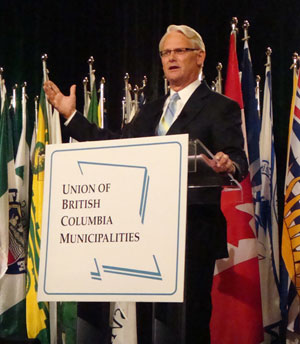
Gordon Campbell speaking at the UBCM

Then premier Gordon Campbell launched task force at 2009 UBCM convention.

Related

When municipal voters go to the polls in November in British Columbia, it will be without the benefit of a series of recommendations made last year to clean up local elections.

The Local Government Elections Task Force made its recommendations in May 2010, but a tumultuous year in provincial politics has meant they've never been put into law.

And while an NDP critic says the failure is a sign of government incompetence, the Union of B.C. Municipalities' president says it's disappointing but it's still better to wait and get it right.

"We understand [the Union of B.C. Municipalities and some local governments] may be disappointed that these changes won't be in place for this year's elections," Community, Sport and Cultural Development Minister Ida Chong said in a prepared statement announcing the changes would be ready for 2014.

"Our highest priority must be to help ensure local elections run smoothly, without confusion, and that all participants have an opportunity to understand and follow the rules," said Chong. The government heard concerns it was too late to make the changes with campaigns already underway, she said.

Long time coming

The changes have been in the works for some time. The Tyee's Monte Paulsen was among those drawing attention to problems with municipal campaign finance with a 2007 series City Hall for Sale.

Former premier Gordon Campbell announced the task force's formation in Oct. 2009, at the UBCM convention. It was a chance to "modernize" local elections, and look at everything from campaign financing to term lengths, he said.

The task force circulated discussion papers and received over 10,000 written submissions.

On May 28, 2010, it released its report. The co-chairs, then-minister Bill Bennett and UBCM's Harry Nyce, wrote in the cover letter, "The Task Force strongly believes that if implemented, these recommendations would make a positive difference to local elections in British Columbia."

TASK FORCE RECOMMENDATIONS

The Local Government Elections Task Force made these recommendations in May 2010:

Implementing expense limits for all campaign participants, including candidates, parties and third-party advertisers;

Setting those limits in a way that works for different sized communities;

Banning anonymous contributions;

Requiring all election advertising to say who had paid for it, as happens now in provincial and federal elections;

Making third-party advertisers register and say how much money they spent on ads;

Shortening time limit for campaigns to submit their financial disclosure statements to 90 days from general voting day;

Providing for financial disclosures to be published online and made available through Elections BC;

Developing standard financial disclosure forms;

Bringing rules for "in kind" contributions into line with provincial rules;

Giving Chief Election Officers powers to enforce rules including those against election-day advertising and to seek injunctions to stop unauthorized advertising; and

Extending time limits for investigating alleged local elections offences from six months to one year.

The full 68-page report is available here, and a summary of the key recommendations is on the task force's website (see sidebar as well).

There were 31 recommendations, including 15 that would require changes to B.C. laws. In July 2010, the government said it would proceed with the recommendations in time for the 2011 elections.

Bungled from beginning: NDP

The Tyee reported in March that there was some doubt the promise would be met and that a government spokesperson acknowledged it "could be tight" to implement the changes in time for the 2011 elections.

From the time the task force was struck until there will be an election using the changes it recommended will have been almost six years, said Scott Fraser, the NDP critic for community and rural development.

"That's ridiculous. The height of incompetence," said the former Tofino mayor and current MLA for Alberni-Pacific Rim. "I thought it was a joke." The government's handling of the file makes them look like Keystone Cops, he said.

"It would be a laughable announcement considering the whole task force recommendation has been bungled from the beginning," said Fraser, who noted the government made its announcement just ahead of a four-day holiday weekend.

There are legitimate problems with local elections that need fixing, he said. But the government convened a process that excluded members of the opposition and that omitted the key recommendation to limit individual donations, he said. "For Liberal partisan reasons they didn't even consider that one."

Rudderless government

Chong said the government ran out of time to make the changes, but it was the government's choice to call the Legislature for only four days in the last 10 months, said Fraser. "The government decided they'd tie the rudder on the ship of state," he said. "It's a government that will do anything to evade sitting in the Legislature."

Since the report's release, the government has had the Legislature sit for just eight days. Premier Gordon Campbell resigned in November and the BC Liberal Party took three months to replace him with Christy Clark.

Union of B.C. Municipalities president Barbara Steele said it's disappointing but understandable that the changes won't be made in time for the 2011 vote. "From my point of view, I would have loved to have it all settled, but we don't," she said. "That's their decision."

The Legislature will sit starting April 27, but only until June 2. Meanwhile, Clark is running in a byelection in Vancouver-Point Grey and the government is fighting a referendum on whether or not to scrap the HST.

Asked if the government perhaps should have met in the fall to make the changes, which would have been before the turmoil in the wake of Premier Gordon Campbell resigning, Steele said, "I'm not going to get into the politics of it."

The changes -- which include moving the election day from November into October -- are significant and will require thorough discussion, she said. There will also be a need to educate candidates and officials on the new requirements, she said, adding that it was preferable to wait and do it properly than to rush.  [Tyee]

10  Comments:

Login or register to post comments

  • Okanagan Orchardist

    1 year ago

    Excuses, excuses...

    Some of us spent a lot of time putting together suggestions for changes that could very easily have been implemented by this November. The basis for our suggestions was the Manitoba Municipal Act which has been in place for a number of years now and has proved itself very successful. Both the BC Liberals as well as the Union of BC Municipalities have an agenda to see that no new regulations be in place for the coming elections. Nearly all of the suggestions pertain to limitation of donations and anybody who is planning on running again would certainly not want to see any restrictions as to who can give and how much they can give. It wouldn't take a month long class for candidates to familiarize themselves with any new laws, so again, this is just another excuse. We need to start publicizing this a lot more in other papers. A write-in campaign should be started immediately!

  • seth

    1 year ago

    Graft

    Right now its defacto legal for municipal politicians as not only is there very little control in the election time frame but there are no limits to donations and no record of such between elections.

    It's pretty obvious that's why Vancouver's citywide WIFI plan got shutdown and why we have amongst the worst taxi service in the world.

    GRAFT!!! Why would they want to change!!!!

  • Mooney

    1 year ago

    Not enough time?

    They sure didn't waste anytime privatizing our ferry s or rivers, giving away our railroad and undermining BC hydro.

  • Christy Fan

    1 year ago

    Little problem called...

    The people of BC told the best Premier and Mayor Vancouver ever had... to seek retirement. Now as Premier Christy Clark seeks to follow in the size 32 footsteps of a giant, she needs time to get up to speed.

    There were major plans in the works to change MCFD laws & procedures as well. How much press has THAT gotten?

  • John Greg

    1 year ago

    Christy Fan

    You really do hate poor people, working people, and the truth don't you.

  • rantnic

    1 year ago

    BOONDOGGLE

    That's what our municipal politics really represents. When councilors have to vie city wide for votes, it leaves only the wealthy or the already known incumbent, able to mount a proper campaign. The ward system is, to me a much more democratic system, in that a prospective candidate may actually be able to meet his neighbours and then represent them. This unfortunately leaves the citizens from the well to do neighbourhoods with a vote only equal to those in the poorer neighbourhoods. I should think our Christy Fan would not want that.

  • mary jane

    1 year ago

    if its good

    If its good and works for the all the people - stall it or get rid of it or hid it or give it some rich person.

    Can you really privatize what belongs to the people. One day the kids will gather up in a group and demand their water, hydro, logs and other resources back - etc

  • alive

    1 year ago

    Rescources back?

    Good point, mary jane, but seeing where we have signed a pact with the devil, there is no going back within any democratic means!

    What will be required is nothing short of a revolution that encompasses the USA as well.

    In the meantime, we can try to stem the flow by voting the bastards out of office!

  • David Huntley

    1 year ago

    The electoral system

    Despite several submissions recommending changes to the system for electing mayors and councillors, the Local Government Elections Task Force completely ignored the topic. The delay gives us an opportunity to press again for changes.

    Why do we need changes? We need preferential voting so that the people get what they voted for.

    Preferential voting is how both the Liberals and NDP elected their new leaders. But so far they have not permitted us to use it for electing mayors and councillors.

    Some examples of what's wrong now are:

    At least two mayors were elected with 30% of the vote at the last election. There may well have been candidates who were more desired by the voters.

    In Burnaby, 51% of the votes for councillors elected all eight councillors from one party (the BCA). The other 49% of the votes elected nobody. Thus almost half of the votes yielded no representatives on the Burnaby City council.

    In the previous Burnaby election, the party that received the most votes lost the election to a party that received fewer votes! This nonsensical result is a common occurrence with X-voting system that we use now.

    The people ought to get representatives they want, and preferential voting would give them that.

  • Okanagan Orchardist

    1 year ago

    Vancouver Sun column...

    If anybody is still reading this article they might want to take a look at a column in the Vancouver Sun by Daphne Branham.
    http://www.vancouversun.com/news/Comment+Municipal+electoral+reform+placed+Liberal+party+back+burner/4679362/story.html

    • The discussion for this story is closed. No more comments can be added.