
News

More Fizz to Saskatchewan Carbon Storage Controversy

Group overseeing project says it will refute study saying CO2 is bubbling back to surface.

By Andrew Nikiforuk, 19 Jan 2011, TheTyee.ca

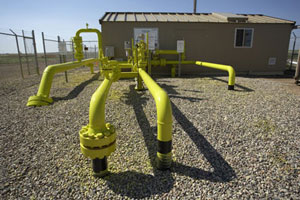
Encana Pipes

Disputed CO2 capture project in Weyburn, SK.

Related

A report that documented lethal levels of carbon dioxide in a farmer's field on top of a national $80-million demonstration carbon storage project in Saskatchewan has generated a storm of controversy, denials and calls for a more studies.

The Petroleum Research Technology Centre, a Regina-based industry and government research group overseeing the international project, says it will issue a technical report today, refuting the independent study. (When released, the report will be here.)

"We don't agree with the findings," says Steve Whittaker, the senior project manager for the IEA Weyburn-Midale Carbon Capture and Storage Project. "There are some significant deficiencies. It's a chicken little report."

But he admitted that monitoring for the project has been intermittent and only covers a fraction of the study area. "We're not a regulator. We're a research group." Whittaker also confirmed that there is no annual surface-monitoring program for CO2 leaks.

Billions spent pursuing sequestration

The Weyburn project, the world's largest full scale field study on capturing, injecting and storing carbon underground, represents a consortium of oil companies and oil exporting governments keen on proving the safety of burying carbon underground.

Both the Canadian and Alberta governments have devoted billions to the costly technology and want to build six or five demonstration cemeteries in Western Canada.

But the Weyburn project is also the only storage experiment where CO2 is also used to enhance oil recovery from an aging oil field. Cenovus Energy, formerly EnCana, injects up to 6,000 tonnes of CO2 a day from a coal-fired plant in North Dakota, to force out more oil from the field.

Most oil fields that inject CO2 (the gas works like a paint thinner) aren't regarded as safe or secure, explains a 2010 U.S. Department of Energy report, "due to missing operational and CO2 monitoring elements that are critical to demonstrating the effectiveness of the process for safely isolating CO2 away from the atmosphere for the purpose of addressing climate change."

High CO2 levels reported

Last week, a report by Paul LaFleur of Petro-Find Geochem found extremely high levels of CO2 (110,000 ppm) during a gas soil survey, or enough to asphyxiate a human. It also matched the fingerprints of the carbon on the farmer's property to that being stored in the giant Weyburn reservoir.

LaFleur and the environment group Ecojustice did the study last year after Cameron and Jane Kerr, a retired farming couple, complained about dead animals, foaming water and explosions at a gravel pit on their farm beginning in 2004.

The Kerrs say that the Saskatchewan government promised a yearlong study in 2007, but never delivered.

Normal levels of CO2 above an oil field range around 5,000 ppm, says Lafleur. He suspects the CO2 on the Kerr property is leaking via a fracture somewhere in the storage site.

"I'm not for or against carbon capture and storage," adds Lafleur. "It's up to the people and government what they will accept in CO2 leakage and what they can live with. Transparency is the key."

To date, only 5 per cent of the 110 square mile oil field has been monitored and LaFleur says that's inadequate. Nor is the Kerr property included in the monitoring area. "The facts speak for themselves."

Global interest in Saskatchewan project

Whittaker confirmed that very little monitoring took place between 2004 and 2008. Between 2000 and 2004, his research group performed the bulk of the monitoring including background CO2 readings as well as surface water and seismic testing. "We are trying to figure out what a good monitoring interval looks like." He says the project plans to do a soil gas survey this fall.

However, a Regina-based group called the International Performance Assessment for Geologic Storage of CO2 (IPAC-CO2) also announced that it will put together a team of experts to investigate the findings of the Lafleur report.

Created by Royal Dutch Shell and the government of Saskatchewan, the research group has a mandate to demonstrate the safety of the controversial technology.

In addition, Bellona, an international Norwegian environment group that supports carbon storage as a solution to climate change, also has supported the need for a thorough investigation.

Fault leakage a 'remote possibility'

Whittaker characterized Lafleur's claim that CO2 was probably leaking up through faults or fractures as "an extreme and remote possibility."

One of the goals of the Weyburn project is to provide policy-makers with reliable information about the security and safety of carbon capture and storage.

Experts in carbon capture and storage acknowledge that techniques to properly measure whether or not a storage site is leaking are still in their infancy.

Carbon storage professionals (yes, they even have their own academic journal) all agree that leaks from wells, abandoned facilities or faults can compromise the security of carbon storage sites and pose a health risk to humans and animals. But they also admit that no real system yet exists to locate and quantify surface leakage.

Invisible subject

Because CO2 absorbs light at specific wavelengths, U.S. researchers are now experimenting with optical detection techniques. None appear to have been deployed yet at Weyburn despite its international profile.

One study by the U.S. Lawrence Berkeley National Laboratory recently concluded that "detection of potential CO2 leakage will be challenging" due to the large ground area that needs to monitored, as well as extreme variability in CO2 levels from the soil.

Carbon capture and storage has ignited controversy around the world. Energy economists call it wasteful and fiscally irresponsible technology, while coal and oil companies argue it will extend the oil age. Some environmentalists favor the unproven technology, while others say the money would be better spent on renewables instead of dead-end storage facilities.  [Tyee]

14  Comments:

Login or register to post comments

  • Bailey

    1 year ago

    Just a question...

    Why is it that whenever some organization's pet theories are threatened by obsevations of the actual results on the ground, they immediately respond with a denial?

    No no no, they seem to always say. It can't be true, these new observers didn't look right, they didn't look where we told em to, they're too stupid to inderstand our brilliant theory.

    Wouldn't it be reasonable for scientists and governments to want to gather data as they go, and wait to make their denials until after they examine it, rather than just deny on reflex?

  • puppyg

    1 year ago

    "Group overseeing project

    "Group overseeing project says it will refute study saying CO2 is bubbling back to surface."

    Let me guess. The petroleum research centre is implementing a new policy - 'Don't breathe and don't look down'.

  • whatthe

    1 year ago

    Admits no way of detecting...

    Impressive.

    Billions of pulbic dollars, no way of knowing if there is any point to it. With the exception of living things dropping dead.

    Soil readings are off the charts, this is a detiction no?

    The whole idea was to "Capture" not "capture and release."

    This is laughable if it was not deadly.

  • mopled

    1 year ago

    The "point" has always been about keeping up oil pressure

    Carbon sequestration is the phony hook they use to have the public pick up the tab for it. They are buying the CO2 from a coal gasification plant in North Dakota.

    "Saskatchewan presently has two successful commercial scale enhanced oil recovery projects at the Weyburn and Midale oilfields. Both of the projects purchase carbon dioxide from a coal gasification facility in North Dakota and inject the carbon dioxide into the oilfields. Significant economic benefit is accrued since the carbon dioxide increases oil production, and at the same time a significant environmental benefit is occurring in that the carbon dioxide is permanently stored underground in the oil reservoirs. "
    http://www.ir.gov.sk.ca/Default.aspx?DN=9eb5e74d-ba2c-486d-8796-ad6008f69180

    Well, it turns out it is not the least bit an environmental benefit, is it? When you factor in that CO2 is perfectly harmless in the atmosphere and can't change climate, I think we are being fiddle faddled.
    Climate Change,Is CO2 the cause? - Pt 1 of 4

    http://www.youtube.com/watch?gl=US&hl=uk&v=FOLkze-9GcI

  • bluerev

    1 year ago

    CCS is a dumb idea in the first place

    First of all it isn't carbon storage, rather Cardon Dioxide storage. We have no idea what taking out twice as much oxygen as carbon from the atmosphere will do, if we can keep this gas underground. The only way to safely store carbon is putting carbon based materials underground under high pressure resulting in the creation of dark dense carbon rich minerals, or not digging up and burning these carbon rich minerals in the first place.

  • cyberclark

    1 year ago

    Some insight to the Phisics of CO2 underground.

    Co2 is a low pressure gas when not under pressure.

    It turns to a liquid at 2600 feet of depth (the minimum) and is safer at 6500 feet and will stay as a liquid until pressure or temperature changes.

    In Africa, a whole village was killed by escaping CO2. Vegetation sunk to the bottom of a deep lake and stayed there, some think for centuries.

    As it accumulated it became a thicker layer until at some point it was marginal on the pressure/heat boundary.

    It is suspected heat, a tiny fraction of a degree (the result of a hot spell) expanded the CO2 and in the turmoil of expansion a huge amount of the gas returned to the lake surface where it engulfed a village killing thousands for miles around.

    A good article from 2006 is still available at:

    http://albertathedetails.blogspot.com/2008/06/alberta-carbon-sequestor-program.html

    Good Luck with it.

  • cyberclark

    1 year ago

    Woops! Physics!

    Woops! Physics!

  • RickW

    1 year ago

    Bailey

    Canada is a petrostate. The only significant money we make is selling O&G. Harper has ensured this by pumping for a higher dollar. This brings more money (from US-bound oil), even though it wrecks a plethora of Canadian businesses tied to the export market.

    While I disagree with mopled over the effects of CO2 in the atmosphere, he is right about using the gas to get more oil our of old fields.

  • pwlg

    1 year ago

    saskatchewan power industry

    There is more to this than meets the eye or in this case the nose.

    Saskatchewan produces more than 90% of its electrical energy from coal fired power plants in Estevan and Cornach both in the south. Estevan and Cornach are very close to the Weyburn oil fields. The level of particulate pollution coming from the Estevan Boundary Dam Plant (the dam is not for hydro electric purposes but is a reservoir for the water needed in the six coal-fired boilers)is disturbing making Estevan the highest per capita population with respiratory illnesses in Canada. The plant not only provides an abundance of particulates but also CO2.

    The feds have ponied up big time to pay for this unproven technology and Saskpower is planning on rebuilding one of its boilers in Estevan for CCS purposes.

    The problem with this technology is the issue with efficiency. Currently coal-fired power plants have very low efficiencies to begin with. The required energy to operate the technology for CCS will further reduce the efficiency and can use up to 25% of the electrical energy output from the coal-fired boiler to run the technology.

    With all these big companies involved why are the taxpayers of this country paying for this very expensive and unproven experiment?

  • pwlg

    1 year ago

    the oil fields of southeast saskatchewan

    If you don't know what a jack pump is go to Estevan and head north, in just two years the road leading north has enough made in China jack pumps that makes Alberta's conventional oil fields look like sleepy hollow.

    Saskatchewan has been very aggressive in developing their oil fields. In North Dakota to the south of Estevan and Weyburn that state has also been very aggressive. Encana or Cenovus' wells have flares coming out of pits in the ground. A very spooky thing to see.

    Tommy Douglas, may he rest in peace, is Weyburn's favourite son. If the town really wanted to honour their favourite son they would stop this CCS madness.

  • cyberclark

    1 year ago

    Weyburn Sask - A good project

    Weyburn embarked on a large CCS program using Dakota Carbon Dioxide. Not only the feds but countries across the globe kicked into the fund to see if it would work; could be proven.

    Capturing C02 from coal operations usually means a rebuild of the plant or a revert to very old technology.

    Using a caustic sump to collect C02 then, stripping the gas from that sump is one way. Not a tiny operation; not cheap.

    Dakota built a plant to collect the gas while burning the coal. It is very expensive and complex.

    Like an inverted kettle, gas is collected off the smoldering coal. Then, oxygen is pumped into the giant flask and the gasses are flashed.

    The result is pure Carbon Dioxide in quantity. The same system has been tested in Europe to good effect.

    On keeping the gas down there, the last I heard from Weyburn is they had no idea how much was coming back up hole with the oil only that it was considerable and they were doing studies to find out what was actually happening to the gas.

    This is still another stage in a proving technology. There will be surprises.

    Stelmach in Alberta is telling us they will study the situation and make sure it is safe. That is just foolish!

    On the other hand to protect industry this same Government has claimed ownership of the gas underground. Then, in the same Act said the crown cannot be held for any mishaps resulting from that storage.

    T

  • Yeoman

    1 year ago

    Simplistic Observation

    If the point is to contain CO2, wouldn't the only formations capable of doing this be natural gas reservoirs that have not been disturbed by frac'ing or pump depressurization? Does the Weyburn site meet this criteria?

  • DaninVan

    1 year ago

    CO2 Monitoring

    What's the big deal; just pop over to Canadian Tire and pick up a bunch of cheapo CO2 monitors.
    What, you say, that won't work? Sure it will; you just hook up 2 CO monitors in series...;)

  • JSoet

    1 year ago

    I have to agree with the petroleum report...

    When I read the article last week I was as incensed as anyone about the possibility that the C02 was just leaking back up... But now that their report is released, I read it and it seems that their disagreements make sense. I'm definitely no expert in the area, but it seems that their references and previous studies seem to refute the 2 main claims; that the C02 is from that well, and that the amount of C02 in the soil is abnormally high...

    Of course now it would be interesting to read the original study's response to this... And of course it's good that some other agencies are going to get in on the monitoring of this too... It's all we can ask for when 2 authors disagree, is more monitoring to come to a verifiable conclusion.

    • The discussion for this story is closed. No more comments can be added.