


 SHARE:
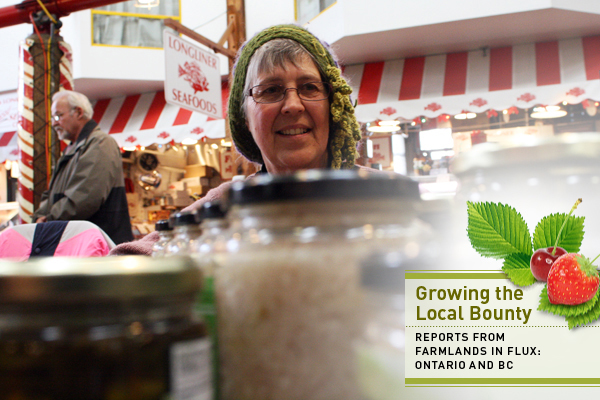
It's just past opening on a mid-week morning at Granville Island Public Market and Donna Plough is already managing a steady stream of customers. Despite the early hour she is dishing out samples of sauerkraut to rave reviews and answering questions about how to use a jar of lemon pickle, made from a family recipe. Plough's day-table is loaded with various jars of preserved farm goodness, all of which (except for the lemons) is made from produce she and her family have harvested from their organic farm.
Along with her husband John and their adult children, she farms 20 acres in the fertile Glen Valley area of the Fraser Valley. The aptly named Glen Valley Artichoke Farm specializes in artichokes and mostly sells directly to their customers at farmers' markets and at venues like Granville Island. They add value to their specialty crops by processing their harvest into jars, which they sell under the McColl's label. Although they almost certainly didn't intend it, the Ploughs can be seen as a model for a successful local food system.
Despite our reputation otherwise, we are far from living in a local food utopia in B.C. It's only in the past five years that many local farmers started growing year round, once they realized consumers would buy whatever they could grow.
There are still huge gaps in our food system. The increase in demand for local products has made it clear that one of the biggest problems we face is not enough supply. A recent report by the Canadian Centre for Policy Alternatives states that even if we closed our borders and our entire collective harvest entered the local market, we'd fall far short of producing enough food to feed our population.
Local growers need revitalized local processing
Along with the power of institutional purchasing agreements that ensure guaranteed markets for contracted farms, a revitalized processing industry will support producers with alternative markets and the opportunity to preserve their products for sale long after the fresh harvest. A cross-sectoral approach is emerging to support the processing industry in B.C. The private sector, cooperatives, financial institutions, industry associations and all levels of government have a part to play.
In an industry with truly global competition the answer may lie inward. As my series co-writer Colleen Kimmett says, "co-opetition is the new black." It is in this spirit that we're seeing a new food processing industry emerge in B.C.
"We're getting older," says Plough, hitting at the heart of the matter. And as they grow older the Ploughs are looking for ways to continue their farm business. "We want to progress, we want to expand, we want to employ people," she says. Having a specialty product like organic artichokes that not many other people are growing may be what puts the Ploughs in a position to allow them to reach those goals, and to help bolster their farming community.
Up until now, the McColl's product line has been manufactured off-farm at a co-packer. A food co-packer is a business that processes products for a third party. In the case of the Ploughs' artichokes, they ship the co-packer their freshly harvested artichokes and the co-packer processes them to the Ploughs' specifications. While the co-packers have done a decent job, what the Ploughs would really like to do is build an on-farm processing facility in order to maintain quality control over their products as well as save on costs.
"For each small farm to put a processing facility on their farm, the cost benefit ratio of it probably wouldn't be very good," says Candice Appleby. The executive director of the Small Scale Food Processors Association (SSFPA) is seeing a trend in which people looking to expand their businesses work in conjunction with other people or other companies. This could take the form of a co-operative facility like the Northwest Premium Meat Co-op processing plant in Telkwa, BC, to the classic co-packer like Tarragon Foods, to a business like Bobo Baby that produces their own line of products but offers the extra capacity in their processing facility -- that they assure is free of the nine most common food allergens -- to other food businesses.
Investors seek community-building ventures
"I don't think it's as simple as let's find a building and put a canning machine on and let's assume that we've solved the problem," says David Berge, echoing Appleby. Vancity's senior vice president of community investment says food is an emerging focus area for the credit union's community investment strategy and food processing and manufacturing is a significant chunk of the sector.
Berge sees great potential in cooperation for local producers. "The stories I like the best are ones where, whether it's one grower, or one food producer, or one restaurant, whoever is coming to the table, if the person coming is bringing a special strength that they are sharing with other parts of the community."
He cites an example of a goat cheese dairy in Vermont. The Vermont Butter & Cheese Creamery started as a small farm-based enterprise. When the owners built a new, modern creamery they laid the foundation for a high-value, farm-based niche that now services 21 family farms. Berge says any investment-seeking local food-based business that has a solid commitment to local growers would be more attractive to a lender like Vancity because all players are building the community together.
'Lots of room for food production here'
"It takes about three minutes to do an artichoke, to get the bottoms out, but this machine does 30 in seconds."
Back at Granville Island, Plough is talking about a machine she saw on a recent trip to a Spanish artichoke farm. She is contemplating importing such a machine in order to ensure that all the artichokes from their annual seeding of 35,000 plants get harvested and processed. Couple that machine with a processing facility and it's easy to imagine the Fraser Valley as a hotbed for local jarred artichokes.
"In particular the challenge is how do we focus on the areas of food production where there really is a value add, where there will be available at the end of the pipe some sort of premium pricing," says Berge. Although the cost of processing goods in B.C. is still, in many cases, more expensive due to lower labour costs and subsidized production beyond our borders, there is opportunity to start rebuilding our lost processing infrastructure.
"I think there's lots of room for food production here in B.C."
Tomorrow: Last in the series Growing the Local Bounty: Reports from Farmlands in Flux: Ontario and BC. A photo slide show and wrap-up of what our team learned in the fields. ![[Tyee]](/design-article.thetyee.ca/ui/img/yellowblob.png)
Read more: Food, Environment





Tyee Commenting Guidelines
Comments that violate guidelines risk being deleted, and violations may result in a temporary or permanent user ban. Maintain the spirit of good conversation to stay in the discussion.
*Please note The Tyee is not a forum for spreading misinformation about COVID-19, denying its existence or minimizing its risk to public health.
Do:
Do not: