
News

A Tyee Series

Eggsasperating!

Organic egg producers in BC say regulations 'gone haywire' prevent them from keeping up with hungry local demand.

By Colleen Kimmett, 25 Nov 2010, TheTyee.ca

KarlHann

Karl Hann, an egg farmer in Abbotsford, says the system is cracked. Photo: Justin Langille.

Related

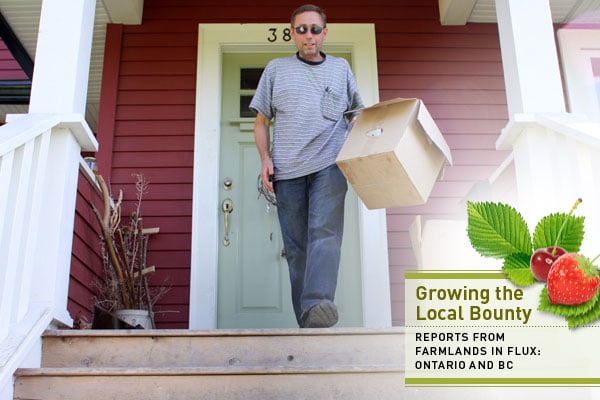
Karl Hann navigates his big white van through rush hour traffic in Vancouver's Kitsilano neighborhood. He slows down and hangs a left into the alley just north of trendy 4th Avenue. Hann pulls the truck in beside a dumpster, jumps down from the front seat and carefully lifts a large cardboard box out of the back. Balancing it on one hip, he walks up a few steps and opens a screen door into the tiny kitchen of a fine-dining restaurant. This is the part of Bishop's that its patrons rarely see.

Sous chef Geoff looks up and greets Hann, but he's preparing for the dinner rush and there's not much time for chitchat. The box goes in the fridge, Hann confirms the next week's order, and then he's on his way.

Three times a week Hann loads up his van and drives into the city to sell eggs from his Abbotsford farm. Mondays and Thursdays are delivery days, and most Saturdays he's at the Trout Lake farmers' market. A growing demand for organic eggs has allowed Hann expand his flock from a few hundred to 2,000 birds. But technically, he's not supposed to be selling these eggs at all -- he doesn't have the quota required to produce them.

But Hann says he's filling a much-needed supply. He and other producers assert that the B.C. Egg Marketing Board (BCEMB), the body that oversees egg production in the province and administers quota, has not been responsive enough to an increasing consumer demand for organic, and other types of specialty eggs, which include free-range, free-run and omega enriched eggs.

And although the BCEMB disagrees, pointing to a new organic producer program as proof, the whole debate raises questions about the role of marketing boards and the challenges that new, non-conventional farmers face when trying to break into supply-managed industries.

The problem with quota

Eggs are one of three supply-managed agricultural industries in Canada (the others are poultry and dairy), which means the markets are regulated with fixed prices on domestically provided products, high tariffs on imports, and quotas on production. The national egg marketing board sets quota for each province, and the BC Egg Marketing Board is responsible for allocating that quota to producers around the province.

The board was created in 1967 -- as the first egg marketing board with quota in Canada -- after egg production outpaced demand and drove down prices in B.C. With so many suppliers to choose from, people who operated graders (which sort eggs according to quality, or "grade" and size, and then wash and package them) could threaten to move on to the next guy if they didn't get a price they demanded.

"You are not supposed to go out and say, 'Oh, I can produce cheaper eggs,'" says Hann. "No, you are supposed to fill a market, you are not supposed to undercut. On that point I agree with the regulations.

Egg farmer Karl Hann

Hann drives to Vancouver three days a week to sell his eggs. Photo: Justin Langille.

"But the way the system has evolved has gone haywire. Somebody has not paid attention to it."

One of the ways in which supply-managed systems have changed is the fact that the value of quota in these industries has shot up over the years. Quota can be bought, sold or traded on the market. According to BCEMB chair Al Sakalaskus, quota to produce eggs is worth anywhere from $160 to $200 per hen, depending on the type.

While food security advocates say supply-managed markets are ultimately good for the farmer, they also acknowledge that the high price of quota has stifled innovation and change.

"The only lucrative farming that exists now is supply-managed farms, or micro-farms," says Herb Barbolet, an associate with the Centre for Sustainable Community Development at SFU. "Basically, the supply-managed commodity farmers are the ones who are maintaining economic viability." But it's not perfect, he says.

"The way it's run requires a lot more transparency and a lot more flexibility," says Barbolet. "And the old guard is holding on tight."

A recent report by the Metcalf Foundation acknowledged this as well. "Supply management does not, however, work as well for those who engage in non-conventional forms of farming and for new farmers. Non-conventional farmers depend on their ability to differentiate themselves in the market, and they do their own marketing to let customers know about what they do differently. They do not benefit from economies of scale to the same degree, and they cannot justify the market price for quota given the production methods they use," stated the report.

LOCAL FOOD TAKEAWAY: OPEN UP TO SPECIALTY PRODUCERS

The value of quota, and power structure of the status quo, can make it difficult for new and alternative producers to break into Canada's supply-managed commodity markets, which include eggs, dairy, and poultry.

Solution? A June, 2010 report by the Metcalf Foundation looked at how to better accommodate these producers. Among its recommendations include increasing quota exemptions for specialty producers or those who sell through direct marketing, decreasing minimum quota levels and establishing separate quotas for specialty products. The egg marketing authority in Quebec recently introduced a program for new producers that loans them quota, for free. That quota can be passed down to children, but if egg production stops, the quota goes back to the egg board.

Demand for organic outpacing supply

Organic producers province-wide can't keep up with demand for organic eggs in B.C. According to the BC Farm Industry Review Board, this province imported 200,000 dozen organic and free-run eggs from Alberta and Manitoba in 2008, compared to 11,800 that were exported from the province.

The legislated role of the BCEMB is to monitor market changes and adjust quota accordingly. Specialty eggs (which includes organic, free run, free range and omega) account for 16 per cent of egg sales at major grocery stores. But add actual sales of specialty eggs from farmers' markets or smaller health food stores, and that share is certainly higher. According to a survey by the Vancouver Humane Society, 21 per cent of British Columbians buy non-conventional, battery-cage-raised eggs.

But the share of quota these producers received from the BCEMB in 2008 was just 11 per cent of total production.

In 2005, the Farm Industry Review Board instructed all of the supply-managed industries in the province to come up with plans to serve this growing demand for organic and specialty products.

The BCEMB responded four years later with a new producer program focused specifically on bringing more organic eggs into the market, quota for 12,000 hens. (The BCEMB plans to allocate quota for another 6,000 hens over the next two years, which would bring the percentage of total specialty egg production to about 15 per cent.)

But with this latest quota allocation, rather than give quota to egg producers who were already producing eggs and had requested the capacity to expand, it asked interested parties to submit business plans, and then drew winners through a lottery. All four winners are located in the already-saturated Fraser Valley, and one didn't even own any property yet, the Vancouver Sun reported at the time.

Stakeholder submissions on the lottery program were posted on the boards' website. One common thread was that the lottery system did nothing to address an immediate lack of supply for organic eggs particularly in regions outside of the Fraser Valley.

"If this lottery system is really the best strategy you can come up with, then at least use separate 'hats' for each specialty egg: certified organic, free range, omega 3 enhanced, etc., and replicate it for each region of the province in the interest of fairness and diversity," wrote Susan Davidson of Glorious Organics.

'The worse thing they can do is ignore it'

Ian Christison owns Daybreak Farms in Terrace. He produces and grades conventional as well as omega and free-run eggs for wholesale across the province.

"The marketing board has to be looking at the requirements of a region and focus on the marketing of the product to ensure that we are supplying 100 per cent of B.C.'s market with B.C. production," says Christison. "That to me is where 90 per cent of the problem is. But they don't seem to get it and they don't want to."

Egg farmer Karl Hann

Hann in the kitchen of Bishop's, a high-end restaurant in Kitsilano. Hann says more and more clients want to know who's producing their food. Photo: Justin Langille.

He says they can't produce enough organic eggs in the Interior to fill demand. "We bring in eggs from [Lower Mainland producer/grader] Golden Valley wherever we can in terms of omega and free run," Christison says. "We have no idea at this point what kind of a market we could have. We could only assume that the market up here would be no different from anywhere."

The Farm Industry Review Board (FIRB) is an administrative tribunal responsible for supervising the BCEMC and other regulated marketing boards. Chair Jim Collins says his board has told the BCEMB more than once that it has to engage with what he calls the "social movement" that is driving demand for specialty eggs.

"The egg industry is in transition," says Collins. "We're asking them to be as responsive as they can. They think they are... others think that they're not."

"Our board has told them more than once that you have to engage in these issues so you can help," he says. "If you have a social movement like this, whether you agree with it or not, the best thing to do is you need to engage that social movement and talk to people and manage the transition."

"The worse thing they can do is ignore it," Collins says. "They believe that they're starting to be responsive. We'll see what the final outcome of that is."

Producers not 'locked in': BCEMB

When asked about the gap in specialty egg supply, BCEMB chair Al Sakalaskus points out that this egg shortage is not limited to the specialty market. This year, all egg producers fell short of meeting demand, not just specialty. He pointed to the new producer program as evidence of how the board is responding to demand for specialty eggs. Sakalaskus also noted that farmers can have 99 or fewer hens without permission from the BCEMB. And the board regulates producers who have between 99 and 399 laying hens, but does not require quota.

"We're looking at the specialty industry and trying to gauge where the market is going to be sometime in the future," Sakalaskus says. "We know what we sell, and we know what the marketplace absorbs, but the art in this whole industry is trying to gauge consumer behaviour some two-and-a-half years in the future, where we have to make a decision today as to what type of product that will be in demand."

Sakalaskus also points out that producers are not locked into one category. "If Jimmy Pattison says I want more free range eggs and he tells a grading station I want more free range eggs, it goes down the system and regular producers will be incentivized by the grading industry to switch over if there is a hole in the marketplace."

So what's driving demand for specialty eggs today? "I don't really have to explain it," says Sakalaskus. "But God bless 'em for buying."

Rob Marten is one farmer who's successfully made the transition to the specialty egg market. After a career in the conventional battery-cage sector, he bought a farm in Chilliwack where he now raises 4,000 free-range hens.

Marten also grew up on a farm with a facility that raised hens in battery cages. His decision to switch to free range practices was strictly business. "I can get more per bird," he says. "I sincerely became a chicken farmer because I love working with chickens. Yes, I was working before with caged hens and I felt exactly on the same level."

"Sometimes I get upset when I hear people say, 'You can't get into that business, it's all protected.' I found a market niche for free-range birds," Marten says. "I didn't have the quota so I made a deal with another producer where I lease the quota. That's my way I'm working within the system, and anybody can do it."

But Hann wonders why producers like him should be required to work in the system -- which includes paying a 40 cent per dozen levy to the BCEMB, if it's not working for them.

"You have to understand that the marketing board is actually not doing any marketing at all. Especially the niche markets or anything new is a horror for these people. For me the market has grown basically by word of mouth and in most cases I had to decline new clients. I just do not have the capacity and in this environment of limbo, one cannot plan ahead or invest."  [Tyee]

17  Comments:

Login or register to post comments

  • DenisB

    1 year ago

    the poor

    Of course if we had cheap eggs and milk we could insure that all those impoverised children in the province had access to quality protein to grow up on. What a novel concept. Children with a good breakfast to help them learn better at school.

  • danneau

    1 year ago

    The Poor

    Perhaps we need to rejig our way of doing business so that there are no poor; as long as we tolerate the current level of inequity, furnishing adequate protein to poor children is one of the many fires we have to run to put out while the firebug is out setting many more.

  • RickW

    1 year ago

    danneau

    If there were no poor, how would the rich know they are rich?

    What I don't much understand about quotas is why they can be bought and sold.......

  • cityprole

    1 year ago

    Eggsasperating!

    I love on Vancouver Island where the VIA actually needs paperwork from you to sell at our Farmer's Markets..not too difficult to get, either..love my fresh, free range eggs..rarely buy store-bought, unless i run out between Markets..
    Hope all these eggtrepaneurs can keep it together..it's a wonderful change..

  • offended

    1 year ago

    2000 chickens is not a micro farm

    It's a factory; organic or not

    I have a micro farm, with less than 100 chickens.

    The dude should be paying for his quota.

    If he wants to be a small producer, such as myself, be small.

  • Stewart MacKenzie

    1 year ago

    Making a living at it

    If 2000 chickens were producing 1200 eggs per day, at $3 per dozen, it would provide $300 per day to cover feeding, shelter, etc and leave a living for the farmer. I'm not sure about the per day production but I don't think it would be quite as high as 1 per chicken. 1800 eggs would produce $450 in revenue. (Selling that number of eggs for $3/doz would probably be a challenge as retailers need their margins.)

    I would ask someone more informed to adjust my numbers if I am way off.

    My wife's wage rate as a senior RN manager is around $42/hr, plus pension, medical, dental, insurance and LTD, and so on. At 7.5 hrs/day, it works out to more than $300 plus benefits.

    It is decent money for a very demanding and often draining job, but not a huge amount for a family to live on especially if children are involved.

    We agree that a senior nurse is well worth the money. We'd say the same about egg farmers, and I hope they can produce enough eggs for the growing market. It doesn't seem to me that this 2000 bird operation would generate more than a decent living, all considered, so if it is being run properly why quibble about size at that level.

    Where we live many get eggs from neigbours with a few chickens.I suspect the lack of enforcement will engender more and more unofficial chickens and eggs, but for full time farmers it is good to see some official type support!

  • newphorik

    1 year ago

    Get Crackin'

    I don't understand why they are allowed to continue manipulating our food at a now "artisanal" level, whilst garnering lengthy articles about their 'free-run' and 'omega chickens'.

    What the hell is an omega chicken doing in the food supply, let alone the vocabulary?

    I continue looking for chicken roaming a range and not getting caught up in a silly game of niche farming scrabble.

    Tyee should go back to interviewing city chicken farmers. This is just more people selling eggs for $6... I am sure they will get the laws changed so they can siphon of egg eaters.

  • x4estworker

    1 year ago

    What's the deal with "organic".

    While organic farmers and other self-interested participants in the organic food industry like to trumpet the benefits of organic food, and look down their noses at those of us who don't buy it, the benefits of organic food are very dubious at best. I question whether the inflated prices of organic food make it really worth it.

    A recently released long-term study by the British government found there was no difference in nutritional levels between non-organic and organic foods. The other concern, that non-organic food contains harmful toxins, has been proven to be without merit. The concentrations of any pesticides are so small (in the parts per billion) and there has never been a credible scientific study that I am aware of that establishes any degree of harm from this source. Simply washing the food will get rid of any residual pesticide. Any herbicides used in the production of food break down into their components (carbon, hydrogen and oxygen) long before the food reaches the market.

    Organic food is largely about marketing and being trendy and cool, and not about any substantial benefits. I'll keep buying non-organic, thank you.

  • RickW

    1 year ago

    x4estworker

    phytonutrients

  • x4estworker

    1 year ago

    Rick W

    Explain!!

  • frank2

    1 year ago

    It's a real ball of wax.

    It's a real ball of wax. Industrial farming minimises unit costs with or without quotas. (The quota ensures a higher price and a "rent" which is received by the quota holder or paid to those issuing the quota.) But one big benefit of quotas (or other minimum price fixing rules) is to enable artisanal producers to sell to folks who prefer their eggs not be produced by chickens kept in tiny cages or dosed in phrophylactic antibiotics and other drugs, and who are happy to pay more for the privilege. In turn, this helps build rural communities (which industrialised agriculture effectively destroys). IF quotas were abolished, the prices of industrial eggs would decline (to US levels), and the "organic" market would become less remunerative (the ratio of organic to industrial prices would have to rise to maintain the same market and margins for artisanal producers). If the concern is mainly with animal welfare or environmental impact, we should pay more attention to regulation. The loss of quota margins would probably be compensated by extra costs (if cheating were avoided). Whether industrial scale producers could meet high standards is questionable, and greenwashing would proliferate. Since most cubicle dwellers are themselves subjected to inhumane conditions, it may be utopian to expect governments to rais food prices to improve treatment of animals.

  • Okanagan Orchardist

    1 year ago

    Are you aware that...

    I wonder if you know that a typical egg yolk contains roughly 200 milligrams of cholesterol? According to Health Canada, that is two-thirds of a recommended 300 milligrams daily limit for healthy people.
    I wonder if MacDonald's tells that to their customers who buy an Egg McMuffin? I rarely go there, but I would wager most of their eggs are obtained from producers that have their hens in cages.

  • Don McBain

    1 year ago

    Organic is not a DEAL

    I don't "look down my nose" at those that don't believe in organic food, that is their choice. Washing non organic food will NOT remove the pesticides and chemicals that are inside, a serious peeling of the best part of lots for fruit and vegetables is the only option which does remove a significant amount of the nutrition of the food. Also of course organically produced food does not destroy the earth it is grown in to only allow it to produce using chemicals.

  • Leslie C

    1 year ago

    x4estworker

    What about the exposure to pesticides and herbicides of farm labourers? Do we care about the health of the people who put food on out tables?

  • Rhea

    1 year ago

    organic isn't about "cool"

    "Organic food is largely about marketing and being trendy and cool, and not about any substantial benefits. I'll keep buying non-organic, thank you."

    Your choice to make, and I think a lot fewer people look down on you then you suspect. Nobody's going to force you to eat it. It's really unfortunate that marketing to the yuppies has tainted the perception of organic food as being a fad or trend, and don't get me started on the greenwashing crap that goes on in the name of marketing. Eco-snobs annoy the utter crap out of me, just like they do out of a lot of people.

    I personally buy organic produce, meats, milk and eggs to avoid the crap that is in the animals' feed. Non-organic meats and eggs all contain meds, growth hormones, anti-parasite stuff...none of it approved for human consumption, even though it sticks around in the animal's flesh. Pesticides might wash off, but you can't do that with this stuff, and the effects are ugly. Google for studies of links between hormones in beef and early puberty/breast cancer. It's truly frightening. I know a couple of local beef farmers who refuse to eat their own beef for just this reason. That should tell you something.

    I also buy organic to support local small farmers, many of whom aren't designated organic, but raise or grow without chemicals or other additives. I buy direct from them, not from the grocery, which cuts out a huge part of the extra cost right there. The pork and the lamb I bought were humanely raised, slaughtered on farm and dressed out by a local butcher. They went into my freezer, and that's meat for a year, plus 3-5 jobs right there in the local community being supported. It cost me maybe an extra dollar per pound for meat that was cut to my own specifications and is far and away more tasty than what I would buy in store.

    For me, that's worth the extra price. For you it might not be, and that's your choice, but denigrating the benefits as fake because you think people are "looking down" at you seems disingenuous at best.

  • RickW

    1 year ago

    X4estworker

    http://www.nutritional-supplement-info.com/antioxidant-foods.html
    Let’s use potatoes as an example. This is what the analysis found:

    Over the last 50 years the potato has lost:

    100% of its Vitamin A 57% of its Vitamin C and iron 28% of its Calcium 50% of its riboflavin 18% of its thiamine

    Of the seven nutrients analyzed only niacin levels had increased.

    The results were similar for all the 25 fruits and vegetables tested.

  • Karl

    1 year ago

    eggs

    Thanks to anyone who takes time to reflect. Farming is complex and controversial like most other things in live. This article is just a scratch on the surface of a whole heap of barnyard waste. Of course I might be partisan, because it is about a topic that has handicapped me for the last 25 years. Should people feed themselves? Should 2% of the nation be responsible to provide sustenance for the rest? Should a corporation be the designated, government approved provider of scientifically balanced nutrition a la Elena Ceausescu or any other self proclaimed savant?
    Percent protein says nothing about nutrition because it does not specify the amount of certain amino acids, which are required in a certain quantity for "proper" nutrition. It matters a lot in what ratio these amino acids are present to make up the total protein. This is said, to give all those that claim that there are no or no significant differences between biodynamic, organic and conventional eggs (or any other food) a little bit of homework. There is a big difference. In Nature the presence or absence of one Co or Mg atom can be a deal breaker.
    And than there is choice which a body like the BC Egg Marketing Board wants to cap. A private interest group seeks and gets government approval to limit choice. This happens in a country like Canada and the province that calls itself the "Best Place on Earth".
    In the meantime I have reduced the number of chickens to 1000 and it will be declining even more by next spring. So we need a lot of 99 bird flocks or one hell of a big factory farm to supply the needs of this Beautiful British Columbia with eggs. Politics and ignorance have made it onerous for the real family farm to survive. The Farm Industry Review Board is oblivious to its own mandate. Consumers are to busy in the imposed race to the top to pay attention. I am not sure if there will be an awakening or a crash that will change the future. Interestingly enough, I read this morning a Brazilian proverb; "Brazil is the land of the future and will always be". So what about BC? What about choice? What about common sense? What about a free market oriented western style economy? Is it the consumer or the State that determines the size and the type of market? this is what I don't get. And this is what I am battling. I am NOT trying to break into the system, Colleen did not word it right. The system does not want me in. I applied several times, got rejected, appealed to the FIRB and also got rejected. Now I am working on a tofu egg that is going to give everybody his/her run for the money.
    On Regulated Marketing is a lot of information available but not easily accessible. Anybody interested can contact me at

    It is a very hairy creation surrounded by controversy.

    • The discussion for this story is closed. No more comments can be added.