

 SHARE:
- Trauma Farm: A Rebel History of Rural Life
- Greystone (2009)
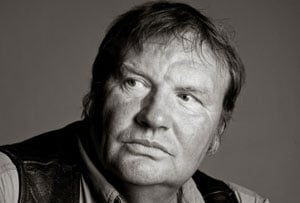
Some call it the real work. I call it honest muscle and Brian Brett would call it.... Well, in the interest of full disclosure it should be noted that I worked for two days for Brett. I was one of a long line of island scroungers who found work and much more at his and wife Sharon's affectionately named Trauma Farm on Salt Spring Island.
The work was hard, the pay was lousy, it was utter chaos, and I loved it. Brett would call that farming.
Trauma Farm: A Rebel History of Rural Life is a memoir and a natural history of small farms, rural life, biology, barnyards and botany set on an 18-year-long day. It begins and ends with Brett biblically and literally naked in the dark in the garden and poetically zigzags through time and place.
Or as Brett says, "How do you write the natural history of a farm when such histories tend to follow a linear logic? When a farm isn't logical?"
Debunking 'modern mythology'
The 18-year-long day is no less epic than a 700-page day spent with Joyce's Ulysses and a whole lot more accessible and pleasurable.
The phrase the 'real work' was coined by poet/activist/Zen Buddhist and beatific beat dude Gary Snyder (fictionalized as Japhy Ryder in Jack Kerouac's The Dharma Bums). The real work made use of "ecological poetics" and a reverence for mother earth. The real work consists of creating and conserving, and making the connection between spirituality and what Snyder calls "the bioregional ethic."
As Brett notes, one of the intentions of Trauma Farm is political -- to create while leaving only a small footprint. "It's an argument against the modern mythology of agribusiness that believes we can control the gorgeous organic complexity of the planet. The small farm is a dying anachronism in our age, but it is here that some of us are taking a rebel stand, returning to the traditional knowledge that grew food for thousands of years."
For Brett, 58, a poet and a big bull of a dude (born with the rare condition known as Kallman's syndrome that left him without male hormones), recognizing beauty in its many guises is as essential as bread. He also embraces absurdity. It comes with the territory. Farming, it's been said, is the only occupation where you buy retail and sell wholesale and pay the freight both ways. How do you make a small fortune at farming? Start with a large fortune.
Feeding an island
Brett's turf is the south end of Salt Spring (the most rural and radical part of the increasingly gentrified island) in the forest above Cusheon Creek, and his mentor is Mike Byron, a wise and valued fellow farmer.
As Brett notes, farmers with the knowledge that Byron represents are disappearing, fewer than a dozen farmers remain at work on the island. Brett refers to the loss of each farmer as equivalent to that of losing a library.
Even on the monied, increasingly urban population of Salt Spring where people demand local food from their shopkeepers, less than 10 per cent of food consumed on the island is produced locally.
Brett is no metrosexual foodie, more rural renegade in touch with the food chain. He appreciates unpopular bovine parts like tongue (best cold with mustard) and tripe, and to hear him rhapsodize about eggs is to understand his deep and hard-earned knowledge of food and farm life and the fine art of eating, the raw and the cooked.
"Since I was a child and had six hens in the backyard," writes Brett. "I've studied the behaviour and breeds of the chicken and still attempt different methods for growing a proper egg.... Egg-drop soup. Cakes. Eggs scrambled with truffles. Egg breads. Scotch eggs. The egg is a paintbrush used to address the enormous range of the human diet."
He brings similar rhapsody to bees, willows, and the wide berth that is his imagination, keen eye and voracious intellectual appetite.
Running from the potato police
Brett grew up with farming, driving around with his father a one-legged potato bootlegger selling the starchy substance throughout the Fraser Valley one step ahead of the Potato Marketing Board. He fondly recalls picking a cabbage at a Japanese farmers' in the fertile soil of the Delta River Valley. Today that farm "grows apartments."
Throughout the book is a howl against the increasing regulation of farm life. He repeats an old farm joke about it: the Lord's Prayer is 66 words, the Gettysburg Address is 286 words, and there are 1,322 words in the Declaration of Independence, but the U.S. regulations on the sale of cabbage take up 26,911 words.
All sense of proportion has been lost.
Brett notes the systematic targeting of traditional island food where items like pies or eggs can no longer be sold at the farm stand. "Personal responsibility, relationships with your neighbours, and the traditional defences of small communities against bad practices," writes Brett "have been replaced by food manufactured in thousands of countries from China to Mexico and a byzantine regulatory structure restricting real food and promoting factory farming."
Brett's farm work has resulted in a rich happy meaningful life -- and a fine read, and if that makes one a rebel -- then Viva la Revolution. ![[Tyee]](/design-article.thetyee.ca/ui/img/yellowblob.png)




Tyee Commenting Guidelines
Comments that violate guidelines risk being deleted, and violations may result in a temporary or permanent user ban. Maintain the spirit of good conversation to stay in the discussion.
*Please note The Tyee is not a forum for spreading misinformation about COVID-19, denying its existence or minimizing its risk to public health.
Do:
Do not: