'Environmental impacts are high' but US should support Alberta's bitumen mining anyway, advised restricted 2008 report.
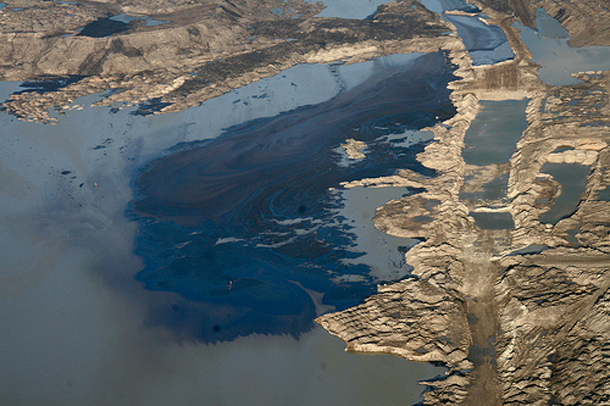
Suncor mining tailings in the Alberta oil sands. Photo David Dodge, Canadian Parks and Wilderness Society.

-
Why did a parliamentary committee suddenly destroy drafts of a final report on tar sands pollution? Here's what they knew.
-
Grits' dissenting report on two-year parliamentary study calls for sweeping reforms.
-
Owners of Koch Industries, a major processor of Alberta crude, spent millions to foment and support a movement against Obama's climate change policies.
Alberta's largest buyer of oil appeared internally conflicted, torn between the need for a large secure oil supply and its desire to control carbon emissions. In the end, though, its support for energy supply won out.
That was the conclusion of a top American diplomat writing to the U.S. State Department headquarters in Washington D.C. in Feb. 2008, nearly a year before Barack Obama succeeded George W. Bush as president. The memo was signed by Tom Huffaker, a lawyer who has been U.S. consul general for Alberta, Saskatchewan and the Northwest Territories since Aug. 2006. In March 2009 he became vice president, policy and environment for the Canadian Association of Petroleum Producers (CAPP) in Calgary.
"In our view, our goal should be to encourage, where we can, a process that is already making fitful progress, the 'greening' of the oil sands," the memo concluded. "Should we opt instead to support policies that damage the market for the oil sands and raise the cost of capital here, we should at least do so knowingly, well aware that, while this may seem to advance our environmental interests, it will harm our energy security."
The memo was obtained under the American freedom of information law (after a one year delay), and marked "sensitive but unclassified," and "not for distribution outside USG [U.S. government] channels." A copy was forwarded to the U.S. embassy in Moscow, where Huffaker had worked in the mid-1990s.
Speaking to The Tyee from CAPP's office in Calgary this week, Huffaker first emphasized that he is speaking only for CAPP today and not the American government. "I'm more sophisticated now. That memo was based on the facts on technology and the economy as I knew it then." He said that if he was writing today, revisions, if any, would be only very minor ones. "There remain the three factors -- energy, the environment and the economy. We don't argue that one is most important."
Although the memo originated in the Bush era, Huffaker says "there is more continuity than change" between Bush and Obama regarding Alberta oil, and "there is much less difference than you would expect on policy." He added that Bush made some environmental progress that is not well recognized today.
Visions of vast reserves, pipelines
To begin, in the memo, the Americans contemplated the below-ground reserves and future extractable amounts of oil in Alberta.
Huffaker opined that oil sands output of some 1.2 million barrels per day should rise sharply in significance as output expands to 3-4.5 million bpd in 2015-2020. By 2015 Canada will trail only Saudi Arabia, the U.S. and Russia as an oil producer, and yet, "Escalating production costs and calls for carbon constraints and concern about localized environmental impacts could slow growth."
Alberta oil sands reserves are now generally rated at about 174 billion commercially recoverable barrels, yet Huffaker wrote, "Bluntly put, we do not know, but we are convinced, as are our contacts, that it will ultimately be far above 174 billion barrels, most likely over 250 billion barrels and on a par with Saudi Arabia, but perhaps far higher."
Beyond 2020, the uncertainty is huge, he wrote. Various estimates have put oil sands output at or above 5 million bpd by 2030. Some, including former Alberta energy minister Greg Melchin, have argued that Alberta can eventually be the world's top oil producer at over 10 million bpd, Huffaker noted, "but this is a generational project subject to all the variables of technology (including some unknowable energy revolution) price, costs, environmental and regulatory policy. With the strain of rapid growth already showing in Alberta, such grand over-the-horizon talk is not very popular here today."
"Rising production will require new pipeline capacity, primarily to the U.S., and has engendered a lively debate over where the gummy output should be upgraded... These pipeline proposals are part of a complex dance in which the pipeliners want to stay up with but not too far ahead of production and in which producers and refiners have to match capacity as well."
The Americans noted that the basic choice is between upgrading the oil sands raw product (bitumen) in Alberta to ship as syncrude (synthetic crude oil) to the U.S., or whether to merely blend it with diluent (making a blend called dilbit) for shipping and upgrading in the U.S.
In 2008, Huffaker noted, massive upgrading capacity was being built in "Upgrader Alley" near Edmonton and "it is expected that a fairly steady state of upgrading some 60-70 per cent in Alberta will be maintained for some time... The labor shortage here is a hard reality for the 'keep the jobs at home' crowd as is the cost logic of 'refining only once.""
He added that "Nuclear energy is also being seriously considered as an oil sands industry heat source."
'No doubt that the environmental costs are high'
Huffaker was well aware of the oil sands' environmental concerns, writing, "Those of us, including many of our readers, who have seen the projects in Northern Alberta, have no doubt that the environmental costs are high. And while mining operations, with their vast, over-the-horizon scale are the most shocking at first viewing, even in situ projects with their dense drilling, massive above ground steam plumbing and upgrading facilities, have a far more visible footprint than conventional fields.
"Over time, the major players are committed to spend billions, perhaps tens of billions, of dollars on reclamation, but the land will never look like it did before. Paradoxically, when the soil is returned and replanted, as has been done on a limited scale, the land lacks the roughness of the native taiga forest and is unnaturally fertile."
Still, he added, it is important to keep in mind that while the oil sands are spread over an area "the size of Switzerland," perhaps only 20 per cent of this area will be mined versus 80 per cent being developed in in situ, all with a much higher recovery rate than from conventional fields.
Huffaker also suggested that fears over water usage might be overestimated: "Just how much can be drawn from the Athabasca River without significant damage is beyond our technical knowledge, but we would note that even with all the projects on the drawing board are completed, the take will be well below 10 per cent of average flow."
US security balanced against climate damage
The Americans next turned their attention to carbon emissions and climate change.
"No one can question that Alberta's CO2 emissions are rising rapidly as a result of booming oil sands development and will rise for years, maybe decades to come," wrote Huffaker. "Industry and provincial leaders acknowledge this, but ask that all of us pay more attention to the energy intensity progress that is being made and to the supply security benefits of the oil sands."
In their defense, Alberta leaders emphasized that the province, the federal government and the industries were on the verge of trying to control CO2 emissions by building huge carbon capture and storage (CCS) infrastructure. Huffaker concluded, "We are among those waiting to see this rather serious discussion make the leap to serious construction."
He noted that Albertans have for some time been growing nervous over the sense that they have "a target on their back" over rising C02 output, feeling this both from Canadians and Americans.
"Discussion of low carbon fuel standards (LCFS) in California began to worry them but recent U.S. legislation that would contemplate LCFS for government procurement, whether it would ultimately apply to oil sands for not, has them alarmed. On the positive side, this does seem likely to accelerate CCS efforts here... LCFS discussions have also lit a fire under the Albertans to get people to look at C02 output more holistically, or at least more their way."
Fear of BANANAs
Finally, security of oil supply to the U.S. was the primary interest. As Huffaker noted, senior Albertans had been asking the Americans for some time where energy security fits into U.S. policy and how they were balancing it with concerns over C02 levels.
"Senior business leaders, such as Enbridge CEO Pat Daniel, for some time have been asking why can't both federal governments provide a greater balance to what he refers to as BANANA (build absolutely nothing anywhere at any time) localism and assert the national and even continental interest in energy security."
"LCFS discussions have dramatically heightened this concern and today regional leaders, including new Saskatchewan Premier Brad Wall are asking us when the U.S. (and Canada, in fairness), are going to start looking at the hard and real trade-offs that must be considered between energy security (which the oil sands provide in abundance and which the U.S. has long welcomed) and our climate change goals."
Huffaker concluded by saying that as with coal at home, U.S. interests are best served by creating a context that facilitates the "greening" rather than the suppression of oil sands output.
"There is no doubt our climate change objectives are complicated by rising oil sands output. At the same time, we have no doubt that in a tough world our energy security interests are very well served by that same rise in output. Both countries need more serious internal discussions of the trade-offs between energy security and climate change."
"What we call for is, thus, rather simple. and perhaps too glib: as the U.S. grapples with climate change policy, in particular such measures as LCFS, we should never forget that we have profound energy security (and investment) interests in the game in Alberta and Saskatchewan." ![[Tyee]](http://thetyee.cachefly.net/ui/img/ico_fishie.png)
Stanley Tromp is a Vancouver-based investigative reporter.
48
Login or register to post comments
Jerry Munro
2 years ago
High and Dry...
"Alberta's largest buyer of oil appeared internally conflicted, torn between the need for a large secure oil supply and its desire to control carbon emissions. In the end, though, its support for energy supply won out." from lead article.
Which is the way it will go everywhere throughout capitalism... given the system's need for endless growth to maintain wealth flow to the ruling class, stave off collapse and revolt.
The US is looking after itself, as it ever and always has, ditto Europe. This country needs to look after itself no less, and the surety of supply into the future, even if other means of locomotion and transport enrgy source are found... for plastics, medicinals etc. etc.
And across time and all countries, tribal groups etc., one of the constants, with few exceptiongs known to me, has been the capacity for self-interest to over-ride conscience.
The one factor however, which we in our particular geographical and political position certainly need to be aware of is, Amerika's long established tendency to be threatening and aggressive, even if it has to manufacture pretext, when you have something it wants.
Still, allowing for that juggling act of dangers as we attempt to ensure our own self-sufficiency first, no less than Venezuala, Cuba, Brazil and yes, even Iran, it is a direction in which we need to begin to move. Fail we, Amerika will, like the self-serving lover, fuck us to his own satisfaction, and leave us high and dry. To say nothing of leaving us with the consequences to carry the burden of ourselves, for having failed to insist upon a prophylactic... out of our own fear and greed desire.
zalm
2 years ago
Huffaker's spin?
'Huffaker also suggested that fears over water usage might be overestimated: "Just how much can be drawn from the Athabasca River without significant damage is beyond our technical knowledge, but we would note that even with all the projects on the drawing board are completed, the take will be well below 10 per cent of average flow." '
Well, as was documented earlier by Alberta's and Canada's ministries of the environment, the "average" flow of the Athabaska past Fort Mac at 630 cubic metres/sec is six times the winter low flow of around 100 cu m/s. Existing water draws of 2% of average flow (more than 10% of winter minimum flow) already cause documented fish habitat problems downstream as low water pools freeze solid, causing fish kills where formerly fish could survive the winter.
Thus, if he is correct that when all projects on the drawing board are completed, the water takings wil be 60% of winter minimum flow. Add to that global warming concerns which cause glaciers to shrink, thereby making for lower water impoundment volumes, thus even lower minimum flows during later fall and through winter...it's not hard to believe that there won't be a fish left on the upper Athabaska after that.
http://www3.gov.ab.ca/env/water/basins/BasinForm.cfm
KWD
2 years ago
security, real or imagined, will override ecosystem health
Given that oil production from the tarpits is likely to be rate limited, rather than resource limited, it must be assumed that producers and their spin doctors will do their best to obscure the truth and down play enviromental concerns.
The fact that water extraction from the Athabasca will be less than 10%, as Tom Huffaker claims, is irrelevant. If they can’t deal with the toxic sludge and carcinogens they are presently producing, any increase in production, whether by nuclear steam generation or NG, will simply increase, not decrease, the problems: CO2 production, thermal pollution and the release of carcinogens into terrestrial and aquatic environments.
mopled
2 years ago
Aside from the fake CO2/climate concern,
what I found very interesting was that land reclaimed after having the bitumen stripped from it is "unnaturally fertile" which is a good thing. Could it be yhat the fertility is increased because the tar has been removed.
Since plants grow 6% more for every additional 1 ppm of CO2, in the long run maybe the tar sands aren't all that detrimental provided the effluent is taken care of appropriately.
RickW
2 years ago
Harper Supports Obama's Intention to Print Extra $600 Billion
http://www.cbc.ca/world/story/2010/11/11/harper-g20-us-obama.html
No wonder he does. The introduction of $600B will lower the value of the US dollar, which means a relative rise in the Canuck Buck. And while this will hurt Canuck exports, Harper isn't much worried about anything to do with our economy, except oil exports -- and these will not stop or slow down, no matter what the difference between our petrodollar and the US peso. The US desire for tar sands oil renders it immune to the vagaries of the marketplace.
And for Harper, it means more money in his pocket, without much care for any other aspect of Canada's economy.
CanadianLatitude
2 years ago
'Environmental impacts are
'Environmental impacts are high' but US should support Alberta's bitumen mining anyway, advised restricted 2008 report.
----------------
Yup the environment and for that matter health of the people be dammed, gods help us if anything stands in the way of the heavily subsidised big dirty oil making a gross profit.
http://thetyee.ca/News/2010/11/09/GasBillForOilSands/]heavily tax payer subsidized (1.7 billion)
RickW
2 years ago
O My Goodness', Mopled!
http://www.sciencedaily.com/releases/2002/12/021206075233.htm
High Carbon Dioxide Levels Can Retard Plant Growth, Study Reveals
Shot down in flames! Now that you have been skewered good and proper on this one, I suppose all the other dreck you profess should be looked at askance as well.......
mopled
2 years ago
Yes, but we are talking about levels way under what can be
achieved in a greenhouse. there has been a great deal of research done for that industry.
Terrestrial Plant Growth Response to Very High CO2 Concentration (Summary)
http://www.co2science.org/subject/v/summaries/veryhighco2.phps
In the real world outside,plants gobble it up and grow faster. Oxygen levels are enhanced during the daytime. There are many benefits to higher CO2 levels. I keep trying to tell you you have been lied to, and yet you persist pushing the same evil silliness.
In case you were going to bring up residence time of CO2, you were also lied to about that.
Correct Timing is Everything - Also for CO2 in the Air
Guest Editorial by Tom V. Segalstad
Associate Professor of Resource and Environmental Geology
The University of Oslo, Norway
http://www.co2science.org/articles/V12/N31/EDIT.php
So how come you are so worried about something so necessary for life itself, and ignore the geoengineering which has been taking place for over ten years?
"What in the world are they spraying ..."
http://www.youtube.com/watch?v=-K9rXydMmfw
http://www.geoengineeringwatch.org/
Alberta Government
2 years ago
Point of clarification
We'd like to point out that this article (and perhaps the document on which it reports, we wouldn't know) makes the statement that "…perhaps only 20 per cent of this area will be mined versus 80 per cent being developed in in situ…" This is incorrect. A total of 20% of the estimated 170 billion barrels is recoverable by mining, and the remaining 80% by in situ. But of the deposit area, to quote RiskMetrics: "the mining reserves are concentrated on only 2.5 per cent of the oil sands lease area. In situ reserves are spread over the remaining 97.5 per cent...."
We think this is an important distinction for Tyee readers and other interested in the impacts of oil sands development.
- David Sands, for the Government of Alberta
RickW
2 years ago
mopled
http://www.skepticalscience.com/co2-residence-time.htm
Individual carbon dioxide molecules have a short life time of around 5 years in the atmosphere. However, when they leave the atmosphere, they're simply swapping places with carbon dioxide in the ocean. The final amount of extra CO2 that remains in the atmosphere stays there on a time scale of centuries.
mopled
2 years ago
RickW
That website is a joke. First...he's not a skeptic,
http://wattsupwiththat.com/2010/09/27/skeptical-science-john-cook-embarrassing-himself/
The only reference for the gobbledegook is the now totally disgraced IPCC.
As I said earlier, you worry over something that works just fine...the carbon cycle is assisted in the ocean by foraminifera which sequester what ever "extra" CO2 there might be quite rapidly.
Yet you totally ignore the poisoning of the atmosphere, land and oceans by geoengineering with barium, aluminum and strontium wrapped in a polymer matrix, which we all breath in and drink. The aluminum in the earth is wrecking havoc on crops, so good old Monsanto has done some modification which allows their seeds to withstand the poison.http://farmwars.info/?p=2927
Monsanto is not your friend.
Neither is the US military, buddy.
"Weather as a Force Multiplier:
Owning the Weather in 2025"
http://www.geoengineeringwatch.org/documents/vol3ch15.pdf
RickW
2 years ago
mopled
And your references aren't? Please define the difference.
mopled
2 years ago
An answer on the level of "So's your ol'man"
But then, what can one expect from someone who doesn't understand that a climate model is not the climate and the difference between the IPCC and a scientific body.
Climatologist Ben Santer: I deleted anti-AGW IPCC comments
"Ben Santer, a climate researcher and lead IPCC author of Chapter 8 of the 1995 IPCC Working Group I Report, admits that he deleted sections of the IPCC chapter which stated that humans were not responsible for climate change.
Accusing Santer of altering opinions in the IPCC report that disagreed with the man-made thesis behind climate change, Lord Monckton told the program, “In comes Santer and re-writes it for them, after the scientists have sent in their finalized draft, and that finalized draft said at five different places, there is no discernable human effect on global temperature – I’ve seen a copy of this – Santer went through, crossed out all of those and substituted a new conclusion, and this has been the official conclusion ever since.”
“Lord Monckton points to deletions from the chapter, and there were deletions from the chapter, to be consistent with the other chapters we dropped the summary at the end,” Santer admits to the program.
Commenting on The Alex Jones Show today, Lord Monckton said that this was the first time Santer had publicly admitted to deleting the information."
http://www.prisonplanet.com/exclusive-lead-author-admits-deleting-inconvenient-opinions-from-ipcc-report.html
G West
2 years ago
@David Sands
When Andrew Nikiforuk wrote his book THE TAR SANDS, he described this partial list:
1) Shell's Albian Sands project will destroy 31,000 acres of forest and wetland and pull 1.9 billion cu ft of water a year from the Athabaska River;
2) Imperial Oil's Kearl project will destroy land the equivalent of 20,000 football fields;
3) SAGD is hardly 'easy' on the environment - although you'd like Tyee readers to believe it is.
In fact, leases for in situ drilling now encompass an area the size of Vancouver Island. Your 'benign' processes not only consume a king's ransom in natural gas, they also industrialize the land and threaten its hydrology with 'a massive network of well pads, pipelines, seismic lines, and thousands of miles of roads.' (Nikiforuk, p67)
In fact, as you well know, the amount of water withdrawn from the aquifers will rival the amount of water taken from the Athabaska River.
The people who pay your salary have NO REAL PLAN, questionable design criteria - To suggest that in situ extraction is somehow superior, or less damaging to the environment is both misleading and dishonest.
I trust Tyee readers to know these facts from the work Andrew Nikiforuk has done here at Tyee over the past few months. If they haven't read his contributions they should search for them in the Tyee archives and, they should note too your facile contributions to this debate.
Then they can draw their own conclusions.
RickW
2 years ago
GWest
Reminds me of the Colorado River debacle:
http://www.huffingtonpost.com/2010/08/02/california-water-demand-c_n_667522.html
Jim Baird
2 years ago
Environment or energy security is a false dichotomy.
Prof D Chandrasekharam, Earth Sciences, Indian Institute of Technology Bombay, has commented that high-level nuclear waste (HLW) in a geological repository should be considered an anthropogenic Enhanced Geothermal Systems with a small volume of waste capable of generating high amounts of electric power.
Capitalizing on the thermal potential of high level waste is the essence of the Nuclear Assisted Hydrocarbon Production Method (NAHPM), which uses the thermal flux of HLW to fracture an unconventional oil formation, alter the chemical and/or physical properties of the hydrocarbon material within the formation to allow removal of the altered materials.
Aside from the Not In My Back Yard factor, the major problems associated with spent nuclear fuel are; the decay heat it generates that can break down the crystalline structure of rock in which it is placed and induces hydrothermal convection that can transport hazardous material back to the biosphere, high-level radiation which is lethal and disassociates water into its ionic components that can detrimentally react with spent fuel bundles and their containers and the cost, danger and the proliferation potential of reprocessing.
Oilsands’ problems are cost, CO2 generation and water scarcity all of which are overcome by capitalizing on what are considered the problems of HLW.
NAHPM zeroes out energy cost and produces bitumen without producing an ounce of CO2 in the absence of all but in situ water.
Hydrogen released by the process of radiolysis and ionizing radiation could also aid in fracturing and upgrading long chain bitumen molecules into more valuable fractions under ground.
Placing spent fuel in a deep oilsands formation to foster production would provide a massive economic benefit to Alberta, which is the best way to address the NIMBY factor associated HLW.
The cost of a Canadian repository has been estimated at $24 billion, which as the Canadian Broadcasting Company reported in 2009 is likely to rise; therefore it makes economic sense for Canada or every other nuclear nation to put this material to work producing oilsands where the energy return on investment for SAGD is estimated at 5.2/1.
Not only does this solution provide the U.S. with energy security, it is an inoculation against the greatest security risk, the detonation of a nuclear device on this continent.
Jim Baird
2 years ago
Environment or energy security is a false dichotomy (part 2)
The U.S. Joint Forces Command Joint Operating Environment 2010 identifies dwindling, energy, water, food and fish stocks as potential military flashpoints.
Considering Joseph Stiglitz assesses the cost of the Iraq War alone at $3 trillion, clearly the logical approach would be to resolve these flashpoints before they lead to hostilities.
The single energy source that will address all four of these issues is Ocean Thermal Energy Conversion (OTEC.
The Nature article, “Global phytoplankton decline over the past century” by Daniel G. Boyce of Dalhousie postulates the volume of phytoplankton in the world’s oceans, which are the base of its food chain and produce half of the oxygen in the atmosphere by consuming the equivalent amount of carbon dioxide, has been declining steadily for the past half century—down about 40 percent since 1950.
"What we think is happening is that the oceans are becoming more stratified as the water warms," said Boyce. "The plants need sunlight from above and nutrients from below; and as it becomes more stratified, that limits the availability of nutrients."
The Nature article, “Robust warming of the global upper ocean” determined the average amount of energy the ocean has absorbed over the period 1993 to 2008 is enough to power nearly 500 100-watt light bulbs for each of the roughly 6.7 billion people on the planet, which is 300 terrawatts (TW) annually.
Richard Smalley, 1996 Nobel Laureate in Chemistry, noted in his paper, Future Global Energy Prosperity: The Terawatt Challenge,, “To give all 10 billion people projected to live on the planet by 2050 the level of energy prosperity we in the developed world are used to, a couple of kilowatt-hours per person, we would need to generate 60 TW around the planet— the equivalent of 900 million barrels of oil per day.”
The total annual world consumption in 2006 for all energy sources was 15.8TW yet as the Dalhousie study shows we are risking the planet generating this with current technologies.
Smalley pointed out that energy production is the largest enterprise of mankind running at about $3 trillion per year in 2004 when he made his presentation, while current projections put this total at $4 trillion producing roughly one quarter of the 60 TW Smalley says said is needed.
The $4 trillion (plus) question therefore is how do you get from 16TW to 60 TW without burning up the planet?
The answer in a thermodynamically coherent sense is to covert 60 TW worth of the 300 TW being absorbed by the ocean to electrical energy.
Jim Baird
2 years ago
Environment or energy security is a false dichotomy (part 3)
OTEC exploits the temperature variations between the stratified ocean layers to produce electrical energy. The laws of thermodynamics dictate the more energy that is produced by this method the more the ocean will be cooled and the process also fosters upwelling of the nutrients required by phytoplankton to consume CO2 while generating O2.
The first law of thermodynamics states, the increase in internal energy of a system = heat supplied to the system - work done by the system.
The best locations for OTEC would require the production of an energy currency and in producing hydrogen you would mitigate the problem of sea level rise in two ways:
1. by lowering the temperature of the ocean, reducing thermal expansion, and
2. by reducing the ocean’s liquid volume by converting a portion to its gaseous components O2 and H2.
The oxygen is then available to revitalize the ocean’s increasing number of dead zones and to replenish some of the atmospheric losses and the hydrogen enables the Hydrogen Economy.
The best OTEC locations are mid-ocean requiring the production of an energy currency to bring the power to market and in this regard hydrogen is as much a water currency as it is an energy currency.
Hydrogen produced at depth can use the chimney effect as a conveyance to shore or would be pre-pressurized for loading in a tanker. It is also lighter than air and thus would rise by its own buoyancy to an elevation where it could produce both energy and water with gravitational potential. This water could then irrigate deserts which would draw down CO2 levels.
Leonard Ornstein, a cell biologist at the Mount Sinai School of Medicine in New York, and NASA climate modelers Igor Aleinov and David Rind have outlined a plan similar to the Global Warming Mitigation Method to sow the deserts of the Outback and Sahara in the Journal of Climatic Change.. They conclude irrigating these deserts "probably provides the best, near-term route to complete control of greenhouse.
In the Time blog, “Energy: Reducing CO2 Emissions Will Be Harder Than You Think” Bryan Walsh says, “Until we take on what the late Nobel Laureate Richard Smalley called the "terawatt challenge," we're just screwing around on climate change and energy.”
The laws of physics dictate that the only viable way to meet this challenge is to convert some of the heat the oceans are accumulating due to climate change to productive energy.
Although Canadian waters are not conducive to producing ocean thermal energy, that does not preclude our profiting from intellectual property rights as well as building out the infrastructure required for the process.
This is B.C's opportunity to provide the needs of a secure world.
What in God's name are we waiting for?
mopled
2 years ago
Here we go again
To avoid production of a beneficial trace gas,CO2, Alberta is supposed to allow High Level Nuclear Waste to f**k up their ground water.
Brilliant!
I'm waiting for sanity to be restored.
YCSTS
2 years ago
Jim Baird - I don't know what you were smoking but...
Spent fuel produces a minute amount of heat, compared to the actual chain reaction that occurs inside a Reactor Core. The initial heat generated by the short lived fission products is sufficient to require storage in a pool of water for a few years. It can't even boil the water in the swimming pool!Then it is vitrified and stored on site in dry casks in open air - they're not hot! And have been for 40 yrs now. It would be completely useless for extracting Bitumen. Small nuclear reactors like the Hyperion would be ideal to supply the steam necessary for Bitumen extraction.
OTEC is a simple idea, and has been tried never with any success. Efficiency is only 1-2% due to the low temperature differential. Same problem with Solar Hot Water/Solar Electricity - great idea except for the Heat Engine efficiency being proportional to the temperature difference.
And H2 is a terrible fuel to store energy. And the inefficiency of H2 production 65% tops, 50% fuel cell conversion efficiency back to electricity is 32% round trip efficiency. So with OTEC at >$20k per kw /.32 = $60k per kw = 10-50X the cost of Nuclear Energy. Nuclear can be located anywhere, with a tiny environmental footprint.
It is easy to make grandiose statements like "there is enough Solar Energy to...", "there is enough Gold in the ocean to make everyone rich", "there is enough Geothermal heat to ...". Problem is diffuse energy sources have never been practical, and the only Renewable Energy that has ever been practical is Hydro (Solar Energy concentrated in falling rain into narrow corridors at high elevations) and Geothermal (Hot magma concentrated by fissures in the rock).
OTEC - a Nutty Idea.
YCSTS
2 years ago
Mopled still is in denial about Peak Oil
Oil hit $147 per barrel two yrs ago. @ 1647 kwh per barrel of thermal energy. Say 80% efficiency of extraction that's 11.2 cents per kwh for Thermal Energy. The per capita energy consumption in Canada is 131 MWh per yr or 526 MWh for a family of four. So cost per yr of raw Oil Energy = $59k per family of four. That is clearly far from sustainable. With Oil supplying 37% of the World's Energy needs.
A recent leaked secret study by the German Military warns of impending World Economic Collapse after Peak Oil. And the IEA reluctantly admitted that world conventional petroleum production peaked in 2006.
It is certainly true that Nuclear Power is the ONLY viable substitute for declining Oil. At 2-5 cents per kwhel and 0.6-1.6 cents per kwhth it is already much cheaper than Oil. So who needs Oil?
Let's get with, start the emergency mass conversion of our energy supply to Nuclear Power. France mostly did it in 20 yrs, most of that in 12yrs. Happy coincidence, the CO2/AGW problem is resolved as well, since Nuclear Power does not release GHG emissions.
You can see why Mopled's Big Oil Buddies hate Nuclear Power with a Passion. And buy politicians & environmental groups in order to block it.
RickW
2 years ago
mopled
Fracking all ready does it:
http://www.greenmuze.com/climate/energy/2562-ugly-reality-of-fracking.html
mopled
2 years ago
Peak -Schmeak!
"Russians prove ‘fossil’ fuel is junk science theory linked to global warming hype. Oil is shown to be mineral in origin-not from fossilized organisms. No more fears over shrinking reserves as experts say petroleum is naturally ‘renewable.’
Yes, you read that right and over 2,000 eastern European peer-reviewed science papers sinisterly ignored by western governments and the mainstream media back up the claims.
Since the mid 20th century scientists have known that the fossil fuel theory is bogus and have compellingly demonstrated that petroleum is derived from highly compressed mineral deposits deep beneath the surface. But the most startling consequence to these findings is that oil is a constant renewable regenerating in nature.
Since the Middle East oil crisis of the 1970’s gasoline suppliers have stoked media fears that our planet’s reserves are fast in decline. The term ‘peak oil’ was coined and we were told ‘fossil fuels’ would have to become increasingly more expensive as our insatiable appetite drank this ‘finite’ liquid energy source dry.
Such propaganda suited the interests of the oil industry and western government who systematically bolstered a weak scientific theory very much mirroring the greenhouse gas theory scam that was the vehicle for taxing emissions of carbon dioxide.
Both stories have been acted out by universal media connivance and scientists and government-funded academia were systematically kept in lockstep for decades with funding strings attached."
http://climaterealists.com/index.php?id=6261"
There are many more references...just search
"peak oil scam"
Exxon was in the nuclear business from the 1960s until they sold out to a subsidiary of Siemans in 1986. As an Exxon CEO said, "We are in the Energy Business."
http://www.highbeam.com/doc/1G1-4576866.html
Shell has no problem with nukes either.
"Shell could take nuclear option to mine oil from Canadian tar sands"
http://www.independent.co.uk/news/business/news/shell-could-take-nuclear-option-to-mine-oil-from-canadian-tar-sands-401772.html
So there is no conflict between nukes and petroleum...
I am less resistant to the idea of thorium reactors than to ones run on uranium, but there is too much investment in uranium,so it acts like a "dog in the manger". Our own dear Queen is heavily invested in uranium through her holdings in Rio Tinto Zinc and somehow I don't think she would like the competition.
Jim Baird
2 years ago
YCSTS, where to start, how about OTEC
The Caloric equivalent of work done against gravity is a mass of 427 kg falling 1 m against a 1 g gravitational increasing the temperature of 1 kg of water by 1°C.
Significant areas of the ocean have a temperature differential of as much as 21 degree Celsius between surface and deep waters which makes for an equivalent thermal dam of a height of 8967 meters – higher than Everest. The net conversion efficiency of OTEC is closer to 2.5%, which makes the thermal dam a good deal of the ocean lays behind closer to 224 meters which is higher than Hoover at 221 meters.
Because OTEC has no fuel cost, the incremental cost of the additional energy needed to produce hydrogen is so low that the energy consumed in producing the energy/water currency is almost "free" in economic terms (albeit not in engineering terms). In exchange for that negligible investment of "free" OTEC energy, however, one gains a very significant advantage that electricity cannot provide -- the ability to store energy for use when and where needed.
As a bonus OTEC can also produce desalinated water concurrent to producing power (lowering sea levels) or hydrogen as a water currency. (In a recent presentation, Twin Threats to Resource Scarcity: Oil & Water, Matthew Simmons noted, Water is even more priceless: (than oil) without out it, we cannot create modern energy or have food.
The first law of thermodynamics dictates, the increase in internal energy of a system = heat supplied to the system - work done by the system.
Producing 60TW using OTEC would convert 60TW of ocean heat to electricity, so 330-60 or 270TW of additional heat would accumulate in the ocean annually, whereas in the case of nuclear power, which is also baseload (and reactors are only 33% efficient) 120TW worth of additional heat would be generated, most of which would end up in the ocean killing more phytoplankton.
The climatic benefit of using OTEC is three times greater than nuclear and as much as 60 TW more beneficial than any other renewable energy source including fusion which some consider energy’s holy grail.
OTEC consumes heat already in the system rather than generating more heat to produce energy that inevitably leads to additional warming of the oceans.
The Nutty Idea is trying to produce 30 - 60 TW over the course of the next 40 years by any other means.
YCSTS
2 years ago
Mopled, still in Denial - Willing to Sacrifice a Billion Lives.
Mopled, you still have a problem with numbers. Oil already hit $147 per barrel and was on its way to $200 per barrel if the financial meltdown hadn't occured. This is not sustainable Energy - why do you have such trouble understanding that?
And Peak Oil has already occured in most countries, in spite of the huge rise in Oil prices. The USA production peaked in 1970. In spite of skyrocketing prices and new huge discoveries in Alaska. According to you, that shouldn't have happened.
Oil is already at least triple the cost of Nuclear. And Nuclear is Clean Energy. It's a no-brainer to replace Oil with Nuclear.
And Exxon & Chevron invested in Nuclear way back in the 60's & 70's until they realized it was HEAVILY reducing Oil consumption - a total loser for their bottom line. They could EASILY be the biggest investor in Nuclear BY FAR - I haven't seen one ad from an Oil company promoting Nuclear. Virtually every one promotes Wind & Solar, as does Shell Oil's energy polls - no mention of nuclear.
Most experts, including the German Military, admit Peak Oil is near. And Middle East Oil Nations have greatly exaggerated their reserves. i.e. chief economist of the IEA:
http://bigthink.com/fatihbirol
US military warns massive shortages by 2015:
http://www.guardian.co.uk/business/2010/apr/11/peak-oil-production-supply
Colin Campbell World's preeminent analyst:
http://www.theoildrum.com/node/5970
IEA Whistleblower claims agency is trying to avoid Peak Oil panic:
http://www.popsci.com/science/article/2009-11/whistleblower-says-energy-watchdog-has-downplayed-looming-oil-shortage?page=8
Jim Baird
2 years ago
YCSTS, nuclear waste
In a paper, “Materials performance issues for high-level radioactive waste packages” Journal of the Minerals, Metals and Materials Society, Volume 52, Number 9 / September, 2000, D. B. Bullen et al. assert with respect to a repository, “If the drifts are closed immediately after waste-package emplacement, the radioactive decay heat will cause the surface temperature of the waste package to rise to greater than 200oC within a few years and to slowly drop to less than the local boiling point of water within about 1,500 years.
Contrary to your assertion it can’t boil water the design for Yucca Mountain required the drifts should be force air ventilated for 100 years in order to keep the surrounding rock at a distance of as much as 40 meters from reaching the boiling point.
Laricina Energy Ltd of Calgary, Alberta, points out in a presentation, Strategies for Cheaper Bitumen, the rate of oil recovery is a function of the (time averaged) reservoir temperature and that the optimal recovery temperature is in the range of 150C. As they note the trade off between this lower temperature and the 200C to 250C typically used in SAGD is the speed of recovery not the amount of oil produced.
Even at 150C the cost of steam in $/bbl is roughly $12 as opposed to $15-18 typically.
NAHPM would zero out this energy cost and produces bitumen without producing an ounce of CO2 in the absence of all but in situ water.
The surface temperature of SNF is sufficient to gradually raise the temperature of bitumen in situ into the 150C range necessary for recovery.
Hydrogen released by the process of radiolysis and ionizing radiation also aid in fracturing and upgrading long chain bitumen molecules into more valuable fractions under ground.
Dr. Michal Moore, Institute for Sustainable Energy, Environment and Economy, University of Calgary concluded in a study last year, “geothermal energy has more potential than previously believed to provide a clean source of electricity and steam for Alberta residents and industries, including the oilsands.”
According to a U.S. Department of Energy report, the initial heat produced by U.S. nuclear waste will be on the order of 30 to 50 times the heat flux in the Geysers geothermal reservoir in California which is a far greater geothermal resource than exists in Alberta plus the energy multiplier comes into play using SNF to produce bitumen.
Lord Oxburgh, one of the world’s leading geologists and former British chairman of Shell, has said of the Nuclear Assisted Hydrocarbon Production Method, “I have often myself wondered whether it would be feasible to harness the heat generated by sequestered nuclear materials. I suspect that the major problems might well be political rather than technological.”
Then again you know better?
YCSTS
2 years ago
Jim Baird you are dreaming. Show us an OTEC power plant.
OTEC is simple tech that's been around since 1881. Tesla himself was initially gung-ho on it until he tackled the engineering "...[Tesla]ultimately came to the conclusion that the scale of engineering required for the project made it impractical for large scale development..."
http://en.wikipedia.org/wiki/Ocean_thermal_energy_conversion
Hawaii has experimented with OTEC since 1974. Probably the best location on Earth for OTEC. Warm surface water - very cold deep ocean water - most expensive electricity in the USA and gets 68% of its electricity from IMPORTED OIL and 13% from Coal - ZIP from OTEC. If it won't work there how do you expect it will work anywhere?
Show us an actual operating OTEC power plant. Show us the numbers. Total cost, peak & avg power output. Materials used. O&M cost.
With huge Renewable Energy subsidies to build these things and ONEROUS Renewable Portfolio Standards - Utilities would jump at the chance to buy OTEC power if it was anywhere comparible to Wind & Solar at 20-80 cents per kwh. (Nuclear at 1-6 cents per kwh).
Jim Baird
2 years ago
YCSTS For the sake of 9 grandkids it is a dream worth dreaming
The U.S. Navy has paid Lockheed Martin $9.32 million to develop Ocean Thermal Energy Conversion (OTEC) technology in Hawaii.
Currently the capital cost of OTEC is not competitive but the same can be said of any technology in its infancy. Zero fuel costs and relatively simple technology are the advantages that will make OTEC competitive.
The true apples-to-apples comparison would be at identical economies of scale (related to stage in development), and of complete life cycle cost vs. complete life cycle costs.
A prototype vehicle can cost a $1 billion that is recouped soon enough with reasonable sales.
One of OTEC’s main drawbacks is the need for massive cold pipes, as big as 30 feet in diameter, to bring cold water to the surface to operate the condensing side of the thermal cycle. Besides cost, these pipes are a technical nightmare. India dropped 2 of them into the depths trying to setup their OTEC prototype, and the amount of water movement they facilitate is problematic for ocean life and create a potential to release dissolved CO2 back into the atmosphere.
The solution is to use deepwater condensers which require the pumping of a much smaller volume of vapourized ammonia, in a closed system, into the depths to be condensed.
Lockheed Martin are going the large cold pipe route and the capital cost for their 10 MW plant is estimated to be about $400 million.
Deepwater Structures Inc. will build you a 100MW plant using deep water condensers for $450 million and supply energy to the grid for $.14 per kWh.
Given the opportunity to build a couple of these plants the cost would doubtlessly come down.
Jim Baird
2 years ago
mopled no body is trying to ruin your water
Bitumen has unprecedented capacity to sequester radionuclides as was noted by a recent study by Canadian, French, Australian and American scientists. Besides bitumen’s sequestering properties, much of the oil sands lie beneath a capping shale formation that would further preclude the migration of radionuclides even though such migration is unlikely because the spent fuel is a valuable resource that can be recovered once its decay heat and the bitumen have been depleted for recycling a second time.
Boiling Water Reactor spent fuel (the majority) can be recycled after depleting Alberta’s bitumen – as is - without the need of reprocessing in a CANDU heavy water reactor using the DUPIC fuel cycle.
In the course of depleting Alberta's oil resource the province could be maturing another form of energy worth at least as much.
Since waste and proliferation are the impediments to the sale of CANDU reactors in which we have all invested over $20 billion the province would be providing another valuable service to the rest of the country.
David Emerson, Chair of Premier Stelmach's Council for Economic Strategy has said, “It may take a dramatic gesture to convince a skeptical public to applaud Alberta as a responsible natural resource steward."
I'm interested in hearing what you think that gesture should be or you one of those who think Alberta can do as it damn well pleases and to hell with the rest of us.
Funny thing is when times get the least bit tough you think British Columbians should put our coast line at risk providing you an access to overseas markets.
Give the province's me first, me all the time, attitude fat chance that's going to happen.
YCSTS
2 years ago
Nuclear Spent Fuel produces a trivial amount of Heat after 10yrs
"...after 10 years, the radiation is only a small fraction of that originally present; the heat production in a typical spent-fuel assemblage containing 461 kilograms of uranium has dropped to 550 watts..."
"...When a nuclear power plant is shut down, the rate of heat production immediately drops by a factor of 16 to about 6% of what it was when the fission process was ongoing. An hour later, it is down by a factor of 100 to about 1%. After a month, the power reduction factor is about 1,000 (0.1%). After a year it is about 5,000 (0.02%) and after 5 years about 30,000 (0.003%)..."
550 watts for a huge mass of 461 kgs - my computer PSU puts out that much. So 1 Tonne puts out 4.8 MWh/yr vs 1 Tonne of fuel generates 250,000 MWh/yr burnt in an LWR.
You ain't going to do dick with 550 watts. Total Spent fuel in Canada is 40,000 tons. So you might get 10 MW out of all that at most. The Tar Sands needs 10's of GWs of heat production.
mopled
2 years ago
Oil is priced in US$
And nobody trusts it anymore...that is why the price went up, not for any lack of petroleum.
Colin Campbell has been pushing Peak Oil for a long time...that does not make the idea any more valid.
BTW CANDUs can run on thorium and I hate the idea of shipping oil out from anywhere on the BC coast.
That said, how can we be expected to make good decisions on energy when the issue is clouded by the evil twin lies of Peak Oil and AGW?
YCSTS
2 years ago
OTEC remains a pipe dream that could never compete w Nuclear.
Yeah, the cost will go up with cost overruns on the FOAK plant. Then costs will fall as they are falling with Nuclear. So you're FOAK costs are $40k per kw 10X nuclear. Not a chance that is going to be significant.
If you care about your Grandkids then I suggest you push our dimwit politicians on an URGENT WWII style Nuclear Build. Else your Grandkids will suffer due to a severe Energy Shortage. I'm very optimistic about Fast-Track Fusion, like Focus Fusion and IEC Fusion. But we don't have the time to spend waiting for success. We need to move now on Proven Nuclear Fission Tech.
mopled
2 years ago
I'm so wary of people who say
Hurry, hurry, hurry! Especially people connected to nuclear research facilities. UBC got on the bandwagon for food irradiation over 20 years ago, probably because AECL was pushing it and also funded TRIUMPH.
Lawrence Livermore Lab in the US provided us with Ben Santer, who threw out 5 statements that there was no human connection to the earth's warming and substituted his own conclusion that there is AGW. Then there is Ken Caldiera who says the oceans are acid and advocates geo-engineering and we mustn't forget the guy who invented the Gaia thingy who also spent time at LLL, Lovelock!
Vested interests have a nasty way of warping
information
Jim Baird
2 years ago
Pipe dream
Phytoplankton are the canary in the coal mine. Continue to warm the oceans and kill them and there is no future.
Fission or Fusion provide no solution to the ocean problem.
Fission is going nowhere in the absence of a waste and proliferation solution.
Bitumen can afford this regardless of the amount of oil you get for free in return.
Sea level rise is the greatest threat from AGW. It is happening whether you believe in AGW or not. OTEC addresses it in three ways. By lowering ocean temperature and reducing thermal expansion. Desalination which reduces the ocean volumes and by converting part of the volume to H2 and O2 by electrolysis.
Fission/Fusion simply exacerbate the greatest problem associated with AGW.
RickW
2 years ago
Jim Baird
But isn't it that much more "comforting" to think that we may not have a hand in it? That way, we can either curse the gods for killing us, or call upon the gods to save us - and we don't have to change anything we do at all.
mopled
2 years ago
What a bunch of alarmist hogwash.
The ocean is cooling because we are in a 20-30 year La Nina phase of the PDO
http://www.drroyspencer.com/2010/10/bottom-falling-out-of-global-ocean-surface-temperatures/
And sea levels are actually falling.
http://stevengoddard.wordpress.com/2010/10/01/sea-level-falling-in-2010/
If you geniuses can't get simple facts like that right, how can one put credence in anything else you write.
Could you all bother to notice that most of the arrows on the map are light green indicating a sea level trend of 0-3 mm per
year or 0-1 ft per century!
http://tidesandcurrents.noaa.gov/sltrends/sltrends.html
Jim Baird
2 years ago
For every Ph.D there is an equal and opposite Ph.D
Nature article, “Robust warming of the global upper ocean” 20 May 2010, the average amount of energy the ocean has absorbed over the period 1993 to 2008 is enough to power nearly 500 100-watt light bulbs for each of the roughly 6.7 billion people on the planet, which is 300 terrawatts (TW) annually.
http://www.nasa.gov/topics/earth/features/mls20100519.html
The amount of phytoplankton - tiny marine plants - in the top layers of the oceans has declined markedly over the last century, research suggests.
Writing in the journal Nature, scientists say the decline appears to be linked to rising water temperatures.
http://www.bbc.co.uk/news/science-environment-10781621
mopled
2 years ago
That was then
and now the oceans are cooling. No matter what is happening you can bet your sweet bippy that atmospheric CO2 couldn't warm the oceans anyway.
Now, undersea volcanoes can and do heat oceans where ever tectonic plates meet.
http://www.suite101.com/content/new-study-proves-volcanoes-cause-global-warming-a220106
http://www.iceagenow.com/Highly_active_undersea_volcanoes-and_we_wonder_why_our_oceans_are_warming.htm
Jim Baird
2 years ago
No worries, God won't allow global warming?
One year of cooling is proof of nothing. Check out the Tide Gauge record from 1880 to 2000 for a true indicator of the sea level trend line.
http://chriscolose.files.wordpress.com/2008/03/700px-recent_sea_level_rise.png
mopled
2 years ago
It isn't "one year"!
From 2005:
"A new study of California elephant seal pups and their weaning weights predicts that a 25-year Pacific Ocean warming has ended, and the second half of a 50-year cycle has begun to cool the northern Pacific. Historical fish catch data indicate the ocean cooling trend is likely to last until about 2025."
http://environment.ncpa.org/commentaries/california-seal-pups-predict-pacific-ocean-cooling
Even if it was just "one year", that still wouldn't mean that human generated CO2
(3% of the total) could be the cause.
God preserve us from people who can write, but can't think. Everything Warmists point to is usually upside down and backwards.
The oceans warm the air....not the other way around.
"As the ocean absorbs incoming sunlight, its surface warms. The ocean emits some of its heat up into the atmosphere, both in the form of thermal energy and water vapor, creating winds and rain clouds. In turn, surface winds push against the surface of the ocean, creating currents that help control the distribution of warm and cold waters. Where surface waters are cooler, they allow even colder, deeper depths to upwell. Where sea surface temperatures are cold, local air temperatures also tend to be cooler due to the surface winds dragging across the water. On the other hand, where sea surface temperatures are warm, local air temperatures tend to be warmer due the heat emitted by the water. In short, ocean and atmosphere are intertwined in a complex and perpetual dance—with each following the other's lead."
http://earthobservatory.nasa.gov/Features/OceanClimate/ocean-atmos_phys.php
And all of this chatter will probably disappear anyway, if the recent editorial policy holds true. Maybe they are trying to save space by reducing the number of comments they keep.
mopled
2 years ago
Jimmy, baby!
I found the origin of that sea level rise chart.
It's a hoot!
Sea Level Shenanigans
Thursday, 25 February 2010 14:49 Dr. David Whitehouse
Last year the Met Office, the Natural Environmental Research Council and the Royal Society released a joint pre-Copenhagen Conference statement that included as one of its five main scientific points:
“There is increasing evidence of continued and accelerating sea-level rises around the world.”
At around the same time the Royal Society also said in a press statement touching on sea level changes that, “…estimates generally larger than those previously projected including evidence of continued and accelerating sea-level change around the world.”
However, a closer look at the data supporting this statement reveals that it is difficult to justify. What is the evidence that sea levels are rising and, indeed, accelerating?
Measuring sea level change is difficult and up to 1992 relied on Tidal Gauges. The ones used in the UK were at Newlyn in Cornwall and in Liverpool. There are many factors that have to be accounted for. Tidal Gauges in geologically active regions of the world can be influenced by sea level changes induced by tectonic movements. The post-Ice Age geostatic rebound whereby land rises when the layer of ice is removed can also be important in some regions.
Given these, and other influences, it was possible to produce a graph of sea level changes since about 1880. Figure 1. Click on the figure to enlarge."
The rest, which concludes with:
"In conclusion, the case for an anthropogenic influence or for a recent acceleration in the rate of sea level rise is unjustifiable given the current data."
can be found here:
http://www.thegwpf.org/the-observatory/580-sea-level-shenanigans.html
Jim Baird
2 years ago
This just in, As Glaciers Melt, Scientists Seek New Data
http://www.nytimes.com/2010/11/14/science/earth/14ice.html
Scientists long believed that the collapse of the gigantic ice sheets in Greenland and Antarctica would take thousands of years, with sea level possibly rising as little as seven inches in this century, about the same amount as in the 20th century.
But researchers have recently been startled to see big changes unfold in both Greenland and Antarctica.
As a result of recent calculations that take the changes into account, many scientists now say that sea level is likely to rise perhaps three feet by 2100 — an increase that, should it come to pass, would pose a threat to coastal regions the world over.
And the calculations suggest that the rise could conceivably exceed six feet, which would put thousands of square miles of the American coastline under water and would probably displace tens of millions of people in Asia.
The scientists say that a rise of even three feet would inundate low-lying lands in many countries, rendering some areas uninhabitable. It would cause coastal flooding of the sort that now happens once or twice a century to occur every few years. It would cause much faster erosion of beaches, barrier islands and marshes. It would contaminate fresh water supplies with salt.
In the United States, parts of the East Coast and Gulf Coast would be hit hard. In New York, coastal flooding could become routine, with large parts of Queens and Brooklyn especially vulnerable. About 15 percent of the urbanized land in the Miami region could be inundated. The ocean could encroach more than a mile inland in parts of North Carolina.
Abroad, some of the world’s great cities — London, Cairo, Bangkok, Venice and Shanghai among them — would be critically endangered by a three-foot rise in the sea. . . .Global warming skeptics, on the other hand, contend that any changes occurring in the ice sheets are probably due to natural climate variability, not to greenhouse gases released by humans.
Such doubts have been a major factor in the American political debate over global warming, stalling efforts by Democrats and the Obama administration to pass legislation that would curb emissions of heat-trapping gases.
mopled I guess I it would be reasonable to put you down as a skeptic.
Jim Baird
2 years ago
What would reasonable people do.
In the face of the prospect of a catastrophe, reasonable people take precautions. They install sprinklers in hospitals and public buildings, the same people who are skeptical about AGW are for the most part the same people who are happy to spend billions and create havoc to guard against the recurrence of another aircraft being turned into a guided missile.
A reasonable person would produce all the energy they could ever need in a manner that prevents the likelihood of raising the oceans 3-6 feet and killing off the base of its food chain.
mopled you would rather go against a significant consensus that you are wrong. Good luck with that. I do have more respect and concern for my grandchildren's future.
mopled
2 years ago
Reasonable people are abandoning the idea
because while ice shelves break off as they have always done, people around the world have stopped buying into the idea that they are responsible, especially after Climategate was followed by the worst winter in years in Europe.
http://www.eutimes.net/2010/02/record-snowfall-hits-moscow-in-worst-winter-in-40-years/
http://www.accuweather.com/blogs/news/story/26496/harshest-winter-in-31-years-fo.asp
"With the AGW hypothesis collapsing all around, radical green factions and central-planning-type socialists in Germany now see that their only chance is to shut down dissent and to shield the country behind a sort of Climate-Berlin-Wall.
These zealots are really stupid enough to think they can pull this off. They ought to look back at history. Little do they know, they are about to be steamrolled by a climate realist D Day."
http://notrickszone.com/2010/11/13/d-day-invasion-by-climate-realists-coming/
The inconvenient fact that it is getting colder, especially in the Arctic.
http://stevengoddard.wordpress.com/2010/11/12/arctic-temperatures-below-normal/
Do you think the rest of us will voluntarily freeze in the dark because we can't afford to heat our homes so the UN can scoop up $100 Million a year?
http://www.breitbart.com/article.php?id=CNG.65d35f849629004f3f01ff977b2a3e33.741&show_article=1
http://www.bloomberg.com/news/2010-09-02/climate-envoys-seek-consensus-on-100-million-in-aid-for-poorer-nations.html
Sure, the money will go to "poor nations".....when pigs fly.
Reasonable people don't allow themselves to be taken in by con artists after the scam is exposed. Would you ask Bernie Madoff to be your financial adviser now? Would you ask a "climate modeler" to predict the next 100 years when he can't tell you about tomorrow's weather?
http://wattsupwiththat.com/2008/12/03/cleveland-area-tv-meteorologists-disagree-with-prevailing-attitude-about-climate-change/
I'm not a "skeptic" anymore about AGW....I know it's hogwash.
mopled
2 years ago
1817
"the story begins in 1817 when the Royal Society used the enormous resources at their disposal to investigate the claim that ;
THE ARCTIC IS MELTING
“It will without doubt have come to your Lordship’s knowledge that a considerable change of climate, inexplicable at present to us, must have taken place in the Circumpolar Regions, by which the severity of the cold that has for centuries past enclosed the seas in the high northern latitudes in an impenetrable barrier of ice has been during the last two years, greatly abated….
(see additional*)
….. this affords ample proof that new sources of warmth have been opened and give us leave to hope that the Arctic Seas may at this time be more accessible than they have been for centuries past, and that discoveries may now be made in them not only interesting to the advancement of science but also to the future intercourse of mankind and the commerce of distant nations.” A request was made for the Royal Society to assemble an expedition to go and investigate.
President of the Royal Society, London, to the Admiralty, 20th November, 1817, Minutes of Council, Volume 8. pp.149-153, Royal Society, London. 20th November, 1817.(from) http://www.john-daly.com/polar/arctic.htm
The quote from the Royal Society is fairly well known, however it is only part of the extract. The missing part –detailed under- heralded the start of modern arctic science.
*Additional…
”Mr. Scoresby, a very intelligent young man who commands a whaling vessel from Whitby observed last year that 2000 square leagues (a league is 3 miles) of ice with which the Greenland Seas between the latitudes of 74° and 80°N have been hitherto covered, has in the last two years entirely disappeared. The same person who has never been before able to penetrate to the westward of the Meridian of Greenwich in these latitudes was this year able to proceed to 10°, 30′W where he saw the coast of East Greenland and entertained no doubt of being able to reach the land had not his duty to his employers made it necessary for him to abandon the undertaking.
This, with information of a similar nature derived from other sources; the unusual abundance of ice islands that have during the last two summers been brought by currents from Davies Streights (sic) into the Atlantic.
The ice which has this year surrounded the northern coast of Ireland ( see footnotes1) in unusual quantity and remained there unthawed till the middle of August, with the floods which have during the whole summer inundated all those parts of Germany where rivers have their sources in snowy mountains.”
http://noconsensus.wordpress.com/2009/06/16/historic-variation-in-arctic-ice-tony-b/
doggone
2 years ago
I know they are "Hot potatoes"
But why is anything I AM INTERESTED IN "cLOSED TO COMMENT"?
OOps
Disfunctional Caps lock.
I still read here and attempt to comment and Thetyee is slightly less worrying than facebbk or ttwits.but I think I'll soon be out of this particular effort
Bye Danke
RickW
2 years ago
Getting colder. Right!
http://www.ctv.ca/CTVNews/Canada/20100620/permafrost-arctic-100620/
http://www.greenfudge.org/2010/09/14/melting-siberian-permafrost-and-climate-change/
mopled
2 years ago
Permafrost melting ...or not
It still doesn't mean human generated CO2 is did it.
I doubt there will be much more melting permafrost as Arctic temperatures dip below the 1958-2002 mean.
http://ocean.dmi.dk/arctic/meant80n.uk.php
It is going on a year since the Climategate emails were leaked and it has been a fun time as scandals piled up.
The end may be near because if they don't get what they want in Cancun, developing countries will not play the game anymore.
http://www.hindustantimes.com/rssfeed/newdelhi/No-climate-talks-in-future-if-Cancun-fails/Article1-624546.aspx