


 SHARE:
[Editor's note: This is the first of a two-part series on food security in poor neighbourhoods like the Downtown Eastside, adapted from a feature in Megaphone Magazine.]
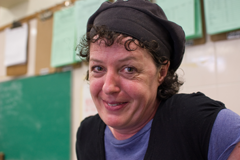
Diane Brown is serving plate after plate of steaming pasta to a shuffling line of hungry Downtown Eastsiders.
A woman holds out a handful of coins to Brown, who takes it and hands back a serving of lasagna and fresh greens.
"This has spinach in it," a woman exclaims. "There's no spinach in lasagna!"
And in one fluid motion, she fires the plate over the counter and right back at Brown who, mouth agape, staggers backwards in shock.
"That kind of incident doesn't happen every day," Brown tells me later, chuckling as we sit down for lunch in the Carnegie's high-ceilinged cafeteria. The Carnegie Kitchen is one of more than 30 free and low-cost food outlets serving the 8,000 or so homeless and low-income residents in Vancouver's Downtown Eastside, a neighbourhood identified as Canada's poorest postal code.
Thirteen years ago, when Brown first began cooking at the Carnegie, the word "vegetable" was practically taboo, much less the practice of slipping spinach into lasagna.
"In the beginning I had a lot of resistance," she recalls. "Apparently there was too much lettuce coming out of the kitchen!"
Brown laughs, then is serious. "I think the people in this community are really given the worst. The worst housing, the worst food. That's why I don't budge on healthy cooking, because it shows them they deserve better."
The Carnegie Kitchen is an oasis in the nutrition desert that is the Downtown Eastside.
Most charitable meal providers in the neighbourhood rely nearly completely on donated food, which means they have little or no control over what they cook up for customers. Salty soups, white rice and day-old pastries are the order of the day -- hardly substantial for someone living with HIV, or a person who's spent the night on a cold sidewalk.
I'm strong to the finich, 'cause I eats me spinach
"Restaurant kitchens never really appealed to me," Brown explains on another day when I visit the Carnegie to find her chopping vegetables and using a big paddle to stir the split pea and ham soup that bubbles inside a steel vat.
Brown trained at Vancouver's Dubrulle Culinary School where she learned the art of French cooking, but rather than work in fine dining, she got a job cooking for tree planters in Northern B.C. "I always like to know who the people are I'm cooking for, otherwise it just doesn't seem meaningful."
When she first began cooking at the Carnegie, Brown says, she lived nearby "in Shanghai Alley, and when I walked home after my shift, sometimes people would pass me on the street and yell out, 'What's for lunch tomorrow?' I'd tell them and they'd moan and groan and yell, 'Not again!' I felt like a school matron or something."
Nutrition is important to Brown, who knows all too well the value of good food and what it means to go without. One of six sisters, Brown grew up in Edmonton in a single-parent household. "We were poor for many years so I always had an appreciation for good food."
Brown takes a break to eat a salad with homemade ranch dressing she whipped up earlier this morning using dill and buttermilk. Brown adores her mother and appreciates her many good qualities, though she didn't learn from her much about making delicious meals.
"My mom had one cooking method," she says, "and that was frying on high heat in margarine."
Brown still remembers what it was like to have real butter at Christmas. "The rest of the year we had a rotating dinner plan which consisted of various versions of hamburger meat fried on high heat," she laughs. "We called it hamburger crap, but there were different kinds like, Hungarian crap had mushrooms in it, Hawaiian crap had pineapple in it, and that was all we ever ate."
Having served lunch alongside Brown a few Thursdays a month, I've noted the handful of people who consistently refuse vegetables, and no amount of playful coaxing on my part could convince them otherwise.
After 13 years, however, Brown is used to the complaints and doesn't let them sway her. "I love cooking vegetarian because it's healthy and it's cheap," she says. "You can experiment too -- I've been cooking Ethiopian for our lunch specials lately, and even though everyone complains at first, as long as I can convince them to take one bite I can usually change their minds and open up their world a bit."
Brown is quick to emphasize that she is part of a Carnegie team of dedicated staff and volunteers. And while fiscal creativity and talent in the kitchen mean Brown and her fellow Carnegie cooks can bake a mean spinach pie on a shoe-string budget, what separates the Carnegie from other charitable food outlets in the Downtown Eastside is that there is actually a budget for food.
The less than five dollars Carnegie charges for lunches and dinners make its restaurant-quality meals easily the best bang for your buck in a food-rich city like Vancouver. But for people who can't even afford that, and for those who are unwilling or unable to volunteer for meal vouchers, the Carnegie might as well be a five-star Gastown restaurant.
According to the Downtown Eastside Demographic Study, the average monthly income of someone living in one of the neighbourhood's sub-standard SROs is just over $1,000. 77 per cent of SRO residents report annual incomes under $15,000, and 60 per cent are on welfare. The province of British Columbia currently provides a single, employable person on income assistance with a support allowance of $7.83 a day for food, clothing, transportation, phone calls and any other expenses that might come up throughout the month.
Breakfast, lunch and dinner at the Carnegie Kitchen would not even leave enough left over for a single bus fare. Though cooking at home would stretch those limited support dollars a bit further, most SROs, which make up half of the neighbourhood's 10,000 low-income housing units, are void of kitchen facilities, and pest infestations make food storage a futile endeavour.
Charitable food outlets are the primary source of sustenance for nearly half of the Downtown Eastside's SRO dwellers. As for the homeless, more than half don't receive any kind of income assistance, meaning the neighbourhood's free food outlets are quite literally their bread and butter. Yet for many people waiting in the Downtown Eastside's charitable food lines, a free meal often comes at a hefty price.
Pray first, eat later
Rain came down in frigid sheets as I made my way to the Union Gospel Mission on a gloomy Tuesday evening to line up for dinner. The streets were deserted until I approached the low, brick building at the corner of Princess and Cordova, where over 150 hungry people were lined up, waiting to eat, most of them getting soaked by the rain.
When the line finally shuffled forward, we were crowded into a small, low-ceilinged room with rows of plastic chairs. After waiting in line for an hour and fifteen minutes, we now were required to sit through the chapel service. A few of the visitors seemed to be enjoying themselves, but most just looked cold, miserable and resigned to the fact that this is what had to be done in order to eat.
After the service, we were told to line up once again until admitted into the crowded cafeteria, where people sat, elbow-to-elbow, eating their evening meal: four meatballs, a serving of rice mixed with a few frozen vegetables and a white bun. People kept their heads down, eating fast so the next person in line could take their place.
Back outside, 20 or so people waited for their turn, but the mission had met capacity and they were out of luck. They'd have to seek out another food line elsewhere in the neighbourhood. Standing in the cold for over an hour can be hard, especially hard for persons living with serious mental illness or a disability. But to avoid hunger, many of the poor in the Downtown Eastside can expect to stand in food lines for two or even three hours a day.
'Food is important to everyone'
A few days later, the weather has changed, and I pop my head in the Carnegie's sun-filled kitchen. Brown greets me warmly. The breakfast rush is long over and the lunch rush has yet to begin so the cafeteria is peaceful. A few people drink coffee or play cards.
The Carnegie may not be an elegant dining room, but thinking back to the congested, fluorescent-lit cafeteria in the Union Gospel Mission, I immediately understand why Downtown Eastsiders warmly refer to this place as their living room.
I mention this to Brown, who nods. "An older woman used to come in here all the time," she tells me. "Her son had just died and she was quite poor and she told me that she came to the Carnegie because she just found the environment so comforting and the food always looked really nice; like someone really put some care into it."
Brown's latest project is a one-pot cookbook that teaches low-income people how to prepare healthy and interesting meals with limited amenities, cooking equipment and finances.
Each recipe in the cookbook offers a meat and vegetarian option, as well as tips on safe, healthy cooking techniques. And because pest infestation is so rampant throughout the Downtown Eastside, all of Brown's recipes can be made with just a handful of simple ingredients. "We're thinking about including a sachet of spices with each cookbook so people don't have to go buy their own," she says.
Though Brown and the rest of the Carnegie's dedicated kitchen staff work hard each day to improve people's lives, the overall health of the community continues to deteriorate because local initiatives, while an important piece of the puzzle, are fruitless without government action. Brown believes that food must be understood as a social and political good that is both fundamental to human rights and essential to people's health, welfare and personal and cultural identity.
"Society's perception of food really has to change from this idea that any kind of food is acceptable to feed the poor," she says. "Food is important to everyone, whether they admit it or not."
Which raises a troubling question: Does our society's increasing reliance on charities to feed the poor actually undermine every person's basic right to decent nutrition in a humane setting? That is the subject of tomorrow's second article in this two part series.
Related Tyee stories:
- Let Them Eat Starch
In food lines of Vancouver, we found scant nourishment. - Seven Solutions to Homelessness
Each is working somewhere else, and will save money and lives here. - A Love that Feeds the Hunger
Interviewed: hunger activist Sara Miles, author of Take This Bread.
![[Tyee]](/design-article.thetyee.ca/ui/img/yellowblob.png)
Read more: Rights + Justice, Food, Housing










Tyee Commenting Guidelines
Comments that violate guidelines risk being deleted, and violations may result in a temporary or permanent user ban. Maintain the spirit of good conversation to stay in the discussion.
*Please note The Tyee is not a forum for spreading misinformation about COVID-19, denying its existence or minimizing its risk to public health.
Do:
Do not: