- Ms Kaye is a Tyee Builder. You can be, too.
- Mary Carlisle is a Tyee Builder. You can be, too.
- Prem Gill is a Tyee Builder. You can be, too.
- Nancy Flight is a Tyee Builder. You can be, too.
- Justin Everett is a Tyee Builder. You can be, too.
- John Westover is a Tyee Builder. You can be, too.
- Nora Etches is a Tyee Builder. You can be, too.
- Edward Henderson is a Tyee Builder. You can be, too.
- Bharadwaj Chandramouli is a Tyee Builder. You can be, too.
- Dean Chatterson is a Tyee Builder. You can be, too.
- Marius Scurtescu is a Tyee Builder. You can be, too.
- Robert Parkes is a Tyee Builder. You can be, too.
- James Murton is a Tyee Builder. You can be, too.
- Susan Doyle is a Tyee Builder. You can be, too.
- Vincent Strgar is a Tyee Builder. You can be, too.
- Helen Spiegelman is a Tyee Builder. You can be, too.
- Subir Guin is a Tyee Builder. You can be, too.
- Kimball Finigan is a Tyee Builder. You can be, too.
- Joanne Manley is a Tyee Builder. You can be, too.
- David Leach is a Tyee Builder. You can be, too.
Peace Could Create Plenty of Green Energy Without Site C
Why kill a valley when its region is rich in wind and geothermal energy?
It's bad enough that the provincial government and BC Hydro are seriously considering the construction of a dam that would destroy the Peace River Valley and with it the north's capacity to feed the people who live there. What's worse is that there are viable alternatives to another dam on the Peace River. Thirty-five years ago, when the idea of a third dam on the Peace River first arose, large-scale hydroelectricity may well have been the only viable way to create the energy that was needed to meet the province's growing demands. But 35 years later, the range of alternatives available to the government for the production of energy, from large-scale geothermal and wind power to micro-level initiatives that would encourage the production of electricity by consumers, makes the proposed Site C Dam just one option among many.
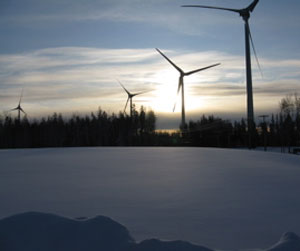
The most promising and practical alternative among these is the development of a wind power industry in northern British Columbia. While the Peace River is a resource for the development of hydroelectric power, the potential wind energy locked into the barren lands on the eastern foothills of the Northern Rocky Mountains that run from Tumbler Ridge in the South to Fort Nelson in the north dwarfs it by a factor of more than a thousand. More importantly, its exploitation wouldn't require the flooding of any valleys, the destruction of thousands of hectares of fertile agricultural land, or the removal of any residents from homes they've maintained for generations. "There's as much power in wind in northeastern British Columbia as BC Hydro's entire generating capacity," says Juergen Puetter, the CEO of Sydney, B.C. based Aeolis Wind Corporation, the company behind the proposed Thunder Mountain wind project near Tumbler Ridge.
"Enormous amounts. There are more than ten Site C's up there." Puetter notes that the quality of the wind resource in the Peace Region is unparalleled in North America. "We've looked all over North America, all over B.C., and there's nothing else that compares with the Peace." What's extraordinary about the Peace, Puetter says, is the quality of its wind, which is some of the best for wind farming in North America.
The secret to a successful wind project isn't simply having strong winds but the right kind, and because of the geographical formations in the Peace the winds that blow so hard and so often here meet all of the important criteria. It is unidirectional, it has a low turbulence rating, and it exhibits relatively insignificant seasonal variations. For example, while winds on the coast vary wildly from summer to winter, in the Peace those variations are estimated to be no larger than 20 per cent. The quality of the wind resource in the Peace allows projects like Bear Mountain and the proposed Thunder Mountain development to operate at efficiencies that other wind farms across Canada could only dream about. For example, while the average hydroelectric dam operates at approximately 50 per cent capacity factor, the proposed Thunder Mountain Project is forecast to approach 40 per cent, a remarkable figure for a wind farm and a figure fare in excess of the 25 per cent that farms in other parts of the country average.
Use the dam you have
Rather than pouring billions of dollars into a new hydroelectric dam, Puetter believes that the better strategy for BC Hydro and its shareholders would be to expand the capacity of the existing Bennett Dam. In doing so, he says, BC Hydro could take advantage of the massive stores of wind energy in the Peace that are just waiting to be tapped. "My personal view is that a much better investment for BC Hydro and for the province than building Site C is to put additional generating capacity on the Bennett Dam," he said. "If you look at the Bennett Dam you have the generating station on the east side, but on the west side is a big cliff, and you could build another powerhouse there and put another ten turbines there and double the generating capacity."
By expanding the capacity of the Bennett Dam, BC Hydro would be able to create a synergy between the intermittent power created by wind farms and the more reliable equivalent generated by the Bennett Dam. When the wind blows, the grid can draw that energy, and when it doesn't, they can let water through the dam to produce it there. In essence, the Bennett Dam would act as a giant battery, storing energy only for when it is needed. "Hydro is extraordinary unlikely to ever build a project like Williston again," Puetter observed, citing the massive flooding and ecological damage associated with the creation of the Williston Reservoir, "but it's there now, and in my view it's not optimally used."
Months after I talked to Puetter, BC Hydro announced the winning bidders for its "clean power" call, private firms competing for the right to supply renewable energy to BC Hydro's guaranteed market. While Aeolis was not on the list, another wind-farming company was. Finavera has drawn some scrutiny for its light cash reserves and lack of a track record in wind energy, but it proposes to build four wind projects in the Peace region producing 293.4 megawatts, enough to power 75,000 homes.
If the projects come to fruition, they could signal the start of a serious wind energy sector in B.C. -- one that BC Hydro should invest far more heavily in order to diversify its portfolio of energy sources, said Puetter. "There's a fuel risk in British Columbia," he explained, "because we're 90 per cent hydro. If there's a drought, we're all out of luck, and in the forties they had a four-year drought. If that happened today, in two years the lights would be out. In this day and age, you have to diversify. We have no coal, we have no nuclear, all we have is hydro, either run of river or storage, a tiny bit of thermal, and a little tiny bit of wind, less than one per cent. We should have twenty to thirty per cent of capacity from wind alone."
Puetter believes that the best way to develop British Columbia's wind energy industry is by implementing a standing offer for wind energy like the one in place in Ontario. "Germany has become the powerhouse of wind because they have a standing offer, and they've had it for ten years," he said. "They have 350,000 jobs in Germany just from the wind industry. In B.C. we have, what, eighty now? Germany fits into B.C. two and a half times, and we have ten times better wind. It should be the other way around." As it currently stands, B.C. Hydro's standing offer program is limited to projects of 10 megawatts or less. The average large-scale wind farm has an installed capacity of at least 100 megawatts.
Instead, the bulk of the wind energy that BC Hydro will acquire will come from the long-term contracts that it signs with producers in conjunction with its clean energy calls. Whether BC Hydro's approach produces the kind of wind energy boom that Germany has enjoyed remains to be seen. B.C.'s route to wind power has been criticized as not only inefficient but a rip-off for taxpayers with the potential for corruption. John Calvert of Simon Fraser University, author of Liquid Gold: Energy Privatization in British Columbia, points out that B.C.'s Liberal government, having decided that only private firms will develop the province's wind power potential, subsidizes those projects in various ways and provides government-secured, long-term energy contracts worth millions of dollars -- awarding those potential windfalls of profit through a secret process. He adds it all up and sees "an enormous giveaway of literally billions of dollars in wind farm assets and future public revenues to private power developers."
A vision of diversified employment
BC Hydro's acquisition policy aside, the payoffs in and for the Peace Region associated with a more substantial investment in wind energy are considerable, Puetter believes. In addition to the jobs associated with the construction and operation of the wind farms, he is confident that a well-supported wind industry would bring other high-quality manufacturing jobs to the northeast. "We would expect that companies like Enercon," he said, "who are our turbine supplier, would build factories in the Peace to make these turbines, thereby further reducing costs." With enough wind power, there's even the possibility of an entirely new industry in alternative fuel generation.
At last year's Coal Forum, held in Tumbler Ridge on October 8, 2009, Puetter delivered a presentation on the possibilities of an alternative fuel that he likes to call "liquid electricity." Blue Fuel, a chemical compound called dimethyl ether, takes excess carbon dioxide from natural gas plants, combines it with water, energy, and the appropriate conductive material and produces a clean-burning fuel that has a wide range of industrial and commercial applications. There's already more than enough excess carbon dioxide being spit into the atmosphere by the Peace Region's burgeoning natural gas industry and the production plants that refine its harvest. If the wind energy in the Peace were liberated, Puetter believes, the two could be combined to produce this miracle fuel.
"Here in B.C. we have what I call a convergence of energy sources," he said. "We have hydro power, we have natural gas, we have coal, we have wind, we have timber -- we have everything, and we have it all together. There are very few places to my knowledge on this planet that have all of these components together." Why hasn't the provincial government, one that has professed on numerous occasions its interest in greening the provincial economy and generating more value-added jobs, jumped all over this idea? "The problem," Puetter said, "is that it's big and bold, and it requires a vision much like there used to be in B.C. that's beyond six months from now. The question is, where do we want to be in twenty years? Do we want to be a have-not province that relies on imports from Alberta and the United States, or do we want to be a powerhouse that exports and reaps the benefits from that. If you don't plan for it now, it's not going to suddenly happen by itself."
Geothermal, another missed opportunity
BC Hydro's aversion to bold ideas like the large-scale exploitation of wind power has also stifled the development of a geothermal industry in the Peace, a source of energy that journalist and climate change guru Gwynne Dyer describes as "the closest thing to magic we have." Geothermal shares many of the benefits associated with wind power, from its status as a low-impact source of green energy to the potential of spin-off jobs and employment associated with its development. Like wind power, the Peace Region is full of untapped geothermal resources, many of which are substantial enough to rival or even replace the power that would be generated by the proposed Site C Dam. But as with wind, BC Hydro also remains unwilling to seriously explore geothermal as a possible alternative to hydroelectricity.
I can't get an answer to this question," Ken Forest, director of the Peace Valley Environmental Association said, "but they will not explore geothermal. If you took the seven to ten billion dollars that are going to a potential Site C and put that into geothermal, you get the same energy back without flooding a river valley. There's almost no impact, and you've got a base source."
Forest noted that there is even a geothermal hot spot near Moberly Lake, right in the proposed Site C dam's own back yard, one whose development would make use of the skills of the local population and create a long-term economic legacy that would easily eclipse the 25 jobs left behind after Site C's completion.
"As the oil and gas sector around here starts to disappear, they can continue to work in geothermal by using exactly the same technology and manpower and infrastructure that they've got," Forest said, "sending pipelines down three or four thousand feet, put water down one side and pump it back up the other side in the form of steam and generate electricity without any impact on anything. This government can't seem to think outside of hydro. They want to dam everything and exploit every river valley, and I can't for the life of me understand it." ![]()


25
Login or register to post comments
Welcome to Hell
2 years ago
Max Fawcett
Sorry to rain on your parade but wind energy is nothing but hot air..6000 windmills have been built in Denmark, yet their fossil fuel footprint has risen,for every bit of windpower capacity that was built an equal amount of coal-fired electricity generating capacity was also built.Windpower throughout the world has been lucky to deliver 17% of their rated capacity,I challenge you to prove me wrong, in other words you need 5 times as many windmills as you think,and even then the wind stops,in fact there was an entire month in Denmark where the output of 6000 windmills was zero,zero for an entire month.
The price of intermitten wind energy is 5 times the price of our heritage dam power, wind mills kill birds,sonic disruption kills bats and other animals, and you need transmission lines, lines to thousands of windmills.
Let me perfectly clear,we have an excess of electric power in BC,more than enough for domestic use, exporting wind power to the US from the peace river area is a fools games, lost in transmission,a fools game to move weak/soft power thousands of miles.
Unless your transmission line is made from super conductors.
But let`s go on a bit, site C will never happen,electrical use is trending downward,items like the Bloom box, solar thermal,portable nuclear,and or big nuclear,even home-based wind power can run a home.
And there are many others exciting things happening,25% of US electrical use is for incandescent lighting,with new LED lightbulds 80% of that 25% can be saved, new transmission lines in the US can save another 25%...
Every year more efficient appliances are made,sorry Max...The need for the energy doesn`t exist.
Lastly, for a story on wind power you have neglected all the problems with wind power in Europe and the US,you have neglected the cost,a very skimpy piece indeed.
As much as nuclear scared me as a child,I am convinced the future energy needs will be powered by nuclear power, in fact they are building one in India which is being touted as being able to use nuclear waste to operate, if that is true than disposing of waste won`t be a problem.
So maybe your idea of paradise is thousands of windmills,mine is not.
There are plenty of links in my story,real experts who decribe the problem with wind energy.
http://powellriverpersuader.blogspot.com/2010/01/who-wants-to-buy-windmill.html
Tbarnston
2 years ago
IPPs
So now we are advocating IPPs and blanketing the Peace with windmills?
Give me site C please.
BTW, for reference, the 5000ha flood zone for this dam is twice the size of Nicola Lake, near Merritt, which is 2500ha. That's a pretty reasonable size for a project of this scale.
Compare that with the Bowron Clearcut near Prince George, with is 30,000 hectares. Now that's an environmental catastrophe.
Tbarnston
2 years ago
What about the work camps?
Max Fawcett wrote in the previous article "I heard their concerns about the social consequences that would result from the creation of the massive work camp that would be needed to construct the project."
What about the work camps required to build the wind farms? What about the workers who would move there to build the turbines?
dirtmeister
2 years ago
Windmills are not Green.
No mention of the environmental costs of windmills especially to wildlife. Evidence of windmill mortality to bats, raptors and other birds is accumulating world wide. Consider that the Rocky Mountains foothills is a major flyway a disaster in the making. Give me Site C or nuclear any day.
Sandra H
2 years ago
looking to the future
Firstly, I think conservation is the most important thing that we can be doing to reduce future energy needs. However, we do have a growing population so should focus on energy production that at least has the lowest impact which I believe to be wind and geothermal. This does not mean promoting IPPs at all... that is just a result of the current government restricting BC Hydro with the mandate they have placed upon them. Whether or not it involves IPPs is a whole different political issue which tends to cloud the important subject of environmental impacts.
For those who keep going on about the price of wind power. Look at the recently completed Bear Mountain wind project near Dawson Creek. It is a 102 MW wind farm with a price tag of $200 million. Compare that with the proposed Site C dam which would be 900 MW and will likely exceed $10 billion. It doesn't take much to see that the Site C will produce 9x the power but at roughly 50x the cost. Big megaprojects come with very big costs.... both environmentally and financially.
There are impacts with everything, except conservation of course, it comes down to which has the least impacts. All energy development has transmission lines and roads. Yes, wind also has impacts on the birds and bats but that is being reduced with new turbine technology. It is not displacing families and is not destroying prime agricultural land. The impacts are far less than destroying over 100 km of river valley with valuable farmland and wildlife habitat.
Flooding over 5000 hectares is reasonable?!? Since when? Over 3000 hectares of which is class 1 and class 2 land which is very rare in BC. Only 1.5% of BC's land mass is class 1 and 2. We have so little of it already, in a time of growing concern over local food security, it doesn't make sense to destroy prime agricultural land when there are other options that have far less of a footprint. It doesn't make sense to destroy prime agricultural land when there isn't a big need for this energy but rather it is intended for export.
California currently has state regulations that any hydro project over 30 MW is considered non-renewable. There is good reasons for this. They don't build dams anymore in California. Across the states, they are decomissioning more dams than they are building. This is because of the huge environment impacts that result from large hydro. Why would we then be looking at this old technology, building dams and destroying river valleys, to satisfy the insatiable energy demands of the States.
Welcome to Hell
2 years ago
@ Sandra H
Sorry to diss your math skills but...Site C would be a about 1000 MW....You claim the Bear mountain wind farm cost is $200 million for 102 MW...And Sandra you claim Site C is 50X more expensive...Excuse me?
If you times 102 MW bear mountain wind by a factor of 10 brings you to 1000 MW...If you times $200 million by a factor of 10 = $2 billion dollars.....
There is equal power to equal power..$200 million for 100MW....$2 billion for 1000MW ....
The above costs are equal.....But now Sandra is where you go loopy!
You claim site C is 50 times more expensive...50 X $2billion dollars = $100 billion dollars....
Site C is estimated at $6 to $8 billion...Don`t add transmission lines windmills would need grid access too...
So Site C is triple the price...Or is it? Because the most efficient windmills at most get 15% to 20% of their rated power generation on a year round basis!
So that makes Site C cheaper than windmillls,firm power,there when you need it,power you could sell...
Let me finish by saying....We don`t need site C,there is a glut of electricity,electric use is trending downward...
But it really riles me up when people talk about the wind when they haven`t a clue about the real cost,or how wind only generates 15% of rated capacity,or how windmills in Denmark have not reduced building or using fossil fuels...
You have the internet...Please try reading and learning before you practice pie in the skying!
cfvua
2 years ago
Work camps
There should be no work camps associated with wind energy projects due to the capabilities and availability of construction/transportation/hoisting companies based in the BC Peace area. So far on the one completed project and the one to be completed the work that could have been done has mostly been done by out of province contractors. Building/improving a few trails to tower sites is not special work nor is moving the components to the sites. Tower erection is somewhat specialized, but is the only part of the work associated with the units being done by BC based companies. Why??? People who live in the Northeast can do this work if they are allowed to as Mr. Puetter says above.
IF workers contine to be brought in it will put off any positive aspect to wind energy as residents will turn agoanst it.
alive
2 years ago
Beware!
At this moment there is a lot of opposition to some new proposed large windmills in Denmark.
Apparantly they were designed for use offshore, but the powers that be decided they might as well be installed on land, because it is so much easier (read cheaper).
These mills produce much more noise and nobody wants to live anywhere close.
Let us be very carefull what we ask for here; once the projects get the go-ahead then you can be sure they start backpedalling to save on the cost.
Ronald Pagan
2 years ago
The problem with most
The problem with most analysis of electricity systems and investment decisions is that there are real tradeoffs to be made. No one decision is optimal for all accounts. Such is the case with Site C. Is another big damn desirable? No, not really, but what are the alternatives?
The basic answer is that there aren't many. Energy efficiency is pie in the sky. A recent analysis by Jaccard demonstrated of all the DSM programs working in the states, that they have had minimal effect and are prohibitively expensive in a dollar invested per energy saved metric. Adjusting our pricing scheme to induce more conservation is ideal but is simply politically unacceptable. Imagine going from 5 cents per kWh to 70 cents.
Nuclear is a non-starter for most people (but probably my preferred option) and Wind farms are too expensive and need backup baseload anyway. Wind cannot be a core component of your system but only complimentary. Site C would provide you with 900 MW of highly reliable baseload capacity.
So what do you do? Under that lens Site C looks possible. The local environmental degradation is definitely problematic but I'm somewhat of a fatalist about it. Addressing climate change will require mass electrification in hydro rich regions. Site C is basically an inevitability if you believe that reduce emissions is important.
seth
2 years ago
Global warming/peak oil
Global warming/peak oil needs electricity.
While currently BC doesn't import net electricity, close to 2/3 of our energy use is fossil fuels. Fossil's cost a lot money and create immense environmental damage from air pollution and global warming.
By replacing our fossil fuel use with mass produced nuclear power, we do our part in the war against global warming, peak oil, and the elimination of millions of annual deaths world wide from air pollution. Because fossils are so expensive financial payback is generally less than three years.
Site C will cost $7B or so $12B/Gw average roughly twelve times the cost of new factory produced nukes or 6 times the cost of the existing Candu tecknology.
Two enhanced Candu 6's like those AECL just spend four years building China at Qinshan for around $2 billion, would produce 50% more power - but of the very valuable baseload variety - than the total of the new Pirate Power scams, or three times as much as Site C and fit on the site at Burrard Thermal.
Pirate Power Chief Engineer, Dr.Bruce Ripley P.Eng, President and COO, Plutonic Power Corporation has stated that nuclear is one of the best options for British Columbia.
Since the US nuclear industry is so crippled by regulation and inefficient power companies, we could export nuclear power creating a massive multibillion market for BCHydro.
Recent surveys havc support for nuclear power in the 65% range across Western Canada. In the US that figure with more info in the media has reached 75%
Given the onslaught of disinformation from Big Oil and their Astroturf supporters at Suzuki. Pembina, Greenpeace, WWF, and Sierra 65% in favour is an amazing result.
A Port Moody nuclear survey would find far more opposition to a ugly noisy wind farm producing almost no power to a quiet nuclear plant producing zero pollution replacing a deadly radioactive gas spewing stinking noisy gas plant.
If we don't do it Alberta will.
Large scale geothermal needs a pump that can work at 500 degrees and it still causes earthquakes. Fusion energy will be available sooner. There is no interest in BC in geothermal.
http://thetyee.ca/Blogs/TheHook/Labour-Industry/2010/04/01/GeothermalAuction/
We can bankrupt ourselves with IPP's, Site C's, and the odd geothermal, wind or tidal plant but the cost of these is so high and the output so small that we'd be better off importing nuclear power from Alberta. I'm sure Bruce Power would be happy to sign us up to their planned 4 reactor complex.
BC Mary
2 years ago
Ontario, lacking oil wells, has been investigating wind power
and it's not a clear victory for clean green energy. There's evidence that it's not clean at all.
"Nearly 600 gather for meeting on health effects of turbines" in the very small town of Fergus Ontario.
Britain is calling for serious studies on the effects of wind power; these concerns are being echoed in Canada where P.E.I. has placed a moratorium on new wind power projects until the research results are in.
Read more here:
http://www.wellingtonadvertiser.com/index.cfm?page=detail&itmno=5741
.
Karl Weissalles...
2 years ago
Wind Power is the one to go
Excuse-me? Health effects of turbines? Are you buying that? There is absolutely no health effects. This is the problem, people are concerned about things that they do not know. Please, before inserting any comment here verify what you are posting.
This is disgusting how many ignorants live in this province.
You know what, go green, turn off the main power switch at home and please, do not use any electricity, because, you are killing fishes, bats, birds and so on.
Everybody is fine with hunting, nobody cares about all the wildlife that is killed for fun.
Get a life a protest to the right thing.....
mopled
2 years ago
This says it all about wind
http://www.youtube.com/watch?v=1RcTjdY1aN4&feature=player_embedded
lynn
2 years ago
Damaged by large-scale exploitation
There was a documentary on TV recently reporting on protests in the Maritimes due to serious concerns by residents over the consequences of large-scale development of wind turbines... can't remember if it was in Nova Scotia or New Brunswick.
The couple profiled in the documentary had a lovely home in a rural area (that had become surrounded by ever- increasing numbers of wind turbines). They literally had no choice but to pack up their belongings and leave, abandoning their much-loved home and the land surrounding it because of serious concerns about their declining health.
They had young children and apparently the wind turbines created forceful vibrations that traveled along the ground and right under their home....vibrations that they literally felt in their bodies. They all developed health issues.
One of the big problems with wind power is, like everything else these days, it becomes fueled by greed and escalates quickly into mass production/development ...nothing is done on a small or more manageable scale anymore.
Locating windmills away from areas where people reside is not an answer in itself either. Imagine the effect those kinds of massive air vibrations must have on wildlife - and on the ability of birds to navigate/migrate, for example?
YCSTS
2 years ago
Wind Power Reality
Juergen Puetter says: "...There's as much power in wind .. as BC Hydro's entire generating capacity...Enormous amounts. There are more than ten Site C's up there..."
This is the typical statement of Wind & Solar SnakeOilSalesmen. Pure idiocy and entirely worthless.
There's enough Copper in the Ocean off of B.C. coast to supply 1000X B.C.'s copper production. So who needs mines - Yep, there's loads in the ocean, Gold too - just have to go get it. DUPES.
And Sandra H - you're unaware of capacity factor. The avg capacity factor of California's Wind Turbines is 20%. Maybe you might get 25% CF at Bear Mountain. So $200M/102MW/.25 = $7.8k per kw. The Wind is often zero - the capacity credit of all the Wind Turbines in Germany together is only 4%. So that means you need a backup capacity of at least 96% of the 102 MW. So who's paying for that? If you use Hydro that's at least another $2k per avg kw.
Public pays for the long power transmission lines to the Wind Turbines. Another $1k per kw added. Hydro will mirror the wind to some extent, but Wind & Hydro are typically very low late summer and deep, cold winter when power demand is max. That means burning NGas or Coal at its least efficient for backup power. Who's paying for that?
O&M costs for Wind Turbines avg 3 cents per kwh over the 15-20 yr life. Add O&M on the shadowing Hydro, add O&M share on the backup NG/Coal power plant and you're pushing a 5 cents per kwh O&M share on top of at least $11k per kw capital cost. For only a 15-20 yr life.
Compare with Nuclear at <$5k per kw (low volume) and 2 cents per kwh O&M, for reliable 24/7, rain or shine, summer or winter power, with 60 yr lifespan.
Wind Power is inexcusable stupidity and the only reason it gets 100's of billions in subsidies World Wide is because the Fossil Fuel lobbies are promoting it, in a Bait-And-Switch campaign to ensure that there no realistic alternatives to their Energy Hegemony.
As for Geothermal, Iceland is the geothermal power center of the World – with decades of experience. They just completed a large 690 MW Hydro project with a 76% CF. So why didn’t they go geothermal instead? They only get 11% of their electricity from geothermal power, the rest from Hydro. You would think Hawaii would be the Geothermal Power capital of the USA. Instead it relies on Coal for 13%, and Oil for 68% of its electricity supply, with 1.8 % coming from Geothermal, 0.7% from Wind Energy and not surprisingly has the highest power rates in the USA of 21.3 cents per kwh. I would say if Geothermal was so economical they would have figured it out in Hawaii decades ago.
frank2
2 years ago
Ronald Pagan
Ronald Pagan wrote:
"Adjusting our pricing scheme to induce more conservation is ideal but is simply politically unacceptable. Imagine going from 5 cents per kWh to 70 cents."
The problem is to shift the political unacceptabity -- not find work arounds.
Currently, residents condone HYDRO paying IPPs high rates for the incremental power they produce, power that is expected to be exported at lower prices to foreign markets. The Tyees efforts to educate us all have not yet had an effect.
But to reject the idea that ALL CONSUMERS OF INCREMENTAL POWER (individual users (household, business, and as noted later, foreign consumers) pay the costs of those extra amounts is surely stupid. Hydro has taken the essential first step in establishing rising block rates (there is room for discussion about block sizes and how much dividend should be paid to the government). Why not raise them to economic levels?
If refusal to sell incremental power at less than incremental cost eliminated some demand, great. And we'd be spared a lot of talk about the best ways of producing power no (unsubsidised) user is prepared to pay for.
These ideas are too conservative for the Liberals, but not, I hope, for the NDP and Greens.
frank2
2 years ago
Ronald Pagan
Ronald Pagan wrote:
"Adjusting our pricing scheme to induce more conservation is ideal but is simply politically unacceptable. Imagine going from 5 cents per kWh to 70 cents."
The problem is to shift the political unacceptabity -- not find work arounds.
Currently, residents condone HYDRO paying IPPs high rates for the incremental power they produce, power that is expected to be exported at lower prices to foreign markets. The Tyees efforts to educate us all have not yet had an effect.
But to reject the idea that ALL CONSUMERS OF INCREMENTAL POWER (individual users (household, business, and as noted later, foreign consumers) pay the costs of those extra amounts is surely stupid. Hydro has taken the essential first step in establishing rising block rates (there is room for discussion about block sizes and how much dividend should be paid to the government). Why not raise them to economic levels?
If refusal to sell incremental power at less than incremental cost eliminated some demand, great. And we'd be spared a lot of talk about the best ways of producing power no (unsubsidised) user is prepared to pay for.
These ideas are too conservative for the Liberals, but not, I hope, for the NDP and Greens.
Ronald Pagan
2 years ago
Frank
I hope you can tell me how to shift political unacceptability. I'm all for charging the marginal cost of generation in the province. What about the industries that rely on cheap power to be competitive however? Those industries employ people, salt of the earth people who vote for parties like the Liberals and NDP.
Do you really think the NDP is going to lie of the sword of conservation through marginal cost pricing to save emissions and the Peace Valley at the cost of rural employment?
Shifting political acceptability always sounds like a good idea. Put it in practice and try to shape public opinion. You are a political leader and you go tell people that from 4:00 to 9:00pm they are going to pay 10 times the cost of electricity than they are currently paying. It's not going to happen.
Furthermore, average cost pricing, currently employed in BC is the law. The BCUC regulates BC Hydro to sell electricity at those rates. Hydro's hands are pretty tied when it comes to broad rate reforms. Unless there is a change in legislation for the BCUC to begin accepting marginal cost pricing it wont happen and a change in legislation requires some iota of political acceptability getting back to my first point.
mopled
2 years ago
There are very definite health effects from wind turbines
"Dr. Nina Pierpont explains in simple, layman’s terms how turbine infrasound and low frequency noise (ILFN) create the seemingly incongruous constellation of symptoms she has christened Wind Turbine Syndrome. (Incongruous only to the non-clinician who does not understand Mother Nature’s organs of balance, motion, and position sense.) For the high level clinician, Pierpont provides a parallel chapter written in sophisticated medical language and format, complete with voluminous, up-to-date clinical and scientific references."
http://www.kselected.com/?page_id=6560
jimmy_laroux
2 years ago
Not a good article.
Rather than trying to critically evaluate the feasibilty of wind energy in BC, this entire article reads like Aeolis press release.
First of all, what does "as much power in wind in northeastern British Columbia as BC Hydro's entire generating capacity" mean? Peak power or averaged over the year? Or is it the theoretical maximum power that could be extracted from either the peak or average power? Or is it what could be cost-effectively generated?
Second, why not get a quote concerning the potential for wind energy production in the North East from some reputable and disinterested party, not from someone in the wind power industry trying to sell their product.
Finally, the title of this article, "Peace Could Create Plenty of Green Energy Without Site C", is kind of meaningless as it stands. Of course it could, but that doesn't matter in the slightest. Wind power is non-firm, so the queation should have been asked is "If wind farms are built in North Eastern BC and Site C is not, can future peak demand be met even if the wind speeds are low in those wind farms."
Perhaps the author could have asked BC Hydro about the feasibility of this idea, rather than accept at face value whatever Puetter says.
Seriously?
frank2
2 years ago
Pagan is right in saying it
Pagan is right in saying it is difficult to get acceptance of marginal cost pricing. BUT, he's wrong when he says we charge average cost -- we do now have rising block tariffs. All that's needed is to relate the higher rate to the marginal cost of production. (I know, it ain't simple, with many different non-monetary values involved among choices -- BUT what IS simple?) As for the point about higher costs reducing jobs, recall we're talking about MARGINAL demands, and there should be ways of increasing productivity in power use.
In any event, somehow the message has to get out that present policies imply all of us are subsidising foreign consumers and (mostly foreign) owners of IPPs.
North of Hope
2 years ago
Has this been peer reviewed?
"mopled, There are very definite health effects from wind turbines"
RickW
2 years ago
Ronald Pagan
There were industries that relied on cheap petrochemical energy. Where are they today?
Sask Resident
2 years ago
Wind is a Joke
Wind is a joke! Too big a carbon foot print and varying output.
Conservation first, then reasonable alternatives like hydro, nat gas (especially all those flare stacks), passive geothermal to reduce heating and cooling demands, run of the river, especially for off grid areas and cheap, abundant coal.
Ronald Pagan
2 years ago
Rick
"There were industries that relied on cheap petrochemical energy. Where are they today?"
They're still around and are still dominating the shape of our economies. Moreover they are being supported by Governments the world over lending credence to my original point that it is exceedingly difficult in a democracy to actively engage in policies that reduce competitiveness of industry. And it isn't necessarily because the industrialists/business are in bed with governments, it's because those businesses employ people who vote.