News

Illegal Voting Is Easy

Vancouver voting officer saw evidence of non-citizens casting ballots.

By Christine McLaren, 20 May 2009, TheTyee.ca

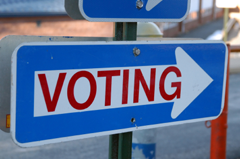
Voting Sign

Fraud stats unknown.

It would be fair for British Columbians to assume that only Canadian citizens voted in Tuesday's provincial election. After all, non-citizens can't vote in Canadian elections, right?

Well, it turns out that's not always the case. In fact, fraudulent voting in Canada is easier than some might think.

On May 13th, the day after the B.C. provincial election, Suzanne Norman, a supervisory voting officer at Armstrong Elementary School, filed an official complaint with Elections BC after learning that several people at the Vancouver polling station where she worked had been registered to vote despite being ineligible.

The concern was first brought to her attention when a man approached her explaining that his wife had received a Where to Vote card -- an official document that allows someone to vote -- despite the fact that she was not a Canadian citizen.

"He said, 'She's not a Canadian citizen, she's not eligible to vote, why does she keep getting these cards?'" Norman told The Tyee.

Later, a second man approached one of Norman's colleagues asking about regulations surrounding citizenship and voting eligibility and informed the official that three of the people voting in the room were not Canadian citizens. He chose not to challenge their vote.

But with four allegedly ineligible voters holding ballots in just one room, it is a situation that Norman, who has twice worked for Elections BC, says is a loophole that could easily be taken advantage of all over the country.

Faith, penalties and risks

In many ways, the Canadian electoral process operates on a certain level of faith in voters. It's simple to register if you are not eligible; they just trust that you won't.

Elections BC gets their voter list from the Elections Canada National Registry, which is built from vital statistics, and a variety of partner sources including Citizenship and Immigration Canada, provincial and territorial motor vehicle registrars, and the Canada Revenue Agency (CRA).

If not on the list, however, voters must only present photo identification and proof of residence to register for the voters list, and are not required to prove their citizenship, age, or other eligibility. If no proof of residence is available, a family member or registered voter from the same electoral district can vouch for them.

Voters and vouchers must sign a solemn declaration confirming their eligibility, the breach of which can result in a $20,000 fine, two years in jail, or both. However, there has not been a single charge of fraud in over 27 years. Only a handful of people have been challenged on their eligibility, despite the indication that it is happening in the province.

Voter fraud facts are scarce

Norman claims, however, it is entirely possible that the people voting ineligibly have no idea they are committing a crime. Two of the alleged ineligible voters she saw on election day had the oath translated to them by family. No translators were provided by Elections BC to ensure what was translated was actually what the voters were signing. Others without a strong grasp of English may see a voter card they have received despite being ineligible and assume rules have changed and they are allowed to vote.

"When they sign the oath, do they know what they're signing? We don't even know," says Norman.

Kevin Atcheson, policy analyst and researcher for Elections BC, said in correspondence with Norman that they make every effort to hire election officials who can speak the common languages spoken in their community, and to reach out to other ethnicities in ad campaigns.

"Elections BC's ads regarding voter qualifications, voting opportunities and where to get additional information are published in the ethnic media in several languages. During an election, Elections BC ensures that voter assistance is available through our toll-free phone service in many languages," Atcheson wrote. "There are also extensive materials available in voting places and on the Elections BC website translated into sixteen different languages to ensure that language does not become a barrier to exercising a citizen’s constitutional right to vote."

Norman says that's not enough.

But Kenn Feris, spokesperson for Elections BC, admits while the system may be flawed, the integrity of it remains strong.

"We've never been given any information about systemic voter fraud in British Columbia and no one has ever come forward with facts to support voter fraud," Feris says.

He maintains that in order to keep voting accessible, a certain amount of faith must be put in the system.

"They sign a solemn declaration when they come to vote and we need to trust them and their word."

If they have gotten on the list and received a Where to Vote card but are not eligible, he said, they have done it themselves either directly at the polls or through one of the partner sources.

Achetson explained further, "All registered voters receive a Where-to-vote card. The only way someone can become a registered voter on the provincial voters list is by directly registering with Elections BC, registering to vote at a local government election where Elections BC registration forms are used, or by being on the federal voters list. Regardless of the source of the registration, at some point the voter has made a declaration that they are a citizen."

Voters, vouchers, and translators must all sign the oath, but to require more with no other options would be unfair and leave voters at a disadvantage, says Feris.

"We administer the Election Act, and we administer elections as a fair and equitable as possible. There are checks and balances in place and beyond that we do what we can to make voting accessible and fair. But there is a level of individual responsibility to be aware of what they’re signing when they sign a solemn declaration."

A fine balancing act

So the system based on faith, with seldom administered punishment and such obvious loopholes begs the question. What should be held higher in a democratic election: security of the ballot, or access to it?

Dr. Dennis Pilon, a political science professor at the University of Victoria who specializes in BC politics and electoral reform, describes it as a concern, but a fine balancing act.

"The fact that [ineligible voters get registered] is obviously a problem," he says. "This is a question to ask [Elections BC] and say how is it possible that someone can get through that rigorous process?"

However, Pilon claims that, despite the unfairness of ineligible voters being registered, it is not a cause for great concern.

"There is no academic evidence to suggest that fraud is widespread in Canada," he says, unlike the United States where claims of fraud are often analyzed as partisan politics to make it more difficult for voters -- mainly democrats -- to register.

"In our voting system it's highly unlikely that someone could organize a campaign that could make any type of impact through voter fraud."

So we walk the tightrope of democratic fairness. Should Elections BC take steps to stop the people falling through the cracks into the election pit that don't belong there in the next election? Absolutely. But does it outweigh keeping a system open and accessible to everyone? Pilon says no.

"On the one hand we want to protect the security of the ballot -- we don't want people walking in from all over and voting when they're not supposed to. But on the other hand we want to balance that with access to the ballot, to avoid an elitist system."

Suzanne Norman was right when she said, "This is wrong. It's just wrong. Something has to be changed."

But the big picture is just as integral.

"We just need to put it in perspective," Pilon says simply. "We need to come up with a solution that isn't worse than the problem."

Related Tyee stories:

 [Tyee]

24  Comments:

Login or register to post comments

  • G West

    3 years ago

    Absolutely

    Since we no longer have door to door enumeration there is no question that there are non-Canadian citizens voting.

    If you pay taxes you're on the voting list and you don't have to be a citizen to vote.

    When paid enumerators established the voters' list with door to door canvassing there was a chance to actually identify potential voters and establish their citizenship.

    Now there is no such chance - file a tax return - get a driver's license and 'bob's your uncle'....the chief electoral officer isn't the slightest bit concerned about anything except making certain that folks have an 'address' not that they're citizens.

    Pee Wee doesn't want homeless folks voting - he could care less if non-citizens do.

    The system has NO integrity..Period.

  • driftwolf

    3 years ago

    Civilised nations consider

    Civilised nations consider the idea of "no taxation without representation" to be a necessary thing. Many nations allow non-citizens to vote for local and regional elections (but not national) so long as they are legal residents.

    In Canada, however, permanent residents are expected to pay all the taxes, obey all the laws, and generally have all the responsibilities of citizens without ANY say in how things are run.

    That, to me, is taxation without representation. Interesting how in Canada, this is considered normal.

  • Grumpy

    3 years ago

    No wonder 50% of the people don't vote...........

    ............the entire system is corrupt and the results illegitimate.

    Welcome to democracy Canadian style!

  • alive

    3 years ago

    like who cares?

    When I rented in Jenny Kwans riding, I kept getting vote-cards for a previous tenant.

    Each election I told the officials about it and nothing was ever done.

    I suspect that nobody gives a shit!

  • ROBBINS Sce Research

    3 years ago

    Our company spoke with an

    Our company spoke with an individual involved in counting ballots--for the old Burquitlam riding in 2005--this man was a former VSE investigator. He said about 150 ballots--from out of town were never counted. We informed NW--they had a reporter phone this man--who immediately contacted me regarding this conversation--which simply means he reiterated what he had told me.

    Burquitlam--in 05 Bloy vs. Heatley NDP--was very close.

    It raised the question--how many more ridings are experiencing this type of selective vote count. These folks are volunteers--and this is fine--unless 'they' are predisposed to wanting one candidate over another.

    Then problems could arise.

    Canada (BC) has the good/bad fortune of having a neighbour to the south that goes through its democratic adjustments--hanging Chads etc. fairly publicly.

    Accordingly, it is always easier to look to the sins of our friends down south--then to look at our own transgressions.

    A leap--as I read and listen to the concerted efforts of regular media to continue to explain/deflect the poor voter turnout (Campbell received 38% of voter support as against 2005--NDP 35% Green 6.5% and BC Conservatives 9.5%) based on 2009 seats and full load of candidates as the non-voters problem--it is becoming increasing clear to me---how
    desperate and fearful they are--,

    what will the public response be as Olympic numbers and budget information finally comes out---how will this impact on things like BC Rail---affect media financial problems--and vacuums likely to result.

    The political establishment is bleeding profusely even after the vote---it is discernable---media is circling wagons--which include political establishment--and 'non-voter's' (anecdotally) don't feel guilty--on the contrary they feel empowered.

    Reminds me a little of the scene in Gangs of New York--where the rich folk up the street--who broker power down to the street--can no longer control the malcontents who eventually arrive at their homes---to slaughter them.

    We don't slaughter elites in this day and age--but the wind direction is blowing into the face of the existing 'establishment'---trouble is brewing straight ahead for 'it' Me-thinks.

  • GordPollock

    3 years ago

    Why can't non-citizens vote, anyway?

    I live with a family who moved to BC 4 months before I did. All of us are about equally likely to leave BC. But I moved from Ontario, and they moved from the States, so I'm elegible to vote and they're not.

    Back in Ontario, I grew up in a suburban area with few immigrants, then went to school with many international students who mostly intended to return to their home countries. At the time the voting restriction against non-citizens seemed totally reasonable.

    But here in BC, many non-citizens are as invested in and committed to our communities as the citizens. It seems to me like they should get a voice in government.

  • ROBBINS Sce Research

    3 years ago

    Something Amazing: Barack

    Something Amazing:

    Barack Obama's speech at Arizona State University. I would not begin to interfere with this perfect man on a perfect day--and a perfect speech to a perfect crowd (politically speaking).

    But to me, I thought it was an amazing speech. Barack Obama has changed the entire language of politics--and made it his own--he has reinvented the American presidency.

    If you haven't already--listen to this speech and tell me if you didn't think that was very incredible.

    Political science, social science, commentators all--this speech is the best I have seen yet--from the best.

    Amazing.

    Can't wait to see Notre Dame.

  • freebear

    3 years ago

    Integrity of the vote Ha Ha Ha!

    Who cares about integrity of the vote when there is no integrity in government!

  • BC Mary

    3 years ago

    What about Bill 42?

    5% of voters -- 170,000 people -- were turned away at the polling booths on May 12 because they didn't have proof of their address [Pacific Gazette].

    Just curious: are convicted felons able to vote, having ample proof of their address?

  • freebear

    3 years ago

    Prisoners may vote I believe is the case

    Crooks voting for crooks!

  • G West

    3 years ago

    Wow!

    Haven't been clicking on all of Ross's links - that's surely a mistake.

    Thanks Mary. That's a disgusting statistic - and exactly what the neocon authors of that bill intended...I wonder how many of the 170,000 were accompanied to the polls in cars driven by folks with Campbell buttons on their lapels?

  • reallife

    3 years ago

    Help please

    Can someone direct me to the link for this statistic?

    "5% of voters -- 170,000 people -- were turned away at the polling booths on May 12 because they didn't have proof of their address [Pacific Gazette]."

    Thanks

  • G West

    3 years ago

    reallife

    It's an estimate - one I'd suggest is likely very accurate - that came from this column which was written at the time that the egregious bill 42 was rammed through the legislature by the very 'democratic' CEO Campbell.

    I could check Hansard to see if the convicted premier was actually there for the vote, but why would I bother, his utter contempt for the institution should be obvious to anyone.

    http://tinyurl.com/q5ypt2

  • ME2

    3 years ago

    But citizenship confers reprsentation for taxation.

    Non-Canadians, whether or not they pay Canadian taxes, are not allowed to vote, since their allegiance may be to a country other than Canada.

    And often these people can't speak or read English, so how can they make an informed choice?

    We have one riding now in dispute over just two votes. Should the discovery of two or more non-citizen votes nullify that contest?

    Considering that new immigrants tend to vote for the party in power, it is easy to see why there is a lack of interest by gov'ts in remedying the problem.

  • ME2

    3 years ago

    RE felons voting

    It is a cental tenet of our justice system that once a felon has served his / her sentence, she / he becomes a person with all the rights of an ordinary citizen, and I'm surprised that an informed person like BC Mary would question that.

    Campbell's record becomes fair game however, only because of the hypocrisy demonstated in his hypocitical pillorying of the ICBC official convicted of alcohol offenses and his ongoing disregard for democratic process.

  • MacKenna

    3 years ago

    A heads up to Elections Canada

    We used to not lock our doors too, but time and experience has made us less trusting and naive. GET WITH THE TIMES.

  • ME2

    3 years ago

    Obama's speech

    Yer right Glen, it's truly an inspiring and believable speech.

    But it remains to be seen if and how he facilitates the dreams and goals he's outlined.

    http://www.huffingtonpost.com/2009/05/13/obama-asu-speech-full-tex_n_203287.html

  • Rod Smelser

    3 years ago

    Other Canadians

    Not that I am trying to change the subject, but there's also an issue around eligibility of other Canadians who have recently moved to B.C.

    Ontario allows any Canadian citizen resident in an Ontario electoral district on EDay to vote. B.C. and Alberta require six month's residence in the province. Which approach is best?

  • shane.polak@shaw.ca

    3 years ago

    Unregistered Voters

    I think the problem is with the unregistered voters. I was a scrutineer for the NDP and I watched unregistered voters register then vote in the poll related to their postal code. If they were to separate out those ballots and double envelope them to keep the ballot private, citizenship could be tested at a later time. That way when Wally wins by two votes we know that he won by two legitimate votes and not by people who are landed immigrants with no voting rights.

  • RickW

    3 years ago

    BC Mary

    Quote:
    Just curious: are convicted felons able to vote, having ample proof of their address?

    Not allowing convicted felons to vote is an infringement of their rights. What I am not sure of though, is whether they vote in the riding the prison is in, or in the riding their previous address is in.

    As an exampke, when my father was in the military, the personnel voted in their home ridings, regardless where they were stationed. Not sure what it may be today.....

  • G West

    3 years ago

    BC Mary and RickW

    Hmm! I think that answer is partly correct and partyl wrong.

    My understanding is that convicted persons who are serving penalties of two years or less ARE permitted to vote while those incarcerated for longer periods are not.

    I believe Sauvé ( a former member of a motorcyle club called Satan's Choice), who challenged the provisions of the election act and won failed in a subsequent challenge after the law was changed to be, as the court demanded, proportional.

    That proportionality was deemed to have been achieved by making the distinction I described above.

    If the finding of the Federal Court of Appeal has been subsequently overturned I'm not aware of it.

    Sauvé v. Canada (Attorney General) (Supreme Court of Canada) Sauvé v. Canada (Attorney General) (Ontario Court of Appeal)

  • RickW

    3 years ago

    G West

    http://en.wikipedia.org/wiki/Sauv%C3%A9_v._Canada_(Chief_Electoral_Officer)

    This is particularly nebulous. I would immediately interpret it as saying that ALL prisoners can vote...............

  • G West

    3 years ago

    RickW - you're right....

    That decision clearly voids the decision of the Federal Court of Appeal that I cited...but the fact the provision is still in the act makes me wonder.

    I'll send a query to the Chief Electoral Officer...suffice to say there's little doubt that current prisoners in provincial custody (2 years or less) are certainly entitled to vote in both provincial and federal elections...

  • S1m0n

    3 years ago

    That wasn't evidence of any kind; it was gossip!

    What Suzanne Norman saw, or rather heard, were ALLEGATIONS of illegal voting. She saw no evidence. Unidentified individuals with no authority to make such a determination made unsubstantiated allegations to Norman that other voters were unqualified, despite being on the list of electors. That's it. There is no way to assess whether this was the truth, and the story does not even indicate why these individuals believed the unknown voters to be non-citizens.

    The Tyee's subhead seriously misrepresents the facts of this story and should be amended.

    • The discussion for this story is closed. No more comments can be added.