

 SHARE:
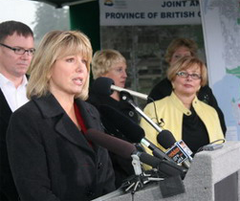
I'm scarcely 30 seconds into my interview with Surrey Mayor Dianne Watts when she decides I have a big city bias.
We've just entered her expansive city hall office and my eyes are fixed on a floor-to-ceiling window that looks onto a small park filled with the bright colours of autumn.
"It's pretty nice here," I remark.
Watts' mouth opens in mock astonishment.
"Pretty nice?!" she exclaims. "What were you expecting?"
I'd been referring not just to the park, but the entire area of South Surrey where city hall is located. Driving into town, I'd passed stands of second growth coniferous forest and open farmlands criss-crossed by narrow streams. It's true what the mayor was suggesting -- not quite the picture of suburban sprawl I'd anticipated.
Watts has bigger goals in mind, though, than pointing out the overlooked beauty of an urban centre that's often viewed as a second tier community on the fringes of Vancouver. With Surrey's population set to meet or surpass Vancouver's by 2040, and a large-scale revitalization of the downtown core in the works, she's intent on turning a Lower Mainland suburb into one of the province's most important cities.
But to be successful, she'll have to face up to some serious growing pains.
Two massive housing developments risk bankruptcy while another burned down last month. And the Gateway project and proposed Skytrain extension threaten to increase sprawl and sideline sustainable development.
Watts toppled former mayor Doug McCallum's decade-long dynasty in the 2005 election, and she's a strong candidate to hold power on Nov. 15. Nobody doubts she's created a new political landscape during her last three years in office. But if she's able to beat Green Party challenger Murray Weisenberger next Saturday, can she reshape an entire city?
Predecessor was 'bullying'
Watts and I sit on comfortable high-backed chairs as the early morning sun begins to light her office. Dressed in bright red pants and jacket, the mayor appears to relish her independence, a political bent that's served her well in office.
Watts entered Surrey politics in 1996 when the Surrey Electors Team (SET), a right-of-centre political party headed by Doug McCallum, broke onto the electoral map. Voted in as a SET councillor, Watts served under McCallum's mandate until 2003, when the former mayor invoked controversy by heavily criticizing the RCMP. He believed the Surrey detachment was hurting the city's image by releasing too many crime statistics to the public.
Watts butted heads with McCallum on the issue and quit SET shortly after.
"McCallum had a style that was very... um... what's the word... bullying," she says.
Two years later, Watts ran as an independent and went head-to-head with McCallum in a municipal race many observers figured was near impossible to win. McCallum had waged a major crime crackdown in the rundown Whalley neighbourhood during his last term and had proven to be a popular -- if controversial -- mayor for the last nine years. But growing opposition over urban sprawl-style development in South Surrey coupled with fallout from a sexual harassment scandal involving a city manager helped turn the tables in Watts' favour.
On election night, the Surrey Now reported that McCallum walked around his headquarters looking relaxed and confident as he shook hands with fellow SET candidates and waited for vote counts to come in.
According to the Now, that mood gave way to "groans and cries of shock and disbelief" from supporters as it became apparent that Watts was steaming ahead of her competitor in almost every polling station. When the night ended, she'd won Surrey mayor by over 10,000 votes and handed McCallum a stunning upset.
Her enthusiasm was short-lived though.
'A gun to my head'
After the results were finalized, SET councillors controlled six out of eight seats on Surrey's council. Resentful about McCallum's departure, the party was looking for political blood.
Only hours before Watts' inaugural council meeting on Dec. 5, 2005, she says she received a phone call from a SET councillor -- who she declined to name -- instructing her to put forward a SET-approved list of nominations for the Greater Vancouver Regional District (GVRD) board.
"I thought 'no, I will present the list I feel is right,' " she says. "I wasn't going to have a gun put to my head."
At the meeting, the SET dominated council voted down Watts' nominations and approved an alternate list that shut the new mayor out of the GVRD. Watts said it was a humiliating rebuke of her authority.
"I had my children sitting there," she said. "So the inaugural meeting should have been a very celebrative time, but it wasn't."
Gradually though, what began as a tumultuous power struggle between the mayor and council subsided over the next year. Thanks to a huge public backlash against the GVRD showdown, council reconsidered and then approved Watts' nomination to the board, a decision that took effect in December 2006.
An even bigger political shift took place next April, when three SET councillors allied with Watts to create the Surrey First party, a loose coalition formed mostly to help raise funds.
"We made the conscious decision of putting politics aside and moving forward with the business of the city," Watts says.
More importantly, Surrey First marked the official unravelling of the once mighty Surrey Electors Team and the beginning of a new political era.
A new party is born
So why did Watts' former opponents become her staunchest allies in less than a year and a half?
Tom Gill, a former SET councillor who joined Surrey First in October 2007, says he was reluctant to change teams at first, but decided to support Watts after she'd shown impressive leadership on crime.
"I didn't want to be considered a flopper," he says. "But I liked the direction she was going in."
Under Watts' urging, council approved the Crime Reduction Strategy, a holistic approach to criminal activity that stressed partnerships between community groups and all levels of government. According to city statistics, property crime declined 25 per cent between 2003 and 2007, a trend Watts credits to the initiative.
James Bennett, outgoing executive director of the South Fraser Community Services Society, says Watts brought a social conscience to Surrey politics that was absent during the McCallum era. An outspoken advocate for Surrey's homeless for the past 18 years, Bennett can barely control his temper when Watts' predecessor is mentioned. He claims McCallum let the city's homelessness problem fester while ignoring urgent appeals for help.
Watts, on the other hand, openly sought his group's support and invested millions in the newly created Homelessness and Housing Foundation, Bennett says. During the last three years, council approved the province's first whistleblower legislation, revived Surrey's transportation plan and drafted a liveability accord for major Lower Mainland urban centres to manage population growth.
"You couldn't ask for a greater paradigm shift between mayors," Bennett says.
Critics see 'business as usual'
While few people doubt that considerable changes have occurred during Watts' inaugural term, she isn't without her critics.
Bob Bose, a three-term mayor before McCallum and current councillor with the left-leaning Surrey Civic Coalition, says Watts hasn't marked a significant departure from her predecessor. With McCallum at the helm, Bose says urban sprawl intensified as the SET council approved development projects without any regard for sustainable planning.
"McCallum never saw a development he couldn't support," Bose says.
Watts has kept that legacy intact, he adds, by supporting truck-dependant industrial growth in South Surrey instead of redeveloping neglected commercial land in the city's core.
"I just see business going on as usual," he says.
Asked if Watts is a shoe-in to win another term as mayor on Nov. 15, Bose says she'll face serious competition from Green candidate Weisenberger. Watts' sole challenger may lack political experience, but he garnered 27 per cent of the vote when he ran against McCallum in 2002. Bose says he thinks Weisenberger's environmental credentials will resonate with voters fed up with Watts' failure to make sustainable development a reality.
The councillor's criticism merits consideration, given that a rapidly expanding population is creating more pressure than ever to deal with issues of urban sprawl.
According to estimates from the province and Metro Vancouver, Surrey's current population -- which Watts places at 463,000 -- is set to meet or surpass Vancouver's by 2040. (The mayor predicts it will happen in the next 10 to 15 years). Mirroring trends across the Lower Mainland, Surrey's population grew by 13.6 per cent -- or roughly 1,000 faces a month -- between 2001 and 2006, according to national Census data.
Such rapid growth has the potential to create serious headaches for civic planners if it's not managed wisely. But it also presents Surrey with a unique opportunity to ascend from second tier suburbia to one of B.C.'s most important cities.
A jewel in the rough
Patrick Condon, a professor of landscape architecture at the University of British Columbia, says Surrey has more assets than most suburban municipalities. Located strategically between the Fraser Valley, Richmond and Vancouver and the American border, the city is well placed to become a major urban centre.
Surrey's total land area is two to three times the size of Vancouver and operates within a protected agricultural land preserve, providing ample opportunities for green-minded development. And whereas Surrey was historically a haven for blue collar workers, a national shift away from manufacturing has created a growing class of local business owners, eager to invest in their city, Condon says.
Such opportunities are not lost on the current mayor. During the last three years, Watts has pushed for careful neighbourhood planning, sidelined ecologically-sensitive development in Campbell Heights and put a halt to single-family houses.
But the central plank of her strategy to transform Surrey into a major city is a massive revitalization of the downtown core. Asked to describe her vision for a revamped city centre, Watts' face brightens up. She describes a civic utopia where a newly located city hall sits beside vibrant cultural centres and the streets teem with pedestrians walking to work and eating in local restaurants.
There are just a few problems.
Flameouts and a fire
Last month, two major downtown housing projects -- Infinity and Skytowers -- were put on hold when tightened credit lines forced the developer to file for bankruptcy protection. Those setbacks followed on the heels of the spectacular Quattro fire, which gutted one of the biggest condominium projects in the city's centre.
Watts answers quickly and directly when asked whether the setbacks threaten her vision. The financial crisis is a global issue, Quattro is being rebuilt and the developer behind the Infinity and Skytowers projects will find refinancing in the next few weeks, she says. In fact, she views the global credit crunch as an opportunity to sideline rampant speculation in Surrey's housing market.
"We've seen buildings in the downtown core sell out in 52 minutes," she says. "That market is not sustainable."
Perhaps a more serious setback for Watts' vision, though, is a major lack of public transit options.
Watts says Surrey residents have only 25 per cent the level of public transit that Vancouver residents enjoy, a trend that supports urban sprawl.
Such figures don't surprise Gordon Price, director of the City Program at Simon Fraser University. "You have an urban form that's pretty much established on the idea that everybody will drive everywhere for everything," Price says.
Escape from Commuterville?
Price traces Surrey's transportation model back to an outdated assumption from the 1950s that people would live in suburban Surrey, and commute to metropolitan Vancouver. Price is concerned that provincial planners still view transit options through that lens, even though a booming job sector in the Lower Mainland means less people than ever are travelling long distances to work.
At the moment, the province is proposing a $1.1 billion Skytrain extension and the Gateway freeway expansion as the solution to Surrey's transportation woes. By encouraging commuters to leave the city, Price warns the projects could "suck the oxygen" out of any plans for a new downtown core.
Mayor Watts has been lobbying for an integrated system of light rail transit in Surrey instead of a Skytrain extension, but she says the transportation minister has been unresponsive. She's also concerned that Gateway hasn't been properly integrated into a provincial plan that looks at all the transportation options for the municipality.
Though Watts acknowledges the setbacks, she still maintains a firmly optimistic position. And she seems determined to make it succeed. "In Surrey, we're building a major city," she says. "It's not without its challenges but certainly there's some amazing opportunities."
A distance to travel
After spending close to an hour with Mayor Watts, it's hard not to get wrapped up in her enthusiasm. I walk out her office door convinced that Surrey is not only capable of being a great city -- it's headed there right now.
But as I drive into the city centre along King George Highway, one of the city's main thoroughfares, it's difficult to match Watts' vision to reality. Outside my car window, I glimpse a horizon of strip malls and fast food chains, punctuated by the odd housing tower. Automobiles whizz past city blocks oddly devoid of pedestrians. I leave my car to explore the area on foot and bow my head against a blustery wind.
To my right lies a sprawling shopping mall and behind me, the chain link fence of a car dealership. A purple banner reading "Downtown Surrey" flaps furiously in the breeze.
When Surrey resident Briana Sumodi passes me on the street, I question her about her city's centre. "It's just horrible," she says. "It has no personality."
Asked whether Surrey is capable of supporting a vibrant downtown akin to that of a major city, she replies cautiously.
"There's evidence that it's starting," she says, gesturing to two half-completed Infinity towers in the distance. "But I think it's going to be a very slow going process."
Related Tyee stories:
- Surrey councillor slams Mayor Watts' Green Zone plan
- Suzuki biologist praises Watts' Surrey leadership
- Growing Suburbs May Reroute BC Politics
Gordon Campbell's party faces strains after he's gone.
![[Tyee]](/design-article.thetyee.ca/ui/img/yellowblob.png)
Read more: Politics







Tyee Commenting Guidelines
Comments that violate guidelines risk being deleted, and violations may result in a temporary or permanent user ban. Maintain the spirit of good conversation to stay in the discussion.
*Please note The Tyee is not a forum for spreading misinformation about COVID-19, denying its existence or minimizing its risk to public health.
Do:
Do not: