
News

Progress Housing Homeless? Ladner, Activists Wildly Disagree

Crunching the numbers behind the claims in Vancouver.

By Monte Paulsen, 31 Oct 2008, TheTyee.ca

Breaking ground for housing

NPA broke ground for just one new social housing project this term.

Mayoral candidate Peter Ladner claims Vancouver will gain 3,813 non-market social housing units in the five-year period from 2005 -- when his Non-Partisan Association returned to power -- through 2010.

Downtown Eastside activist David Eby claims the city has lost 1,448 low-income hotel rooms from July 2003 -- when the Olympics were awarded -- through March 2008.

Both claims are interpretations of facts. Neither tells the whole story.

And this widening canyon between the way the NPA-led city hall perceives its accomplishments and the way frontline workers see the problem points to a problem buried within Vancouver's homelessness crisis: Until politicians and street-level social workers can agree on the scope of the problem, the odds of agreeing on solutions remain slim.

NPA claim mirrors homeless plan target

Ladner's claim is stated at the top of the seventh page of the NPA's "Action Plan For Vancouver," which was released on Oct. 16.

In a section entitled, "Our Record -- Some of Our Accomplishments to Date," the NPA plan asserts that the NPA team "Partnered with provincial government to construct, convert or develop 3,813 units of non-market and supportive housing, including 2,461 new units between 2005-2010."

Ladner has repeated that claim -- often without the careful qualifying language -- in campaign appearances and debates. Likewise, he has repeatedly expressed his belief that the city's June 2005 Homeless Action Plan will solve the city's homeless problem.

The number 3,800 is significant because it also happens to be the target number of supportive housing units called for by the city's Homeless Action Plan. Thus, by asserting both that the city has already created 3,800 units and that the city plan is sufficient, Ladner has subtly laid the groundwork to declare victory over homelessness.

Memo written in response to Tyee report

The NPA's number was drawn from a Sept. 11, 2008 memo authored by Dan Garrison, a planner in the city's Housing Centre.

Garrison's memo was written in response to a June 2007 Tyee report entitled, "Province's Boasts of 'New' Homeless Units Don't Add Up."

Garrison tallied up every non-market housing project that had changed status since the beginning of 2005 and concluded: "From 2005 to the end of 2010, 3,813 units will be added to the non-market housing stock. Of these units, 2,461 are new construction and 1,352 are conversions from private rental market."

Garrison's claim was somewhat more limited than the NPA's subsequent boast, in that he made no effort to identify which civic political party was responsible for which units. The memo included an appendix that lists each project included in his claim.

The Tyee cross-referenced Garrison's memo with earlier city memos detailing each of the projects listed in Garrison's appendix.

After subtracting projects that were either not new (as noted), not the work of the NPA (as claimed by the party), or that are unlikely to be completed by 2010 (as claimed by both Garrison and the NPA), The Tyee was able to identify only two projects remaining, with a combined total of only 117 units.

Whittling down the NPA claim

Not new: Garrison's memo and the NPA platform both acknowledge that 1,352 of the 3,813 alleged housing units are not new construction but are units that are being "converted" from non-market seniors housing, market rental apartments, and the 16 residential hotels purchased by BC Housing.

"I didn't say they were all new units," Ladner acknowledged during questioning in last week's homelessness debate. But when he raised the issue, he initially cited only the "3,800 units" figure. Likewise, on the campaign trail and in previous debates, Ladner has claimed the "3,800 unit" number without qualification. That's the number most voters hear; that's the number that has been cited in media reports.

Not NPA: Another 913 of the 3,813 units on Garrison's list were developed and fully funded before the NPA took control in November 2005, according to city memos detailing those projects. These include both the Woodwards redevelopment and the Olympic Village at South East False Creek, where the NPA trimmed social housing.

"Every council benefits from the work of previous councils," Ladner replied when challenged on this point. "I'm not saying the NPA built these buildings."

Not by 2010: Another 1,471 units on Garrison's list have yet to break ground. Development approvals have been granted for seven BC Housing projects, and approvals for two more are anticipated in November. Construction could begin early next year, but the city expects it will take two to three years before those units will be in place.

"We've zoned for eight of them now. The rest will be zoned very shortly," Ladner replied. "The fence has gone up around 7th and Fir."

3,813 units; one groundbreaking

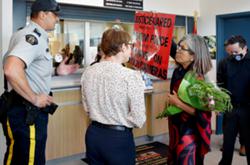
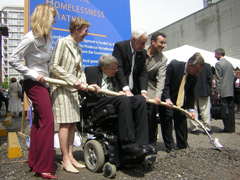
The Tyee's review of Garrison's list did identify two non-market housing projects for which the current NPA-led city council can unabashedly claim credit: The creation of 30 transition units above the Insite supervised injection site, and the re-launch of Kindred Place at 1321 Richards St.

Mayor Sam Sullivan brought a large, custom-made shovel to the Kindred Place groundbreaking (pictured above). Sullivan promised to carve a notch in that oversized handle each time he broke ground for another new social housing project.

Sam's big shovel has yet to reappear.

In a one-on-one conversation with Coun. Ladner immediately following that 2007 groundbreaking, The Tyee expressed concern about Mayor Sullivan's exaggerated housing claims. Ladner agreed that some of Sullivan's claims merited examination, but (correctly) argued that the Kindred Place apartments were new units.

Now candidate Ladner claims his party has created 3,813 units of housing by 2010, in spite of having thus far broken ground for only one new building.

More units lost than gained?

Pivot Legal Society lawyer David Eby, like other activists working in the Downtown Eastside, counts housing in a whole different way.

"There's only one question that matters to the homeless," Eby said. "How many rooms are available at the $375-a-month welfare rate?"

The answer? Close to zero, according to recent surveys by Pivot and the Carnegie Community Action Project.

Those studies find that the losses of aging hotel rooms to modernization and redevelopment have significantly outpaced the additions of new social housing units, and that few of the remaining rooms are being offered at the provincial welfare rate.

An ongoing Pivot study identifies 1,448 rooms in residential hotels -- often dubbed single-room-occupancy or SRO hotels -- that have been closed since the 2010 Winter Games were awarded in July of 2003.

The Pivot tally does not take into account the renovation of nearly a thousand SRO rooms purchased by the province.

"Those SROs were fully occupied with people at risk of homelessness," Eby explained. "Several are currently closed for renovations. When they reopen, those SROs are expected to contain fewer rooms -- with fewer beds -- than they offered before."

Compounding that number, the Carnegie team reports that fewer and fewer of the remaining privately owned rooms are available at welfare rates. The Columbia Hotel, for example, now charges more than $800 a month for a room.

"Anyone who's lived down here for the last few years will tell you the same thing," Carnegie's Jean Swanson said. "There are far fewer rooms for rent today then there were three years ago."

Rate of added housing 'significantly short of target'

On one point, both the NPA and its critics agree: Vancouver is doing more to help its homeless than any other Lower Mainland municipality. But how much is B.C.'s largest city really accomplishing?

Among the most even-handed assessments of the city's progress toward creating homeless housing can be found in a July 2008 report on progress toward the city's Homeless Action Plan.

"From 2005 to 2008, a total of 458 new units of supportive and transitional housing have been created in the city, and average of 150 units per year over the past three years," stated that memo, also authored by Dan Garrison. "The addition of 150 supportive and transitional housing units per year since 2005 reflects action in the right direction, but falls significantly short of the HAP target of 380 units per year."

A Carnegie tally of planned units similarly estimated Vancouver's completion rate at about 100 new units per year.

"Replacing 4,000 SRO rooms at this rate would take up to 40 years," Swanson said, "and still wouldn't provide housing for the thousands of people already living on Vancouver streets."

Pivot's Eby questioned the logic of Sullivan and Ladner in claiming the city is on target for meeting its social housing needs.

"It doesn't make any sense to me why the NPA continues to make these exaggerated housing claims," said Eby, who unsuccessfully sought a spot on opposition party Vision Vancouver's council slate. "How do these claims help the city impress senior governments on the need for more funding?"

"If I were a councillor," Eby added with a chuckle, "I'd make darned sure that every unit was new, fully funded and under construction before counting it."

Related Tyee stories:

 [Tyee]

33  Comments:

  • Luke Skywalker

    30-10-2008

    Full disclosure: David Eby

    Full disclosure:

    David Eby is a failed candidate for the NPA's opponents... Vision Vancouver... although I have always respected the Pivot Legal Society's work.

    Quote:
    An ongoing Pivot study identifies 1,448 rooms in residential hotels -- often dubbed single-room-occupancy or SRO hotels -- that have been closed since the 2010 Winter Games were awarded in July of 2003.

    That's a bit of a red herring.

    These SRO's would have likely closed with or without the 2010 Olympics. Nobody is gonna close an SRO many years in advance for a 2-week event years down the road. Doesn't make any financial or common sense.

    And then we have Vision Vancouver mayoral hopeful Gregor Robertson's answer to the homeless problem at the recent at St. Andrew’s Wesley mayoral debate:

    Quote:
    How will you pay for your homelessness plans?

    Quote:
    Gregor Robertson: “We are in the process of costing the plan but it won’t cost much.”

    Yeah right. Politics as usual.

  • Blackbird

    31-10-2008

    Use the Force, Luke

    Quote:

    That's a bit of a red herring.

    End quote.

    It isn't a red herring if you consider the social legacy promises made by three levels of government and VANOC's predecessor in the bid book that won Vancouver the Games and shortly thereafter by VANOC - promises like no evictions as a result of the Games and the creation of 3,200 units of new social housing.

    What doesn't make sense is how government and VANOC could fool themselves into believing they could get away with not living up to what they had promised in a city like Vancouver with its dedicated, intelligent and hardworking activists keeping an eye on things and then taking their concerns to the streets in protest rallies for the world media to witness.

    The only red herring I observe, aside from Ladner's claim at the St. Andrew’s Wesley mayoral debate that he did not vote against the Homeless Action Plan, is Luke Skywalker's failure to hold the promise makers to account.

    The promise makers' true colours were revealed when, in the summer of 2007, Gordon Campbell and John Furlong went on record before TV cameras to state they would not follow through on their promises because the Inner City Inclusive Commitment Statement that formed part of the bid was not a legally binding document. They changed their minds a short time after, when protests escalated and the potential for international embarrassment political fallout grew.

    You might want to replace the Duracells in your lightsaber, Luke.

  • cocean

    31-10-2008

    Affordable Solutions but for NIMBYism and Political Will

    There ARE affordable solutions but both political will and NIMBYism get in the way. Two posts which I wrote recently have received a lot of attention - they're ranked #1 and #2 in popularity over the past two weeks: http://tinyurl.com/5eqlp2 and http://tinyurl.com/65jxgf.

    The posts describe two solutions for providing shelter to low-income people, and people who want to reduce their carbon footprint to as little as possible.

    The cost of these tiny houses is low both in terms of initial outlay and to maintain. But where to put them?

    What government, at any level, will ease property restrictions and make public land available for these little homes?

    And what neighbourhood will "allow" them to move in?

  • BC Mary

    01-11-2008

    Remember when ...

    ... in other turbulent times, a lot of B.C. people worked together. That was 25 years ago and they called it Operation Solidarity. Rod Mickleburgh lists the 26 bills which were rammed through the B.C. Legislature in a single afternoon, to set off the explosion of protest:

    COVER STORY: OPERATION SOLIDARITY: 25 YEARS LATER

    THE CONTROVERSIAL BILLS, ONE BY ONE

    Operation Solidarity was spawned by a series of 26 bills introduced by the Social Credit government on a single afternoon, July 7, 1983. Opponents saw them as a concerted attack on trade union, social and individual rights in the province:

    Bill 2 wiped out the right of unionized government employees to negotiate such basic issues as major overtime, scheduling, hours of work, seniority and job security.

    Bill 3 gave public employers the right to terminate employees "without cause," regardless of seniority.

    Bill 5 eliminated rent controls, closed down the Rentalsman's office that reviewed landlord-tenant disputes and allowed landlords to evict tenants at will.

    Bill 6 gave extraordinary control over local school-board budgets to the minister of education.

    Bill 8 dissolved the Alcohol and Drug Commission.

    Bill 9 declared regional district plans null and void, permitting individual municipalities to ignore regional planning.

    Bill 11 extended the government's wage-control program for the public sector indefinitely, allowing wages to be determined by an employer's "ability to pay."

    Bill 15 increased the sales tax from 6 to 7 per cent.

    Bill 18 reduced pension entitlements for employees who are laid off.

    Bill 19 gave the government widespread control over the B.C. Institute of Technology, erasing student, faculty and staff representatives on the BCIT board.

    Bill 20 extended government control over community colleges, including course content and budgets.

    Bill 21 disbanded a legislative committee that scrutinized Crown corporations.

    Bill 23 eliminated mandatory vehicle inspections and closed motor-vehicle testing branches across the province.

    Bill 24 allowed doctors to opt out of medicare, while at the same time restricting how much doctors in the system could bill. User fees were increased and opportunities for doctors to "extra bill" were enhanced.

    Bill 25 ended the life of the Harbours Board.

    Bill 26 wiped out the Employment Standards Board, transferring complaints over labour standards to the courts.

    Bill 27 abolished the Human Rights Branch and the Human Rights Commission. Staff were fired immediately, ordered out onto the street, their keys snatched from them before they left. A clause banning "discrimination without reasonable cause" was missing from the new Human Rights Act.

    Bill 28 centralized control and authority over borrowing by government and Crown corporations.

    Rod Mickleburgh
    The Globe and Mail - Nov. 1, 2008

  • Bobby Peru

    01-11-2008

    Dream the Impossible Dream

    Operation Solidarity wasn't about the BC people, it was about powerful BC unions protecting their rich contracts. Over the last 25 years, BC unions have weakened themselves and couldn't pull off an Operation Solidarity even if they wanted to. In fact, alot of BC workers hate the class warfare, firebrand tactics of BC unions. Glenn Clark had alot to do with bringing the final nails into the coffin of union empathy for the avg BC family. Ironically, when Clark was turfed from office it wasn't a BC union that gave him a job, but BC's most ardent capitalist, Jim Pattison. The unions couldn't even take care of one of their own.

    The BC left misinterprets polls that show that homelessness is a major issue. Yes, it's a blight and an issue, but BC voters aren't going to allow the NDP to take power in BC, engage in reckless Glenn Clark style spending just to solve homelessness. Homelessness may be a problem, but when you ask voters how much they are willing to pay to solve it the answer won't be spending as much as it takes.

    Giving homeless people- who are mostly drug addicts and people who need to be in a hospital or mental institution free homes in a city where hard working tax payers struggle to pay for their homes is a travesty that will only result in the formation of govt subsidized ghettos.

  • joelguy

    01-11-2008

    This is what the media should be doing

    Great work. Though I would like to see a broader perspective added to this. For instance, what has been the NET increase or reduction in social housing in the past three years? What about the past 7 years? The latter would help us understand the effect, up or down, of Gordon Campbell's legacy on homelessness here as well.

  • cocean

    02-11-2008

    Bobby

    "Homeless people ... are mostly drug addicts and people who need to be in a hospital or mental institution."

    Tell that to the homeless with skills to offer whose disabilities are excuses for employers not to hire them.

    Tell that to the homeless who would love to work but are told by potential employers that they must have a permanent residence in order to be hired.

    Tell that to the homeless who have McJobs and whose income isn't anywhere near enough to pay rent.

    Tell that to the homeless who have applied for work, over and over and over again, but BECAUSE they are homeless are discriminated against.

    Tell that to the homeless who ...

  • G West

    03-11-2008

    Sorry Bobby

    The Universal Declaration was adopted by the General Assembly on 10 December 1948 by a vote of 48 in favour, 0 against, with 8 abstentions (all Soviet Bloc states, South Africa and Saudi Arabia).[11]

    The following countries voted in favour of the Declaration: Afghanistan, Argentina, Australia, Belgium, Bolivia, Brazil, Burma, Canada, Chile, China, Colombia, Costa Rica, Cuba, Denmark, the Dominican Republic, Ecuador, Egypt, El Salvador, Ethiopia, France, Greece, Guatemala, Haiti, Iceland, India, Iran, Iraq, Lebanon, Liberia, Luxembourg, Mexico, Netherlands, New Zealand, Nicaragua, Norway, Pakistan, Panama, Paraguay, Peru, Philippines, Thailand, Sweden, Syria, Turkey, United Kingdom, United States, Uruguay, Venezuela.

    Despite the central role played by Canadian John Humphrey, the Canadian Government at first abstained from voting on the Declaration's draft, but later voted in favour of the final draft in the General Assembly.

    It used to be something all Canadians were very proud of - sadly, we slipped considerably since then - and that should be something every Canadian should be ashamed of.

    I take it you're entirely in favour of the hardworking taxpayers' money that's being spent on the Olympics?

    Personally, I'd rather we paid a little more attention to our obligations as a member of the United Nations than as members of the IOC.

  • realisticman

    03-11-2008

    Don't forget 29 West!

    "Article 29. Universal Declaration of Human Rights.

    (1) Everyone has duties to the community in which alone the free and full development of his personality is possible.

    (2) In the exercise of his rights and freedoms, everyone shall be subject only to such limitations as are determined by law solely for the purpose of securing due recognition and respect for the rights and freedoms of others and of meeting the just requirements of morality, public order and the general welfare in a democratic society."

    Talk to us about the DUTIES to the COMMUNITY of your beloved drug dealers, junkies and tourist hobos, of which there are many. Please expand too on, "meeting the just requirements of morality, public order...".

    Once we get the druggies and the tourist bums out and comfortably house the mentally unstable, we can then do what we should be doing. That is, directing the present resources towards taking care of those that have fallen on hard times and really need assistance.

  • G West

    03-11-2008

    No problem R/man

    Feed them, clothe them, house them, give them a chance to rehabilitate themselves - at a considerable savings to the exchequer as opposed to the current system and then we'll see how they accept their responsibilities.

    Oh and that one about tourist hobos, maybe you need to read the declaration again too.

    Are you forgetting Articles 11 - 16?

    Article 11
    Everyone charged with a penal offence has the right to be presumed innocent until proved guilty according to law in a public trial at which he has had all the guarantees necessary for his defence.
    No one shall be held guilty of any penal offence on account of any act or omission which did not constitute a penal offence, under national or international law, at the time when it was committed. Nor shall a heavier penalty be imposed than the one that was applicable at the time the penal offence was committed.

    Article 12
    No one shall be subjected to arbitrary interference with his privacy, family, home or correspondence, nor to attacks upon his honour and reputation. Everyone has the right to the protection of the law against such interference or attacks.

    Article 13
    Everyone has the right to freedom of movement and residence within the borders of each state.
    Everyone has the right to leave any country, including his own, and to return to his country.

    Article 14
    Everyone has the right to seek and to enjoy in other countries asylum from persecution.
    This right may not be invoked in the case of prosecutions genuinely arising from non-political crimes or from acts contrary to the purposes and principles of the United Nations.

    Article 15
    Everyone has the right to a nationality.
    No one shall be arbitrarily deprived of his nationality nor denied the right to change his nationality.

    Article 16
    Men and women of full age, without any limitation due to race, nationality or religion, have the right to marry and to found a family. They are entitled to equal rights as to marriage, during marriage and at its dissolution.
    Marriage shall be entered into only with the free and full consent of the intending spouses.
    The family is the natural and fundamental group unit of society and is entitled to protection by society and the State.

    Now what were you saying about tourist bums?

  • Stump

    03-11-2008

    The Far North ghetto

    "Big, institutional hospitals and facilities in a place with cheap land like Fort Nelson should be efficient. "

    Not only would they be inefficient, they probably would be ineffective. This has been pointed out to you several times Mr. Peru, yet you persist in this silly fantasy.

    Constantly re-iterating useless non-solutions because they suit your philosophy is counter-productive. If you are truly looking for solutions to homelessness and drug addiction, then efficiency wouldn't be your first criteria but effectiveness would. What you want is a cheap answer that works and as the old saying goes, cheap, fast, good. Pick any two. Because people's lives are at stake, fast must clearly be a factor. What's left? Good and cheap. We know you want cheap. What you're not wiling to do, is pay for good. And that's one reason among many that your addiction gulags would be a waste of money, potential, and human lives.

  • The discussion for this story is closed. No more comments can be added.