
News

Another Side to Private Power

First Nations, municipalities explore controversial energy source.

By Colleen Kimmett, 11 Apr 2008, TheTyee.ca

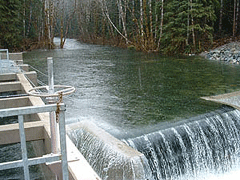
Run-of-river power, China Creek

China Creek run-of-river hydro project.

Environment Minister Barry Penner decided not to go against a very vocal majority when he nixed a plan to run a power line through Pinecone Burke Provincial Park last month.

Groups opposed to the project, which had been rallying for months in advance of the decision and packed rowdy public hearings in Mission and Pitt Meadows, breathed a collective sigh of relief.

Underlying the controversy around this high-profile project is a greater concern about the private sector's role in power production.

Although some see independent power producers (IPPs) as part of an unwelcome shift away from the centralized publicly owned model British Columbia has known, others view public-private partnerships as essential to foster fledgling renewable energy technologies.

Increasingly, First Nations and municipalities are the IPPs, working with the private sector but retaining full or partial ownership of their utilities and the revenue stream they provide.

Renewable energy is uncharted territory here in B.C. and the rest of Canada -- and it's not as simple as public good, private bad.

Power pioneers

Taking on the responsibilities of an energy utility has been a learning process for some trailblazing communities.

When Hupacasath Chief Judith Sayers and her council decided to take power into their own hands six years ago, the result was a best practices model of how to build a small hydro project from the ground up.

Widespread opposition to the Duke Point natural gas facility in the late '90s was the impetus for council to explore other options for resource development in the Hupacasath territory near Port Alberni, says Sayers.

With help from the Pembina Institute in 2002, the Hupacasath council identified China Creek as having run-of-river hydro potential.

Financing was difficult at first, says Sayers, but with a loan from Vancity, a grant from EcoTrust and the pooling of resources with the Ucluelet First Nation, the council was able to partner with Synex Energy to build a two-turbine, 6.5 megawatt project that has been in operation since December 2005.

The council's corporate arm that manages the project, Upnit Corporation, owns 72.5 per cent of the project, the neighbouring Ucluelet First Nation owns 10 per cent, Synex owns 12.5 per cent and the City of Port Alberni owns five per cent, an "in kind gift," says Sayers, for the city's cooperation and use of its water data.

More to come

"Now we're working on our second project, and we actually had banks knocking on the door," says Sayers. Another 6.5 MW run-of-river operation on nearby Corrigan Creek is scheduled to go online next year.

"These run-of-river projects are, I think, a really good thing," says Sayers.

"As a First Nations, this is how we've been able to use the resources in our territory and actually manage the resources in our territory."

Sayers says she and her council have learned a lot through the process of applying for various licences, commissioning studies on impacts on fish and the environment and negotiating with the city and local logging companies.

"I would encourage any First Nation to really get involved as an IPP," she says. "Some are just taking royalties, but what do you learn?"

Matt Horne of the Pembina Institute says this situation is fairly rare in B.C. because typically it's the IPP that tries to "sell" projects to a community and not the other way around.

"If you're looking at both the technical side of developing a project and the administrative side of management, you're looking at a whole new skill set for most communities," he says.

"It's not simple processes to have to work through . . . but I don't think they're barriers that can't be overcome."

Taking ownership

As chief of Douglas First Nation, located on the north end of Harrison Lake, Darryl Peters spent nearly nine years in negotiations with Cloudworks Energy Corporation on what began as a one-creek project and now includes eight.

Cloudworks initially approached Peters and his council to approve a run-of-river project on Big Silver Creek, about a two-hour drive east of Vancouver.

"We found there was an even better opportunity if we set aside the Big Silver project," says Peters. "We started realizing there was a larger process for our involvement."

In order to offset the cost of a substation required so the community could connect to the B.C. Hydro transmission grid, Peters said more projects needed to come on board.

Now, Cloudworks is developing on eight tributaries of the Upper Harrison River, three of which the Douglas First Nation is directly involved with.

"We're going to be having ownership of two of the projects, on Douglas and Tipella [creeks]" says Peters. "We also have the opportunity to buy into the other projects."

Until these projects are complete and supplying the grid, probably by late 2009, the Douglas First Nation will continue to use diesel generators for electricity.

The fact that his people have had to rely on these generators for so long frustrates Peters.

"We wanted to get out of that concept of being in a Third World state," he says.

"If we're Indians on an Indian reserve struggling away we can never become equal."

Private beats government

Peters won't go into details about the deal between Cloudworks and Douglas, but says the First Nation will also be receiving payments on an annual basis and as part of the agreement Cloudworks will provide the community with energy.

There is also opportunity for an educational endowment fund, he says, and where possible local companies get first dibs on construction contracts.

"Look at what we're able to accomplish now with the private sector rather than with a government agent," says Peters, who says his elders remember promises of B.C. Hydro grid access made thirty years ago.

"No one went to school to learn how to build a power project . . . but we're motivated to do business."

Wind farmers

On the other side of the province, the city of Dawson Creek is developing a totally different resource using a different type of ownership model.

The city has partnered with Peace Energy Cooperative
and Aeolis Wind Power Corporation to build a 120 MW wind farm on Bear Mountain Ridge consisting of up to 57 turbines.

Peace Energy is the only co-op of its kind in the province, with more than 300 members. A $200 membership pays dividends based on annual profits and members can also choose to purchase shares that are expected to appreciate in value as the co-op grows.

"Power production is the biggest drain in local economies because all that money simply goes out," says Emanuel Machado, director of corporate planning for the city.

"The co-op provides a community ownership opportunity around renewable energy that has never existed before."

The wind project is the co-op's first, and it has yet to develop any others. Machado says the city is also exploring other renewable energy options, such as bioenergy, but says it's taking its time.

"There are a lot of questions. This is outside of most municipalities' areas of expertise," he says.

"But I think the writing's on the wall that there's tremendous opportunity there."

Community economic development, while important, isn't solely enough to justify building a power plant, says Gwen Barlee of the Wilderness Committee.

Her group says renewable energy development should be regionally planned, environmentally appropriate and publicly owned.

One of the biggest concerns, she says, is the cumulative impacts of "one-off" projects that aren't part of a larger land and resource use plan.

"From a citizen's perspective, we should be asking, 'Is this the type of power we need?' " says Barlee.

"Let's slow down, take a deep breath and make sure these projects are in the public good."

Related Tyee stories:

 [Tyee]

28  Comments:

  • Luke Skywalker

    10-04-2008

    IPP's...

    Quote:
    Increasingly, First Nations and municipalities are the IPPs, working with the private sector but retaining full or partial ownership of their utilities and the revenue stream they provide.

    I think this article provides a good and reasonable insight into the involvement by other important stakeholders in ROR projects.

    A good detailed analysis of IPP's was in the Vancouver Sun from one week ago and here are another couple of interesting snipets:

    Quote:
    According to a January 29 press release from NDP energy critic John Horgan, it costs BC Hydro "an average of $5.98 per megawatt hour for electricity it produced, compared to $60.67 per megawatt hour for power from IPPs."

    Hydro documents dating from 2003 show it costs BC Hydro $25 per megawatt to produce power.

    Documents on file with the B.C. Utilities Commission also show that a recent upgrade to the Alberfeldie Dam in southeastern B.C., an older Hydro-owned facility, has pushed the cost of electricity production there to $62 per megawatt hour - same as an IPP.

    Quote:
    Neither do the NDP comments jibe with its track record of encouraging IPP development when it was the government.
    Neufeld noted that there were 26 IPPs operating in B.C. when the Liberals were first elected in 2001 and since then, 19 more have been built or are in advanced development.

    http://www.canada.com/vancouversun/news/business/story.html?id=16849aa0-63a9-4500-97e0-8161af9d23cd&k=37476

  • UnCivilizedEngineer

    11-04-2008

    Well-Written Articles

    Thanks to Colleen for presenting this side of the IPP issue. This is a highly important aspect of IPPs that gets overlooked by many on both sides of the argument.

    The more remote First Nations communities in particular will finally be able to wean off the unreliable and expensive diesel generation and start to feel some independence, control, and maybe even participate in an economy that is usually out of reach at the community level.

    Municipalities can and have benefitted as well. Almost any municipality with a surface drinking water supply can start looking at opportunities to leverage these assets by adding generation - something that would have been very difficult to the point of not being worth pursuing under previous energy policies. Now we see the District of West Vancouver generating from Eagle Lake, and a number of others looking at proposals. Even if the municipalities don't build the power themselves, IPPs building within municipal boundaries pay tax, which again, benefits the community.

    The article Luke Skywalker refers to also makes some very salient points about the oppposition to private power, which I won't discuss the finer details of. Suffice to say, BC Hydro can't deliver new power for any cheaper than the IPPs, and would be forced to expand in order to meet the new power demands. Conservation is a nice idea, but the teeth needed to mitigate our growth requirements would be unpalatable to most customers (and voters!).

    If you really want to know some facts about the cost of new power acquisition, I refer to the BC Hydro Resource Options Update process, which has scoped out a wide selection of power sources:

    http://www.bchydro.com/info/iep/iep53123.html

    And check out the map on the page, in particular:

    http://www.bchydro.com/rx_files/info/info54929.pdf

  • Skywalker

    11-04-2008

    Sure, but will they remain public?

    "BC Hydro can't deliver new power for any cheaper than the IPPs, and would be forced to expand in order to meet the new power demands." Yes it can and has done so for years. It is not allowed to by the current government because of an adherence to an ideology which will see us all paying more. All these little IPP's will be bought up by the multinationals because energy is the next easy money for them. In every other country where this hydro has been allowed to go private the cost have skyrocketed just to line the pockets of the big corporations. Oil, energy, water, food all the essentials are at risk.

    Hydro production is and easy one that should remain public ownership. WAC proved it could be done.

  • lynn

    11-04-2008

    Private lies

    Skywalker wrote:

    Quote:
    Hydro production is and easy one that should remain public ownership. WAC proved it could be done.

    As the brain remarked in another thread, corporate rule by privatization demands that perfectly functional public systems be made dysfunctional...How else can privatization be brought in? How else can private companies steal control of our public resources away from us - and all our public profits and benefits as well?

    It is the grand lie that privatization builds their foundation of contrived lies on. Their malicious intention is to make proved public successes look like failures.... simply because it serves their sly and greedy cause.

    The privatization agenda of the BCLiberals has followed this exact mode - a relentless assault on the public system that is designed to make it it appear that a perfectly functional system like public ownership of power is somehow dysfunctional. In fact, as Skywalker makes clear, BC Hydro has worked... and brilliantly so for the people of BC. It is BC's big success story.

    In fact, it is BCLiberal legislation that has intentionally disabled BC Hydro....in order to open the door for IPPs and the lurking multi-nationals that have been droolingly biding their time, in wait for "the easy power" door to swing wide open, for in Skywalker's words, "easy money".

    There is no reason that a public system of power cannot amend the past and address power issues for First Nations.

    No, what this is is simply the privatization of BC Hydro, the grand theft of this grand public resource, without Gordon Campbell having to say it out loud..without having to admit to it.

    It is the sneaky lie their government is (in)famous for.....like the BCLiberal's "misuse" of the treaty process, set up in reality to benefit "their corporate friends" self-interests, but made to look like the saving grace for First Nations - this run-of -river sell-out has been set up to appear in the same way. The only goodwill in reality being extended or offered here by the present BC Liberal government is towards the corporate interests they faithfully represent - a loyalty that knows no bounds.... and apparently has no borders. And that is who the IPP's were really designed for and whose interests they will serve....far into the future as well... sad and incredible as that is for all the people of BC.

  • snert

    11-04-2008

    lynn

    So you're saying that any benefits that might come to FNs are a myth? Are they suckers for believing that any might come their way?

    You may call it a "misuse of the treaty process" but we'll never rally know for sure if people keep getting in the way. That is also a misuse of the treaty process.

  • ME2

    11-04-2008

    Baseless finger-pointing?

    Snert, Unless they've been strongarmed into "public" participation - a la the GBR - FNs have never shown any obligation to the commonweal, or any interest in participation in it. The recent ALR deal is proof enough of that.

    Sure, there's lots of pretty talk of mutual cooperation, but that always involves significant concessions on the part of others and much larger gains for FNS.

    The fact is that Treaty negotiations exist purely for the benefit of FNs and no-one else. Of course there's the much-heralded benefit of "certainty" for business, and IPPs are one such, where RORs are rented out or partnered in, with no guarantee the multis can't wind up with ownership.

    OTOH, I guess one can't point fingers, given the total disregard the Campbell gov't holds for the public's interest.

  • G West

    12-04-2008

    ME2 - I agree with you

    I suspect that - just as in the case of the Tsawwassen treaty and the UBC golf course/Pacific Spirit Park betrayal - ROR deals are worked between a few compliant and largely unrepresentative members of bands who are doing the deals as much for their personal gain - and probably more - than any sense of sustainability for the future or in respect of whatever the 'real' First Nations interests are.

    In the long run, in my view, this is just another colonial attempt to force the Indians to assimilate, integrate and disappear as cultural and national entities. We know with certainty that's the case in Ottawa under pee wee and I'd say it's exactly the same situation in Victoria - in fact, it is the push from Campbell's corporate backers that started the whole chameleon-like change in the CEO premier's colouration during his first term.

    Campbell, at his oleaginous best and flashing that toothily diabolical Cheshire-cat grin on his Maui-tanned face – carries it off with much greater aplomb than the little fat man in Ottawa does.

    In fact, he's done exactly the same thing in labour negotiations as well - but that's another story.

    Cheers.

    The native groups who think they’ve made a good deal with these particular ‘business partners’ ought to look closely at the wampum they’re getting in return for their birthright. All, once again, in my opinion.

    Speaking of deals that are too good to be true, did you see this:
    http://www.canada.com/vancouversun/news/business/story.html?id=dc0e01a3-dde7-4415-95a0-40e9b5731525

    Seems like current management at MDA was more interested in real estate gold mining than continuing to be a cutting edge space research company. Hope you're not sitting around with any of their stock in your stockings.

  • snert

    12-04-2008

    So the fact that a band

    votes to accept a deal means nothing to you.

    Quote:
    I suspect that - just as in the case of the Tsawwassen treaty and the UBC golf course/Pacific Spirit Park betrayal - ROR deals are worked between a few compliant and largely unrepresentative members of bands who are doing the deals as much for their personal gain - and probably more - than any sense of sustainability for the future or in respect of whatever the 'real' First Nations interests are.

    Therein lies the problem with most of these deals. There are a whole lot of people like yourself who think they know better but never come up with practical solutions.

    Naysayers and NIMBYs, it's a wonder anything gets done.

  • G West

    12-04-2008

    There are votes and there are votes

    I'm not in the habit of criticizing the Native Bands for accepting the deals they've been given - one has to actually read the whole of what I posted to understand where I think the blame lies - and it's not with the First Nations.

    Perhaps I should re-post the pertinent passage for you:

    "...In the long run, in my view, this is just another colonial attempt to force the Indians to assimilate, integrate and disappear as cultural and national entities. We know with certainty that's the case in Ottawa under pee wee and I'd say it's exactly the same situation in Victoria - in fact, it is the push from Campbell's corporate backers that started the whole chameleon-like change in the CEO premier's colouration during his first term."

    I certainly do think I know better than you do snert - as for the circumstances surrounding the 'democratic' institutions in effect in many Indian bands in this province - I'll let the First Nations people themselves speak to that.

    If you're really interested you can start here:

    http://www.fcpp.org/main/publication_detail.php?PubID=802
    It is difficult to overestimate the importance of functional governance. It impacts at all levels of society and plays an essential part in our lives and communities. Governance structures and processes:
    1. represent constituent’s welfare and basic human rights;
    2. create and enforce policies and laws;
    3. administer essential programs and deliver services; and
    4. manage human, land and cultural resources; and negotiate with governments and organizations.

    How well such structures and processes perform these functions has a direct affect on the strength and well-being of every community. In the same way, effective and stable Indigenous organizations reflective of, and accountable to, their community’s needs and values form the foundations for regional and community socioeconomic development. I’m the last person who’d maintain the native governance structures have served them well – but I’ll leave that for First Nations commentators to discuss – because, in the end, I’m not the ‘nimby’ you’d like to cast me as snert.

    If you take some time to understand the actual structure of the negotiating framework as well as learn to appreciate how the people doing the financing (the federal and provincial crown) possess a hammer-lock on the final outcomes (please look specifically at the Cowichan band for an example of this and don’t overlook the role of former Liberal Cabinet minister Graham Bruce) because, in the end, they’re writing the cheques.

    Like a lawyer representing both sides in a real estate deal, mischief happens.

  • The discussion for this story is closed. No more comments can be added.