


 SHARE:
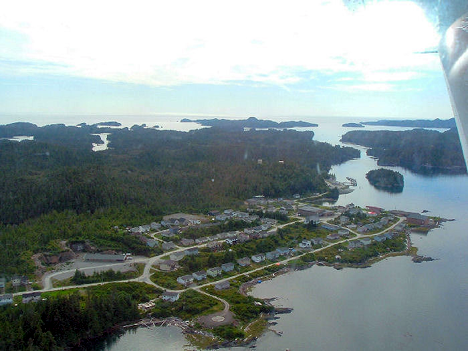
As the education coordinator for the town of Kitkatla, on an island south of Prince Rupert, Bruce Innis has seen many young people come and go. Ever since the fisheries collapsed, a lot more have gone.
"When people visit Kitkatla," Innis said, "they ask, 'Doesn't anybody live here?'"
Unemployment and depression have haunted the town, home to the Gitxaala First Nation, since the fish stocks dwindled to nearly nothing in the 1980s. So when a European salmon farming giant offered the town over a hundred jobs in 1999, most residents were heavily in favour.
Since then, however, environmentalists have spooked many locals with tales of a fish farm fuelled ecological disaster. Support for the farms, which supporters claim was once nearly unanimous among band members, has flipped, opponents say. Those involved with the fight against the farm now say that 80 per cent of the Gitxaala are opposed to the development.
The struggle over whether to proceed with fish farming in Kitkatla reveals a schism common to many First Nations communities weighing big decisions about how to use the land and resources they claim. Most Gitxaala members live outside of Kitkatla, and those tend to be strongly against the fish farm. Some local Gitxaala members resent that power wielded from afar.
Tug of war
The residents of Kitkatla are caught in a tug of war between economy and ecology all too common for the First Nations of B.C.'s coast. This Tyee series first examined this dilemma for two First Nations that have already chosen their paths.
Though the unemployment rate in Lax Kw'alaams often reaches 95 per cent, few voices there express regret over rejecting salmon farms in 2001. And in Klemtu, where a deal with Marine Harvest Canada brought salmon farms and jobs, the Kitasoo/Xaixais are grateful for the boost to their economy, though they remain wary of environmental threats.
In Kitkatla, however, unity and resolution remain elusive.
Farms never materialized
Like many coastal communities, Kitkatla lost its main source of employment and revenue when fish stocks dwindled in the eighties. Since then, unemployment, stuck at 85 per cent, has been forcing residents out.
Renewed hope came in 1999, when PanFish invested $300 million dollars in fish farm projects all over the North Coast. Kitkatla was targeted for three salmon farm sites, a processing plant and a hatchery. And in 2003, the province granted the town two licenses.
With 137 jobs on the horizon, 25 Gitxaala students attended North Island College's program in salmon farm technology. But the graduates never did find work in Kitkatla; the planned fish farms never materialized.
The Gitxaala's traditional territory borders the Skeena river system. When their fish farm project was announced, neighboring First Nations communities feared that the salmon farms would poison their marine ecosystems. As a result of the dispute, PanFish put the projects on hold.
They were still on hold in 2006, when the provincial farming licenses expired.
In the meantime, the Supreme Court had set more stringent standards on the province's obligation to consult with First Nations on development projects, including fish farms.
Consultation is key
As a result, the provincial Ministry of Agriculture and Lands cannot renew Kitkatla's licenses before reaching an agreement with neighbouring communities such as the Gitxsan and Gitanyow. Jim Russell, the department's fisheries and aquaculture licensing director, doesn't know how soon that will happen.
"It depends on these other First Nations and how quickly they can get back to us," he said. "If they all decided tomorrow that they were not opposed, then that would resolve it."
Matthew Hill, a Kitkatla resident, former fisherman and spokesperson for salmon farms on Gitxaala territory, is frustrated with the time lag. "[PanFish] have packed up and walked away," he said.
Kitkatla's band council fears that a report released in May by the Special Committee on Sustainable Aquaculture, an all-party group tasked in 2005 by the B.C. legislative assembly to look into the economic and environmental impacts of salmon farms and to recommend sustainable changes for the industry, will aggravate the situation. The Special Committee recommends banning salmon farms from the North Coast.
"The unemployment rate is going to go up again. All we ask is that [the Committee] give us a better alternative," said Hill.
But Russell dismisses the significance of the report.
"The government hasn't expressed a position on it. When the government does, it may impact our ability to license or not license up on the North Coast," said Russell.
'Fearmongers'
Hill and Innis both believe that it is not just the neighbouring First Nations who are holding back the project. Kitkatla's economy is being attacked, they say, by environmentalists, sport fishermen and a fishery union for whom cheap farmed salmon is serious competition. These outsiders, they say, should not have so much power to determine Kitkatla's destiny.
When council started negotiations with PanFish, 99 per cent of the community supported them, according to Hill. Over the last eight years, however, "fearmongers" such as the conservationist group Friends of Wild Salmon, "got to them."
"Our people are sucked right in and used," he said. "Our people will never benefit from anything that [Friends of Wild Salmon] do."
Most Kitkatla residents, say Hill and Innis, believe that the PanFish deal could have revived the town. Those who oppose the PanFish deal tend to be off-reserve Gitxaala members.
But for Conrad Lewis, Friends of Wild Salmon's Kitkatla liaison, Hill's and Innis' dismissal of salmon-farm opponents as clueless outsiders points to a major problem with the band system: the disenfranchisement of off-reserve band members. For the Gitxaala nation, this includes 1,100 of its 1,600 members.
It was only a year ago that members living outside the town were granted the right to vote for band councillors. But even now, it's hard for them to make it back to a cut-off place like Kitkatla to participate in elections.
What's more, for Lewis, living on reserve is not much of an option. Kitkatla barely has enough resources for 500 people. It would collapse with 1,100 more.
Ties still bind?
Lewis and his colleagues in the association of Gitxaala Clan Chiefs, Elders and Landholders (GCCE&L) insist that they still have ties to their ancestral land -- whether they live in Kitkatla, Prince Rupert, or Timbuktu. Therefore, they say, they should have a say in any decision that affects Gitxaala territory.
Lewis wants to return Gitxaala leadership to its roots. Land and resource management decisions that affect so many generations of the past and future should be made by hereditary chiefs, he said.
But Hill said that salmon farms did have the support of hereditary leaders. Initially concerned for the land they hold in trust, the clan chiefs hesitated even when, according to Hill, virtually the entire population of Kitkatla supported the PanFish deal. However, a trip to Vancouver Island, where salmon farms have operated for 30 years, convinced them that it was safe. They signed on to the Pan Fish deal.
The clan chiefs who now oppose salmon farms, said Hill, lost their privileges long ago.
"There's a misconception out there that we have chiefs all over the place, and that they're the ones that are governing this community," said Hill. "If I have a chieftain name, it's attached to the land here. It's not valid anywhere else."
Depression haunts a high percentage of the population, said Hill. It's not fair for off-reserve members to judge council.
"They have a right to have an opinion. They just have to live here and experience the hardships first. They get all kinds of benefits where they are living. We've got nothing," said Hill.
What next?
Lewis feels vindicated by the Committee on Sustainable Aquaculture's recommendation to ban salmon farms from the North Coast.
With PanFish out of the picture, he hopes that Kitkatla will move on to greener pastures. The town needs to diversify its economy with investments in industries such as shell fish aquaculture, ecotourism, and a sawmill operation.
"Twenty simple ideas is better than going for the one big project," said Lewis.
But Hill doesn't feel as inspired about Kitkatla's economic prospects.
"We're exactly where we started: zero. The [Committee on Sustainable Aquaculture] have given us no alternative," said Hill.
Related Tyee stories:
- Fish Farm Committee Nails It
Lice harm is real. But Campbell won't act. - Farmed Controversy (series)
Exploring the world of aquaculture and aboriginals on BC's coast. - Push North for Fish Farms Blocked
Gitxsan Nation thwarts planned 'critical mass' of farms. A Tyee Special Report.
![[Tyee]](/design-article.thetyee.ca/ui/img/yellowblob.png)








Tyee Commenting Guidelines
Comments that violate guidelines risk being deleted, and violations may result in a temporary or permanent user ban. Maintain the spirit of good conversation to stay in the discussion.
*Please note The Tyee is not a forum for spreading misinformation about COVID-19, denying its existence or minimizing its risk to public health.
Do:
Do not: