A Rancher's Radioactive Hell
Joe Falkoski says he's being forced by bad laws to allow toxic mining on his land. A special report.
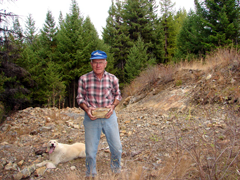
Falkoski with barite chunk at prospecting site left barren.
What do you do if you are a rancher told by a company -- and then the courts -- that there is nothing you can do to stop your rangeland from being dug up and further strewn with radiation?
If you are Joe Falkoski, you refuse to take no for an answer.
The Kettle Valley rancher fears mining for barite in radioactive soil on his property is a threat to his land, his livestock and the health of people in his community. He lost his latest court battle in September, but vows not to give up a fight that concerns many citizens across B.C.'s southern interior.
Digging in Against Dust, Radiation
Citizens press officials to halt mine.
Rancher Joe Falkoski's fight to prevent mining on his land has support from some equally determined neighbours. The Committee for a Clean Kettle Valley is alarmed by the prospect of digging up an area that the B.C. Centre for Disease Control has noted for its high background radiation.
Tests at Kettle Valley schools (most recently published in 1999) showed a concentration of radon (a radioactive gas) second highest for 365 schools surveyed throughout the province. The barite mine would be less than a kilometre from Rock Creek's elementary school.
Citizens also worry because the ore is 20 per cent silica, which, when ground down, creates toxic dust.
"Ore that contains more than 10 per cent...silica presents special hazards in mining, transportation and milling," industrial ventilation engineer Ed Chessor stated in a letter to the Mines Ministry. Chessor noted the dust can cause silicosis, a degenerative lung disease.
Rock Creek locals collected 140 signatures (in a community with just 300 mailboxes) on a petition demanding a halt to the mining. The petition was sent to Zena Capitol Corp., the firm wanting to mine Falkoski's land, as well as the mines, environment, and forestry ministries.
The concern over mining and radioactivity extends beyond Rock Creek now that uranium prospecting is picking up again in B.C.
In 1980, then-premier Bill Bennett issued a seven-year moratorium on uranium mining, citing health risks, as uranium claims began popping up throughout the Okanagan and Kettle River valleys. By the time the moratorium ended in 1987, uranium had dropped in value and the push to find it in B.C. seemed dead.
However, uranium prices are now higher than they were at their previous peak in the 1970s -- up 150 per cent in the past year alone.
In places where uranium is present, mining other ores also can release radiation (as on the Falkoski land). And the province now allows radiation levels related to mining 15 times higher than in the days of the moratorium, according to the mining industry's 2003 Health Safety and Reclamation codebook.
In a town meeting held by Zena and attended by mines officials in October of 2004, Rock Creek residents demanded more extensive radiation tests. Mining inspector Reid said: "We barely have enough money for our ministry to attend meetings." Reid said his ministry lacks the resources to test for hazards before mines begin full production. Those responsibilities, he said, are left to miners on an honour system.
In 2002, the B.C. Liberal government eliminated 106 Mines Ministry jobs and empowered mining officials, rather than civil servants, to oversee environmental permitting.
Critics note the province and other levels of government often end up paying millions to repair sites torn up and polluted by mining.
"Monitoring remains a huge problem," Sierra Legal Defence Fund lawyer Lara Tessaro told The Tyee. "Small communities faced with giant mine proposals often have very limited timeframes in which to provide public input. They don't even have, under provincial legislation, the automatic right to provide public input."
-- Kendyl Salcito
Falkoski believes the court ruling and provincial mining laws essentially require him to go into partnership with a venture-capital mining company that has already damaged his property and failed to repair it.
The dispute is just one of many to arise since the provincial government relaxed policies and regulations to promote the development of subsurface mineral, oil and gas claims on otherwise private land.
Zena Capital Corp. believes it is entitled to enter the land, since the Mines Ministry's Mediation and Arbitration Board gave it the go-ahead in February of this year.
Falkoski rejected the arbitration board's ruling, insisting that he was given no opportunity to air his concerns in either mediation or arbitration hearings.
He wanted no responsibility for any of the mining activities taking place on his property, so he rejected settlement money awarded following the hearing. "They can do what they want, but I won't have any part of it. I won't accept their money -- I refuse to be held complicit in their liability and responsibility."
Falkoski, 80, is fuming about the way the provincial government has dealt with his dilemma. Drawn out discussions and tribunal hearings through the mines ministry have failed to protect his now radioactive and barren rangeland.
Falkoski believes his experience with government officials reflects a Ministry of Energy, Mines and Petroleum that is unable to effectively manage the industry it governs.
What's more, he believes the regulations fail to fairly protect the rights of private landowners and the public's health.
It's a complex story that now involves citizens throughout the Kettle, Similkameen and Okanagan valleys who dread the growing exploration and mining in an area rich with radioactive minerals.
Falkoski once helped miner
Falkoski's problems began with a single miner named Byard MacLean, who arrived on Falkoski's land in the spring of 2003. Falkoski did not own rights to minerals beneath his land; MacLean had purchased an option from a third party allowing him to prospect there.
"Byard never got a local number, hotel, anything," Falkoski recalls. "Never talked about his past, never talked about landowner compensation or any kind of agreement. But I assumed that when he decided he was going to go through with this, we'd get to that stage," said Falkoski.
In the meantime, Falkoski says, MacLean slept in his car, worked alone, took core samples from his claim, and accepted Falkoski's water, advice, company and the use of his storage shed.
Barite is a mineral popularly used as an ingredient to lubricate oil and gas drills. It's not radioactive, but is often found in radioactive soils, as was the case on Falkoski's property.
MacLean was the first miner in nearly a decade to actively pursue the barite claims on Falkoski's property, and Falkoski at first had few qualms. MacLean took core samples, which required a lot of water, and Falkoski trucked water to MacLean all summer. MacLean removed topsoil by washing it down the mountain with hoses. Though he destroyed the potential for plant life to grow in the area, Falkoski did not complain. When the weather turned cold in the fall, MacLean packed up and left Rock Creek.
He left the property peppered with holes, and dotted with dozens of core boxes. In the November snow, Falkoski lugged the 60-pound boxes into his shed away from his animals. The law doesn't require miners to remove core boxes from rangeland, even though they often contain dangerous minerals.
Falkoski was irritated, but the spring of 2004 brought new problems. Rock Creek was facing a drought, and MacLean's drilling method could not be supported by the nearby pond. Falkoski stopped trucking in water, and MacLean switched to a new method of drilling that carved holes just six inches in diameter but nearly 60 feet deep. Rather than refill them, MacLean plugged most with branches, stones or logs. Some just gaped. Debris from the exploration -- both drilling and backhoe scraping -- was left in heaps. Falkoski suspected it might be radioactive, given the geology of the area.
A 10,000-tonne plan
Then MacLean announced that he would remove 10,000 tonnes of barite. He commissioned a backhoe operator to clear a path for a large drill. Rather than log the timber, a backhoe simply tore away at the trees, making ready for a 60-foot pit. Falkoski says he insisted the planned pit be refilled with clean gravel and good topsoil, but MacLean responded that he couldn't afford to do that. The Mines Ministry just required the hole to be sloped.
Falkoski also worried that MacLean intended to pull far more rock and ore out of the ground than his permit application indicated.
The ministry allows miners to extract up to 10,000 tonnes of bulk ore to test for its quality and assess the processes required to separate the minerals from the rest of the rock. MacLean specified in his permit application that he would be extracting up to 10,000 tonnes of "direct-ship barite."
As Falkoski explains it, 10,000 tonnes of barite of "direct-ship" quality would require closer to 30,000 to 50,000 tonnes of bulk ore excavation. Falkoski considered MacLean's plan an abuse of the exploration system. No red flags were raised in the Mines Ministry, as direct ship is a fairly common specification on permit applications. It usually indicates that the mineral is of such good quality that no processing is necessary. Falkoski is certain this is not the case, and Zena spokespeople have said they do not yet know the ore's quality.
What's more, extracting and milling 10,000 tonnes of barite -- an amount that would fill about 700 pickup trucks -- promised to be a messy and complex process. MacLean intended to grind the ore right on Falkoski's ranch and then truck it into Rock Creek for milling.
The proposed mill site was less than one kilometre from the local elementary school, stirring much concern in the community (see sidebar).
Falkoski had not yet learned what he would discover later -- that MacLean had been president of a B.C. gold mining enterprise that ended in bankruptcy in 2000, just when big reclamation expenses were due to be paid.
Nevertheless, he worried about the effects of the mining project, and whether MacLean would do the job right.
Radiation present
At that point MacLean had done no radiation testing at all, even though the Kettle River area is known for its high presence of radon, a radioactive gas linked to lung cancer, emphysema and other respiratory diseases. The dirt is laced with uranium and thorium, which release radon at elevated rates compared to most places, about five times the exposure recommended by Health Canada. Falkoski suspected that debris from the work had even higher radiation levels than the surrounding ground. He asked MacLean to test -- a request that MacLean denies fulfilling.
When MacLean started shaving off the tops of knolls without asking, Falkoski says, he lost patience and turned to the Mines Ministry for help.
Meanwhile, the hazardous minerals piled higher and the six-inch-wide, 60-foot-deep holes throughout Falkoski's cattle range remained unreclaimed. Spring rains filled sumps that MacLean left unfilled and cattle drank from them.
Then, Falkoski says, three cattle fell ill. They all died the next winter. "I've never had an animal get sick and die on my land, except after these drill cuttings were left out over the winter," he said. The cuttings that MacLean had left on the property contained silica sediment and uranium -- both dangerous when they contaminate drinking water. Two more cattle were crippled when they fell into uncovered drill holes. When they failed to recover, they were both shot.
Stop-work order circumvented
That June, the day before MacLean was set to begin extracting his 10,000 tonnes of barite, Falkoski called in provincial mines inspector Steven Wuschke. Falkoski showed him the damaged trees and land and asked him to take radiation readings.
Testing performed by both Wuschke and, later, MacLean's mining company, confirmed that levels of uranium and thorium were elevated in certain excavated areas. But the B.C. Centre for Disease Control deemed the levels too low to pose a threat to the public. The Mines Ministry considered the case closed, but Falkoski claims the readings aren't accurate or representative. There is a spot on his property about a mile from the barite deposit that he says shows Geiger counter readings of 800 counts per minute -- eight times what the government's readings indicated. The government knows nothing of these readings, though, and Falkoski has not presented them to the Mines Ministry.
Regardless of the dispute over radiation levels, Wuschke wasn't satisfied with the condition of the property left by MacLean. In July, the inspector issued a stop-work notice to MacLean and demanded full and satisfactory reclamation of all the exploration damage before mining could recommence.
In a letter to MacLean, Wuschke wrote, "the landowner is very dissatisfied with the current state of affairs," remarking that he would be "directing the regional permitting staff to forgo the issuance of any further permits or authorization under the existing permit."
Zena in the picture
However, there was another player in the mining claim that Falkoski had not yet encountered. Zena Capital Corp. had invested in MacLean's mining venture in the summer of 2003, according U.S. and Canadian records.
When Wuschke's stop-work notice was issued, MacLean left the project.
Three months later, Zena, which began publicly trading on the TSX Venture Exchange in April of 2004, filed a permit application almost identical to MacLean's -- handwriting and all -- attempting to override Wuschke's order. The new application, signed in September 2004, was the first indication to Falkoski that MacLean's backing company intended to mine, even though it didn't have a miner.
Accountants Terry Amisano and Kevin Hanson had created Zena Capital Corp., first as a tech venture, which fell through, and then as a mining company to develop MacLean's barite claims.
Though no mining has occurred since MacLean's 2004 departure, Zena's stock has increased in value seven-fold. Yet in reports to the Securities and Exchange Commission filed in April of 2005 and 2006, Zena's auditors, Morgan & Co., expressed "substantial doubt" about Zena's ability to continue existing. The report stated the company "has incurred substantial losses from operations, has yet to achieve profitable operations and is in the process of exploring its mineral properties and has not yet determined whether these properties contain ore reserves that are economically recoverable."
Hanson failed to return over a half dozen Tyee phone calls and e-mails, and Amisano, reached by phone, refused to answer any questions.
Money returned
Falkoski had seen MacLean fail to reclaim damage done to his land by exploration work. Then Zena began pressing forward, filing a complaint against Falkoski with the Mines Ministry.
At a hearing on June 28, 2005 in Fort St. John, mediation board chair Ib Petersen could not promise Falkoski that his land and watershed would be safe, he couldn't address community health issues, and he couldn't compensate Falkoski for lost cattle. Zena, he ruled, would only pay for the land, the timber and the time they spent on the property.
In a follow-up hearing five months later, arbitrator Paul Love refused to accept any testimony regarding or complaints against the validity of the permit issued to Zena or the evidence of environmental risk.
In much the same fashion that Petersen did, Love ordered Zena to pay Falkoski a $5,000 advance, to be augmented annually with a $1,700 per acre land fee, and $1 per foot of timber logged or destroyed. Additionally, Zena was ordered to pay the ministry a $10,000 security deposit for future reclamation work. Falkoski didn't think $10,000 would cover the damage if Rock Creek suffered silicosis or radiation poisoning.
The board also ordered reclamation to be completed "immediately."
Regardless, Falkoski wouldn't take the money, because the board wouldn't address the community's concerns about watersheds, schools, silica dust and radiation.
Zena mailed Falkoski a cheque several times, and each time Falkoski returned the envelope, unopened.
Eventually, Zena sent a local bailiff to deliver the cheque. Zena Chief Financial Officer Roy Brown says Falkoski "attacked" the bailiff. Falkoski's version is that the bailiff wouldn't get off his property, and in the ensuing confrontation, the bailiff's shirt was torn and Falkoski suffered a fat lip.
"You ain't seen nothin' 'til you've been cranked through the wringer by the mediator and then the arbitrator from the [Mines Ministry] board at Fort St. John," Falkoski says.
Ministry: 'We are satisfied'
Mines Ministry media relations officer Tamara Little told The Tyee: "We are satisfied that the mediation and arbitration process functioned as designed in this case, and would anticipate their terms and conditions are being followed." As such, she says: "The company is continuing with their exploration under permit and terms and conditions set by the Mediation and Arbitration Board."
When asked how the government will ensure that reclamation is done, Little said the ministry was "finished corresponding with The Tyee" and refused to comment. She also refused to explain who oversees the permitting process, resolves permitting conflicts and ensures that problem miners are not issued permits.
These days in British Columbia, the government's ability to ensure reclamation is no sure thing, according to John Errington, who until last year was responsible for reclamation oversight for the ministry.
Errington spent 28 years in the Mines Ministry, writing guidelines for reclamation plans and researching reclamation. At a conference in 2001, he noted that B.C. still had a great deal of work to do before reclamation work fit the public's standard. He also acknowledged that "frequently" mine owners cannot be held accountable for the damage they cause. They challenge liability, lack the cash to pay for the damage, or just fail and resurface in new companies.
Errington told The Tyee that in some instances "there's nothing there to fine."
Company in debt
Zena's latest quarterly report claims the firm, in debt over $500,000, is set to begin mining. They have little reclamation left to do, as Falkoski and friends did much of that in the past two years, but Falkoski says Zena has plans to dig up his land.
In September, Zena successfully applied for a court-ordered injunction against Falkoski, allowing its workers to enter his property. Then the company applied for a new permit -- this one for just 50 tonnes of ore -- and hired a local contractor to excavate the three truckloads of rock.
In recent weeks, Zena staff failed to return a final round of e-mails and phone calls from The Tyee inquiring into the company's plans for Falkoski's property.
Falkoski finds a somewhat tarnished silver lining to the fact that the courts have ordered him to allow Zena on his property. If the mining churns dust and radioactivity into the environment, "It's taken all of the responsibility off me," he says. He cannot be held accountable for any damage they do to the property. "And that's fine. That's great."
'I will not stand by'
In the course of his 80-year life, Joe Falkoski lived in Saskatchewan and various parts of British Columbia and worked as a welder, logger, computer operator and, yes, even a miner before settling 25 years ago in the sage dappled hills near Kettle Valley.
The idea, he says, was, "to get back to my roots and heal awhile."
Instead, he says, he's taking a beating. "I'm not a youngster. But I will not stand by and see injustices."
The dispute he has with MacLean and now Zena, says Falkoski, "are resolvable in a genuine and honest one-day sit down. I have always operated on a handshake and if I could trust these bastards, I would have."
He adds: "I retired to this farm to enjoy the forest and land, not have to fight for it. As I said to my lawyer not long ago, 'I've had 25 years of paradise here, the farm is up for sale, now we fight!'"
As for Byard MacLean, for months in the preparation of this story, he was off in Africa. Finally, as the story was going to press, he was reached and asked for comment on the situation. His response: "If you're casting around for a story, then you've got the wrong cowboy, so goodbye."
Related Tyee stories:
- Company Grabs Mining Rights to Premier's Land
- 'War Brewing' over Mining Rights in Rural B.C.
- Hot Summer Where Prospector and Landowners Square Off
- Who Decides on Mines That Pollute?


147
Login or register to post comments
snert
5 years ago
Comments on "A Rancher's Radioactive Hell"
Interesting article. Does the acquisition of sub-surface rights include permission to process an extracted mineral on otherwise private property?
Grumpy
5 years ago
Let's just have the all so self important mining industry poision everyone, like hey who gives a s***! the mining industry are good friends of Campbell & Co. and can do anything and everything they want, without fear of politcal intervention.
"So, what me worry", is Campbell's refrain as he lies sunning himself on a sandy beach. The only radioactivity he is afraid of is the UV rays, but what the hey, he has sunscreen and maybe those in the 'hurtlands', should use plenty of sunscreen to stop that nasy old radioactivity from affecting them!
mcdull
5 years ago
Another example of Vote Lieberal Keep B.C. Brown or in this case radioactive. Mainstream reporters never seem to cover this stuff so I wonder if any of the reporters that are giving tthe liberals glowing accolades for 2006 are setting themselves up to run as B.C. Lieberals.
flyingfish
5 years ago
Yes. It is happening in Alberta as well, with oil and gas exploration. Basically, resource extraction is considered a public good that overrides private property rights.
It certainly wasn't a concept invented by Gordon Campbell.
maestro
5 years ago
I will agree with the TYEE Leftie/Socialist/ Communist (aka TYEE majority) that this is B.S.
This subsurface mining -rights legislation is really a bizarre thing to still allow in this day and age.
If nothing else, the owner of the given "deeded surface land" should be given first right of refusal to these subsurface mining rights as part of their deed/title to the surface land/s.
OR....the miners must be obligated to FIRST cut a deal with the landowner...otherwise this gets into a legal hair -splitting exercise as to do we actually own the land we "thought" we bought?
What IS land ownership...then perhaps becomes a developing Federal issue via the Charter ?
This story may end up like a quasi/Britannia Beach..." get the gold while the gettin' is good " , then an environmental disaster which the Crown(ie All of US ) is obligated to fix when the Private sector miner goes broke or folds its tent at the stroke of a pen.
Gary
5 years ago
In reading this story I was reminded of a mine in the Kamloops area which started in the early 70's. At that time the parent company had assured the government that reclamation procedures would be follwed. The was a big to-do about how they would fill in the open pit, with artist conception drawings. Environment was a priority.
That mine was Lornex. Owned and operated by Rio Algom/Rio Tinto. The oriinal mine life was to be approximately 25 years. Since then they have absorbed the Bethlehem mine and found other deposits. A new company was formed, And I beleive a new owner has the property. That mine is now called Highland Valley Copper. And the mine pit is one of only two man made excavations on the planet that can be seen from outer space.
Now my question is this: given the department of mines shoddy handling of Joe Falkoski's situation is the department also going to turn a blind eye to The Highland Valley when reclamation is due. I certainly hope not.
but with all the back door and under the table dealings with this present Provincial Government I am certainly concerned.
Gary
5 years ago
maestro: I really think you can agree and disagree on this site without putting your personal label on others as individuals or groups.
By your last post I get the impression that you are a landowner. Where's your property, I have a freeminers license.
maestro
5 years ago
Gary:
Actually in the sometimes happenstance path to discovery and enlightenment....I came across an interesting bit of info re this mining issue.
My particular situation makes me (and many others )literally IMMUNE from the subsurface mining rights legislation.
Seems mining etc. licenses are as readily available as Canadian Tire money.
Re Landowner...that's my point ...do I or ANYONE actually own the land ? Maybe it is time to permanently address it..or what does ANY Gov't have to fear ? Individual ownership often creates greater stewardship via greater certainty. Otherwise, lets screw everyone equally by starting a massive excavation process in Southern BC and work our way North.
PS Re: Labelling...I rarely mention names unless FIRST engaged to...though the converse is often true by other TYEE parties.
murdock
5 years ago
Sounds like it is time for the rancher to put up better fences (like tank traps).
Require that the company purchase (from him at insane rates) rights to access the property and have anyone 'tresspass by night'.
otherwise use any and all means to destroy any surface remaining materials or equipments that remain overnight (and at night therefore tresspassing by night) on his property.
Use all and any legal means to enforce his property rights...any other property owners now take heed -> file your own claims for subsurface rights to your real estate holdings.
Include this in any and all future land purchases.
SharingIsGood
5 years ago
Hi Gary,
The plan for that Highland Valley Copper mine is now to line it with clay and fill it with garbage trucked up from Vancouver. The company "guarantees" that it will not leach toxic chemicals into the water-table for 200 years. Such short-sightedness! The First Nations communities that use the water from that acquafir have been living here for thousands of years. Further, there are many other people who have their life's savings invested in their homes and ranches above that aquafir. It is insanity. Aquafirs are important in this area because it is truly a semi-arid climate with about 12 inchers of precipitation per year. Prickly-pear cacti grow naturally in the area. People who live above that aquafir are helpless. This is all because Vancouver doesn't make it a priority to deal with its own waste. The Liberal politicians who live in the area are all in favour of this: it will protect jobs and provide employment when the orebody is gone. The NDP MLA whose riding covers part of that aquafir has been silent as far as I can tell. I have seen nothing being done to stop it.
You Lower Mainlanders:
You, whose garbage it is, should tell your politicians that you want to take care of your own waste. You should take responsibility for yourselves. I truly love the city, but I moved out here to have to deal with the snow and the heat and the inconveniences of not having art and culture and commodities at my doorstep so that I could develop a piece of toxin-free property to raise my family. Now, you folks are sending your problems to me - threatening to poison my water. It's bad enough you want keep all of the tax money generated from ranching, mining and the logging to build your RAV lines and Olympics, now you want to give us your waste.
You city people are, by and large, selfish, thoughtless: you couldn't care less about what happens to those who do the work that extracts the true wealth that enables your lifestyles. You couldn't care less that people who live in the Interior often think multi-generationally when they work a piece of land - leaving what they have started to their children and grand-children and their children. You don't care that it will poison their water make their work meaningless and property values worthless. You don't really think about what must be done 20 years from now when HV Copper closes the lnadfill. Where will you truck your waste then? Who will be the next victims to have to deal with your shite!? Maybe you can hire the privatized train to take it to fill the mines up by Ed Deak's property. You may as well do those people in as well - turn the whole bloody Interior into a Love Canal! Why don't you send your waste to Whistler? It's closer and many of you own land up there.
Six or eight months ago, I sent this Highland Valley mine issue into The Tyee as a good topic for an article, but the Tyee and their writers done nothing. Pehaps the people running and writing for The Tyee don't really want to pay higher taxes to take care of their waste - I don't know.
woody
5 years ago
maestro said,
Bingo , simply put, if True-Dough would have given us Property Rights in The Charter of Rights, rather than god and religious rights(written in 3 times) these land owners would have some control and protection and power to deal with these miners and exploration, etc.
Now ,before all the nay sayers sh!t themselves,let me say, property rights is not just real estate, the word property rights pertains to e.g. your car , your clothes, your antique guns , your blue berry farm that the government wants to drive a highway through, possibly eagle ridge bluffs that so many in West Van., Horseshoe bay fought so hard for.
Harper stated before the last election that property rights should be in the Charter. Now why didn’t True-Dough do it, him being a lawyer realized that half of his colleagues maybe put out work if this protection were to be in the charter.
Watch and see what the response from the Liberal, NDP, wing nuts will be.
An after thought, seeing as we have God and religious rights right up to our ass in the charter, why don’t all these affected land owners put up a church of some type on their property and or declare all their ground scared, turn this into a charter rights case.
SharingIsGood
5 years ago
apologies again for the rypos in my article. ma spellin' an ' grammer jist gose out the winder wen its a 'motionally charged toppic.
Reader11722
5 years ago
In America, corporations and gov't are merely quid-pro-quo whorehouses sold to the highest bidder. When the gov't needs illegal wire-taps, Verizon and Sprint allow them secret rooms to listen in on calls. When Haliburton (and KBR) need more revenue, the gov't hands out no-bid contracts. When the gov't dislikes literature, Amazon and Wikipedia ban the book "America Deceived". Even the Supreme Court is in on the land theft by providing legitimacy to the stealing in the Kelo decision. We The People had our gov't (and land) sold out from beneath us.
Final link (before Google Books caves to pressure and drops the title):
http://www.iuniverse.com/bookstore/book_detail.asp?&isbn=0-595-38523-0
maestro
5 years ago
SIG
Naught -2 -wurry
You are forgiven...penance later.
maestro
5 years ago
From Maestros' soon -to -be- a- bestseller Handbook:
If threatened by a mining claim : " Lesson # 372.8".
Get some First Nations artifacts, get an Excavator.....start excavating on your so-called private property....
Exclaim loudly " oh my God...whats that ??? "
Have a video camera handy ...pull out say a pre-planted " arrowhead" etc. ...call the appropriate Federal Gov't / BC Gov't Dept.
Will very likely scare- off the current and future miners/mining companies (if you understand THAT overlapping and often over-riding bit of legislation).
PS N/C.
Gary
5 years ago
sharingisgood: I don't know about you but I'm having trouble visualising a clay liner in that pit. Although I don't know what the "giant pit"looks like I do know about open pits. Clay is a "wet substance" it oozes. Gravity controls where it settles.Those benches make a pretty steep hole. I worked at the old Lornex site before they took off the first of the overburden and was still there 3 yrs later. Makes me wonder.
Maestro: just wondering. What is it that makes you "exempt". Are you a bureaucrat or an MLA who can adjust the laws to suit your personal needs
Gary
5 years ago
Sorry maestro. Asked and answered just before i could post. LOL
Gary
5 years ago
But you had better be careful that the natives don't include the discovery in their land claims. I see Gordo has had a complete turnaround about that situation. Do you think he figured out a way for the corporations to make a bundle of money? I think so.
maestro
5 years ago
Ah Woody, ....congrats!!!!....and you missed your "legal" calling (unless there is an actual Q.C after your name.
Yes....TrueDough-sky the Lawyer... Dumb-sky like a Foxsky.
The Charter and it subtleties.
Open to interpretation.
Non -inclusion of "X" benefits one side of the equation. If property rights are not included they don't necessarily exist, give or take some de -facto case.
Why EXclude them? VERSUS Why not INclude them? ....oh to read P.Herr Trudeaus and Co. mind back then . My guess is more entrenched state control, ie didn't the NEP evolve at the same time as the Charter ? In my view, this was NO simple "oversight" .
Probably this lack -of -entrenched- property -rights was a fall- back position for the Gov't (especially the natural governing LIEberal Party ) so as to pull a legal rabbit out of a hat IF and WHEN the time came when someone would seriously challenge the actual " ownership " issue in court.
The Crown would say " sorry, not 100% GUARANTEED" etc. etc. even though the vast majority of land is owned by the Crown anyways , is it not?
maestro
5 years ago
Gary:
You simply play the cards a myriad of ways...
Some people just don't understand that most things are not one -sided...there are generally two -edges to any sword...
I'd read a couple of books, maybe buy a pitcher of beer for an archeology student, plant a couple of things...talk to the miner/mining company FIRST...they'd catch my drift.
(ie I wouldn't necessarily have a BillBoard and some CTV/Can West female Hottie reporter broadcasting my " discovery " ..that would be the next step... "possibly"..in the arsenal progression)
SharingIsGood
5 years ago
I don't trust the liner to last longer than the HVC corporation's ability to dismantle itself into a no longer existing entity once the hole is filled. Two or three mergers and corporate head offices shulling about over the next 30 years ought to make for a good "cover-up" of the whole toxic mess.
Futher, I have seen a number of posters posting since my post an hour ago, but I have yet to see one Lower Mainlander at this or the previous few times I have brought this forward say anything to the effect, "You know, you are right SIG, we are being selfish and inconsiderate. We do have a resposibility to ensure our problem is not your problem." Many writers, here, whine about environmental issues, but you do nothing - even when it is their responsibility.
It's just like the Music Fest, Lower Mainlanders come up here spread their garbage and engage in Bacchanalistic (sp?) pleasures, and give tons of money to people who don't even live here to take care of it. Of course, Active Mountain entertainment doesn't take care of it. Whoever takes care of the sewage gets permission to over-flow the capacity of the sewage treatment plant and poison our river. Money that should be used to clean that sewage is pocketed. Most of local people I know, leave town if they are able when the Merritt Music Fest is on.
It goes on and on...
Colin
5 years ago
I don’t know, there is something odd about this story. I would have liked to see an interview of the miner, but as indicated they declined the offer, although the Tyee’s rep might have caused them to decline. My job has me dealing with disputes on a frequent basis, people have a tendency to leave out details not favorable to their side of the story. Most of the Mining Inspectors I have dealt with have been pretty decent folks trying to do a job with not enough resources.
woody
5 years ago
maestro is correct, years back on road construction job I was on, cut, fill and blasting, were in progress when a rep. from the min. of highways showed up on the job site, he ordered the job stopped, just ahead of the workings, 2 - 3 hundred meters, in the path of the survey stakes was a rock with a picture graph, the road had to be rerouted around the rock, the amusing part, old timers in those parts never recalled noticing or seeing it before, the authorities never questioned, as there were other picture graphs in the area .
All one requires is some red or orange o-cher and draw away ,short of that, pay a native to paint some picture graphs then it really becomes legitimate.
I know of a fella, who made up a stop work order out a red piece of scrap paper, and stopped a sizable construction job with it, the job went down for about 4 hrs, a kindergarten kid would have seen that the note wasn’t legitimate , but nobody has the balls to question it. The list is as long, as to ones imagination to the misery one could cause these trespassers.
Stump
5 years ago
SIG:
As a city person who recyles, composts, and has roughly a small white grocery bag's worth of garbage a week I'd just like to say your characterization of us urban folks and our garbage leaves me, by and large, wondering how you manage to find the time to handcraft all the items you probably need and rely on to make rural living possible, or whether, just maybe, some of the items in your home might have been manufactured in an urban setting?
My admittedly limited exposure to rural landfills suggests to me that urban folk hardly have a monopoly on generating excess garbage.
SharingIsGood
5 years ago
Gee whiz, and shucks, Stump; if you'ens will deal with your own garbage, we'll deal with ours. You don't find us trucking our garbage for four hours down to Vancouver. Further, as a percentage of the per capita GDP, Vancouver hardly produces anything. Practically nothing I get is produced in Vancouver (except for the Tyee). Most of my manufactured goods come from offshore or from the local area. Granted, I can use a few of you guys to unload a container for my famly every now and then, but you are incredibly ego-centric if you think I need Vancouver to survive. It's bad enough the transfer of wealth from the forests felled, the minerals ripped from the earth, and grasses turned into hamburger is unequal in your favour on a percapita basis. You folks want more than an equal share of the spoils and you want us to take out the trash too. Say it ain't so, and prove it by showing me the letter you have written to your MLA that says you don't want to ship your garbage up to my fairly pristine water-table. Tell me the time and date you set up a community meeting to tell others that you guys are being unfair and rotten to the Interior, and you will get my personal thank you. But until you really change things you are part of the problem, regardless of your home recycling centre. And just what is in your grocery bag full of garbage - any double A batteries? how about an old graphics accellerator? perhaps some old toner cartridges? The coffee shop where you get your late' has more than a grocery bag's worth of garbage. The hospital where you get your stitches has some garbage. It doesn't not exist because you do your part at home - (as do I, by the way.)
Stump
5 years ago
I take my batteries in to Mountain Equipment Co-op for recycling and throw out a computer about once every half-decade. Don't own a printer personally.
A good rule for debating (and negotiating) is to never ask a question to which you don't already know the answer. See how in this instance all you did was give me an opportunity to strengthen my argument?
What's in my garbage? Only stuff that can't be recycled. Haven't been in a hospital in ages (last time I went to a hospital... coincidentally to get stitches... the wait was too long so I went to the drugstore and Krazy-glued the wound closed... cuz I'm hardcore, LOL!).
I don't really buy too many coffee-shop lattes or eat out a lot either. My point is your generalization is both off-base and offensive and really doesn't make me want to hear your concerns.
Actually, I referred to 'urban areas'. Take a look around your house and tell me how much stuff in it was either made by yourself or manufactured in an urban area.
Let me put a question to you. If you suffer a brain injury when you're kicked by the horse you were shoeing for the annual trip to town, do you think your treatment will come from a rural doctor or an urban specialist?
There's room and a need for both ways of life, but characterizing all urban dwellers as wasteful and thoughtless is about as accurate as saying all
country-folk are a bunch of hicks too stupid to tell the difference between sushi and sashimi, right?
Stump
5 years ago
Woody;
I'm guessing you are referring to "pictographs" and/or "petroglyphs". Just a friendly correction, don't flame me for my vocabulary skills OK?
SharingIsGood
5 years ago
Stump,
You still haven't said you will keep your own waste. And, yes, I am generalizing because, your gabage and all of your neighbour's is going to end up in my water supply. You can keep your garbage. I don't need it. To me this isn't open for debate. I do not want your garbage. If I need a hospital great, I'll come down. But you guys get more than your share of the money and resources from the Interior and you want us to take out the garbage to boot. What divorce judge would ever make a person pay child support and alimony while also telling the other ex that he or she must also take out the other's trash. It's the same kind of thing thing. It's ludicrous! I don't ever foresee letting my neighbour through his garbage over the fence into my yard, why should I want someone from Vancouver doing it?
SharingIsGood
5 years ago
*throw = through
Stump
5 years ago
Are you going to take the garbage created by your hospital visit home with you?
The Lower Mainland makes up the lion's share of the B.C. population. I suggest to you our (urban dwellers) share might be more proportionate than you are suggesting. Further, ifyou want some of the benefits that flow out from having urban areas at your disposal, you're going to have to accept some of the costs too IMO.
How are you going to fuel your farm equipment w/out oil refineries that require lots of manpower? Where will equipment manufacturers find enough manpower for that equipment to be manufactured in such quantities that the avg. rural dweller could even afford it? Probably in or near a city.
doggone
5 years ago
Sorry I could not engage sooner I saw this "Hottie" and wanted to get down to blathering but had to go to work with the flue.
I have left a few scars in the "Bush" - all on crown land and let's not dig it up because that was then and this is now.
The article is perfect:
Not only are the mining companies and the temporary Libs trampling on the rights of a farmer they are also endangering "elementary school children"!
I love it since I quit the penny stocks years ago for just that reason: I knew (as "Party Cheif") there was nothing there; the geologist in Big town knew there was nothing there but the promotor came to visit and wanted us to show some "Pizzaze" and core drill the property. I quit the mining exploration business at that point. Looks like I should have waited till the stakes were higher. Maybe "Zena" is the same bunch.
SharingIsGood
5 years ago
Hey Stumpy,
Don't get me started on hospital. When the Libs came in we had had a fully functioning hospital with an operating theatre and birthing unit. Now we have 8 beds, reserved primarily for the nearly dead to live out their last few days and a bit of a bandaid station. If one is really injured it's high mountain roads to Kamloops. It isn't even called a hospital anymore. The equipment that many of the local citizens worked their buts off to in charity drives to buy was shipped to Kamloops with the Drs. and nurses. And don't worry, our health care professional spend plenty of time looking for lost hikers/hunters and patching up people from the Lower Mainland who get in car wrecks and have ATV accidents and sunburns up here.
Like I said, this isn't a debate, we don't want your garbage. Besides, we get plenty of your Lower Mainland pollution with people just passing through on the Coquihalla - and from mining and logging operations of which you folks take the per capita lion's share of the spoils. It sounds like it just burns you to think you are behaving in environmentally friendly ways at home and yet I am not happy to have you dump your stuff (by way of your regional district) in my water table.
I know you didn't make the plan. My feeling is, put in your own water table; better yet, deal with it in a truly ecological manner, recycle as much as can possibly be recycled and what you can't recycle, find some safe way to keep it where it is. Look to Europe and Japan for some answers, but don't get high and mighty when I tell you I don't want your garbage. Put it in your own backyard.
woody
5 years ago
Stump you are correct, it should have been spelled p-I-c-t-o-g-r-a-p-h-s .I admit ,I did have a problem with pictographs. How about o-cher? I wasn’t sure of its spelling either. Is it correct?
What’s this about “don't flame me for my vocabulary skills OK?†I bet, I haven’t flamed you for about 6 months now, It probably just seems shorter than that to you.
doggone
5 years ago
Radioactive spoil is not on a par with disposal of Nicad or even Lead acid batteries. Nor whatever you guys are chatting about - Plastic bags?
It will be ok if we all recycle our bags and cans and quit smoking?
Give me a break!
Pull that crap out of the ground and you live with it.
Full stop
DJT
5 years ago
Woody: It's spelled ocher or ochre. Both are acceptable.
PS: I just bought a freeminer's licence at Canadian Tire. Need directions to Gord's house.
Stump
5 years ago
Woody:
It can be spelled ocher or ochre. RE: the flame comment... I just wanted it to be clear that I wasn't trying to be confrontational.
Sharing:
I don 't really care if you're happy or not (although I guess if it's my choice, I'd choose for you to be happy). I just fail to understand why you feel entitled to some of the urban benefits without shouldering some of the burdens. Do you really think your little community has the tax base to support infrastructure w/out money from the province, much of which is generated through the taxes of urban residents?
I agree that it's a bad thing that we are trucking our garbage to Cache Creek... but isn't it a bit unrealistic to expect the Lower Mainland to find a place for it within the GVRD? Is your local garbage dump in the city or on the outskirts? Now scale upwards. When a region has more than a million people, the outskirts get to be a little further away. Using Fraser Valley farmland for a landfill doesn't make sense, so we have to move it a little further. For our province to be successful at providing a reasonable quality of life for all, there has to be trade-offs.
Doggone:
I'm not saying recycling batteries will save the world. I'm trying to take Sharing Is Good to task for his/her "I've got mine Jack" attitude... and for believing small towns could stay in the twenty-first century without urban areas to provide some goods and services that would be impossible to provide - without a critical mass of population and industry located near to each other... aka The City.
Stump
5 years ago
I feel it's a bit hypocritical for you to say I must lobby the GVRD to find a better way to deal with waste if I live in the city, when rather than face the issue you chose to leave.
Telling me to act locally when you've already run away from the problem strikes me as bit 'high and mighty' too.
regards.
doggone
5 years ago
Ok Stump you have a point. I don't use many of the resourses in the Big Smoke directly myself but it's kind of reassuring to me that they are available.
I want to congratulate DJT.
Go for it! Gordon very likely has been perusing this page (as is his wont) and has already staked his lawn.
But you and I (with your FMC) can wander about this province (apparently now without getting our feet wet) and stake (or buy) ground just about anywhere.
This ain't gonna last long so lets get on it. I know a couple of "Hot" zones: Barriere Lakes (staked a few claims in honour of a dead buddy: ZOTL - not his real name)
Northern Vancouver Island: we tied on to the Utah Mine copper show.
Chilcoten: think uranium in till.
woody
5 years ago
DJT and Stump, thanks for the lessons, never to old to learn ,and yes, I have much learn.
snert
5 years ago
flyingfish
A little late getting back in but there is a big difference between extraction and processing. I realise that "resource extraction is considered a public good that overrides private property rights" but does that include, by default, processing of those resources on private property?
doggone
5 years ago
Where is that writen?
I don't "realize" that "Resource extraction is considered a public good"
In fact "resource extraction" reads a lot like "collateral damage".
Don't be silly.
If this crap was for the "public good" we would not be here questioning it.
If you do not know how to deal with radioactive waste from a barrite mine you should definitely not be mining uranium for fuel
SharingIsGood
5 years ago
Stump,
I have never lived in your city but for a few days. When I lived in the city of Victoria, I attended UVIC. While attending UVIC I was a co-chair of VIPIRG and the manager of UVIC recycling - while being a full-time student. As manager of UVIC recycling, I collected $21 per week in pay to recruit, organize and oversee 25 volunteers who collected, sorted and shipped 200 tons of various grades of paper. With my position in both organizations, I and my fellow Public Interest Research Group associates were able to convince the university to recycle its own waste. They have been doing so ever since. After recycling, I worked as a volunteer to help street kids get off the street. Upon completing my degrees, I returned to rural BC.
So you see, I was very responsible when I was in the city. Like you said, one must not assume when trying to debate.
Morality about polluting is not something that can be debated. Either you are polluting or you aren't. Yes, there are degrees of pollution, but there is nothing ethical or moral about one group of people poisoning another group of people's water. The poor man in the article is one person with his ranch being poisoned by radioactivity. The people who drink and bathe the water in the aquafir in which HVC is a part of number 10,000 or more. If it is wrong for people to poison one man's ranch by digging something up, it has to be just as wrong to poison 10,000 people by burying things: disposable diapers, pressure treated lumber, pcbs, dioxins: whatever people in your part of the world throw away - it will be in our water.
pure
5 years ago
Please don't get stressed out over mining rights. Gordon Campbell represents all of us as our leader of BC. I am sure Gordon C. will do his best to make all things private and we will be a puppet on his string.
NOW WHAT COULD BE SWEETER THEN THAT.
SharingIsGood
5 years ago
Further to the above. Also when attending UVIC I was a member of a GVRD round-table that worked out ways to implement its bluebox recycling program and helped keep a corporate polluter (who claimed to be a recycler) from being granted a buisness licence to further poison the industrial area of Victoria.
DJT
5 years ago
doggone: How about the legislature grounds? Nothing much going on there these days anyway. The undermining of the people and assets of this province goes on inside all the time- might as well happen out on the lawn too.
Stump
5 years ago
Where does the waste from your area end up?
SharingIsGood
5 years ago
Stump,
Nature's ability to filter and break down the waste of 10,000 people spread in 2 small middens does not compare with what she must do to overcome that of 2 million or more in one dump.
I have only visited the dump that my family uses. I have never visited the other dump in this area. The dump I use is not clay-lined, it is clay top to bottom. It is well-maintained/well-layered. The dump predates houses that are in that area. People who built their houses near that dump did so knowing full well that it was there. That said, I continue to work actively to make sure that the refuse generated in my area be dealt with as best it can.
Keep your garbage to yourself. Deal with your own garbage, don't throw it in my back yard.
Stump
5 years ago
IMO, If you want to SHARE in the benefits of modern society, you're also going to have to SHARE some of the burdens.
SharingIsGood
5 years ago
Keep your garbage to yourself.
Stump
5 years ago
Enjoy the 18th c.
SharingIsGood
5 years ago
Without Vancouver and foreign-owned corporations sucking all the money out of the Interior, the people of the Interior would be far wealthier on a percapita basis. It doesn't take Vancouver infrastructure to sell billions of dollars worth of product to the rest of the world. With Vancouver taking the lion's share of the true profits (not the capital moved about by the mostly tertiary businesses that exist in your town), do you think that 10,000 people spread out in several little communities and on ranches living above the aquafir of the HVC mine really have the infrastructure and resources to deal with the pollution caused by more than 2 million people's waste? Come On, get real. Perhaps Vancouverites can purchase all of our property at high market value and find us employment and property elsewhere, move us, and give some other bit of cash to deal with the hardships of moving. Failing that, maybe we can bottle the water for you to drink and bathe in.
BTW, I don't live in Cache Creek, Stump. Vancouver and the HVC mine are working out the deal for the next dump, located near Logan Lake. There are three native bands whose reserves are sitting on the water-table that the mine is above. They don't want your waste. Before the "modern society" came to them they flourished. That is no longer the case. They are the bulk of the residents here and most live in poverty. Only a few have been University educated. Those people have been here for thousands of years. They didn't ask for your garbage, nor do they have the resources to deal with it. They don't want it. As a matter of fact, a band council member came to me asking for help because they felt lost. I am speaking for those people as well as my family and other neighbours.
Stump
5 years ago
I understand that we need better ways of handling waste. But, this "keep it to yourself" tack you're taking is unrealistic.
Last time you bought a car, washer, dryer, tv, etc, did you get the waste and by-products of the industrial processes necessary for manufacture shipped to your house?
Why not? Who are you to ask others to deal with your mess?
If it's sauce for the goose....
Us vs them, city vs country. It's divisive and serves no one.
SharingIsGood
5 years ago
Stump, you don't get it. We are already dealing with the waste and pollution caused by the logging, mining, farming and ranching that we do to generate the wealth and electricity that keeps Vancouver going. We don't truck the acidic mine tailings down to the city. We don't take our feed-lot effluent to your neighbourhood. We don't ask you to put our beehive burner (that is still running -but that is another issue) in our area your back yard. We do more per capita manufacturing than you do already. Now, you want us to take your garbage. We don't want it. We don't want your waste. You make it to make money, but you want only the money and not the waste. Get Real.
SharingIsGood
5 years ago
We don't ask you to put our beehive burner that is still running (in our area - but that is another issue) in your back yard.
Stump
5 years ago
I get it just fine... and I agree with much of what you say, but balkanizing (if I'm using the term correctly) the province seems pretty unworkable to me.
I maintain that if you expect us (urbanites) to deal with our waste at the source then you (rural dwellers) need also accept responsibility for the processes and wastes that make rural living a heck of lot more comfortable than the conditions experienced a few centuries ago... because without urban areas you wouldn't have the goods and technologies to remain in the 20th century.
Stump
5 years ago
How do you keep the smoke from the burner within your area? Or do you export waste too?
SharingIsGood
5 years ago
Hey Stump,
I think we could live better and longer with what we have than what you have. You urbanites would not last long without the coal, oil, gas, metals, lumber, wood, apples and beef that we slave to provide for you to use. We are primary and secondary industry people; and we could go on living without the city. Modern conveniences created in urban centers have not shortened my work-day over that of the 14 generations of farmers in my family that preceeded me.
There is nothing wrong with me and my neighbours not wanting you to poison our water. We don't have to believe that it is acceptable, just because it is expedient and easy for you to dump it 4 hours up the road. There are ways for you to deal with your waste to make it safe and keep it there. Dumping your garbage in a hole in the ground up here is not the way to deal with it. It only creates problems on down the road for our children and grandchildren.
Using deisel-burning monsters to truck it up the Coquihalla into a valley that is more often than not dealing with an air inversion is also not fair to a community that is in the worst health region in the province. The people of these valleys are suffering enough to provide the wealth that Vancouver wants. We already have an abnormally high rate of asthma and other respiratory ailments - even for the nonsmokers.
SharingIsGood
5 years ago
Believe me, Stump, I agree, the beehive burner is wrong. There were four of them running in this valley when I moved here. Now, we have it down to one - and some of us are working fairly hard to get rid of it. The one that is left has been modified to burn much more efficiently than in years past, but I still don't want it to burn. I will continue to do my part to stop it - but it is harder to fight big business and the Liberal government than it is to fight your metro area. The Liberals don't reply to queries about why we have to have provincial guidelines suspended for one of the few remaining burners when burners have been made illegal in virtually all other parts of the province.
Will you do your part to stop your garbage from being trucked to my water-table?
Stump
5 years ago
Ahh, we'd last for a while. Soylent Green may not be tasty, but it's sure nutritious. :-)
I don't want to pollute your water either and would expect the proper containment of dangerous wastes no matter where they end up.
But don't you understand that you can't have your cake (the benefits that come from urban ares) without cracking some eggs (to mix a metaphor). You simply have to accept some trade-offs.
SharingIsGood
5 years ago
We already have more waste to deal with on a percapita basis. That's what woug et with primary and secondary industries. Vancouver is primarily a tertiary-industry town. It produces practically nothing of any real worth (percapita) but human waste. I don't want your waste in my water table. It is not healthy for me or the families that live around me. These are not eggs we are talking about. If you want to ship me your egg shells, I can deal with them, probably even make good use of them.
maestro
5 years ago
Quite familiar with rural dumps on a seasonal basis. At times I take more home than I drop off. Any piece of good useable lumber etc. "coincidentally has my name on it" and "coincidentally ends up loaded into my vehicle" . In fact, a trip to a rural dump can often end up as a treasure hunt.
However, not criticizing the local citizens...they have few cost effective options other than an open pit dump that gets buried when filled. In the winter the wood and other combustible refuse gets burned.
There is a spot to dump metal and a contract with a company to recycle it as scrap.
Other than those who wish to grab bottles and cans for deposits...can't see the status - quo in rural areas ever changing.
woody
5 years ago
Not intending to stir up any SH!T here but, Sh!t, where does all the SH!T from G.V.R.D. end up? But, because its SPECIAL SH!T, from Vancouver, Richmond, West Van, North Van, etc, etc, its not referred to as SH!T ,because, you see the G.V.R.D is going to give this SH!T to those lucky enough to live out side of the lower main land. Let me explain the process ,when some one SH!Ts in their Vancouver toilet ,it goes down the pipe then, magically when that SHIT exits the pipe its no longer SH!T, no its, NUTRIFOR .
http://www.gvrd.bc.ca/nutrifor/production.htm
maestro
5 years ago
Hi Woody:
Why don't the "usual TYEE suspects" lobby for a SH!T free day.
They work with the enviro factions and have a "crap in your organic garden day". The GVRD shuts off the water supply and sewage system to force compliance.
Then they can roll to their local farmers market and advertise the organic human fertilizer source. "HUMANURE" .
Yes, notice the subtle difference in the carrots...and the lettuce. Yummm!!!!
However, due to indecent exposure laws, we will have to have an immunity day....or else tell the cops to catch real criminals on the same day....
Whadddya think ?
Stump
5 years ago
I think you post as often as any of us, which makes you one the usual suspects too!
woody
5 years ago
maestro
Yes, Yes, lock em up, real criminals, like that 80 something year old activist Betty Krawwczyk who keeps pissing off the Judges by ignoring their court orders. Judges must feel real good when they resort to sending people like her to jail.
SharingIsGood
5 years ago
Great News! announced in the paper today:
Our beehive burner is now going to operate on a schedule of once every other week instead of 2 times for every 3 weeks. By doing this, it will spend more time running hot instead of smoking at startup and running cool. Still not great, but CO2 is better than other carbon compounds in the air. Now, if Vancouver wants our wood waste (which they can use to mix with their sewage to compost instead of pumping their effluent out into the ocean), I'm sure we can find a way for the mill to get them their soil conditioning mulch.
SharingIsGood
5 years ago
From 5 hours ago:
"That's what woug et with primary and secondary industries. Vancouver is primarily a tertiary-industry town."
should have read:
"That's what you get with primary and secondary industries. Vancouver is primarily a tertiary-industry town."
I hope the myriad of typos and errors in grammar throughout my posts can be waded through without too much undo stress to the readers. My apologies to those wanting to follow my lines of reasoning.
woody
5 years ago
SharingIsGood are you aware that the GVRD has been spreading NUTRIFOR ( sh!t) for some time now at Highland Valley, have ever seen or smelled the stuff ? I have seen and smelled it, stinks so bad it would make a maggot puke!!
Gary
5 years ago
woody: are you sure its NUTRIFOR and not the acids they use in the mill?
btw: nutrifor= Politically correct
sh!t= absolutely correct
woody
5 years ago
Gary, I know not of mine acids, but knew couple fellows in the hauling and distributing end of the nutrifor.. There is one guy that has a pretty good site ( some humor) about nutrifor ,Ill find his site and put the address below.
Tell me what you think of the site and his story.
http://www.bearspage.info/h/ar/sh.html
SharingIsGood
5 years ago
Hi Gary and Woody,
It seems they also spread it at Pennask Lake and Nicola Ranch (which borders the Nicola River). I have seen that black stuff, didn't know what it was.
The picture they chose for the HVC mine doesn't do it justice - it is much more of a moonscape than they show.
http://www.gvrd.bc.ca/nutrifor/projects/highlandmine.htm
http://www.gvrd.bc.ca/nutrifor/recycling.htm
The site that shows that Cache Creek will close in 2008
http://www.gvrd.bc.ca/recycling-and-garbage/landfill-replacement.htm
Here is the HVC proposal: The company says that nothing will happen...but, who wants this in their back yard. My dog swims in Guichon Creek with regularity.
http://www.gvrd.bc.ca/recycling-and-garbage/submissions/HighlandValleyCopper-SperlingHansenAssociates.pdf
woody
5 years ago
SharingIsGood here is another site and more bad news regarding World pollution and contamination to our land, water, by cattle and the cattle industry, this research was carried out by the U.N. this is serious stuff that they mention . The cattle Barons and beef lovers will be pissed about this report , but HAY that’s tough, site address follows.
http://www.fao.org/newsroom/en/news/2006/1000448/index.html
doggone
5 years ago
DJT:
First move would be to incorporate a company. I propose: Zombies On The Loose or ZOTL.
Then we can play with the "Big Boys". Apparently we don't have enough debt - I owe about 50Gs on what BC Assessment just evaluated about 290G - but that can be fixed if we hire some good accountants.
Skip the business plan part. Just rent some big equipment and start tearing into the earth anywhere we please. If we do happen to strike it rich we backdate the claims. If there is nothing there we could still turn a profit by accepting garbage.
The bigger the hole the greater the profit
maestro
5 years ago
Stump:
RE: " usual TYEE suspects"
What makes thou thinkest moi was referring to "thou"...???
H-O-W-E-V-E-R...if the chapeau fits...be my guest.
maestro
5 years ago
Re URBAN Landfills:
I seem to recall that the area of Vancouver at the South East corner of Kerr and 57th ie Champlain area was an ex Landfill, closed in the late 1960's /early 1970's . Not sure if they built residential on it, but there is all that currently UN -used bushland North of Marine Drive.
Also the Arbutus and 33rd area of Vancouver(West of Arbutus) once had something similar (...some sort of refuse dump)where the Arbutus Mall is now.
One in East Van as well, can't recall the specific locale.
Also, much of the BC Place/GM Place/ False Creek Flats area is made up of landfill material...Right across from BC Place I vividly recall seeing all sorts of ex household items being excavated in prep for Expo.
SharingIsGood
5 years ago
The following came from a Jessica Snyder Sachs Discover article: At Play on a Field of Trash: Hastily converted landfills can be unruly dragons, belching garbage, gas, and fire. But done right, a dump can be a thing of beauty.
DISCOVER Vol. 18 No. 06 | June 1997 | Environment it was found at http://www.discover.com/issues/jun-97/features/atplayonafieldof1150/
maestro
5 years ago
Some due - diligence in any property purchase would be in order....one never knows where many old dump sites may be,and one may be shocked if one looked at local records. One sure as hell doesn't want another Love Canal like they had in the U.S.
It is my understanding that the False Creek area has a far bit of social co-op housing, with 60 + year leases, almost 30 years into them already (ie started in the 1970's ).
The City of Vancouver was recently re-assesing the lease rates ie "more current market value" ie Rents $$$$= WAAAAAYYY Up..., but some parties claimed that they were living on a toxic landfill site.
(The irony is that the most valuable waterfront now was simply wasteland back then).
Given old photos of False Creek and the activities once present decades ago, I wouldn't be surprised.
Stump
5 years ago
RE: " usual TYEE suspects"
What makes thou thinkest moi was referring to "thou"...???
H-O-W-E-V-E-R...if the chapeau fits...be my guest.
I think most people could read what I said and tell I wasn't referring to just myself, or anyone in particular for that matter when I said "any of us."
I wonder why you couldn't?
SharingIsGood
5 years ago
I think the Vancouver area could use another Ski mountain that it builds with it's own garbage.
maestro
5 years ago
Actually, speaking of potential Ski - Hills ....anyone know what the hell that huge hill in Burns Bog (GVRD Dump) is???....or what purpose it serves???.
It appears to be over 5 -8 stories high. It dwarfs the Heavy- Duty excavation equipment which one often sees parked at the top.
One can see it from the Highway 99 travelling towards Vancouver, or from the Alex Fraser bridge.
maestro
5 years ago
Stump:
BTW: I know it's tough when some UN- named parties think farmers = socialists whose public duty should = production of free/cheap "hopefully organic" food.
FTR: There is the overall frequency Bell Curve....and the political -spectrum Bell Curve. I was actually referring to the latter.
Otherwise:..... Chapeaus on sale today till closing, just mention THE TYEE and get 50 % off.
maestro
5 years ago
S.I.G.
Actually, I myself attended a few GVRD seminars on Waste Reduction...part of a Focus Group with stakeholders etc. ...I'll post some comments later.
However...THE question should be asked as to how much of a Ca$h Cow$$$ the DUMPS A-C-T-U-A-L-L-Y ARE are to Gov't bodies, especially the GVRD.
I think there-in lies some serious conflict -of -interest given the basic DUMPING monopoly there currently is.
woody
5 years ago
SharingIsGood said
[Vancouver could use another Ski mountain and build it with their own garbage.]
Good idea SharingIsGood , once they finish logging off Stanley Park they could pile garbage there , no longer will GVRD folks have to drive the highway to no where ,their play ground will be in their back yard, as a spin off less cars on the road, less pollution, it’s a win, win, situation , in addition on Sundays when the sky train and rav. lines are running at about 2% capacity , these units can transport the garbage on a new spur line to the Stanley dump, and for a back haul, all those home less people, who be digging through the garbage trying to earn a buck, will be able to ride back into the city for free in the empty sky train cars .Im sure the folks from GVRD will jump at this suggestion, after all we all know have sensitive and caring for the environment these people are.
woody
5 years ago
maestro did you have a look up that site that I posted? Its in regards to serous pollution problems being caused by cattle, this report is put out by the UN.
http://www.fao.org/newsroom/en/news...0448/index.html
maestro
5 years ago
Hi Woody:
Yes... its consistent with the premise " THE -SOLUTION -TO- POLLUTION -IS- D-I-L-U-T-I-O-N "
It applies to both natural and man - made situations...
The opposite of course is " NON - DILUTION " = " CONCENTRATION " and if one overwhelms any given system beyond its normal capacity to neutralize the effects, then it creates a problem.
However, NIMBY Urbanite-types tend to want their cake and eat it too...they whine about farm activity and all the smell/s, thus these agri-operations move it further out of town, which leads to economy of scale and often concentrated mega -farms.
Where I am, dairy etc. farmers were once allowed to spread manure year round, yet apparently Fisheries etc. got involved, and limited manure - spreading to fewer months, which by definition concentrates the manure...as the cows tend the SH!T year round( except the enviro - cattle who may vote NDP or Green ...they can hold it in I guess as some sort of enviro - friendly statement ).
In my view, farming and farmers etc. are the entities which are continually getting SH!T on by society .
Skookum1
5 years ago
That was certainly Saskatoon's answer...
http://www.se.gov.sk.ca/saskparks/ParkInfo/parks/park.asp?park=BlackStrap
Fiat lux
5 years ago
There's an old Hungarian proverb, going back to the serf/lord times, rapidly coming back as "multinational agribiz":
"If the farmer doesn't shit, the lord doesn't eat"
Ed Deak.
doggone
5 years ago
Wasn't that the platform of the Rhino party?
Tow the rockies east so the prairies could have some skiing?
Some of my family are farmers in BC. I can't see them lying down while some accountant mines away on their land.
CGA does not make you "Bullet Proof"
doggone
5 years ago
Ed: You are not a "bohunk" I hope (whatever that meant)
I'm a true canadian: Scottish/French/Irish/German possibly some Austrian.
So the "hungarian proverb" is what I'm after.
Far as I know it is pattently true.
Don't tell me the farmers are stopping themselves up
woody
5 years ago
doggone, a true Canadian is a fug-ow-we
woody
5 years ago
Fiat lux, People who cultivate the land are referred to as farmers , those who raise or tend to cattle are usually referred to as ranchers , two totally different trades. The UN report I alluded to, was in regards to cattle ranching.
SharingIsGood
5 years ago
Does that make you a farcher, Ed? LOL
Skookum1
5 years ago
That was, I believe, the Saskatchewan or Manitoba Rhinos. The BC ones proposed walling the passes off once and for all. Oh, and turning the rivers into wine and the lakes into beer, I think it was...
Skookum1
5 years ago
Or I guess there could be a compromise, and run them right down the middle of Alberta....
I think the moving-them-East thing was from a Prairie boy who'd lived in Whistler and knew Salmi from there who'd gone back to run in Saskatoon or Winnipeg or wherever. Weyburn? Whatever their connection to the party was, if it wasn't Salmi (just a guess), I'm not sure. Quebec's Rhino agenda was in a completely different direction, of course, like ''les verts''. But let's not get me started about them (at least as they were in '83...).
Skookum1
5 years ago
And back to the supposed subject of this forum, what ever happened to that mineral claim underneath G. Campbell's house. You'd think he'd invest in the company/claim, no, what with free enterprise and all?
DJT
5 years ago
doggone: good idea re: filling the hole with garbage if we don't find anything. A few politicians thrown in for good measure wouldn't hurt. Maybe we could just build that ski hill SIG mentioned.
SIG: Back home in the late sixties they did just that, built a ski/ toboggan hill out of garbage. We used to go up top in the summer and drink beer. It's pretty big, actually. There are vents up top to exhaust the methane. Good for an extra buzz.
Fiat lux
5 years ago
Woody..... How about "agribiz operators" to fill today's economic ideology?
I'm fully aware of the fact that I'm called a rancher, but I find the distinction ridiculous and nitpicking.
The correct translation of the proverb would be "If the peasant doesn't shit the master doesn't eat.", but I used the word "farmer" as people would object being called a peasant.
The big mistake Falkoski made was to permit exploration on his land. Even helping the guy. Something we would never allow, even though our lands in this area are probably all have been claimed by "wealth creating foreign investors", thanks to the email claiming scheme introduced by this crooked government.
We had a couple of government geologists on our land last summer, doing survey. Had a very pleasant conversation with them, then I asked them, nicely, to please leave, as we have no intention allowing any exploration, or mining on our land.
So much for the neocon interpretation of "property rights".
If I had to money, I would sue the government to define the distinction between surface and subsurface rights. It can not be done, because under the present interpretation, all farming and gardening activities by the land owners are illegal.
Ed Deak, Big Lake.
doggone
5 years ago
Fiat Lux:
You could have the key there. Exactly how deep is the "surface"?
Every housing foundation in the province must violate the mining rights (existing or future) of some prospector. I will have to sell up just to compensate for my basement let alone the hundred (or so) foundations I have helped place down on "undisturbed" bearing as required by local building codes
maestro
5 years ago
Back to the original topic...
Yes, I agree with Ed, Mr. Falkoski's biggest mistake,in hindsight, was co-operation and assistance.
aka " No good deed goes unpunished ". However, perhaps incidents like these will make people more savvy and wary about who they let on their property and what their business is .
It's high time the many loose strings to these sort of issues get resolved, ie property rights etc. Can't see it in anyone's best interests to let the status -quo continue.
WOODY; Some farmers "ranch", or have dairy operations as well as other non -livestock operations. ie various crops etc. My own experience and observations is the "dairy" farmer is the only cattle "farmer/rancher " in or near most urban settings...those involved in meat production tend to be farther out of town in more rural areas.
doggone
5 years ago
Brian Smith on another thread says the "surface" is defined as the top 6'.
Twould be interesting to know what this is based on "legal" wise and exactly how the miner can proceed without disturbing the landowner's legal property even if it was only paper thin.
Anyone sure about current property rights?
maestro
5 years ago
Doggone:
I'm musing here, but I think a lot of this is old pioneer "legal" culture that the Gov't can't easily extinguish. However, they can certainly create more balance, which I think is seriously deficient and lacking .
I read about Lawyers literally going back to the Magna Carta when they are stuck and the situation also warrants it.
We seem to forget that much of BC's history is based on attracting miners via the Gold Rushes, so mining is an important historical fact here in BC.
Also, given we are resource rich in many areas and the Crown bases a lot of its own revenue on the royalties collected, exploration sets the tone for the future Tax revenue streams , provides jobs and other economic benefits, etc.
I'm not sure how many stories like Falkoski's there are out there, but if it gets to a certain critical mass point, it could force this property rights issue to where it has to be addressed in very black and white terms.
The Gov't can NOT have it both ways, where one so-called "buys" land, builds on it, pays PST and GST on improvements , pays property taxes yearly , yet one effectively only rents the surface ??? Bullsh!t !
woody
5 years ago
Fiat lux said
Although, I did mention this distinction of rancher-farmer to Ed you, it was also intended to point out to others, who may not have been aware of the difference. Being raised on a small farm in Richmond, Im more than well aware of the difference of these two occupations. I suppose , in your world , there is no distinction in regards to tradesman either, a carpenter is a plumber , a plumber is an electrician, or vice versa.
In addition Ed regarding your comment of
The blame for that one hangs entirely on your good friends the Liar-berals and NDPs, their the ( farmers language) chicken sh!ts who wouldn’t enshrine "property rights" In the charter of rights.
maestro I agree, A rancher raises or tends to cattle (beef) , will, or can cultivate the land, raise crops, chickens, etc. but the majority of their income is derive from cattle, hence the title Rancher.
Dairy farmer, is pretty well self explanatory.
Farmer, tills, cultivates the land , raises and grows crops, can also have cattle, chickens,etc, but the majority of their income is derive from their crops. Hence the Title, Farmer.
Chicken farmer ,Ostrich farmer, etc, etc, as above
doggone
5 years ago
Good points Maestro.
I certainly do not know the existing laws but the story offends my sense of what is fair.
In some cases mining can pay dividends to the local community and to the province but BC has an history (Vancouver Stock Exchange in particular) of Carpetbag cut and run resource extraction. Many well known mines are shut down and left gaping when prices fall. The environmental cleanup costs (Britannia Beach?)exceed the revenue of the extracted ore. These are not billable to the few who did see profits.
doggone
5 years ago
The "environment" just made top billing in polls monitoring the concerns of canadians.
Hopefully there will not be something worse which takes attention away from this threat.
We are beginning to question the way that the "Bottom Line" is defined by major thinkers of the business world. Is this line where the profits slow and the company lays off workers and walks away or is it still to be writen (usually in red ink) when the cleanup costs and ongoing health problems are tallied?
Bailey
5 years ago
Nevertheless, metals and minerals are indispensible to life on any level, stone tools on up.
What you're really talking about, doggone, is the distorted economic process that governs it. And even that was once useful as an incentive to develop.
The problem lies in the failure of economic thinking to evolve beyond those earliest necessities. It's like the fundamentalist movement in religion.
'Gimme that ol' tahm religion, gimme that ol' tahm religion, gimme that ol' tahm religion, it's good enuff fer meeee!'
As people are moved into the complex dangers and exigencies of the future, they quake in their boots. And easier than making the stretch required, is to attempt a retreat into less complicated ways of being. And that requires forcing others back with you.
Any who say 'face the realities and act as we know we must!" becomes enemy. And that drive bacwards over the cliff becomes an opportunity for power for those whose talent is for manipiulation.
But those would exploit any movement in any direction for the same ends. It's their nature.
doggone
5 years ago
Bailey:
Yup.
But I'm also talking about "The needle and the damage done"
In general we are responding like addicts:
we get a pleasure rush from the initial bit of profit. We invest some of it and get more profit and so on. But strangely no matter how big the profit the rush is more elusive. Meantime the side effects of our addiction start to rear their ugly heads.
maestro
5 years ago
On the other side of the coin....
We can all muse about Urban and mining potential ie someone staked a claim on Campbells' property.
However, Rural economies have found mining of cellulose- based entities ie Trees and logging , though renewable, not sustainable.
I don't see agriculture in many rural areas of BC as sustaining the local economies. Mining seems to provide good incomes for these areas, albeit all mines eventually close.
Some resource towns have established a local population after the fact,ie Gold River, Tumbler Ridge, ...etc etc.
Thus , if the mining issue wasn't so contentious, it may be more the main hope for rural prosperity before the last person left is asked to turn out the lights.
Skookum1
5 years ago
Yes, and the facts of the matter re the gold rushes is that the buildling of infrastructure to help out the gold miners was so expensive that the pittance in mining licenses and petty royalties collected from the "Gold Colony" were not enough to pay its bills. It wound up in bankruptcy, got snookered into a forced union with Vancouver Island, and the two of them got snookered (because the united colony inherited the mainland colony's debt) into joining Confederation, which promptly screwed them on the deal, as ever since.
The building of the Cariboo Road and other celebrated routes - the Douglas Road, the Dewdney Trail - may be provincial-history icons. But they're actually emblems of how unworkable the give-away system of mining rights as a form of "development" was. The gold left the colony, in buckets. The colony was left with the bills.
Sound familiar?
doggone
5 years ago
Just heard an article on 690 am about the Gold Rush and the 1862"Overlanders" who came to strike it rich here. Since I am a decendent of one of the couples in the famous party I was interested to find out that few even attempted to mine gold - they were too late or there simply was not enough to go around. Most of them stayed where they washed up and contributed to the growth of the fledgling province.
Bringing this up to the present you may have a point regarding the positive effect on the "hinterland" to be produced by a mineral or fossil fuel "rush".
I still hope that the environmental cost will somehow be factored in to the equation
maestro
5 years ago
Woody....
I agree ....you seem to have the literal definitions down pat.
Back to Property Rights... Perhaps we "own" the top 6 feet (coincidentally, average depth of a grave?? )as Doggone mentioned...but ONLY subject to no-one stakes a claim?
What I am unclear is does ANYTHING that exists G-R-E-A-T-E-R than 6 ft = the Gov'ts P-E-R-I-O-D ???
The "Miner" explores , takes the risk but if he/she finds something on YOUR property...the Miner THEN acquires permission from the Gov't and pays the Gov't royalties ???
The Gov't can expropriate(ie buy) your surface property which you so -called " own" but must pay you fair market price (+) a premium to my knowledge. However, mining seems to be an end -around and thus milk a greater cow.
If they ever found a major resource strike in Urban Vancouver ie on the West Side...do we really think they would mine there??? one can see the major political fallout...ie forget it...however a few "land -rich" Rural ranchers can easily be displaced...not much real fallout for any Gov't.
This is all done under the guises of the greater public good, whatever that means. I agree with Woody's points, and that this is also simply masking and hiding a greater "socialist farm".
All Gov'ts should thus be forced to be more up front with this Property Rights issue.
However, in hindsight, this "mining" issue may also expose more reason's the NDP's downfall, why it wouldn't support a major BC industry, yet alienated and marginalized it , and thus a greater detachment from reality within the NDP party which has inevitably caught up with it.
Skookum1
5 years ago
Then there's the detachment from reality within the mining industry, as with the mythology about "how mining built this province" as I just responded to; in actuality, revenues from mining into provinicial coffers have never supported the amount and sweeping power of land law rights that successive governments, since the colonial one, have allowed them. The industry's rejoinder is that tax revenues are made up from income and sales taxes and such paid by employees, which is just a shell-game and a red herring. We don't get enough for our coal or copper, just as we didn't get enough for the gold - whether it was Barkerville's or Bralorne's or all the silver of the Slocan.
For one thing, if mining development was such a great thing, why aren't those towns flush with development and still thriving. Because it was "take the money and run". At least the Swiss had the sense to turn their ores into jewellery, watches and arms before sending them out of the country. As it is, we're getting our coal back from China and Japan in the way of particulate pollution, and goods made with cheap energy we provide them because we're too stupid to come up with a use for it ourselves.
SharingIsGood
5 years ago
Frost footings in high altitudes may go down as far as 11 feet. I suppose if a ski resort built a mountain-top lodge, it may not own have of its foundation if 6' is the depth of ownership.
Skookum1
5 years ago
BC has more ghost towns than the rest of the continent put together. And THAT is near-entirely due to the way the mining industry "operates".
SharingIsGood
5 years ago
woops, have = half
maestro
5 years ago
See....
That's why the TYEE is a great avenue to facilitate discussions.
I suppose if Columbus ..or Vikings,( or whoever came to the New World first or afterwards ) saw nothing but swamp or solid barren rock this may be a different discussion, my point being that something must attract parties to not only explore and visit, but to also "stay a while", maybe even permanently .
The Hudson's Bay Co came over to harvest such things as furs, did it not? ...which in hindsight may be frivolous...but this " catalyst " attracted more and more people. Eventually a country was created because some economic activity was generated, and again because the New World was more than just bare rock and/or swamp.
The Industrial Revolution created a huge demand for such things as metals...hence also such things as coal and various metals were required...give or take a few World Wars and the demand they created.
Most of these "ground -based" resources are limited...and the mines created to extract them all have limited lives. Mines like Britannia unfortunately existed before there was a more sophisticated understanding of the downside of mining, ie various leachates etc.
However, we have to appreciate the multiplier effect, the jobs besides simply the mine jobs...its not all simply pillage and bugger- off.
At the end of the day, modern society as a whole benefits from this resource extraction, whether the raw resource/s originated here or elsewhere.
Skookum1
5 years ago
Skookum1
5 years ago
If the HBC hadn't[/I} been so opposed to settlers during the tenure of the Columbia District, the Lower Columbia and Puget Sound would have had a few thousand settlers, at least, by the times the Americans began "flooding" in just prior to the Oregon Treaty. And Fort Vancouver, Wenatchee etc would be part of "British Columbia", whatever we would have been called as a result...; the US might still have gotten the Williamette and other areas south of the Columbia, but it depends on how much settlement had taken place. Farming and industry [I]develops[/I} a place, [I]mining doesn't.
Do you want me to post a post of all the BC towns that were touted as the next big metropolis because of their ore deposits, but which didn't even last ten years? It's a very long list...
Skookum1
5 years ago
damn sorry about those italics misfires. Ed. - can you get those buttons working again?
And as far as the "trickle-down" rationale goes, we can see how well that works with the current "real estate gold rush", and how its wealth trickles down into the 100 block East Hastings....
woody
5 years ago
maestro you point out a very interesting and controversial issue. [ The Hudson's Bay Co came over to harvest such things as furs,] The harvesting of furs is a renewable resource, this were all aware of.Try walking in Vancouver wearing a fur product, sure as sh!t you will be cursed at, possibly have some kind of liquid splattered on you. These same people who are against all trapping , skinning of animals, at least those animals, which are fury and cute, will come out and publicly state, that there is no longer a need to use or kill these animals, as there are substitute materials, which can be used in lieu of, which there is. The problem being, this substitute material is man made, a petroleum by product. I mentioned on another thread that I was raised on a small farm in Richmond. It was not uncommon in those days to see some one walking back to their vehicle with 20-25 Muskrats slung over their shoulders. There were registered trap lines all over the lower main land those days. The point I wish to make, this is just one of many renewable resources industries that will have to return, if we are to lessen our dependence on oil. But those who advocate against the killing, and or trapping of animals will go ballistic. The following clip refers to peoples behavior, when it comes to their giving up some thing on behalf of the environment, it speaks for its self.
maestro
5 years ago
Skookum 1:
My reference to HBC was in reference to its original roots 100's of years ago with its presence in Canada,not necessarily B.C. , and that it was once considered a de facto Gov't until a more domestic Federal Gov't was established.
Regardless, your ever -insightful and valuable expertise in things historical is always appreciated.
I would be interested in your list of BC towns once touted as major metropolises.
I'm sure it is old news to you that one of the parties who died on the Titanic was a person who had grand visions for Prince Rupert, who I believe was in transit with his plans when he perished. Ironically this vision may one day be realized in the future and again much of it resource -based.
This tale of short -term exploitation of locales exist all over, in BC, Canada and the World in general ...its a historical pattern. I will agree that in these modern times, that if the given town can't survive, remediation to its natural state should be the next option.
maestro
5 years ago
Woody:
That excellent quote you posted pretty much sums it up...doesn't it???
It's another version of the Butterfly Wing effect...OR one can't have their cake and eat it too .....OR every action has an opposite reaction....etc. etc.
I even recall a First Nations leader who even admitted they like modern conveniences, and also stated there was no way in hell they ever wanted to live in a Teepee without running water and central heating, etc.
I try to keep a foot in both camps, rural and urban,try hard to keep an open mind , and try hard not to end up as the dreaded " armchair expert" like some are who tend to marinate in Bullsh!te 24/7 .
I think most people are rationale and practical, or aim to be, the rest is simply fear-mongering.
PS what part of Richmond did you grow up in....???
SharingIsGood
5 years ago
Yes, Maestro, you and Woody get it.
The environmentalists of Vancouver must take responsibility for their own waste, or they are not environmentalists at all. They are providing fashionable lip service to being environmentalists while they consume energy and resources, then ship their great quantities of garbage and sludge to poison others.
Fiat lux
5 years ago
The best definition of "trickle down" I've heard is:
"Those who believe in trickle down will be trickled on"
Ed Deak.
maestro
5 years ago
So Ed...
....how many times did your vote for Reagan LOL....
doggone
5 years ago
Always keep coming back here and usually learn something.
Still waiting for the lawyer to define exactly what the current laws say regarding mining/surface rights.
maestro
5 years ago
Sharing Is Good:
I still intend to comment on that GVRD seminar I mentioned earlier...(probably post it tomorrow).
I think a lot of the problems that exist lay at the feet of the bureaucrats. The elected -politicians tend to be more nomadic and transient, hence more reliant on these so -called experts and whatever their agendas are.
maestro
5 years ago
Doggone:
Try calling ENQUIRY B.C.(TOLL FREE) and they can direct you to the appropriate BC Gov't department to answer your question. (Yes, they can connect you to a REAL LIVE person !!! ).
Maybe even ask them for the proper web-site "link" for future reference.
Not sure what part of BC you are in,but check the BLUE Pages where "BC Gov't" headings begin in your local phone book.
PS A great "FREE" resource if you are not already aware of it.
Skookum1
5 years ago
Yes, and that de facto government had no interest in settlement, and no interest in development, and was deadset against both as it would disrupt the fur economy; this was just as true in Rupert's Land as it was in New Caledonia or the Columbia District. cf. the history of the Selkirk and Red River Colonies. In the Columbia District, John McLoughlin was the exception to the rule, as he made things easy on newly-arrived Americans coming in via the Oregon Trail; much to the chagrin of other company staff and his superiors...Douglas and others were dead-set against any settlement, partly because they knew the volatility of their customer base and were trying to protect their clients from the depradations well-known to accompany settlement colonization. All the HBC constitutes in the history of how Prairies is a legal/imperial context - it had nothing to do with developing the place, or settling it; quite the contrary, as also here in BC (where they didn't have title, and were NOT the de facto government - which would have been contrary to the 1818 Anglo-American Convention which created the awkwardness of "joint occupancy" which is what got resolved, not in "our" favour, by the Oregon Treaty.
I'm currently "building" it for Wikipedia, as I'm trying to flesh out their coverage of BC history, including all our ghost towns. But as I come across the big ones I'll make a separate text file with them, and their lifespans. Some that pop to mind are huge ones like Phoenix - OK, about 20 years maybe - and one called, of all things, Brooklyn. Then there was Granite City or Granite Creek - near today's Coalmont - which was so important the Great Northern built a line up the Similkameen River to get to it (now the roadgrade of Highway 3 between Princeton and Keremeos...). The list of those that never amounted to much at all, but were touted as the next big thing, is even longer, of course....the mining industry, and the real estate industry, operating then as now on hype as much as anything else....(you do know the story of the Golden Cache, don't you?).
doggone
5 years ago
Drove through New Denver to get to Kaslo a couple of years ago. Looked up at the mountains above the road. You could almost hear the men grunting up the slope and sighing down in the evening. What they left is still there if it has not collapsed into the valley.
I'll be interested in that list Skookum1.
Someone might make another list: the Cannerys of the Coast or the logging camps. We can see a pattern here. One big difference is the number of people who now populate the province (possibly the HBC was correct in attempting to discourage settlers).
But here we are
Skookum1
5 years ago
Certainly from the First Nations point of view....which, incidentally, was a major factor in Douglas' sentiments and policies throughout his career....
Fiat lux
5 years ago
Quesnel Forks was once, I believe, the biggest city West of Chicago (?????) now only a few rotten pieces of wood remain.
I was lucky to have been able to photograph and later draw some of the then still existing buildings 20 odd years ago.
Ed Deak.
maestro
5 years ago
Re: the Next Great Metropolis...
The HBC was simply an entity that was here at the time, it could also have been a number of companies and/or individuals, the key being that it was for all intents and purposes a "frontier" where the rules/laws were made up as one went along. The HBC perhaps was an original Cartel and took charge of the resources much like De beers or OPEC does now.
It's simply human nature...cost versus benefit...that if one can access a given commodity which is in demand at minimum cost for the maximum benefit...it will attract people.
As Skookum alluded to there were numerous canneries along the Fraser River, and Steveston was once deemed one of the largest ports of its kind in the world. It may have evolved into something resembling this and continued to be if not for some other factors.
However, with the collapse of salmon stocks, it no longer has a cannery, but its urban locale has resulted in yuppyfication/gentrification and will certainly not be a ghost town.
Other promoted metropolises are simply built on hype...the Non - renewable resources will deplete. I recall the Cassiar mine closure in the 1990's and the instant decommissioning of the town. I seem to recall they had just built a new school. Was this town closure a Pro-Active move so as not expose the Gov't to high and perpetual operating costs...once the main employer was gone?
Those that buy into a New Metropolis Theory really only have themselves to blame...history has shown most that do not have a diversified base and effectively exist for a single commodity have a relatively short shelf life.
maestro
5 years ago
Sharing Is Good:
A few years ago I attended a Waste Reduction workshop /seminar held by the GVRD. In total there were (3) such meetings held with feedback in between.
Many stakeholders from the Private Sector attended. The main issue was "How can we Reduce Waste " etc. given most landfills will eventually fill up.
One person I met at this GVRD seminar had started up the DryWall (Gypsum)recycling busines in New Westminster. As I am sure you know, DryWall when dumped in landfills often creates a caustic leachate. DryWall is now effectively banned from most Landfills, but the indirect message, (much like a Tolled vs UN-Tolled highway) is that another avenue of disposal must first be provided...in this case recycle it.
The DryWall recycler told me that they had literally pioneered the industry, with much financial risk, as their banker had no track record to go by for such an endeavour...which I interpret as much refinancing including mortgaging the home till the Black ink was greater than the Red ink and thus a viable fiscal enterprise.
However, this entrepenurial person mentioned that after all the initial hassle, they have such a demand for the material that their Gypsum recycling company has at best about 3 weeks supply of material for a local manufacturer who then re-processes the Gypsum into new drywall sheets.
However, there were then some unscrupulous types who apparently were shipping the DryWall material into the US or BC Interior for so-called legal dumping.
This Gypsum recycling process is apparently a made in BC one, as other North American jurusdictions do not re-cycle but simply bury it, and I have even heard about spreading it on agri-fields.
Finally, I observed a small rancher home being demolished nearby and estimated that the Drywall component via the truckloads removed amounted to approx 30% in VOLUME of the total demolition waste,ie one truckload in three. (By WEIGHT it is more denser and hence a greater % of the gross demolition weight).
Hence, Gov't didn't step up to the plate, but someone ELSE did who saw an opportunity and a Win -Win situation for all concerned was created and hopefully for the long term.
To be cont'd
Skookum1
5 years ago
Fiat lux:
"The largest city west of Chicago and north of San Francisco" was a title that moved around the colony/province...Victoria originally, although it never bothered to claim the title. But Yale, Port Douglas, Lillooet, Barkerville, Quesnel Forks, Quesnellemouthe (now Quesnel), a few other Cariboo towns, Granite Creek (Coalmont), and not a few others also held this distinction; last and most famously Dawson City YT, which for a brief few years eclipsed Vancouver, Seattle and Portland in size....
No, there could not have been a number of companies and/or individuals in the territory at the time, as the HBC's license to trade with the Indians was a monopoly license, even though they didn't have title as they did in Rupert's Land. Out there, beyond the Granite Curtain, I've always viewed the annexation of Rupert's Land and its transformation into the Northwest Territories (as everything north of about Sudbury was, for a long while...) as a transfer of assets from the HBC to the CPR, but there was no parallel out here, where the HBC did not hold title, nor could it, in the absence of a British legal mandate, other than the license to trade with the Indians. There was initially some kerfuffle, back in the days of the marine fur trade, over whether or not the East India Company or the South Seas Company had exclusivity in this area, but because of the competing rivalries and claims of the various empires over this region there was no possibility of a monopoly recognized by all parties. The Pacific Fur Company, aka the Astoria Company, was the "Boston" (American) interloper (and John Jacob Astor, was, of course, a Bostonian, although his heirs are more associated with New York).
If the HBC had had half its wits about it - and what wits there were were mostly in the field offices throughout Rupert's Land, New Caledonia and the Columbia District, and not in the London boardrooms of the company - they would have sought the declaration of a colony before the treaty by which the Spanish sold off their remaining claims to the US, and sought to settle at least some of the area. But as far as the Chief Traders and Chief Factor were concerned, this would hurt the fur business and also impinge on the then-recognized sovereign rights of the native chiefs/confederacies, who were friends and customers of the Traders and Factors (and often, in fact, in-laws, as Stephen Hume explained in his recent column).
So I repeat - the fur trade had no role in "developing" the Pacific Northwest, and it had only a contrary role when colonization finally was formalized (Vancouver Island in 1849, the mainland in 1858), and still tried to enforce its monopoly and anti-settler policies. The HBC got in hot water, politically, in the formative months of the Mainland Colony - or the "Gold Colony" as it was usually referred to, even after colonial union in 1866 - when they tried to pretend that they had a monopoly on trade with the miners as well as the Indians. This got shot down damn fast, much to Douglas' chagrin (even though he'd resigned his post as head of the HBC in the region in order to assume the governorship of the new mainland colony), and others were allowed to import and sell goods, although subject to taxes imposed by the new colonial regime.
(cont.)
Skookum1
5 years ago
Among those goods, by the way, were a case of Piper-Heidsick imported from San Fran that was among the treats at the post-McGowan's War fête at Ned McGowan's camp at Hill's Bar that Ned held to show hospitality to Begbie and Moody - both of whom declined the precious champagne because they were on the Queen's business and it would have been inappropriate (Moody was teetotal anyway, I believe, but Begbie must have eyed the bottles longingly....).
The gold rush was the pretext that Douglas used to force London's hand on the declaration of the Mainland Colony. It had nothing to do with the HBC presence except that HBC officials became promoted to colonial officers when the time came. But it couldn't have been, and wasn't, a cartel in the same way as the East India Company or, for its short lifespan, the South Seas Company (cf. the South Seas Bubble).
Even with the risks of the American influx caused by the gold rush overthrowing the British claim north of the 49th Parallel, which was until then unincorporated though nominally British, it was a greater risk to not stage the gold rush (as D. Hauka maintains in his book on McGowan's War, and Dan Marshall also does in his very interesting UBC thesis, Claiming the Land. Had the gold finds on the Thompson and Fraser, of which reports were trickling into HBC/colonial offices well before Douglas sent the boat-load of gold to SF that triggered off the Fraser Gold Rush, not been publicized, sooner or later a "flood of Americans" would have swept into the BC Interior following the spreading rumours of gold in British territory - British territory which was still not recognized as such by the mass of Americans, and also by many American politicians. It was the gold rush that "caused" the colony - but the gold extraction was largely profitless, and the main upshot of all the activity was it gave Douglas a pretext to declare the colony without London's permission, such that London had no choice but to ratify it (though slapping Douglas on the paw for doing it without their say-so - as well as soliciting without orders a fleet from Admiral Baynes, then located at the Royal Navy base in Callao, Peru, to protect British interest; Baynes declined until orders came from London).
Gold royalties and taxes on various infrastructures (tolls on the Douglas Road and Cariboo Road, various shipping taxes and excise taxes) were never sufficient to pay the colony's exorbitant bills; same as with any resource extraction industry since, including forestry most of all. Stuart Parker, in his brief reign as BCGP leader, had an interesting point - if forestry is our largest industry, why does the MoF require a budget out of non-forestry revenue dollars at all. What happened to "user pays".
"User pays" was what Douglas was trying to do in the Colony, with various taxes and tolls which were shot down, either by political pressure or by counter-mandate from the Colonial Office. As a result, the Colony could not function; part of the reason was that the Americans and Chinese and others did NOT report their full takings from the gold fields, shipping who knows how much out unreported and untaxed.
The amazing engineering feat of the Cariboo Road was the Coquihalla of its day, only proportionately ten times as expensive. Like all colonial infrastructure, it was plagued with graft and other forms of corruption - at least not shoddy engineering, as the Royal Engineers were in charge of it, unlike the first version of the Douglas Road which was a huge financial mess as well as a construction fiasco, as Moody's assessments later showed...and so more money was spent to bring it up to standard, even though it was more or less abandoned within 10-15 years....
Skookum1
5 years ago
The overall idea is that subsidizing extraction infrastructure in order to ship usable materials to other economies is just STUPID right off the start. WAC Bennett had the right idea, about building up infrastructure so as to set the stage for industrial/economic diversification; but neither the NDP nor his own son had the same vision, and we've been re-trenched into the resource-and-real-estate economy which resembles so very much the hypester economy of the sad history of BC's hundreds of ghost towns (over 1500 by one count, or double that potentially...).
Skookum1
5 years ago
Using Jane Jacobs' model - how can you begin import replacement if you don't have anything left to make your import replacements with? And if you aren't even thinking about importing them, only selling more raw goods so where you're importing them can keep on making them and shipping them back to you with significant mark-ups.
No wonder this place's economy can only run on hype (real estate values and associated construction - oh, and mining promotions/public fleecings); it's the only renewable resource we've apparently got. How many marketing/advertising/p.r. firms are there here, again?
maestro
5 years ago
Skookum:
Thanks for more interesting info:
If not mistaken, the California Gold rush in the mid 1880's precluded the Barkerville one....and BC was still quite an unsettled frontier.
(NOTE: Not debating the HBC "fur issue" in BC...but the HBC role in the big and small scheme of things is its own interesting discussion).
I seem to recall there was a fear of a major influx of Americans from the West Coast ...which of course a local BC gold rush would attract.
Given BC was effectively two colonies,( Vancouver Island and the Mainland ) and all sorts of dynamics were coming to a head in a relatively short time period that decided BC's fate/destiny. Alaska had been purchased in 1867, loyalties were supposedly to Britain but ties to the US were also strong.
Perhaps the fact that BC was in debt via a recession as a result of the collapse of the Gold Rush , it chose (or was perhaps forced ) to lay the groundwork for joining Confederation .
In other words the UPside to the short- lived BC Gold Rush was that BC became a Canadian Province (due to the debt incurred) rather than become an American State, given the circumstances, and Canada simply seized the opportunity while the US was asleep at the switch.
Skookum1
5 years ago
The California Gold Rush was in 1848-49; the acquisition of Alaska was a long way off yet, even in 1858 when BC was finally incorporated as a colony (it had been a null entity between 1846 and 1858, except for the HBC's monopoly to trade with the First Nations). More later; gotta run for now.
doggone
5 years ago
I appreciate all the information but!
What do you do if Zena forfiets your peice?
Zena is nothing! Couple of accountants who saw a window. These are not miners.
That is a major part of the problem: If there is money to be made me and my friends will be there to visit.
When we visit you lose a mountain, a river and a pristine view
Skookum1
5 years ago
Rehasing BC history for the latter-day
I'm not meaning to be patronizing here, Maestro, but the version of BC history you've summarize above is a demonstration of why BC history should be taught better in our schools and universities. So many vaguenesses are repeated through popular history and journalistic rehashes (with notable exceptions such as items by Stephen Hume, James Delgado, Terry Glavin and others), and also by ethnocentric rehashes of our past are proof to me that somebody's dropped the ball in the curriculum. And this applies maybe to universities even more than secondary and primary education; most professors of history at BC universities know nothing at all about the place except what the specialist-ideologues in their departments have cultivated as the image of "the way things were". At best I was able to coax a few cliches and more than one complete misconception out of various professors of my acquaintance - while trying to figure out if it was worth pursuing finishing my degrees - that I gave up completely on the idea that an M.A. in history on BC history was worth anything - other than, that is, the necessary credentials to suck up the academic ladder so as to get a teaching position on the public teat, maybe one day even tenure and a nice fat pension. Sure, nice if you're willing to sell out, and talk about our history the way someone else has come along and decided it was, or must have been, and let them dictate the terms of how it was to be discussed and studied.
Y'know, the usual post-modern politically-correct vamp - gender, race, class etc. - without any reference to how it actually was, and how people in those times actually thought. Instead we're supposed to judge them on modern-day terms - to JUDGE them - as if we were Minos presiding over the infernal court at the edge of the Pit (the Inferno is one of my favourite bits of imagery now, but I'll desist), and the righteousness of the Lord was on "our" side. Or the righteousness of Marx or Steinem or whomever, that is.
On the flip side, much of the curriculum - and "media history" - is also focussed heavily on stuff that doesn't have much to do with BC. The Rebellions of 1837, the War of 1812, the endless fractiousness of Central Canadian politicking, and so on. So whether it's at university or in school, kids here are more likely to know about the rest of the country than they are about our own history.
Now, this is scarcely your problem or directly about the passages in your post I'm going to respond to, but only a preface about how it was you got these ideas - all muddled, and over-simplified, and bass-ackwards in some cases (bass as in the fish, not the fiddle). A friend is just arrived so I'll have to come back to your quotes and what I can tell you about what really happened in each case. Back later tonight.
maestro
5 years ago
Skookum: I have personally
Skookum:
I have personally had an interest in history since I was a pre-teen, but not to the detail you obviously have a passion for.
History is often a Cold Case mystery...many of the witnesses are dead, one goes with the evidence at hand, and draws ones' own conclusions.
I like to try to have an eagles -eye view, step back and see the big picture... people are much like molecules and what happens is simply a variation of basic natural laws, and being people, it may be simply motivation by basic "greed"...or "better way of life"(immigration)etc. etc.
There is the devil in the details, ie "X" Local Reps met with "Z" higher Gov't officials and signed "Y" treaty....but nothing happens in a vacuum , and there are often deeper underlying reasons one may have to extrapolate.
I myself am doing a major research project(can't discuss the details) it started off as an "inspiration". The jungle of acquired information slowly paints an interesting picture to perhaps answer my original questions...my "theory" of WHAT happened and now WHY what happened is getting pretty slam dunk. I wasn't there at the time as a fly -on -the- wall , but its all getting pretty slam dunk beyond a circumstantial case . The "historical" evidence and my conclusions derived from them would be very hard to refute
Granted,and to further qualify my premise with a rider clause, someone may some day find some "magic bullet" document to refute my claim's theory, but like a historian, from what evidence I see,which I feel is also pretty comprehensive I rest my case and stand by my conclusions.
Often History is set in stone, when its over, its over and unchangeable, but the interpretation of what really happened after its over is much like a court case..."beyond reasonable doubt" etc.
One other point..as part of my research...the older documentation was often hand written, on what are old fragile documents, often barely legible, and with no background reports. That makes history both interesting and frustrating and full of gaps and holes.
Skookum1
5 years ago
Rehashing BC history for the latter-day Part 2
Well, now that I've inveigled against what is taught in our history programs and popular history/myth, and my friend has left (and then another one called), I'll try and get back to each paragraph of your post and shed some light on this far-flung last, lost corner of the world. So last and lost that this was the last part of the temperate latitudes in either hemisphere to be mapped; well, somewhere in there with the southern Australia coastline anyway.
The better term here is “Californians”, as laid out in recent publications (D. Hauka’s book on McGowan’s War, and Dan Marshall’s UBC thesis, I think both mentioned somewhere above already), as the influx was multi-national in origin, as were the California goldfields; Americans (mostly Southerners) were the dominant element in this group, but it included Brits as well as Canadians and Maritimers who had spent the previous decade, or parts of it, in California (likewise the first wave of Chinese to reach BC). And it’s important to wrap your head around the notion that California was the only place that an influx could have come in from, especially on short notice; there was no connection to Canada by land, nor would there be for almost another thirty years. BC was a spin-off of California, not of Canada; Britain was eighteen months away by the Cape, maybe about six by rail across the US to San Fran, China about three or four…
“Had been purchased” is a-contextual. BC was founded in 1858 because of the Fraser Rush (i.e. Douglas’ connivance of it, according to both Hauka and Marshall….), the Cariboo Rush and the other early BC rushes all took place – and were largely over – by the time Seward committed his “folly” and purchased Alaska from the Russian Empire. The Russians were piqued by various other bits of the Great Game being played out across the globe, and saw Seward’s offer as a chance to screw with Britain’s presence in the Pacific, as the Royal Navy shipyards and squadron were major strategic elements in the global struggle for power between Russia and Britain. If the British had known what they were doing (and they rarely did in this part of the world, which is why “Southern Columbia”, as the Akriggs dub the pre-1846 Northwest “south of 49”, is now Oregon, Washington, Idaho and some of Montana), they would have brokered Russian America as war-booty from the settlement of the Crimean War; fur prices were already falling in 1854 and the Russians might have conceded had it been demanded of them but it never occurred to the British to make it part of the peace terms; their concerns were the Straits (the Bosporus) and the Russian warm-water fleet. The result of the US buying Alaska was a “pincher effect” on the British sector of the Coast (prior to it the British had trading rights as far north as Skagway, and also rights to the sites of what are now Skagway, Haines and Dyea as well as the mouth of the Stikine…).
“Ties to the US were also strong” is misleading; there were annexationists among the Americans, and also even among some Britons in the colony (largely ex-Californians, though ex-Californians also included British-loyalists and Confederationists such as Amor de Cosmos, John Robson and others), but by the early 1860s the bulk of the Americans had moved back across the line in pursuit of the Colville, Oregon and Colorado gold rushes, and/or found their way back east of the Rockies to engage in that delightful bit of massacre known as the American Civil War (Ned McGowan figures prominently in a certain episode of it after his departure from here). But even among non-annexationists, there was dissatisfaction with the idea that BC should have to join Canada and hopes for status as a separate colony; but that would have required settlement initiatives from the Colonial Office, and none were forthcoming - not even after the new province joined Confederation, when the BC government sought mass immigration from Scots, Irish, Cornish and Welsh to build the railway; the CPR’s tight budget and overwhelming power overruled that and the American Onderdonk was hired to engage Chinese from California, and then – when many of those guys bailed from the railway workings to the goldfields – a new wave imported from China courtesy of Chinese “labour contractors” in San Francisco and Victoria (the same business known today as “snakeheads” though you won’t hear that coming out of Chinese-Canadian ethno-historians, or the descendants of these particular businessmen either).
What I’m getting at is that annexation by the US was not a given, though it was certainly a risk, and a big one; but there were elements in the colony, or rather colonies – including Douglas and Admiral Baynes – who were of the opposite opinion, very opposite, and during the Civil War pushed for British entrenchment and armament in the region and a putsch to seize the lost lands of Puget Sound; this in the context of the statemate of the Pig War (the San Juans dispute, 1859-70 and despite Douglas’ cordial relationship with Isaac Stevens, governor of Washington Territory) – London declined, although had the Trent Affair mushroomed into an Anglo-American War (see http://en.wikipedia.org/wiki/Trent_Affair) the question of who controlled the Pacific Northwest might have seen a very different history than the one we’re familiar with, although the outcome of such a war and its effects on local boundaries would largely have been determined elsewhere, i.e. in a treaty settlement. But at the time the Royal Navy and Marines were more than equipped to seize Puget Sound back, although American troops brought up from California might have been sufficient to hold the British advance at least to the line of the Columbia….
Yet we’re always told that BC’s merger with Canada was somehow predestined and inevitable, and that the only alternative was annexation by the US. No it wasn’t; there were other possibilities. But holding those possibilities back was the nature of the Gold Colony itself – too expensive to outfit and run, as explained in previous posts and which I’ll get back to after another quote.
BC didn’t choose anything. London (Whitehall actually, where the Colonial Office was) gave the marching orders, and the marching orders were that the Colony had to pay for itself and not come to London with the red ink, and failing that other means had to be found, and the only available means was, as far as the politicians at Westminster were concerned, was to join with the rest of British North America – as physically impossible as that was at the time; conceivable only by a look at the map, and not based in any practical reality. It’s STILL not based in practical reality, but that’s a longer discussion. The BC-as-BC faction was effectively deposed when Douglas was forced from office and replaced by Seymour, who was sensitive but ineffectual (and highly dyspeptic, i.e. alcoholic); the pooh-bahs who had manage to snooker Douglas into retiring weren’t particularly happy with Seymour’s penchant for dealing with the natives fairly and were relieved when he died of diarrhea/dehydration at Bella Coola (from a drinking binge, as a few accounts are a bit more clear about, though that’s not the official autopsy report). Musgrave, who had been chief hatchetman of pan-British North American interests in the Maritimes, forcing those colonies into union with Canada, was assigned the same job for BC when he was appointed Governor of the merged colonies, and presided – “shepherded” as even pro-Confederationist historians put it – BC’s shotgun marriage with Canada. And it WAS a shotgun marriage; the pro-Confederationist elements here were not the majority, even among British subjects, but they DID control the newspapers and managed to control the colonial Assembly and Executive Council.
The “upside”?? I don’t see it as an “upside”. I see it as a major error by the British Empire’s planning department, and a failure of BC to stand up for itself, as well as a result of the failure to pay for itself of the resource-extraction economy/rationale for the colony’s existence. The same reason, in fact, that our newspaper editors and politicians still trot out as to why we have to remain in Canada, even though we’ve been screwed from day one by the arrangement, and will continue to be until our lack of control over our own affairs is resolved through reform of the democratic structure of Canada to more adequately let the regions govern themselves (and I don’t mean letting the Premiers govern themselves…which is the drift of “regionalist” impacts on the ongoing reshuffling of the constitutional deck by the various inter-provincial and provincial-federal agreeements.). But that would also take a visionary overhaul of the provincial economy away from boom-and-bust hypersterism and dependence on world commodity prices and markets which the resource extraction economy locks us into. And I have yet to see a politician here with that kind of vision, or a newspaper editor with the balls to stand up to the Canadian national mythology (and his own publishers, who are part of the pan-Canadianist propaganda machine).
Skookum1
5 years ago
whuh? - formatting problem.
Don't understand why the formatting problem in my recent post; it was copied from an MSWord doc/sketchpad I was using, but I guess hidden characters, e.g. format/font bits, carried over in the copy-paste. To Tyee ed. - can you fix the post?
Skookum1
5 years ago
interesting typo
That was meant to "hypsterism", but "hyper" suits the concept as well, alhtough "hypersterism" doesn't work as a word...
Skookum1
5 years ago
another tangent from Maestro's post
Short, hopefully, but simple:
You used the term "the BC Gold Rush" as if there were only one. There were a good couple of dozen in fact; the Fraser rush wasn't even the first (the Queen Charlottes was, in 1850), and the Cariboo was about the sixth or so. And there were yet more to come, even into the twentieth century, though because of the "company town" environment of these - e.g. the upper Bridge River goldfields - Bralorne, Pioneer Mine, Minto and others in that area, including the Blue Creek/Big Dog Mountain find of 1941, which was obscured and forgotten about because of the war (a branch operation of Bralorne Mines; now revived but only requiring a few workers, unlike the old days when thousands were needed). Lillooet itself, in Georgina Keddell's account of her parents (George and Ma Murray), is described as having no less than eight gold rushes itself.
Cassiar. Stikine. Omineca. Big Bend. Wild Horse Creek. Rock Creek. The Tulameen. Atlin. Those were the big ones, plus the Fraser and Cariboo, and I'm leaving the silver rush in the Kootenays an the galena-copper rush in the Boundary out of the list altogether.
Skookum1
5 years ago
and I left out...
Goldstream and Leechtown, on the Island, and if I scratched my head a bit a couple more there, too, though those were the two biggies.