
News

A Tyee Series

Fraser River Will Surge over Dikes, Experts Find

Study predicts 'multiple dike failures.' But government has cut warning system.

By Chris Wood, 10 Aug 2006, TheTyee.ca

Fraser River

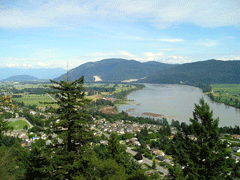
Facing inundation: Mission suburb of Hatzic and other Lower Fraser communities. Photo by M. Lounsbery.

[Editor's note: Chris Wood, a National Magazine Award-winning writer on climate change and water resources, has been looking into what British Columbians can expect from global warming for this series funded by a Tyee Investigative Reporting Fellowship. Today we publish the first two of his reports, with three more to appear on consecutive Thursdays. To learn more about Wood, his series and Tyee fellowships, go here.]

Hundreds of thousands of Lower Mainland residents living behind dikes along the Fraser River face a far more deadly flood threat than they know. New research uncovered by a Tyee investigation reveals that should the river rise to the level of previous floods, dikes from New Westminster upstream as far as Harrison River would fail in "multiple" locations.

A return of floods seen in the past would overtop existing dikes by as much as three feet at Mission, a new modelling study predicts. The report, funded by local, provincial and federal agencies and overseen by the Fraser River Council, is due to be distributed later this month to local governments and First Nations in the affected areas. The year-long study used highly detailed updated surveys of the Fraser River and records of historic floods in 1894 and 1948, in conjunction with powerful hydrological models, to forecast what would happen if the same water flows returned today. The last time such a study was done was 1969, using less detailed information and weaker modelling tools.

"What seems to be the case is that water levels that would be generated today are higher than in 1969," says Steve Litke, the Fraser Basin Council manager overseeing the study. The difference is dramatic in places -- reaching a maximum of 1.6 metres in the area of Mission Bridge. Dikes along the river are designed to remain six tenths of a metre above the 1969 design profile.

Rainfalls getting heavier

Differences between the new and old flood forecasts are less dramatic above and below Mission. But kilometres of existing dikes in either direction from that point are well below the flood crest foreseen in the new forecast. Additional kilometres of dikes, as far upriver as Harrison River and downstream to New Westminster, could be severely compromised by a flood crest that encroached on the .6-metre margin of safety. If the newly forecast flood levels proved correct, Litke says, "There would be multiple dike failures."

More worrying still, the historical record used as a basis for the updated forecast may no longer be an adequate measure of flooding in the future, Litke warns. Precipitation across the Fraser River basin has been increasing at two to four per cent a decade in the nearly 60 years since the last serious flood on the Fraser, leading Litke to ask: "How valid is that historical peak flow? Climate change is an obvious big question. Something bigger could occur."

One science-grounded scenario of a catastrophe triggered by drought and then flood is also published today in The Tyee. Described in the article is a deluge that wipes out rail lines, highways and sewage treatment plants, causing tens of thousands of residents to flee their homes and cutting the Lower Mainland off from the rest of Canada.

Warning system cut

How much warning residents would receive that flows upriver could threaten to overwhelm the dikes is also in doubt -- thanks to cuts in provincial funding for the network of hydrometric monitoring stations that track rivers in the province. The network, which stood at 600 stations a decade ago, and which experts say needs as many as 1,000 stations to adequately monitor British Columbia's many rivers, has been reduced to about 400. That number may fall to as few as 230 when the current funding commitment expires in the spring of 2009.

"It's denial," charges John Azar, spokesman for Water Highway B.C., a group formed by representatives of several water-related industries to fight for adequate funding for the hydrometric network. "At a time of growing climate uncertainty, guessing is not an intelligent strategy for a resource upon which everything else in the economy depends."

The total amount the province could save by decommissioning the early-warning network is $5 million, its budget for 2005-2006. A review of risks from a return of historic flood levels, conducted before the latest study calling into question the reliability of dikes along much of the lower Fraser, estimated potential economic losses at more than $1.8 billion, with as many as 300,000 people directly affected.

Population grows along banks

No federal or provincial program currently exists to assist municipalities in rebuilding, raising or reinforcing dikes along the Fraser. Meanwhile, development continues behind the dikes -- adding hundreds of potential new flood victims annually.

Flood management and protection in British Columbia is a responsibility of the Water Stewardship Division of the Ministry of Environment. The Tyee sought comment from the office of Environment Minister Barry Penner on several points related to this and additional reports to follow in our special investigative series about water and climate change in British Columbia. Those inquiries, over a period of two weeks, received no reply.

Some additional reading:

The GVRD’s analysis of changing precipitation patterns.

The Fraser Basin Council’s collection of flood-related documents.

Veteran journalist Chris Wood is recipient of a Tyee Fellowship for Investigative Reporting, which provided the funds necessary to do the in-depth reporting in this series. Tyee Fellowships for Investigative and Solutions-oriented Reporting are supported by donations from Tyee readers and intended to support independent journalism to educate the public about critical issues facing British Columbia. If you are interested in making a tax deductible donation, please go here. If you are interested in applying for a fellowship, please go here.

Wood is working on a book, Dry Spring: When the Water Runs Out, forthcoming from Raincoast Books.

 [Tyee]

63  Comments:

Login or register to post comments

  • gasworks

    6 years ago

    Comments on "Fraser River Will Surge over Dikes, Experts Fi

    I doubt this is a problem at all. I live on waterfront in the valley and the water levels are getting so low that the salmon will soon have to walk upstream to spawn. the last time we were actually threatened by high water was in 1991. MOREOVER as far as I know no one is building on the banks of the river and it is nearly impossible to get a permit on floodplain. but what the heck, spend a few hundred million just in case - Why worry?

  • RickW

    6 years ago

    Good attitude to have. After all, it is sustaining the residents who live along the San Andreas fault.........

  • Bailey

    6 years ago

    Oh yes, of course you're right. It'll never flood again. Couldn't happen in a million years. Why spend money on something that isn't happening to me?

    Besides, disasters are so profitable! Just ask the New Orleans division of Haliburton.

    Get a grip, eh?

  • sebastian toombs

    6 years ago

    Anyone ever been to the old Alexandra bridge just above Yale? It was built in the 1930s and was part of the Trans-canada until 1961. Its open-grid deck seems to tower above the fraser, so that you get dizzy looking down into the river. However, it was built only 3 feet above the level of the earlier bridge from the 1860s, and that bridge was submerged beneath the flood of 1894.

    http://www.bcarchives.gov.bc.ca/cgi-bin/www2i/.visual/img_med/dir_69/a_03925.gif

  • Grumpy

    6 years ago

    Don't worry be happy, seems to be the order of the day. Look at New Orleans and they still will not list how many people were killed. Watched a PBS station a week ago and the people doing demolitions of houses are still finding bodies!

    The developers don't have to worry, watching events unfold with flooding in BC, in their Condos in Hawaii.

  • Logjam 603

    6 years ago

    and when you tell people in Richmond that they live behind the safety of a dike, 90% will shake their heads with a "so what" response.

  • Grumpy

    6 years ago

    Well, Richmond's residents can all go to the safety of the Olympic Skating Oval, except it is too, below the level of the dikes!

    RAV will be elevated, so it can run, but........if the surrounding area is flooded, what use it will be?

    A recent report in one of the Richmond rags, said the sea dikes were in need of repair and much of the earthen dikes, were also in a state of disrepair, due to lack of programs to keep them in shape.

  • climber

    6 years ago

    Yes I have been on the old Alexandra bridge, very cool piece of history. Facts now, the river carries down millions of tons of sand and gravel on its journey to the sea. This ends up on the bottom as the river slows, in the valley, this makes the river rise higher even with the same flow. The dredging on the Fraser is grossly underfunded, only the part of the river big ships use is dredged by the Fraser River Port Authority (underfunded by the Feds, too bad we aren't in Quebec). This Authority is only responsible for the river 20k north of the Port Mann bridge. The situation is getting worse, gravel extraction from the river by Chilliwack has been fought for years, by David Suzuki and others. Passing the buck and snivelling about the enviroment has put many people and billions of dollars of buildings and infrastructure at risk.

  • trueman

    6 years ago

    I have to agree with Grumpy. I am a far cry from being an engineer but I have to think that the geography of Richmond bears some small resemblance to that of New Orleans. The decision to build the Olympic oval there always struck me as bravado of the most arrogant kind.

    We on the West Coast often display a superior sort of arrogance. We are, after all, a blessed people. No third world building practices here. No sirree.

    And we can hold back the sea. We've done it for years.

  • climber

    6 years ago

    I don't know about arrogance as much as ignorance. After the flood of 1948, the flood threat was taken seriuosly and a massive program of dyking and pump stations were built. Then people really got building in the flood plain. You can build the dykes higher and higher, but if the river floor keeps rising, it is useless. The emphasis must be on dredging right from the sea to north of Chilliwack. Seb Toombs is pointing out something to think about, the flood of 1894 was bigger than the flood of 1948, very few around to be affected though, if that ever came through now, mayhem. Oh well, we can just sit back and wait, that seems to be the new way, hiring a bunch of conslutants to tell us whats going to happen and then doing nothing about it.

  • jesterjogger

    6 years ago

    I know it's not related to this important topic but I just heard that harper fired his pilot after the pilot told him not to operate his cell phone in compliance with safety regulations!!
    Is this true?

  • gasworks

    6 years ago

    Don't be silly jesterjogger, he did no such thing. He simply took over the controls and is coming in for a landing on runway 666 ....

  • jesterjogger

    6 years ago

    (in exagerated chicago accent to the point of mockery)
    "What I would really like to know iz how harper would fare in a confrontation wit coach DITKA?"

  • Rhea

    6 years ago

    If we ever have a really good quake, or even if sea levels rise, Richmond is screwed. It's mostly below sea level, it's in a perfect spot to get hit with a tidal wave, and if you add to that the soil instability...it's sayonara Irene to all those McMansions people have built out there.

    To all those who build houses in the Fraser's flood plain: That river's not just painted scenery, people, and the dykes aren't just for walking the dog. People seem to forget that the Fraser is a huge river with many feeders, and that a too-quick thaw in the interior can have very sudden and unpleasant consequences downstream.

  • climber

    6 years ago

    It isn't only Ditchmond that will be devastated, the flooding in '48 was all the way up the valley, past Mission. Most on this site are disconnected from the nuts and bolts realities of life, the power and flow of the river that is so important to the GVRD is often ignored. It is not just earthquakes or rising sea levels that will result in disaster, do nothing and its inevitable. I can see it now, after the mayhem and cleanup, a Royal Commission set up with some political hack who gets a $2000 a day job to answer "Why did it happen?" Predictable and pathetic.

  • Skookum1

    6 years ago

    Quote:
    I have to agree with Grumpy. I am a far cry from being an engineer but I have to think that the geography of Richmond bears some small resemblance to that of New Orleans. The decision to build the Olympic oval there always struck me as bravado of the most arrogant kind.

    As also the new Skytrain line, which though less needed than the Evergreen Line got the go-ahead first. As well as what I call the Freeway From Nowhere To Nowhere - the Richmond Connector and a bunch of new bridges, as well as the main overland route to and from the US (where disaster relief is most likely/easily to come).

    But didn't ya know that Richmond has good feng shui - between two arms of a river, facing the sea (to the west isn't so good, but...) and it's board-flat as well as has a nice rectangular/square street grid. Funny how the most celebrated geomantic theory in the world doesn't grapple with the idea that the whole thing is quite literally a castle built upon the sand, ready to be devoured by the sea.

    Here's another thought in the case of a liquefaction of Richmond (more likely from a quake than a freshet, unless both occur at once): the backwash wave as the Strait of Georgia rushes into the hole where Richmond used to be will run up the Fraser as far as...????? Pitt Meadows? Mission/Matsqui? Chilliwack? And in the other direction, the subsea subsidence produces that most trendy of all disasters, a tsunami; thankfully (or not) Nanaimo and Duncan are protected by islands, though Sechelt and Squamish are not....

    But as far as the freshet goes - the assumption that 1894 was the record level, or that 1948 is only a once-in-a-while kind of thing, belies the notion that either repesents a 100-year flood or a 50-year flood. What happens when there's a 1000-year flood, as might happen if things warm up enough to suddenly melt the Pemberton and Lillooet Icecaps, or a record spring snowfall hit the Interior followed by sudden melt?

    Same issue applies here as with the "infrastructure feedback" resulting from overdevelopment of the Fraser Valley: the cost of stupid planning decisions in favour of fast-buck developers will be born by the taxpayers. And by the dead.

  • Skookum1

    6 years ago

    Quote:
    What happens when there's a 1000-year flood, as might happen if things warm up enough to suddenly melt the Pemberton and Lillooet Icecaps, or a record spring snowfall hit the Interior followed by sudden melt?

    Anyone remember the BCTV/Global footage (whoever they were at the time) showing the Green River during the Pemberton Floods a few years ago? There was one shot of a Niagara-like torrent that took me a second to realize what it was - Nairn Falls at [I]full bore[/I}! Normally a narrow rockthroat and cauldron with lots of bare rockface to scramble around on....well all that bare rock face is because of torrents like the one in question, which was a good 50' deep or more. And that was only because of Rutherford Creek running wild from rain-melt on the Pemberton Icecap, and didn't include potential outflow from the Soo River, Wedgemont Creek, or the Lillooet River tributaries of the Icecap (Ryan River, Meager Creek and a couple of others). Seems like a long way from the Lower Mainland, but it's not; a surge of the level of Harrison Lake would wipe out Harrison Hot Springs and course through the little valley between it and Kent, across from which are the Chilliwack/Vedder River dykes and pumping stations, and downstream from which are the Nicomen-Hatzic and Mission-Matsqui dykes....

    BTW the image adorning the article is showing a residential area that's well above most normal flooding; it would take a 20 or 30 metre or more flood to hit the Hatzic benchland; it's the Hatzic Lake/Prairie and Dewdney/Nicomen Island areas that are at risk, plus Mission's old downtown (south of the CPR mainline) and Silverdale Flats.

  • Grumpy

    6 years ago

    Liquifaction with a major earthquake in Richmond, though a bit off topic, still is important. Only where there is a clay base in Richmond, will it liquify, not so on the peat. In the 1948 earthquake, the peat in Richmond rolled in great 'waves', coresponding to the seismic waves. Because so few people lived on the peat, few witnessed these waves. (My parents, who lived on the peat along #5 Road, were told of this event when they moved there in 1950.)

    Back to the flood, it is my belief (and I stand to be corrected) that id a flood occurs on the peat, the peat will swell and expand, causing much havoc with the houses and the plumbing underground. The great housing estates now built on the peat would have to be abandoned and when there was money, to be reduced to produce.

    I recall in the late 1960's, travelling to river road in Delta to watch the Fraser rise above the dikes at high tide. The eerie sight of the water overcoming the dike slowly made a great impression on me.

  • climber

    6 years ago

    The Harrison river is also carrying more than the rivers and creeks Skookum 1 speaks of. There are also those that flow directly into Harrison lake, the Chehalis river, Big Silver creek to mention a couple. Creeks around that 40 mile long lake can go from a trickle to a raging torrent in a few hours during heavy rains. So when that river comes rocking into the Fraser it will be just another kick in the balls to the dykes. Along with the Pitt, Stave, Chilliwack and the creeks.

  • buddy21

    6 years ago

    Climber...read some of the real info regarding the Fraser flooding and dredging, not just the political editorials in the papers. Look into some of the research done by Dr. Church from UBC who has spent decades studying the geomorphology and hydrology of the Fraser and gravel accumulations.

    You will learn that the accumulation is anatural process that is slowly moving down the Fraser, and that there are actually very few locations where gravel accumulations have raised the elevation in any siginifcant way.

    The whole gravel extraction issue is mostly a scam pushed by industiral intersts and politicians who see it as a cheaper way to please the public then addressing the real issue. As well, the environmenal affects of disturbing the spawning and rearing grounds of endangered sturgeon as well as millions of salmon fry and enormous.

  • climber

    6 years ago

    Buddy, Its a "natural process", yes it is, accumulation, what does that mean? It means that the accumulation accumulates, raising the water levels, pretty simple really. The rivers natural course has been changed, it has been narrowed, where does this accumulate go? To the bottom, when the river slows. Most of the information I get is from people interested in flood prevention and keeping the Fraser docks open, not from aggregate salesmen or newspapermen. Salmon do not spawn in the middle of the channel, they spawn on the banks. I know the area where charges were laid for disturbing fish habitat near Chilliwack, right by the Aggasiz-Rosedale bridge, coincidentaly where the Stolo Nation have a completly illegal, non permitted garbage dump next to the river. There is no harm to the salmon by dredging the main flow channels, the charges were laid because the gravel on the banks was been taken. The huge majority of salmon that come up the Fraser to spawn do it well north of the area in question anyways. I will not speak to the sturgeon, I don't know that much about them, but to me, I think that we can possibly risk the sturgeon in that area to protect what lays downstream, sturgeon live well above that area as well. Now, why is it that dredging continues on the river below the Port Mann bridge, the sale of this sand gathered only offsets the cost by about half. If it is in fact a "scam" and the deposits are minimal, as you say then why? What should happen is that the river should be dredged on a yearly basis, deepened and kept that way, the dykes should be improved as well.

  • climber

    6 years ago

    Oh yeah, what is the real issue you allude to?

  • Skookum1

    6 years ago

    Quote:
    So when that river [the Harrison] comes rocking into the Fraser it will be just another kick in the balls to the dykes. Along with the Pitt, Stave, Chilliwack and the creeks.

    I was raised in the shadow of the Ruskin Powerhouse and Ruskin Dam. More than a dozen times I've watched the four (sometimes five) of its spill-gates at full throttle, with the waters of Hayward Lake churning out like big green, white-streaked grinding wheels, thundering for miles. When gates 3-6 aren't enough, gate 7 will get turned on, resulting in a huge fountain of spume because of the foundation-reinforcement of the old canyon wall at the base of the "wheel". Gates 1 and 2 are never opened except to small degrees for maintenance and other reasons, but never at significant throttle for fear they would undermine the river's right bank (west bank) and release Hayward Lake out the side of the dam. We pretty much assumed that if the dam ever did go, we'd go with it; on the other hand the "spill" could wash the other way because of the shape of the hill/gorge just below the dam.

    We were too young to care, and often dressed up in rainslicks to get right up next to the bridge across to the dam (featured in an X-Files episode, and rather well, too - the place is pretty Gothic-looking - http://en.wikipedia.org/wiki/Ruskin%2C_British_Columbia ) and stand just out of the hurricane-force winds that poured out of the gorge when the gates were open. Two was enough to make the bridge impassable, three or more made it dangerous to even approach along the cut through the rock wall lining the road to the bridgeway. Typically when four were going we were pretty much under parental orders to go no farther than the office; and we were never stupid enough to be playing/exploring (or whatever it is kids do) on the sandbars and marshes in the area in front of the townsite and downstream for it. Much less on the "pilings" (the ruins of an old mill) which is just opposite the powerhouse if even one gate was open. Half-throttle maybe, but we knew better.

    This long ramble by way of saying I'm well familiar with the power of the Stave and have seen some amazing things when it's unleashed. There've been a number of times when the combined powerhouse and gate capacity were close to being overcome (the third generator in the powerhouse was only opened in 1961). It's more heavy rainfall and snowmelt that could ravage the old Stave power project; but a snowmelt that took out the Stave Glacier and several others lining the Stave basin could have very nasty results. And as observed, it would certainly take out Glen Valley and what of Fort Langley that wasn't high enough, and Derby and Albion are likely causalties; but the backwash could also go up the Fraser as well; never mind all that nice real estate on Silvermere Lake (Hullah's Lake we called it) that Genstar is now the Big Bossy Neighbour to. Come to think of that, Hullah's Island - built from the dredgings of Silvermere upon the old centre-island of the Stave oxbow marsh/delta - is all silt, ready to be washed away; as well as both national railway mainlines and of course the Lougheed....

  • sebastian toombs

    6 years ago

    This thread reminds me how one of the nicest things about the Tyee is that it covers-- both in its stories and in readers' commentary-- a much wider range of British Columbia than do any of the province's major dailies...

  • Grumpy

    6 years ago

    A note: The Seattle PI allows readers to blog about major stories and editorials, not so with the Sun or Province.

  • climber

    6 years ago

    Skookum 1 that is interesting, I am familar with that area as well. I did a lot of treework for Hydro all around that area, right in the little company townsite as well. In his book, Never Fly Over an Eagles Nest, Joe Garner talks about working on that damn in 1928, and almost falling to his death there. The damn above at Stave lake had a lot of earthquake work done on it recently and that complex at Stave has a B.C. Hydro museum/visitor centre, which I never went to, funny, doing work for them. I also have bucked further up besides Stave, off of the Florence Lake/Burma road main, a favorite dumping site for murder victims and stolen cars. Down at the bottom of the hill, close to the Lougheed Hwy there is log pub, besides the shake/saw mills. In that pub are pictures and big old chainsaws, typical stuff. I met a friend of my gfs mom who had grown up around the head of Stave back around the war, she is in one of the pictures at the pub. I like it around there but its inevitable that it will be "Maple-Ridged" soon. Getting back to the story, yes the Stave is a force to be reckoned with for sure. There is also a pretty old damn setup on Buntzen lake, holding back the Coquitlam River. Few people have ever been there, restricted watershed, I had to piss in a bottle and get a card from the GVRD to cut down trees up there for Hydro, deserted place, some cool old Hydro buildings, a huge private park.

  • Rhea

    6 years ago

    Quote:
    But as far as the freshet goes - the assumption that 1894 was the record level, or that 1948 is only a once-in-a-while kind of thing, belies the notion that either repesents a 100-year flood or a 50-year flood.

    Something I don't think the article mentions is the fact that a lot of people living in certain types of flood plain areas aren't covered by flood insurance. I know you can't get it if you're down on Hatzic Flats, not sure about other areas. Can you imagine the economic consequences if everyone in the flood plain areas around the Fraser was involved in an insurance claim fight? Ugly ugly ugly.

  • Alcibiades

    6 years ago

    climber, you and skookum 1 should get together and write this stuff up - very worthwhile: Beers might even buy you a few if he can publish it. It's a perspective that no one pays much attention to anymore but still very worthwhile - email each other back and forth over the long winter months and pull it together.

    Just my two bits worth from the back of the crummy.

  • climber

    6 years ago

    Rhea, many houses right around that shit filled pond known as Hatzic Lake were flooded when the pumping system at the Lougheed Hwy. failed two years ago. Apparently the system is in need of extensive upgrades and repair. All kinds of building has gone on and continues in that particular floodplain, with it own problems, besides the Frasers threat. I haven't set up a level and taken elevation shots, but Hatzic Lake and the Fraser seem to be at the same level, hmmm.

  • Rhea

    6 years ago

    Quote:
    All kinds of building has gone on and continues in that particular floodplain, with it own problems, besides the Frasers threat.

    Yes, but nobody I've met who lives there seems to have adequately educated themselves about what living in a flood plain actually entails (including the fact about insurance). And then they get all shirty and expect compensation from somebody when it (gasp) floods. I guess this was more a rant about the blinkered entitlement mentality that's becoming more and more prevalent.

    If we do have a huge flood in the future, I suppose I can only hope that it wipes out the proposed Genstar abomination.

  • climber

    6 years ago

    The Genstar thing is going to be above the floodplain, well above, I lived in Mission up till a year ago, I know. I also cut down many trees to widen the Slowheed Hwy. and to make the intersection by the gas stations in Silverdale for that development. The Genstar thing is well past proposal stage, palms have been greased, council voted for it, Genstar didn't buy up all that land just to sit on it. I have no problems with development in general, hypocritical to oppose seeing as how I made a living from land clearing and construction. But developing that hillside is retarded, the infrastructure is not there, the road is the biggest turd in the punchbowl of all. But endless development of the valley is inevitable, got nowhere else to go. Glad I moved.

  • realist2

    6 years ago

    I live in the north where B.C.earns its real money. Without us this province would be broke. Yet, when it comes to governmental spending of tax dollars we are treated as second class citizens. It would be unfortunate if the above scenario happened but at least it would shift the real power back to where it deserves to be: Northern B.C.

  • climber

    6 years ago

    Realist2, yes, all true, the provincial capital should be Prince George. Just like it was once in New Westminister, it can be changed again.

  • Skookum1

    6 years ago

    Quote:
    Rhea, many houses right around that shit filled pond known as Hatzic Lake were flooded when the pumping system at the Lougheed Hwy. failed two years ago. Apparently the system is in need of extensive upgrades and repair. All kinds of building has gone on and continues in that particular floodplain, with it own problems, besides the Frasers threat. I haven't set up a level and taken elevation shots, but Hatzic Lake and the Fraser seem to be at the same level, hmmm.

    They are; Hatzic Lake is really an oxbow of the Fraser that got cut off from it by the CPR mainline; the old Dewdney Trunk Road got to Dewdney via Durieu - what is now "Stave St." (we knew it as Stave Lake Road); the DTR (now "Dewdney St", sometimes "Dewdney Avenue" depending on if it's E-W or N-S in whichever block) was rerouted down to the old River Road, AFAIK, when the CPR was upgraded; getting lost in the historical roads here, which I might be wrong about anyway....but the point is that Hatzic Island has always been floodable and often floods; when I was in MSS in the late '60s-'70s it was every other summer that people living on Hatzic Island had to evacuate because of rising flood levels; guess that was before the pumping station; never did like swimming in it, even if it was warmer than Hayward or the Blind Slough (we swam in the tailrace rapids below Ruskin Dam, which were coldest of all as they came out of the bottom of the reservoir...brrrrr).

    I'm not sure how much of a torrent it would take, but a really major surge of the Stave might not only take out the dams at Stave Falls (and thereby Ruskin below) but also crest over the old terminal moraine in the McConnell Creek/Miracle Valley area - which was the original outlet of the Stave in the days of its great glacier being where the main arm of Stave Lake is now. The flooding of Hatzic Prairie in recent years was from Cascade Creek, just south of Mt St Benedict and Davis Lake (easily one of the most spectacular lakes in the Lower Mainland, and among the least-known and relatively hardest to get at...); and the reason for the Cascade Creek floods, same as with Pemberton and Howe Sound, was very simple: over-logging on steep slopes...

    Alcibiades: I don't post my email here as it's web-scannable; check the mail links at http://www.cayoosh.net or send me an email from within Wikipedia if you're a subscriber (my username is the same as here).

  • DennisG

    6 years ago

    I would like to note that a flood is a the product of a convergence of factors with dykes being only one of them.

    I think the potential for a Fraser River flood in the Lower Mainland is present every year if the relaevant events converge.

    Most important would be an extended period of heavy warm rain on a snowpack just at melting temperature and a very warm air mass at the upper altitudes.

    Dykes are built against probabilities of all the conditions converging to the extent they did in 1894 but there has never been a nil possibilty of those conditions being exceeded in any year.

    A flood will come but raising the dykes may reduce the probability for any given year.

  • squishy

    6 years ago

    Anybody notice that the Sun scooped this story and rushed it onto B1 of Friday's paper after seeing it in Tyee first? Way to go Beers for getting this onto the agenda -- though it must rankle in some ways that the Sun essentially scooped for free what you had to raise money to bring to light. Good on you anyway.

  • Colin

    6 years ago

    The problem with building anything on or near a floodplain, is that the river never really stops moving, if you constrict the flows it chews out channels in one place and dumps the silt and gravel elsewhere, forcing it to change again. Dredging is only part of the answer to maintaining the current situation. You need to give rivers a place to flood a concept that the US Core of Engineers is being getting a painful lesson in. Building in flood channels and wetlands will help reduce the impact of flooding.

    In my job I make people build to the 100 year flood event level, after the rains that washed out the Rutherford Hwy & rail bridge a few years ago, people seem to realize that it is a lot more likely than they thought.

    A friend of mine that built bridges for Canfor told me that the improved road and bridge that they built due to the tougher regulations actually saved them money as they were not replacing washed out bridges and culverts all the time.

  • Skookum1

    6 years ago

    Quote:
    A friend of mine that built bridges for Canfor told me that the improved road and bridge that they built due to the tougher regulations actually saved them money as they were not replacing washed out bridges and culverts all the time.

    Building to last...what a novel concept! So rare in BC, huh? My line on infrastructure here is they begin debating it at least 10 years after it's needed, and take another 10 to plan it for completion ten years later, on a design already outmoded/obsolete relative to the initial demand was first recognized; the projected is never considered, nor the projected consequences: Hence the Gateway Project's obsession with highways vs alternatives (as also with Hwy 99 vs building a high-speed rail link to Whistler-Pemberton (and maybe beyond).

    But to build stuff like that across mountainsides riven with potential cataracts and across gorges and floodplains that are, by definition, water courses of the conceivably most extreme kind. Canyons don't get cut by mere trickles of water; not when it's granite you're talking about (different in the US Southwest where sandstone is the norm).

  • Steve P

    6 years ago

    Quote:
    The Genstar thing is well past proposal stage ... But developing that hillside is retarded, the infrastructure is not there, the road is the biggest turd in the punchbowl of all. But endless development of the valley is inevitable, got nowhere else to go.

    Did we just read the same article about how stupid it is to build on the flood plain? Hillside development is the alternative to building on flood plain and agricultural land. It is where we should be building future neighbourhoods.

    Yes, infrastructure will be expensive to place up the hill, but this will bring benefits to many locals who rely upon unreliable shallow wells and septic fields.

  • Skookum1

    6 years ago

    When I mentioned Genstar as the Big Bossy Neighbour to the Silvermere Lake residents, I was meaning the new rules Genstar - which owns the lake, technically dry land-property and not public property/water - was trying to impose new no-water skiing and no-swimming rules, partly because of the new sewage requirements/capacity of the lake. Not that the Silvermere shoreline folks haven't been dumping their own crap into the lake for decades (I remember coming nose-to-nose with a turd on more than one occasion, and the foamy quality of the lake against its northern dike didn't help property sales up that way one bit), but the general tone of Genstar's behaviour around Silverdale and Silverhill has been that of a swaggering bully.

    In this case I suspect it's more to do with liability clauses (something Ned Hullah never seemed to worry about, cloistered in his mansions on the private island as he was), but I do wonder why it is that the new Rape-of-Silverhill development is going to dump moresewage into the dredging pond that is Silvermere; or is it just a run-off issue, I'm not sure (I don't live in Mission anymore and don't follow the local rag).

    As for not building on the floodplain, this isn't the issue with Silverhill; and the infrastructure and road spoken of in the quote (which wasn't mine) has to do with Highway 7, not with roads on Silverhill. I'm not sure from the quote if the small-v "valley" is in reference to the Fraser Valley, or the Stave River Valley; I imagine the former, but it's worth noting that the Stave Valley is relatively untouched compared to the rest of the Lower Mainland, even to the rest of Mission. It won't be for much longer after Genstar is done what it's doing. And what it's doing is going to look like the Westwood Plateau or Mary Hill and is going to be automotive-based and tract-housing based, rather than rail-based or village-based. Sure, there's going to be a Silverdale/Ruskin WestCoast Express Station, with vast parking lots no doubt, but what was beautiful about Silverhill will no longer exist. In fact, as noted here before, Genstar even tried to do away with the name of Silverhill, and Silverdale itself was marginalized (it's older than Mission City).

    As long as future neighbourhoods are built on the urban sprawl model, it's going to be a disaster. And if what's happening on Silverhill is also to come between 240th and 287th (Albion-Whonnock-Ruskin) as well as north of the Dewdney Trunk (between there and the projected freeway along the powerlines that cross Stave Lake around Rolley Lake), the result is going to be another North Surrey/Coquitlam suburbanoid MESS. And what this also means is that the new re-doubling of the Pitt River Bridge will be obsolete in short order, and the doubling of the new Golden Ears Bridge will be "urgently needed" twenty years down the line, just as the twinning of the Port Mann is now.

    Developments like Genstar's help along the Ministry of Highways/Transportation (whatever they call themselves now) plans for all the new freeways they'd like to build between Vancouver and Chilliwack, that's for sure. Nothing like one form of development to cross-pollinate another, especially when tasty construction contracts are in the offing for the ruling party's buddies....

  • Skookum1

    6 years ago

    To clarify: I'm all for encouraging development on the upland areas of the Fraser Valley, instead of on the floodplains, as long as there is a moratorium on the current style of housing development, i.e. tract housing requiring automobiles as the main form of getting around. A European-style plan based on villages and local rail or other alternatives is the ONLY sane way to proceed from here on in. Not that anyone's going to listen to that, the professional planners most of all.

  • Skookum1

    6 years ago

    Quote:
    Not that anyone's going to listen to that, the professional planners most of all.

    or "least of all", I suppose is the proper syntax for that..

    One thing I would like for local governments to consider: that developers be liable for long-term infrastructure expansion needs caused by their projects. This would reduce the profit margin of such developments, to be sure; but it would also mean that unfair burdens on future taxpayers would be reckoned into development costs, as they should be.

  • Steve P

    6 years ago

    Quote:
    In this case I suspect it's more to do with liability clauses [re: use restrictions on Silvermere Lake]

    That's exactly what happened. Genstar found out their were liable if anyone was injured or killed recreating on the lake. They were very unhappy to feel pushed into this, as they last thing they need in the Mission area is bad pr.

    Quote:
    A European-style plan based on villages and local rail or other alternatives is the ONLY sane way to proceed from here on in. Not that anyone's going to listen to that, the professional planners most of all.

    Actually, most planners I know (myself included) are very supportive of this vision (however difficult rail may be on the slopes). Check out http://www.smartgrowth.bc.ca/index.cfm

    Some of the folks I've spoken to in the Fraser Valley, who were opposed to the Silverdale/Silverhill/SW Mission development, opposed the higher densities required to support transit --this is a very difficult message to communicate with the public, especially with so much (well-earned) distrust between the public, local government, and the development community.

    Quote:
    but the general tone of Genstar's behaviour around Silverdale and Silverhill has been that of a swaggering bully.

    It is easy to take cracks at Genstar, as they are a large residential development company. But seriously, when have they behaved like bullies? I attended many of the council meetings and public hearings over the last five years in Mission, and never saw Genstar or their reps acting like bullies.

    Quote:
    It won't be for much longer after Genstar is done what it's doing. And what it's doing is going to look like the Westwood Plateau or Mary Hill and is going to be automotive-based and tract-housing based, rather than rail-based or village-based.

    Have you even spoken with Genstar's land use planners, District of Mission planners, looked at the preliminary area plan (done in 2001), or read the Silverdale Urban Area Neighbourhood Plan Terms of Reference?
    http://www.city.mission.bc.ca/AssetFactory.aspx?did=1187

    I think you'll be in for a pleasant surprise. Mission is very dedicated to making this development very high quality, and as "sustainable" as possible. Of course, there will be change as the area becomes urban, but I think invoking the ghost of Mary Hill is premature, especially since there have been no neighbourhood plan layouts yet!

    Quote:
    In fact, as noted here before, Genstar even tried to do away with the name of Silverhill, and Silverdale itself was marginalized (it's older than Mission City).

    This is misinformation -- at least about what Genstar "tried" to do. =^)
    Genstar used the name "South West Mission" in its preliminary studies because it is what the District of Mission called the area in its planning documents -- Mission called it the South West Mission Urban Reserve (this area has been planned for urban expansion for decades). Genstar was trying to be sensitive to the fact that there are several historic communities in the area, so they didn't title their maps after only one of the communities. They have, of course, since changed the name to reflect the District of Mission's wishes -- now it is the Silverdale Urban Residential Area.

    Quote:
    One thing I would like for local governments to consider: that developers be liable for long-term infrastructure expansion needs caused by their projects

    Well Skookum1, your wish has come true: check out the neighbourhood planning terms of reference I linked above.

    Skookum1: I enjoyed your posts and hope you'll help keep folks like Genstar & the Mission planning department honest & committed to sustainable neighbourhoods as they proceed with their plans!

  • climber

    6 years ago

    Steve P, I was talking mainly about the road, not roads, hwy 7. Also, I lived in Mission, high above Hatzic lake, and the septic field worked well, the water from the shallow well was fine. Now, Hwy 7, how anyone could think this single lane each way sometimes, double lane sometimes is adequate is beyond me. The road was way too small years ago, with another ten thousand people it will be the Super Slowheed East. Nothing against development, maybe if Hwy 7 was made into three lanes each way first, oh wait, that will take forever, where is the freaking bridge from Langley to Haney even?. We should dig up old WAC Bennet and bring him back to life, he had his faults, but he made shit happen, big time. Unlike the culls now, that just fuk around, gathering reports, from conslutants. What a shithole (the whole area south of the Aggasiz-Rosedale bridge, right to the ocean), for so many reasons, a swirling cesspool of enraged motorists, etc, ect, perfect.

  • Steve P

    6 years ago

    Hi climber:

    Quote:
    The road [hwy 7] was way too small years ago, with another ten thousand people it will be the Super Slowheed East.

    Fair enough. At least they have four-laned it (i.e. two lanes each way) as far as the western part of Mission!

    Quote:
    I lived in Mission, high above Hatzic lake, and the septic field worked well, the water from the shallow well was fine

    I'm pleased that your well & septic field worked well for you. Some others in Mission have not been so fortunate, and have had difficulties stemming from their shallow wells drying out due to lower precipitation this year.

    Quote:
    We should dig up old WAC Bennet and bring him back to life, he had his faults, but he made shit happen, big time.

    Nostaglia for an infrastructure-building premier meets the Dawn of the Dead: I picture a WAC Bennett zombie intimidating opposition and planning new dams and highways before hunkering down for some more bwains ... =^)

  • Skookum1

    6 years ago

    I've scanned the reports you linked for me, but I think you misunderstood what I meant by infrastructure - and it's my fault for not being more explicit. What I mean is meta-infrastructure, not municipal/local infrastructure. i.e. regional road demands, as well as social problems associated with land-use scenarios currently holding the momentum (e.g. alienated, media-addicted kids/adults whose idea of having a good time is hanging out at Starbuck's); social/cultural space in other words, being absent, helps produce a lot of nasties we've all come to bemoan in modern society and culture (or lack of it).

    What I'm really meaning, though, is the entrenchment of the automotive infrastructure but continued low-desnity development; and the idea that such places as Silverdale should be bedroom 'burbs for downtown Vancouver commuters (currently TransLink's model for the WCE, also) rather than free-standing communities; part of the problem with that is that only so many people will use interurban transit (WCE) and the residence-work model will increase loads on the Lougheed, and so also on the bridges - which are already strained enough by the burgeoning development in Maple Ridge. Point is that, despite opposition to high-density development which is "needed" to validate transit development, the point is that low-density development has other consequences that are a lot more expensive in the long as well as short run; sure the public needs to understand this, just as they need to understand that roadways that are the consequences of low-density development are also one of the "hidden costs"; which ten-twenty years down the line emerge and wind up being billed to the taxpayer, though never discussed in the planning strategies. This is partly what went down with Maple Ridge - the regional infrastructure demands were not reckoned into the costs of the project, so the developers could high-grade housing developments without (themselves) having to worry about the costs (and tolls) of the new bridges required, or the strain on the local/inter-regional road networks. A big part of this, of course, has to do with the centralized model of urban development, i.e. everything devolving off the metropolitan core, instead of being more decentralized; as also again in Europe.

    And terrain's not really an issue for transit - witness San Francisco; and not necessarily cablecar systems or cog railways are needed, just well-planned contour-derived routes; and they need not be high-cost systems like the bloatware that is Skytrain, or heavy-rail systems like the WCE. Here's one contour route: from Mission out 7th Avenue/Silverdale Road to Wren, then bridging Silver Creek and up Clay to Keystone, then out that route to Wolfe, down Wolfe to the Silverhill-Manzer junction area (where my old primary school still stands today, sigh), then instead of down Manzer to Silverdale, around the slope to connect to the top part of Nelson, then via the necesary grades back to West Heights (Wren-Clay). Another route out Hayward and back up to Malquist/Wolfe (some grade), and another from Silverdale up towards Nelson (again a grade, but not undoable). Then on the upper levels a light-light streetcar system, or one of those individual-service new systems that let users travel in privacy and without intervening stops. All cheaper than Skytrain/LRT; such transit requires lighter visions of technology than the kind the government likes to throw its construction contracts to its friends for, though...

    I've also pointed out previously that the water licenses that were granted for the Stave River were for the provision of electrified public transportation (for Vancouver); no doubt those clauses have long been overridden but their spirit reamins. Remember that everytime you look at the old trestles along Hayward Lake - which at one time was a relatively busy passenger line, with connections to the more-than-daily CPR passenger service in those times.

  • Skookum1

    6 years ago

    All of this not politically viable until gas reaches $3-5/litre, of course.

  • Steve P

    6 years ago

    Hi Skookum1:

    Thanks for another informative post.

    I think I understand what you are getting at re: the need to have development pay for regional infrastructure, rather than just the roads that will serve the development. I'm not sure what kind of off-site fees developers in SW Mission/Silverdale/Silverhill will face.

    As for Mission's need for social development, I totally agree -- I think economic development rests upon a level of social development (i.e. education, a sense of control over one's life choices, opportunities, places for youth, etc.). Any developer in Mission is required to put money toward a community amenity fund, in addition to amenities which would be provided within a development. Some of this recently went into building a Mission Assisted Seniors Housing complex.

    As for economic development, I think Mission recently developed a new business park -- this will provide some jobs in the valley, and avoid some commutes into the metro core (although more economic development would likely be required to provide meaningful work to a significant portion of new Silverdale/Silverhill residents).

    Although it is true that cable cars can haul people up pretty steep grades, BC transit buses don't do well on grades in excess of 8%. Whenever people need to switch from, say, a streetcar to a bus, it adds a transfer to the trip, so BC Transit isn't always supportive of rail-based transit. 8% grades will probably be okay on much of the hill, although there will likely be some tight squeezes ... I'll check out the potential right of way you identified in your post.

  • Steve P

    6 years ago

    Quote:
    All of this not politically viable until gas reaches $3-5/litre, of course.

    Agreed. For this reason, I perversely celebrate when energy prices increase, as it provides incentives for better transit and development of better energy efficiency and fossil fuel alternatives. =^)

  • Skookum1

    6 years ago

    Quote:
    Although it is true that cable cars can haul people up pretty steep grades, BC transit buses don't do well on grades in excess of 8%. Whenever people need to switch from, say, a streetcar to a bus, it adds a transfer to the trip, so BC Transit isn't always supportive of rail-based transit. 8% grades will probably be okay on much of the hill, although there will likely be some tight squeezes ... I'll check out the potential right of way you identified in your post.

    I didn't look at the contour map as I estimated it; just eyeballing it from my mental map of the area; and that's only meant as a trunk line, not as the community lines. The idea remains that rather than a network of arterial/subdivision roads covering the hill, a network of rail systems of varying gauges would produce a more amenable result; especially with what I know of Silverhill's propensity for icing and snow as well as low-altitude cloud (when it's not standing above the valley-spanning fogbanks).

    And buses is the last thing I had in mind; noisy, bulky, uncomfortable to ride on (lurch, lurch, lurch); the little mini-shuttles maybe but the nostrum that "people want more buses" is only based on surveys that ask people how they want their transit service immediately improved; they want better schedules so "more buses" seems like a good answer. They aren't offered other options. Buses, to me, are dehumanizing human cattle-cars, and are a product of the automotive infastructure, not a solution to it.

  • Skookum1

    6 years ago

    BTW Mission was the original point-of-connection between the Burlington Northern (back then the Great Northern maybe?) and the CPR; in fact two of the original proposed names for the old Town of Mission City were East Vancouver (ahem) and North Seattle, indicative of that connection point's role in the regional infrastructure; this was before the New West rail bridge and in a time when the BCER interurban service was, of course, electrified rather than having any connection with the steam-engine heavy-gauge rail lines (i.e. because of course it had its own bridge at New West).

    I always though the WCE or anything of that kind should have had a connection to/from Abby and/or even Bellingham/Chilliwack. The triangle of land in between the rail spurs coming off the bridge to the CPR mainline could have been a triangular platform-in-the-round station with a residential/commercial complex on top of it, as is common in Korea, Japan, Europe etc. On the floodplain, true enough, but so is the Mission WCE station anyway.

    I have an old District of Mission map scanned somewhere, with the 50s vintage road system, which still forms the backbone of the municipality's roads. Trying to remember the name of the road that Silverhill Road almost connects to at its top end...the one coming into the south end of Clay Road, before the jump down into the Silver Creek canyon. Not sure what the grade there is but it's another obvious trunk route. But there aren't any street plans of the new development online yet anyway, are there?

  • Skookum1

    6 years ago

    Quote:
    I always though the WCE or anything of that kind should have had a connection to/from Abby and/or even Bellingham/Chilliwack.

    I should add that the idea with this concept is to help give Mission a leg-up on the regional economy that it lost when Eaton's bailed and moved to Sevenoaks when Hwy 1 opened; i.e. at one time it had been the main commercial district in the CFV; the rail node I'm proposing would lend itself towards that; as well as would make a lot of sense for commuters from Abby currently using Hwy 1, as well as connections to a possibly-revived interurban system.

    My comments about Silverhill and rail-residential development apply also to the proposed annexation of Sumas Mountain to the City of Abbotsford.

  • DNA

    6 years ago

    Re flood danger:
    I don't see how we can be in the same danger as 1894 or 1948 for two reasons.
    1) A huge amount of the Fraser River watershed was diverted to the power plant at Kemano in the late 1940s and early 1950s.
    2) Global warming has certainly decreased the annual flow from he snowpack, and the flood danger came in the spring if the snowpack melts too rapidly.
    Where is the water that will produce a great flood?
    This is a question, not an argument. Does anyone know?

  • Steve P

    6 years ago

    Quote:
    Trying to remember the name of the road that Silverhill Road almost connects to at its top end...the one coming into the south end of Clay Road, before the jump down into the Silver Creek canyon.

    Grove? Tyler?

    Quote:
    But there aren't any street plans of the new development online yet anyway, are there?

    In 2001 Genstar's team produced an Area Plan with a preliminary road concept for the major roads. This has all been superceded, since the District asked the proponent to do further comprehensive environmental base mapping & a host of other studies before proceeding with more detailed plans. I think this base mapping will be subject to peer review & District approval this fall. We'll probably see some transportation plans shortly thereafter.

    For background info, here's a link to Genstar's land use planning consultant's teeny web site. It contains summaries of the planning to date -- much of this planning will be subject to change based on findings from the environmental mapping process this fall. You'll find the preliminary road planning in the "South West Mission Area Plan."
    http://www.jordencook.com/SWM/

    As for buses vs. rail, I agree that rail is far more pleasant to use ... yet buses are so much less expensive! =^)

  • Skookum1

    6 years ago

    Quote:
    As for buses vs. rail, I agree that rail is far more pleasant to use ... yet buses are so much less expensive! =^)

    Are they now? Are you sure? What about the (rising) health-care costs and liability/damage/personal loss costs of the high accident rate with automobiles/roads? The long-term and short-term environmental costs of the acreage that gets paved and then doused regularly with automotive fluids? The aforementioned social and community damage associated with automobile culture? Noise pollution - never mind the Harleys - trucks, buses and overblown engine noise from powerful vehicles is bad enough; which also bears on health costs because of hearing damage, remember.

    The point is with automotive infrastructure, of which buses are a part and only a band-aid solution, is that many costs are offloaded in one way or another, either to future generations or to immediate secondary/tertiary effects of automotive-based life. How many fatalities a year are there on rail systems vs automotive networks? And given the old issue of user-friendly transit, getting people to use transit is unlikely to be successful with the upper classes if travellers are lumped together with squawling teenagers, mentally-handicapped seat-mates. people yakking loudly about their personal lives on cellphones, or just scowling at everyone who gets on the bus as is so typically the case throughout metropolitan Vancouver. Makes me wonder about psychiatric costs/damage from bus-use as well ;-) Hearing damage alone must be considerable; try sitting at the back of a bus, on top of the differential/drivetrain and consider the decibel level you're subjected to; never mind the decibel level at streetside while waiting for the bus.

    You get what you pay for. Cheap is what buses are; and cheap is what you get. No - not really cheap, as noted. Because of all the other costs that entrenchment of the automotive infrastructure exacts on public budgets, the environments, and the social/cultural landscape.

    And the point, again, with rail, is that it doesn't have to be expensive graft-oriented lollipops like Skytrain. Anything but.

  • Skookum1

    6 years ago

    And again concerning rail, vis a vis densities sufficient to support it (supposedly). It was in Mission High, in fact, from geography teacher Ray Selbie, that we were shown comparison of topo maps of what appeared to be rural parts of Germany vs topo maps of Vancouver/Burnaby. Count up the little black dots, multiply them by the average no. of inhabitants according to a certain formula - et voilÃ* the "rural" areas of Germany had higher population densities. As well as farmland and forest.

    So the density/transit formula is, to me, a red herring, and planners should re-think the North American norms of yardspace, subdivision layouts, and above all the dependency on the land-wasting (and life-costing) automobile.

    And at a local level, there are new transit designs which are consumer-oriented; I mentioned the point-to-point system, which is a light rail/monorail where the cars hold up to four or eight people or so and wait on a siding until engaged by use of a programmed smartcard. You only travel with who you want, and there's no stops anywhere but where you want to go. And the rub is this system, whatever it's called (and I'm sorry I don't have the weblink) is supposedly cheaper to build and run than any other system. And can be built/budgeted to scale, such that even small cities like Medicine Hat or Kelowna, say, or even smaller, can afford it....

  • Skookum1

    6 years ago

    voil�* was supposed to be voila with the accent, but you probably figured that out, huh?

    Wanted to bring San Francisco's transit system up again, as being multi-tiered. One scale of transit serves neighbourhoods, the others are variously intercity and transregional (the latter being BART); likewise Paris and London....

  • Steve P

    6 years ago

    Quote:
    As for buses vs. rail, I agree that rail is far more pleasant to use ... yet buses are so much less expensive! =^)

    Are they now? Are you sure?

    OK ... financially more expensive to the transit provider =^)

    Point taken on broader social & environmental costs.

    Although it is true that Germans use more rail, I don't think that density is entirely a red herring -- transit still needs passengers and popular destinations. But I agree with where you are headed with the point, in that if we made rail-based transit a greater priority, and it was considered more normal than driving a car, then lower densities would be required to support a greater amount of track.

    I haven't heard of the point-to-point system you mentioned -- I'd love to find out more about it!

    best wishes,

    sp

  • Skookum1

    6 years ago

    Preliminary googling on "alternative transit systems" found:

    http://www.atsltd.co.uk/
    http://www.atsltd.co.uk/prt/faq/

    http://www.taxi2000.com/
    http://ourworld.cs.com/PRTdesign/PRTpage.htm
    http://www.cprt.org/
    http://www.cprt.org/Flyers.htm#WhatIsPRT
    http://www.cprt.org/Images.htm

    Somewhere I've got a bookmark (in my vast bookmarks file) of yet another system. The first time I heard of this was on a CBC Radio program, not sure how long ago (years, though). The version/account I remember was that it was a high-density grid - not a widely-dispersed grid like Skytrain, or even like New York's MTC subways or London's Tube, but "tighter" and covering neighbourhoods. And the idea was a low-tech track that didn't cost much to build and didn't require much in the way of heavy construction, even as a monorail/elevated system - perhaps like the old Expo Monorail, which ran on I-beams and was supported by same. Also low-profile and relatively silent, such that having one go by your apartment window wouldn't rattle the dishes or even take up much space in, say, your local alleyway; small, ultra-light transit.

    Most of the systems in the googled links above seem a bit wider-dispersed, but I'm not familiar enough with the cities featured (Chicago, Minneapolis, Cardiff and others) to know the scale involved. The CBC account discussed a system that was a thorough grid, with many possible intersections, such that the computerized control system (the only truly high-tech part of the system) would choose the optimum route depending on traffic conditions elsewhere in the grid; to the same destination might use a different routing depending on the location of other vehicles on the grid.

    Disney Inc.'s transportation division - which used to be WEDWay (WED=Walter E. Disney) - had a number of designs, including the old Disneyland peoplemover, which was more about the track technology than grid-governance. The peoplemover was unusual in that the "drive train" was in the track itself, in the form of motorized rubber tires to provide the traction on the uphill sections, with the downhill sections entirely gravity-fed, like a low-speed roller-coaster; this was meant as an energy-efficient application but I'm not sure of the specifics (motors were electric).

    All very Buck Rogers; but given that those "visions of the future" have been around since the 1930s, it's amazing that heavy-tech applications like SkyTrain and other bulky, high-cost systems, continue to be favoure by governments. Part of the reason, I think, is that governments are much better at looking at centralized heavy infrastructure rather than decentralized light infrastructure. As also with residential/urban design....

  • Skookum1

    6 years ago

    More links from googling "personal rapid transit", which is the emerging name for this kind of system (PRT or PAT):

    http://www.advancedtransit.org/%5Cpub%5C2002%5Cprt%5Candreasson.pdf (see Personal Rapid Transit section)

    http://faculty.washington.edu/~jbs/itrans/prtquick.htm
    http://en.wikipedia.org/wiki/Personal_rapid_transit
    http://www.personalrapidtransit.com/

  • Skookum1

    6 years ago

    One last comment on this tangent-topic, which is very far from the original catastrophe-scenario theme of what this forum is supposed to be about: implementation of PRT/PAT and rail-based community development obviously is going to take not only a commitment on the part of municipal politicians/bureaucrats and their communities, but also the development of new neighbourhood/development models from planners and architects. "Two cars in every garage" is no longer a working/viable model; re-thinking how housing and commerce/services fit together also implies different ideas about what a house is, and what a neighbourhood is. And one thing I'm very wary of is the sterilized version of development of the kind that's emerging on Burnaby Mountain with Cornerstone and its kindred - "sustainable" and "safe" almost being bywords for "controlled" and "gated" communities; there's a sense of stiflement up there, NIMBYism verging on oppressive "community", where individuality doesn't seem to fit....like most of SFU, in fact. Looking at the planning documents for Silverdale/SW Mission it's true they may be a step up from the endless strip malls that make every small town and suburb in BC look just like every other small town and suburb in BC; but ultimately there's a "sameness", and also a sense of group-control where everything has to be approved by committee. Where strata councils and neighbourhood watch become the equivalent of the party secretaries in Soviet Russia and Maoist China...except with nicer duds and deeper pockets (and heavier lawyers).

    BTW are either the new Pitt Meadows or Golden Ears Bridges designed to accommodate rapid-transit or other rail lines? If not, why not?

  • Steve P

    6 years ago

    The Golden Ears bridge will have transit routes across it, but I don't think rail is part of the design. Not sure why not -- I don't know what the trip generation data is like, etc.
    http://www.translink.bc.ca/goldenearsbridge/project_information/project_description.asp

    The Pitt River bridge is designed with some extra width for a future light rail transit line. I guess this means they want to complete the Gateway project improvements first?
    http://www.partnershipsbc.ca/pdf/prb-factsheet-22-feb-06.pdf#search=%22new%20pitt%20river%20bridge%20design%22

    Quote:
    Looking at the planning documents for Silverdale/SW Mission it's true they may be a step up from the endless strip malls that make every small town and suburb in BC look just like every other small town and suburb in BC; but ultimately there's a "sameness", and also a sense of group-control where everything has to be approved by committee.

    (warning: I'm about to wax philosophical!)

    One huge challenge is the conflict between freedom for designers and planners to do their job and the need for them to be reined in by political committees (council, ratepayer associations, etc.).

    Speaking generally (i.e. not specifically about Mission), I find this to be a big frustration. On the one hand, our democratic system favours consulting people (not necessarily doing what they say, but consulting them). On the other hand, why should a small cadre of current residents wield such control over the future home for an additional, say, 30,000 residents? It doesn't seem "fair" from a democratic/"majoritarian" perspective. Similarly, I also believe that our democracy is part of what sustains social inequality (not enough people would vote for wealth redistribution to end poverty) and some of our stupid ways of building cities (people generally like familiarity and fear change). Not that I have a viable alternative to democratic process =^)

    I don't have a simplistic answer to this, except that the tension between freedom and political control is an endemic feature of our political culture. Too much freedom can yield crappy results, yet sufficient freedom is necessary for people to come up with creative solutions. Insufficient political control allows the market to run wild in a self-destructive manner, yet too much political control stifles initiative and makes all new neighbourhoods look the same (i.e. the need to conform to public subdivision, planning & engineering standards that create "cookie cutter" communities that everyone hates).

    Thanks for a fun tangent, Skookum!

  • netscaper2

    6 years ago

    Flooding from water coming up the Fraser from the Arctic meltdown sounds logical to me...
    So, where do they start the dikes ?

    At Squamish and work down to the 49th ?

    And we can't forget those poor soles in those waterfront homes in Delta that demanded financial aid from local and provincial gvts.
    to "bail" them out when a wind storm left them
    with wet feet ......
    Lets just dike the whole province and call it
    "The United State of British Columbia"
    We can't afford it anyway with 2010 coming up.

    • No best comments selected by an editor for this story yet. To see all comments, click the All Comments tab, above.
    • The discussion for this story is closed. No more comments can be added.